Grant Report to the Robert and Ardis James Foundation
Quilters’ S.O.S. – Save Our Stories 2.0: Sustain, Envision, Connect, 2022-2024
Reporting period: 1/01/24 – 10/15/24
Grant period: 1/1/22 – 12/31/24
 Funding awarded: $75,000 with equal distributions in Q4 of 2022, 2023 and 2024.
View financial report for grant here – Download full report as a pdf
This report covers years three through five of a five-year plan to sustain and care for the historic QSOS oral history project, envision new ways to interpret and present the collection, and use an inclusive partnership strategy to help groups document the stories in their communities. 2022-2025 saw the Quilt Alliance in an evolving moment. As we celebrated our 30th anniversary as an organization, we also adjusted our activities and programming to better suit the needs of a growing and evolving quilt world. We grew our membership and increased individual support, undertook a new focus on diverse and underrepresented voices in our collections, and shifted to adapt to an increasingly virtual-first world, while also making in-person visits to locations across the country to help them learn to document, preserve, and share the quilts in their communities.
Sustain: Reopening QSOS for Research and Submissions and Organizational Sustainability
- QSOS Indexing: Since 2022, Quilt Alliance has been working on a major goal of migrating its collection of more than 1,200 oral history interviews to a new platform, called the Oral History Metadata Synchronizer. This involves copying the interview details, transcripts, and photographs into a new web interface, as well as uploading and hosting the digitized interview audio, and writing an interview “index”. An indexed interview allows readers and researchers to quickly locate specific themes and makes interviews easier to access and explore.
 However, creating an index, migrating interview details, and converting and preparing audio for each 30-45 minute interview can take up to 3 hours. Because staff time is limited, we have been grateful for the support of the James Foundation to hire contract indexers– primarily students in graduate Folklore and Textile History programs–to help complete this work. While we complete the indexing process, we also have used staff time to create a basic record with a transcript so that every interview can be searched and accessed on our new site, qsos.quiltalliance.org. About 600 interviews still need indices, requiring approximately 1800 hours of contract indexing work. We are working with the University of Kentucky’s Louie B. Nunn Center for Oral History to reach this goal by the end of 2025.
- While we work to increase access to the existing collection of interviews, we are also working to re-open the project to newly-created interviews from across the quiltmaking community. We have created a new edition of the QSOS Guidelines and submission process, updated for the digital age. We have begun to share new QSOS interviews via Textile Talks and Quilt Alliance member features, and we are testing the new guidelines and digital tools with an invited group of QA board members and partners. Widespread promotion of the QSOS project is a major component of the next phase of Quilt Alliance’s oral history work.
Addressing organizational sustainability:
- Salary increases – With the support of the James Foundation, we were able to commit to three years of successive salary increases to ensure salaries were comparable to similar organizations and commensurate with market expectations.
- Membership growth – In 2023, Quilt Alliance substantially increased its membership by 34%. Thanks to exposure to new audiences via Textile Talks presentations and community-centered membership incentives like a Block of the Month program and members-exclusive virtual content, we have reached new milestones each successive year since 2020.
Envision: The Ardis James QSOS Scholars Program
The Ardis James QSOS Scholars Program celebrated its 10th anniversary in 2023. Since then, eight scholars have used the QSOS archive to produce original research to disseminate as essays, exhibitions, curricular materials, and interactive content. AJQSOS Scholars dig into the archive and investigate stories, make connections among interviews, find common themes, place histories in context, and spotlight incredible moments.
The 2024 AJQSOS Scholars were selected from a competitive pool of applicants by the QA board. Awardees are Technologies of Black Care Collective: Ashley Jane Lewis and Carey Flack, and Stephanie Capps Dyke. See their work now.
The Technologies of Black Care Collective hosted MEMORY PATTERN, a collaborative 4-week virtual quilting project in tribute to Black textile communities of the past, present and future. Facilitated by artist, archivist and speculative design duo Ashley Jane Lewis and Carey J Flack, 30 selected participants met weekly on Zoom to co-create a cross-national quilt while ruminating on the oral and written history of Daughters of Dorcas, the oldest Black quilt guild in North America. MEMORY PATTERN made special use of excerpts from the 2002 QSOS interview with Viola Williams Canady.
Stephanie Dyke’s project dovetailed with her recent work studying Dr. William Rush Dunton Jr.’s quilt collection, and the use of handcraft as occupational therapy for his mentally ill patients in the early- and mid-1900s. She created a 3-dimensional, multimedia, quilted piece that utilized snippets of the QSOS interviews. The quilt highlighted the effectiveness of handwork in managing mental and emotional health, as well as educating and inspiring current and future needleworkers. Stephanie’s project made use of multiple QSOS excerpts focused on how quilting helps interviewees through difficult times, such as illness or grief.
The two winning projects were presented in a Textile Talk that was well-attended and one of the most engaging Textile Talk presentations of the series. The Ardis James QSOS Scholars program was able to simultaneously fund new quilt scholarship, but also publicize the existing collection of quiltmaker interviews and the possibilities of future research. Feedback from the Textile Talk audience included:
“So well done! Keep sharing the works and stories of diverse populations!”
“Probably the finest webinar I have ever seen. The presenters humbly conveyed their love of textile arts, homage to ancestors, art education. The information on handwork as a path toward mental health was extremely powerful. Beautiful quilts — beautiful presentation. Thank you.”
“Today’s presentation, both of them, were FANTASTIC! Very inspirational. So great to see the value of oral histories incorporated into new art!”
“Yet another reminder that quilters belong to an amazing community of talented, introspective, caring, giving, and creative individuals.”
“A fascinating project that lays the foundation of years of expansion. How lucky we are to see not only the beginning of it but to follow it as the quilt and the stories and the research grows. Brava!”
Stephanie Capps Dyke
Ashley Jane Lewis and Carey Flack
Connect: Community Quilt Days and Running Stitch, a QSOS Podcast
The Quilt StoryShare initiative in 2021 became a model for the Community Quilt Days program launched in 2023. The online model of groups sharing quilt stories via recordings presented virtually transitioned to in-person Community Quilt Days.
For the pilot program Quilt StoryShare, we worked with four partner groups to produce video collections:
- Chattanooga Modern Quilt Guild (see all videos for this project)
- Sacred Threads Exhibition (see all videos for this project)
- Remember Me with the International Quilt Museum and The Quilt Show with Alex Anderson and Ricky Tims (see all videos for this project)
- Museum Show & Share, working with 19 U.S. museums, both textile museums and larger art or history museums (see all videos for this project–for QTM attendees until public release on January 1, 2022)
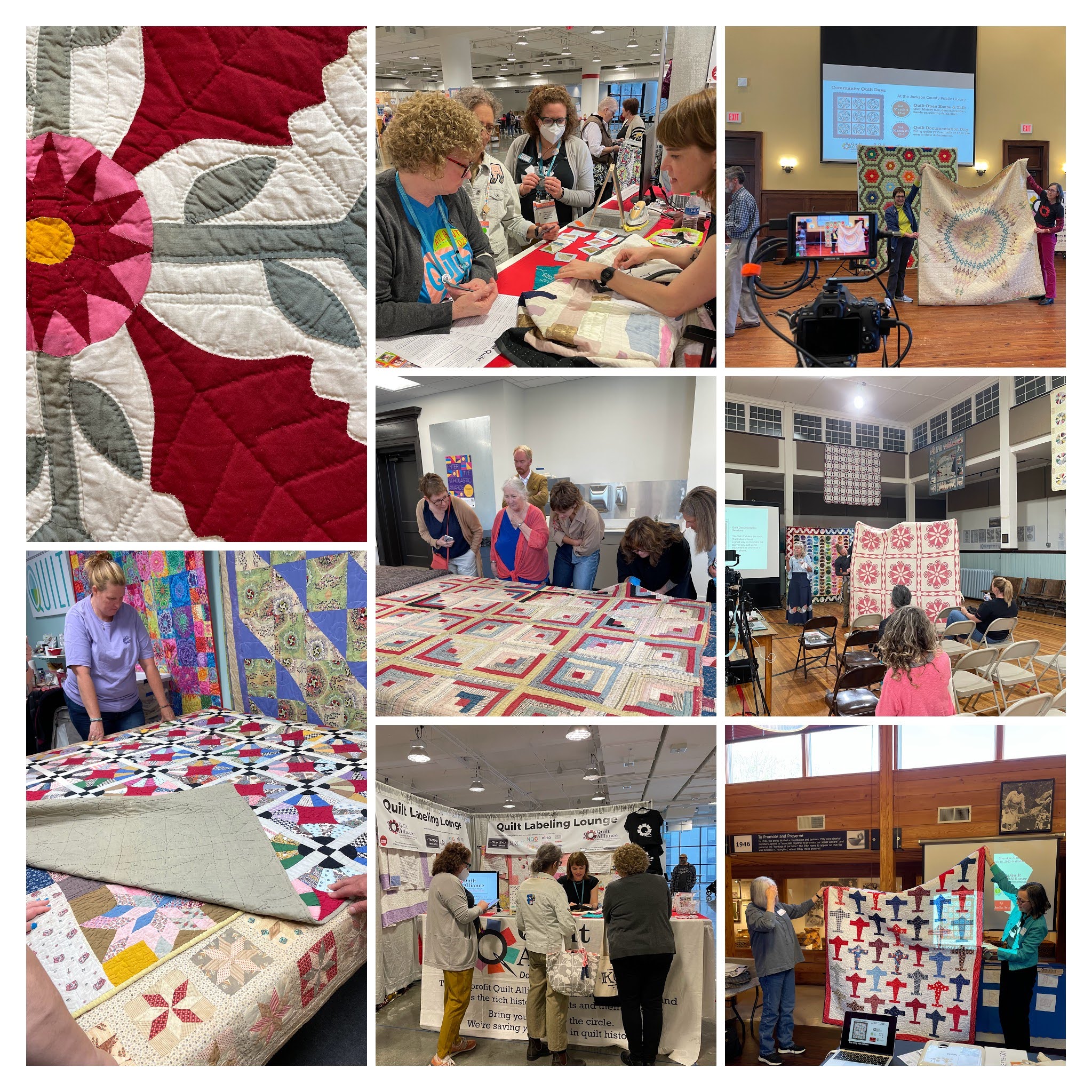
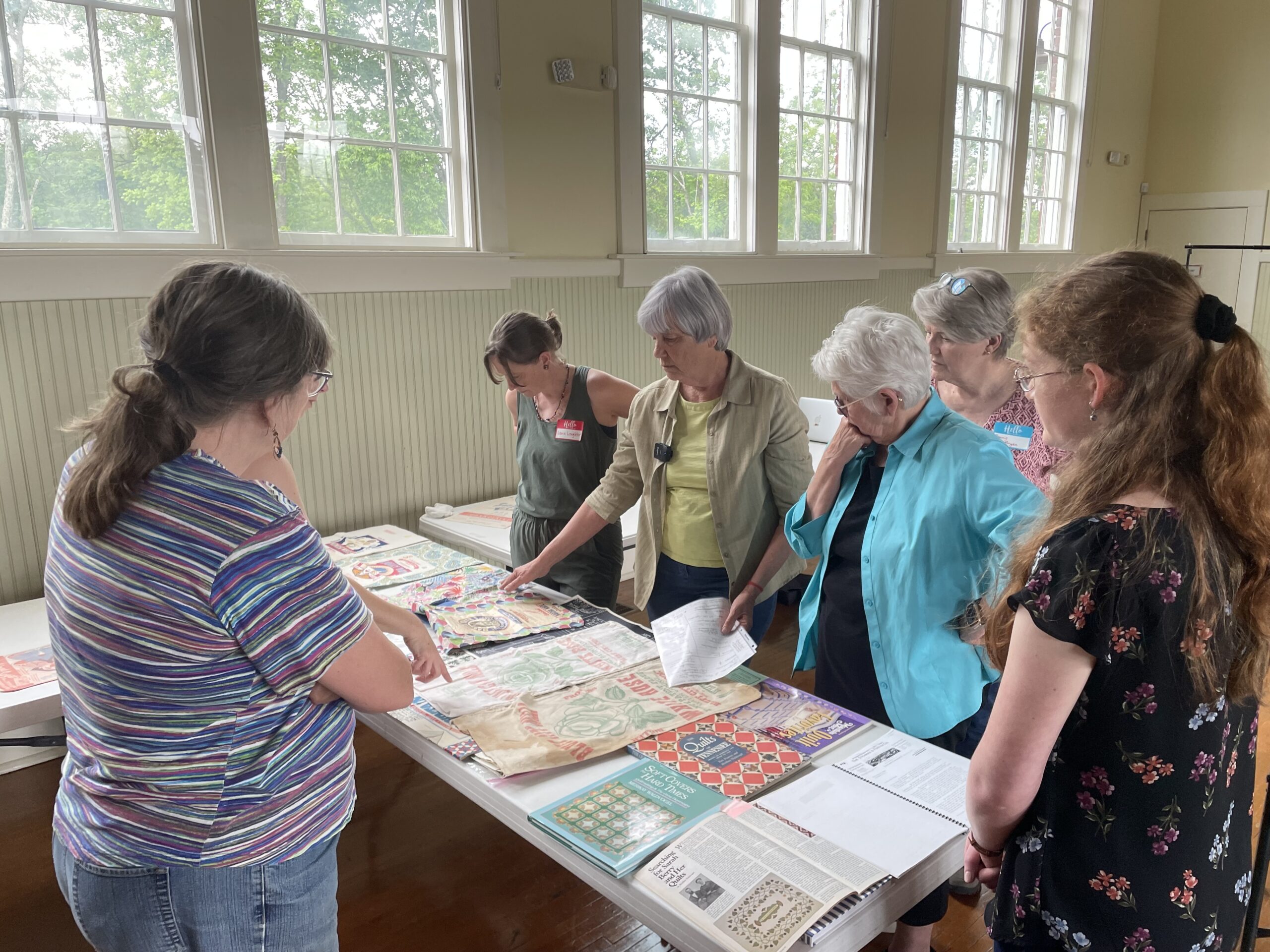
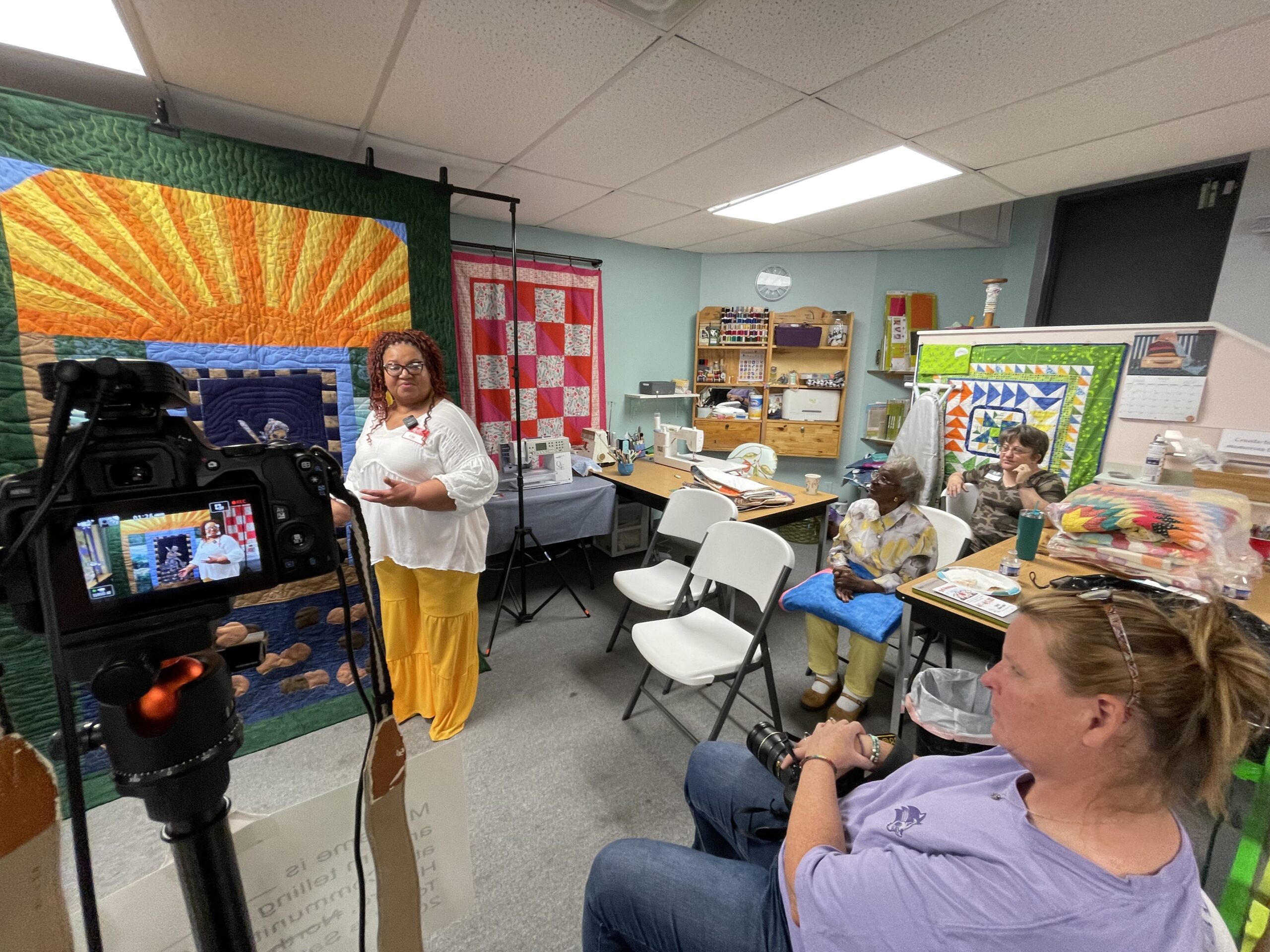
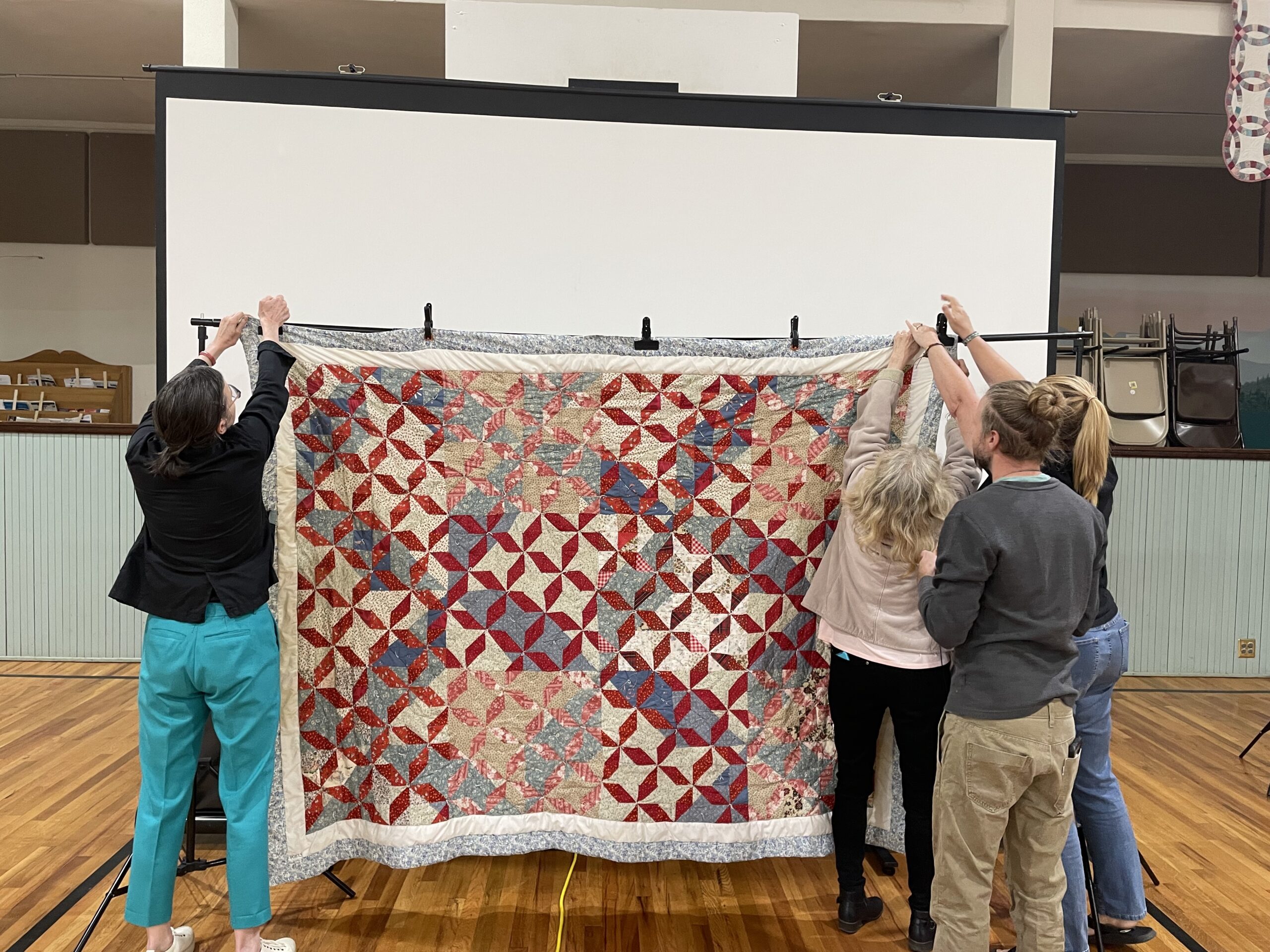
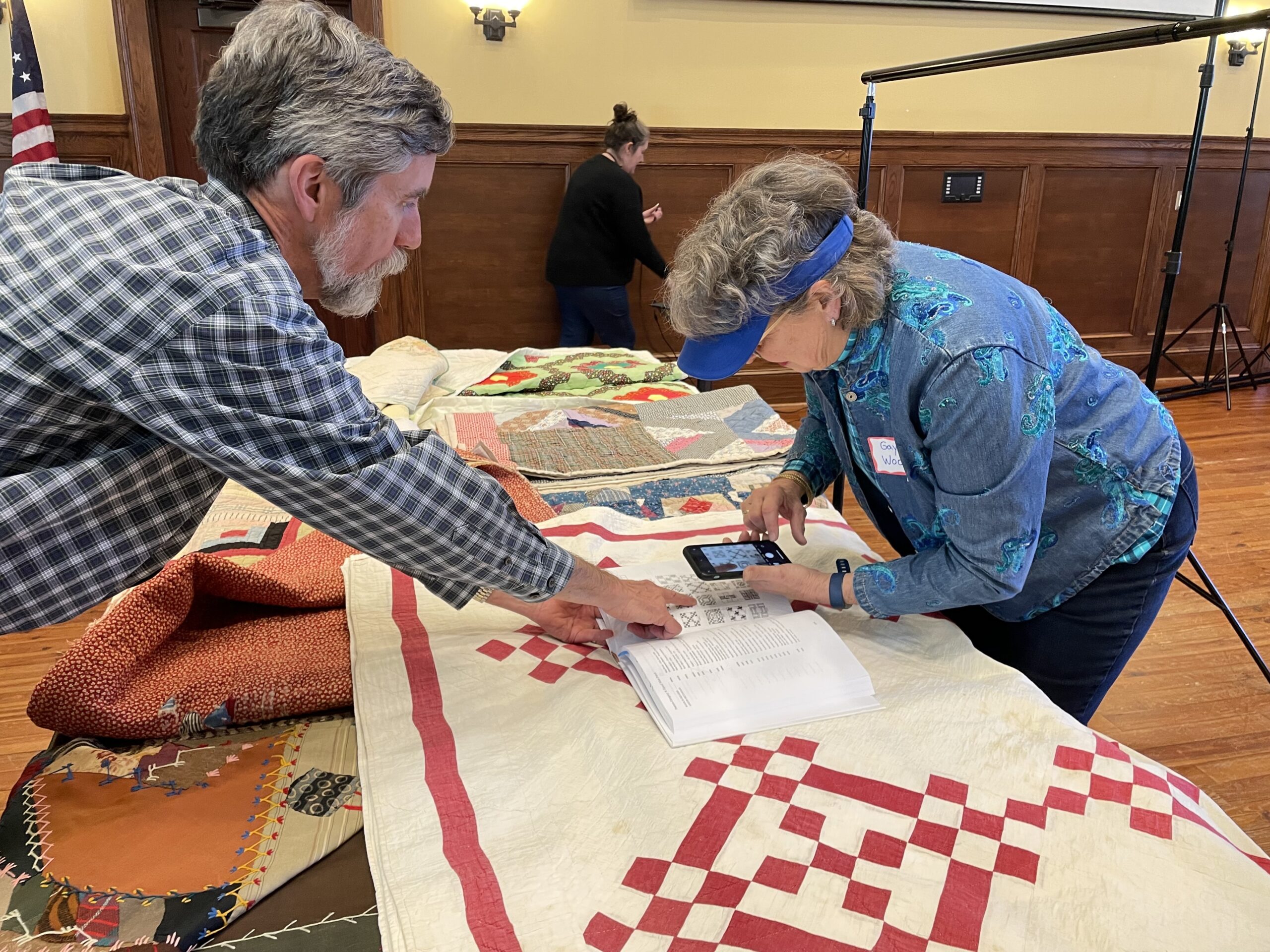
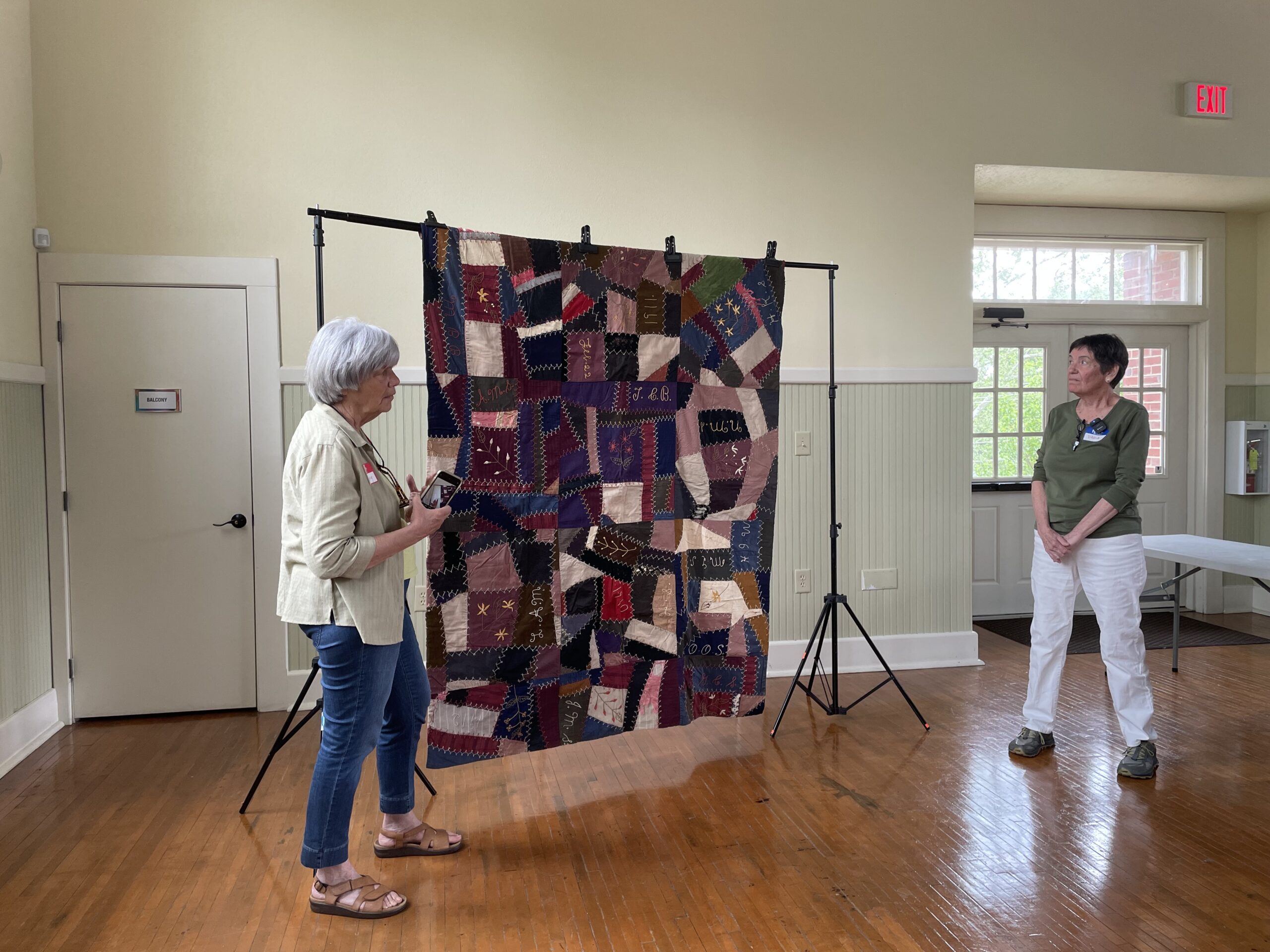
Community Quilt Days focused on connecting in-person with quilters and quilt owners within their communities, groups, and cultures. Using a flexible model and the help of an evaluation consultant, we worked with a range of partners from universities to community centers to quilt shops. The goals were to both collect, connect and demonstrate the projects.
After completing Community Quilt Day programs in central Appalachia we used what we learned to continue expanding and honing the model with groups whose members are currently underrepresented in the QSOS collection. These communities include African American and Native-American quilters, members of the Modern Quilt Guild, and volunteers for the Quilts of Valor Foundation. We also received funding from the National Endowment for the Arts for this project and expect to apply for a continuation of the project in 2025 to offer training to groups and organizations in 2026-27.
Community Quilt Day documentation already collected includes QSOS oral histories and Go Tell It! videos.
Running Stitch, a QSOS Podcast: four seasons nearly completed
 Running Stitch, A QSOS Podcast, hosted by Janneken Smucker, Professor of History at West Chester University, is now in its fourth season, focusing on the intersection of technology and quiltmaking, defined broadly. Guests for season four have included:
Dr. Rachel Maines, a visiting scientist at the Cornell University School of Electrical and Computer Engineering and a seminar associate at Columbia University. This episode focused on the Industrial Revolution and the introduction of mechanized sewing machines as a game-changer for hobby quiltmakers. Listen now.
Penny McMorris, explores the backstory and invention of Electric Quilt, the leading quilt design software. Penny McMorris was the co-founder of The Electric Quilt Company and a key player in the late twentieth century’s quilt revival. The episode shares how Penny and her husband Dean Neumann created Electric Quilt software and snippets from quilters across the decades about how they use EQ to design their quilts. Listen now.
Kristin Barrus, a PhD candidate at University of Leicester and a quiltmaker. Kristin’s work explores 21st-century quiltmaking through the lenses of women’s studies, fan studies, and anthropology. We talk with Kristin about the origins of the Modern Quilt movement, and she also shares with us the fascinating history of how quilters came to use–and love–the rotary cutter. Listen now.
Libs Elliott, a quilter who uses computer code to design and color her quilt designs. We talk with Libs about the joy of randomness, the skills and limits of computer-aided design, and the intersection of handmade and digital art. Podcast episode coming soon – listen to the Textile Talk interview.
Myrah Brown Green, an artist, longarm quilter, art historian, author, arts consultant, lecturer, interviewer, and independent curator and agent. Myrah talks about her research and creative work surrounding African symbols in quiltmaking, as well as her recent passion for longarm quilting. The conversation dives into quilters and artists using longarm quilts as a new technology that revolutionizes the quiltmaking process. Podcast episode coming soon – listen to the Textile Talk interview.
HollyAnne Knight, founder of String & Story, an online platform for learning free motion quilting and other machine quilting skills, as well as a brick-and-mortar and e-commerce shop. HollyAnne and Janneken discuss growing an online community, running an online shop, and the role digital technologies play in sustaining the quilt industry. Podcast episode coming soon – listen to the Textile Talk interview.
Podcast listener statistics and reviews
- Downloads: 55,243 unique podcast downloads so far!
- Global rank: top 3% of podcasts (source: Listen Notes)
- Listener demographics Each episode averages between 2,100 and 5,400 listeners. Running Stitch reaches a younger age demographic than the average quilter (age 65, according to 2020 PNA Quilter’s Survey): 53% of listeners are younger than 60.
- Global Audience Listeners from 37 countries, especially the US, the UK, Australia, Canada and the Netherlands. Smaller numbers of listeners are tuning in from Italy, Brazil, France, the Philippines, Malaysia, and India.
- Engaged listenership Podcast episodes have a higher rate of completion (percent of each episode listened to) than the industry benchmark, and positive reviews demonstrate the value of the story-based format.