Tips for Labeling Your Quilts

From Dee Winter: I belong to a small group that are making some charity items. One of our member’s mother was a prolific piecer. Not so good on the finishing. So we are finishing them, mostly tying, some long armed by friends, and we are going to donate them to the emergency family shelter. The label we are using has Pieced by (her name) and finished by the Sew and Sews. Gives her credit for her part, some for us. None of her chidren wanted any of them until her daughter offered them to us. They are now doing their own finishing.
From Dr. Laura Guertin: Excerpt from Laura’s blog post about this challenge: For this July Challenge, I’m reflecting upon these prior challenges and how I’d like some of my quilts to be remember in the future. I decided to generate fabric labels (printed by Spoonflower.com) for each of the 19 quilts in myStories from the South Atlantic Oceanquilt collection. These quilts mean alot to me as a scientist and a science communicator, so I want to go back and add more to the back of each one. I’ve ordered the labels to be printed on swatches and am waiting for them to arrive. Here is what they will look like, which will supplement my hand-signed/dated/numbered information that already exists on the back.  
[et_pb_column type=”1_3″ _builder_version=”4.27.0″ _module_preset=”default”…

What is Quilters Take a Moment and Why Should You Register?

Quilters Take a Moment, the QA’s annual educational event is coming up on September 20 & 21 and this year all members can register for free! Just log into your membership portal and click on Register for Quilters Take a Moment. Non-members, you can purchase tickets ($60) or join and register for free via this form. This virtual event is designed to help you document the quilts you make and own. This is a unique event completely focused on tips and inspiration for documenting and preserving your personal quilt history. We often hear: What will happen to my quilts? Will my family and friends take care of them and know their value? The most important steps you can take to ensure your quilts are cared for and valued when you are no longer able to do so is to properly label and document them. Documenting a quilt underscores its value and importance and provides historical, technical, artistic, and maintenance information to the owner and anyone who comes across it. QTM Presentations will be aired live on September 20 & 21 and recorded for viewing through December 31, 2024. Sessions include: Telling the Story of Your Quilt Through Photography – Kitty Wilkin Video as a Tool for Documenting Your Quilts – Lyric Montgomery Kinard An Archive of Your Own: Using Spreadsheets to Describe and Catalog Your Quilts – Rachel Ivy Clarke Documentation as Creative Practice – Hannah Parks Documenting Your Guild or Group – A’donna Richardson Sustainable Routines for Quilt Documentation – Jenni Grover Register for Quilters Take a Moment today! 
[et_pb_image src=”https://quiltalliance.org/wp-content/uploads/2024/08/Adonna-in-action.jpg” title_text=”Adonna in action” _builder_version=”4.27.0″ _module_preset=”default”…

Announcing a New Membership Benefit

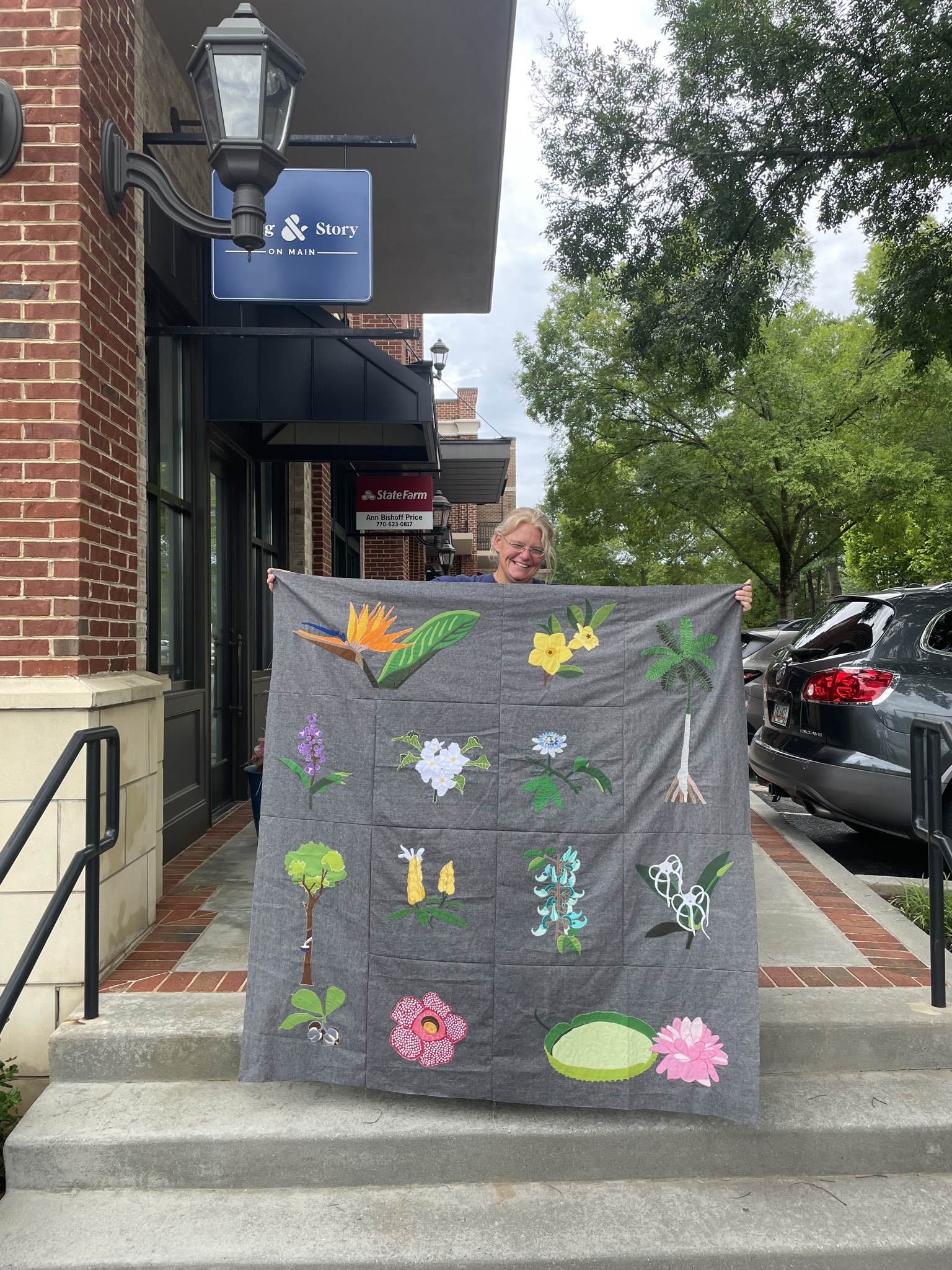
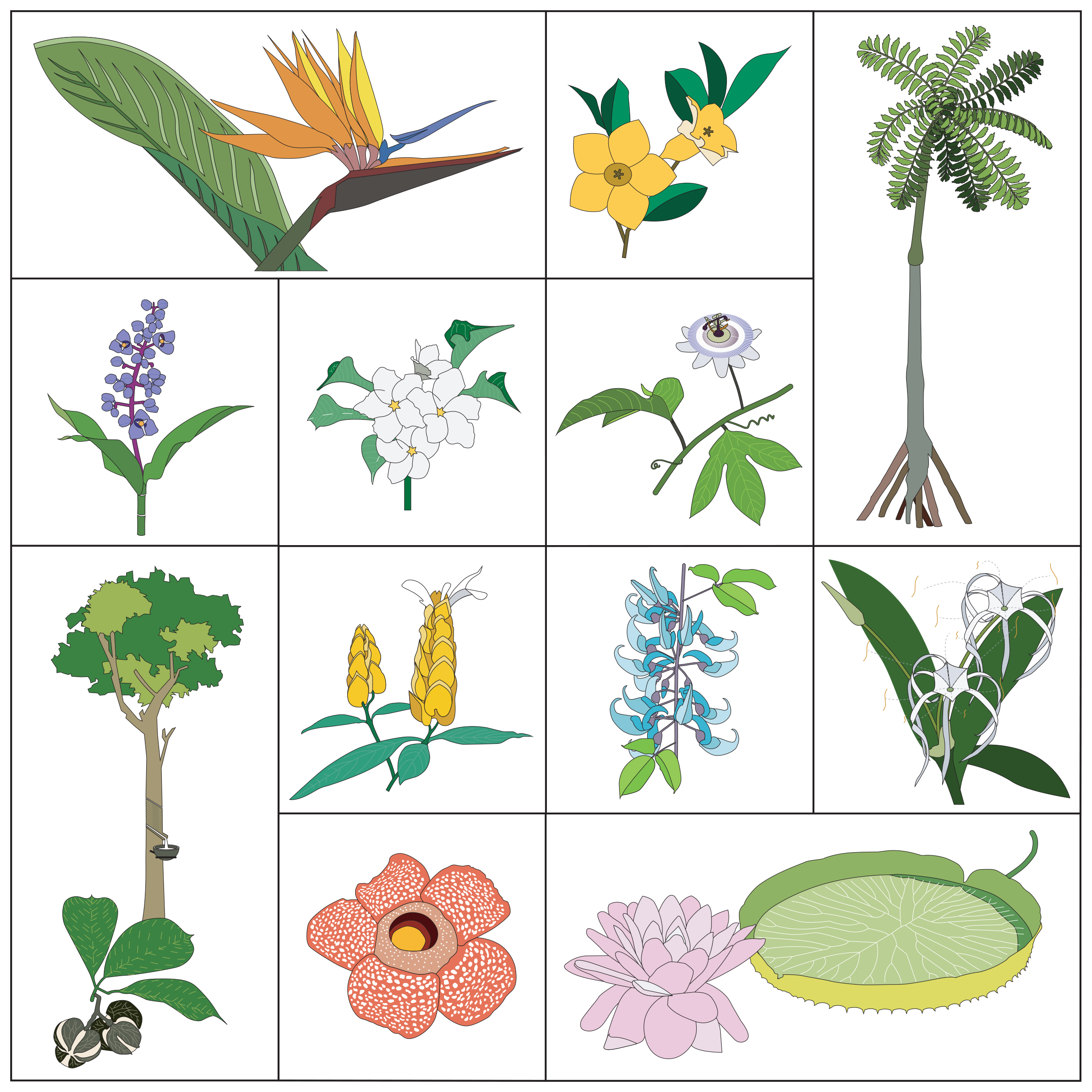
Announcing a New Membership Benefit from Aurifil! Last year QA board co-president, quilter, curator and writer Laura Hopper created a Birthday Block of the Month featuring blocks by nine incredible designers to celebrate our 30th anniversary. It was a huge hit and helped us grow our membership by 32%. This year, co-president Bradley Mitchell and his generous and creative colleagues at Aurifil are gifting our members another Block of the Month! Starting in May we will begin sharing the Aurifil Flora Block of the Month with our members. The blocks, instructions and any supplemental resources will be shared via this newsletter and your membership portal. So if you haven’t yet logged in to your portal, give it a try soon. There are twelve months/blocks in the Flora series and we will keep the BOM archived in your membership portal for at least six months after the last block is released in April 2025.  Not a member yet? Join today! The last few years have been a wild ride. We’ve had to stop, adjust, reimagine, reroute, redo.  It’s been a challenge, but in some ways, all of the changes have helped us to slow down, to appreciate the beauty that lives right in front of us, and to experience the small things with a more grateful heart. Perhaps it manifests as an unexpected cool breeze on a hot summer day or the sound of a bird chirping outside your window. Maybe it’s a favorite hike just outside the city or maybe it’s a burst of color that provides the perfect distraction on your Sunday morning stroll. A tree, a flower, a bloom, a petal… the sense of calm and renewal that nature provides is often overlooked, but this year, we are choosing to bring that natural beauty to the forefront.  Introducing Flora, a 12 month Botanical Appliqué BOM designed by Aurifil’s Kate Brennan in partnership with graphic designer Christina Weisbard. The colors and design of Flora were drawn from 12 breathtaking rainforest plants from the Amazon Water Lily and the Bird of Paradise to the Jade Vine and the Spider Lily. The monthly blocks,  allow each of the 12 featured plants to take center stage.  While instructions are given for fusible appliqué, a variety of methods of appliqué and finishing will be highlighted. Depending on the month, raw blocks are 12-1/2″ x 12-1/2” or 12-1/2” x 24-1/2”. They can be finished into individual minis or collected to create a finished 48” x 48” quilt.
[et_pb_image src=”https://quiltalliance.org/wp-content/uploads/2024/04/FloraQuiltTop.jpg” title_text=”FloraQuiltTop” _builder_version=”4.24.3″ _module_preset=”default”…

Community Quilt Days: Place, Culture, Stories and Quilts!

Community Quilt Days: Place, Culture, Stories and Quilts!
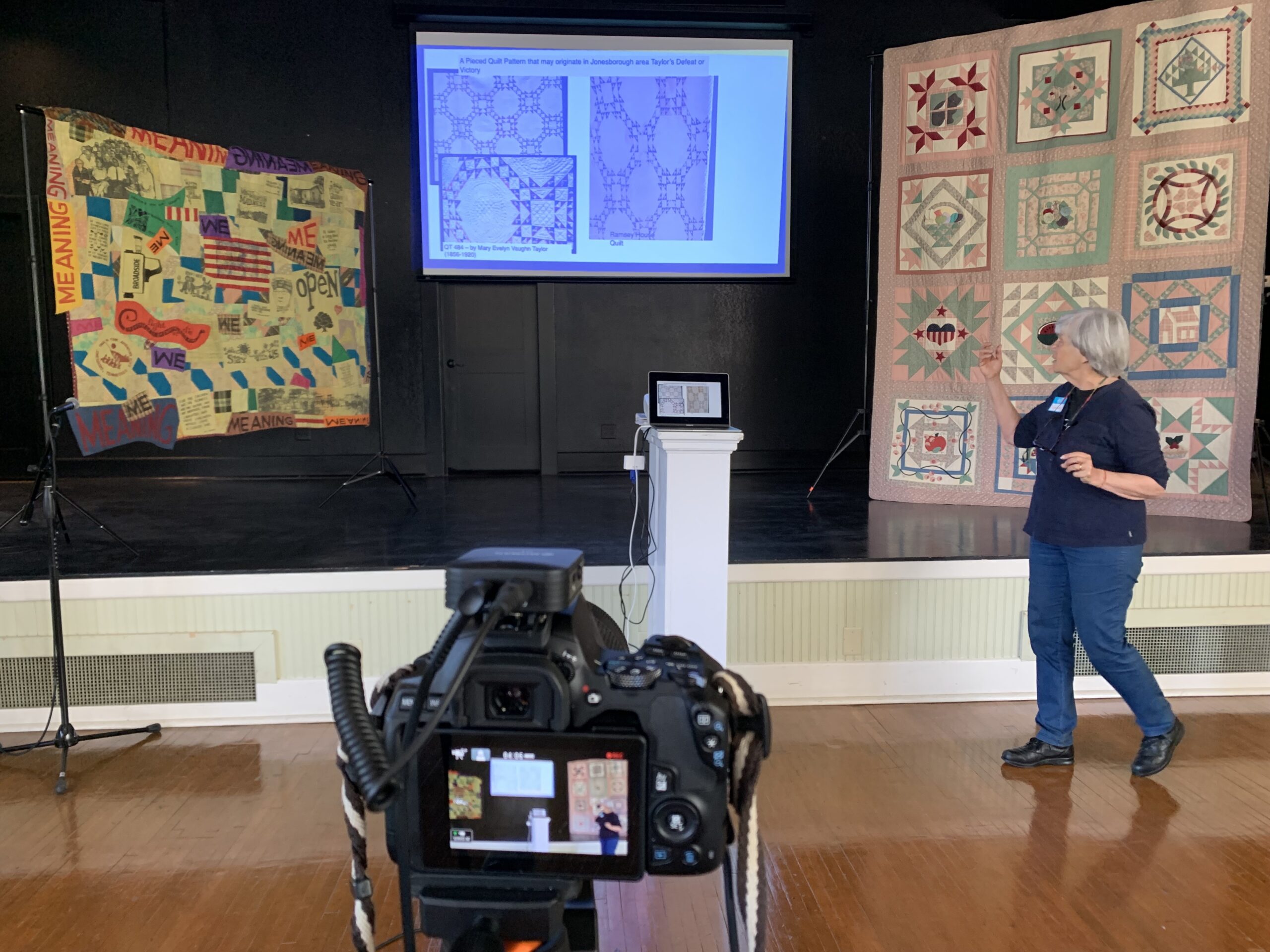
Quilt Alliance staff are hitting the road again today with camera equipment, quilt stands, a coffee urn, a fresh batch of Deb Josephs’ tasty homemade cookies and a cue card that reads: “Hi, my name is ____ and I’m telling my quilt story at the McKinney Center in Jonesborough, Tennessee and today is Saturday, May 13, 2023.” Jonesborough is Tennessee’s oldest town, and home to the International Storytelling Festival. You’ll find Tennessee Quilts, a shop and retreat center co-owned by Linda Crouch-McCreadie in the historic downtown. Linda and fellow Tennessean, quilt historian and longtime Quilt Alliance board member, Merikay Waldvogel, were featured last Saturday on the first day of our Community Quilt Days event in Jonesborough. Linda (pictured top right with her first quilt) was interviewed for the QSOS oral history project, and Merikay (pictured bottom right) gave a fascinating lecture on Tennessee quilts. She told the story of Margaret Hays, a Jonesborough woman who designed quilt patterns for Mountain Mist batting in the late 1920’s and early ‘30’s. Rebecca Proffitt, director of the nearby Reece Museum at Eastern Tennessee State University, brought an example of one of Hays’ designs along with another contemporary quilt in the Reece collection by artist Marge Gregg, made in the 1960’s and 2010’s. We’ll resume the quilt sharing and documentation activities today at the beautiful McKinney Center, a renovated 1940 school that was once the grade-school for Black students in Jonesborough until integration in 1964.
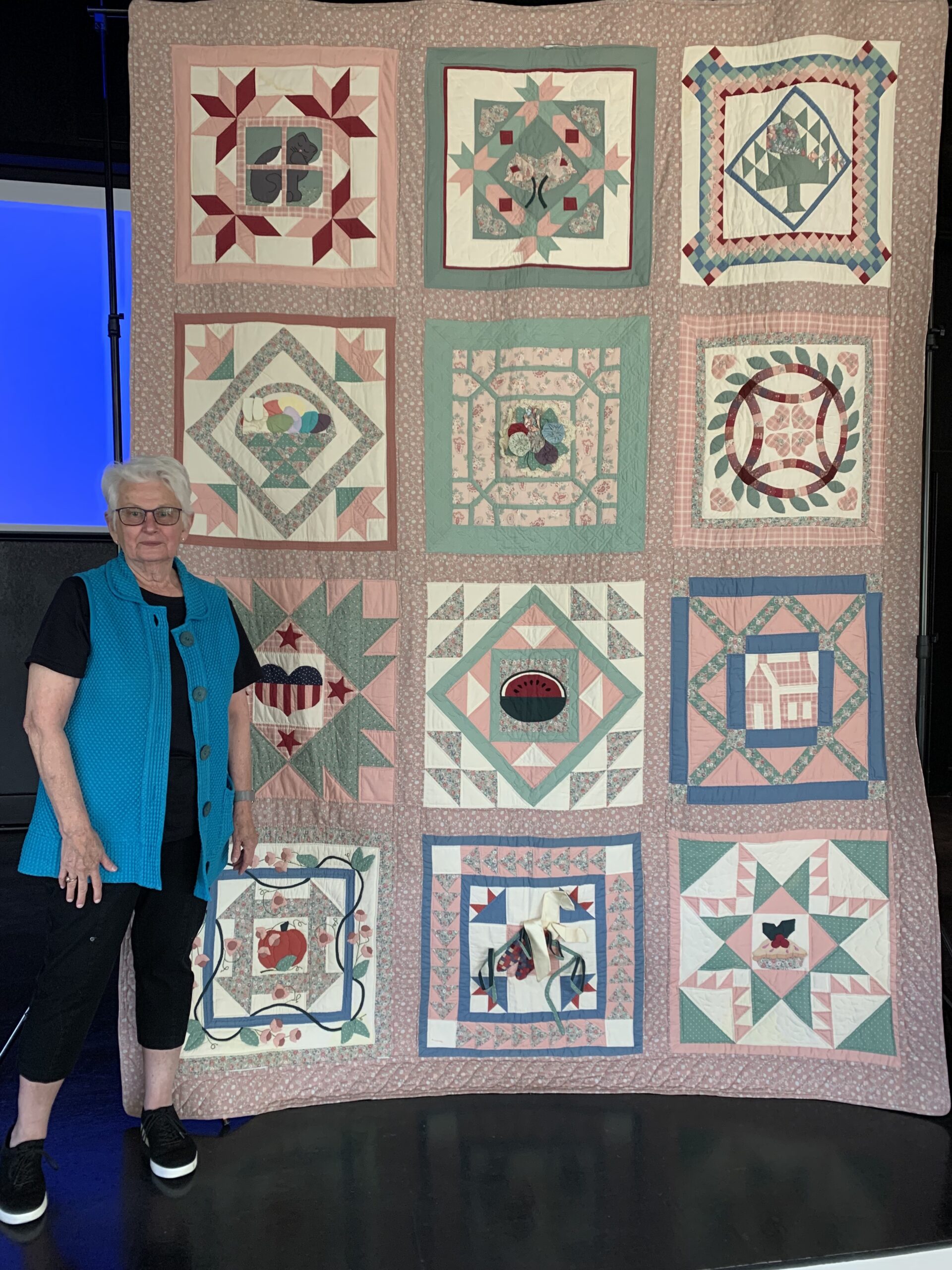
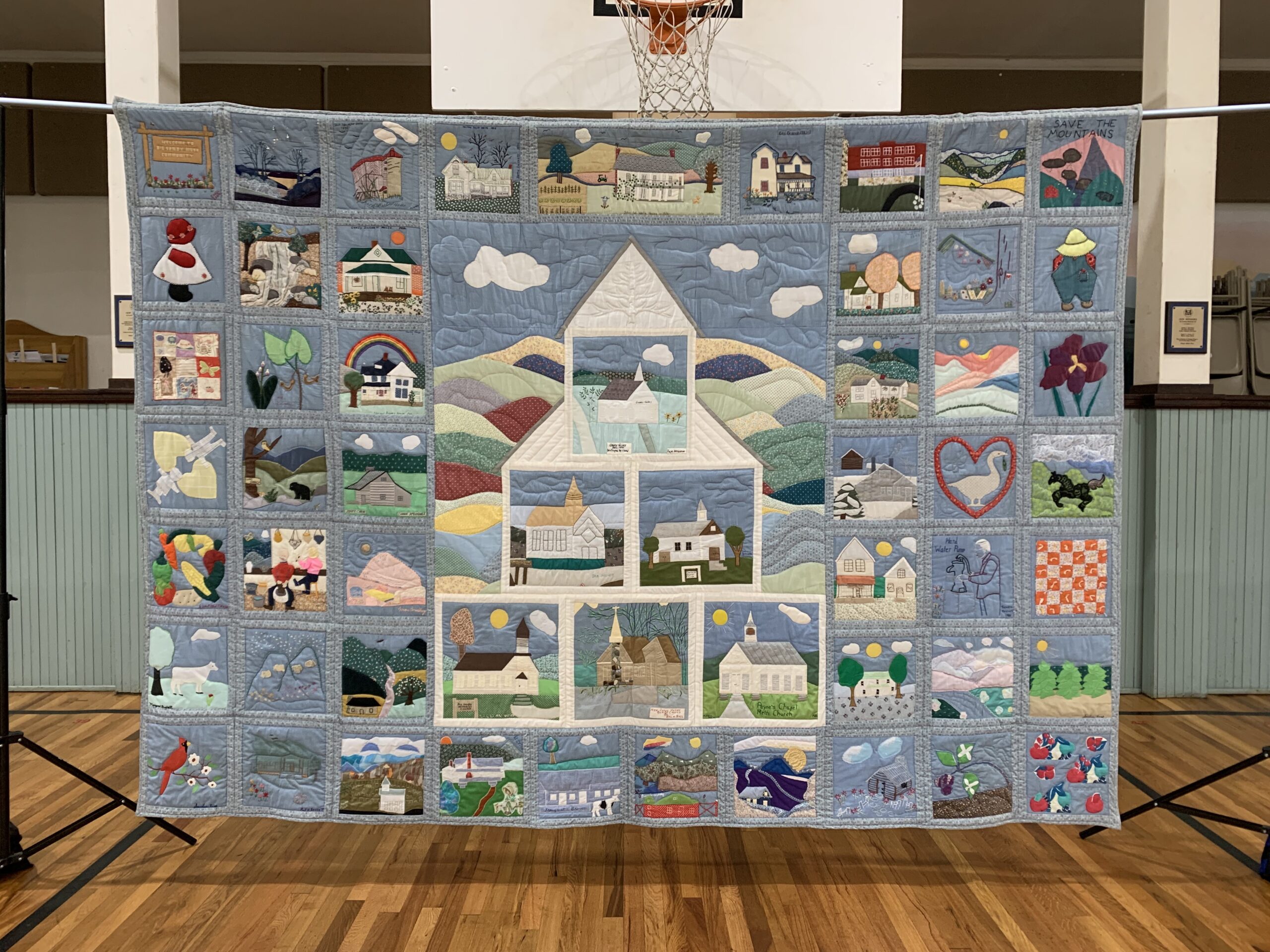
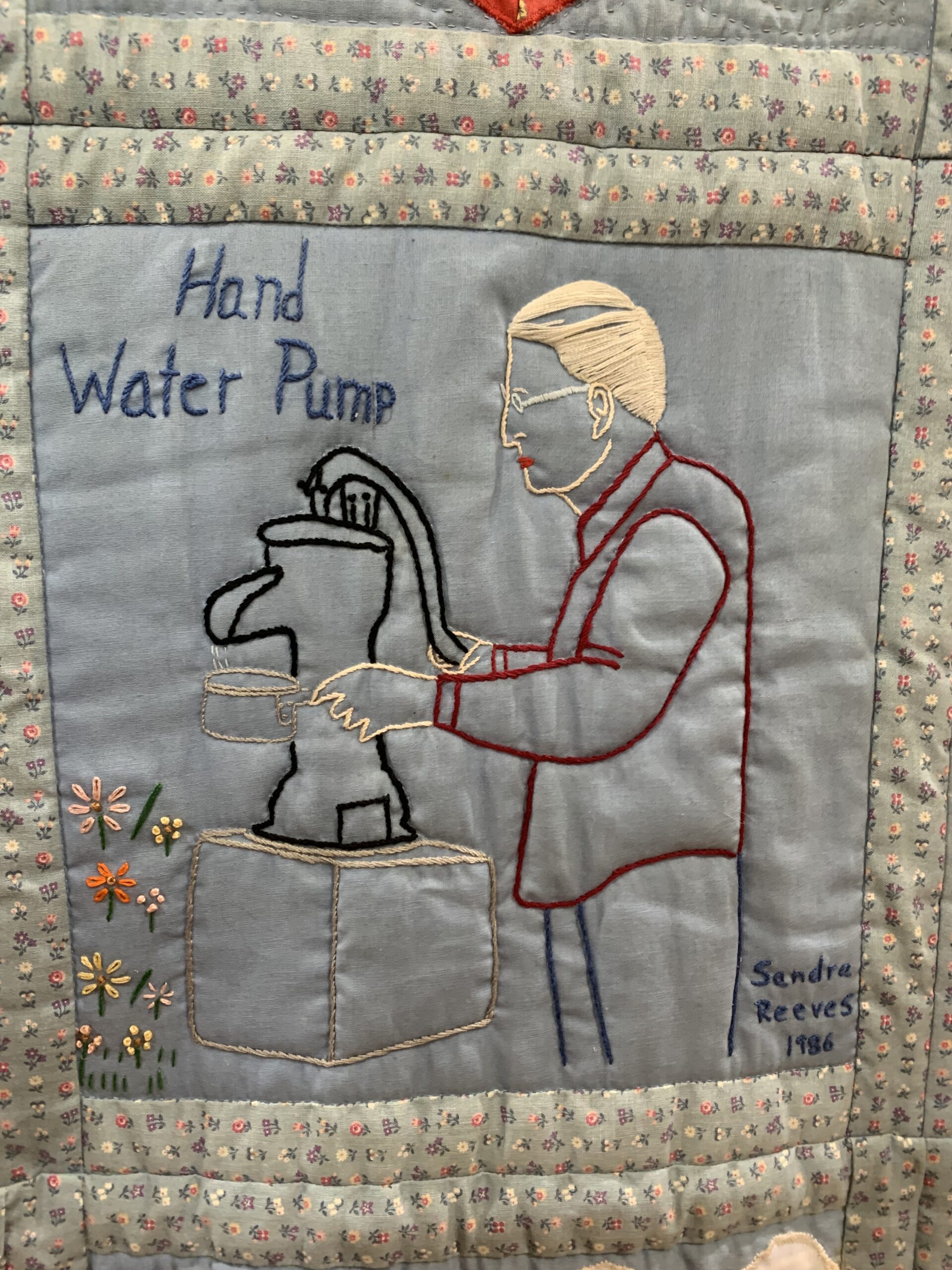
Another renovated school, the Sandy Mush Community Center, served as our event site on April 23 and 30 when we documented quilts, quilters and community history in Leicester, North Carolina, a hilly Appalachian farm community about 18 miles northwest of Asheville. One of the 30 quilts documented was a special collaborative quilt titled “A Celebration of Sandy Mush.” It was made in 1986 by over 40 women in the community determined to show developers planning to build a high-level nuclear waste site in Sandy Mush just how special and  beloved their community was. The community’s unprecedented opposition to the dump site caused developers to cancel their plans later that year. The group quilt and other quilts made by Sandy Mush residents hang along the perimeter of the community center’s gymnatorium space. Artist Norma Bradley, a former Sandy Mush resident, and artist and quilt appraiser Connie Brown, played important roles in planning the presentation for this site. Norma and other makers of the collaborative quilt were invited to tell the story of their block and the experience of making the quilt to protect Sandy Mush. One of the makers came with her son and together they shared quilts made by four generations of family members. 
Community Quilt Days are a great way for any place or group to celebrate and document the things that connect them: place, culture, stories, and quilts! This project, supported by grants from South Arts and the NC Arts Council, has focused on Appalachian communities, a region close to our home base, to learn how to create a flexible model for Community Quilt Days. Join us in Hazard, Kentucky on May 27 for the next Community Quilt Day. Our partners there include artist Nicole Musgrave, Emily Jones Hudson, founder and director of the Southeast Kentucky African-American Museum & Cultural Center,  and the owners and staff of the Appalachian Quilt & Craft shop. You can sign up on our website…

We Are Our Stories

We Are Our Stories By Karen S. Musgrave   We are our stories and this one is mine. How do I reach you and make you care about the stories behind quilts?  By you I mean the public, researchers/academia, people I wanted to interview, workshop attendees, lecture attendees, readers of the articles I wrote and the manual that I edited for Quilters’ S.O.S. – Save Our Stories and the Alliance—so everyone. Even now after being away from interviewing for years, I want you to care. Though we have come a long way, women and quilts still face inequality. We can learn a lot about a quilt by looking at it, but that does not tell us the whole story. Listening to the quiltmaker does.  A little bit about me. I made my first quilt, for a baby, in 1974 after seeing an article in a magazine. Quilts were not a part of my life growing up. It wasn’t until I started doing genealogy that I learned that there were quiltmakers in my family. I, like many people interviewed, came to quiltmaking through sewing my own clothes. I didn’t know the “rules,” so the quilt was made with my drawings, rendered with fabric crayons using polyester/cotton blend fabric. From there, like many others, I created traditional quilts before moving on to create my own designs. I came to Quilters’ S.O.S.- Save Our Stories (Q.S.O.S.) via Boxes Under the Bed™, the Alliance’s first project that dealt with quilt ephemera in 1996. I volunteered to go to the Boxes training as my guild’s representative. The guild’s board decided to hold an essay contest to determine who would attend. I spent weeks on my essay to end up being the only one to write one. I attended both training sessions that were offered at the International Quilt Festival in Houston. And while I felt it was important work, it did not excite me. I never imagined that attending the first Q.S.O.S. training would change my life in the ways that it did. After attending the training, I volunteered to put together a manual and worked for a year with the project’s volunteer task force members—Bernie Herman, Patricia Keller, Marcie Cohen Ferris and Pat Crews – and the manual was born.  Q.S.O.S. started by interviewing prize winners and people with quilts at the International Quilt Festival in Houston. Therese May’s interview from 2000 has stayed with me through all these years. It is not one that I conducted but was fortunate to sit in on. Therese’s honesty and openness left me in tears.  It was the first time I cried during an interview, and it would not be my last. I think one of the most powerful questions ever asked is, “Have you used quilts to get through a difficult time?” Shortly after Therese’s interview, I was sent to the exhibition floor to interview Marion Mackey and to discover the story behind her quilt depicting baseball player Mark McGwire setting a home-run record. I was trying to remember everything I could about baseball. But it turned out the quilt had nothing to do with baseball. Her husband needed a liver transplant. He almost died twice while waiting. They were hoping and praying for a donor. Well, McGwire breaks the home-run record while they are watching it on TV, and then the phone rings and they get a liver. She started crying and I started crying. They travel with the quilt and talk to children’s groups about the importance of being an organ donor. This was another defining moment for me about why oral histories are so important.  Quilt Festival made conducting interviews easy, but I felt the interviews did not reflect the diversity of quiltmakers and their stories that were out in the world beyond Quilt Festival. So, my personal mission began. In the end, I conducted nearly 300 interviews, transcribed nearly 75 (not all mine) and read every interview posted online. For 10 years, I never went anywhere without my trusty $35 tape recorder and paperwork.  The interviews cover all sorts of territory, and often dispel common myths. There are traditional quiltmakers who think that art quiltmakers don’t do handwork. There is a notion that hand quilting is dying out—I don’t think that is the case. There’s the notion that you cannot be artful with a long arm machine. Reading the interviews and seeing the quilts helps set the record straight and eliminates these misunderstandings.   Here are a few things that I learned. Regardless of the skill level, creating something means that a part of us will still be around after we are gone. Quilts heal. Quilts can cause change. Quilts can create awareness. Quilts can be a source of much needed income. Some people are more open to sharing than others. Some people regret how much they shared. Interviewing Latina quiltmakers and their children, especially those in northern California, gave these makers a way to share their stories about the impact in their lives from the income they made from selling their quilts. I will be eternally grateful to the Salser Foundation for supporting me and Molly Johnson Martinez who was the organizing force behind the group. Los hilos de la vida (The Threads of Life),a mostly Latina cooperative quilt group, was quietly making pictorial quilts for years before I arrived. Their quilts depict scenes of family life, border crossings, life in Mexico, dreams, and reverence for the natural and spiritual worlds. Vibrant with color, the quilts make an immediate impression on the viewer as they unselfconsciously capture the pure essence of the women’s stories. Even more impressive, the women had little or no previous experience creating art or quilts.  Angeles Segura’s quilt shows her asleep on her GED diploma surrounded by the things she loves—her books and her guitar. The mother of four, she worked in the vineyards while studying for her diploma.  Some of the most compelling quilts are those that depict scenes about crossing the border into the United States. Carmela Valdivia has created many border crossing quilts, which always have the figure of death somewhere in them.  After returning from California, my mission became to help the group gain more recognition. I immediately made the first of many attempts to get the attention of the National Museum of Mexican Art (NMMA) in Chicago. Success was achieved when two of the group’s quilts hung in the museum’s exhibition Declaration of Immigration. I also curated an exhibition at the Pacific International Quilt Festival XVII, in Santa Clara, California. Unfortunately, funding ended for the program that supported the group which means the interviews I was able to conduct now provide a glimpse of something that no longer exists. My involvement with Hilos led me to start a quilting group at the NMMA. Again, the participants had never made quilts before, and many had never used a sewing machine. However, unlike the women of Hilos, many of the women had immigrated to the United States when they were young, and all had legally immigrated. The quilts are no less powerful. Maria Tortolero’s detailed quilt is split in two—one side depicts her life in Mexico and the other side her life in Chicago. Maria Herrera’s quilt honors her father and the stories of his immigration adventures and traveling around the United States to find work.  “My quilt is …based on my dad/s journey from Mexico to the United States…I started recording my dad’s stories because I wanted my son to grow up hearing my dad’s stories…the stories I grew up hearing…I know that when my dad seed this quilt and a bit of his life in this quilt…he is going to start crying…My dad’s journey is being told through this quilt.” By the way, he did cry. The group at NMMA also created quilts that dealt with the torture, rape and murder of young women and children in Juarez, Mexico. The difficult subject matter produced incredibly thought-provoking quilts. Christina Carlos’ message, “al fub…en paz/ Finally at Peace,” is typical in that it expresses young girls no longer suffering and in a better place. I think Luz Maria Carillo expresses something universal when she said, “Each one of us leaves a piece of our hearts in each quilt that we make.” A handful of people that I interviewed (who did not know me) asked about me personally. One of them was the writer Spike Gillespie, who had begun writing about quilts at the time of her interview. After our conversation, she invited me to write essays for her book Quilts Around the World about my involvement with Q.S.O.S., Latina quiltmakers and my work with connecting American quilts with quilts or patchwork in the countries of Georgia, Armenia, Kazakhstan, and Kyrgyzstan. My connections to the Alliance through one of the founders and then president, Shelly Zegart, provided me with the connection to take an exhibition of quilts from Gee’s Bend, Alabama to Georgia, Armenia, and Kazakhstan. These quilt exhibitions provided a link in a global movement to revive interest in traditional culture and crafts. They illustrate the shared common threads in our arts and cultures—highlighting what makes us unique and embracing our commonalities.  Interviews with some of the members of the Georgian Quilt Group can be found in the Q.S.O.S. project. My writing for Spike’s book led to an invitation to author my book – Quilts in the Attic –  Uncovering the Hidden Stories of the Quilts We Love. I was also interested in gathering interviews of how quiltmaking can make a difference for incarcerated people. I found a quilting program in a Minnesota detention center for men. After months of answering questions and even signing papers stating I did not expect to be rescued if taken hostage, the warden decided without any explanation to pass on the project. I was devastated. Fortunately, in 2009, I was able to interview women who had participated in a quilt project featured in an exhibit called “Sacred Threads” in Columbus, Ohio.  The Ohio Reformatory for Women (ORW) is just outside of Columbus in Marion, Ohio. Driving down the long road to the prison passing fields filled with wildflowers, it was such a shock to see buildings surrounded by a tall wire fence with razor wire on top. The warden required the women to state the reason that they were incarcerated at the beginning of each interview. It was explained to me that this requirement was to get the women to realize they were accountable and become more comfortable talking to strangers about why they were there. I made it clear before the tape recorder was turned on that I did not care why they were there.  I cared about their experience making a quilt. None of them had made one before.  The assistant to the warden was also present in the room during the interviews. She worked quietly a few tables away and I made sure to sit so that the women would have their back to her. I continued my relationship with these women after their interviews and with a few even until today.  Rhonda Edwards was the most intense interview and one that I wished we had videotaped. Her quilt shows her split in two- her life before and her life after. Rhonda is a talented artist, so her quilt is full of her drawings. It also expresses her journey from a violent person to one who has found God, from a person who was deeply grieving her father’s death to someone who feels joy. Rhonda sent her quilt to her mom. The women were not allowed to have the quilts in their possession. Rosa Angulo’s quilt is called “Hope.” Her artist statement says so much about her quilt, “I want to give my first quilt the name of hope–Because I’m trying to express it somehow. My life in this place is the patches and the stitches are the different stages I’ve been going through. The ribbons are the razor wire that surrounds this prison. And the eagle is me, who with the help I’ve been getting from recovery and religious services, and some of the staff members, I feel I will have the tools to fly when my time gets here. Like it says in Isaiah 40:31 ‘They that hope in the Lord will renew their strength, they will soar as with eagles’ wings; they will run and not grow weary, walk and not grow faint.’“  And she added as a personal note: “I am 48 years old and the mother of three beautiful daughters and the grandmother of an eight-year-old girl. I work as a porter in my cottage, and love to do community service through the Stitching Post (a place to gain skills and employment sewing items for nonprofit organizations, many dealing with children). I’ve never made a quilt before, but I really enjoyed working on this one.” Rosa was deported to Mexico upon her release. She had sent her quilt to her eldest daughter. I never heard from Rosa after her release. I do hope that the skills she learned while at ORW continue to help her and that her desire to make more quilts continues. Once the interviews were posted and several articles about them were written, I received threats from some of the women’s victims’ families. Nothing came of them, and I certainly understand their anger and pain, yet I still feel the interviews should be included in the Q.S.O.S. collection..  I was not as successful in getting Native American quiltmakers into the project. It was only by chance that I interviewed Lois Beardslee. We met while I was working in northern Michigan. Her interview was conducted in her bedroom while sitting on her quilt. “I started piecing our old clothing and old blue jeans, everything…old handkerchiefs, old pillowcases, everything…this is {a piece from] my wedding dress…It was my son who one day took the sleeves off, and my husband said, “’Oh, no.’ I told him, ‘See, it is not about the dress. It is about the being married to you and growing old with you.’…It is a great quilt because it is our lives all wrapped up into one package.” Interviews with people included in exhibitions truly capture a moment in time and continue the historical use of quilts to communicate social or political messages. The exhibition-based projects include interviewing people who made quilts to celebrate the election of Barack Obama as president and the Ancestor Project that took place at the American Indian Center in Chicago where women from the senior lunch program stayed to appliqué designs of ancestral portraits, animal spirits and plants. Other exhibition-based projects include  the Alzheimer’s Forgetting Piece by Piece and Priority Alzheimer’s Quilt projects led by Ami Simms, that helped raise awareness of Alzheimer’s and funds for research, and Healing Quilts in Medicine project to name a few. There are so many times that I wish I could have left the recorder going because far too often that is when amazing things were shared. They weren’t always about the quilt or quilts in general, but they provided intimate details or funny stories that I wish everyone knew.  Interviewees were given the transcription of their interview to review before it was published  online and archived. One interviewer called me quite upset stating that she did not talk the way the transcription portrayed her. She “most certainly did not have a potty mouth.” I tried explaining that transcribers do not add or subtract from the interviews. Still not satisfied, I played the tape for her. In another interview, the person shared details about other quiltmakers that they regretted and so the comments were removed. After one Houston interview, I encouraged editing because I thought it would hurt the interviewee’s reputation, but she stood by her words.   I was pleasantly surprised by the deep friendships that happened because of interviewing people. I am so thankful that I was able to interview Yvonne Porcella, Merry Silber, Gwen Marston, Elizabeth Cherry Owen, Maxine Groves and Lisa Quintana, who are no longer with us.  I think my proudest moment was after we lost our original archives at the University of Delaware. As the chair of the task force, I had to find a new archival home for the collection. Board members volunteered their universities as potential partners, but I set my goal higher. With the help of David Taylor, I wrote a successful proposal to the American Folklife Center at the Library of Congress.  Repeatedly, historians often run into the same obstacle when working to identify information about a historic quilt: a dearth of clues as to the origin, maker, and story. That means a lot of mystery remains. And while Q.S.O.S. might not help today’s historians solve certain mysteries of the past, the interviews will leave behind a legacy for historians of the future.    While interviewers probably did not set out to touch another’s feelings and longings, words and images emerge in interviews that are just as universal as they are personal. Q.S.O.S. has provided a place where quiltmakers’ stories are accessible, where others can draw on them for strength and make a connection. This is the gift that volunteer interviewers will continue to give for years to come.  I will close with my favorite quote by Betty Reese and one I use at the end of my lecture, “If you think you are too small to be effective, you’ve never been in bed with a mosquito.”   About Karen Karen S. Musgrave is an interdisciplinary, multihyphenate artist whose recent body of work deals with loss, memory, and identity. She feels passionately about connecting cultures with quilts. Her projects include curating a traveling exhibition of the African American quilts from Gee’s Bend, Alabama, alongside quilts in Georgia, Armenia, and Kazakhstan. In Kyrgyzstan, she organized, curated, and wrote the catalogue for an exhibition of American art quilts and Kyrgyz patchwork. She has served on numerous nonprofit boards. She was a consultant on the 9-part documentary Why Quits Matter. As a writer, she contributed to Spike Gillespie’s book quilts Around the World, wrote the book Quilts in the Attic: Uncovering the Hidden Stories of the Quilts We Love and has written numerous articles for magazines. She has exhibited internationally, and her work is in many different private collections. She lives in the far west suburbs of Chicago. Visit Karen on Instagram                            …