by Janneken Smucker | Mar 14, 2016 | New & Announcements, Quilt Alliance board member post
The Quilt Alliance is pleased to announce the launch of our new website! Please, take a look around, make yourself at home, and let us know what you think. I first learned about the Quilt Alliance in 2002 when I was a graduate student in Textile History and Quilt Studies at the University of Nebraska-Lincoln. While attending the annual American Quilt Study Group seminar, I met a board member of the Alliance for American Quilts, as the organization was then called. She was attending AQSG to train members in how to conduct oral history interviews for the recently launched Quilters S.O.S. – Save Our Stories oral history project. As I soon learned, the Quilt Alliance was a virtual hub for quilts, and its website—one of the first sites dedicated to quilts on the World Wide Web—was known as “The Center for the Quilt Online.” Much has changed in our digital world since our founders established the Quilt Alliance in 1993. At that point, the World Wide Web was in its infancy. Today, the Quilt Alliance is far from the only website dedicated to quilts. In fact, the World Wide Web has changed quilting as we know it, helping foster communities of quiltmakers; teach new generations of quilters the art; and disseminate quilt knowledge, images, and stories on a scale unanticipated in 1993. Those outside the quilt world may assume quiltmaking is a dying art—just as some have claimed since at least the 1840s! But a mere glimpse at any number of quilt focused communities, organizations, or businesses indicates strongly otherwise! And much of this growth has transpired online. The Quilt Alliance is now one of many centers for the quilt online, each part of the thriving world quiltmakers and quilt enthusiasts inhabit. We are glad to not be alone in this digital world, and are in fact in very good company. We hope our new website will help us continue to play a vital role in this digital quilt network. We have strived to harness new tools to share our amazing projects with you and hope you’ll be patient with us as we iron out all the kinks (or should I say, press all the seams flat?) of our new platform. Enjoy, and do come back soon! Posted by Janneken Smucker President of the Board of Directors, Quilt Alliance jsmucker@wcupa.edu…
by Quilt Alliance | Feb 16, 2016 | Alliance Quilt Contests, Go Tell It at the Quilt Show!, QSOS, Quilt Alliance board member post, Quilt Index, Quilt Treasures
Beloved quilt world legend Yvonne Porcella died on Friday. She will be greatly missed by her family and friends and by so many in the quilt world–her fellow artists, her students, her colleagues at SAQA and the Quilt Alliance. Yvonne (or YP as many called her) was documented by the Quilt Alliance and its partners via projects like Quilters’ S.O.S. – Save Our Stories (Q.S.O.S.), Go Tell It at the Quilt Show!, Quilt Treasures and The Quilt Index (see excerpts below). The vibrancy of her work and her spirit were exciting and magnetic, and the YP brand was easy to spot–bright red and/or pink and always a black and white element (be it a quilt binding or a pair of socks, pants or glasses). Many of our sister organizations have also documented and honored Yvonne. (Find links to these resources at the end of this post.) In 1989, Yvonne founded the Studio Art Quilt Associates organization and remained committed to its mission until her death. In 1998, she was inducted into the Quilters Hall of Fame in Marion, Indiana. That same year, Yvonne was named the 5th recipient of the Silver Star Award at the International Quilt Festival in Houston, Texas. Yvonne was very supportive of the Quilt Alliance’s newest project, Go Tell It at the Quilt Show! which debuted in 2012. We recorded two Go Tell It!’s with Yvonne in 2014: the first during SAQA’s 25th anniversary conference in Alexandria, Virginia and the second at the International Quilt Festival in Houston, Texas. https://www.youtube.com/watch?v=OGwsRz842TE https://www.youtube.com/watch?v=9I9vGT9_7bI Yvonne’s life and work was documented by the Quilt Treasures project in 2002. Quilt Treasures, a joint project of the Quilt Alliance, Michigan State University Museum and MATRIX Center for Digital Humanities and Social Sciences, documented the stories of a limited number of notable individuals – quiltmakers, designers, business people, collectors, scholars, publishers – who were instrumental in moving the 20th century quilt revival forward in some significant way. Yvonne’s Quilt Treasures Web Portrait includes a photo gallery, biography and timeline, and features a Mini Documentary video and Interview clips (below): Yvonne Porcella Mini-Documentary https://www.youtube.com/watch?v=MFF16T0xtMw Interview clips https://www.youtube.com/watch?v=-t6Ego1-UgE As a founding board member of the Quilt Alliance, Yvonne contributed to many aspects of the organization’s projects and initiatives, including co-founding the Alliance quilt contest. In 2006, she worked with Karen Musgrave to launch this annual fundraising and documentary effort, and since then, artists from the United States and around the world have created and donated 872 quilts to support the Quilt Alliance. For the past nine years, Yvonne has made and donated one or more of her own quilts to the contest. Here are those quilts, now documented both on the Quilt Alliance website as well as in The Quilt Index.
-
-
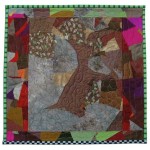
“The Mocha Tree”, 2013, for the “TWENTY” contest.
by Quilt Alliance | May 11, 2013 | Alliance Quilt Contests, Guest Blogger, Quilt Alliance board member post
Every year I make a quilt for the Alliance’s fundraising contest. I love doing this for so many reasons, but the one I want to share with you is how important this is for me as a quiltmaker. I get to play with new ideas on a small scale and try new techniques as I think about each year’s theme… But wait a minute! All my quilts have been about gardens! That being the case, please allow me to escort you on a garden tour, to show you how these contest quilts themselves have “grown” each year. I want you to see all the techniques I’ve discovered along the way and incorporated into my subsequent work. 2008 The Home in the Garden In this quilt, for the first time, I tried printing a photograph onto fabric and then enhancing it with hand embroidery. It was like “painting by numbers” a little bit, very easy, and so much fun. I’ve made many home portraits since this first one. Freeform applique as applied to crazy quilting was another first for me, discovered while making this quilt. Now it is my preferred method of choice for creating any crazy quilt block. Here is how those white patches look sewn down….. ….and then hand embroidered with crazy quilt stitching. Another first: only using one color for all of the stitching on the seams. Again, this is something I do a lot now. Giving the central section an on point setting allowed for some fun in those four blue silk corners. A confession! I dripped some juice on that blue silk and could not get it out! So, do you notice those white mother-of-pearl butterflies? You guessed it. And again, what I tried here I’ve used since, so in later quilts, if you see butterflies you’ll know they’ve flown in to solve some dilemma…… 2009 Ode to Tamar Flowers, not quite gardening, became the subject of the next quilt. This gave me a chance to revisit a favorite technique from my early quilt years, Broderie Perse, which is a style of applique using printed elements to create a scene on the background fabric. Combining Broderie Perse with a crazy quilt background and border of small blocks was this year’s adventure. A pile of cut out flowers, ready to arrange in collage fashion. I have made more floral collages than I can count, but it had been several years…so I was loving this! The collage is set and ready to sew down in this picture. I’ve pieced the border blocks and have begun arranging the all black background fabrics. The top is all finished and awaiting embroidery. The black background reminds me a lot of the white background in The Home in the Garden. The fabrics and stitching again each only use one color. Many quilts of mine now use these strict design parameters. In case you were wondering who the Tamar is in my quilt’s title is, this label gives the answer. While I could not replicate the quilt by Tamar North pictured here, it totally inspired the making of mine. Using antique crazy quilts as a jumping off point for my own interpretations has also become a recurring theme for me since making this quilt. 2009 Garden Lace I enjoy printing my own floral arrangement photos onto fabric. For this quilt, I wanted to try using nothing but these fabrics in a quilt to see how it would look. Fusing lace over wide ribbon, and then using that to cover the seams between fabric patches, was another new idea in this quilt. Every year, I learn so much working on my Alliance quilts! 2010 Granddaughter’s Flower Garden My cousin Tracy Seidman painted this watercolor of our grandmother’s house. After printing the image on fabric, I set it in a border of vintage Grandmother’s Flower Garden blocks. This began my continuing explorations of combining vintage blocks with crazy quilting and embroidery. Three dimensional flowers were prevalent in my work at this time, so I had to add some to this quilt too. 2011 Soil and Sky The theme for this year’s contest was “Alliances”. I can find a relationship to gardening in any contest theme, and this year’s quilt was no different…to me, the relationship between soil and sky is truly a romance, not just an alliance. This quilt combined my own printed fabric (including imagery of paintings of tomatoes I found online, after I received the painter’s permission to use them), some Broderie Perse, three dimensional vegetables instead of flowers, and for the first time, stitched writing on the quilt. I wish I had used a darker thread color so that the words are easier to read. But these small quilts are great for teaching us what to do better next time. Those tomatoes are so great! In the upper left is a photograph of tomatoes growing in our garden, too. The carrots are vintage millinery (can you imagine a hat with carrots on it?). Their tops were another experiment for me. I tried doing some machine thread-painting on water soluble stabilizer, rinsing the stabilizer away, and gluing the resultant “carrot tops” to the carrots. I read this quotation on the Facebook page of a man whose life’s work has been teaching small scale sustainable agricultural practices to villagers all over Africa, via the Peace Corps. And how true this sentiment is! Click on the picture so you can read it. Except for the writing not being dark enough, this is my favorite of my Alliance quilts. But there are two more that I loved making too and that have taught me a lot, so read on… 2012 Washougal Valley View For years I had tried to figure out how to integrate a little machine quilting into my heavily embroidered and embellished crazy quilts. It seemed to me that those two surface treatments were mutually exclusive. But for this quilt, I was determined to find a way. The vintage blocks–and some flying geese strips I had made years ago of vintage fabrics–were put to work for my background. How I love using those old blocks and fabrics! They contrast well with the sky, which was hand painted by Mickey Lawler, of SkyDyes. The hills of my view of the Washougal River Valley came next, along with a fragment of hand dyed Battenberg lace for the lower border area, a gift from my dear friend Michele Muska. I added a little cabin, symbolic of my own home, and some three dimensional flowers to the foreground. And….there is the quilting! It’s in the sky! This is the finished quilt, in the house shape for the theme “Home is Where the Quilt Is”. I loved absolutely every second, making it. I’ve made several other quilts with my little home in them, too, including the next one… 2013 20 Years in the Garden While this year’s quilt is not a crazy quilt per se, after years of embroidery making crazy quilts, there was no way I could depict a garden in a quilt without it. The quilt is well along in this photo. You know my process by now! A little trick I discovered is shown here. My bed of silk ribbon lettuce needed some definition…so I used a permanent marker directly along the edge of the ribbon after it was stitched into place. Risky! I knew if it didn’t work, I could snip out the ribbon and try again…but I didn’t need to, at least, not this time…. My husband is always trying to get me to spend more time in his garden (weeding, I suspect.) But this kind of “gardening” works for me! I am gluing the squash leaves into place. The quilt is finished, and ready for its adventures this summer at various exhibits, and then to go to its new owner’s home after it is auctioned off. Always, always label your quilts. People in the future will want this information! On my label is my husband’s garden, the inspiration for this quilt, where we have indeed spent twenty happy years. I hope you can see by now what an important and thoroughly joyous part of my quilt life making the Alliance contest quilts has been. Won’t you make one too? You’ll be so glad you did, surprising yourself at what you learn. And you will feel such satisfaction, helping this wonderful cause of documenting, preserving, and sharing quilts and their makers’ stories. And thank you for taking my tour! See you in 2014….. Allison Ann Aller is an award-winning quilter, author and teacher who has served on the Quilt Alliance board of directors since 2009. See more of Allie’s work, including more great tutorials and works in progress on her blog, Allie’s in…
by Quilt Alliance | Jan 27, 2013 | creativity, Guest Blogger
Time for creativity. How to find the time. It’s the million dollar question isn’t it? I know for myself, finding time is a priority. Not just because quilting it’s what I do, but because I have to do it. It comes with being an artist or any kind. Whether you write, quilt, paint or cook, making time for something you are passionate about is good for you soul. What is the minimum time needed for creativity? How do I do it? Many of you know that at one point in my life, “15 Minutes” was my life mantra for creativity. As a new mother, I found out quickly -but in a very good way- what people meant when they said, “Time? Wait until you have child! You won’t have time!” In those days I discovered that 15 minutes-a-day to be creative, was just enough time to keep me connected to my creative process. Amazingly, I could still do everything else I had to do! Sometimes it had nothing to do with quilt making. Sometimes it was taking 15 minutes to make something new, fresh and delicious for myself and family. Sometimes it was coloring with her, or stacking blocks…or writing in her baby journal. Make a boundary around it. Be firm and selfish about that block of time. It’s easy to get overwhelmed by life’s responsibilities but it’s worth it to find a morsel of time that you can give your self to be creative and freethinking each day. See how TIME actually includes “ME” in it? Permission granted! Overwhelmed? Are you organized? I get overwhelmed when my studio is a mess…(which is usually) …But ~ I find when I clean, I get a HUGE boost of creative energy. Perhaps that is why I make a “great hot mess” of my studio! So for starters, get rid of clutter. Take 15 minutes to tackle big cleaning projects, walk away and comeback alter for another small block of time. Small amounts of time used on overwhelming tasks makes them more manageable and sometimes even fun! FUN? Cleaning? As you clean, or go about your day, make a list of projects,or sketch out an idea, so you can come back LATER, and have FUN with your ideas! Visualize your time, through out the day. Think about HOW you will use that time the next day, so when you sit down to work, you are ready to go! I dream quilts, come up with great ideas in the shower, and while sitting in traffic…( I do live in NYC after all… most great thinking is done in traffic) Keep a pocket diary in your purse or briefcase to capture those ideas. Keep a good pen and pencil on hand too, I prefer sharpies! A little COLOR can take you a long way! Even if your 15 MINUTES is plain old, “sit down and put your feet up,” have stack of books and magazines available for inspiration. One you start to think about time in smaller increments during the day, you will be surprised at how you DO have the time to be creative. Be gentle, Be confident, Create! Victoria Findlay Wolfe is a New York City based quilter, fabric designer, and author of 15 Minutes of Play (C&T publishing), president of the NYC Metro Mod Quilters, board member of the nonprofit Quilt Alliance and since 2009 has run several community drives with BumbleBeansBASICS. Born and raised on a farm in Minnesota, Victoria’s passion for quilt making runs deep in her midwestern roots. She credits her quilting influences to her grandmother’s double knit crazy quilts that kept her warm growing up. Her biggest supporters are her loving husband, Michael and daughter, Beatrice. Follow her main blog at: http://bumblebeansinc.blogspot.com/ and her popular teaching site: …
by Quilt Alliance | Dec 18, 2012 | Guest Blogger
Creating Quilt Labels You are FINALLY finished with that wonderful quilt! It has been pain-stakingly pieced, quilted, and bound. If destined for a show, it has a hanging sleeve proudly attached to the top. All set to pack it up and send it to the new owner or the show venue? Not. So. Fast. What about the label? Quilts, like paintings or other art forms, tell a story. They are love-offerings, dimensional forms of artistic expression that have told countless tales of friendship, political activism, and even loss. Quilt historians can offer information about the era in which a quilt has been created based on the textiles used. Still, what every historian, what every descendant who discovers a wonderful quilt in an attic trunk, even the bidder on an eBay auction, wishes for is a label on the quilt. Quilt labels add value to every single quilt. Labels can tell a story that adds so much to the artistry of the piece. Labels can offer as little as the maker’s name, date of completion, and the city where the quilt was constructed. They can offer information about the occasion for which the quilt was created: wedding, birth, anniversary, and more. Every piece of information the quilt artist includes adds meaning to, not only the original recipient, but everyone who encounters the quilt in the future. I am a great “rescuer” of abandoned quilts: those forlorn pieces that are found on eBay, finished and unfinished. I always want to know more than the quilt has to “tell” me. I have a mid-1800s signature quilt that I want to know more about: was it given to a friend who was moving away? Did the quilt commemorate a milestone in the recipient’s life? If only I knew! I wonder what I might find out if only the quilt had the maker’s name, a city, a date, and even more on the label. Making labels is as simple as writing directly on the quilt back with a permanent textile marker or pen, to a more elaborate printed label that has been stitched onto the back. Labeling certainly does not have to be labor-intensive. I’ve come to the conclusion that creating a unique label is the equivalent to an “artist signature” on a painting: an opportunity to express my own creative mark on a finished creation. I’ll show you a couple of very simple methods of labeling a quilt as well as a few images of some of my more “interesting” labels. Labels may be hand or printer-generated. I use both equally. Often, I will create the label and fuse it to the quilt back prior to the quilting. When finished, the label is securely embedded onto the back surface. When adding the label to a finished quilt I fuse, then hand- stitch, the label. Fusing is a means to stabilize the label, but I always add stitching to assure that it will remain in place in spite of use and probable washing (in the case of a bed quilt). Online sources for additional information about labeling: http://quiltwithus.connectingthreads.com/page/quilt- labels http://www.quilterscache.com/Q/QuiltLabels.html http://quiltlabels.com/ http://www.allpeoplequilt.com/techniques/finishing/ making-quilt-labels_1.html http://www.victorianaquiltdesigns.com/ VictorianaQuilters/PrintableQuiltLabels/ freeprintablequiltlabels.htm Pinterest is a great source of inspiration for creative label ideas, and includes links to more tutorials on label- making. Here are a few: http://pinterest.com/cheri_barnett/quilt-labels/ http://pinterest.com/search/pins/?q=quilt+labels http://pinterest.com/search/boards/?q=quilt+labels Here is my general Etsy search for quilt labels, which turned up 617 items! http://www.etsy.com/search? q=quilt%20labels&view_type=gallery&ship_to=US&ref=a uto1 http://www.etsy.com/people/lillalotta? ref=owner_profile_leftnav A label will be created using another square from the “Multidot & Delight” charmpack, by French Bull These die-cut, printer paper-sized sheets of freezer paper provide simple method for printing label information onto cloth. A traditional roll of freezer paper can be cut to size for this purpose. I prefer these as they lay flat! Fabric is positioned at the leading-edge of the paper, and, in this case, centered. One can heat-set a larger piece of cloth, then cut the edges to the paper size. I use a section of kitchen parchment paper to protect the surface of my iron when heat-setting the fabric to the shiny surface of the freezer paper. Parchment is placed over freezer paper surface. Dry iron, at medium-setting, moves over the surface to temporarily “set” the fabric onto the freezer paper. Freezer paper clings to the shiny surface of the paper. Run a line of tape across the leading edge of the paper and fabric, which prevents the fabric from getting lifted from the paper surface by the printer rollers. Position the tape with a very thin edge of the tape on the cloth surface to prevent excessive fraying during removal. Fold remainder over to the back of the freezer paper. Tape edge. Computer screen shows the contents of the quilt label, aligned in the center, on a Word document. Selecting “Print” from my file. The fabric after passing through the printer. Be sure to position the freezer paper so the fabric will be on the proper side as it passes through the print rollers! After printing, the fabric is easily peeled from the freezer paper surface. Gently remove the leading edge of the fabric from the tape. Now the label is ready to be sized using a ruler and rotary cutter. Creating a symmetrical size for the label. Using another piece of freezer paper that has been cut approximately 1/8 inch smaller on each edge of the label, the paper is pressed, shiny side down, to the RIGHT SIDE of the label in preparation for appliquéing the label to the quilt back (needle-turned appliqué). Using a coordinating thread color, the label remains stabilized by the freezer paper, which provides a nice edge to support the needle-turned appliqué. Working around the corner of the label. The needle “sweeps” the fabric edge under the surface as the stitching secures the finished edge. Once the entire label is stitched into place the freezer paper is easily peeled off the surface. The result? A fun, colorful label that adds so much to the quilt (no matter what the size or occasion!). Another option: The hand-written label. I love these Pentel Gel Roller Fabric Markers. These are permanent and are really easy to use on most any type of cloth. Writing on the label. One distinct advantage of the hand-written label is the ability to add special design elements to it! I am including 5 examples of labels I have created for quilts using a wide variety of ideas. There is no end to the creative possibilities for quilt labels! This label graces the back of a quilt created for one of my daughters using a note she wrote to me as well as old photos transferred to fabric. This label has several thermofax images printed onto the quilt back prior to quilting, as well as hand-written information. This label incorporates some stitched imagery that reflects a component of the quilt surface. Another example using screen-printing. The label was created on a fabric “plaque” which was added after the quilting was finished. This label uses some “leftovers” from the quilt surface which were fused & stitched in place after the quilting. Finally, I would like to add that, in cases of quilts that have sleeves and are destined for exhibitions, I add yet another label that includes contact information: name, address, contact number, email address, and website. This may be removed at a later time, but while the quilt is traveling it assures yet another layer of information. Leslie Tucker Jenison is a quilt maker & mixed-media artist. Since moving to San Antonio, Texas, she has incorporated hand-dyed cloth and personal imagery into her work. Leslie’s award-winning quilts have been juried into national and international venues, including a first-place award in the digital category in Quilts: A World of Beauty, 2012. She has also participated in creating award-winning group quilts. She serves on the board of the Quilt Alliance, is a professional member of the Studio Art Quilt Associates, Surface Design Association, Art Cloth Network, Texas Federation of Fiber Artists. Leslie is one-half of Dinner At Eight Artists, curating exhibitions and workshops with partner-in-crime Jamie Fingal. Leslie loves hanging out with her husband and three daughters, and is also an avid reader, gardener, cook, and a pilot. Life is good! Leslie may be contacted at leslie.jenison@gmail.com, or visit her at http://leslietuckerjenison.com and…
by Quilt Alliance | Dec 10, 2012 | Guest Blogger
Welcome to the launch of the Quilt Alliance blog!! Whether you make quilts or collect them, sleep under or study them, or just want to learn more about quilts, you have come to the right place. Founded in 1993 by four women who cared passionately about giving quilts a voice, the Quilt Alliance documents, preserves and shares the stories of quilts and their makers. Originally, the nonprofit was called the Alliance for American Quilts, but the name was changed this year, as the Alliance’s projects go global. Feel free to drop in anytime to the Alliance’s unparalleled “virtual quilt museum” at www.quiltalliance.org. You can browse more than 53,000 quilts from four centuries at the Quilt Index, an amazing archive run in partnership with Michigan State University Museum and MSU’s MATRIX. Some of the quilts come from major museum collections, but many were photographed and analyzed by state documentation projects, hidden treasures rarely seen. Or go read one of the 1,000-plus interviews at the oral history project, Quilter’s S.O.S. – Save Our Stories, which are also archived at the Library of Congress’ American Folklife Center. The reason for this blog is that the Quilt Alliance is so much more than these outstanding online resources. This blog will be a place for quilt-lovers to find out about new projects, live events, volunteer opportunities, quilt contests, and more. As well as a place to connect with other quilt nerds. And about the website. You might think you know it pretty well, but I can tell you, there are some hidden gems lurking there. I know, because I hid some myself. When I joined the board of the Alliance in 2005, I created a virtual honoring quilt on the website as a personal tribute to my late mother, Jo Cox, who taught me to quilt. You can see it by CLICKING HERE. The thing that makes me truly proud: there is a second, simpler honoring quilt, and someone bought a block on it for me. My husband’s ex-wife gave it to me as a Christmas gift, and I did cry. You can be a part of a virtual online quiltmaking memory quilt and help support Quilt Alliance in the process. The Memory Quilt is a place for individuals and groups to honor the special people who have touched their lives and taught them to love quilts. Many beloved people die without their accomplishments and generosity being celebrated as they deserve to be. Here’s your chance to honor that special person in your life! CLICK HERE for more information on how you can get involved in the “Star Memory Quilt” or the “Chinese Coin Memory Quilt.” Welcome!! Come back often. Bring friends. And tell us what you think. Meg Cox, President, Quilt…