Meet the 2024 Ardis James QSOS Scholars
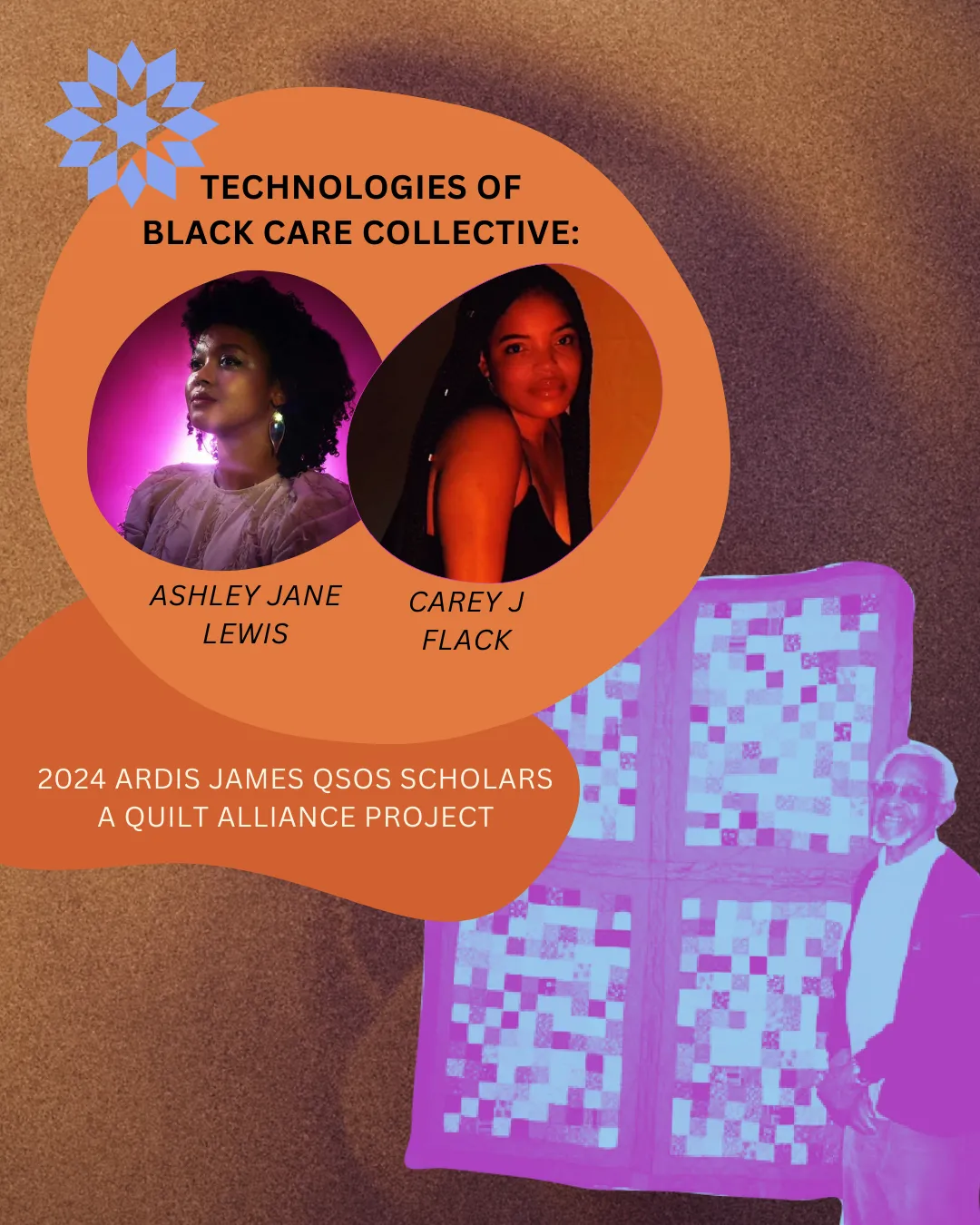
The Technologies of Black Care Collective will host MEMORY PATTERN, a collaborative 4 week quilting project in tribute to Black textile communities of the past, present and future. Facilitated by artist, archivist and speculative design duo Ashley Jane Lewis and Carey J Flack, 30 selected participants will meet weekly on Zoom to co-create a cross-national quilt while ruminating on the oral and written history of Daughters of Dorcas, the oldest Black quilt guild in North America.
MEMORY PATTERN will draw especially on excerpts from the 2002 QSOS interview with Viola Williams Canady.
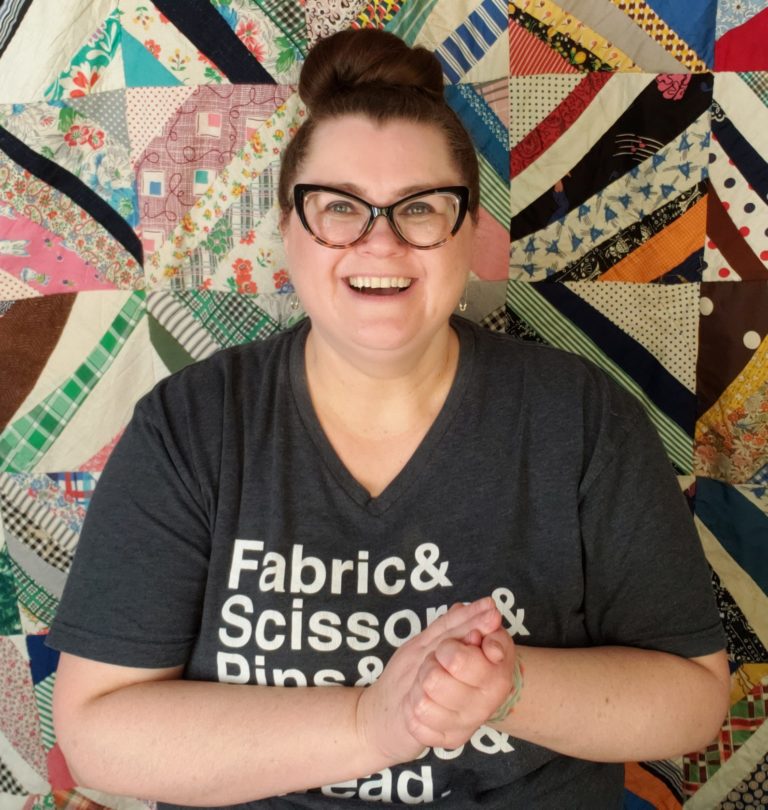
Stephanie Capps Dyke
Stephanie’s proposed project dovetails with her recent work studying Dr. William Rush Dunton Jr.’s quilt collection, and use of handcraft as occupational therapy for his mentally ill patients in the early- and mid-1900s. She will create a 3-dimensional, multimedia, quilted piece which will utilize snippets of the QSOS interviews, as well as other collected interviews. The goal of the artwork and its accompanying media will be to highlight the effectiveness of handwork in managing mental and emotional health, as well as educating and inspiring current and future needleworkers.
Stephanie’s project will use QSOS excerpts focused on how quilting helps interviewees through difficult times, such as illness or grief.
About the Scholars Program
The Quilt Alliance established the Ardis James QSOS Scholars Program in 2013 with the support of the Robert and Ardis James Foundation to support research that draws on the rich resource of over 1,200 Quilters’ S.O.S. – Save Our Stories (QSOS) interviews collected by the Alliance since 1999. Scholars use the QSOS archive to produce original research to disseminate as essays, exhibitions, curricular materials, and interactive content.
QSOS interviewees share how quilting impacts their lives, including inspiration found in unlikely places, comfort during times of grief, and joyful artistic collaboration among friends. Our interview archive is a valuable resource for anyone interested in quilts and quiltmakers, as well as craft, folk art, and the process of making things. It’s our hope that the Ardis James QSOS Scholars Program will enable scholars to dig into the archive and investigate those stories, making connections among interviews, finding common themes, placing histories in context, and spotlighting incredible moments.
I Felt Like Making a Quilt
by Stephanie Capps Dyke
The statistics are staggering. According to a recent U.S. Census Bureau survey 32.3% of adults reported symptoms of anxiety and depression in 2023. Mental Health America found that adult mental illness in the U.S. ranges from about 17.5% to over 29.5%, depending on which state you live in. Worldwide, over 1 billion people are said to live with mental illness and the pandemic unquestionably amplified the effects of these illnesses. In fact, mental health concerns are said to be increasing faster than physical illness, with “diseases of despair” showing a marked increase.
The World Health Organization (WHO) defines mental health as: “A state of wellbeing in which the individual realizes his or her own abilities, can cope with the normal stress of life and can work productively and fruitfully, and is able to make a contribution to his or her community.” Mental illness refers to conditions that prevent us from coping and acting productively in various ways; grief, depression and anxiety, OCD, PTSD, and psychosis are just a few conditions that fall in this realm.
It is safe to say you are acquainted with someone – likely numerous someones – who are living with mental health concerns. It is statistically possible that you, yourself, are living with an acute or long-term mental health condition. After all, most of us eventually lose a loved one. And while it may be temporary for most people, the effects of grief can be as gut wrenching and painful as any form of clinical mental distress.
But there is good news! As reported in a recent piece by the Craft Industry Alliance, a February 2024 Quilter’s Survey supported by a number of industry giants, revealed that quilting continues to be an extremely popular activity. It is estimated that there are 85 million “active creatives” (meaning a person made at least one item in the last year) in North America and that the quilting industry is projected to reach $5 billion by 2027.

That’s a lot of fat quarters, y’all! But in all seriousness, this quilty activity is a very good sign in my opinion.
In 2022, I began research on Dr. William Rush Dunton, Jr., a psychiatrist practicing in Baltimore in the early 20th century. It is well known that he “prescribed” traditional handcrafts, including quilting, to his patients. Referring to the quilters as his “nervous ladies,” Dunton believed that the focus required in sewing, along with the stimulation of working with colors and patterns, eased their suffering. His efforts, in addition to those of several other “alienists,” led to the formalization of the profession/field of Occupational Therapy (OT) in 1917. Dunton’s nascent foundation is still referenced today in the field of psychiatric OT, so he was definitely on to something.
When I explored the interviews of the Quilt Alliance’s Quilters Save Our Stories (QSOS) oral history archives and conducted some of my own discussions, I realized that more than a few quilters innately understand what Dr. Dunton suggested. The QSOS interview format includes a question about using quilting to get through a difficult time and more than a few described their needlework as a form of therapy or comfort.
Many used quilting to process grief, from loss of a loved one. Others used quilting to manage the complex emotions and experience of being a caregiver, as with the quilters included in the exhibit Alzheimers: Forgetting Piece By Piece.
As I worked on my project, incorporating the QSOS interviewees’ words both in written form and interactive audio, I reflected on my fellow quilters’ experiences. I have used stitching and quilting for many years as a mechanism for dealing with my own depression and anxiety. In fact, if you search the hashtag #quiltingismytherapy on Instagram, you’ll find my posts among others. After the loss of my beloved grandmother in 2018, I too processed my overwhelming grief by making a quilt with her sewing scraps.
In a terrible irony, I lost another loved one in the middle of working on this project. My dear mother-in-law passed away in May 2024. I was gutted, but remembering that my sewing was there, that I have this productive and immediate tool for coping, was a solace. Knowing that a sisterhood of many other needleworkers metaphorically sit beside me, processing their own troubles, gives me comfort. We turn to fabric and thread to soothe us. With our hands, we pour our hearts into our stitches.
And guess what? Science supports what our hands and hearts intuitively seem to know. According to neuroscientist Susan Magsaman in Your Brain on Art, a book co-authored with designer Ivy Ross, “repetitive motions with the hands have been shown to release serotonin, dopamine, and oxytocin in the brain.” These hormones, the very chemicals our doctors chase with prescription drugs, are produced by our bodies – no assistance required – when we make quilts!
Furthermore, Magsaman and several other psychiatrists and psychologists have documented the effects of creative work in managing PTSD and other trauma responses. Mark Darrell, known as the Quilting Marine provides more than anecdotal proof. He credits the sudden idea to create a quilt for his grandson with deescalating the overwhelming distress he experienced following active duty in Fallujah. That initial attempt at quilting has led him on a therapeutic journey that he now shares on YouTube.
Likewise, New Yorker contributor Ayelet Waldman found emotional relief in quilting as she watched the recent tragedies in Gaza unfold. In her article, Piecing for Cover, she writes about anguish over the destruction of her childhood home and the loss of so many lives. She describes closing “a video of mutilated bodies strewn across the site of the Nova music festival,” and navigating to a YouTube tutorial by Jenny Doan of the Missouri Star Quilt Company.
Waldman goes on to explain how quilting can physiologically work just like therapy. Her own investigation uncovered that using our hands stimulates the hemispheres of our brain both simultaneously and alternately. This action simulates a clinically effective treatment for PTSD known as eye-movement desensitization therapy.

While I would never suggest that a person completely abandon necessary mental health treatment for quilting, I think there is something hopeful in Diane Bielak’s (pictu quip: “I, to this day, claim it as my therapy and think I’ve saved a lot of money in therapy fees because of it.” At the very least, quilting is never contraindicated, no matter what your condition. Although, maybe don’t operate a rotary cutter until you know how any medications may affect you…
Quilter Kathy Weaver reminds us that “the act of quilting is relaxing.” The often intense focus of quilting helps take our mind off our worries. A special brain function called the default-mode network takes over during such focus. This mode is described as a state of “wakeful rest” which is known to be “profoundly restorative.”
Identification of the default-mode network clearly aligns with the work done by psychologist Mihaly Csikszentmihalyi, also known as the “the Father of Flow.” Csikszentmihalyi’s life’s work was in the highly focused brain state we reach through participation in pleasurable activities. In a 2008 TED Talk, he notably asked, “What makes life worth living?” Zora Selliken’s answer would have been quilting. She simply stated, “It keeps me interested in getting up each morning.”
There is, of course, supplemental meaning in my quilted, sculptural piece. While a few male quilters figured into my exploration, my focus is primarily on women. Societal expectations and gender bias for certain roles put enormous pressure on women. Emotional and mental health support isn’t always an option. In some communities there is a dearth of resources and in some it is still a stigma. Many women are expected to juggle an impossible load of responsibilities and are hard hit by trauma, grief, emotional fatigue, and burn out.
My piece incorporates many symbols of the sisterhood of quilters. Numerous orphaned quilt blocks and pieces – antique, vintage, and modern – represent the unfinished work of numerous hands. Additional textiles, such as embroideries, household linens, and a baby’s christening gown, bring to mind both the mundane and the tragic. But there is joy and hope reflected here. Bright pink is my signature color; it is playful and speaks louder than the old “pink is for girls” trope.
The quilt is appliquéd on both sides, tied, and bound in a long strip. The long, skinny quilt may be twisted and joined at the ends so that it becomes a Möbius strip, a spatial anomaly that turns a two-sided piece into one continuous surface. Text, hand-lettered on vintage fabric scraps, features the words of 21 QSOS quilters, intermingled with the orphaned blocks and textiles.
The typewriters, upholstered and skirted, their components replaced with vintage rolling pins and antique shirt buttons house 12 clips of the QSOS quilters’ interview audio. By literally pushing buttons, their voices emanate from within these contraptions, which are symbolic of “women’s work,” both household and corporate. Yet the quilt itself, represented as “endless,” flows through the typewriters as a colorful riot of words and handwork.
To bookend the experience of making my piece, and to give it a title, I called on the words of quilter Vivian Milholen who said she simply “felt like making a quilt…” And Marjorie Escher summed it all up concisely: “I think it’s very therapeutic.”
Stephanie Capps Dyke is a textile artist, writer, and independent researcher with an obsession for quilts. She streams weekly on Twitch as Stephanie Cake and on YouTube with fellow quilt enthusiast, Jill Alexander, as the duo Quilt Nerding. Their fun and light-hearted exploration of quilts, needlework, and related texts attracts viewers from across the globe. An active member of the American Quilt Study Group, Stephanie regularly lectures on quilt-related topics and loves a spirited “quilt gossip” as much as her long-term research subject, Dr. Dunton. She resides in Baltimore, Maryland and can be found @thestephaniecake.