by Emma Parker | Feb 11, 2021
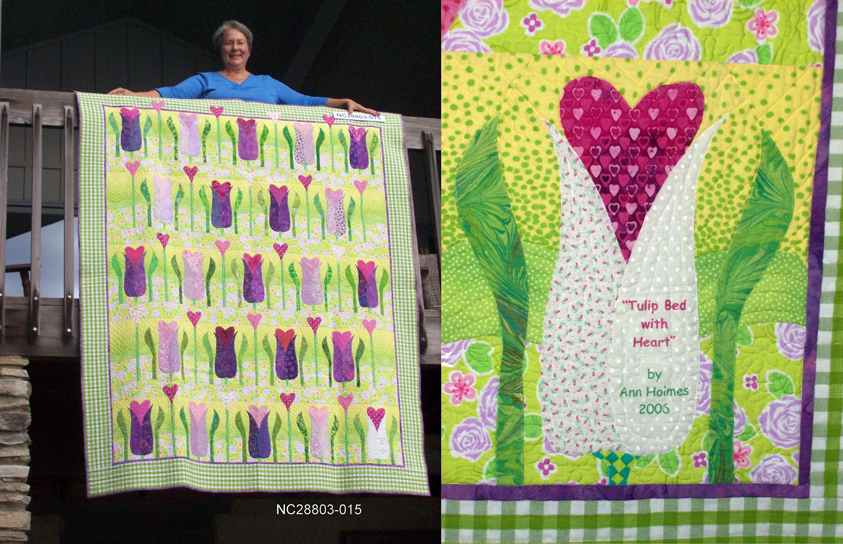
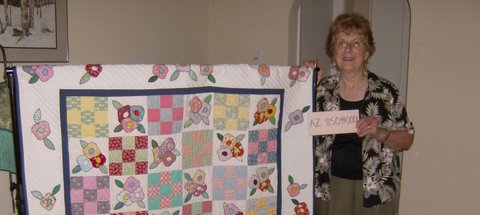
Alice Helms (AH): My name is Alice Helms. Today is September 15, 2010. I’m conducting an interview with Ann Holmes for the Asheville Quilt Guild Quilters’ S.O.S. – Save Our Stories project. We’re at a quilting retreat at Lake Logan in Canton, North Carolina and it is 1:50 p.m. Ann, tell me about the quilt you brought today. Ann L. Holmes (ALH): All right. Thank you, Alice. This quilt was important to me in that I realized, with a new technique that I developed from my stained glass background–I’ve been a stained glass artist for over thirty years and I wanted to recreate some of my original designs in fabric but my designs didn’t lend themselves to traditional piecing. And the quilt that I brought today has a lot of points and curves that would be difficult to piece in a traditional way. You could hand appliqué it but that would take a long time. As a stained-glass artist, I was used to building my windows on top of a drawing and I made patterns then that I used glue stick to glue on the glass to cut out my pieces and with a product called French Fuse, I found that I could build my quilt tops without any sewing, turning under the edges using a glue stick and so everything is very direct, everything–you don’t have to reverse anything, it’s exactly the way you look at your drawing with the freezer paper patterns on top. I add seam allowances to all my freezer paper patterns. I’ve developed a magic button, it’s just a button that I had taken out of my button box and added it to the side of my small rotary cutter with 3M double stick tape and what it does, it just gives me a visual aid for automatically adding my seam allowance. When I roll my button along the edge of the freezer paper patterns, it’s automatically–my blade is over about a quarter of an inch, that’s where I’m cutting–so it’s automatically adding seam allowances, it’s an easy way to add seam allowances. It’s not precise for machine piecing, but anything that you turn to the paper, this works very well. And so anyway, when I first started this technique, building right on top of my drawing, I put one continuous piece of French Fuse over my drawing. The French Fuse is an interfacing that dressmakers have used for many years for knits and people that make t-shirt quilts use it as a stabilizer, so I had some on hand and I noticed that you could see through it, it’s soft and it’s drapable, it’s fusible just on one side, so you just put one continuous piece over your drawing with the fusible side up and then you build your quilt right on top of that. You build the whole quilt appliqué style, that I learned from when I took some hand appliqué classes, everything has a seam allowance and as you look at your pattern you say what is in the background, what is in the foreground and as you’re building to the foreground, you just turn under those seams that need to be a finished edge. Anything that is touching something else, that’s going to be a finished edge, that’s what you turn under. And originally when I started this technique, I thought it was just going to be suitable for wall hangings, but this particular quilt is for a twin-size bed and I was very excited to see that’s it’s possible to make a large quilt with this technique. AH: So this isn’t the first quilt you made using the technique. ALH: No, I made lots of wall hangings, smaller pieces, first. And I was motivated to make this particular quilt because the year that I made this, the big quilt show in Paducah, Kentucky had a special award that year, it was a $10,000 prize for a quilt that would be selected for the new heart wing in Kentucky, in Paducah, their hospital. Unfortunately, I didn’t get in the show, but I think it’s a very cheerful and fun quilt and anyway I had fun doing it. But that wasn’t the only reason, I also had a girlfriend whose 25-year-old son had to have a heart transplant. He had had heart problems as a child and as he grew he was taking so much blood pressure medicine, he needed some surgery and his aorta burst and it was very touch and go for a long time so I was also thinking of Ryan when I built this quilt. This quilt has rows of tulips and there’s heart-shaped pieces in the tulip and so that’s why I call this quilt “Tulip Bed with Heart.” [Ryan is well now and a doctor of Radiology.] AH: And does it have a name? A title? ALH: Yes, “Tulip Bed with Heart.” AH: And why don’t you just describe the colors of it too. ALH: Well, there’s spring colors, because tulips come up in the springtime, so there’s lots of greens and yellows as a background and there’s a green and white checked gingham border. It’s really an upholstery fabric rather than a cotton fabric and there’s lots of pink, because I love pink so there’s pinks and purples and some white in it. AH: And have you gone on to make other large quilts using this technique? ALH: Yes, yes. This was my first large quilt and then I was president of the Asheville Quilt Guild in 2005/2006 and when you retire, they will make you a friendship block and you get to select what you want and I asked them to make me a Flying Geese [block.], just a traditional Flying Geese and the pattern that I asked them to use was something from a Patricia Hair workshop, one of my first workshops that I took as a guild member. Anyway, so they made these traditional [blocks.]–those were hand sewn. [corrected to machine sewn.] But then I designed this queen-size quilt using the squares that they made me. were only six inches–or they were rectangles, six inches by three inches so I made this very large queen-size quilt and I call it “Working Together to Achieve Our Goals.” The center I designed is a five-pointed star and Carol Bryer Fallert is an artist that I always admired. We were lucky in our guild to have many fabulous teachers come to our guild and I loved her Flying Geese where they’re a swish. She was an airline pilot [hostess.]and so she did these curvy swishes with the Flying Geese that were all graduated in sizes and so that’s what I did going into the center of this star. They fed into the center of the star. So the sixty inch center of the queen-size had no sewing in it. Anyway, I built this whole quilt with this technique but I feathered the star. I’ve always admired the traditional eight-pointed feathered star, but I wanted to do this unique so it was a five-pointed star that I feathered and then had her big Flying Geese swish from very tiny to very large on the outside border come into it. Anyway, so the only traditional sewing in that was a six-inch border that went around the center sixty-inch, what you call a medallion or something, with the star in it and then the [outside.] borders themselves. I just designed those with lots of straight strippy pieces but the big curvy swish of the Flying Geese went out to the border. It was a fun project to do and I love scrappy quilts and I made it blue and yellow and orange. It was a perfect color combination. [both talk at the same time.] And people had signed the traditional Flying Geese, people who made those blocks signed those, so it’s essentially a friendship quilt. AH: Very Nice. ALH: Thank you. AH: Okay to get back to “Tulip Bed,” how do you use this quilt? ALH: Well, right now I’m a quilt teacher with my new technique and so it travels with me to have samples of my work. AH: What are your plans for the quilt? ALH: Well, I think my granddaughter will get that at some point, when she’s a little older, she just turned four, so when she’s just a little older. AH: Okay. Let’s talk about your interest in quilting. When did you start quilting? ALH: Well, I’ve always admired quilts. I grew up in Pennsylvania so I had seen a lot of the Amish quilts but I was never motivated to make them. I thought they were lovely but I had no desire. My grandmother–I never actually saw her sewing a quilt but she had made a couple of quilts and she gave us a quilt in a typical quilter’s way, [in.] that she got it done the year after we were married. [laughs.] Anyway, I have her quilt that I still use and it’s pretty threadbare. She used her old house dresses and things like that to make it and so I’ve always cherished that and then when my brother got married many years ago–our mother died when we were young and she grew up on a large farm where the school teachers would go around and stay in different peoples’ homes and this school teacher evidently taught my mother to embroider and so I found some of her blocks that she had embroidered, her sister told me, and so when my brother got married that was the first big quilt that I ever made and I didn’t know what I was doing [laughs.] but I used–the quilt blocks [that.]were like a Star of David and so there were four of those across the pillow and then were two extra blocks down at the foot of the bed and then I duplicated the shape of the Star of David with some calico fabric that was the color scheme, mostly it was a white, like on a sheet [laughs.] and I had big stitches, I did quilt that by hand but– AH: What year was that? ALH: That was probably in, probably in ’70, probably1970. [corrected to 1974.] AH: And you were self-taught? ALH: Oh, yes. And it wasn’t really until I moved to Asheville, North Carolina in 1998 that I became involved with our quilt guild. And I had seen an exhibit of quilts downtown at the Arts Council in their building on Biltmore Ave., yeah, and it was a lovely exhibit and I thought, ‘Well that’s really cool, you know I’m moving to a new place and my kids are all grown,’ and I thought, ‘Well that would be cool,’ and I called Connie Brown and she gave me information about the guild and then I joined up and I really didn’t know very much about quiltmaking until I came to the guild meetings and I was so impressed in how friendly everybody was and so I originally started doing the more traditional things but then I’ve been this stained-glass artist for over thirty years and have stacks of my own designs and I wanted to be able to do some of my own designs in fabric but as I said before, they didn’t lend themselves to traditional piecing and I didn’t know how to go about it and so I gradually developed this technique and now I’m really thrilled because I can do complicated designs without a lot of intricate piecing. So the top has no sewing until after I make the quilt sandwich and then I quilt and stitch all at the same time so it saves time too and it’s just a fun way to work. I mean it’s not real spontaneous, I still plan. As a stained-glass artist, you know you have to plan and make your drawing ahead of time and that’s the way I’ve approached my quiltmaking. But with this technique it’s very easy to make color changes or design changes if you find something that’s not going well you can just easily pull up a piece without ripping out seams and replace that pattern piece or if you want to just draw another shape on it, make another pattern piece. AH: So when you joined the [Asheville.]quilt guild, and you started doing traditional quilting, did you take classes at that time? ALH: Yes, I did. This Patricia Hair was one of the first workshops. I thought what she did was just a very fun technique. Her workshop, I think, was you take a Flying Goose and end up with Duck Soup, or something like that because of the way she made the Flying Geese, you end up with two free cutoffs when you sew your triangles. You take a rectangle, say it’s a three by six rectangle, and then you take two three by three inch squares, and when you sew, instead of sewing right, you draw a line across the corner and then you sew a quarter of an inch on either side of that and then cut on the line, so you have no waste, that’s really cool, so you end up with a freebie and it was those freebies that I had people feather my star with, with the friendship quilt, the “Working Together to Achieve Our Goals.” The star–so the only sewing in that outside feather was the diagonal line which was the cutoff from that rectangle that they had made. So when they gave me that rectangle with the Flying Geese, they gave me the two cutoffs with it and that’s what I used to feather the star. AH: Now, do you still do stained glass? ALH: Oh yes. Yeah. I do commission work so I’ve been fortunate I’ve had a couple of nice pieces around Asheville. I can’t remember what year it was, there was a competition, a design competition, for a new sign for the arts council downtown. They had a call for artists to present a proposal for a new sign. The new building was purchased by someone and they wanted to name the building the Suzanne Marcus Collins building. And originally they weren’t thinking of stained glass at all. They really wanted to put a sign above the window on that pretty herringbone brick they had up there and they had very specific size requirements and stuff but I’m looking at the picture of the front of the building, that black hole and they had those old landscape windows which was just clear glass and during the day it just looks like a big black hole and so I’m thinking to myself, ‘That’s where it needs to be.’ And so I did a proposal, did a lot of work for it and when I turned in my proposal, they said, ‘Oh well we weren’t thinking about stained glass,’ and I said, ‘I realize that but I hope you’ll show it to the committee anyway,’ and so they did do it. But now, I don’t remember how many years later it is now, maybe ten years later, the thing’s been up there about ten years, now the arts council has moved out of that location and a restaurant just went in there so I don’t know what will happen to that window. It’s sad to me because I think it was a nice colorful addition to the downtown scene there. AH: And I’m sure it was built to last. ALH: [laughs.] Of course. AH: The stained glass. AH: So how many hours a week do you quilt? ALH: Well, it just depends what I’m doing. I try to work in my studio, for my whole career, when I started doing stained glass, I would work from 10:00 to 3:00. That seemed to be a good time frame for me when my children were younger, I’d take them to school, go grocery shopping, whatever and get in my studio by 10:00 and by 3:00 they were ready to come home and I was tired because it’s physically hard work because I stand most of the time, you know, to do that. And I have maintained that schedule pretty much when I work on a quilt. I mean there are projects that you get carried away with and work longer hours, but you can maintain a pace for a long time and not get burned out if you just set some parameters. Unless you’re under a deadline crunch or something, but– AH: So is that every day that you work from ten to three? ALH: Not every day, but mostly, yes. If I have a project going, I’m pretty dedicated. I like goals and deadlines. AH: Ann, what is your first quilt memory? ALH: Well, I guess it’s my grandmother’s quilt that she gave us after we were married. We were married–and anyway, I’ve always loved that quilt and it’s well-worn. [laughs.] AH: Okay. And aside from your grandmother, were there other members of your family who were quilters? ALH: No. My mother didn’t sew at all. My Aunt Katherine did teach me some sewing. I was in 4-H and did 4-H sewing projects and stuff and I ended up becoming a Home Economics major, that was my background in college. AH: Oh, okay. How does quiltmaking impact your family? ALH: Well my husband is probably my best promoter. He’s excited about what I’m doing and quilting, you know it’s a softer thing, it’s really almost easier and not quite as dirty as working with stained glass. [laughs.] Stained glass can be really messy and once you make a window, it’s hard to–you have to have a place, really, to put it. I mean it’s hard to put it in a box and transport it. You can, but you know it’s very fragile and a quilt, you can just fold up easily and transport. My husband–right now he is working at the National Science Foundation in Arlington, Virginia. We’ve been up there for two years and we’ll be there another year and I made him a quilt for his office and it’s from an Escher design with the flying geese, because that’s the way our life has been because we’re going back and forth from Arlington to Asheville, North Carolina and so I named the quilt “Are We Coming or Going?” because the geese are going in both directions. That was a fun one to do and people come in his office all the time and admire it and I’ve gotten a couple commissions from that quilt hanging up there too so that’s kind of cool. AH: And how about– ALH: See he’s always encouraged me and my kids have always grown up with me doing something and so, ‘Mom’s working on another project.’ [laughs.] AH: Have you made them all quilts? Your kids? ALH: Oh surely. Yeah. A couple different quilts. AH: But none of them are interested in quilting? ALH: No, my daughter loves history and anything to do with art but she’s not so much interested in doing it. We did make a quilt for her [together.]one time that was just like Chinese Coins, just straight pieces, that she’s actually got hanging on her wall in Egypt right now. She is in Cairo, Egypt teaching and we used that to decorate her apartment because she had this big wall space and it’s very colorful, behind her dining room table. AH: Have you ever used quilts to get through a difficult time? ALH: Well, I’m going through a tough time right now, my son is going through a divorce and it’s very nice to have something creative to focus on. I think quilts are very healing and you know, it’s just nice to put yourself in, submerge yourself in a project. AH: What do you like most about quiltmaking and what do you like least? ALH: Well, I love the challenge of designing and figuring out colors, at the same time, it can be very frustrating and challenging. It’s very–it’s worth trying to do hard things sometimes, making those difficult choices, but it’s very satisfying. The thing that I have always struggled with is the machine quilting. When I first started to learn to do machine quilting, I thought, ‘I’m not going to be able to do this at all,’ but with this technique I have gradually learned how to control my machine and I’m using a zigzag stitch instead of all straight stitching and for some reason, with the zigzag stitch, because there’s no sewing in my project, what I have to do–now it’s all turned edge, under edge, so I don’t want to satin stitch anything but I use a small zigzag stitch, it’s like one point five or one point six width and it’s just all free motion, I use the free motion foot and so I just have to guide it around all the individual shapes. Now, when you get to the top of a curve, like the top of these hearts and the zigzag doesn’t go in the right direction, I switch it to straight stitch and just with very light hand movements, just do that zigzag until I get over it. So I plan my work. With this quilt, there’s a lot of vertical shapes in it, you see, so I did most of the vertical stitching first and then you just turn the quilt and then stitch in the background as a horizontal. So you just kind of have to plan your work, you just look at your quilt and figure out, ‘Which is the most practical way for me to proceed?’ But that was the struggle, was figuring out to do the machine quilting. AH: I know you mentioned the Asheville Quilt Guild, but are there other quilt groups, or art groups you belong to? ALH: Well, right now, living in Arlington, Virginia, I was a member of the Potomac Fiber Arts Gallery where they did quiltmaking, felt making, all kinds of weaving and knitting and anyway, it’s lovely to be up there and to be part of that organization. They’re a guild, like our guild, where it’s open to anybody, and then there’s the gallery part of it where you’re juried into the gallery part and then there’s a gallery space in the Torpedo Factory in Alexandria, Virgina. There are seventy members of that gallery space and it’s a cooperative so each work a couple days a week [corrected from week to month ] and they put a new show in every five weeks, they take everything out and put new work in and so that’s been a fun thing to be a part of that group and it’s stimulating to be around other creative people. AH: Have advances in technology influenced your work? ALH: Well, yes, I mean I use a sealing iron when I make my quilt tops without any sewing, I’m using this French Fuse which is fusible on one side and so I use a small sealing iron, it has like a five-inch head, with a very pointy top, it’s actually used in modeling, when people make model airplanes and stuff like that but it’s a perfect appliqué iron, and because it’s got a very pointy top, it maintains its heat, so I don’t know how long French Fuse has been around, dressmakers have used it for a long time but it’s a tricot fusible interfacing, so I mean I don’t think that was around a long, long time ago and I use glue stick. I use Spray Baste to layer my quilts so I don’t have to pin them or baste them, I use 505 Spray Baste, has been a very good product for me because it doesn’t have a lot of odor like some of them do, you’re still supposed to work in a well-ventilated area but you know the smell is not bothersome at all. But it holds our quilts together, that is amazing, that is a huge time saver to not have to pin it all and then you know you worry about all those puckers, and to take all the pins out, so that’s a wonderful advancement. AH: I agree. Describe your studio. ALH: Well my fabric studio is my family room in my house. When we moved to Asheville, North Carolina, we just bought an old ranch-style house but it has nice rooms, it had a nice size living room and a nice size family room and I don’t need all that living space, you know, and my kids are gone so in the beginning I was just going to sew in a little corner of that family room, one end of it was going to be my sewing studio and then it was going to be like a computer room and family room, I had a sofa and all that in there. But [then.]I made a stained-glass window, it was a commission for some people in Asheville, a very large window called “Oriental Garden.” It’s eight feet wide and seventy-nine inches tall and there were fourteen feet of transoms over the top, and after I did that window–it turned out quite nice, it’s in a private home–and I was thinking I would love to use that design to try to make a quilt. But at the time, I didn’t have my technique yet. I didn’t quite know how to do it so I’d read books by–oh my goodness–Ruth McDowell. I love her work, but it was very difficult piecing but I did my sky, my mountains and my water with all that curved piecing that she does, but it was very tricky. But after I did all the background, then I still had all the flowers and the trees and the rocks to add and so I had seen an article in Quilter’s Newsletter Magazine, Sharon [Malec.] it was like in [October.] 2002, I had seen an article where it was called “Freestanding Appliqué” where she constructed the face of a cat and she did it with freezer paper, much like I’m doing my thing, but she assembled this unit, off the background, and then applied it to her background. You know, she just assembled it, turning under edges using the freezer paper as a guide, you know for putting the pieces together. And so that’s the way I did that for “Oriental Garden” that’s the way I fashioned my flowers and the rocks, as individual units and then appliquéd them to the background. But that started me thinking, ‘Why can’t I just build the whole quilt that way? That’s like what I’m doing in stained glass, is putting all these individual pieces down but then my solder holds it together.’ And so anyway, I found I had some French Fuse, I was going to do something–my father had passed away and I had all his ties and those are bias cut and it was Laura Casey, in our quilt guild, that said, ‘You need French Fuse as a stabilizer for that.’ And so I had some on hand and I noticed, ‘Well my goodness, you can see through this.’ So that’s really where I got this idea to just start building this and in the beginning I was a little nervous about it all falling apart, so I would just do a little section at a time. I would build it on the French Fuse, a few pieces at a time, but then I’d take it to the sewing machine and stitch. Well, in 2005, I had bunion surgery that didn’t heal properly and I was off my feet for a long time and I didn’t know if I was going to get my quilt done for the quilt show and so I just took a chance. I thought, ‘Well, why am I sewing it twice?’ So I thought that would save me a lot of time, rather than taking it and sewing it and then you make your sandwich and then you have to sew it and quilt it [laughs.] I thought, ‘Well, why am I sewing it twice?’ So that was really the beginning of it, the desire to finish my quilt on time, I just took a chance and I did “Rainbow Falls,” that was the first quilt that I did this whole technique without any sewing in it, and that quilt was thirty inches wide by eighty inches long. And there’s a neat story about that quilt. I had it in our quilt show and then at the time I had booth space downtown [Asheville.] at the Woolworth Walk and I had it displayed downtown and also another little, smaller wall hanging that I had made because I was president that year, the theme–I had made a smaller, like mini-quilt with a Mariner’s Compass in it that was the theme for that year and both of those quilts were stolen from the Woolworth Walk and I listed it on Lost Quilts.com and almost two years later, I get a package at my front door, and it’s “Rainbow Falls” returned to me and it was kind of an anonymous letter saying that this lady had found it in a thrift shop in Asheville and my label was still on the quilt, it was in perfect condition so it was really kind of a miracle that I got that back because it’s– AH: Amazing. ALH: Yeah. It was very special. [laughs.] AH: I wanted to ask you–I know you teach quilting –so I wanted to ask you to talk about that a little bit. ALH: Well I’ve enjoyed quiltmaking very much because as an artist, most of my career I’ve worked by myself, you know it’s wonderful when I have a big project to hire people to help me and I’m able also now to hire some people to help me with my quiltmaking because I can be more efficient if there’s–you know you can get lots more done if you can hire somebody to help you. But, I have loved going out and teaching. Quilters are generally very friendly and eager to share and want to learn so it’s a very good environment and I can make more money that way, honestly because you know I would struggle so hard for a two hundred and fifty dollar stained glass piece that somebody would want and you struggle for days or a week and now I can go out and give a lecture for two hundred and fifty dollars, so that’s pretty cool. AH: And how many times a year do you teach? ALH: Not very often. Right now, sometimes it’s twice a month, sometimes it’s once a month. I’m going to teach in Atlanta, [Georgia.] October the 4th, and then I’m in Hendersonville [North Carolina.] November so then I don’t have anything for a while and next June at the Quilter’s Unlimited in Arlington, Virginia, I’m going to be teaching at their big quilt show. But I am in the process of writing a book, I’m working on stuff for the American Quilter’s Society, they have given me a contract to write a book and I’m going to try to go for a May deadline, I don’t know if I can reach that goal or not, but anyway, once my name gets out like that, perhaps I will be busier as a quilt teacher. And I don’t want to be completely swamped, to do it once or twice a month, that would be nice, you know. I think I’d like that and that’s the wonderful thing about this career, there’s so many quilters that are beyond retirement age, I don’t need to retire just yet, you know it keeps you young, I think, to be able to go out and continue to share what you love. AH: That’s great. Ann, I meant to ask you this earlier, but I was wondering whatever became of the quilt you made for your brother. ALH: I actually remade that quilt. My brother and his wife used that for many years and several years ago, they gave it back to me because they didn’t want to throw it away but it really was in tatters. Where they had it on their bed, the sun faded it all on one side and the fabric was fraying and stuff, so they didn’t want to give it away, but they didn’t know what to do with it, they didn’t want to throw it away so they gave it back to me and that same year, I was in a little fiber bee here in Asheville and they had a recycling exhibit, that was the theme, recycling and so I decided to recycle that quilt, so what I did was just take my rotary cutter, I just cut out the good parts and made a plan. There were just three of mother’s embroidered pieces that were okay, the other three were no good, there were six originally and so I redesigned it so that it would be like a large wall hanging and anyway, it turned out pretty cute, it’s hard to describe it in words but I recycled it. I just took the rotary cutter and sliced it up and then on my table, I just butted the joints together and then cut red fabric and made little sashing pieces and that’s the way I joined it and then put a new back on it, that helped hold all the back together and then requilted it. Originally it was hand quilted with my big looping stitches [laughs.] and now I stitched, machine quilted around the original hand stitching so anyway, it turned out pretty good and so they have it back, I gave it back to them. [Both talk at the same time.] And they’re happy. AH: And it’s still bed-sized? ALH: No, no, no. It’s smaller, it’s like a wall hanging. It’s not as large as a twin. It’s a large wall hanging. Maybe it’s thirty-six wide by, I don’t know, sixty long or something like that. AH: Well that’s interesting. ALH: And three of my mother’s original blocks [are.] in it still. AH: What do you think is the biggest challenge confronting quiltmakers today? ALH: Well, with my new technique, you know a lot of people are set in stone, you know they have very specific ideas but then there are a lot of people who are open to new ways of doing things, so sometimes you know, people just kind of turn up their nose and you know–but I think there are other people that are saying, ‘Well you know, that’s pretty cool.’ And now, as quilters are getting older and having a hard time with holding a needle in their hand, you know that small needle, you get arthritis in your hand, I think some people have enjoyed this technique and then being able to finish it on the machine. AH: I think we’re very close to the end of our time, so is there anything else you want to add about quilting, your quilting story? ALH: I am just very grateful to all the quilters that have come before me. I got into quilting–we were out in California in 1990/1991. That was the first time I ever walked into a quilt shop and learned about the rotary cutter. That’s revolutionized quilting, man. [laughs.] AH: It sure has. ALH: And I picked up my first quilting book which was by Donna Slusser, it was watercolor quilts. So I was very attracted to those because they looked like a Monet painting to me, dabs of color and line and so I spent a couple years just cutting up scraps, you used very large bold prints then and you cut them into two inch pieces, so you can kind of fracture the design and then you have to arrange them by color so I spent a long time doing that but I have done several quilts like that and it was fun but it was very time consuming. AH: Okay. Well, I think this concludes the interview then. ALH: All right, thank you very much. AH: Thank you and it is now 2:32 p.m. ALH: Okay, thank you. [laughs. ] I hope I did all right. AH: You were wonderful. Visit Ann Holmes’…
by Janneken Smucker | Jun 1, 2016
[addtoany] [space height=”10″] Explore and listen to Anne Rolfe’s interview by clicking open a segment title and selecting “Play Segment,” or by searching either the index or…

by Emma Parker | Aug 24, 2016
Gail Van Horsen (GV:): Okay you have answered some quick little questions here and I have a question about one of them. The question is ‘Do you sleep under quilts?’ and you answered ‘no.’ Why is that? Audrey Waite (AW): I have mostly antique quilts and I put them on the guest bed, so then when guests come I move them. They have a tendency to put their suitcases on top. GV: I heard that just last week. Are you a self-taught quilter? AW: No. GV: Who do you think encouraged you to start quilting or how did you start quilting? AW: It was kind of a long involved process, because I learned patchwork before quilting and I used to make doll quilts and I would just tie them. Like little nine patches. When we lived in Missouri my husband was in the Air Force and the Officers Wives had a bazaar and they wanted people to make things to sell at this bazaar so when I went to the organizational meeting they passed around pictures of suggested things and one was a magazine article about patchwork pillows. And I said oh I’d like to do that. So I started making these patch work pillows and I got so enamored with all of the different patterns. I wanted to make one of every pattern that existed. So pretty soon I said how many pillows did you want? And she said well I don’t know and I said well I have nineteen. So I had to have my own booth at the bazaar because I was having so much fun putting these pillows together. So that is how it kind of started. When I began collecting antique quilts. I decided that I should know how to make them. When we moved to Arizona I took a class through the Mesa [Arizona.] Parks and Recreation. We had a very nice teacher and we had a choice of two patterns: a hole in the barn door or a sailboat. I made the hole in the barn door and I chose the cheapest fabric I could find and it never went with anything I ever had in the house. GV: About what year was that? AW: That was probably 1976, maybe. GV: That was pretty much right at the beginning of the new quilting revival. It says here that you had quiltmakers in your family. Who was that, that quilted in your family? AW: l didn’t find out until much later that my grandmother quilted and that my aunt had some of her quilts. But, I never got to see them. An aunt gave me three quilt tops and we could never figure out who had made them, so I was always looking for someone to quilt them. When we lived in Missouri I found out that the ladies in the Methodist Church quilted every Wednesday, so I had them quilt them. GV: Wonderful, Tell me about the quilt that you have hanging here today. AW: This is a quilt that I made. When we lived in Arizona I quilt my job at ASU [Arizona State Universitv.l I wasn’t sure what I really wanted to do but I was still into crafts a lot and doing the patchwork thing. The Quilted Apple had just opened in Phoenix [Arizona.] so I went there and I fell in love with the place and I told the owner that I wanted to work there and she told me that we don’t need anybody. So I went back a couple of months later and she was gone and her husband was there and he was very busy. I told her husband, who was very busy, that ‘I told your wife I would like to work here’. She called me and told me we’ve just opened and I can’t afford to pay you very much. I told her ‘I don’t care just as long as I have enough money to pay for gas to get from Tempe [Arizona.] to Phoenix I’d be happy’. Because, I just knew that I needed to be there. While I was there I took a beginning applique class and then I took an advanced class at the home of Helen King and mostly it was about where to find supplies. We were still in the infancy of quiltmaking, making templates of cardboard, we’d cut up cereal boxes to make our templates and that sort of thing. When I moved to Virginia I happened to live on the same street as Jinny Beyer so I wanted to take her medallion quilt class and she said I could as long as I read through her book Patchwork Patterns and did all the exercises, which is learning to draft your own patterns. Then I took her class and I made this quilt. GV: Do you draft your own patterns today? AW: I do. GV: Do you make mostly traditional quilts today or do you consider them more art? AW: l think they are traditional. GV: Is there something that people viewing your quilts might conclude about you? AW: l don’t know what that would be. GV: Okay, they are not all in the same vein. Do you do a lot of different things? AW: l did a lot of different things because when I worked at the Quilted Apple I taught Classes. A lot of the things I made were class samples. I taught the Mary Ellen Hopkins method of “It’s Okay If You Sit on My Quilt” It was a lot of cutting of strips, machine piecing and machine quilting. Doing things an easy way. GV: How do you use this particular quilt? AW: l don’t use it. It’s the one and only bed size quilt that I have made. Like I said, most everything I’ve made has been class samples. So, my husband bought me a quilt frame. It is a round quilt frame, it’s cherry wood on a stand and I have an antique quilt in that. It is partially quilted and when someone wonders when I’m going to finish it I say I have that in case some one wants me to demo hand quilting it’s all ready to go. GV: Did you learn to quilt at the Quilted Apple or did you know how to quilt prior to that? AW: No, I didn’t know how to quilt. I don’t know if I still know how to quilt. I’d just as soon have someone else do that part. I like the designing and the selecting of the fabric and making tops. My husband calls me the quilt top queen because I never would go from there. I just make tops. I have machine quilted and hand quilted and a combination of both on small pieces but not really bed size quilts. Just a lot of wall hangings and smaller things. GV: Are you also a quilt teacher? AW: Yes. GV: And what kind of technique do you teach? AW: A variety. I like to do hand applique. I have taught that in different quilt stores and for the state guild traveling teacher program. I’ve taught classes in hand applique. GV: I think I might have taken one of those. Did you teach mola? AW: Yes GV: I was the only one who finished my mola, I love reverse applique. AW: Good girl. GV: What do you find most pleasing about quilt making? AW: Well, like I said, I started out collecting antique quilts and that is still my main interest. My main interest is antique quilts and the history connected with quilts. GV: The history of quilts? AW: l belong to American Quilt Study Group and I have been to several of their seminars. I find that most interesting. GV: Do you belong to any other quilt groups? AW: We have a group here in Sedona [Arizona.] that just are just friends, eight of us that get together every Tuesday, and I belong to the state guild and the American Quilters Society. GV: Have the new advances in technology influenced your work at all? AW: Definitely, like I said we started out with sandpaper and cardboard templates and scissors. I had a class one time with Wailani Johannson from Kaui and she said you have to have Gingher scissors so we all bought Gingher scissors. So it has been a progression from just cutting with scissors and pencils and trying to find what supplies you could to use to make quilts until now it’s just a plethora of things. It’s just wonderful everything that is available now and the fabric is just beautiful. GV: Do you use any of the computer technology to quilt? AW: l haven’t. You know, I had a business where I was sitting at the computer a lot everyday so I didn’t want to incorporate that into my quiltmaking. GV: I know you best in Arizona for your Quilt Camps. How did that come about? AW: Well, Dee Lynn moved to Sedona, Arizona and we had worked together at the Quilted Apple so I had known her for several years. Before she moved here she had been in California and part of the Orange County Quilters Guild and they have a biannual retreat called Camp Watchapatcher and she had been registrar for that and so when she came here she was still working for them and I thought that was silly living in Arizona and working for a guild in California. So I said why don’t we do one here? We thought we won’t compete with them. We’ll have ours on opposite years if they are the even years, we will be the odd years. At our first Quilt Camp in the Pines in Flagstaff in 1995 we had a survey for everyone to fill out and we asked if they would come again in 1997 and they said they wanted to come next year. So then we decided we’d do it every year. GV: Did you teach at the camp too? AW: No, I wanted to take classes and the first year I enrolled in one of the classes making a jacket. I had the fabric and I went to class and I was so tired I was afraid to cut the fabric. So I decided that this was probably not a good idea. Just be the administrator and not try to take classes. GV: Yeah, that would make sense. Well, you could have taught, been the administrator and taken classes. What do you think makes a great quilt? AW: Having studied antique quilts a lot, when I first started buying them I looked at the quilting stitches that was the important thing to me. Because when I had these three family quilt tops done they were done by a group of ladies and most of them were elderly and some of them probably didn’t see as well as others so the stitching was uneven. When I say quilts that had beautiful quilting on it I thought that’s what I wanted to buy. But then looking at books and magazines and calendars and what was published. I thought why would they select that quilt it really doesn’t have nice quilting so it finally dawned on me that there was more to it than the quilting. GV: That is interesting that you first viewed it as the quilting as opposed to the applique or the patchwork, I think most people do just the opposite. What do you think makes a quilt artistically powerful? AW: Color. The color and the value patterns can look so different dependent upon the value and the different colors used. GV: This is another question that your collection background will come in handy here. What do you think makes a quilt appropriate for a museum or a special collection? AW: Provenance. It depends on what their focus is at the museum. They can only accommodate what their space will allow. Usually museums can’t exhibit everything that they have only a portion of what they have so they have to be very selective in what they have. GV: Is there a specific quilt maker that you are drawn to? AW: l like them all. I’m just not particular. I just like them all. GV: Have any artists in particular influenced you? AW: l think Jinny Beyer did, because I learned to draft patterns and everything on her quilt was done by hand. Only long straight borders were sewed on by machine and she still does everything by hand. I think she was a big influence. GV: How do you feel about machine quilting vs. hand quilting? AW: It’s come a long way it is just amazing what they are doing with machines nowadays. GV: Have you ever had a quilt long arm quilted? AW: Yes. GV: A smaller quilt or? AW: The smaller ones I do myself. I have the bigger ones done by long arm quilters. GV: Why is quiltmaking important to your life? AW: It is my life. [laughter.] Years ago I had an exhibit in a museum in Mesa [Arizona} and the woman who worked there she told me I was obsessed, she meant it to be derogatory but I was flattered. GV: I would be too. AW: It’s a blessing and a curse I guess. GV: Do you feel that it interferes with your home life at all. AW: don’t think so. He’s very tolerant. GV: What do you think about the importance of quilts in American life? AW: That’s pretty deep, I don’t know if I can answer that. GV: Do you have any politically motivated quilts in your collection? AW: I don’t think so. There was a [inaudible.] recently about using flags in quilts and I thought I made one years ago that had little flags in it and nobody said anything about it then. It was in a book, it wasn’t an original idea. Quilts, especially when you go around documenting quilts or when you talk to people about being a quilter, they always have some comment like oh my grandmother quilted or they always have some thing in their mind that they know about quilts. We had a pest control service when we lived in Mesa, he came every month. We have quilts on the wall, quilts on the bed and he said you must really like these blankets. Everybody you run into has some relation to quilts in their life. GV: That seems to be true. How do you think quilts can be preserved for the future? AW: Oh, we just do the best we can. They are all cotton they seem to have survived, the special ones that people didn’t use. GV: Do you make quilts for friends and family? AW: Yeah. GV: Do you know what’s happened to those quilts? AW: Hopefully they keep them. I don’t know. I recently did ones for two grandchildren that were corning to Sedona and going on a camp out. I made them quilts to take on their overnight camp out. One was an I Spy for my granddaughter. One of the things that these people on the camp out were going to do was invite the astronomy club to come with their telescopes and they were going to look at the stars and what not during the evening after it got dark so this other one was this new fabric that is out that glows in the dark and has all the constellations on it. So I made that for my grandson. So I quilted it all in silver thread too. I just make some little stuff like that and whether they hold on to them or not I don’t know. GV: What do you think is the biggest challenge confronting quiltmakers today? [Telephone rings/recording political announcement.] GV: Have you ever been a chair or a board member of a committee or a quilting guild? AW: I’ve done a lot of work with guilds in places where we lived. GV: Did you find that rewarding? AW: Yes. GV: Have you had pictures of your quilts or patterns published? AW: Yes, many of them. GV: Where was that? AW: The quilt that you took a picture is in Jinny Beyers medallion book and one time the guild had Joyce Schlotzhauer come and teach. She stayed with me when she was here and she asked me to do something for her book. I made the yin-yang pattern she wanted. GV: ‘Linger Here Garden’. How do you pronounce that Chinese town? AW: She was doing all of this curved piecing so I did that. GV: What’s the date on that. AW: 1988 GV: So all these new curved books are not necessarily new. It’s just the next AW: She had a really good technique. She blocked every piece once it was stitched and she would have on the ironing board a drawing of the size of the finished piece and you had to block it to make sure it fit. GV: Wow. AW: When Elly Sienkiewicz came to the Quilted Apple to teach she saw a lot of my class samples and she asked if I’d do some sewing for her. So I did this quilt that she had made for her daughter and all I did was piece it together. GV: That is called ‘Project #24 small quilt: Katya’s Album’. That is beautiful. AW: Yeah, its kind of cute. It’s not real big; it is fifty nine and a half by sixty seven and a half. GV: I like quilts with writing on them. AW: She always has different people doing different things. I did the piecing and she had dged by Mary Sue Hannan and quilted by Mona Cumberledge. They are always done by different people. I did another block for one of her quilts and she sent them all to me to put together. The Odense Album – this one here. [Showing picture in book] I did this block she did the inking and I did the sashing and then someone else had already done the border so I had to make it fit the border. Wasn’t that fun. And then some one else did the quilting. GV: I think that would be a hard quilt to make by committee. AW: Yeah. GV: Especially adding the border later. AW: It was on the cover of Quilters Newsletter one time. It’s in Baltimore Beauties and Beyond Volume 2. GV: I think I have that book at home so I can find it AW: There’s my block. It’s the Little Mermaid of Copenhagen. GV: That’s beautiful. Now, when you do that. Does she provide the fabric and send you all that and then you make the block? AW: Yes. GV: So she has figured out what all the colors will be and that type of thing. AW: Right. I had one of my antique quilts in this book. The Irish Chain Quilt by Blanche Young and Helen Young Frost. It’s a red and green quilt. I bought it in Mesa [Arizona] There was a gal who advertised in the paper that she had a quilt for $25. So I thought what could it be. So I went to see what it was and it was a Lone Star that was all machine quilted so she didn’t think that it was worth much. I bought that and she said well since you are interested in quilts I have one that is museum quality. So I thought good thing I came and she sold me this one Irish Chain. GV: Is it hand pieced and hand quilted? AW: Yes. GV: Oh, circa 1870. AW: It’s interesting because half of this border and all of this border is tan. GV: Oh, it’s a different red. AW: It might have been green, it was a polka dot because there are little holes where the dots were. Lot of time the greens faded to that tan color. So who knows what it was but evidently she ran out of the red she was using. GV: Nowadays that would just be a little artistic detail. GV: So, when did you begin collecting quilts? AW: In 1976 when we moved to Alabama, like I said I was really conscious of the quilting in antique quilts. We had started buying antique furniture so my husband was looking at a desk and I spied this double wedding ring quilt that was beautifully quilted so I said to him when you negotiate the price for that desk see what they want for this quilt. I wanted that quilt because it was beautifully quilted. So it just kind of blossomed from there. You know they say if you have three it’s a collection. I wanted more than three. GV: Okay, Do I dare ask how many you have now? AW: I don’t know. GV: Is there any specific type of quilt you collect? AW: I was buying everything at one time but then I thought I should concentrate on something. I try to collect signed and or dated quilts. GV: That limits your choices. AW: Yes, and they are usually more expensive because that wasn’t done then. GV: Sure, Do you still pay particular attention to the quilting when you collect them? AW: I like it if they are very nicely quilted. GV: But, It’s not a requirement. AW: No. GV: Do you have quilts from all eras? AW: I try to get them to have an example from each decade because I would give talks on quilt collecting and quilt conservation and that sort of thing. So I have them from 1790 on. GV: On to when? AW: The present. I’ve got three on the way. Don’t tell him. [laughter.] GV: Are you still giving talks on quilt history? AW: I do, I just gave a talk for the Questers International Convention in Phoenix. It was in May and there were over 600 people there from around the world. They wanted me to give a talk on quilt conservation. I belong to questers here in Sedona. All of the chapters in Arizona were heavily involved in getting ready to host this convention. It was at the Biltmore Hotel. So I had 160 or 170 people come to the talk. GV: Wonderful. In your conservation of quilts do you repairs as well. AW: I can do that. I try to buy quilts that don’t have to have repairs done. But every once in a while if there is just one patch that is gone or something I do have a collection of old fabric so I can do repairs. That’s how another collection started I thought if I get quilts that need repairs I need to have some fabric. You couldn’t find fabric so I bought aprons. I thought I could cut up an apron and use that fabric but, then I never cut up any aprons. GV: So now you have aprons. AW: Now I have forty aprons. GV: Are they mostly from the thirties and the forties? AW: Yes, recently the historical museum here in Sedona exhibited my aprons. GV: How neat. I notice they are very popular in antique stores nowadays the aprons. You don’t have any idea how many quilts are in your collection. AW: No GV: How do you store your collection? AW: They are everywhere. When we bnilt this house I wanted to have enough storage so that I wouldn’t have to put them under beds. They are still under beds. In the closets, under beds, in blanket chests and on the walls, in pie safes and acid free boxes and pillow cases. They’re everywhere. GV: Okay, AW: I just can’t keep track. GV: Do you mostly collect while traveling throughout the country or do you do it online? AW: l haven’t got much on line. I used to get some by mail. We are from Pennsylvania and I still have contacts. There is a gal in our hometown and she used to buy quilts in the area and she would sell them to stores in New York City and places like that and so she’s sending me three more. GV: Do you find a difference between quilts made in East or Northeast compared to quilts made in the West? AW: The older ones? I don’t notice too much of a difference. The ones in the South seem to be thicker like they used heavier batting but it seems like the same type quilts are made everywhere. GV: Do you have Pennsylvania Dutch quilts in those beautiful colors? AW: Yes. GV: Those are my favorite, I think. AW: There is one in “Grand Endeavors” this was the documentation that we did around the state and this is one of the quilts that ended up in that book. See it’s dated 1901 and it’s Mennonite from Pennsylvania. GV: I didn’t realize that your name was on that. There is a quilt very similar to that I wanted to reproduce for a star challenge. I’m sure I would have recognized your name on that. AW: l was on the book committee. We had a lot of fun going around the State and documenting. GV: We had hoped to do that again this year for the 2012 Celebration and it didn’t work out. GV: Have you won any awards for your quiltmaking? AW: I don’t like to enter for judging. It’s just not my thing. I did enter some in the Coconino County Fair in Flagstaff and one was rejected. I don’t know who the entry person was but they said it was dirty, but it was tea dyed. GV: Oh, they must have thought it was really dirty. AW: So I called up and said who are your judges up there? They wouldn’t tell me. I said it’s not dirty, it’s just tea dyed. I got some ribbons there. It’s really not my goal to try and get prizes. GV: I know you are a member of the Arizona Quilters Hall of Fame, were you surprised when you won that honor? AW: That was very nice. Wonderful. GV: Had you heard about the Hall of Fame prior to winning that award? AW: Yes. I’m on their mailing list and I’m on their email list. AW: This is one of the local papers. You can have this if you want. Where I did a talk for a Questers Chapter. There was a gal for the newspaper one taking photographs and one had a laptop she was typing into and she did a pretty good job. They don’t always get everything correct. GV: I know. AW: It’s the flood issue [newspaper.] GV: That was this year? AW: No, last year. GV: I remember that one. GV: Do you have a quilt studio or a place you make quilts? AW: l do. In our other house and other places we have lived I’ve had a bedroom. In our previous home we had a laundry room that was like 9″ X 20″ and that was very good because it was a long way. I could see from the kitchen like ifI was standing at the kitchen stove I could see to the end ofthe laundry room. It was great to have a design wall at the end of that far distance. I could really see what was going on as far as value especially when I was doing watercolor quilts. You didn’t have to use a reducing glass. You could just look from far away and move that one right there. When we built this new house I needed more office space so I have a big closet for fabric storage and a small space for sewing. GV: Do you have a design wall now? AW: I don’t. GV: So how do you do that? AW: The last fifteen years I haven’t had too much time to make quilts. So it hasn’t been a problem. But I did a portable piece of foam core that had flannel on it and I could put that up if I needed to use a design wall. GV: Do you have quilts in progress right now? AW: I’m making some charity quilts right now for the Coconino Quilters Guild. GV: Great. Do you do that every year? AW: No. Like I said I haven’t had time to do a lot of that so I’m trying to make up for lost time. They put together kits so I brought home a kit and then I added to it. I got carried away making blocks with the fabric they sent me so I think I’ll have about three. They are all pink and purples and pastels so I want to do something for a boy too. They have several different charities that they give them too. I don’t want to have all girlie stuff. I want to do something for a boy. I’ve got some cowboy fabric and I’m going to do another one from that. GV: Do you ever make patterns? Have you sold patterns or designs? AW: Years ago I did a tree skirt. That was a log cabin design. I think that’s the only one I’ve ever published. GV: Was that in Arizona? AW: Yes at the Quilted Apple. I haven’t really gotten into it. I do design things and I designed things for classes I was teaching. But, I didn’t really sell patterns. GV: Are you still teaching with the Arizona Quilters Guild traveling teachers? AW: No. They took me off the roster. They decided they wanted to have every one come to Phoenix in January of every year for a 15-minute review. I said I was not driving five hours to do a 15-minute review. They took me off the list. [Laughter.] That’s just the way I am. GV: I don’t blame you. That’s a long drive. It’s a very long drive unless you can do moret han one thing when you are down there. AW: In January I was busy with Quilting in the Desert. I just didn’t want to take the time to fool around with that. GV: You’ve sold your quilt camp now, so how did that transfer go at Quilt Camp in the Pines? AW: Well, part of the sale contract was that I would help her through Quilt Camp in the Pines so I was there for several days. Helping and assuring people it is going to go on and making sure it was a smooth transition. GV: Great. So now you have more time for quilting. Do you have some projects in your mind? AW: I’m still just trying to decide what to do with the rest of my life. I just saw on CBS Sunday Morning this story about women on motorcycles and I said to my husband maybe I’ll get a motorcycle. Travel around looking for antique quilts. GV: Well, you’d better get a little trailer then. AW: Yes, maybe I’ll get a little side car. GV: That sounds like a lot of fun. AW: I’m still working two days a week for the bead store here in town. So that keeps me busy, too. GV: Thank you, Audrey. If I have any more questions, especially when I start to write peoples’ names that you have mentioned, I’ll give you a call. AW: Okay GV: It is quarter of twelve. 11:45 am….
by Emma Parker | Aug 15, 2016
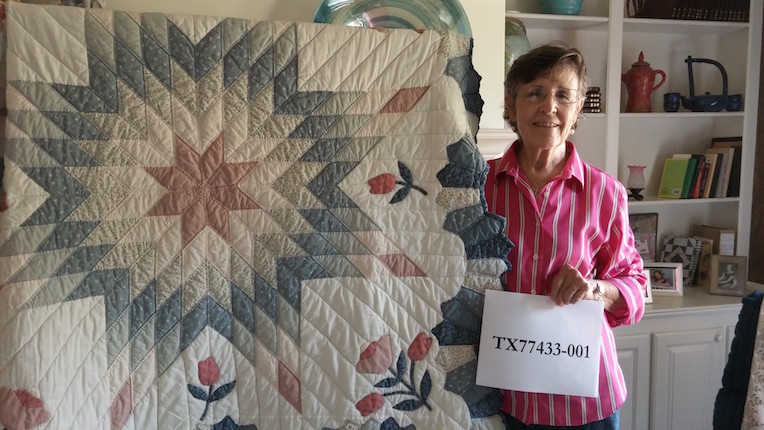
[addtoany] [space height=”10″] Cathey Spies (CS): My name is Cathey Spies (CS), today’s date is July 23rd, 2015, it’s 10:05 in the morning and I’m conducting an interview with Barbara Thieme for Quilters’ Save Our Stories project. We’re at Barbara’s lovely home in Cypress, Texas, and I’d like to thank Barbara for allowing us to come and interview her today as part Quilters’ Save Our Stories Project. Barbara Thieme (BT): You’re welcome. CS: So, first of all, let’s talk about the quilt you’re sharing with us today. BT: All right. CS: Tell me a little bit about it. I understand it was your first quilt. BT: Yes. I taught myself to sew and I was, I guess what you would call, a garment maker. I made all my clothes as a teenager and early marriage and it was a way of saving money. We had no money [both laugh.] but finally got tired of sewing clothes and found a picture in a magazine actually of a quilt and thought, ‘that looks pretty,’ and this was way before your fast speed cutting [laughter.], and of course I took the pattern and cut the pattern from a piece of cardboard and, you know, drew the lines and cut out each piece. I maybe did two at a time, I don’t know that I did one at a time, but it was the Six or Eight-Point Star. I have to count the points now, it’s been a while since I looked at it, but chose the colors, and it really was advertised in a woman’s magazine; not really advertised, it was shown as a table topper. So it’s not a large quilt and it had pointed edges, which I didn’t know how I was going to do but I figured I can follow directions, I sewed for years, and I loved the colors. And I got my fabric, started out, put it together but the point, the center, and as any quilter knows on a star that is the most critical area to get to lay flat. When you put all of these points together, or all the centers together after you’ve made your point, anyway, with a lot of extra manipulation I did get it to lay flat. Hand quilted the whole thing. At that time I did not know anything about machine quilting, but the edges–on each one of the edges I had to make a mitered point on the binding. Oh my Lord. Oh my goodness. It took a lot of effort. I finished it and I was proud of that quilt; hung over my fireplace for a long time. And recently, when I changed the décor in my living room I removed it and that was actually the first time I think it was gently washed. We never used the fireplace much, so I wasn’t afraid of the smoke or anything, but it was very dusty so it’s now lovingly held in my quilt chest [laughs.], and I should really put it out and display it but the colors, you know, they change, fabrics go in and out of vogue, and pinks and blues are just not used so much anymore, so anyway, that’s kind of the background. I don’t know that I can tell you too much more. That’s about it as far as the background of the quilt, of that quilt. I mean I’ve done many more. CS: Are there any other quilt makers in your family? BT: No. My mother did years ago, and I was actually going to ask my daughter, because she [BT’s mother.] didn’t label her quilts, but one year she gave each of her three children large bed-size quilts and each of the grandchildren, which were maybe seven or eight of them, lap quilts. And they were hand done. I think they were machine pieced, but they were hand quilted. But that’s the only things I know that she did. Well, I take it back, when I went through her stuff, in her cedar chest I found about twenty-plus, maybe thirty, and I didn’t even know the name of it at the time, but there were thirty squares of your—what is that thirties fabric; I can’t think of the name of it—and I looked at those and I thought, wow. And they were machine pieced, but it was actually called a Caesar’s Crown, I believe is the name of it. I was amazed when I saw that, and so I took those because at the time I was not a quilter that enjoyed scrappy quilts, mine had to be all [laughter.]—I thought—matched and purchased fabric from a quilt store or something. But I took those, divided them up and made two full bed-size quilts. I had two children. I made one for each of them, and I framed an extra one. There must have been twenty-five because I had one extra and I quilted it and framed it for my daughter. Other than that, it wasn’t something she spoke of. I never saw her quilting. But I guess my background—I love fabrics. Both of my parents worked—what is the mill; they don’t make fabric there anymore I don’t believe in New Braunfels–the Brentex? Maybe they still do. But at the time it was the Comal County Mill right by the river. My grandparents lived within walking distance of it and both of my parents worked there. My dad was actually a weaver. And he took us in there years after he moved to Houston and we went back. My uncles worked there, and he showed us what he used to do and they made at the time: the gingham check. All sizes. And he showed us how to run the weave and the warp and my mother was actually I guess now what they would call it is quality control. She flipped the sheets of the fabric. Other than the gingham check they made fabric for sheets and pillow cases and they would literally have ladies running, looking at the fabrics as it came across. I don’t know. I didn’t go in and see that part. And then they had a large fabric store there. Needless to say, I had a lot of gingham check clothes as a child [laughter.] but maybe it was just ingrained in my DNA that I loved fabric. And to this day I just love it. CS: I think it’s in there, yeah [both laugh.]. CS: I see that you do teach. Have you had a chance to teach your children how to quilt? BT: Well, my daughter has picked it up. She, at this point, is still too busy raising grandchildren and still working, but she knows how to sew. She’s not interested at this point in quilting. She does knitting and crochet. And she’s very good it. I have the one granddaughter who’s, right now, quite busy being a teenager, and I’m just working on binding a quilt that she actually pieced the strips. We were making a jelly roll. She didn’t buy it, though. She didn’t like the fabrics or the colors, so she went and purchased her own and literally cut 3-1/2” wide strips by hand and then sewed them together, but we never got the time. I offered to put it together for her because she’s now into cheerleading and going to mission camps and she has no time. So I’m trying, and she’s interested, but with the time aspect maybe I’ve planted the seed. CS: Do you nowadays do any quilting, other than maybe pieces, by machine, like the long arm and such? BT: I don’t do the long arm. Up until about two years ago when I entered a piece in our quilt show, the Tri-County Quilt Show, we’ve had two of them, we’re having our third one in February of 2016, but I’ve had two pieces of hand quilted, machine pieced. But this year I think I’ve about given up hand quilting because of my arthritis. [phone ringing in background.] Excuse me a minute if you don’t mind. [pause recording for phone.] I’m debating even to enter a quilt for this next one, but I really have to just go to machine quilting now. My arthritis is really [inaudible], and really that is sometimes bad. CS: Yeah, yeah. You are a member, as you’ve mentioned, a member of the Tri-County Guild. Are there any other groups that you’re involved with? BT: Well, our Stitch and Pray at church meets once a month on Wednesday, on the third Wednesday of the month and we do, I sort of call them, comfort quilts. They’re lap size quilts that we hand out for any hospital stay visit or in the home. And we also this past year started making about thirty-four to thirty inch square receiving blankets for the babies that are being baptized in our church. So, other than that, I don’t. I just do my thing here. Well, I do help out at the Tri-County Guild. There is what we call a charity bee up here at Cypress Crossing Church. I haven’t been there in a while, but they meet once a month. They bring the tops that are pieced that people maybe don’t want to quilt or don’t want to finish binding, and when we have our meetings they are bundled up from the meetings once a month and brought to the stage and anyone can come up and pick up a particular bundle and finish it. We all have different things we enjoy doing. Some of them like to just piece. They don’t want to quilt. Some of them don’t want to put it together in the quilting process. Some of them don’t want to bind it, so God has given us all different, you know, things that we can enjoy doing. Just recently I have two to return that I picked up and don’t mind finishing. I sit there in the evening and do my hand work or put the binding on by hand. Some people don’t even want to put the binding on by hand. We have techniques now that we can put it on with a machine. I mean, do both with a machine. But other than that, I just do my thing, I guess. I have taught several. There’s a lady at our church that has asked me and she has come to my home a couple of times. Now she’s babysitting this summer so she’ll be back in the fall, but other than our church group which last year Stitch and Pray offered, and we did, a Christmas quilt; a lap size. I mean they’re about 40 inches square, to those who wanted to learn to quilt and our Missions group graciously donated eight Janome machines, small machines that will do free motion and also has the walking foot. And so last year we had eight ladies that came and took about six weeks and taught them. We’re hoping to offer it again this fall. CS: Very nice. You use a design wall. Is that just to organize your thoughts? BT: It is a piece of cloth I have hanging in the room. I have the piece of flannel. Mine is quite large and I think it could be redesigned [laughter.] because when I make my large quilts they don’t all hang up very well. So, I have found it not as useful as just laying it on the floor sometimes, but I do have one. If that is one of your main questions, I do have one [laughter.]. CS: So you get an idea about a quilt, or you come across a pattern that you like in a magazine and you think to yourself what? This would look good in these colors, or that you have some fabric that would work here? How do you decide what kind of color scheme you want to do, or how do you want this to look, or does the quilt just take on a life of its own as you go? BT: No, people say that I’m creative, but it’s not as much as depending on people who really have the knowledge [both laugh.]. I do, if something catches my eye, yes, usually in a magazine or something that I have seen I will sometimes change the colors of the fabric and I do want to try a pattern. I’m sort of willing, ‘oh well, you know, that’s new. I haven’t done that. Let me see if I can do that’ effort, but I usually find a pattern that I like and go from there. But I kind of, most people do sort of self-teach themselves when they’re free motion quilting and I don’t do a really great job of it, but I’m learning. But the thing that I did, I found some of these whole cloth fabrics and it was a design of a city with roads and houses and a police station, hospital, a boatyard and all the things you might see. At the time my grandson was young and I thought, ‘oh, I can make him a quilt.’ I put it all together and I thought, ‘oh, I don’t do free motion very well.’ But I got the clear thread—monofilament—and just started following the roads and following the outlines of the buildings and the trees and it really worked out very well. And so I had a second one because had bought two of them. After I gave it to my grandson, he was very delighted at the time, he was into the Matchbox cars; perfectly fit the little road. Okay, so I had this other piece and thought well, how nice would that be to make another one and donate it? Some child would enjoy it. So I made a second one and on the back I made a little pocket with a Velcro and I took it over and was talking with my grandson about it and I said, ‘Do you like playing with your quilt?’ ‘Oh, yes ma’am.’ And I said, ‘You know, Grandma made a second one.’ ‘You did?’ And I maybe burst his bubble a little bit, and I said, ‘But you know what I thought would be nice? I thought I would give it to some little boy that would like it as much as you like your own.’ They go to church they’re into mission, and at the time of course, he was just five or six years old, but he was already going to Sunday School. And I said, ‘Don’t you think another little boy would enjoy it?’ ‘Oh, yes, Grandma.’ And I said, ‘Would you be willing to give one of your cars, or maybe two,’ because he had a lot of these little cars, ‘So that I could put some in this back pocket, so when I donate it they will already have something to play with?’ He was willing. He said yes. So I said, ‘Can we go look at your cars and you could pick out some, maybe that was your favorite or that you thought maybe you thought you had more of than you needed?’ He said okay and we went and sat down and we picked out some cars and he lovingly put them in the back pocket and Velcroed it closed. I thanked him and that was how I sort of how I started doing the free motion. I’ve grown a little bit, or a lot, I think, from there, but back to your question, I enjoy trying a new technique or a new pattern that maybe I haven’t tried before. I have sort of branched out and I do like scrappy quilts now, so we do tend to evolve and grow, I think. I hope. CS: What is the one thing you enjoy most about quilting? The actual [gestures encompassing space with hands.] quilting? BT: Gee. What I enjoy the most is actually working with the fabric. But also, as I’m quilting, especially when I’m sitting there at the machine, I am trying to envision the person I’m going to give it to. Because to me, when you work on something, I love any time type of item that is hand made. I love pottery. I don’t do pottery but because I know the effort that goes into any handwork, I lovingly look at the crocheted doilies that are sitting in a basket in an antique store that’s selling for fifty cents and I think someone spent hours on these doilies and no one appreciates them. I can’t do anything with them anymore, but anything that someone sits and spends hours, I mean if it’s any item that people spend their precious time on, and I think when I’m giving a quilt I’m giving it from my heart I think, and I don’t mean to be blasé about it, but I mean, I do think about that if it’s going to be donated to our church or if it’s going to be donated by the Tri-County to the DePelchen Home. We donate to the Boys and Girls Country, I believe. I think that’s a new one. We kind of keep growing. There’s a home over on K-Z [CS interjects: The Lutheran Home?]. Yes, and I think these are on the list. If not they have been thought of, but we can only give so much but we have quit a large group, I think we have over 300 in our guild, but they’re not all part of the charity group. But when you get a group of ladies together that are dedicated they can really put out some quilts. But that’s basically why. Why do I enjoy it? I love fabric, I love to go purchase it, that’s part of it. I love to cut it out. I just love fabric and it’s something I can do with the fabric that I purchase possibly. That would be the answer. I don’t know. It’s just kind of a tri-fold. CS: That’s a good answer. BT: It’s a lot of answers. CS: It’s a very good answer. Yeah. Yeah [nodding.]. Let’s talk a minute about design aspects and craftsmanship and that sort of thing. What do you think makes a good quilt? Have you looked at quilts and gone, ‘I like the colors, but, oh noooo.’ Or ‘That’s a lovely design, but those colors make me a little twitchy’. What do you think would make a successful quilt? Not any right or wrong answer. BT: For me? You’re talking about, for me? Because there are some quilts I look at and I think why would anyone spend the time making that? But for me, like you said, there’s maybe not one answer. It is just that like that table runner right there [points to table runner on display stand nearby.]. I wanted to learn how to do it. I have not gone beyond that. I would love to. It’s learning the new techniques and just enjoying what I’m doing. If I’m not enjoying it, I’ll just take it and fold it up and put away. So it brings me great joy and pleasure to do these things. Maybe because I know most of them are not going to sit very long, I’m going to give them away. I give 90% of them away to somebody, even if they don’t want them [both laugh.]. CS: Which brings me to another question. What do you think, because you’re so in tune with quiltmakers and you give yours away and they are given for charitable reasons, what part do you think this plays in American life; a quilt, in today’s life, as opposed to way back before electric blankets and central heat and stuff? People relied on quilts to be functional and keep them warm. BT: I realize that and I think sometimes that my quilts that I give might not be used. But it gives me pleasure in giving them and so I’m hoping that the people that receive them will use them and I stress please use them; please. They grow in the way they feel even. You can pick up a quilt that has been lovingly used and folded and it just gets softer and cuddly. Is that a word? I don’t know. I believe people like to use them, even as decorative pieces, to put them on the back of a chair or drape them over the edge of a bed. At least that’s what they’ve told me. My husband’s not comfortable using them on the bed. He says they’re heavier. He likes a lighter weight; just a little bit of a cover to keep out the chill or something. But we don’t sleep under them and I’ve often wondered why I’m making these things. But people seem to want to buy them. At our church they’re auctioned and there’s always people willing to bid on them. People have never turned them down that I know of. Maybe like I’ve said they’re being kind, but I believe too people appreciate the handwork that’s gone into them, the hours and the efforts and know that it’s coming from someone that enjoys that enjoys their craft. CS: I totally agree. Well, I would like to thank Barbara Thieme for allowing me to interview her today as part of the Quilters’ Save Our Stories project. Our interview concluded at 10:36 in the morning. And thank you again. BT: You’re more than welcome. It was really a joy. It didn’t hurt a bit [both…
by Emma Parker | Aug 24, 2016
Gail van Horsen (GvH): Okay Bernie, we’re going to go through some questions here. One of the first ones is ‘Do you make quilts?’ and– Bernadine Singer (BS): Obviously, yes I do— GvH: [laughs] yes you do. Do you ever make wearable art? BS: No, I make wearable clothes, but I don’t make wearable art. GvH: Okay, do you make most of your clothing, or— BS: No not anymore there was a time when I did sew for my girls. GvH: So did you learn to sew at a young age or? BS: I was about six or seven when my mother taught me how to sew on a treadle sewing machine. GvH: And you’ve done it your entire life, then? BS: Sewn? GvH: Yes. BS: Yes. But not with a treadle. GvH: No [laughs.] Okay. Do you sleep under a quilt at night? BS: Oh yes. One my mother made. GvH: Did you sleep under quilts when you were a child as well? BS: Oh yes. Um hmm. My mother didn’t hand quilt or even machine quilt, but she did machine piece and she made squares in her time. So we always had quilts. GvH: So do you consider yourself a self-taught quilter? BS: Probably. I have taken three classes but most of the time when where I lived there hasn’t been anyone to teach it so I taught myself. GvH: How far is Crown King away from a town or a community of any size? BS: Sixty some miles. GvH: Sixty miles? BS: Umm hmm. GvH: And how many years have you lived there? BS: Permanently, twenty five years but we built a cabin forty years ago and we’ve been going up there every weekend since. GvH: [laughs] That’s a good deal of time then. BS: Yes. GvH: So you said that you had a mother that made quilts when you were a child. Did her mother or did any of your grandmothers quilt? BS: My dad’s mother did quilt. I have, my daughter has it now, but she made two baby quilts, they probably were all hand done. GvH: So did they do it just occasionally like when a baby was born or did they quilt continually throughout— BS: Oh, I think just occasionally. GvH: When you started quilting did you start in occasionally too just as gifts or things or did you start in and go hog wild? BS: When I started quilting, I worked at a school and an art teacher came into the cafeteria and she was hanging up quilts in the back as a backdrop for a play that was happening. And I went up and admired her quilts and I said, ‘Now when I retire, I’m going to learn how to quilt.’ And she said ‘Don’t wait until you retire. If you really like to quilt, you’ll find the time to quilt while you’re working.’ So that was a year before I retired and I signed up for a class at Quilted Apple and then I took – we made one block. Then I signed up for the second class and we made six blocks. And then I started up with the advanced class with Lorene Sinema and I haven’t stopped since. GvH: So those were the three lessons you took. BS: Yes, at the Quilted Apple– GvH: Wow. It’s funny when you say that Quilted Apple and Lorene Sinema because so many people I talk to here in Arizona learned to quilt from her. I mean she has quite a story in this state, it’s amazing. BS: Yes, uh huh. She could motivate you into – like that advanced class we made like six blocks every week we had to finish and bring back in. And I don’t seem to do that with any of my girls that I’ve been teaching [both laugh.] GvH: Now were those applique classes or just a variety? BS: They were pieced or applique. GvH: Okay. BS: But all by hand. GvH: Um hmm. So it was a sampler that you were making? BS: Yes, uh huh, yes. GvH: And about what year was that, do you think? BS: What would twenty-six years ago be? GvH: ’75-ish? ‘74. [laughs.] BS: Yes, ’74. GvH: Okay, 1974. So you were pretty much in there in the new quilt revival. That was right at that time frame. Yeah. Do you belong to a sewing group? BS: We have a small group in Crown King. There’s only about six of us right now. They come and go. But we still meet once a week. Now it’s on Monday nights. We mostly do our own thing unless they have something that they want. Sometimes we’ve done a Christmas party or something. GvH: That’s a good idea. BS: Usually we do our own thing. GvH: And so do you bring your sewing machines or do you do hand work? BS: Mostly we do hand work, but we do have a machine there. We meet at the school and we do have a machine there at the school. GvH: Wonderful BS: There are several girls who don’t have machines at home. GvH: Do you have a collection of quilts? BS: I have quite a few. GvH: Your own quilts? BS: My own. GvH: And then you said you had some from your mother. BS: I have a couple that I bought at garage sales or somewhere. Antique shops. Mostly, I just make my own. GvH: Are your quilts that you’ve collected, are they mostly from the 20th century or are they into the 1800’s? BS: 20th. GvH: 20th century. BS: I think so. GvH: Do you also collect sewing memorabilia? BS: Yes, I have a few things. Like darning eggs, I have about half a dozen of those. [laughs.] GvH: [laughs.] That’s funny. I do too. Have you ever worked in a quilt shop? BS: No. I’d love to. GvH: Now this next question: “Do you teach quilting?” I know you do, so why don’t you tell us a little bit about your quilting experience as teaching. BS: As teaching? Well, when I moved to Crown King 25 years ago nobody taught quilting there and there were a few ladies who were interested in doing some quilting so I started the classes and mostly we did hand piecing and I just started with the basic Hole in the Barn Door. They learned how to do it and then they worked on their own projects after that. But when new girls come in then they mostly just do a square to begin with until they decide what they want to do. Now I have a new student who doesn’t want to do that kind of thing but she wants to do applique. So I got her started, she’s making a Christmas tablecloth and she’s learning how to applique. GvH: So you just kind of have an ongoing class— BS: Right— GvH: –for the last twenty-five years. What! That’s really neat. Have you ever won any awards with your quilting? BS: No, [pause] because I quilt for my own enjoyment. I don’t really make them for show or anything. I just enjoy especially the 30’s fabrics and everything of that era. GvH: Yes, this quilt you’ve brought in, this Nine Patch with the flowers from the ‘30, in the ‘30’s fabric is beautiful. BS: I’m sitting here looking, just look at those two [inaudible] yellow and green blocks, I’ve never noticed that before. They’re both the same. GvH: No they’re not. BS: No, the green isn’t— GvH: –the designs are different, yeah. BS: but they’re still yellow [laughs.] All these years I’ve had this, well, several years I guess, I’ve never noticed it before. GvH: That’s because it’s upside down. See, those would have been at the bottom. BS: Well it hangs over the railing at home so I maybe don’t see that. [laughs.] GvH: And do you have a studio or a sewing room in your home? BS: I have a sewing room, upstairs. But I do like to sew downstairs too on the kitchen table or the dining room table. GvH: Then you’re kind of in the center of things. BS: Yes, that’s my biggest thing. You know, I’m upstairs and then I don’t hear what’s going on downstairs or whatever so I move my stuff downstairs, but all my fabrics or most of them are upstairs. GvH: Now does this quilt you’ve brought in today have any special meaning for you? BS: Oh yes. Certainly. Can I tell my story? GvH: Yup. BS: Okay. About 3 years ago the sewing group had a booth at our Apple Fest, and I took a quilt down there to hang in the back of the booth just for color. And during the day a lady that I had just met, Teresa, she came down and she had a booth a little ways away and she admired the quilt and she asked if it was for sale. And I said, ‘No, I don’t ever sell any of my quilts.” And later on in the afternoon she came back down again and she said, ‘If you ever sell that quilt, I want first chance at it.’ So I had just met her and her son who was 18 years old at the time. And he was in a wheelchair. He can’t speak. He can only blink his eyes and raise one arm. But he’s with her all the time, no matter where she goes she has him in his wheelchair and she’s so good with him. And I just decided if anybody deserved a quilt it would be Teresa. So at the end of the day, I folded it up and I took it down and gave it to her. And she was just thrilled with the quilt. So then the next year, two years ago, we had the Lane Fire in Crown King. The night before I had put all my quilts in tubs. And my husband and some friends took them all down that morning before we had to evacuate and they put them in this mine tunnel that we have on our property. And then we had to evacuate and by the grace of God or somebody we definitely saved our house. Everything was covered with slurry but the house was still there twelve days later when they let us back in. And a reporter from the Prescott paper called and asked if she could come out and do a story on us because the Forest Service and the Fire Department had saved our cabin. So when I told her the story about our quilts and the mine shaft, mine tunnel, so she said, ‘Well, grab a quilt and come down and I’ll take a picture of you in the tunnel.’ So I grabbed this one because it’s fairly small and won’t drag on the ground. So she took my picture holding this quilt up. And it was in the Prescott paper and the Phoenix paper and several papers all around. So then a couple of weeks later, they were going to have a benefit for the Fire Department and somebody suggested that we think of something for a money raiser for the Fire Department. And I thought well everybody had seen this quilt in the newspapers. And I thought maybe that would draw some interest. So I donated it to the Fire Department to sell chances on. And it was probably at the store maybe three to four weeks at the most. And in those four weeks it brought in almost two thousand dollars in raffle tickets. GvH: Wow. BS: –from chances. But I said a good share of it came from our family because they were so glad that our house hadn’t burned so that we didn’t have to move in with them. GvH: [laughs.] BS: And anyway, then they sold the chances and then in September they had the benefit for the Fire Department and they had the banquet first and then they drew the name for the winner for the quilt. And Teresa who I had given the quilt to the year before, she won the quilt. So she called me up to the stage and she presented me with my quilt again. GvH: How neat. BS: Wasn’t that nice? GvH: Yes. BS: She told me she said she just prayed all morning that she could win that quilt so she could give it back to me [laughs.] GvH: What a wonderful story. BS: Everybody cheered and there was hardly a dry eye among the volunteers. But you know, well it almost seemed like it was meant to be, you know that I– GvH: Yes, did you put other things of value in the mine shaft when a fire comes? BS: Well all my quilts or projects I’m working on. And fabric I’ve gotten for a new project or something like that. But other than that, I don’t. GvH: Well—- BS: Well, pictures. GvH: That’s a good idea. BS: We have two tubs for family pictures we put ‘em into. I guess I don’t have anything else that can’t be replaced. [laughs.] GvH: That’s true. BS: But I did have. I think I decided this last time to put in all my hand made quilts. GvH: Oh wow. So you do have quite a few quilts. BS: Yes I do. GvH: So do you think someone looking at this quilt would get any idea of your personality? BS: They’d probably know that I was born in the Thirties. [both laugh.] I like Thirties’ fabric. GvH: It’s so bright and cheery. [6 sec. pause.] How many hours a week do you think you quilt? BS: [7 sec. pause] I should say at least twenty hours. Some weeks vary. Some years vary, I should say too, because when we have a good baseball team I always watch the ballgames and then I quilt the whole time. This year I haven’t been quilting as much. [both laugh.] GvH: So you learned to quilt from The Quilted Apples and as a child did you ever make a quilt at all? BS: No, I never did. I did make a quilt when my first child was born. I did make a Nine Patch that Spring, I don’t know whatever happened to that one. GvH: And did you tie that? BS: No–Yes, I did. Yes, I tied that. And then my first quilt I quilted was a Grandmother’s Flower Garden that I bought already pieced, a full size quilt and it was at a Goodwill antique store. Paid $8.50 for it. And it was all done by hand. GvH: Oh my gosh. Was it a 1930’s top? BS: Yes. Yes. GvH: Grandmother’s top. And did you know how to hand quilt? BS: No, but you just did it. GvH: You just did it. BS: I just did it, but you can see when I started I used double thread, and my knots were on the back when I started. I didn’t have any idea how to quilt. My mother never hand quilted. GvH: I think that’s fun when people just start. You think, ‘Well, I can do that!’ BS: I always had an interest in it. Because I had an interest in sewing. I always sewed. GvH: What is your first quilt memory, do you think? BS: Probably that Grandmother’s Flower Garden. Because that took me all summer to quilt. And that’s the last time I have quilted with a frame, a big frame. GvH: Oh, okay. You actually put it on a frame. BS: Uh huh. In my living room. And it took all summer. GvH: Do you still have that frame? BS: Yes, I do have it. I can’t quilt. I’m so short waisted that by the time I got done with that quilt my ribs hurt so bad, it just, there’s no space in here and it’s just leaning over. I don’t know. The angle was not right. The height, rather. Or whether it was too low. But it’s not comfortable. Now I quilt with a hoop on my lap. GvH: Okay. BS: I do have a round hoop on a stand sometimes I quilted on but if it’s straight lines that’s fine but if I have to move it around all the time like with echo quilting, it’s too hard to keep stationary. GvH: Oh, right, yes. What do you find pleasing about quilt making? BS: I like quilt making because it’s so relaxing. And it’s something I can do by myself. I don’t depend on somebody else to entertain me. I can, you know, spend hours and I never get bored quilting. I can spend hours working on it all by myself. GvH: Do you like making the top or the quilting part the best, do you think? BS: Probably making the top. GvH: Do you have top-tops already made up that are in a line to be quilted? BS: Oh yes, [laughs.] GvH: Oh okay. You’re normal. [BS laughs.] BS: Some lady asked me one time in a quilt shop in Minnesota, she was doing machine quilting, she was sitting at a machine doing quilting. And she said, ‘What are you working on now?’ And I said, well, ‘something or other I had at home and then I said, the one in the car that I’m working on.’ And she looked and said, ‘Oh yes. You’re a quilter.’ [laughs.] GvH: Do you have any favorite techniques? BS: I like applique. I enjoy applique. But I don’t enjoy needleturn applique. GvH: Okay, how do you do applique? BS: I use freezer paper underneath and turn the edges under and then do stitching. GvH: Oh, okay. Do you think that the advances in quilting tools have helped your quilting? BS: Oh yes, yes. My sister had a fabric shop and when she went out of business making wedding clothes she sold me a mat and a cutter and she said, ‘Oh you’ll really like it.’ I probably had that three years and I hadn’t used it. And she kept saying, ‘Why don’t you try that mat?’ I said, ‘Well, I don’t know, my scissors work fine.’ Until I started with the mat and then I cut everything with it. [both laugh.] GvH: It speeds things right up. BS: Oh it sure does. And so much better, straighter, it’s easier. And the rulers that they have now too are so much nicer. You can go to 6 o’clock and square your block up where you don’t have to struggle with a big ruler and it’s so much nicer. [chime or clock chime.] GvH: There’s an interesting question. Tell me how you balance your time. BS: Well, I don’t usually quilt during the day. Unless it’s maybe a rainy day and I don’t feel guilty sitting here piecing all day or quilting all day. But otherwise, I usually do most of my quilting in the evening. GvH: Now, what should you be doing during the day? I mean, you’re retired and – BS: I was always cooking and cleaning and washing and all that! [laughs.] GvH: Do you design your own quilt patterns or do you usually use a commercial pattern? BS: I use a commercial pattern because I like the old patterns, and I don’t really have the imagination to do those. I can appreciate that in other people but I don’t possess that ability. GvH: You seem to have a wonderful color sense. Is that– BS: It’s just what I like. GvH: Okay. Very pleasing, I think. And do you have a design wall in your quilt room? BS: Yes, I have a– not too huge but sufficient. GvH: And do you use it a lot or do you– BS: Well, I’m making a lavender sampler right now and I’ve got probably 8 blocks up on it for about a year or so. GvH: Oh, I know other people who do that. And leave them up because they just can’t— BS: When I finish them I put them up there and so I get them out of the way. And that’s a project that I can take in the car to work on. GvH: Is it applique? The sampler? BS: Some of them are appliqued and some of them are pieced. GvH: Now do you normally make quilts for other people or for yourself? BS: Well, I make them for my sisters. Three sisters, each have a half a dozen, so I make four of each for wall hangings or that sort of thing. GvH: Wow. You normally make four of the same, same fabric and everything or? BS: Yes. GvH: My gosh! BS: Yes. Now those girls’ feedsack dresses, the little girls’ dresses–some of those are different, but most of the time they’re pretty much the same. GvH: Wow. I’ve never done that. So that doesn’t get old or anything? BS: No, well they’re not a full size quilt. Some of them are just one square or one block. I made a couple of Christmas blocks [inaudible.] GvH: Do you usually make quilts every year for Christmas? BS: I have for a while, but I didn’t last year. I guess I did make one. But you use them for such a short time and I’ve got so many of them out that I can’t use any more. GvH: What time of the year would you start if you wanted one done for Christmas do you think? BS: Oh, probably about October. GvH: Wow. [6 sec. pause.] What do you think makes a great quilt? BS: Well, I think it depends on who’s making it and what they like and if they’re making it for somebody else or if they’re making it for their own use. I think if it turns out the way that they want it I think that’s a great quilt. GvH: That’s a good answer. I agree with you. Do you, I don’t think you do art quilts, but do you enjoy looking at art quilts? BS: Oh yes I do. Yes I do. A friend, one of the quilters, went to the MN quilt show a couple of weeks ago and she came back with a bunch of pictures that she’d taken. It was one of the girls who does art quilts who was looking at this little album, and I was looking at it. It just struck me funny because she would page through all the ones like I like and then she got to the art quilts and she was just so intent looking at those— GvH: [laughs] –every little detail— BS: yeah, right, it’s just the difference in people and the difference between them. GvH: What makes a quilt appropriate for a museum do you think or a special collection? BS: Well, I think a Baltimore Album Quilt is just fabulous. And you know the ones that Laurene Sinema did, they were just so special. GvH: She was known for those. BS: Umm hmm. GvH: What do you think makes a great quilt maker? BS: Someone who enjoys what they’re doing. GvH: Good. BS: And if you don’t enjoy it, I don’t think you’ll ever be a good quilter. GvH: That’s probably true. I know you’re a hand quilter. Do you have an opinion about long-arm quilting or machine quilting or— BS: No, I don’t. This girl who I said does the pictures and things, she showed me the other night, Friday night she brought a quilt over that she was machine quilting, and it was just beautiful and I think it’s wonderful. And she’s making these for charity and I think there’s nothing better than the machine-done especially when they’re given to children who are just— GvH: –going to use them— BS: Use them, yes, I just think it’s wonderful and her quilting is beautiful. I just enjoy the hand quilting part of it. GvH: [5 sec. pause.] Why is quilt making important to your life? BS: Because I spend so much time at it and enjoy every minute of it. [laughs.] And it’s a good pastime living where I do. GvH: True. BS: There is no movie theater to go to. There’s a library – I do that, too, all the time, but other than that there really isn’t that much. It’s a wonderful pastime. GvH: [6 sec. pause.] Do you think that quilts have a special place in women’s history in America? BS: Well, I’ve enjoyed reading all about the different quilts from the Civil War and certainly there’s a place in history there. And I enjoyed looking at [inaudible] some of the first presidents and quilts that they had, their families made beautiful work. GvH: How do you think quilts can be preserved for the future? BS: Well, probably in museums under the right conditions they can be, but if they’re going to be used in the home they’re subject to light and dust and things like that. But they’ll soon be destroyed especially if they’re used. GvH: Yeah, do you use your quilts? BS: Some of them. Right now I have one on my bed that I’m using. I’m hesitant about putting them on the guest bed because [inaudible] [laughs] I shouldn’t be that way– GvH: [laughs.] I’ve heard that before. [laughs.] BS: Most people don’t know what goes into a quilt. GvH: Oh isn’t that the truth. BS: Especially the grandkids. [laughs.] GvH: What do you think’s happened to the quilts that you’ve made and given to people? BS: Well, one that I brought down to Tucson I made for the graduation of my granddaughter, she’s never used it. It’s in a box up in her closet. Maybe someday she’ll use it when she has a daughter, but– GvH: Do you think she’s saving it first because she’s— BS: –probably— GvH: –afraid she’s going to hurt it? BS: I think so. I think so. Yes. GvH: Do you include washing instructions and things when you give quilts to people? BS: I think that’s a wonderful idea. It really is. GvH: What do you think is the biggest challenge confronting quilt makers today? BS: Finding enough time— GvH: Oh! BS: –to quilt. Now that I’m retired that’s not a problem but it certainly would if I had a job. You’re not feeling guilty sitting there when you should be doing something else. [laughs.] GvH: I know, women have the tendency to feel guilty when they’re enjoying themselves. [laughs.] BS: Right, right. [laughs.] GvH: Yeah. Okay, you were in the second class of quilters inducted into the Arizona Quilters Hall of Fame last year. Was that a surprising experience to you? BS: Oh yes. [laughs.] Yes, it certainly was. And a very humbling experience. GvH: It was a wonderful group of gals last year. Some beautiful quilts. BS: Oh yes. This doesn’t really pertain to this, but do you know who made the one quilt that was hanging in the back by the podium? The one that was appliqued. It was just fabulous. I just– GvH: –We’ll find out. BS: –I could have stood there all day and looked at it. It was all little appliquéd pieces and just wonderful. GvH: I don’t remember it, even, but— BS: I hope it’s there. GvH: –I couldn’t see very well last year. BS: Oh. [laughs.] GvH: Now, I’ve had my eyes fixed. [both laugh.] BS: It was wonderful, just wonderful. GvH: I think you were the person inducted last year who had probably done the most teaching because it was said that you taught everyone in Crown King who wanted to learn how to quilt. That’s wonderful. BS: [laughs.] Well, we only have about 105 or 110 residents so that isn’t too many. GvH: But you’ve kept this class going for 25 years. BS: Yes, that’s right. GvH: I think that’s remarkable. Yeah. Let’s see. Is there anything you can think of that you feel like you should add? BS: No, but I should say that being in the class with some of these other people it’s a very humbling experience. It’s just never been my experience to win any awards. GvH: Since you don’t enter your quilts in anything. BS: No. [laughs.] GvH: No, so, who in your community nominated you? BS: The girl who does the, the— GvH: Art quilts? BS: –art quilts, yes. GvH: Oh, neat. BS: And she’s only there in the summer. Her twin brother owned the cabin and he died and he left the cabin to her so now she’s come back. This is her third summer. And she quilts a lot during the summer. And then she goes to West Virginia, or North Carolina, that’s it. GvH: So she’s not one of the ones that you taught to quilt. BS: No, uh uh, no, but she had been to the quilt show, the quilt show, not the craft, the other one that they had. GvH: At the t—, I don’t– BS: Tempe? GvH: Yes, last— BS: The year before, whenever that was, as far as– GvH: The University of Arizona west or east or someplace. BS: Yes, she was there and she saw the booth. GvH: ASU, that’s where it was. BS: And she got the information. GvH: Oh great, so she got it from the booth. Good, good. BS: Yes. GvH: We always wonder if anybody remembers that. [laughs.] BS: Right, she got it from the booth. Then there was another girl that I was with that day, so she approached her. So those two wrote letters. And then there was two more that had gone to the quilt chair that [inaudible.] GvH: Wonderful. Okay. Oh, I forgot to ask you about your husband. Now, does he enjoy your quilting? BS: Oh, I think he does. Especially because like at night he’ll sit and watch TV and I’ll sit with him and I’ll do my work there. It isn’t like I’m upstairs and he’s downstairs. GvH: True. BS: So he doesn’t mind, no. GvH: Has he ever asked you to make a quilt? BS: Yes he has. He thinks I should make a Crown King one and he’ll design the blocks for me. And then I’ll applique like a miner or a pick and shovel with a gold pan or something like that, you know. Maybe someday I will but he keeps saying he will but he hasn’t yet. [laughs.] GvH: Oh that’s a neat idea. That’s a wonderful idea. BS: [laughs.] I think so. Um hm. GvH: So, he knows how to do that kind of thing? BS: No, he just climbs into his chair. GvH: Okay, sure. Well that’s a great idea. BS: So I have to design the blocks into a quilt [inaudible.] GvH: You can do that. I have confidence in you. [laughs] I know you could. Yeah, that’s a great idea. BS: That would be a keepsake. GvH: Yeah, yes. Need to be kept. Do you actually have a fire hall in Crown King? BS: Yes. GvH: Oh yeah, that would be wonderful. BS: The store has a glass showcase. GvH: Have him start designing these blocks, you know, one a month or something. You can do them as he designs them. BS: Yes. GvH: Yeah, that would be fun. I’d love to see that. BS: I’ll check my fabric. GvH: No you’d have to go shopping. BS: Yeah, right. GvH: Well, thank you Bernadine. BS: Well this will…