by Emma Parker | Sep 5, 2016
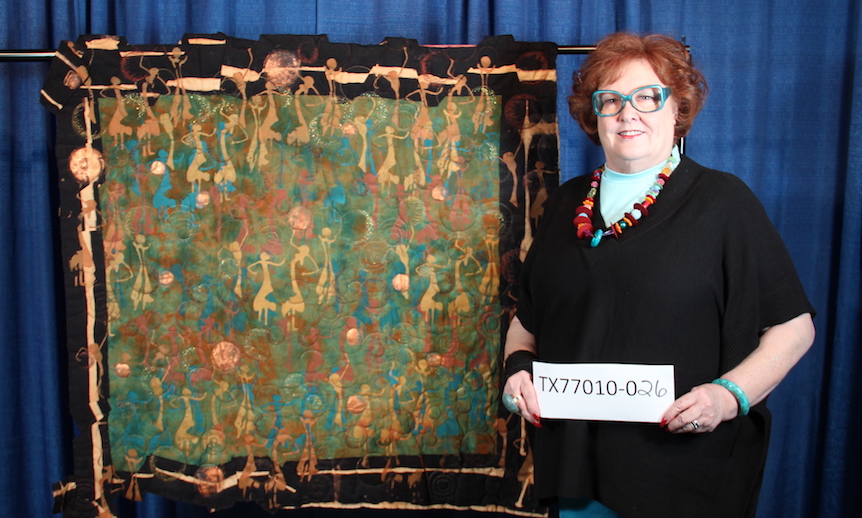
Helen Kamphuis (HK): This is Helen Kamphuis. Today’s date is the fourth of November and it is at twenty past nine and I’m conducting an interview with Beth Kennedy for the Quilters’ S.O.S. Save Our Stories a project of the Alliance for American Quilts. Beth and I are at the International Quilt Festival in Houston, Texas. Beth, will you tell me about your quilt that your brought today? Beth Kennedy (BK): Yes, this quilt is one of a series of four Spirit Dancer quilts; this is Earth, the other three are Air, Fire and Water. I had just finished a long series of quilts called Matriarchal Rituals which celebrated the contributions women made to their cultures and I had used commercial fabrics up to that point. This is the first series that I did after I started dyeing my own fabric. I had dyed four pieces of cotton and I wanted to use them together. I was looking through some publications and saw this cave art of four dancing women who were thought to be dancing a dance of joy, so I thought that would make a wonderful compliment. The colors of the four pieces of cloth suggested earth, air, fire and water, so I embellished each quilt with a symbol that was befitting its element. The Earth has the spheres, the Fire has flames, it’s red, and then Air and Water have symbolism that suggest air and water. This one, is dyed, discharged and over-dyed, then silk screened in several colors with the four dancing women. The border is a piece of black cotton fabric that has been discharged and pleated and attached. HK: What do you mean by discharged? BK: Discharging is removing the color and since I use cottons and other natural cellulose fibers for my hand dyed quilts, I can use safer methods for removing color. Some of them chemicals are pretty toxic but the ones for natural celullose fibers aren’t as bad. HK: Which techniques have you combined in the quilt? BK: In these quilts, the embellishment is made at the same time that it’s quilted so it’s quilted and machine embroidered at the same time with the circles and the spirals. Spirals are a goddess symbol and that’s why I used them in this series but the machine embroidery uses different threads and I also love using foil. Foil is an iron heat technique that transfers a metallic color to the surface. I used various free motion machine techniques to enhance the circles that represent the earth. HK: What has inspired you to use this theme? BK: I’m really interested in depicting women and I’m really interested in promoting women in art and as artists, so when I found these images of the four dancing women, I thought it was beautiful. I was looking for a place to use them and the elements, earth, air, fire and water, are what we need to exist but the joy of friendships is what we need to survive. I thought they fit together well. HK: I agree with you. Why did you choose to bring this quilt with you to the interview? BK: In my previous work I had used commercial fabrics. When the last quilt in the previous series was finished, I was pretty despondent.. That series consisted of eight quilts which I called Matriarchal Rituals. I really loved that series, making it and researching it, it was a wonderful time in my life. I knew it was coming to an end and I was really unhappy because I didn’t know what I was going to do next. Then I took a class with Jane Dunnewold in San Antonio [Texas.] in hand dyeing and I knew I had discovered what I was going to do next. I continued to pursue that and this is the first quilt in the first series of the new era of using my own cloth so that’s why I picked this one. HK: How many series do you have, if you look back on your life? BK: I have several. I’ve done several quilts too, Our Lady of Guadalupe in Mexico, she’s the patron saint of Mexico and the goddess of the Americas, she’s popular all the way from South America up to Canada. Being from Texas, I love the colors and the passion of Mexico, I just think it’s a wonderful culture. Our Lady of Guadalupe, before she was incorporated by the Catholic Church, was the Aztec Corn Goddess, Tonantzin, who is the Mother Earth goddess. In my research I found that whatever culture came in to influence another culture, like Christianity or Buddhism or whatever, the indigenous people were willing to give up all of their idols except for the Earth Mother and so if they were going to convert the indigenous people, they had to incorporate her into their symbolism. Our Lady of Guadalupe was Tonantzin, so for me she’s Tonantzin, and I just I’ve made several quilts of her because I just love it. I also have a series on shards of ceremonial robes, that I call Ritual Cloth. There are three quilts in that series and I have other series. I have a shrine series that’s small quilts and a couple of others but my big ones are the Matriarchal Rituals and then the ones with the dyed cloth. HK: Do you apply research with your quiltmaking? BK: I do. One of the things I learned when I started making art quilts, I learned from Nancy Crow. She is a wonderful critiquer and when she looked at my work, which at that time was not in a series at all, she pointed out similarities throughout the work and she said, “You need to pursue that,” and she also told me to look at ancient pieces of art, all kinds, and “look at how embellishment was used,” (because I do use a lot of embellishments), “and incorporate it as an integral part of the piece, rather than as an add on.” She gave me some new things to think about in pursuing quilting and she also said that, “Serious quiltmakers work in a series, so that way they can improve their techniques, they can investigate different ones.” I began to realize that my academic degrees in linguistics reflected my interest in the way people communicate, I’ve always been interested in it. I also noticed that I used writing in a lot of my quilts, or some other symbolism of communication. So I decided to pursue that as well as different methods of embellishment, another love of mine. HK: When did you become a quiltmaker? BK: I lost my job when I was, let’s see it was 1978, where I had worked for fifteen years as an evaluation specialist for an educational organization and we lost our funding and so I lost my job. I had a friend who wanted to open a natural fiber fabric store. I had made my own clothes since I was in junior high and I love to sew, so we decided to open a natural fiber fabric store. One of the obvious things to do is to offer quilt lessons in a shop that specialized in natural fibers and there was a quilter in Austin [Texas.], Connie Hufnagel who was accepted throughout Austin [Texas.] as the primo quilter. She had a wonderful sense of color, she drafted her own designs. They were traditional designs but they were her originals, and she was an excellent teacher. I hired her and started taking the classes, which might have been a mistake because you get hooked so fast. Two years later, we sold the store but then I continued to make quilts and started entering them and started teaching myself. It was a fun time. HK: Do you still teach? BK: I do. HK: Yup. BK: I’ve kind of retired from traveling but I still teach in Austin [Texas.] and I do love to share. HK: What makes a great quilt according to you? BK: For me, a great quilt evokes passion in the viewer, it doesn’t have to be the same passion as the maker, but it evokes some kind of strong feelings in the viewer. I think that’s really important. Of course I think overall impact is important and color balance and all the art principles are important, but I think it shouldn’t just be a color study. HK: Right. What do you think about the importance of quilts for American life, world life? BK: Well, I read a wonderful article several years ago about cloth in our lives; you’re born and wrapped in cloth, and when you die you’re wrapped in cloth and you are covered with cloth throughout your life and so cloth and quilting are just a natural part of life and it’s associated as a women’s art. I think that’s really important to emphasize the kinds of things that women do to improve their culture. HK: Are you also busy with the appreciation of women in society and quiltmaking? BK: Yeah. When I was employed, the Equal Employment Opportunity Commission was begun and I sued my employer for sex discrimination. HK: Okay. BK: I won [laughs.] but it was during the time of women’s liberation and the prominent women in the movement who presented women as more than just a supplement. I was very interested in that because I worked for a living, I had a husband and a child and so it wasn’t that easy. I just felt like women deserved the recognition that as people, not just as helpmates; that’s always been important for me. HK: You’ve kind of incorporated these feuds in your quiltmaking. BK: I do and there’s a heavy emphasis on women in my work. It makes me happy [laughs.] HK: [laughs.] Whose works are you drawn to and why? BK: I’ve always been an embellisher. It’s interesting how you discover things about yourself. When I first got into quilting and started looking at other people’s quilts, I loved Terrie Mangat’s work. I thought Terrie pushed the envelope with her embellishment. I also liked Jane Burch Cochran’s work; I thought it was real fresh and different, expressive. Then I started looking into other nationally known quiltmakers and started going to Ohio for the Quilt Surface Design Symposium that Nancy Crow and Linda Fowler put on for several years and really enjoyed that because up to that time, all of the summer seminars were multi, they covered multiple artistic endeavors like basketry and clay and painting and journaling. But the Quilt Surface Design Symposium was the first one that was exclusive to art quilters. It was wonderful to be able to get together with like-minded people and not have to defend yourself from the get-go because at that time, non-traditional quilts were questioned. It was very comfortable and yet challenging because they brought in wonderful artists, so you could meet them for one thing and look at their work and study with them to learn techniques; it was lovely. I met a lot of wonderful friends there. One of the people that I’ve, that has become a very good friend is Libby Lehman. Her mother, Catherine Anthony owned a quilt store here in Houston [Texas.]. A long time ago when there weren’t that many, we would bring a caravan of cars to come shop in Houston [Texas.] and we would always call to let them know so they could put on extra people and they did and they earned it [laughs.] Libby was Catherine’s daughter and she and I have very similar backgrounds in that we both have boys that are the same age, who have the same affinity for work [laughs.] so we shared lots of stories and her work is wonderful. HK: How do you think quilts can be preserved for the future? BK: How? HK: Mhm. BK: Well I think what Carrie’s doing is a really good start. She has done so much for the whole aspect of preserving all kinds of quilts. She’s really put her money where her mouth is and with starting the museum, the Save Our Stories and the information for her first book, and when she did the, I can’t remember what they were called, when they went into little towns and did essentially Save Our Stories interviews of people and their quilts; that was just marvelous. I think it’s absolutely necessary as a part of our history to preserve the art of everyday people and particularly women. I think it is important. HK: How do you balance your time? BK: I’m retired now, but I did have an issue with that and what I would tell my students that really worked for me is I had a huge calendar with those dry erase markers, and I color-coded the information; my son and husband got green, anything green on the calendar was for them, and then I got all the other colors and for everyday things, that was black, for my teaching schedule it was blue and then red was studio time. I would mark out time for studio and then stick to it, and that’s the only way I could find time to devote and I’m really glad I did because it goes away if you don’t make time for it. That’s how I balance my time. I quit vacuuming [laughs.] I do love to cook but when I first started designing on the wall, I didn’t have a design wall and so I put a big flannel sheet over the closet in our family room, where the vacuum cleaner was kept and so while I was designing a quilt, which could take months, we didn’t vacuum [laughs.] that saved two things. My husband is a very good sport and a very good vacuumer. HK: [laughs.] Has it become easier to balance your time now that you’re retired? BK: It does, oh yeah because now I can do whatever I want whenever I want. I do have commitments but yes, it’s given me a lot more time to. Plus, I have two grand boys now and it’s a lot of fun making quilts for them and spending time with them, but it’s not anything like it used to be with, you know I don’t have to raise them [laughs.] I just get them for a while. HK: What do you think about the issue between machine quilting versus hand quilting? BK: When we first had the store, our teacher was a hand quilter but we did introduce machine quilting and of course it was blasphemous with a lot of people; they weren’t quilts to some people who only thought about hand quilting as valid. Things like that don’t bother me because I figure if somebody’s going to laugh at you, or talk about you, then you might as well give them something to laugh at or talk about. If you want to dress funny, then go ahead. If you want to machine quilt, then go ahead. Eventually it was accepted and then low and behold, one year, here at festival, a quilt got Best of Show that was machine quilted. Same thing happened in Paducah [Kentucky] and so after that, it became a little bit more acceptable. You know now there’s recently been a big controversy about whether or not painted quilts are quilts and people have fussed and there’s been a controversy about the computer designed images that the artist designs and then puts in the computer but the computer executes the work. I think there’s always going to be things like that because things are going to change. You know, we consider crazy quilts traditional, but that was a big radical thing to do back when they were first done and so this type of thing will become traditional and something really new and different will come along, and I think it’s fantastic. HK: When you were asked to be interviewed, which message did you want to get across? BK: I think we live in a terrible time and the more we learn about it, the more we learn that it’s always been like this. There’s always been unrest politically, there’s always been people who have used the system for their own benefit and not the benefit of others, and it’s very distressing. I think to counter that, in order to have a healthy society and raise healthy children that are going to make a contribution when they grow up, it’s essential to do what you love to do and to live by example as well as by teaching. 99% of us are not going to get rich, so you might as well do what you love and make a living from that and I was able to do that, and was grateful every time I realized what I had chosen and why and we’ve always managed to eat and I’ve always managed to be able to buy fabric. As long as we can eat and have shelter [laughs.] and Beth can buy fabric, then we’re happy. HK: What aspect of quilting do you not enjoy? BK: You know, there aren’t any. A lot of people don’t like to bind, they just moan and groan about binding, well one thing you can do is not bind your quilts. This particular one has a raw edge. I don’t mind binding because I think it’s the final stage of a work so it’s when you finish it and when you say goodbye and you send it off and it’s just, it’s a little ceremony. I don’t find any part of quiltmaking arduous at all. Basting maybe [laughs.] HK: [laughs.] BK: But now they’ve come out with the spray baste and so they’ve made that easier, but probably basting is my least favorite. HK: What are your plans for this quilt? BK: This quilt is in my personal collection. Since I don’t show them that much anymore I don’t sell them, two of these are sold, Air and Water have sold and I still have Earth and Fire. They will still be a part of me until I pass them on to somebody else, one way or the other. It’s interesting the Earth and the Fire quilts are the ones that were my favorite of the four and I still have them. HK: How many quilts do you have at home? BK: I have no idea, but there are a lot. I have them on the wall, I have several walls in my home that are devoted to quilts, some of which are mine, some are others, they’re on the beds, and I just think they’re wonderful. I love to be surrounded by them. I have them displayed on chests and draped over furniture, so they are everywhere; they’re very, very visible. I love it. HK: What is your favorite quilt memory? BK: Oh my. My favorite quilt memory? I think, I’m not sure [announcer.] [laughs.] One of my favorite moments was one of the earliest shows of Carrie’s, it was still in the Shamrock Hotel and we loved going to the Shamrock Hotel, it was such a fabulous place because that was back when the Hilton was the height of opulence and that hotel was a gorgeous hotel. I had entered a group quilt with a group that I quilted with and our goal was to improve with every piece that we did. When it came my turn to have a quilt quilted, I chose a whole cloth quilt. It was a beautiful Delft blue, a real soft blue, and it had a lovely art deco design on it which I designed. I entered it as a group quilt and the judge, I don’t remember who it was, moved it to the whole cloth and she gave it a blue ribbon. It was the first ribbon outside of my Guild, my local group, that I had won and I was absolutely thrilled. The next time, I entered another group quilt, which was a friendship quilt that I had designed and my friends made blocks. It did not get a ribbon, and I thought it was fantastic, but it was a sampler quilt and Diana Leone was writing a book on sampler quilts and she invited my quilt to be in her book from seeing it in Houston [Texas.] Both of those things really started me off. This was a good feeling and I wanted to have it again [laughs.] HK: [laughs.] And you’ve kept on going. BK: I have managed to do that, but those were great days. We would get up on ladders and hang those quilts, and it was really something. It’s come a long way; we don’t do that anymore. HK: I want to slowly ask the last question. When you were thinking about coming here, which question did you want me to ask you? BK: That I don’t know. It was interesting, I’ve retired from quiltmaking several years ago and it was because of physical, I have arthritis and I couldn’t silk screen anymore and dyeing fabric was just too hard, and so I quit doing all that. Then right about that time, my grandchildren were born, so I diverted my attention to them happily, and I got away from quiltmaking. So when I was invited to bring a quilt, I chose this one for the reasons I said before, but that was ninety-four, 1994, so that’s been a while ago and I’ve slept since then. Fortunately I have documented every quilt that I’ve made with a journal, journaling, so I got on my computer and I hunted them up and after I had selected this one, and I started reading what I had written and I was so glad I had written about them because I never would have remembered a lot of the things that I said back then. I copied all that off and did my homework, but I really don’t remember, I really didn’t think of anything in particular except for the emphasis on women and their contributions and that’s been the focal of all of my work. I guess that’s the most important issue for me. HK: Then I would really like to thank you Beth for allowing me to interview you today at the Quilters’ S.O.S. Save Our Stories oral history project. Our interview concludes at 9:51. BK: Okay, you’re delightful. I really enjoyed it. Thank…
by Emma Parker | Aug 24, 2016
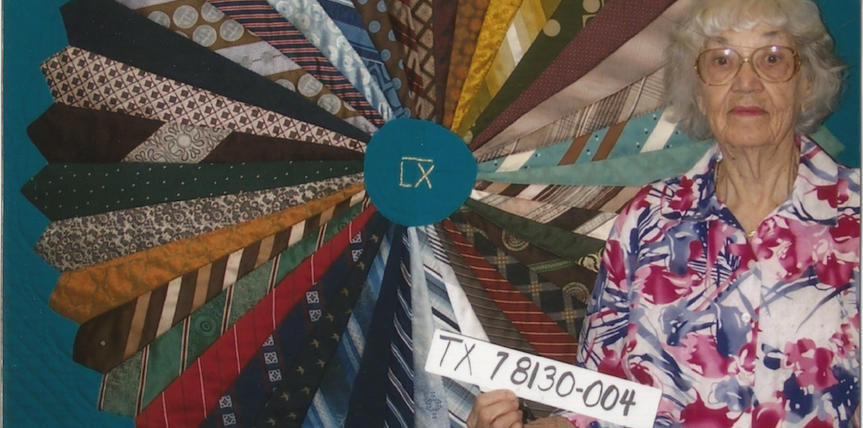
Phyllis Jordan (PJ): This is Phyllis Jordan. Today’s date is September 27, 2012. It is 1:49 p.m. and I am conducting an interview with Betty Boehle for Quilter’s S.O.S. Save Our Stories project in the Sophienburg Museum, New Braunfels, Texas. Betty, tell me about the quilt you brought today. The one that you had hanging out there. Betty Boehle (BB): What did you want to know about it, how many ties are in it? PJ: You just tell me about the quilt. BB: Well, I saved all my husband’s ties. He went into the service when war was declared, World War II, stayed in until it was over with and he had a different tie each time he had to attend meetings. So I kept these ties all these years, and so I decided to make a quilt for him, and that’s what I did. PJ: Good. BB: There’s 42 ties in the quilt. PJ: Well, this really has a special meaning for you. When did you finish this quilt? BB: In ’85. PJ: OK. BB: 1985. PJ: Yep. Is this a favorite quilt of yours? BB: One of them, yes. PJ: Good. Why did you choose that? Because of the memories? BB: Because it meant so much to me. Each tie had a certain meaning to me. One was when he was in the service. Next was when we got married, and then when we had our children, when they graduated from college, grandchildren, and on down the line. PJ: How did you keep track of all of that? BB: I wrote it down in a notebook. PJ: OK. What do you think that someone looking at your quilt might conclude about you? BB: What they might think about me? PJ: Yeah, what they might think about you. BB: Well, that I was just interested in doing something that pertained to myself and my family. PJ: OK. How do you use this quilt? BB: At the present time it hangs on the wall. It’s a memorial in other words in memory of my husband and for our family. PJ: Do you have any other plans for this quilt? BB: No. PJ: Don’t plan ever to put it on a bed, because of it’s being so special? BB: No, no. Then when I die, well, it’ll go to my son. PJ: At what age did you start making quilts? BB: I guess around, maybe 12 years old. I, my grandmother and mother taught me how to quilt and that’s how I learned and from that. . . PJ: Was it on a machine? Did you. . . BB: Yes, treadle machine, treadle sewing machine. That’s what we started out with. PJ: And, when they taught you, did they do, did they teach you like in increments, you know, first they’d show you how to one part, or did they help you all along the way. BB: All along the way and taught me how to sew and make a small stitch instead of a large. PJ: How many hours a week do you estimate you quilt? BB: Well, that just depends. If I’m on a quilt, then I spend about six or eight hours a day; but, if I’ve already got it finished, well then, I don’t spend that much time. PJ: Do you only do hand quilting? You don’t do any machine quilting. BB: No machine quilting. PJ: Now, do you piece by machine? BB: Yeah, I piece by machine, but I don’t quilt by machine. PJ: OK. Can you think back about your first quilt memory? BB: Yeah, it was a doll quilt. PJ: And, did you make it? BB: Yes, I did, with help of my mother and my grandmother. PJ: Do you still have that quilt? BB: That I don’t know. It could be at the ranch, I really don’t, in my cedar chest or my trunk; but, I don’t think so. PJ: There are other quilt makers in your family; are there any friends that also, that quilt? Do you have a lot of friends that quilt? BB: Oh yeah. My sister and I quilt quite a lot. See, what happened, my sister’s sister-in-law, worked for Joske’s [large department store chain] of Texas. I have to tell you this. And, whenever Joske’s of Texas sold out, they gave this lady all their materials; so, my sister said one day, “Betty, come over and we’ll go and get material. We took her station wagon and we got it full; brought it to my house, went back and got another. Then we got two for her; and then our husbands said “No more. Where are you gonna put it?” [BB laughs] Since then I’ve never had to buy material. All I had to do was go to this sister-in-law and she had all this beautiful material from Joske’s. PJ: You’re saying “Joske’s,” is that. . . BB: Joske’s of Texas. In San Antonio, you know where that is. PJ: I know where San Antonio is, I don’t remember where. . . BB: You don’t know where Joske’s is? PJ: No. Are they still in business? BB: No. PJ: OK. BB: Well, let me see, they closed out about eight years ago. Maybe not that many years ago, I’d say. . . PJ: Well, was the fabric on bolts or was it just folded? BB: Bolts, yes, some on bolts, some just small pieces, and. . . PJ: Do you still go to your sister-in-law, her fabric store? BB: If I need some. She has quite a bit at her house. She lives in San Antonio, close to Saint Mary’s University. So, if I need material, all I have to do is go there or to her sister, her sister-in-law; and, I haven’t bought quilting material in a number of years. PJ: Now, do you have to buy other supplies, like threads and needles? BB: Oh, yeah. Threads and needles and cotton. We have to buy that, but not the materials. PJ: You’ve been very fortunate that way. BB: I have and I’ve made some beautiful quilts. PJ: Tell us, have you ever used a quilt to get you through a difficult time? Or quilting to get you through a difficult time? BB: Well, I guess I would say that with my grandmother, she was very active like that and if I needed help or something, she was always willing to, I could go to her home, she lived in Bandera [Texas] and see we lived in Hondo [Texas] and I could stay with her after I got through high school. PJ: Betty, there is a symbol on the quilt you brought today. Tell us what that symbol means. BB: That was my husband’s brand that he branded his cattle with, and that was his brand. PJ: OK. What do you like the best about quilt making or pleasing about quilt making? BB: I don’t know, I’ve always loved to quilt. It’s just something that I can relax and I know how to do it and my mother and grandmother taught me how to do things like that and relax and I could do it. And my grandmother had a quilting machine and she did a lot of knitting. They had cotton, raised cotton and things and we’d spin that and we could tromp that treadle and spin that thread and then she’d make. . . I have a sweater that she made me when I was a little teenage girl, about 12 years old, and I have that in my cedar chest. I hope it’s still there. [BB laughs.] But, other than that Grandmother and Mother were wonderful helpers. All of us, I have two sisters, they all knew how to quilt and sew. PJ: Have you some kind of amusing story about anything that’s occurred from your quilt making? BB: I don’t think so. PJ: OK. Do you belong to any quilt groups? BB: Yes, I do. I belong to the Quihi one, in Quihi [Texas], and then I belong to one in Hondo [Texas], and then the one here in New Braunfels [Texas]. PJ: And then you belong to a Bee, don’t you? BB: Yep. PJ: Here in New Braunfels, also? Technology has changed things in quilting; has any of that technology influenced your work? BB: No. I still go by the way I was taught, and . . . PJ: Do you use a rotary cutter? BB: Yes, I do. PJ: And, that’s about the only technology that you . . . BB: That, and scissors, is about the two things that I use to cut the material, and a pattern, of course I always have a pattern. PJ: What are your favorite techniques? BB: I guess it’s my son, who puts the quilt in the frame for me. He measures it after I have cut it out or made the quilt top and he, we have a frame that, he knows how to measure the quilt and puts it in there and puts the cotton in there and puts the top on it, then rolls it and I start quilting. PJ: Where is that frame kept? BB: Either in a closet or in his garage. PJ: Oh, so, it’s not out all the time? BB: No, just whenever I’m using it. PJ: Do you have a studio or a place where you quilt? BB: Yes, their living room. That’s my studio now. Donna has made me a nice little sign and put up there, “Betty’s Studio”. [both BB and PJ laugh.] PJ: How do you balance your time? I know you’re retired, but, how much time, like how many hours, you know, how do you break up the day? Do you start in the morning? BB: I start in the morning, and then stop for lunch and rest an hour or so at lunch and then I start working until evening and then I find out if I need to add more on to it or get through with it sooner, I keep on quilting. PJ: OK. Do you use a design wall? Do you put it up on a wall when you’re working on something, designing something? BB: No. PJ: Do you use patterns? BB: Yes. PJ: OK. BB: I always have a pattern. PJ: Do you ever make up your own patterns? BB: I do. Just like those ties. PJ: OK. BB: I didn’t cut them down or anything. I left them as is and placed them side by side, then that’s how I used that many ties. PJ: What kinds of things make for a great quilt? BB: Is your material. That’s one of the things that you should always think about, is your material that you’re gonna use, because that quilt will be handled quite a bit. So you want the material to be a good grade of material and then you use a good brand of cotton. PJ: Is there a particular color that you seem to be drawn to? BB: No. PJ: OK. In your estimation what makes a quilt artistically powerful? BB: The way it’s made. PJ: Do you always do large quilts? BB: No. I make baby quilts. I make just regular quilts that you’d put on a chair or something like that and I make the king size or queen size. PJ: Well, I know that you’d come to Guild and you have had a lot of queen, king size. BB: Yes. PJ: Is that your favorite color? Favorite one to do? BB: Yes. PJ: The bigger ones? BB: The bigger ones are; because, one thing, I have the material to do it. Why not do it, rather than cut it and throw it away? PJ: Do you ever go to museums and look at quilts? BB: Yes. PJ: And what makes a quilt appropriate for a museum? BB: the way it’s made and the material. Not just the person that did it, but, the material and what’s in it. PJ: What about the pattern that they’ve used? BB: Yes. PJ: What makes a good or a great quilt maker? What kind of things do you have to have to be a good . . BB: I would say the way it’s made, your quilting, your cutting, and the pattern. PJ: And how precise you are? BB: Yes. And if it’s for a certain, if you’re making it for a certain thing. Like I’ve been doing, I would say the last 30, 40, years, or ever since our church has had the sausage supper. I have donated a quilt every year. PJ: And that church is? BB: Quihi Lutheran Church in Quihi [Texas]. PJ: And that is down southwest of. BB: West, close to Hondo [Texas]. PJ: Down near San Antonio [Texas]. BB: Yeah, it’s west. PJ: West of San Antonio [Texas]. Is there one particular, when you go into a quilt show, is there one particular thing that you go to first? I mean do you like the art quilts? Do you like the traditional? BB: I try to see them all. To see what has taken place. PJ: But, you’re drawn more to what, for you to make? BB: I guess just, I don’t know, how would you explain it. It’s just, where it would just be normal. PJ: Like a traditional, like Grandma. BB: Traditional, that’s what I started to say PJ: Like Grandma would make? BB: Yeah. PJ: Has there been any one book that you looked at, or an artist, or a designer whose patterns you favor more than another? BB: Well, there’s a friend of mine that lives in Castroville [Texas], you probably know her [asks unknown person] “What’s Shark’s last name?” [Unknown person replies “Faustina”] Shark, Dr. Shark’s wife and her picture is in this book I’ve got and she started out like I did. She’s been a quilter all her life. PJ: Did you take some inspiration from that book? BB: Yes. PJ: Good. BB: You always get a little something from a book. PJ: I agree. How do you feel about machine quilting vs. hand quilting? BB: Well, I am a hand quilter; so, machine, I haven’t done much of that, so, that’s hard for me to say; but, I am hand quilting. PJ: What about longarm quilting? BB: I’ve never done that either and neither has my grandmother or mother that I know of. Now I have a sister who quilts; but, she’s in a rest home right now, but, she, I think she had a quilting machine. But other than that, no, I do all of my own handwork. PJ: You’re fairly fast, aren’t you? I mean. . . BB: The longest it has took me, is being on a quilt, a week and I’ve got it finished. But that’s. . . PJ: Now, is that from start to finish? BB: To finish. Yes. PJ: And that is all. . . BB: That is a huge size quilt, king size. It’s pieced, I mean it’s a pieced quilt. It’s not blocks, it’s pieced. PJ: Why is quilt making important in your life? BB: It’s just something I love. Just like people have other things that they like to do, I just love to quilt. PJ: Do you think your quilts ever reflect the community you live in or the region you live in? BB: Yes, like I have friends right now, they live in Hondo [Texas]. They call me different times and want to know if I’m coming out or if they could help me with a quilt or something like that. PJ: And do they come and help you with the quilt? BB: They used to, but now that I live here in San Antonio [they don’t ever come]; but, they did when I still lived at Hondo [Texas]. I usually had, when I put a quilt in the frame, I would have two or three quilters helping me all the time. PJ: Coming to your house and . . . BB: Yeah, coming to the house. PJ: Have you had that frame a long time? BB: Wooden frame? Yeah, I’ve had two or three. [BB laughs.] PJ: Oh, it’s not your first one? BB: It’s not my first one, no. PJ: Do you think that your quilts reflect how you feel about the world, I mean? BB: I hope so. PJ: Well definitely with the one about the ties, that you did for your husband. BB: Yeah. PJ: And for yourself. BB: And I’ve made each one of the little granddaughters a doll quilt and then we’ve made the boys a “Spinner”. That’s a strip quilt and different ones I’ve used different patterns. PJ: Do you have any idea how many quilts you might have made in a lifetime? BB: No, I don’t. PJ: You’ve never kept track, or. . .? BB: I used to have a book that I had them in; but, I don’t know where my book is now. PJ: Why do you think quilts are so important in American life? BB: Well, to me, it’s relaxing. It gives me something to think about and to do rather than go to a nightclub and sit there and drink beer. This way I can quilt, make something, to give to somebody. PJ: Is that what you do mostly, give your quilts away? BB: Most of them, I do. But, now that I have all this material, then I can PJ: You’ve taught quilting, is that correct, at times? BB: Yes. PJ: And who did you teach to quilt? BB: The ladies who belonged to our Lutheran Church in Quihi [Texas] and also whenever, I had friends when my children were in school, some of them would come over to the house. We would quilt, or I’d have them cut out a quilt, different things like that. PJ: Did you teach your daughter-in-law to quilt? BB: No. Donna [Boehle] knows how to quilt without me teaching her. PJ: And what about the grandbabies that you made the quilts for? BB: All of the daughters, or daughter-in-laws, they know how. PJ: Was that because you taught them? BB: Well, yeah, that or my mother did, or my sister. See, my sister can quilt just as well as I can and she lived at Bandera [Texas], well lived on the ranch, out from Bandera [Texas] and she, more or less, taught quilting, where I let them come to my house and we did it that way. PH: How do you think quilts can be preserved for the future? BB: Well, for one thing, if you’re going to take care of them, be sure, if they have a stamp on them, to wash them and dry them real good and then keep them in like in a cedar chest or trunk or something like that. PJ: Do you wash all your fabrics before you. . .? BB: Most of it I do. PJ: Most of it? BB: Yeah. PJ: What would you not wash? BB: Well, if I was in a hurry to get a quilt done and I needed to get it finished and I had to have some of the material, well then, I wouldn’t wash it, but, most of it I wash. PJ: What happens to all the quilts that you’ve made for family and friends? Do you, like, do the children sleep under them? BB: Sure. PJ: The grandchildren? BB: Yeah. PJ; You give most of them away? BB: Yeah. PJ: How do you make selections when you’re choosing? Do you choose the pattern first, or the fabric first, or is it done at the same time? BB: Same time. PJ: Do you see a quilt and it tells you, “This is how I have to made this.”? BB: Right. PJ: So it , actually. . . BB: I have to have a pattern. PJ: OK. The fabric will tell you that. . . BB: Yes. I can do. . . PJ: OK. Do you use templates? BB: Well, I cut my own pattern. I can look at it and take my measurement that I know, say the quilt is going to be 80 by 90 [inches], well then I know how to cut the blocks and how many to put in that and I know how to cut it. PJ: Now, do you use template plastic? BB: No. Paper. PJ: Paper? OK. BB: Cause if I’m gonna cut it down, I can cut it down. You use template, it’s too hard to do it. PJ: What do you think is the biggest challenge confronting quilters today? BB: I would say, make up their mind that they’re going to do it and do it. PJ: Because of time or. . .? BB: Time, yeah. Because a lot of times you’ll see something and you’ll say “Oh, well, I’ll do that tomorrow.” and then you don’t do it. But, I had a list. I had a notebook and I had a list of different things I wanted to do and I did it. PJ: Was, have you done everything on the list BB: Just about, yeah. PJ: What are some of the things that you still want to do? BB: I did that “Lone Star” about, I don’t know how many times, and then I’ve done others; “The Doll Quilt”, I’ve done that and just regular quilts. PJ: Do you do appliqué at all? BB: Yeah. PJ: Because I have, I know at the Guild I’ve never seen you bring things in, but I had heard that you did appliqué. BB: Yes. PJ: Is there anything else you’d like to tell us that we have not covered? BB: Well, all I can say is don’t, don’t just give up. Whenever you can’t get something going right, sit down and think about it or go talk to somebody who will advise you and help you and then do it; but, don’t give up. PJ: Thank you very much. BB: You’re…

by Janneken Smucker | Jul 19, 2016
[addtoany] [space height=”10″] Explore and listen to Carol Miller’s interview by clicking open a segment title and selecting “Play Segment,” or by searching either the index or…
by Emma Parker | Jul 27, 2016
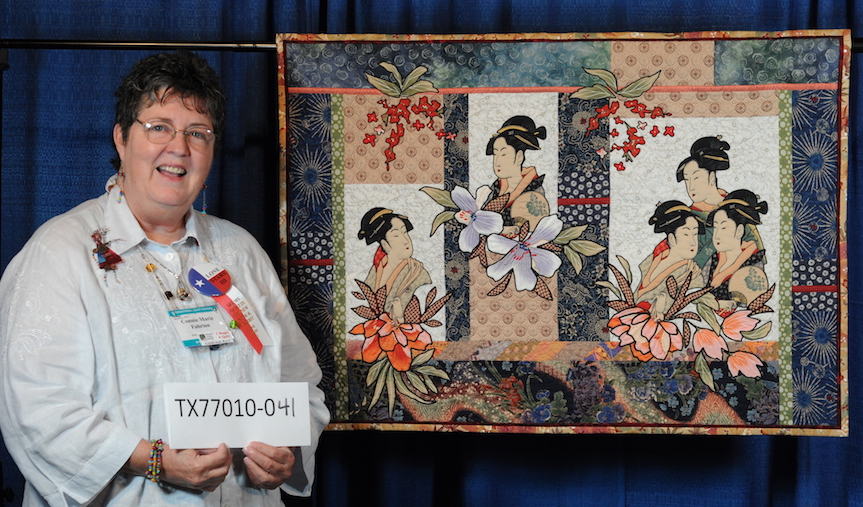
[addtoany] [space height=”10″] Nichole Webber Rivera (NWR): This is Nichole Webb Rivera. Today’s date is November 5th, 2011. It is 9:17, and I’m conducting an interview with Connie Marie Fahrion for Quilters’ S.O.S –Save Our Stories, a project of The Alliance for American Quilts. Connie and I are at the International Quilt Festival in Houston, Texas. Connie Marie Fahrion, will you tell me about the quilt that you brought in today? Connie Marie Fahrion (CMF): Yes, I made this quilt in early 2000. My stepmother had given me a book by Roberta Horton called The Fabric Makes the Quilt. I think the book came out in 1995 or 96, I’m not sure. I admired Roberta’s style. She has a degree in Home Economics. She has studied a lot of art and definitely knows the purpose of good design, and the elements of good design. I went through the book cover to cover. I didn’t get to take a class from her until about 1998 or 99. She actually came and stayed at my house, and I took several classes from her. Finally, the year I was going to take her African Fabric Class, I made this quilt top to take in and show her. It was based on the design principles listed in her book. That was the beginning of learning about a more artistic approach to work. My goal after that was to learn about and pursue art quilting. NWR: That’s really lovely. Would you tell us what the title of your quilt is? CMF: It’s called “Perennial Beauties.” Actually, this was the first quilt that I ever entered into IQA [International Quilt Association.], and had juried into the show. I think they accepted it because I had created the flowers that are on the quilt out of a piece of commercially printed theme fabric. Of course, they were not the flowers that were in the fabric, so it was a little bit different interpretation at that time. Also, at the time, quilting was huge, and everything was about quilting design and thread. They called me on the telephone and said ‘What is the quilting like on your quilt?’ And I said, ‘Well, it’s just kind of ordinary quilting. It’s really a focus on fabric quilt.’ They understood that. And so, in 2004, they accepted it into the show, to my surprise and delight. NWR: Awesome. It’s just wonderful. CMF: Thank you. NWR: Does this quilt have special meaning, since it was juried in? Was it the first one that you had juried into the IQA– CMF: It was the first one juried in. It pays tribute to the Japanese culture. I spent early childhood in Hawaii, and I really didn’t know what an impression their design sense made on me until I began quilting. A lot of my subsequent quilts seem to have a Oriental flavor which is not always my original intent. NWR: It looks to me like the quilting is almost sashiko style in the back, the diamonds. It’s very– CMF: Yes, I did that because there was quite a bit of curved fabric, and I thought straight lines balanced the design and worked well with what was going on in the fabric. There are twenty different fabrics in it, and it’s a small piece. Because some of the fabrics were busy, I thought the quilting really needed to be simple. NWR: Why did you choose this quilt to bring to the interview? CMF: It was one of my first original quilts, and was the beginning of my creative journey. NWR: What do you think someone viewing your quilt might conclude about you? CMF: Well, they might conclude that I admire the Japanese sense of design, having grown up with it. I had many Japanese friends. It looks a little traditional to me, so they might think that I am a traditional quilter, which I really am not, although I did begin as a traditionalist. I would have been a purist, a hand piecer and a hand quilter, if I didn’t have a physical problem with my arm. NWR: So, tell me about that. One of our questions in our quadrant they give us asks, ‘has quilting ever got you through a hard time,’ and it sounds to me like this is a perfect example of that. So, would you tell me about how you transitioned from being a traditional quilter to the more, more artsy stuff? CMF: Well, I had a pinched nerve in the neck from compressed vertebrae received in an auto accident when I was 21 years old. I lived with it until I was 50. I thought pain was a normal part of aging. I began limping and limped for three years. When the doctor saw the x-ray, he said, ‘You have the largest bone spur I’ve ever seen in my career–surgery immediately.’ They told me I had no nerve damage. However, I certainly had a fair amount of muscular discomfort when hand-quilting. One door closes and another opens. It seemed a perfect time to begin a more personal, creative journey. And, I was able to become close friends with my sewing machine, which I had avoided getting too close to up till then. NWR: Tell me about the traditional quilts that you liked to piece before you were launched so unceremoniously into art quilting? CMF: Because I had no quilters in my immediate family, I didn’t even know quilt guilds existed or that there were books out there. I had seen quilts of course and simply decided making one was something I could do. I started one and finished it after a friend saw it and said, ‘Gee, you really need to join a quilt guild.” That was the beginning of the end. I was hooked, I was passionate about it. I would work in the middle of the night. I would tell my friends, ‘We really need 36 hours days, because we can’t get enough done in 24.’. My first quilt was a printed panel quilt with half-square triangles thrown in after watching Alex Anderson on PBS. NWR: So what age did you start quiltmaking? CMF: I started when I was 44. I thought I was too old then and here I am over 20 years down the road, and I still think I’m too old for quilting, but I’m having so much fun, I just keep doing it. NWR: How many hours a week do you quilt? CMF: Not as many as I’d like. I started out quilting eight hours a day when I was younger, but since I have moved next door to two of my grandchildren, I can only get about eight hours a week in. NWR: What is your first quilt memory? CMF: My first quilt memory was a wonderful charm quilt that was probably 100 by a 100 inches with tiny little three quarter inch hexagons. It belonged to my aunt. I was about 5 years old but knew this quilt was really something different. I was very impressed that a woman had created it from scraps and hand-stitched it. NWR:. Are there any quiltmakers among your family or friends? CMF: Well, my mother has made a quilt since I started quilting. But I had no immediate quilters in my family. My husband had quilters in his family. His grandmother gave us quilt as a wedding gift 41 years ago. I still have it. NWR: Was that quilt hand quilted by his grandmother ? CMF: I don’t know if she hand quilted it. She sent a lot of her quilt tops off back East and guilds quilted them. But, it was all pieced with her fabrics by her. I remember my sister-in-law telling me, ‘Oh, I remember. I had a dress made out of that fabric. CMF: Yes, it is. NWR: Do you use it on your bed or is it–? CMF: I do not. Well, it’s 41 years old now, and it has been used quite well, so I try to protect it. NWR: What do you find most pleasing about quiltmaking? CMF: I began quilting really as a stress reducer, and as way of having something to do, keeping my hands busy. My boys were getting ready to leave home, so I thought I could avoid empty nest syndrome by quilting. And, I have made several quilts that have been related to stressful events or worries. NWR: So a therapy sort of ? CMF: I would see it as sort of a therapy, yes. NWR: What aspects of quiltmaking do you not enjoy? CMF: Probably the actual quilting. I always feel like that is my weakest area, I don’t know why. Once I get started, I enjoy it. I would have been a hand quilter as opposed to a machine quilter so perhaps I have a little residual resentment [CMF laughs.] NWR: What art or quilt groups do you belong to? CMF: I belong to the Houston Area Fiber Artists, to the Studio Art Quilt Associates, and I belong to a small fiber art group called Fiber Voices. We are six members who meet often. We are mainly a good critique group. I can go to them for good critique. We’re not afraid to tell each other exactly what we think about how a quilt is working or not working, or what could be done to improve it. And they listen. It’s been wonderful to participate in that, because I get to see their work in the beginning stages, then go through the critique process to the finished product. It’s been very educational to see that. CMF: Have advances in technology influenced your work? NWR: Let’s see, advances in technology– I have done quite a bit with photo transfer, transferring onto cotton and silk, creating work from that. The computer takes up time away from my studio but I do like that I can download my own photos, crop them up and use them to submit to a show. It is very fast and efficient. I have had very few quilts professionally photographed. NWR: What are your favorite techniques and materials? CMF: Well, for material, anything goes for me. I wrote an article for Quilting Arts Magazine about the use of thread trash as a surface design element. Its use is something I go back to most often. I love exploring with thread trash. Thread trash is that stuff that you rip off the side of your fabric after you’ve washed it and taken it out of the dryer. I first started using it as a textural element, to add texture to a flat surface of a quilt. It worked marvelously well for that. I especially like using it on seascapes. NWR: So, do you dye your thread trash? Or paint it CMF: I have painted it, yes. I– NWR: What’s your preferred paint ? CMF: I like acrylics, you can add textile medium to them, and they work just fine. NWR: Ok. CMF: I have also done some dyeing. I’ve taken a lot of classes in dyeing fabric and used the print paste to thicken up dyes. It’s fun to use and play with, but it’s very time-consuming, It’s much easier and faster to get out the paints, and add a little textile medium, and go to town . NWR: And it dries pretty quickly, too. CMF: It dries very fast. In fact, sometimes I add a little retardant. If I’m painting a painting, then definitely I add a medium that will slow down the drying time on acrylic. Yeah. NWR: Thank you very much for that information. Describe your studio. CMF: Yes, my studio right now is actually pretty neat. I have two machines, a Bernina and a Juki. And I use the Juki for machine quilting and free-motion applique because it’s so much faster. I use my Bernina to do everything else. When I go on retreat or down to my beach house, I have a little Bernina 240 and I do everything on that. NWR: So do you use your Juki in a table or on a frame so that the machine moves? CMF: No, I have a table where it sits flat, it’s stationary, and even my little machine down at the beach is stationary. NWR: Hmm CMF: I really like the stationary, flat surface, because I don’t have to worry about my quilt falling over the edge or pulling at the needle.. . NWR: I saw on your questionnaire that you said you have two design walls– CMF: I do– NWR: And that fascinates me. Will you tell me about that? CMF: One of my design walls , is used for works in progress. Sometimes I’ll have more than one project going at the same time so I will use the other wall for that. Sometimes I pin up ideas, sketches and drawings. Right now I have construction paper cut outs I did while playing with my grandkids. At home, I have my kitchen table set up for them with their crayons, paints, stamps and pens. Often I sit down and work with them. All that goes on my design wall so they can see it. NWR: So have your grandchildren’s art, has that influenced any pieces that you’re currently working on , or do you have ideas inspired by them? CMF: When my first granddaughter was three, she came and stayed with me for a week. She’s very artistic. She sits down everyday and creates art. Every morning at 9 o’clock, she would say, ‘Come on, Grammy, it’s time to go to your studio and create art.’ Needless, to say, I was inspired by her art. After she left, I created “Abby at Three” based on her work . NWR: Oh , that’s wonderful. Thank you for sharing that. CMF: They do influence my work, and I expect to be influenced even more now I live next door to another two of them. I have an idea for another project with my two-year-old grandson called “The World According to Finley.” NWR: Oh , that’s so; I can’t wait to see that piece. CMF: Well, I can’t wait to start working on it. NWR: I bet. What do you think makes a great quilt? CMF: I think a really great quilt follows the principles of good design, and also follows the purposes of good design. And for the purposes of good design, I like narrative quilts, direct representations of drawings, something that looks very architectural or impressionistic. I like a quilt that invokes a feeling when you walk up to it, quilts that make a statement. I like asymmetrical balance and I don’t want my quilts to look too perfect. I like a little bit of imperfection. . NWR: That must go back to your Japanese influence. CMF: I think it does. They have a thing called wabi sabi – learning how to see the beauty in imperfection. I’m definitely there. I don’t want perfect; nature is not perfect, life is not perfect. NWR: What do you think makes a quilt appropriate for a museum or a special collection? CMF: I’m not sure. When I go to the museum, I like to see the work of a quilter starting from the beginning and going to the end of their career. I like to see the growth, the transition, and the different areas he/she pursued to study. That’s always fascinating to me. I saw an exhibit like that in Golden, Colorado, the work of Ricky Tims . I could see the progression of his work from classes with other quilters to ‘Oh, look at this, this is totally original, he’s branched off,’ and then on and on to his latest work. It was fascinating to see his progress. NWR: [clears her throat.] What makes a great quilt maker? CMF: I think a great quiltmaker is someone who pursues his/her own creativity and is dedicated to that end. I like to see good workmanship. It doesn’t have to be perfect but it can’t be too sloppy or messy. NWR: Whose works are you drawn to, and why? CMF: In the quilt world or–? NWR: Yes, ma’am. CMF: In the quilt world, I love Leslie Gabrielse’s work, and I love Pat Croft’s work which pays tribute to painter, Jackson Pollock. I like Jackson Pollock’s work, and I think Pat does a marvelous job of reinterpreting. I like all the impressionists. Painter, Jean Michel Basquiat has made a huge impression. I was able to see his work from the very beginning of his creative life to the end. He died young, but left a huge body of work that’s really quite impressive , a little [UP shouts.] chaotic, a little immature here and there but really very nice in a very imperfect way. I like Roberta Horton’s ability to see a fabric’s design possibilities and Ginny Eckley’s surface design work. Her finished work has a delicateness to it that seems oriental to me. The list could go on and on. I love them all. I think they’re all wonderful. I admire their creativity. I understand it; I know where they’ve been and where they’re going. . NWR: It’s like a sisterhood. CMF: It is like a sisterhood, yes. NWR: So, you’ve mentioned using thread trash. Are there any other embellishments that you like to use on your quilts? CMF: I’ve done a fair bit of beading, and believe me, I’m no beading master for sure– NWR: Do you do that by hand– CMF: Yes. NWR: Or you use your machine for that? CMF: No, I do it by hand. And that’s probably why I don’t do very much of it. But, every now and then, I add a few little beads here and there. There ’s actually a few little beads on this quilt I brought today, you can’t really see them very well– NWR: I saw that in the centers of your flowers– CMF: That’s right I would probably do more if I had the hand for it, which I don’t. NWR: Why is quiltmaking important to your life today? CMF: I don’t know. I think of it as an addiction and for years, I thought of it as a healthy addiction until I realized that I had some nerve damage, and kept on working in spite of it [They both laugh.]. It’s a passion and probably not something that I can give up– NWR: How is it important– CMF: It’s just part me, and is the fabric of my life. NWR: Yes. Something you can’t give up would be the definition of an addiction, wouldn’t it? CMF: Yes, I think so. NWR: Do you feel that your quilts reflect your personal community or region in any way? CMF: I would say it’s more personal for me than community. NWR: Tell me what you think about the importance of quilts in American life CMF: I think they are the fabric of our life. They go all the way back to wherever we came from. My family came from England in 1620, and I know they came with quilts. NWR: In what ways do you think quilts have special meaning for women’s history in America? CMF: They have cataloged events in history and expanded our vocabulary. There is the verbal expression “It will never be noticed from a galloping horse”. You’ve never heard that saying? Well, I whipped that one on my stepmother who had quilters in her family. ‘Oh, how did you know that expression?’, she asked. I said, ‘Well, it’s a quilter’s expression,’ and she said, ‘I grew up with that expression.’ I had never heard it until I started quilting. NWR: How do you think quilts can be used? CMF: Oh, I think they can be used for everything, from their utilitarian purpose, to appreciating the craftsmanship, workmanship, and art. They are gifts to be used as fundraisers which is a wonderful thing, part of the camaraderie and spirit of quilting and quilters. They are expressions of love to family and friends. NWR: I wanted to ask if you’ve ever framed any of your art quilts. CMF: I have framed them. My first art quilt group, Beyond the Borders, had an exhibit at the Copper Shade Tree Gallery in Round Top, Texas., where we hung work the way we normally do, on a rod. The gallery owner said, ‘A lot of people wished that they had seen them framed and on the wall.’ And the following year, many of us did frame, and then it was a case of ‘Now, we don’t like that, because the work is under glass.’ There’s something about fabric under glass. It did not look natural. We started mounting work on painted canvas. That worked much better because there was no glass between the viewer and the fabric. This now seems to be the preferred way to hang small work on the wall in the gallery today. NWR: My question about that is:, when a piece has been hanging on a wall or a gallery, and it has no glass protection, how do you keep it clean? Do you know how some things collect dust and–? CMF: Oh, absolutely. And that’s one of the reasons I do have a some pieces protected by framing them under glass. One of them actually hangs in my breakfast room, and there, it not only would pick up dirt and dust, but grease as well. You have to consider where it is going. I also add a disclaimer on work listed for sale saying, “Please do not hang work in direct sunlight. This is fabric and it will fade when exposed to sun” . NWR: Thank you very much for sharing that. How do you think quilts can be preserved for the future ? CMF: Well, I think they’re doing a wonderful job of preserving them. Keep them out of the sun, keep them clean . I don’t wash them very often, but I will fluff them in the dryer, and take the dust out of them. Fabric does deteriorate over time so it is not easy. NWR: I wanted to ask you, do you have any ideas on how we quilters today can inspire the youth to become quilters of tomorrow? CMF: Well, I think young quilters today are very much into experimentation and just playing. When I’m with my grandchildren, that’s what I encourage them to do. I want history to evolve and move forward. I don’t think we really need to do it the way our grandmothers did. We each can be our own self. I hope I impart that to my grandchildren [Intercom announcement: ‘10 minutes, 10 minutes until we open the doors’.] when and if they start quilting. NWR: Is there any question or statement that you would like to make before we close that I missed, or something that you would like to share to preserve in the–? CMF: Follow your heart, be creative, do it your way.My goal is to keep creating as long as I can, and of course we never know how long that will be. NWR: I’d like to thank Connie for allowing me to interview her today for the Quilters’ S.O.S– Save Our Stories Oral History Project. Our interview concluded at 9:51 a.m. …
by Emma Parker | Aug 24, 2016
Janneken Smucker (YS): Testing, testing, testing, can you speak also Connie– Connie Watkins (CW): Yes, testing– JS: Yup I hear you. Great. CW: Good. JS: Wonderful. My name is Janneken Smucker; I’m here today with Connie Watkins. This is an interview with Quilters’ Save Our Stories. Today’s date is, it’s November 3rd, 2011 and the time is now 2:07 in the afternoon. I’m here at the International Quilt Festival in Houston [Texas.] and we’re going to start off with our touch tone object which is a beautiful quilt Connie has brought with her today. Connie, can you start off by telling me about the quilt? CW: Okay. I teach quilting, a lot, and I love appliqué and I was asked to teach a Baltimore class and I thought, “Well, okay I can do that, I’ve done a lot of Baltimore quilts,” but I thought, “I want to do one for my family and have a little Texas in it,” so this is my Texas Baltimore quilt. It does have my family name on it, it has the date of my husband and I got married, and my three children on it, with their birthdates, up in that block has all my grandchildren and their birthdates, some of the ruched flowers are from bridesmaid dresses from my daughters and flower girl dresses from my grand daughters when they were in the wedding of the other daughter,. Down here is a ribbon, a ruched ribbon from a mother’s day present from one of my kids when they were little. I just, I wanted it to be Texas so there’s the Elissa, that’s in Galveston [Texas.] Then I have a Texas Christmas cactus to give it a little Texas style to it, and Texas vineyards for my grapes. It’s just a Baltimore with a little Texas flare. All handquilted, all hand appliquéd, and I have some embroidery purse flowers with lots of embroidery because I love any kind of handwork, I love embroidery too. JS: That’s really fantastic. I like that is has so much family significance to you. What else do you like about this quilt, it clearly has personal meaning, are there other parts of it that really appeal? CW: Well, I’m very traditional, even though my quilt that’s in the book is not traditional, but I love to keep the tradition of old quilts coming forward and a Baltimore is probably one of the greatest American folklore type quilts, and so that’s probably why I love them. So are the Baltimore quilts. I started on one when my husband got sick, and so I worked on it to keep my mind kind of free a little bit and it’s portable, I could take it with me when I came to Houston [Texas.] for his treatments and things, and so, and I finished it right before he died. JS: Oh really? CW: Yeah. JS: I’m so sorry. CW: So he got to see it. JS: How long ago was that? CW: He died a year ago. JS: I’m so sorry for your loss. CW: Oh well thank you, thank you. JS: Well it’s wonderful that you– CW: He was my biggest fan and my biggest critic. JS: [laughs.] CW: If he didn’t like something, in fact he told me about the Elissa, he really liked it, but he said, “Your flags are going the wrong way,” and I said, “Well, I know, but they were the only flags I could find of a Texas flag and that was the direction it was facing.” JS: [laughs.] You got to go with what you have. CW: That’s right. JS: What can you tell me about how you first learned about Baltimore album quilts? CW: Going to museums and especially on the east coast, and Washington D.C. [Maryland.] and New York, and I was a docent at a historical home in Waco [Texas.] and I got real big into Civil War type quilts, which is my true passion, are Civil War scrap quilts, and so I just have always been drawn to the Baltimore quilts, the red and the greens and the rich colors. JS: Why do you think that these historic quilts, nineteenth century quilts like Baltimore albums and Civil War quilts that you also like, why do you think they’re important to American history? CW: It just kind of shows where people were in that period of time. Baltimore quilts are older so they were probably quilts when women had access to fabrics and a little more money, on the east coast to buy fabrics and have fabrics shipped from France. When you get into the Civil War quilts, you may be getting into the western quilts, where on the side of the Mississippi where we didn’t have access to factories, or fabric, so they were truly scrap quilts made from old clothes and old quilts and I just kind of think it puts a place in our history of where people were at that time. I think women, especially need friends, and this was a great place that women, because Baltimore quilts a lot of time were made for weddings, were made as gifts and so maybe one lady would make one block and you know they put them all together and give them as a gift to somebody. It shows the friendship that women had then, that we still have now and need. JS: Now you teach a class on making Baltimore albums? CW: I teach lots of different classes, yeah. I’ve taught Baltimore, I’ve taught a lot of appliqué classes because that’s my favorite but I teach a variety. I teach at the college, and I love to teach beginner quilters and I love to get people your age excited into quilting. I do some art quilts just because that will bring a different people in that aren’t interested in this kind of a quilt, but would really like to do a fun art quilt. I like all of them. JS: How did you get into teaching? CW: I guess just from my friends, they wanted me to show them how to do things and then someone would call me and say, “Connie would you come teach at the college? Would you teach a quilting class at the college?” or, “Would you come to the quilt shop and teach one there?” Just from, you know, people getting, looking at my quilts and wanting to just learn how to make them. JS: How did you learn yourself? CW: I started quilting when I was, I started really when I was about five, making doll quilts. My grandmother, I can remember going to her house, she lived out in the country in Illinois and lived out on a farm, and every quilt on her house, in our bed had a quilt on it and everything was embroidered. She first showed me how to do embroidery, and so my first quilts were embroidery type quilts. Then as I grew up a little bit, my dad got me a sewing machine and so, then I started making doll quilts and quilts for me, then I started sewing some and then after I got married and had children, then I made baby quilts and so it just revolved. Then finally, I got to a point where I thought, “Well I really should learn how to do this right,” because I had been doing it self-taught for so many years, so I started taking classes. When probably in the late 80s and early 90s I started taking classes. JS: What do you like about teaching other people to quilt? You mentioned beginners, what is exciting about that to you? CW: Just that they can take a piece of fabric and make something out of it, it’s something they wouldn’t expect, just the process of, because I love quilting, it’s my passion, it’s not just a hobby, and so I just love to pass it on because I’m so afraid that if we don’t get young people interested in quilting, that when I die it’ll be gone. JS: Have you given quilts to family members that they– CW: Oh yeah, they stand in line for them. JS: I’m sure they do. CW: Yeah, and my daughter, my two daughters order them like pizza. JS: Its buy one get one free? [laughs.] CW: They call me and say, “Oh mom, so and so is having a baby, will you make me a baby quilt?” Then when I truly make a large quilt or something, usually before it’s even finished, they’ll start saying, “Well that one’s mine,” and the other one will say, “No, mom that’s mine,” and my Jeff will say, my son will say, “Well you got to save some for me,” so anything that he has decided, anything that has the name Watkins on it, is his, because he is the only true Watkins because the girls got married. That has not made my girls really happy because some of my prettiest quilts do have the name on it, but he’s decided that was his, his birth right. JS: [laughs.] Do you use a quilt on your own bed? CW: Oh yes babe, I have quilts on all my beds. My children have quilts on all their beds. We trade them out and everybody’s got Christmas quilts on all their beds and I’ve got, my house has a lot of quilts on the walls and on couches, everybody’s got to have a couch quilt to watch TV> JS: Of course. CW: Right. So oh yeah, my, I have quilts everywhere. JS: They’re all ones that you’ve made? CW: Yes, yes. Lots of family members, I’ve never met a Christmas quilt that I didn’t like, so I’ve made lots of Christmas quilts and almost everybody in my family wants a Christmas quilt, because that’s something even if you don’t have a house that’s suited to quilting, you can always bring it out at Christmas. JS: Now you talked about when you were a child, your grandmother in Illinois, can you tell me some more memories of her sewing or? CW: I was young when she died, but she was truly my inspiration as far as sewing because I just loved even her tea towels in the kitchen were embroidered and pillowcases were all embroidered and every quilt. Her quilts weren’t like this type of quilt, they were scrap quilts, and feed sack quilts, they were just happy; you couldn’t go in her house and not be happy because there were quilts everywhere. Even though she died when I was quite young, I’ll always remember that, always, because my other grandmothermother sewed but not quilts. She was my really true only one in close family that sewed. JS: Do you belong to a quilt guild or other groups? CW: I belong to two quilt guilds; I belong to one in Waco [Texas.] and I belong to one in Temple [Texas.] which is about thirty miles south of Waco [Texas.] I have a group of bee ladies and we’ve been quilting together about sixteen years now and we meet once a week at each other’s houses and not only are we all quilters but we’re just true friends. You know, everybody supported people through illnesses and husbands passing and so without my bee I would’ve had a tough time when my husband died. JS: Right, I imagine so; it’s good to have close friends. When you meet weekly, do you all bring your own projects or do you sometimes quilt on each others? CW: Well, and we do, we do find most of the time we will bring our own projects and you know, when you’re coming to somebody’s house, you know you bring some kind of handwork with you. JS: You could bring a block like this? CW: Yes, and something like that, or you’ll be maybe quilting on something, probably three-fourths of us in the bee also knit, and so some will bring their knitting because it’s portable but then we do our little group challenges. We’ll do, we’ll say, “Okay, we’re going to pick one pattern and each of us pick out our fabric fabrics,” and we may make the same quilt on our own time, but all out of only different fabrics and so we do that probably about once a year or so we’ll do that. Then we all will make a charity quilt for the guild when we’re doing them for babies and we did them for the veterans at the Brook Army Medical Center in San Antonio [Texas.] and sent quilts down there and for burn patients and for people that are taking chemo, we’ve done charity quilts for them. We do a little bit of everything. JS: Do you think there’s something about quilts in particular that brings people together in this way? CW: Oh yeah, oh yeah. JS: What do you think it is? CW: I think it’s the love in the quilts because you know, it takes a lot of time to make a quilt and a lot of effort and it’s not just an old blanket, and you know, so I think the love that’s behind it, making of them, and the friendship and fellowship of making quilts together just ties people together. JS: Can you tell me about the room in your home or your studio where you work, what it’s like? CW: Well, it started out as a bedroom [laughs.], it really did, it had a bed and everything in there. Slowly but surely, all that’s gone now and I just have just all my sewing in there. I do not have a sewing wall, a design wall, because I don’t have a wall that’s free. All the walls that I have, have quilts on them and so I really want, I’ve seen something where I can put up a shelf and you pull down a design wall, and I’m going to look into that, but right now I have a huge floor space that I lay my blocks out on and do, but I don’t have a wall unfortunately. JS: And you do a lot of your work by hand, do you do that also in that room or do, you say that’s portable, so? CW: No in my sewing room is, I actually do my machine sewing and putting quilts together in there. I do my handwork in the den, or my bedroom has a television in it, I’ve got a chair that I sit in is very comfortable because I do a lap quilt, a lap frame. JS: Like a hoop? CW: Yeah it’s like a hoop that’s on a swivel thing that I can sit on my lap and if I’m at home, I will probably quilt from seven to ten every night, unless I’m going to, I need to be somewhere. JS: Every evening? CW: Every evening, every evening, and then I will do any machine quilting and things like piecing and things in the daytime, I don’t use my machine at night. JS: What do you think makes a great quilt? CW: First impression. JS: Yeah? CW: I think you know, if people are walking down a row and something catches their eye, I think that’s the first thing they see is the first impression has to be, has to catch them to get them there. Once they get over to it, then it needs to be the workmanship, it really needs to be the workmanship, no matter if it’s machine workmanship or if it’s hand workmanship or whatever it is, I think the workmanship is probably one of the most important things. JS: I know that you’re a handquilter, do you do any machine? CW: Uh-huh, the one’s in the book, that’s in Carrie’s book, is machine quilted. I really started machine quilting kind of because I’m not going to live long enough to get them all handquilted. JS: [laughs.] good policy. CW: It’s hard to know, you’ve got to start somewhere, so that’s what made me start machine quilting. I really did it very begrudgingly at first, because I thought, “A quilt needs to be hand done,” and I thought, “No, it doesn’t Connie, you know,” and my husband would say, he’d say, “If you’re going to give it away, they don’t know the difference,” so he said, “Start machine quilting,” so I started taking some quilting class, I mean machine quilting, start taking some classes, and I love it, and I’m really pretty good at it now. JS: Good. Do you use a longarm or do you just use your regular machine? CW: My regular machine. JS: Good. CW: Makes it a little harder, but I do. JS: You figure it out, that’s good. I’d like to ask you a little more about how this quilt in particular got you through a hard time. You mentioned when your husband was ill, did you find quiltmaking almost meditative? CW: Yes, it was comforting, it was comforting. It was something that when you’re involved in cancer and running back and forth to Houston [Texas.] all the time, your life is hectic and crazy and this is something that was my cornerstone and my rock. I could come back to my quilting because it was something I did all the time that relaxed me, so yeah. I lost my passion for a while, after he died I couldn’t quite finish things, couldn’t pick them up, couldn’t, I had a project that I was doing when he did die that I couldn’t look at for a long time so, but yet I looked at it and the quilt that’s hanging in the traditions exhibit was one that I had started hand piecing while I was at the hospital with him and I had it part way handquilted when he died and I couldn’t finish it. I got to talking to myself and I said, “Bill would have wanted me to finish that quilt,” because he loved it and he knew how I loved quilting and so I had to finish it, and that kind of got my passion back into my quilting again. So yeah, it’s helped me through lots of hard times, lots of hard times. JS: Where do you find the inspiration for the different designs? CW: Usually from old quilts. There’s never been an old quilt I don’t like hardly. I’m getting a little bit more out of the box now where I’m not making all just old quilts, but I love to go to museums and look at the quilts and see, and then I may make an old quilt pattern, but make it with a newer fabric, a newer design or something. My son, who tells me I don’t make him enough quilts, I’m shopping for fabric for him this, during the festival. JS: Oh, here. CW: Right and his is going to be black and white and a little bit of red, so that’s you know, not real feminine but you know, enough that I won’t get bored but he’ll still like it. JS: Will he help pick the pattern? CW: Oh no, no. JS: That’s up to you? CW: Yeah. You don’t let people pick patterns because they’ll pick something that’s usually you know, something I don’t want to make, but it’s going to be stars so he can’t, you know, it won’t hurt. JS: So you clearly have a lot of appliqué skills but you also piece quilts– CW: I also piece– JS: This will be a piece quilt maybe– CW: Like the one that’s in the book is all pieced. JS: Right. CW: And I sewed for so many years that I don’t mind curve piecing, I don’t mind any of that just because that was something I did before so it doesn’t bother me like it scares some people. JS: Right, you knew how from making– CW: Yeah, marking clothing. JS: Sure. For the older quilts you’re interested in, do you adapt your, draft your own pattern based on looking at a photo of an old quilt sometimes? CW: Lots of times, lots of times like when I did, you know, I will take part of a traditional basket or something but then when I put the flowers in the basket, I’ll put my own flowers in or my own design of flowers so I may start with a pattern and then just completely change it to what I like. JS: Sure, good. What do you think the biggest challenge confronting quiltmakers is today? CW: Time. JS: Time? CW: Time; people are so busy and are being pulled in so many different directions and mamas of young children and you know you’re just hoping to get supper on the table and you now it’s not so much me because I have more time but I think time is the hardest for people. Fabrics are getting very expensive so you can’t just buy fabric because you like it anymore, you almost plan what you’re going to buy because of that. I really think time is the hardest. JS: Speaking of fabric, do you, at this point, since you’ve been a quiltmaker for many years, have quite a, quite a stash? CW: Oh yeah [laughs.] I really do but you always need more. JS: So you do go out still and buy for specific projects? CW: Oh yeah. Well, and I make a lot of scrap quilts, but sometimes you don’t have quite enough of one color when you’re planning the quilt and so you may have to just augment your scraps by buying a few more something’s, you know. JS: Sure. CW: Oh yeah, I’ve got lots of fabric. JS: Will you be doing some shopping here? CW: Oh I already have, yes. JS: [laughs.] CW: I already have. JS: Can you tell me an amusing story, I don’t know if it would be from teaching or working with your bee or other guilds, but something funny about your experience making quilts? CW: Well I was down here for the show one year and it was one year when I wasn’t staying at my daughter’s house, I was staying with a friend out at one of the hotels in the medical center and we rode the busses in. There was this lady sitting across the bus from me and she kept looking at me and I thought, “What have I done?” you know, and she kept looking, and she was smiling, and she was a young lady and she was with an older lady and she just kept looking over at me and she finally said something. She said, “I know you don’t know who I am but I know you,” and I said, “Oh I’m sorry, I don’t recognize you,” and she said, “Well, it’s all your fault that I’m here,” and I said, “Oh really?” and she said, “You have got me hooked on quilting,” she said, “I took one of your beginner classes at the college in Waco [Texas.],” and she said, “I just fell in love with quilting,” and she said, “When I first took your class, I shouldn’t even have taken it because I really wasn’t even a sewer,” but she said, “You took me in and showed me how to thread the sewing machine and were so patient with me,” and she said, “Now I am absolutely hooked.” JS: [laughs.] CW: So that made me feel good. JS: That’s good, yeah, it’s good to be blamed for something like that. CW: That’s right. You know, I’ve been blamed for worse, right? JS: Now your daughters, they clearly love quilts but have they ever expressed interest in learning? CW: No. My girls don’t quilt, they love quilts and they love all my quilts, but no, they don’t want to learn how to quilt. My granddaughters are a little better, they’re both grown, at Adrian College [Michigan.] now, and I taught them to do some basic little quilting when they were younger and of course they’re too busy in college now, but they learned something so many someday they will come back to it. JS: Sure. CW: Especially my oldest granddaughter, she loves to do things with her hands, so she may come back to it when she’s grown. JS: What would be some advice you would give her if she came back to quiltmaking? Or to actually you know– CW: Yeah. JS: Pursue it later. CW: Just to enjoy it, if you don’t enjoy it, don’t do it, find something else that you do enjoy. Life’s too short not to do things because most of the time some people get stuck in jobs they don’t enjoy, they get stuck in situations they don’t enjoy, whatever you do with your own free time, make sure you love it. JS: That is good advice. I’m interested in what you think about displaying quilts as art objects versus using them on beds in utility, like, do you think that quilts should be in both places or is one more important than the other? CW: Oh yeah, wherever you need them, wherever you need them. I have quilts on my wall and they’re usually ones that will be more like this that aren’t really great quilts to wash, because of all the ribbons and all the satin and the different fabrics, and they can be spot cleaned but it would be very hard to wash them, and so they’re very much display quilts. Then, I have all kinds of quilts that are quilt quilts, that you really, and they are usually my piece quilts and they go in the wash machine and when I make baby quilts for babies, I tell the mama, “Let this baby use this quilt, babies need quilts,” if they ruin it, or mess it up, or wear it out, I’ll make them another one, I said, “Let this baby use this quilt, don’t hang that baby quilt on the wall, you give that quilt to the baby.” So I think they, they have places, both places, and art quilts are beautiful and I love them and you know, so, that’s a, that has brought into our industry more fabric and more good things, the art quilts, because I know a lot of quilters will complain, “Oh all the quilts are art quilts now,” but they have brought techniques, and things into our world that have made our lives easier, more fabrics, you know, more different tools to make things easier for us; so I love all, you know I think there’s a place for all of them. JS: Can you tell me about a tool, something that you’ve encountered more recently in, since art quilts have become more popular? CW: Well, like you know when I first started quilting, you didn’t have rotary cutters and rotary mats and you had to use paper patterns and templates and it took forever to make something. And now man, you can strip cut and I can make a log cabin quilt in a week and it’s just revolutionized and you know, made it more fun, easier and more fun. JS: Yeah. You mentioned that you’re really drawn to older quilts from seeing them in a museum, what makes a quilt worthy of being in a museum? CW: First impression again, I think first impression, the workmanship, and for it to go in a museum I think it’s really crucial to have history of the quilt, that’s why I, whenever I tell my people when I teach, or whatever, or a friend that has a quilt, if you know anything about that quilt, you need to put it down now and attach it to the quilt, whether it’s a label, paper label, that you make a pocket and put it in, or if it’s a cloth label, if you know anything about that quilt, document it because, you know a quilt hanging in the museum that says, “Artist unknown,” “Date unknown,” it’s just not as interesting as a quilt that they can say this is made by Connie Watkins from Waco, Texas, you know and it was made in whatever year and I think that just makes quilts special. My mother was very ill in the hospital in Fort Worth [Texas.], and I was staying in her apartment at night, and staying with her in the daytime, and I was cleaning her apartment out because I knew she wasn’t getting out of the hospital, and I found a quilt in the bottom of her closet, and she knew I’m a quilter, and I got up to the hospital and I said, “Mama,” I said, “I found a wonderful quilt in your closet, in the bottom of your closet on the floor,” and she said, “Oh that old thing?” and I said, “That old thing is gorgeous mother,” I said. It was one inch squares, huge, with a beautiful little prairie point border on it, and it was 30s fabrics so it wasn’t beautiful fabric or anything but it was a beautiful quilt, and she said, “Oh that’s just my wedding quilt,” and I had not a clue and she died like two weeks later. I would have never known that quilts history if she hadn’t of told me and it was made by a neighbor next door, mother was the oldest of eight, her neighbor next door they called Grandmother Agle, she had thirteen children, and she made quilts for every kid in the neighborhood when they got married, so she made that quilt for my mother when she got married, and I would have never known that. So it just, I just had chill bumps all over me when she told me. JS: What happened to that quilt? CW: It’s mine, and it’s got a label on it [laughs.] JS: Good, well that’s wonderful. CW: And take pictures of your quilts too. JS: Preserve memories, yes definitely. Before your interview we were looking at the gorgeous new book of Lonestar quilts, can you tell me what it means to you to be featured in that book? CW: It was so special. I had just gotten home from the hospital when my husband died, got home from Houston [Texas.] and had the service and the funeral and everything and I was feeling really low because I got married when I was seventeen, I was married forty-six years, you know and I had never been by myself, and the telephone rings, and Carmen from the book, from Carrie’s office, called said, “Connie, we’ve been trying to find you, we want your quilt in Carrie’s book,” and I was just so overwhelmed that I thought, “They want my quilt?” and it had hung in Houston [Texas.] one time and it had been in a magazine so you know, I knew people had seen it but when she wanted to include it in her book because I have her other books on Texas quilts, that I was just very, very honored. I have just been so excited, real excited. JS: Well the book really is spectacular. CW: And it’s a beautiful book, it is beautiful. JS: Can you tell me about some of the other quilts in there that you’ve noticed or other quiltmakers that you are admire? CW: Gosh, I can’t even think of any right now because they’re just all so wonderful, they’re just, and most of them I have of course seen before because I come every year and most of them had been in Houston [Texas.] at one time the other so I had recognized them. A dear friend of mine who is not in the book, but was one of my biggest inspirations because she’s a wonderful appliquér, and so is Darlene Christopherson and she’s written a couple of books and she does beautiful hand appliqué and she was a, lived in Virginia for a long time and studied a lot of the old antique quilts, she helped design a couple of my blocks for me with the birds in them. So she is probably my true inspiration and she was so excited when I got chosen for the book. JS: It is really an honor. CW: For sure. JS: I’m wondering if there are any questions that I’ve neglected to ask you, or any stories, or other quilts you’d like to tell me about as part of our interview today. CW: Well I do have a quilt hanging in the exhibit. JS: Tell me about it. CW: It’s in the traditions exhibit and it actually one that’s a little basket quilt, it’s a piece quilt but its all hand pieced because I did each block while I sat in the hospital with my husband. JS: That quilt right. CW: So that one is special to me. I did finish it in time to get it in the exhibit and so it’s special to me too. JS: Sure. Are there quilts, I know that many of your family members and friends own some of your quilts, are there quilts in other collections or places they’ve ended up? CW: Not that I know of, not that, just in lots of family members, you know lots of family members and a couple that had been in magazines, featured in a magazine for some reason or other, and like that. JS: Sure. Well are there any last bits you want to record for posterity as part of our interview today? CW: I can’t, I just feel very fortunate that I was invited to do this. I just think it’s wonderful that you all are doing this. JS: Well we are so glad that you came today Connie. CW: Oh, thank you. JS: Thank you so much for your time and for joining us here for Quilters’ S.O.S. Save Our Stories at International Quilt Festival 2011. At this point we will conclude our interview, again my name is Janneken Smucker, and I’ve been here today with Connie Watkins, and we’re concluding our Q.S.O.S. [Quilters’ Save Our Stories.]…