by Emma Parker | Aug 24, 2016
Cassino Richardson (CR): My name is Cassino Richardson and today is November the third, 2011. It’s 2:45 in the afternoon and I’m conducting an interview with Dana Klein [Greenberg.] from Dallas [Texas.] for Quilters’ S.O.S. [Save Our Stories.] and we’re at the Houston [Texas.] quilt festival. And welcome Dana. Dana Greenberg (DG): Thank you. CR: We’ve seen your quilt hanging out in the quilt show, and it’s lovely. Would you tell us what inspired you to make that quilt? DG: Well, the real inspiration for that quilt was a photograph of what I saw in an old quilt digest, in a series of books that were called The Quilt Digest and this was one that was made in the 1860s, I believe in Vermont. I just loved the real bold graphic image, and at that time I had just moved into a big new house and had a big wall in the family room that I just knew needed a quilt and so I really made this quilt specifically for that room, and for that wall, but it was a pattern that appealed to me. CR: How long had you been quilting when you made this quilt? Was this your first quilt? DG: Not my first quilt. I married in 1980, and went home to be a housewife and later a mom and didn’t know what to do with myself. I had not come from a quilting family, hadn’t sewn before, but I had a love for quilts when I would see them. I remember I had gone on a trip with my then husband and gone into a library to pass the time one day and while he, it was a business trip for him, and I checked out some books on quilts and I just thought, “I’d really like to do that.” I signed up for a class back in Dallas [Texas.] it was, we had several major quilt shops at that time that were very busy and full of activity, and I signed up for a beginning class [inaudible.] that was taught by Helen Hibs who founded the Dallas [Texas.] quilt guild. She, Helen, just passed away this past year. I remember the very first class, she asked at the beginning, “Is there anyone in here who hasn’t sewn before?” and she had prefaced that by saying, “Quilting, and especially piecing by machine, was precision sewing,” and so people who really did best in her classroom were people who had experience with sewing. When she asked, “Had anyone never sewn before?” and I raised my hand, she looked and me and she said, “Well, we’ll just do the best we can,” [laughs.] CR: Encouraging [laughs.] DG: Oh it was great. Helen was wonderful. She was a great teacher and encourager and that was where I started but you know, it’s funny, I never really took to piecing on machine, I really have always preferred appliqué and I think its because I’m more comfortable with the handwork than I am with the “precision” sewing. CR: This quilt was done with needle turn appliqué? DG: Needle turned appliqué, yes. It’s all hand done, all of its hand done. It has a lot of appliqué points; it’s got the razor tooth edges on the feathers of the prince’s feather. Then the border is reverse appliqué which I have not don’t recall that I had done any reverse appliqué before that quilt, if I had it was only to sample a little piece and there’s quite a bit of reverse appliqué which was a challenge for me in the beginning but then it was easier. CR: Did you have a pattern to go by or did you just look at the antique? DG: I drew the pattern from the, from the photograph of the antique quilt in the book. I had a projector that enabled me to blow it up on the wall and you know, sort of trace it off that way, and if you look at the quilt, it’s very, it does not, you can tell that it wasn’t a machine drawn pattern that each feather is slightly different, it has kind of a folk art feel to it. CR: Not my catch. DG: It’s not precise, yes, exactly. CR: Tell us about your sewing room, do you have a sewing room in your house dedicated to quilting? DG: I do and I will say that I haven’t really quilted in the last gosh, probably fifteen years, but when I did begin quilting, and when I made this quilt, it was such an important part of my life, I mean I, when I worked on this quilt in particular, I quilted like it was a job, from the time I got up in the morning to the time I went to bed at night, if I didn’t have other things that I had to tend to, quilting is what I did. When I took the first quilt class, and began quilting, it was a time in my life where I was trying to reinvent myself, I didn’t know how to be a stay at home wife, without children, and then you know, later as a mother, and the whole transition from the work world to being at home, and not coming from a domesticated sort of background, you know, not sewing, and those sorts of things. It was a way that I really reinvented myself and the prop that I was going to bring today and I tore up my house looking for it, of course when I was looking for it I couldn’t find it, it was my grandmother’s thimble. My mother’s mother lived with us when I was a little girl, she passed away when I was about eight, but my grandmother sewed our school dresses, there were four kids in our family, she sewed our special dresses for the first day of school every year and she cooked and she baked beautiful cakes and decorated them; she did all those domestic things that my mother didn’t do, she knitted, crocheted, embroidered, and I learned as a little girl sitting by her, I just was so attached to her and I learned to embroider and I learned to knit from her. I was never able to really master crochet, but that was where I really had my first interest peaked in those sorts of crafts, even though she never quilted. Over the years, I saved her thimble, nobody, my mother really didn’t sew and so when my grandmother passed away, and the thimble was always there at her sewing machine, I took it and I still have it somewhere, I just couldn’t put my hands on it today [laughs.] but I do feel that connection. I can only imagine what pleasure she must have gotten from doing those things for us. You know, quilting was solace to me, through years of real unhappiness of a difficult marriage, it was the camaraderie with the women in the quilt guild and in the classes and in the little quilt groups that I went to, that really carried me through some really sad difficult times and I, it will always have a special place for me because of that, and it’s something that I know I can always go back to. I can still remember being in this multi-age group of women and I was certainly one of the youngest ones in my mid-twenties, and their praise and encouragement meant more to me than I think they would really realize, that it was kind of a validation of who I was, or who I was becoming since I was no longer you know, a banker or whatever in the work world. It was always really, really important for the strokes that it gave my ego, and that’s why I was so flattered really to be included in this book, I just feel like, it’s been nice to go back down memory lane to the time that I made the quilt that’s hanging in this show today, and back to the whole era when I quilted so ravenously [laughs.] and I still have all my quilt fabrics, I have a whole wall of fabrics and patterns and needles. I just, this stage in my life, I haven’t had the time really to devote to big projects. I’ve taken up other crafts just in the last several years since my children have finished school, left home, and I find myself alone. I’ve taken up crafting again, but its things that I can start and finish quickly and easily [laughs.] so I really believe wholeheartedly in the value any kind of craft has in a women’s life. CR: Very therapeutic. DG: Yes. CR: Tell me about the past to the show here, how did that quilt get in the show, how did it get in the book? Can you do that for us? DG: Oh well this had an interesting path. When I started making this quilt, it, this is a funny story. My son, he had just gone off to first grade, and so I found myself at home alone again and when he entered first grade I looked at my husband then said, “Oh my goodness, I need a baby,” [laughs.] I had just devoted myself so to being a mother and absolutely loved it, and actually I had a baby nine months after he started the first grade and it was during that nine months that I made this quilt. CR: Oh my. DG: I used various quilt shows as my goal to finish it because the quilting on it was quite tedious, a lot of quilting was necessary to make it really look complete and I believe the first show that it was in was the Dallas [Texas.] quilt show, and at that point I only had part of the quilting finished, I had done the background quilting but not all the big leaves, the feathers. CR: Was it bound? DG: It was bound, it was bound and just the background, you know just some of the background quilting. So I entered it in the Dallas [Texas.] show and then next was the Houston [Texas.] show and I had never had the courage to enter a quilt in Houston [Texas.] before then, but I just decided why not. I entered it in the Houston [Texas.] show, and was flabbergasted when I came with my girlfriend, she and I used to quilt, do all of our child rearing and cooking and sewing and everything together and we came into the show and looked and went, “Oh my gosh, there’s a ribbon on it,” I just couldn’t believe it [laughs.] so it won a second place in the appliqué category here in Houston [Texas.] and then I entered it one final time at a juried show, Quilters Heritage, up in Lancaster, Pennsylvania and was not able to travel to go to that show, I had an infant, but I did enter it in that show and it also won a judges choice award there; then it was completely finished, the quilting. CR: It won two ribbons before it was even finished? DG: Before it was completely done, right. You know, sometimes you don’t know it’s done. You just have to pronounce it done. CR: Right [laughs.] DG: But yes, so quilt shows were my incentive to keep going and to get it finished. CR: How did it get in the book? DG: I got a call, actually I got an email sometime last year that they, Carrie, was trying to find the Houston [Texas.] quilt show gal was trying to find me, she was trying to track down the previous, some of the previous ribbon winners at the Houston [Texas.] show from that time period of this new book that she was doing, Lonestar Three Quilts, and she was gathering the quilts to look at, decide which ones to include in the book and was having a hard time finding me. She found me and I, actually she found me late, and she was ready to do the photograph things with these quilts and to decide which ones she was going to use, and so I actually drove my quilt to her at her ranch down in La Grange [Texas.] which is where the new quilt museum will be opening up, real excited about that. I drove it down there to her and it was really, it was nice that I actually got in the car and drove it down, it was probably a four and a half hour drive from me, it gave me time to think back about how important really quilts had been to me, even though I wasn’t currently involved in quilting, but how important it has been in my life, it was a, it made me really happy. CR: Well, it would, I can understand that. What are your plans now? Do you have other quilts, do you plan to get back into quilting? DG: As I walk through here, I’m really inspired. I can’t imagine that I would never make another quilt, I really can’t imagine that. I don’t have grandchildren yet, that will be another reason to, I have a married son so you know, it could just be a matter of time before that, that would be a. CR: That’s great inspiration. DG: Absolutely, and when I first quilted, I made a couple of larger quilts but really for a number of years what I made were baby quilts, and I gave away a number of baby quilts that I would do for friends, you know we were all young and just starting our families and I really, I loved the quilting part and so I made a lot of white work quilts, just little– CR: Whole cloth quilts– DG: Whole cloth quilts that I thought were really sweet for babies, and I can, I can see me getting back to that pretty easily actually. CR: [laughs.] I noticed that you’re a member of a guild in Dallas [Texas.] Do you teach at all or do you? DG: No I have not been involved at all for so many years now, I haven’t but it’s something that I think I really would like to get back into. CR: What obstacles do you see that quilters meet today in quilting? As a suggestion maybe, the price of cotton has gone up. DG: Yes. It is a much more expensive hobby today than it was twenty-five years ago. CR: We were buying calico that was– DG: Three dollars, two-fifty a yard [laughs.] CR: It was thirty-six inches wide. DG: Right, right. It’s very different. I don’t know about the availability, the world has changed so retail wise that so much shopping today is online, you don’t go into a store and feel the fabric and see that fabric with your own eyes. You have to rely on seeing it online if you don’t find it in a shop, and there seems to be fewer, unfortunately, fewer quilt shops within easy access to people. That’s made it hard. CR: So the internet is really been an advantage but a disadvantage also. DG: Right, right, right. CR: Most quilters are shop by feel, and so that is a disadvantage. Is there anything else that you want to tell us about your quilting career or about your quilt? DG: I think that’s pretty well covered it. Just that it’s, I think there’s a kinship, I know that there is, a kinship and spirit among all of us who quilt and do any sort of needle art or needle work, and I don’t think that the role quilting has played in my life is really so different than it has been for a whole lot of people. I think that as women, we find outlets that bind us together, I really do. CR: Okay. Thank you Dana. DG: Thank you Cassino, I appreciate it. CR: It’s just been so exciting to interview you. DG: Thank you very much. CR: It is…
by Emma Parker | Aug 15, 2016
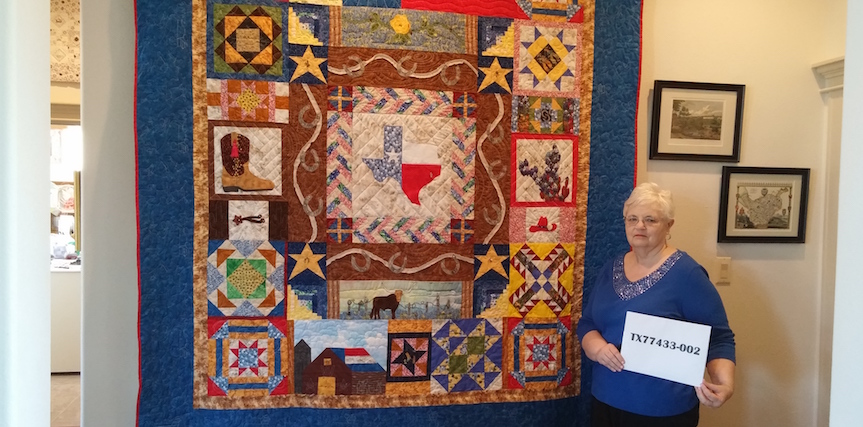
[addtoany] [space height=”10″] Cathey Spies (CS): This is Cathey Spies. Today’s date is September 25, 2015, and I’m here with Deborah Woolley. Hello, Deborah. Deborah Woolley (DW): Hello. CS: We’re in her lovely home out here in Tomball, which is just a little way from Houston, Texas. We’re here to talk about her quilt. So tell me about the quilt you’ve made; or touchstone, as we’re going to call it. DW: Okay. Well, I think probably most people that are born and bred in Texas want a Texas quilt. I had started a bee in my home a number of years ago and we met every Tuesday and it got too big and we moved it to a church and then we moved it to a quilt shop [laughter.] and it just kept growing. And one of the members by the name of Carol Stewart offered to do a block-of-the-month for us and she had a Texas quilt pattern that she was altering and changing it around to make it a little bit more original and so we started on it. I was the only person in the group who finished. And that’s it [laughter.]. I know. I stay with it. CS: So you might say this quilt has a special meaning for you? DW: Well, yeah, because it has a lot of personal stuff in it. The blocks are all my favorite choices. The only thing I had was just a rough pattern, so with the applique blocks I just took the liberty and went on. I like to embellish my quilts. I put a lot of things on them and so this was an opportunity to change it with a lot of things. It’s got a lot of charms on it, I like the hand-dyed fabrics in it, you know, it’s just representative. And then I personally did not quilt it. My friend Carol Stewart who taught the class, quilted it by machine, she’s a long-arm quilter. And if you look at the quilt there are initials, our names, you know, there’s all sorts of cowboy symbols. It’s quite lovely. She finished what I started probably. You would have to call it a two-person or joint effort. I think I don’t really enjoy that finishing part. I like the design of it and the colors and the patterns and all that. CS: So would it be safe to say that if somebody just walked in, like I did, and didn’t know the back story, what would I conclude about you by just looking at this quilt? If I thought, oh my gosh, she made all of this herself. Look at this piece; look at all of these fabrics. DW: Well, I think probably what you’ll get from me is color. It’s all about color. It’s about a challenge. It’s a big quilt, and to stay with something that big, you know, so she went through a lot of trouble for one person basically. And so I appreciate that from her. You know, I mean, it was fun, I enjoyed it, I like playing with fabrics and manipulating them, and that’s what I got to do. CS: Which brings me to our next set of questions. Tell me about your interest in quilt making. You just did; it’s all about the fabric and manipulating them. DW: I think, in my case I got some friends who decided to help me rehab with quilting. I know that are a lot of people who quilting has brought out of a kind of a dark time in their lives. My grandmother was a quilter and did beautiful hand pieced, hand quilted quilts, you know, the sort that you dream about owning, so I knew what quilting was and I had bought quilts from the Amish community. They’re really loved there. But after ’96 I had the time to do it and that’s a big part of it right there; having the time to do it and having the financial resources to be able to do it because quilting is not a cheap hobby. You don’t do it out of necessity now. We do it out of a love for creating something. CS: It’s true. DW: I mean, I think probably when quilting started it was a necessity, you know, and people were putting old clothes together because they were cold and today, I don’t think that’s so much our problem. I think now it’s just a way to express ourselves. CS: So about how many hours a week would you say, on an average, do put into a project once you are getting into a project? DW: It depends on the project. I mean, different projects call for different things. I’ve only done two quilts with groups of people: this Texas one and another one that’s in my bedroom and those were done over the course of a year, so it was an ongoing process. I worked on them every week, maybe 8 hours to 10. It just depended on what we were doing. A smaller quilt, of course, doesn’t take that much time. I mean, you’re not going to spend a year making that. I don’t like to spend a year any more [laughter.]. My friends tell me I’ve gone to the dark side [laughter.] because I tend to like art quilts. How many big quilts do you need? I mean we’ve got a lot of big quilts. My kids have big quilts and my grandchildren have big quilts, so I just gradually have gone over to smaller, artistic type of things, but they are still technically a quilt. Our definition of quilt is basically two layers of fabric with something in between with stitching to hold it together, you know? That’s a quilt. There’s nothing in the rule books about size. I think when I first started quilting there were what I all the quilt police and everything had to be precise and measured and all this sort of stuff and gradually as I went a long I was thinking, ‘No, I don’t think so [laughter.]. If you don’t see a mistake running past on a horse, then you’re okay. You know, you do it for the love of doing it. I’m not a perfectionist. I’m not competitive. I’ve shown before, but I only show because I’m invited to show not because I want to win anything. I do this for me and not for anybody else. CS: I love hearing that. So, I see that you were not self-taught. Who did you learn from? DW: I first started out with some girlfriends teaching me. My first quilt was called the 5/8 Inch Quilt. That’s because I had sewn clothing in my past so I thought everything had a 5/8 inch seam. The little quilt I was making [inaudible.] kept getting smaller and smaller. And so I call that the 5/8 Inch Quilt. I did remake it and it was much bigger when finished. Fortunately, it was all squares and triangles, so it went together okay. That was my first endeavor. After that I started taking classes. My first class I ever took was at Great Expectations, at Karey Bresenhan’s shop when they were out on Memorial, and I did a quilt there when Minay Sirois taught it, and it was all hand pieced, all hand stitched and quilted. The whole thing, you know, which was good because you need to know those skills. I can do them if I want to but I don’t have to. Quilting has become streamlined these days. CS: Yeah, it really has. I know that your grandmother quilted. She did it all by hand? DW: All by hand. CS: Did she have one of those frames that hung from the ceiling? DW: She had a frame that my mother purchased from probably Jo-Ann’s or someplace. I don’t know where they got it. It may have even come from Woolworth’s. I don’t know. But it was a stand-up frame that she could set up and take down. But she would sit in her chair and quilt, you know? She would hand piece and we would all have quilts. I probably have one of the few double-knit tablecloths ever quilted [laughter.]. My grandmother was a true person who made it from what she had. She didn’t necessarily go out and buy fabric unless it was for a backing, and all the quilts I have from her are made out of our old dresses. So, I can look at them and remember different things, which is a nice memory, whereas today we tend to go to the store and buy what we need. CS: Exactly. DW: There is a movement now for re-using that hasn’t been there for a long time. I think we’re going to do a lot more of that. There’s a lot of repurposing going on. And you see that, I think, more in the art quilts end of it than you do in the big traditional piece quilts. CS: What aspects, one or more, of quilting do you just not enjoy? DW: Cutting it out. CS: You didn’t have to think long about that. DW: No, I don’t like cutting it out. I’m not a straight line person and if you’re cutting for a pattern you have to be very precise and I’m not precise by nature. I’m flawed if you get down to it. Another thing I really don’t like is, I don’t like the actual quilting. I like the design, I like choosing the fabrics and colors, I like putting it together and sewing it together, but in order to do that I must cut, so I do. However, with the invention of the long arms and long-arm quilters, I am so thankful for those women. I do quilting on my small pieces but on the big ones, I’m more than happy to share my quilt with someone. CS: So what quilting groups do you belong to? DW: The Tri-County Quilt Guild, I participate in several small groups. I have an art quilt group that meets at my house once a month, I have another group that I attend once a month that is all hand work, then I have another group that I attend once a week that is basically hand work and crazy quilting, and then another group I attend once a month that is strictly crazy quilting. You learn from people. It’s social. It’s what the pioneer women did. They sat around together and quilted together. They never would have gotten very far on their own. CS: Have you picked up new techniques from some of these? DW: Oh, yeah. There’s always sharing. CS: Do you have a favorite, or something that you never knew about until you saw somebody doing it? DW: I think everything I learn is kind of a new revelation. I attended a lot of classes and tried different techniques. I like techniques. And I’ll go and learn a technique. Whether I use it again or not is not the important thing; it’s exposing yourself. And then when you get around other people who are taking more classes, I’ll say, ‘well, here’s the way I do it,’ you know, everything is new. There’s no one big ah-ha moment or anything like that. I think it’s just a gradual thing; the more you do, the more you know. It’s learning one thing at a time, the more people you’re around. CS: So tell me about where you go; your studio, your workroom. Are you one of these who just kind of disappears in there and no one may see you for a couple of hours but they know where you are? DW: Yeah, I have a studio right here in the house. When we got the house we did it. However, now it has expanded. It was the one room, now it’s two rooms totally and half a dozen closets. CS: Dare we say it’s growing? DW: It’s spreading like wildfire. Vendors like me because if it’s new I want to try it. I think I’m ADD. CS: I see you very much using a design wall. Just very at ease with using one. I know that you’ve got one and I can picture you trying different combinations of fabrics or colors together then throwing them down and saying, ‘now let me see.’ DW: If it’s a large quilt, yeah. If it’s a small quilt, not so much. I do a lot of small pieces and they just happen. I kind of have a direction I want to go. Like, if maybe one day I want to see if I can print on tea bags then put tea bags on a quilt, then I do. Or, I may want to paint on a quilt; paint fabric and then use it in a quilt, so that will become integrated [inaudible.]. And then sometimes I’ll put something on the design wall and keep it up there for six months before I finally decide what I want to do with it because I like to design fabric. The quilt shops don’t like me anymore because of that. However, if you have new embellishments or ribbons or trims, or new technique, it’s all good. There’s a lot of room at the table. CS: We’re going to change focus here for a bit and talk about designs, aesthetics and craftsmanship. Think about this a minute if you need to. What do you think makes a great quilt? DW: That first glance that you take; whether it grabs your attention or not. And I think, for me personally, there’s a color story that’s got to develop first. CS: Like, what do you mean by that? DW: I don’t tend to like quilts that are on a white background. They’re pretty and I can admire them and all that, but that’s not where I like to work. They don’t catch my eye. I prefer something that’s got bright colors and a happy theme on it. Yeah, I like that. But it has to catch my attention and it’s gonna be through color first. That’s what’s going to catch my attention; then I’m going to go look at the workmanship. However, there are many beautiful quilts that I personally would not do that I totally admire the workmanship and the craftsmanship and I totally salute them for the hundreds of hours they put into their craft, because I know what it takes. Just because I choose not to do that doesn’t make it unlikeable, it’s just we work differently. And that’s okay. CS: Then I think this next question absolutely does not fit here, but I’ll ask it anyway. What makes a quilt appropriate for a museum or special collection? DW: Any quilt. Yeah. There is not one kind of quilt. I believe we need to preserve the past, but we also need to preserve for the future, too. And somewhere in time, I don’t know quite where it happened, we went from bed coverings to art on the wall. I don’t know when that happened, but there’s need for both of them and I think there’s probably a lot of people like me. How many big quilts to you really need? CS: Can you think back about people, artists, who have influenced you in what you put together; your quilts or your combinations of color? DW: There are so many people, because I like a lot of different techniques. I like the work of Caryl Bryer Fallert a lot; her use of color, her expression. I don’t think there is just one person. I like Caryl because of her color. I think that’s why her name comes to mind. There are so many talented quilters out there Sharon Schamber, I mean oh my gosh, her work is to die for. But am I willing to give that much of my life to that? I think the thing is with quilting, it is one thing I do, it doesn’t define my whole life. CS: You keep in it balance? Is that what you’re saying? DW: I don’t know if it is so much in balance, but sometimes it takes over and then other times it’s in the background. It is just one of many things I like to do. I also weave. I also like to do hand stitching and felting. Fact is, bottom line is that they are all fiber related, and so they are connected. I like to do crazy quilts; that’s a lot of handwork, there’s not a pattern for it, so I like it. It’s innovative. CS: Let’s talk about machine quilting. Any chance of getting a long-arm quilting machine in your future? DW: I looked into it one time. I was seriously going to do it. Was going to take one of the bedrooms in my house and put this machine in there. Everything I was looking at was going to cost $30,000 and I was thinking, ‘Hmm, I can get a lot of quilts quilted for $30,000. Yep.’ [laugh.] No choice. There are people who are good at that, and I have no problem with that. A lot of people don’t want to do that because they think it is taking away from quilting. But that’s not the part that I like. It’s not for everybody. CS: Let’s talk about where quilts fit in American life. We’ve touched on that already: how we’ve gone away from having to use them as a utilitarian thing to gradually seeing them as works of art on walls, in exhibits, we wear them [laughter.]. DW: Taste needs to come into check with this, but it doesn’t always, though it should. I’ve seen some pretty bad things walking around at quilt shows [laughter.]. I have a couple of pieces that my children will say, ‘Please don’t wear that in public’ But fabric permeates every inch of your life. We all wear clothes, we all sleep in beds, you know? Our furniture is upholstered with it, our cars are upholstered with it, and we dry our dishes with it. It’s all pieces of fabric put together in different ways. It’s part of our lives, you can’t get away from it. CS: Aside from Texas, how do quilts reflect you? DW: For one thing, my quilts are noisy. CS: I think they’re bright. DW: You can just look around the house and there’s color everywhere. I been known to take a traditional pattern and put very strange fabric in it. That’s okay. I think what you can say about mine is that they are bright. They’re colors that I like. And I’m not going to work on a quilt that I don’t like the colors. I think sometimes some quilts don’t come out so good. Those are the ones you might put in the dog’s bed. It happens to everybody once or twice in their lifetime [laughter.]. CS: Pioneer women, as you’ve pointed out, would get together and quilt out of necessity. They relied on those quilts to keep them warm over the months. What aside, and I’m not demeaning the art aspect of it, do you see quilting as a growing part of American life anymore? DW: In the circle of friends I run into yes, it is. It’s a very viable part. I have acquaintances that go to week-long retreats two or four, five times a year. I tend to go to my groups because number one, I’m going to learn something from somebody. I don’t know what, but I’m going to learn something. Or I’m going to have a chance to share something with someone. And number two, it is social. And I totally believe that for those pioneer women and our ancestors it was very much a social thing that they came together. But for the most part, when you really get down to it, quilting is very solitary. It is an individual endeavor. I do my best work when I’m by myself. I do not do good work when I’m in big groups of people. I learned that about myself. I’m better in a very quiet room working without a lot of things. But, I do that because I’m aware that solitude is not the greatest thing in the world for you. You have to have social interaction. CS: Do you think that quilts have special meaning for women’s history in America? DW: Probably yeah, I think so. What was it? One of the World’s Fairs that they issued a call out to women to produce quilts. [inaudible.] And we see more and more men getting involved. I don’t know what the statistics are. And today because quilting is so expensive chances are the person whose doing it is okay financially and not a lot of issues and so their lives are a little different. They’ve got the time, they’ve got the finances and resources to do it. They’re not, you know, so busy that they can’t do it. Or so poor they can’t do it. I mean, it will bankrupt you. CS: It will. When my mother died many years back, she quilted, my grandmother quilted, all the way back. I don’t know why I didn’t get the bug. I don’t. DW: It skips generations. CS: But, there were two huge blanket boxes in her house of just the tops. My dad was in the service and she had a lot of time to sit and she did all this stuff by hand. Her mother did it by hand, so on and so on. There must have been over 100 tops in there. Some of them were pieced together and still had pieces of paper behind them like they had out patterns from newspapers. DW: Yeah. Actually some people, a long time ago, used to use newspaper as batting for insulation. CS: I’ve got one that they had used during the depression. DW: Back in the ‘30’s, I think it was, they used to print quilt patterns in the newspaper and you could mail off and get one, or something like that. And so, they had no choice but to use the newspaper. I’m not a big fan of paper piecing. I find it very time consuming, so my hat is off to them. I know that they did a lot of that. We have so many tools now. We have machines that if we’re clever enough or computer savvy enough, we can get a machine to cut out our pieces for us. CS: I’ve seen that. Do you ever use a rotary cutter? DW: Yeah, absolutely. CS: I see them used more and more often. Thank goodness for rotaries. DW: Well, I don’t know when the first rotaries came into being, but rotaries were there back in ’96 when I started quilting. I don’t know prior to that how long they have been there. But now they have machines that you can cut out quilt pieces. I have a cutting machine but I don’t use it to cut out quilt pieces. I mean, I just don’t. It’s not what I use it for. But there are some that are specifically created for fabrics. The temptation would probably be there. CS: Here come the holidays, do your kids wonder if they’re going to get something from Mom in a quilt? Or do you give them a quilt then it’s, ‘Don’t ask me for another one’? DW: I only make quilts on their request, if they want something. I’ve made them a tee-shirt quilt, it’s a labor of love, but the true compliment comes when you make a quilt because you enjoy it and they say, ‘I really like that quilt; can I have it?’ The chances are they’re going to walk away with it. I have a son who seems to pick the best of the best. He’s not dumb; he knows. He can spot a good quilt. CS: So, what’s your next quilt show? DW: My next quilt show? The International Quilt Show [in Houston, Texas.]. I don’t put quilts in stuff anymore. I’m doing it for me. CS: But we can see you at the International? DW: Yeah, then I’m going to Tokyo in January. CS: That’s wonderful. DW: I’ve been to England, to Birmingham. I love that one. And of course all the local ones and stuff, but the next one is the International. We’re fortunate here in Houston to live near such a good show. But it’s overwhelming. You have to be able to pace yourself. You can see some little thing and then you think, ‘Oh, how many years did it take that person to do that?’ And it does take years sometimes for some of these quilts these people turn out. I’m not competitive enough to it. I do it for pleasure. If it frustrates me then it’s not fun and it’s a happy time. Do I like to challenge myself? Every couple of years I do a really highly-technical quilt just so that I don’t lose skills. But I don’t know if I will do another technical quilt because I’m having too much fun playing [laughter.]. I’ve done technical quilts, I can do them. I’ve done them and if I have to I can do them again. But I don’t have to. I can do what I want. CS: That’s nice. I like to hear that. DW: One of the best quotes I ever heard about quilts was a lady who came to our guild not too long ago; I wish I could remember which speaker it was, but her whole thing was to use your quilts. I think it was Diane Gyleen, actually who said it. She said, ‘And then one day they finally had the sense and took that quilt on a picnic.’ And that’s the fun of a quilt. You take it and you use it. As I’m teaching new quilters I always tell them it’s only fabric. It’s temporary; it’s not going to last forever. Use it, enjoy it, don’t put it in a box and not use it. Put it out, let your kids cover up with it. When my grandkids come over and the weather’s too hot to play outside or whatever, we build tents with all the quilts in the house, and we cover the dining room table and we play under the quilts. That’s what it should be. I’ve got to touch it; I’m not going to be here forever. I do have a couple I’ll probably put in the coffin with me [laughter.] just because they were hard to make. I have one I call my shroud [laughter.]. People laugh at me, ‘You think I’m kidding, don’t you?’ It’s temporary. That’s the thing. Yeah, we like something to last and think they’re going to be in a museum forever and all this. It’s not going to happen. Maybe to one person or 1% of all the quilts ever created, but let’s use them up. Like, I’ve had relatives pass on and you go into their linen closets and you find all these beautiful linens they never used. They were saving them. I want to know what they were saving them for because by the time anybody else got them the creases were in there permanently and you were never going to get them out [laughter]. CS: I would like to thank you for allowing me to interview you today Ms. Deborah Woolley. DW: Thank you. CS: And as a part of Quilters Save Our Stories Project. You can look for this to be on our website when depending on how long it takes me to transcribe this and stop laughing in all these places. We concluded our interview at 3:36 in the…
by Janneken Smucker | Aug 16, 2016
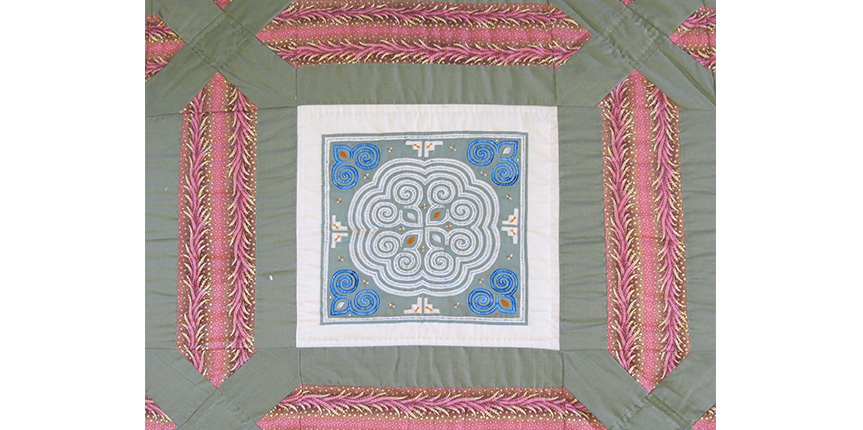
[notes from the interviewer- Emma Witmer is an Old Order Mennonite. The interview was recorded on pencil and paper at Emma Witmer’s request. Portions of the interview that were not recorded verbatim are noted in brackets. There are no photographs.] HG: How did you learn to sew? EW: Mother was always sewing and so we tried to sew. I was about four years old when I started making dolly clothes. The first time it didn’t look, but I improved in a week’s time. Mother made some crocheted rugs. Dad whittled a hook out of wood. We would sew carpet strips together and mothers crocheted them into rugs. I did some hand piecing before I started school. [Soon after she made her first quilt, a neighbor moved in who was sponsored about twelve Ukrainian immigrants. Mrs. Witmer’s mother asked her if she would donate the quilt to this family because she could always make another one. She decided to donate the quilt.] My grandmother, my father’s mother, made each of her twenty-seven grandchildren quilts from start to finish. [The children received a quilt by choosing a number that corresponded to a quilt.] Quilting has been in the family. HG: What is your favorite part of making quilts? EW: Picking the colors. On the best quilts one color does not stand out and say ‘Wee!’ I only went to school for eight years. I always got an A in art but never in arithmetic and spelling. HG: But you must use math to do the pieced quilts, don’t you? EW: Yes, but I use a calculator. We didn’t have calculators back then. I wasn’t too bad in math. I only got one B in art. That was in the first semester in a new school. All we had to do was color pictures. The teacher said she never have farm children an A before but if she didn’t she’d have to give someone else an F. We had a large classroom with a stove in the back. We threw our potatoes on the stove and took them out at lunch. That was our hot lunch. HG: How did you begin the quilt shop? EW: [Mrs. Witmer’s mother ran the quilt shop for twenty-six years and Mrs. Witmer has taken over for the past eighteen years. The business initially began when a fabric salesman from Philadelphia appeared one day and said he could take a group of quilts to sell in Philadelphia. Mrs. Witmer’s mother put together twelve quilts for him to bring back with him. Later he returned with ten and said he could only sell two. At that point, Mrs. Witmer’s father told his wife to put a sign out advertising the quilts for sale.] HG: Did your mother tastes in color similar to yours? EW: Yes, but during the first years of the shop half the quilts she sold were tans and browns. Sometimes they had avocado, but that color went out. She had one with hex signs, horse and buggy, and a barn. Her designs were appliqué. With appliqué you are not limited to squares and triangles. HG: I noticed that you signed a quilt for the customers that were here earlier. When did you begin signing quilts? EW: I occasionally signed quilts when people asked. In the past couple years I’ve been signing most of them. A 1200 dollar one gets signed in thread. HG: Do you donate quilts to charity auctions? EW: I do a lot of donations. The more I give the more I sell. For the Make-A-Wish Foundation I donated a cross-stitch with six different transportation vehicles. [Mrs. Witmer mentions several other charitable organizations to which she has contributed.] HG: What is your favorite pattern? EW: “Emma’s Dream.” [Mrs. Witmer designed the “Emma’s Dream” appliqué pattern. Before the interview she explained the pattern to a customer and said, ‘I have pretty dreams, don’t I?’] I do have pretty dreams, but I have to turn them off at night or I won’t stop going. I have to get up early in the morning to get more quilts ready. I saw a picture in a magazine from a quilt show. That gave me an idea. I got out a Baltimore Beauties pattern and did some free hand drawing. I was going to name it Victorian Romance, but my friends insisted I name it “Emma’s Dream.” HG: How is this “Emma’s Dream” different than others you have made? EW: I have added lace. The original way of doing it was with two rows of color. Every one is a little different. There is a rose placed in the center of the circle in the center of the bow at the top. Another “Emma’s Dream” being made has twelve different blues. Blue is my favorite color. In this quilt there are a lot of different rose and blue colors, with green and yellow to break it up because it gets too pink. I designed the corner so it doesn’t hand on the floor of a double bed. HG: Do other members of your family quilt? EW: Yes. I have a sister near Kutztown that is also in the quilt business. Her shop is called Quilting Friends. She and I are different, with some similarities. HG: How are you different? EW: She has created a few designs. Rather than buying a pattern she would rather draft them to fit. I’d rather buy the pattern ready made to save time. [Mrs. Witmer’s shop is larger than her sister’s shop, and her sister’s shop is also part of a farm and produce shop.] HG: What makes a great quilt? EW: Sometimes you will have a red and white quilt with fine little pieces. One time I counted 105 different fabrics and not one was brighter. Anything that makes the quilt say, ‘Wow.” Not everybody likes vanilla ice cream with chocolate sauce. Some people like butterscotch. [Mrs. Witmer was once on the television show Simply Quilts. Rachel Pelman, a Lancaster quilter who designed the popular “Country Bride” pattern, was also on the show. Mrs. Witmer laid out a “Country Bride” quilts in an unusual color scheme and Rachel Pelman asked her what pattern it was. Mrs. Witmer uses this as an example of how color can really change the visual effect of a pattern.] It’s almost endless what we can do with the fabric choices we have today. HG: How can someone become a great quilter? EW: Practice. Some people don’t practice to do fine stitching and some don’t have the ability to do fine stitching. [Mrs. Witmer tells the story of teaching a young lady to quilt. The student said she simply couldn’t get the stitches to come out nicely. Mrs. Witmer relieved a bit of the taughtness of the quilting frame and the young woman was then able to quilt fine stitching. The fabric had simply been too taught.] Using a good needle is also important. HG: How can the art of quilting be preserved for the future? EW: By teaching the younger people to appreciate needlework. Quilts have made a comeback. Lancaster is the quilt capitol. Some say Paducah, Kentucky is the quilt capitol, and maybe it is for designing quilts but not quilt sales. HG: Have you taught young people to sew? EW: Our children know how to sew, especially clothing. My oldest daughter has a fine stitch but it takes her longer. My younger daughter has three children and helps on a dairy farm, so she doesn’t have much time to quilt. HG: Do you make quilts for members of your family? EW: Yes. As they get married, my daughters have eight quilts. The boys get two. My grandchildren get a quilt when they turn sixteen. I don’t know why I wait until they are sixteen to give them a quilt. HG: What do you like about running a quilt shop? EW: Making people happy by having the perfect quilt. They send me wallpaper and we go from there. Sometimes they bring in designer sheets and towels from the bathroom to match colors. I don’t sell patterns and supplies. I tell them Lancaster County is quilts. In any other part of the country a quilt shop sells supplies. HG: Do you purchase your supplies in the area? EW: I send for some. Fabric salesmen come with suitcases and sometimes with a truck. It’s my downfall. I’m like a kid in a candy store, one in every flavor. HG: Do you travel to area quilt shows? EW: I have taken in the Heritage Center quilt show. One time I might get to Colonial Williamsburg. Another dream is visiting the Shelbourne Museum. HG: Do you have younger Mennonite ladies working for you? EW: Yes. Young Mennonite women enjoy doing the piecing because you can pick it up and put it away easier. Also senior citizens. Young mothers and senior citizens still need to cook and clean for the men. You can do it in your spare time. If you really enjoy something you will find more spare time. I have a mug that reads, ‘Quilting Forever, Housework Whenever.’ HG: What type of work do the Hmong ladies in the area like to do? EW: The Hmong from Laos do a lot of the fine stitching. Appliqué is what they like to do. HG: When did you first start making quilts with Hmong patches? [Mrs. Witmer has made some quilts with patches she purchases from Hmong women. The patches are decorated with very intricate reverse appliqué stitching.] EW: Approximately eight years ago. The Hmong brought me some squares and said I could purchase some and I would be helping people and I would have something to keep. So I did something with them. At first I called the quilts “Hmong-Amish” quilts. It just didn’t sound right. It didn’t sound appealing to me, I guess. HG: What do you call these quilts now? EW: I say they are the combined Hmong and Amish. I call them “Harmony A-Hmong the Cultures.” I sold one to a woman in England. She said she wanted to show people what fine needlework really is. Most people who buy them are needleworkers because they know what goes into them. HG: [Shortly before leaving the interviewer spoke with Mrs. Witmer about spots and imperfections on quilts.] EW: When a quilt gets messed up you can take it down and wrap up. If you take a painting down, you can’t do anything…