by Emma Parker | Jul 28, 2016
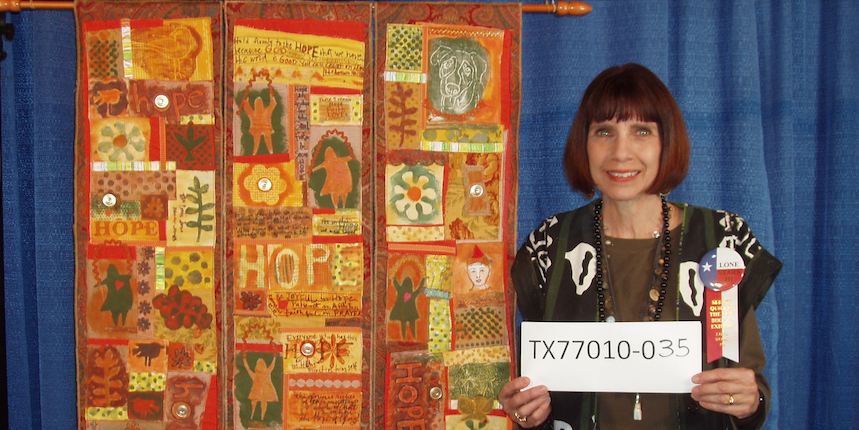
[addtoany] [space height=”10″] Karen Downer (KD): This is Karen Downer. Today’s date is November 4, 2011 and it is 3:15 approximately and I’m conducting an interview with Fran Patterson for Quilters’ Save Our Stories a project of the Alliance for American Quilts. Fran and I are at the International Quilt Festival in Houston, Texas. Fran, would you please tell me about this fabulous quilt you’ve brought with you today, just talk about it a little bit in general. Fran Patterson (FP):This piece is a triptych, about ten inches wide, thirty across and thirty-four high. It’s a stenciled mixed media piece. It’s primarily done on fabrics with acrylic paint and textile media. I etched my design into styrofoam blocks and printed with the paint onto the fabric. I used rubber stamps on some of the designs. I even experimented by burning a design into the Styrofoam. It was fun trying different techniques, making it a very spontaneous piece. I made the pieces separately and individually and let them dry. I laid them out to view them all at once and figure out what shape and color and texture would go best with the other ones. This approach would let me change each shape easily to achieve balance. I did this in the fall using autumn type colors. Here in Texas we don’t have dramatic leaf color changes, but its certainly my favorite time of year. This piece was actually made for a show at Hope Chapel Church. Every artist was told to use the work “Hope” in their art piece. It was an open ended show, so you could do anything you wanted as far as the design went. This gave the show a varied presentation with many mixed medias. I looked at some scriptures that had the word hope and used things that seemed hopeful to me. I used images of children with their arms up jumping rope or rejoicing and playing. My dog’s portrait is in the upper right hand corner. Using lots of birds and flowers and things that reminded me of hopefulness, and happiness, I accumulated those images and put them together. KD: Does it have special meaning for you? FP: I try to bring a lot of enthusiasm and warmth into my art pieces using color and whimsy. The word, “Hope,” was very appropriate for me to play with because it seemed playful. A lot of times when people look at my work they say, “Oh this makes me happy to look at this piece.” That’s when I feel like I have accomplished my goal. KD: Why did you choose this one to bring today to this interview? FP: Because it was bright and it’s one of my favorite pieces that I’ve done in the last couple years. KD: When somebody looks at this, what do you think they might conclude about you as the maker? FP: I work in a lot of different medias, one thing I love is children’s artwork, and primitive and outsider type art. I worked at a psych hospital for eight years and I taught art as a therapy. I love spontaneous art from non-artists and I think this piece captures that idea, because it has a lot of child-likeness in it.. KD: You mentioned using art in therapy, are there plans for using this quilt? Do you have any plans for this quilt? FP: Not particularly. I have it in my collection and I am sure it will appear in another show. t’s also a good teaching aide if I happen to be teaching. KD: It is a happy quilt, it does make you kind of happy when you look at it and those are the colors in the east that we’re seeing right now. I’m going to move to a section of our quadrant questions that involves your involvement in quiltmaking. So tell me about your general interest in quiltmaking and how did it start? FP: I came in the back door of quiltmaking because I’m not a traditional quiltmaker. I have a degree in art and I have always loved textiles and fabrics and yarns even as a little girl. I remember making my own paper doll clothes and doll clothes out of fabrics and at a very young age. My mother would sew our clothes and I would get the scraps and put them together. My grandmother sewed on a Treadle sewing machine. She wasn’t very good at it but that didn’t stop her from making a lot of things and of course I loved anything she made. Then the other grandmother was very meticulous and precise and a perfectionist and she made a few things but not too many, because she was such a perfectionist that it took her a long time. When I was a child, most women did some kind of hand sewing or quilting, so I was exposed to that. I was always around fabrics so I’d pick them up and make things out of them. I remember I had a great aunt that would paint bedspreads with some kind of fabric paint. I don’t know what she used, but she painted big morning glories and flowers and used them as bedspreads. I thought that was just the most beautiful thing I’d ever seen when I was eight years old. It influenced me to want to do that kind of thing. I pursued that and by the age of eight to twelve I was trying to make my own clothes and my mother would teach me. My mom didn’t really like sewing all that much either. But there was a home-ec teacher that was a really good teacher and she would teach us how to do pleats and pockets and buttonholes. Pretty hard stuff for a 14 year old. I learned a lot of technical skills with fabric. I entered a sew it with wool contest when I was in high school. I made a coat when I was about 15. I think I won a prize in that contest.So I started young with fabric.It’s always been a part of who I am and then when I went to college I majored in art. I worked with lots of different types of medias. I had a teacher at Texas Tech University that specialized in fabric, fiber, weaving, macrame and tie-dyeing. I loved every bit of that. I did some summer workshops in Taos, New Mexico. KD: For you, what came first, art or sewing? Or was it always both there? FP: Well it was all together because I would make things, art things out of fabric and materials. I I still do, nothing has changed. I do a lot of mixed media, painting and stenciling and rubber stamping on the fiber and the fabrics. I love the tactile quality of it, there’s something that really draws me to fabrics. I manipulate those in with other things. I’m not a purest,I don’t have one technique and one style. I am very non-traditional, and love the tactile quality and the texture of textiles. KD: In addition to color, and all of those techniques, I notice that in this quilt you use words, you use text and that’s not really common. Can you talk a little bit about that? Does that convey your message or what is that about? FP: I do quite often put text or words in my artwork. I notice here at this show they do have a section with quilts with words. I love to put messages in my work. , I might start scribbling words and ideas or parts of my journal or maybe even paint over them where you can see little bits and glimpses of them. In this particular show I had to use the text that had the word, “Hope,” in it. Quite often I will use words and also just the shapes of letters are just wonderful to use as a geometric design or whatever, not even worrying about what the word says. I love doing that. Someone said my work has a spiritual spirited flavor to it. I like to put proverbs or poems or thoughts into my artwork that kind of relates to the piece. KD: You mentioned just briefly journaling, how do you use journaling to contribute to your art quilts? FP: I love quotes and I collect quotes from anywhere; on the Internet or books or things I hear people say, particularly about art and creativity. I really enjoy writing messages down and I go back and read them later and either consciously or subconsciously incorporate them into my work. I’ve given workshops for non-artists several times , because I think everybody is creative. Some people just don’t know how to express it. I found working in the psych hospital with people that were shut down that I could get them to start doing the art piece and then they would progress and they would relax and start enjoying it. That was when insurance was paying to stay two or three months and by the time they left have a nice little collection of work that they did. I would say, “See you’re not stuck, you started here but you ended up here and this shows how you can change and grow, and you can work with your doctors and your therapists and your counselors to grow and get out of your problem, out of your stuck-ness.” It seemed that art was the easiest and fastest way to help people heal and have self confidence. KD: Are there other quiltmakers among your family and friends? FP: Well my sister has published two books, and she has taught art wearables for quite a few years and worked for Bernina. She’s four years older than me so she’s kind of a mentor to me. She does beautiful quilts and is very talented, so she’s been very influential in my life. KD: How many hours, how much of your time to you devote to making quilts? FP: Like I said, I’m not a traditional quiltmaker, so it’s not just making quilts, but it’s using mixed media with fabric and fiber. But I work in my studio as much as I can. I have an active studio and if I’m getting ready for a show then I push it 24/7. At other times I might take a break and work in spurts, and not work everyday. I try to do some sketching or something in my studio as often as I can. KD: Are there any aspects of quiltmaking, be it art quilts or other kinds of quilts, are there aspects of it that don’t please you? That you don’t like? FP: Because I’m not a great technician or a very precise type person, I don’t particularly enjoying the finishing off process. Putting the back on and doing the edges, and that kind of thing because that’s just kind of tedious and boring. I like doing the messy creating parts better. [laughs.] KD: Do you belong to art or quilt groups? FP: I have in the past. I’ve belonged to various fiber and quilt type groups and some collage groups. I’m in a collage show now with a show at Texas State Univ. I’ve been in art groups and guilds. I’m not really a big joiner or a big club person so I come and go in those groups, but I don’t mind working alone. I have a lot of art friends, and we find creative things to do. KD: Tell me about your studio. FP: It is a large bedroom that I took back after my daughter went to college. It’s just a big room, probably fifteen feet by twenty.I have a painting area and a sewing area and I try to keep the areas separate so that it’s a little bit easier to control. It can get out of control pretty fast when projects are going on. KD: Do you use a design wall? FP: Yes KD: How does that enhance your work? FP: I use it to motivate me. If I find something that triggers my creativity, colors or things from nature that stimulate my imagination I would put them up on the board. If I’m designing something, I would tack it up there and the next morning when I look at it, it looks fresh and different if you leave it for a while. You can step back a few feet and look at it at a distance and see it from a different perspective. I think a design wall is very important. KD: Technology has so influenced and what they look like and how we produce them. Has technology influenced your work? FP: Probably not as much as most people because I love the hands on stuff. I wish I were more savvy with photoshop and those kind of programs. But I love to get my hands dirty with the tactile quality. KD: Do you have favorite materials? FP: You mean with a certain fabrics and things or with— KD: Anything, embellishments, fabrics, your favorite materials to work with. FP: I don’t know if I have favorites. What I’m working on at the time is my favorite. KD: Okay I’m going to move on to a section that involves craftsmanship and design aspects. You have an art background, what makes a piece artistically powerful in your opinion? FP: I think the most important things in designing and executing a piece, besides the basic art elements, are color and value. Because if you don’t get those two right, then you could have good proportion and size and all the other art elements but it won’t hold your attention. You will lose the viewer but if you don’t have the color that makes it pop and the value that draws your eye in and lets it relax back. KD: What makes a quilt appropriate, and you’re a good person to ask this, for a special collection or a museum or a gallery, what makes a quilt appropriate for that or qualify for that? What makes a quilt right for that kind of viewing? FP: That’s a real open-ended question because I think it depends on the museum or the type of collection. This show has dozens of categories and each one has its own requirements. Technical skills is really important in one category and then creativity and techniques and maybe uniqueness is important in another section. I think it totally depends on the context of where it’s going to be viewed. A folk art museum and the Smithsonian, would have different requirements.. I don’t really think I’m really the best person to answer that question because I’m such a non-traditionalist. KD: Still a good answer [laughs.] You mentioned your sister had influenced you, are there other artists, other quiltmakers who have influenced your work? FP: Quiltmakers in particular? KD: Or artists. FP:As artists go, I like Chagall. He has influenced my work a lot, particular my paintings and some of my earlier pieces. KD: I’m going to go back to there which artists have influenced you and ask you to elaborate on some that you mentioned. FP: Okay. I mentioned Chagall and in 1982 I had a nice color photograph section in a magazine called “Texas Homes” and it was published March 1982.. I have several full colored pages and each piece is definitely influenced by Chagall because I love his dream-like imagery and these pieces that are in this particular magazine capture that. I love horses, horse imagery even though I’ve never owned a horse but they’re free-spirit and their strength and they are noble creatures. I’ve always enjoyed using the shape of horses. So each piece in this particular magazine has the horse shape in it. It has the dark values, the night tones against the brighter tones and Chagall did a lot of that. His flowing dream-like images have really captured my imagination. A quiltmaker that has influenced me Jane Cochran. She too, uses a lot of the dark against light, and bright tones and she uses a lot of whimsy and fanciful imagery in her work. And she uses a lot of buttons. A woman can’t have too many buttons! KD: I’m going to move to a section of our quadrant questions that speaks to the function and meaning of quilts in American life. You’ve covered a lot of these already about talking about how your quilts are used in therapy. I do want to ask you, how do you think quilts can be preserved for the future? FP: Do you mean physically preserved or just the tradition of quiltmaking? KD: Both. You can start with either one. FP: I think it’s really important to have children involved in quiltmaking and textiles and hand skills at a very young age because when you have learned something when young, you have an appreciation for it as you grow up. In our technology age where kids just zone out on the computer, TV, and cell phone they don’t use their imaginations. When I was a child we didn’t have those things so all I did was use my imagination and create my own play world because I grew up in West Texas and I didn’t have a choice. If I wanted to have a good time I had to create it. My mother always said, “If you are bored, its your own fault!” If the parents could influence kids to explore with paints and fabrics and crayons, anything and everything, at a very young age it would enhance all areas of their lives. Children are all artists, you know they’re all born artists as Picasso said. We must remember how to be a child after we grow up. KD: We’re approaching the end of this interview and you have made so many wonderful comments that are so valuable. I want to take this opportunity to ask you is there something that you were hoping to get on record that didn’t come out in my questions? Is there something that you would like for people to know if somebody comes across, acquires your quilt seventy-five years from now and they see your name on it, what do you want that person to know about arts and quilts? FP: That quilts have been such a big part of our heritage and that they need to continue to be. The human spirit of creativity and expression is such a God given important aspect of being alive that I just hope and pray that it continues on forever. KD: Okay thank you. Is there anything else we didn’t cover that you want said? FP: I don’t think so [laughs.] KD: Okay. FP: Thank you Karen. KD: I’d like to thank Fran for allowing me to interview her; it’s been such an honor just to see a little bit inside of her head, for Save Our Stories oral history project. Our interview concluded at 3:45….
by Emma Parker | Sep 6, 2016
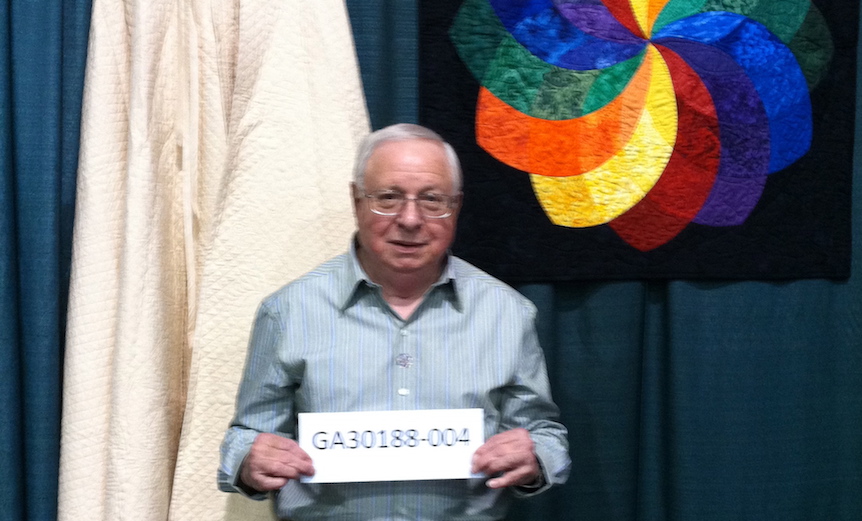
Amy Milne (AM): We are rolling. And this is Amy Milne. Thank you for joining us. Thank you. Today’s date is Thursday, October 20th and it is 12:23 p.m. And I’m conducting an interview with Holice Turnbow for Quilters’ S.O.S. – Save Our Stories, a project of the Alliance for American Quilts. Holice and I are at the Georgia Quilt Show in Duluth, Georgia and happy to be here. Holice Turnbow (HT): Yes. Absolutely. AM: And let me make sure all my little bars are going so I won’t be paranoid. Holice, you brought a quilt and a cape with you today. Will you tell us about them? HT: Yes. I think one of the defining points in my quilt career was a project that was started back in the early nineties in which a company asked me if it was possible to preprint a whole cloth quilt in its full size in an ink that washes out. My answer was of course, ‘Yes, if you have the technology.’ So we started the project and I had to learn how to draw, literally, because while I’d had Art, I’d never drawn about this. So there was a whole series that were printed. Then there got to be a point in which I was honored by being asked by the group that did the Bernina fashion show and that was a show of quilting garments that traveled around the country, so I was asked to do that so I designed the cape based on a preprinted quilt design that I’d designed from a quilt in the Smithsonian because back in the nineties, you know, when the furor was going on about reproducing quilts in China, I had read an article that said that this protest was going on and the Smithsonian was interested in changing their focus because they were the ones that were contracting. So I called them and I said, ‘Would you be interested in having your whole cloth reproduced here in the United States and they said, ‘Yes.’ And so this particular design on the cape that I used as inspiration was from a quilt in the Smithsonian’s collection based on a christening quilt of about 1842. So I took the basic motifs off that and used it for that fashion show and I have to admit that when I saw the show, even as magnificent as I thought my piece was, it was rather dull because you can imagine the flamboyant kind of garments that the other needle workers made. But I was very pleased and I consider that probably my crowning achievement in quilting. It’s all machine quilted, silk pongee base with rayon thread. This also happened about the time that I was really becoming comfortable with machine quilting and come to the conclusion that machine quilting was okay, now that I could do it. The second piece is one that I have recently designed and I have been playing around with primary colors and it’s a design based on the traditional giant dahlia design but reducing the number of points in it to make it a little bit easier so I could find the gradations of color. Most of my work is quite simple but occasionally I do branch out and do something a little bit more complicated and the difference in this and most medallion quilts like this you see, is the way the points come together in that if you look at it closely they come together in a curve and I have not found any instructions, any pattern that describes that particular process and it’s been a chore to figure out the technique and the mechanism for doing that. Finally I believe I did. I did a second one and I still had a hole in the middle so I just turned that sucker over and just wrapped some thread around it and tied it closed. So sometimes you have to take drastic measures to achieve the results you want. But, the other design worked, I try to be a little more complicated but I still stay relatively simple and this has the three primary, three secondary colors and then the four gradations within those colors. So that’s what these are. And these two pieces on the front of the table are examples of the whole cloth preprinted quilts that were done in the washout ink and are still available. So I think that this was probably one of the crowning points in my particular quiltmaking which is strictly a design project. There have been others along the road and it’s been a case of being in the right place at the right time and so forth. AM: Are these quilts, are they in your collection now? And the cape? Or are they borrowed for this– HT: Oh no, these are mine. These are in my collection. And the collection, if I can anticipate your question, is mostly what I have collected are the whole cloth, white on white type quilts because I have done several of these, probably two dozen in all, designs, and I have used the old quilts and patterns and motifs on those, as inspiration for the quilt. In fact this one on the top was based on a quilt that I bought from a dealer who had a lot of quilts from North England and the motifs in this are very much in the style of the quiltmakers of northern England. I thought initially it was Welsh but found that it wasn’t but it was more representative of the northern English type with the feathers whereas the Welsh quilts, their white work designs or their whole cloth designs were more geometric in their construction than this was. So what I would do is sometimes with the dealer, or I’ve even bought them off the Internet, I would buy a quilt that had certain motifs that I could then expand on for this. I mentioned the fact that I really had to learn how to draw and the first ones that were done, the company purchased the designs from designers out in the West Virginia, Virginia, Maryland area, primarily Mennonite quilters because they were well known for the white work designs, the brides’ quilts that we see and I was copying their designs and with one designer, Lydia Ann Beery who lived in northern Virginia, she gave me her design after we’d arranged all the legal matters, and so it was really copying her work. So I was sitting there one day doing this, drawing these feathers and I say to myself, ‘I’ve done this before but I don’t believe in reincarnation,’ and suddenly it occurred to me: elementary penmanship. So I realized then that through life we learn things and we learn skills that we don’t know that we’re learning, that we later bring up into whatever our craft and skill is. It’s just like the way I started quilting. Many years ago, back into the sixties, we bought our first house and of course back in those days when you moved into a development, the first three people who appeared at your door was the paper boy, the milkman and an insurance agent. And so when the insurance agent came, and was talking about my plan and did I have social security, and I said, ‘Well, no, I work for the federal government. I don’t need social security. He said, ‘Maybe your wife and kids would.’ How do you get it? You become self-employed. So I started teaching needlework as an art form because I was raised in a house full of women who knew how to do all that thing and when that happens, when you’re raised that, you learn things you don’t know you’re learning. So I could crochet and of course that was back in the days when boys were called sissies if they did that. On the other hand I have an aunt that kept beating in our heads that you better learn how to sew on buttons and wash your clothes because you may never have a wife to do it. So I learned those things and so I was teaching needlework as an art form and this was in the early seventies and one day I get a call from the director and she said, ‘Do you know anything about quiltmaking?’ And I said, ‘Sure.’ Now you notice she didn’t ask me if I could do it. Because as a kid I played under the quilt. I watched it. I knew the process. And that was when the first major exhibit of quilts as folk art was traveling the country. Jonathan Holstein and Gail [van der Hoof.] were doing that and sitting out in the rotunda of the museum were these women from the National Quilting Association. So I go up and say, ‘I got a problem.’ ‘What is it?’ ‘I need to teach. I know the process but I’ve never put it together in a constructive form.’ And so I got started and at a time before it was cool for a man to quilt. And then over the years there have been really stair steps that have brought things. The first quilting event in Washington D.C., I was very prominent in that, doing the announcements, getting invitations, was invited by the Postal Service in the state of West Virginia to be part of the issuance of the postage stamp in 1978 to commemorate quilting. I got my name in the magazines. Then the white work project. Then the Hoffman Challenge came along, which was accidental. So there have been a lot of those things that has brought me along and now there are just men all over the place quilting. I’ve been shuttled to the back now. AM: Well, I was going to ask if you had been approached by other young male quilters or just beginning male quilters who sought you out as a mentor. Or had questions for you. HT: In a limited amount of way. Because in the last I would say five years, male quilters have started emerging. Back in the seventies there were really five of us who were out on the show circuit and prominent. And I was fortunate to be one of those early people. And we didn’t find then an influence or presence of men in quilting until probably I would say, the last five years, they started coming out and being more identified with quilting. Many have approached it from an art standpoint. Artists that have changed the media that they have worked with. And now there’s an Internet site called Quilt Guy, there’s one called Man Quilter, and men who have kind of come together on the Internet and now those on Quilt Guy, we have our own retreats. No women allowed. We’ve had about six retreats now and it’s fascinating to be there and see the work that the men are doing and they range from very traditional to very art-type quilts. Just depends on what their background has been. And I’m out there now pounding the streets telling people that we have good male teachers, designers, quilters, and we should have a bigger presence. You women no longer should be in charge. [laughs.] AM: Shhhh. Just kidding. Are there any folks in your family who were quilting, like you said you grew up in a household with folks who were sewing. Are family members still quilting? HT: Yes, I have a sister who is very prolific as a hand quilter. It seems that it almost jumped, not a generation but a period of time. I had aunts who quilted and a grandmother who quilted constantly during the winter time and of course those were the days before there was central heat and you covered with quilts. You had to have them to keep warm. Utility quilts. They did not do fancy work. And then there was that period of time in which the general population was not quilting and they had moved from the farm into town and there was just not a place and in my family it did not emerge again until the seventies when I started and then my sister is probably the most active. I visited a sister and a niece down south of Atlanta, Ga., the other day and gave my niece a little private lesson because she said she wanted to start and I don’t know what the future will be as far as the family is concerned. I do have a granddaughter who is an artist but she hasn’t gravitated to the quilting, although she works with my daughter in the Stencil Company, which is her company. AM: So we asked some questions before the interview to try to guide what questions we choose during the interview and you said in the questions before that you don’t sleep under a quilt. HT: No. AM: So are the quilts that you make, your quilts, are they exclusively for the wall at this point in your quiltmaking? HT: Yes, they are. I do quilts as decorations for the house. I did make a full bed quilt, but it’s a show quilt, you know, it’s one that I don’t really put on the bed. Although, I have two beds in the house that do have older quilts on them. But they’re in the guest rooms, so I don’t personally sleep under them. But mostly what I do now are the wallhangings if I need a piece for the house. And I do a lot of charity quilts, more specific things that are used as raffle quilts for benefits and auctions. But then I also do a lot of very simple things that I donate to the hospital. In fact two years ago, I met my goal of one hundred in the year. But these are so simple that they can be made in three hours. It’s just interesting fabric on top, sandwiched together, machine quilted–remember I said machine quilting is okay now that I can do it? And it’s faster. Just quilted down about every four inches and put a binding on it. But interesting fabrics. I’ve discovered over the years that you don’t have to be fancy to be good and have something good looking. It’s all in the fabric that you selected. If you select interesting fabric, you can make squares and it’s going to look really good. AM: Describe so that we can envision what your studio is like, what the place you make quilts looks like. HT: Have you ever gone out to see the junk pile at the city dumpster? Do I need to say anything else? Well, not really. There are shelves there, there is some organization, but I tend when I’m working to make kits and things for classes, that the excess goes on the floor. There are boxes all over the place with what’s in it written on it but I know where things are. Except there’s some things that it’s easier to go out and buy again than it is to look for it. It takes less time. AM: I’ve had that experience myself. I know that you also–I read this and you told me–that you were the founder, or the co-founder of the Hoffman Quilt challenge. HT: Yes. AM: Can you talk about that a little bit? HT: Yes. In nineteen and eighty-seven, I was at the National Quilting Association show in Easton, Pennsylvania and my friend was across the aisle. Her name is Betty Boyink and she lived in Michigan and was a rather prolific book author and teacher. I describe Betty, and I’ve done this to her face, as her style was Grandmother’s Flower Garden pastel fan. So I look across the aisle and Betty is standing there holding this bolt of very bold Indian Oriental fabric. Very bright orange, persimmons, blues, etc. And so we kind of joke and I say, ‘Betty, what are you doing with that?’ She said well she saw it in a booth, she recognized that it was not her type of fabric but she was intrigued by it and the vendor said, now I want to emphasize the vendor said she considered it the ugliest piece of cloth she’d ever had in her shop because she’d had it three months and only sold a half yard. And went ahead to say it was from Hoffman of California and she bought every piece Hoffman made. Now you can tell what time period it was because we can no longer do that. So we joked about it and we went about our business, had customers, so I looked over about thirty minutes later, Betty was still there contemplating that fabric. I say, ‘I’ll get you out of your misery. Go buy a couple of yards, bring a couple of yards to me, we’ll make something and come back next year and show each other what we’ve done. So we did. So at the end of the day she asked me if I had anything for show and tell and I said, ‘No. I don’t have anything to make and I don’t want to tell about it if I did.’ So she said, ‘Well let’s take our challenge and tell about it.’ So we practiced in the parking lot, put our fabric in brown paper bags. We got to the stage, made sure we were last on the program, and it had been a dull show and tell. We saw lots of Grandmother’s Flower Garden pillows that night. So, we get up there and tell it back dramatically just like it happened. At the end people cheered. I could have sold my fabric ten times on the way to the seat. We kind of forgot about it, went about our business. Next morning, we discovered there was a line of people waiting to get into the vendor hall. They rushed to this vendor, bought all she had, because we’d said, ‘Why don’t you buy a piece of this fabric which has been considered difficult to use?’ They bought all she had, she went to the phone, called Hoffman and bought two more bolts and sold all that before the end of the show. So we decided we had something going and so we decided we’d set a rule and maybe next year we’d ask people to send in what they had and we would show them at the next year’s show. I decided I’d better call Hoffman and tell them and ask them if they still had the fabric. So I called, I didn’t know the people, this person, there was a pause at the other end and she said, ‘We’re sure glad you called us because we want you to know we don’t make no ugly fabric out here. Because shops have been calling us, asking for the bolt of ugly fabric.’ I got that cleared away and we found that it was last season’s fabric, but we got through that year and got 93 pieces. So we formalized it, continued on, the height of it was the tenth year in which we got over 850 entries and the only prize that you got for it was the first prize in each category was three yards of Hoffman fabric and a special pin. Only those who made the quilt got the pin. Second prize was two yards, third prize was one. What was happening is people who were unknown, all over the country were entering and getting their quilt traveling and those quilts left and there were three groups of 40 each, a clothing exhibit and a doll exhibit. They left and never returned. They never saw them again until the end of the year. And yet thousands of people were seeing my quilt and I’m unknown and people would travel miles to come to see their quilt hanging. It’s still going on over 25 years. So the interesting thing about it is this piece of fabric did not really match the coordinates that they’d done with it because it was much brighter in color but yet I found out that Philip Hoffman had insisted that this color way be done. No one else in the company wanted it. The designers, the merchandisers or anything. But yet, he said, ‘I want that fabric.’ They were not promoting it but all of a sudden the world wants it. So they told me that he walked into the office and calmly said, ‘I told you so.’ Just one of the little trivias about it. But it’s been a phenomenon, still going, and it’s an exhibit really, of the ordinary quilter. Rarely see people there whose name is prominent and that’s the pleasure in it. And especially if you have a young person or a child because when we were doing it we’d make sure that any child or real young person got their quilt to travel. AM: That’s so cool. I’d like to ask you what you think makes a great quilt. HT: The first thing is good workmanship. I look at that first. Of course I think many of us think about dynamic design but yet excellent workmanship of a simple design is also a great quilt. And that’s why that I really emphasize the basic skills that are needed to do that. Not because there’s someone looking over your shoulder with a book of rules but yet if you do things properly, correctly, and precisely, think about how much time that saves that you don’t have to rip out and re-do, because it’s just like a jigsaw puzzle, it has to fit together. So I think a great quilt has to start with good workmanship and then the design is next, that needs to hold together into a whole that you don’t suddenly see three pieces of something there. Color, I’m not so fixed on that because the color is the quiltmaker’s choice, it’s not mine. And there was obviously a logical reason for selecting that. I may not like the combination but yet the quiltmaker had a purpose for that and so when it comes to color, it’s do those values carry out the theme which I see in the quilt? So that’s one of the things, but again the workmanship. I judged a show in northern New York about three years ago that I was absolutely excited at the number of just ordinary quilts that were extremely well made. They were comfort quilts. AM: Are there any quilters or artists or people that inspire your work? HT: That’s really a tough one because all of those quiltmakers whom I admire do the kinds of quilts that I’ll never want to do because I don’t want to take the time to do it. But I do try to understand what they do and how they do it especially as it affects my judging, you know, when I’m judging. But the thing that’s beginning to inspire me is what we’re reading about, the whole modern quilt movement, because that’s going back to the simplicity of quiltmaking which is really what I enjoy doing. And a lot of people have stashes of fabric, well my stash are five-yard cuts of fabric and bolts on walls but then I do have a personal stash that’s green, brown, beige batiks. They’re in a very simple wallhanging that I carry that over into other smaller things that I may do for charity and auctions. So I’m more impressed right now with what I see as a movement going back to simplicity and my concern is have they abandoned, are they adhering to those rules of precision, the workmanship, have they abandoned good workmanship for being fast? I hope not. I’m told by the people that it’s not. It’s the combination of simplicity, good workmanship to produce quilts for a more modern age that blend with the lifestyle that we have. How’s that for a philosophical statement? AM: Well that’s where I was going next. I was going to say, I’d be interested in to hear more from you in terms of your being a part of a growing demographic in the quilt world, men in quilting, male quilters, and how you see that. What do you think male quilters bring to the culture of quilting? HT: The demographic as I said earlier, is the whole range. I believe we’ve always known that there were men who quilted. And back in the seventies, you know, we could read about the husband who would thread his wife’s needles but would never think to put the needle and thread into the quilt. There was a man out in Kansas who introduced machine quilting to us but this was back in the forties, see. So there have always been men there and they did not begin influencing until probably the seventies when we found Michael James out of Rhode Island, Jeff Gutcheon in New York who I believe introduced a concept of the illusion of using fabric. I did a lecture a number of years ago on this, on the early days and I found that Jeff Gutcheon was the one that introduced this, not optical illusion but using the gradations of fabric and then of course Beth [Gutcheon.] did the one The Goose is Loose, which is Flying Geese that are just all over the place. See so the two of them, but especially he, had an interest in color. There were two others, there was a fellow out in Chicago that did primarily the design end of large pictorial things and then Charles Counts in Alabama who worked with that Rising Sun Quilt Co-op. But other than Michael James, not many continued so there was a period in there where you didn’t find them. I find that now that men who have emerged, are into all kinds of styles beginning based on what their background is. If they have approached it from an artistic standpoint, you find their quilts are more artistic in nature. They’re using fabric instead of paint. Then there’s a group that seems to have picked up old blocks from their relatives and they’re working on those as a basis. Then you have those that are very traditional, stand with the traditionalists, and then you have those that just don’t care if the seams are straight or not, which I joke with them about all the time. I’m not sure that I could say that any of those groups are having a tremendous influence on the basic construction, but the group that are, are the machine quilters. Because you have this whole technology that has developed with the longarm quilting and they are having a good influence. Probably the other one that has major influence and it’s not only design but it’s the use of technology, is Ricky Tims. Because he’s brought more out of the communication technology end of the field and a woman could have done it as well. But yet he happens to be a man and it’s combined with good design, good techniques, good workmanship. AM: Well I think that we are close to our end time, but is there anything else, any questions I didn’t ask that you’d like to respond to? HT: I’ve learned there are only three rules in quiltmaking. And I want these to be put down for posterity, in a prominent place in the Smithsonian, wherever it is, Library of Congress, and once you do those, then everything else falls into place. Accurate measuring and marking, accurate cutting and accurate piecing. And what happens next is what you put in as your individual personality. But once you do that, everything else falls into place. And let me tell you this: contrary to popular belief, hand quilting is not dead. With this organization, I’ve taught five years straight, eight shows a year, each show I did hand quilting two times, so do the math, we don’t have time to do it here and I had full classes from 15 to 20 people. So that’s a lot of hand quilters out there so we’re not dead yet. AM: Absolutely. Thank you so much. I’d like to thank Holice for allowing me to interview him here at the Georgia Quilt Show for Quilters’ S.O.S. – Save our Stories oral history project and we are concluding our interview at exactly 1:00. Thank you. HT: And I thank you too, this has been delightful. AM: You’re welcome. [applause.]…
by Janneken Smucker | Jun 29, 2016
[addtoany] [space height=”10″] [interview begins as Houa’s mother in-law, Mai Yang, is showing some of the Hmong embroidery she is working on.] Houa Yang (HY): This is what she does in her free time, embroidery. It’s like cross-stitch, but this is Hmong cross-stitch. When she is done, she makes it really nice and puts coins like that to it. You wear it around like this for the money bag. Have you seen that? Heather Gibson (HG): Yes. So these are in process? HY: Yes. HG: How does she choose the colors? HY: These are mainly Hmong colors. I never asked my mom, but Hmong colors are always bright green, bright red, blue, yellow. Really, really bright. So I think she has just stayed with the traditional colors. HG: Does she buy her threads here? HY: No. Unfortunately they don’t have this kind of thread here. [speaks to Mai Yang in Hmong.] These were exported from Thailand. I don’t know who sent it to her sister, but her sister sent it to her from Minnesota. So that’s how she got it. HG: What about the car ornaments? HY: [Mai Yang has brought out ornaments for hanging on the rear-view mirror of a car.] These are hers. One of her nephews sent them from Laos. What they do to earn a living is they make these and they sent it to us, to her mainly, to help sell them. So this is how they earn their living. HG: Where do they get sold? HY: At craft fairs. Sometimes neighbors buy them, friends buy them. They would be like ten dollars. That would be their rice money for food that they need to buy. [Mai Yang speaks to Houa in Hmong.] She says all these are made by hand. HG: Are these made by men or women? HY: [speaks to Mai Yang in Hmong.] Her nephew sews. He’s learned to sew, draw and make a lot of the paj ntaub they send here. A lot of the men are learning how to do anything they can do to make a living. HG: Are they in Laos or Thailand? HY: They are Hmong in Laos. HG: Have they come back from Thailand, or had they never left? HY: They were in Thailand, but they were forced to go back to Laos. This is the most recent that they have sent. HG: Do you have one in your car? HY: No I don’t. I guess I’m more of an Americanized Hmong. I don’t like a lot of the colors like this. But a lot of people do. I like more neutral colors. I have this thing with color coordination. They’re very beautiful. I would have to order it in my colors. HG: So does your mom sew mostly for costume? HY: Yes, she sews mostly for costume for family. A lot of the things she made she would say, ‘This is for you to keep to remember me by.’ She doesn’t do the paj ntaub like the piece I made into a pillow. [Houa holds up a story cloth.] She doesn’t do these, although she has done it before. These are mainly for sale, like Pang Xiong has. HG: Is there a specific meaning behind the design she is making? HY: [Houa speaks to Mai Yang in Hmong.] She says there is no meaning. Her parents and their parents have always done this pattern. They have passed it down to her. Like this, I know it is an elephant print. HG: Has she ever made story cloths? HY: [Houa speaks to Mai Yang in Hmong.] She has done it before, but now she doesn’t do that. HG: Can you ask her what she enjoys most in sewing? HY: She enjoys doing these. [Houa points to a pink Hmong costume piece with coins.] She also does some quilts. She appliqués. When she’s done with it, I put it together and I quilt it. It’s more like a family business. HG: This is for sale? HY: Yes, this is for sale. It is extra income. HG: Where are they sold? HY: They are sold through quilt shops or sometimes just through people that see them and like them, or people we know. Mostly they’re sold in quilt shops. HG: Do you ever incorporate paj ntaub in them? HY: We have never done that, but I’ve seen it done. Not paj ntaub with the American quilt, but what I’ve seen is they make this and they make it really big and they do sashes and triangles and they make it into a really big quilt. I’ve seen that done. It’s pretty nice, too. HG: I’ve seen a couple that Pang Xiong has done, but no others. HY: [Mai Yang speaks to Houa and shows a quilt block with a rooster.] We’re making roosters. They are very, very popular among people that collect roosters. Here is one where I cut it and pin it together, then she sews it, then I would give her some money to help her. This is what she’s working on. HG: Beautiful. HY: You know the Lone Star? [holding up different appliquéd quilt block.] The Lone Star has corners and triangles. This is combining piecing with appliqué. So this is one of the squares in the Lone Star. This is one of my sister-in-law’s. HG: That’s beautiful. Are the patterns purchased? HY: I think what she did was she purchased a pattern and she moves it around and makes it her own. I don’t think this is the original pattern. She would get a flower from the pattern. I think she bought this at the Host Quilt Show they have here every year. She bought that there and she likes the flower and she comes up with ideas. HG: Oh, the Lancaster Quilt Show. I have been there. HY: Yes, she got the pattern there. [Mai Yang speaks to Houa in Hmong. Houa holds up another rooster block.] These are my roosters and I’ve done a big rooster quilt with many different roosters. They are more like collector’s items. This is what she’s working on for me. HG: Wonderful. She enjoys the animal pattern? HY: Yes, she likes that. [Mai Yang speaks to Houa in Hmong.] She says of all the chickens this is the hardest to do. HG: Why is that? HY: Because of the many pieces. She says because of the many pieces. HG: I love the leopard print fabric. HY: I have the pattern for this, but it’s very hard to find the colors and cutting it and putting it together and making sure it comes out right. This is what she’s making. HG: So you choose your own patterns? HY: If you work for a particular quilter where they have their own stores, or where a person makes a lot of stuff, they give you the fabric and the pattern. What I’m doing now is that I see something that I like and I also look at what people are buying. Combining that together and coming up with something like this. HG: For your mother, would doing this type of appliqué remind her of doing paj ntaub? HY: Oh yes, I think because of the paj ntaub she’s able to do this. Like for myself, learning to sew paj ntaub and coming to this it’s not hard. So it’s like in our background. Why don’t we start with the paj ntaub? My mom gave this is one that she made. My mom does things like this for Pang Xiong. We lived close by to each other so they were pretty close. Whenever Pang Xiong had a meal she needed help with my mom would go help her with the meal. Or whenever she’s cooking a new dish and she learns it from Pang Xiong. She comes and cooks it for us. There is one particular dish, it’s more like a soup, a chicken coconut soup, and I just can’t make it like my mom. I forgot to ask her for the recipe. I asked Pang Xiong if she can give me the recipe because my mom made it and I can’t duplicate it. [holding up block of paj ntaub.] My mom made these for her. I remember a girl embroidering these for my mom. She would put this on it. This is one she made. HG: I’ve never seen one with this type of embroidery around the border. Is that typical or an innovation? HY: I think it’s probably an innovation. Like this, we have done it before in our clothing. I think we had a table when I was growing up and it had this design on it. She really liked the design and she incorporated it. But it’s just an extension of the elephant feet. [Mai Yang speaks to Houa in Hmong and points to photographs.] She says a lot of the sewing that she does will become costume. HG: Is this for a New Year? HY: Yes, for New Year, for weddings and special celebrations. HG: Who is in this picture? HY: These are my nieces, her grandchildren. This is more of the newer, not too new, but this is what the young people wear. HG: Were they made by your mother? HY: Yes. [tape is shut off while taking photograph of image. when tape resumes, Houa is talking about how she received a piece by her mother.] I lived the closest so I was the first one to get to choose out of those three so I chose that. This is very old. I don’t know when she made that. It’s a sash to a costume. People always tell me, ‘It’s too old, throw it away.’ HG: Who said that to you? HY: I wear this with my Hmong costume. Some of the ladies say, ‘That’s too old, it doesn’t match that.’ I said, ‘No, my mom made it.’ HG: The colors in this look different to me. Can you talk about the colors in this one? HY: This one I don’t know why my mom made it dark like that. I don’t know if she was just trying out new colors. The Hmong colors are very bright red, yellow, black. Those are more the traditional colors. I don’t know why my mom made it this color. HG: Was it for a specific occasion? HY: No, it was for a very black Hmong costume that I had. It’s just very plain black, so she made it to go with the black. HG: Where have you worn the sash? HY: I would wear it to church when we have New Years’ singing groups. We do special songs. I like the very modern Hmong costume but I also love the very old traditional costume where you very wear black and paj ntaub, just the red, very simple. HG: What are the main differences between the older and newer styles? HY: This is the newer style. [points to piece with coins and beads.] This is not traditional. The newer style they would put coins like this to it, beads. This is what the young people are wearing now. I just though I should get one in case a couple years from now, maybe ten years from now, my son gets married or if I have a daughter. I though I’d get one in case. This is more in the newer style. HG: Who made this one? HY: This one I bought from a lady who’s cousin sent it from Thailand. The older style is just plain, black velvet. The older one I have is just black and plain. This would be the sash to it. HG: Was the outfit made in the United States? HY: Yes, but it was made when I was very young. It was made here but it’s pretty old, I would say maybe twenty years old. Maybe something like this. You would wear a skirt and pants. The pants would be the same fabric as this. The skirt I have is an all white skirt. This usually goes in the back but I will wear it in the front so you can see. I would have my paj ntaub here. HG: What about these pink and green colors? Would you call them old? HY: This one is pretty old although she made it in the United States. This is the traditional. I think my mom got this in Laos so when she passed on she also passed this to me. My son or husband wear this for New Year. They wear traditional Hmong pants and they use this to wrap their waist and they save something like this to show. This is an old one. It’s all torn. HG: Your son still wears this? HY: Yes, he still wears this. I tell him to please take care of this. HG: Do people tell him to get a newer scarf? HY: People look at it and say, ‘Oh that’s too old, get a new one.’ But I tell them, ‘This is from grandma.’ A lot of our people, I don’t know if they save old things, but I like to save what my mom gave me. This is like the old one I was telling you about. It’s all black. It’s velvet. I also like the velvet shirt. Everything is very black so it looks very simple but it’s also very old costume. The young people nowadays would have velvet with glitter stuff. I’m not too crazy about that. It’s very beautiful. HG: Is it mostly teenagers that would do that? HY: Teenagers and young women and also older ladies in their forties and older would wear that. My sister in-law gave me this when we went to Minnesota. HG: This was purchased in Minnesota? HY: Yes. HG: I’ve never seen anything printed with the Hmong design. HY: It’s newer. A lot of Hmong people now have a lot of ideas. They do a lot of things like this. HG: Do many people in this area get things like this? HY: I haven’t seen anyone wear one like this. HG: What will you use it for? HY: I will use it for the costume like this one. HG: So it will be a sash for the back? HY: Yes. I also wanted to show you something. When I was growing up, we didn’t have this. We call it the ‘lazy Hmong.’ HG: Normally that would be something that was wrapped. HY: Yes. This is wrapped. But our young people now. They say, ‘Young people, they don’t want to learn it so let’s do something simple.’ So now they make it like this where it would just fit on like that. We don’t use that skill. I don’t know that skill. I’ve learned it, but it’s not perfect. When I was young, this is what I wore. HG: Did your mother wrap it for you? HY: Yes. I remember because when I was young I had so much hair. My hair was down to here. Putting my hair up, I had such a lot of hair it was very hard for them to put this on. Wearing that for the whole day, imagine wearing that for the whole day. It was heavy and very hot, but to please my mom I wore it. I just wanted to show you what we have gone through. HG: So now you wear this one? HY: Now I wear this one. A lot of our Hmong stores now sell these. HG: Can you buy them in Pennsylvania or do you have to go to Minnesota? HY: You can go to Minnesota but my sister in-law; she’s learning to make these. I don’t think you can get them in Pennsylvania unless people send them. That’s what I wanted to show you. This one, like I tell you, I try to make things with Hmong traditional stuff, and I transfer them to fit into my home. Little pillows like this one I use as decoration. HG: Did you sew that square? HY: No, this is from my mom’s nephew. [holds older Hmong costume.] This is also something that’s very old. The coins are so dark I don’t know how I’m going to clean them. But my mom gave them to me, so it’s too dark I can’t wear them because people will go, ‘Oh, what happened to your coins?’ But I like to save them. People say cleaning them in lemon juice will clean them off. But I’ve seen solutions that Americans use. HG: And this was made for you by your mother in the United States? HY: Yes, when I was very young. So it’s probably 25 years old. [holds up newer Hmong costume.] This is the newest one that I have. My mom’s niece made this and my mom put these together. HG: Is her niece in Laos? HY: Yes, she’s in Laos. This is one of the paj ntaub that I learned to make in Philadelphia before I got married. I remember Pang Xiong giving classes. This is one of the paj ntaub that I learned to make. Each of the girls had to pick the blocks and we had to make it our own. I made this my own. I chose the color. I really liked aqua back then. I picked this one and I made this. I think I have a picture. [holds photograph of her at the class.] This was the end of the class and we were taking pictures and mine was not done. I got a little bit of this done. I think we had about ten girls and we learned how to be a good girl. HG: In the same course? HY: Yes. Although my mom has always taught me that, I think she got a grant to teach learning to be a good, traditional daughter in-law. She also taught us paj ntaub. I learned to appliqué and I did embroidery. HG: What are some of your favorite patterns? HY: I think my favorite is the red and white one, this one. I like old things. HG: Is it an elephant print? HY: I forgot if it’s an elephant print or snail. Either one of those. HG: What about these designs? HY: These designs, I saw my mom making one with them and I like them so I just made it. HG: How long did this entire process take? HY: It took a while. I remember putting these together, appliquéing these on, everything was done by hand, the embroidery. It took months, months, because I had school. HG: Did those months include sewing the squares? HY: I don’t think we made the squares. I think we bought them and incorporated them into our quilt. So these were not made by hand. But all these were made by me and my mom finished this. HG: What are some of the lessons that would go along with the course? HY: Like I said, being a good daughter in-law. I think for her in was more like enhancing my mom’s teaching. My mom has always taught how to be a good daughter in-law, being a good girl, planning so you can have the right suitor or when you are married how to be a good daughter-in-law to your in-laws. She also taught us the paj ntaub. The basic rules are serving meals to your in-laws, what time to get up, little things that are traditional Hmong. HG: Would the sewing be part of that? HY: Yes. We also had a lesson like that and she also had lessons on Hmong quiltmaking. That’s where I learned to make this. Have you seen the Hmong skirt with the pleating? We had an instructor come and show us how to do that. We each made a little doll. HG: Do you still have yours? HY: I still have mine. It’s deep down in my suitcase. HG: That’s interesting. Is that the only time you’ve made the pleated skirt? HY: Yes. Now I want to make a white one for my son, but I don’t have the time right now. I remember, so I don’t think it should be that hard. [tape shut off to photograph quilt.] HG: Would you call this a sampler? HY: Yes, this is a sampler. HG: What year did you make this in? HY: I think it was 1985. HG: Have you made any samplers since? HY: No, this was my last. I’m not very good at sewing paj ntaub. I love to. I’ve tried making an elephant print block, but it’s so hard. HG: What makes it so difficult? HY: I think because cutting it, you know how as a child you make snowflakes at school, you kind of make that and then put that on the background and then you have to baste it and sew it. HG: I can’t imagine. HY: It’s very hard. I’ve done very complicated quilts, and I would rather do that than this. I do like it because it’s my culture and it’s my background. So I keep a lot of the things that my mom made and I’ve learned. [holding up hair piece.] This is my mom’s also. She gave this to me. They call this [Hmong name for hair wrap, pob pa?] There are many hair pieces. This one goes like this. My mom passed this to me. When I got married she gave me this one to keep. HG: I notice it has the same black and white stripe that the other hair piece has. Does the black and white stripe go anywhere else on your body? HY: No, just your head. I think they use this to hold it together. [holds up jacket with an embroidered panel on the collar.] This one is my mother in-law’s. Her mother gave this to her in Laos. This is probably about, oh my goodness, maybe about fifty or sixty years old. I was telling my mom, they had this back then [corduroy.] and they used it to make costume. This one is pretty old. HG: Do you have an idea of what types of occasions she made it for? HY: Mostly New Years. I know back then people were really poor and they don’t wear things like this every day. They would wear something like this for everyday except not as fine. They would save this mainly for New Years. HG: How did she keep it with her all that time? HY: I think she brought it with her from Laos and then she just kept it. This is something the Hmong did. I think eventually maybe she would give it to me. I’m not sure. If she does, I will keep it as a remembrance of her. Now I’m going to start with the American quilts. I have a lot of pictures of things I’ve made, but I don’t have a lot of the things I’ve made. How I got started on quilts. When I first married my husband, my mother in-law, that’s what she was doing. That was something she did to earn extra income. So when I got married my husband was working full-time and going to school full-time, so that was something I did to earn an extra income to help with everyday bills. That’s how I got started. It was a little bit easier because I knew how to sew paj ntaub. So it wasn’t as hard. I’ve heard people say that it was really hard. That’s because they don’t have the paj ntaub. If you know paj ntaub then it’s really easy, although adjusting from paj ntaub to an appliqué quilt is also hard. It’s not something you learn overnight. It really does take time. [pointing to baby quilt.] This is my first baby quilt that I made my son in 1988. It’s very old. I signed it. HG: Is there a name for this pattern? HY: No. I don’t know why I made that, but I guess a heart represented love. I just came up with that. I did my own template for the heart and I put it together with the squares. HG: Did your mother in-law teach you to make American-style appliqué quilts? HY: Yes, she taught me how to do that. This is something that’s very old but I will never throw it away. I think my son wants it. He and his future wife can have it. HG: Did he use it on his bed? HY: Yes. He used it until fifth grade. HG: It’s so soft. HY: Yes. He used it a lot. It’s a very well worn out quilt. We put it in the car so sometimes if we go on a long trip we can use it, so it’s still being used today. These are a lot of quilts that I’ve made. I saw a pattern for this but I would design that to match with that. All these are quilts that I’ve made. HG: What is that pattern? [pointing to photograph.] HY: That’s a traditional Boston Common. When you mix appliqué with piecing it makes it unique. What I did was I came up with this. [pointing to photograph.] This is my own and it sold immediately. I designed this myself. It’s my own design called Grape Galore. A lot of the quilts now are very traditional. This is not traditional. [holding up quilt top.] This is a Country Bride. This is more traditional. I wanted to make something for a young couple or a single young lady that would want it in their more contemporary home. My aunt came from Laos and she wanted to do something, so I asked her to sew this. This is mine to keep. You know the old saying, ‘you quilt but you don’t have quilts yourself.’ I have a lot of tops but I would love to get it quilted someday for myself, but I want to quilt it myself. I just don’t have the time. HG: You have the quilting pattern marked on here, don’t you? HY: It’s all marked. Everything is marked. It’s just waiting to be in the frame and quilted. HG: When did your aunt put this together? HY: She was here maybe five years ago. I cut everything and I asked her to sew it. I gave her spending money and I told her this is for me to remember you. This is all hand appliquéd. HG: Was this her first time making this style of quilt? HY: I would say that would be her first time. HG: That’s a wonderful story. HY: This is a very traditional pattern. You will see a lot when you go to quilt shops. HG: Are you going to put this on your bed when it’s quilted? HY: Yes. This is for me. A lot of people when they make quilts, it’s more of an income. I know a lot of the ladies that do a lot of quilts it’s more of a business. For me, I love quilting. It’s for business, but I always want to keep what I make. That’s the problem. HG: And Grape Galore was sold? HY: Yes. I did get that copyrighted. HG: I want to hear the story of how you started designing Grape Galore. HY: I love designing. If I have time and I have the money, I would design it and put Grape Galore in a book. I saw a picture of a grape wreath and like I said I wanted to make something more contemporary for younger people, for the younger generation. I came up with the pattern and I got it quilted. So I said, ‘What to name it?’ My son came up with, ‘Mom, just name it Grape Galore.’ HG: How old was he when he came up with that? HY: I think that was two years ago, so he would have been twelve. HG: What a bright kid! HY: He says, ‘Mom, just name it Grape Galore.’ I go well grape is very contemporary with some traditional nine-patch. He says, ‘Mom, just name it Grape Galore.’ I took it to a show and it won top honor. HG: What show did you take it to? HY: [inaudible.] It won top honors. I really liked it so I got it copyrighted just so it’s mine. HG: Have you made any more? HY: I have. I have one on the frame over there, but it’s different. I changed it and made it a Grape Galore II. I just changed it a little bit. HG: It’s very elegant and contemporary. HY: Like I said, if I see a pattern I like, I like to change it and make it my own. I add corners to it like this one. [pointing to photograph.] It’s very antique. The couple that bought it wanted one for their antique bed. I do mostly appliqué but I also do a lot of piecing, just combining the work. This one I came up with myself, too. It’s a very cute one. It’s called Memories of Home. I don’t remember when I made this, but it was a long time ago. I do a lot of designing myself, just coming up with little things, not a lot, little things and playing around. HG: Do you usually have a specific person in mind when you’re designing something, or a type of person? HY: Oh yes. I think when you’re making any type of quilt you’re thinking of a country person or a sophisticated lady, or a younger couple or someone that really likes, I have a friend that does whimsical quilts, folky, she does a lot of that so I do particular for each quilt. It’s not all just traditional. HG: What kind of things do people commission from you? HY: I’ve never really done commission work. I worked for a lady, Jean Herrs. She does a lot of her own designing. Her work is also copyrighted. So whenever I do something, whatever is hers, if it’s copyrighted you don’t make that to sell, it’s always her. What she does is, she will commission me to make a particular pattern. Then she will get that quilted. [end of tape side one.] HG: Do you give quilts as gifts? HY: Yes. HG: For what kinds of occasions? HY: I can’t make it for wedding gifts because it’s too hard to make and so time-consuming, and I have lots of nieces and nephews. I don’t think I can make everybody a big quilt. ‘Po’ is aunt. They would say ‘Po po, you gave this to [inaudible.], I want one.’ So I don’t know if I can give everybody one but I’ve given baby quilts. I’ve done baby showers. I’ve done just making baby quilts. I do have a quilt so that it’s quilted and it’s not just hand-tied. I do have a quilt and give to them for their first child. For other people I’ve done quilts, but just tied. I don’t have time to quilt but I wanted to give something more special. I make the top and I do the batting and the backing, but I would tie it. HG: What types of designs do you usually give as gifts? HY: The easiest ones. I like to do Windmill. That’s very easy. I also do the Ohio Star. That’s also very easy. Or just blocks, little blocks. And I like the Bargello. HG: I can’t remember what Bargello is. HY: Bargello is very easy. [brings out a Bargello quilt from back of couch.] If I make a baby quilt for a little girl I make it pink and white or rose and white, but mostly I do it more for boys so it’s mostly yellow. HG: So are there curved pieces here or is the color tricking my eye? HY: The color is tricking your eye. This was for my fireplace, but because it was so big and we just finished painting. What you do is you strip and pull that up. It’s just tricking your eye to make it look like it’s curved. My son says ,’Mom, that looks like an alligator’s mouth.’ This is called Bargello. I’ve given mostly squares, stars, triangles put together. This is for my fireplace but I don’t have time to finish it. We’re going to use it as a throw. This one a friend gave to me. I have a Mennonite friend and we love to trade work. I would make an appliqué top for her, whatever she needs, and sometimes I would trade work with her on her piecing. This one I think she needed a top and she had these left and didn’t use it. She was going to throw it away. I said, ‘Don’t throw it away. Put it together for me and let’s trade some work.’ So we trade work and she gave me the top. We’re using as a family quilt. HG: What types of work do you give her back? HY: A lot of times she will give me a piece of work and she says, ‘Do whatever you think looks nice.’ I have a sample that I can show you. [holds Bargello quilt.] This one she would give me the top and that’s also called Bargello. She wanted something more contemporary and she said, ‘Do whatever you think will look nice.’ She trusts me in that area. What I came up with is just simple leaves. You don’t want it too busy because you don’t want to take attention away from the inside. I made just very contemporary leaves. HG: You have them overlapping the piecing. That’s unusual. HY: Yes, although I’ve seen that done before. HG: Do you have a name for this beside Bargello. HY: She said that the two remind her of twin towers. I don’t know what she’s going to name it. My job was just to come up with an appliqué pattern for her. HG: Is this something that she’ll use for her bed? HY: I think she’s going to sell this. She has a small business. She doesn’t do a lot. She just does a lot of piecing for people that have shops. She does piecing. She doesn’t know how to do appliqué, so when she needs appliquéing done she comes to me and asks me what to do and I would make the appliqué for her. HG: How did you meet her? HY: We were doing a project together. We did a crazy quilt together. She pieced the crazy quilt and I did the border on the crazy quilt, [inaudible.] designs but more embroidery. That’s how we met and we became friends. That was about nine years ago. HG: So what she will be returning for the Bargello? HY: This one she will just pay me unless I think of something. For this one I think I did an appliqué. After I put it together and it’s quilted she saw how flat it lay and she says, ‘Oh that turned out nice.’ Our family has been using this for a lot. I call this the sick blanket. We use it a lot, especially to cuddle up. My mom says, ‘Why do you use that? It’s going to get old and worn.’ But I tell my mom, ‘Mom it’s made to be used.’ HG: She thinks that textiles should be preserved? HY: Yes. HG: Are there any quilts besides your son’s baby quilt that you are really careful with? HY: Yes, I do have some. Would you like me to show you? HG: Yes. HY: I have some tops here. These I did make, but these are the ones I’m going to save for myself. The lady I trade with, I made her an appliqué quilt, a top. [holding up quilt.] Her daughter made this. We also traded a top. A lot of times the tops that I ask her to make, these are the ones that I like to save for myself. I just don’t have the time to quilt it. HG: When was this made? HY: Last year. HG: I like the fabric. It looks like batik. HY: Yes, they are batik. In my stash I have about five or six quilts that I’d like to save for myself and just pass along to Tong. These are signed quilts and I think they are also dated. HG: Where are they signed? Here it is ‘CHW 10/11/02.’ HY: The ones they made for me, I ask them to sign and date them so at least maybe fifty or sixty years from now my grandchildren will know when it was done. HG: So do you sign your work? HY: Yes, the ones for friends I would sign. HG: Do you sign the ones that you sell? HY: The ones that are not my designs I don’t sign. The ones that are my original designs, I sign that. HG: Did you sign ‘Grape Galore?’ HY: Yes I did. I’ll show you my workroom later. It’s very messy. HG: I would love that. It’s the way they should be. HY: I tell my husband, ‘it’s messy but I know where everything is.’ The lady I trade with, her name is Grace High. She is an excellent, excellent piecer. [holding quilt.] This is one example of her work. HG: Wow. Did she do the appliqué on this, too? HY: No, I do that appliqué. This appliqué is my own. I just come up with things that I think would look nice with it. HG: Is this one signed? Oh, here it is. So this one was made for you personally, as a gift? HY: Yes. HG: Was it an exchange? HY: It was an exchange. Whenever she needs like a top done. The top I made for her was a two hundred dollar top, very nice top. Then I would choose one thing that she could trade. Sometimes she doesn’t have the money to pay me or I don’t have the money to pay her, but we like to trade work. I could sell this, but I like to keep it. Maybe some year I will have time to quilt them. So that’s what we do. We trade work. I give her the fabrics and then I ask her what to make. So this is one of the patterns that I ask her to make. HG: Do you enjoy the piecing, also? HY: Oh yes. I’m learning but I’m not doing the hard pattern. I love the Mariner’s Compass. I think that is such a beautiful, beautiful pattern. I can do simple ones, like these stars I can do. I can do triangles. I can’t do the stars in the middle yet. I can do Bargellos. A lot of the things you see that I have here, that star I don’t think I can do that yet because of the points. [pointing to pieced pillow cover.] HG: Why is that so difficult? HY: You have to get the points exact or else it won’t look nice. If I make it I would have it cut off. You have to get the point really nice. HG: Is that something Grace High made? HY: Oh yes. Some people do paper piecing. You can do that and get it really nice. HG: That’s actually how I’m doing my sister’s quilt because it’s the easiest way for me to do it. HY: Yes, you can paper piece also. She just pieces it together. I’d like to take a class and learn to do paper piecing. HG: I’m learning it from a book. HY: I’m not the type of person that can read a book and follow directions. I’m the seeing person. If I see people do it once, I can learn. It’s easy for me that way. I guess if I really spend time and read it, I would learn. HG: Do you think you got that from your mom? HY: Yes, I probably got that from my mom. HG: I’ve heard women of that generation from that generation talking about how they learned very easily by watching their mothers. HY: Yes, so I learned that from my mom. [brings out two quilts, one bed size and one wall size.] There’s a story to this quilt that I’d like to share with you. This is also a Bargello quilt. This is my son’s quilt. If you look on the back there are two colors to it. It’s a little bit odd. If we turn it to the front, I’ll show you the story. I was pregnant in the year 2000. The doctor said it was going to be twins. My friend, Grace High, wanted to make a gift for me. So I got her the fabric and she was going to make two baby quilts for the two twins, two boys. Unfortunately, I had a miscarriage and I wasn’t able to have the two babies. She’s just a terrific lady. Instead of making two quilts she made one quilt for Tong. Now it’s her gift to Tong. What she also did was she made a memory quilt. She had all the doctors and nurses sign this. HG: Does it bring back a lot of memories? HY: Oh yes. HG: Do you keep this folded up in your suitcase? HY: My son had this on his wall. But he redid his bed so I just put it down. He did have it on his wall for two years. HG: Who wrote this inscription? HY: I wrote that. Believe it or not, we got together and quilted this together, also on a frame. It took a whole day to do this, but we got together, Grace and her daughter. The three of us got together and just quilted. We always joke about this, a Mennonite lady and a Hmong lady. HG: Is that a funny combination? HY: It is, it is because mostly it is just business. People would just work to appliqué a top for a Mennonite or an Amish lady but they never have a friendship. They do have friends, but it’s just like acquaintance. She is like a mom. She’s really, really nice. She gives me things free and I give her things free. She’s like a second mom. We would get together and quilt. We would get together and donate quilts for Doctor Morton’s show. I’ll show you what we did. Some of the quilts that we donated for Doctor Morton. We donated this one. [pointing to photograph.] HG: Is this a Mariner’s Compass? HY: Yes. I would do all the appliqué, come up with the pattern, her daughter would do the middle, and she does the star. This year we didn’t do anything. She did something of her own but just because I’m so busy I didn’t have the time. We’ve been doing it for maybe three or four years. HG: Without pay, just donation? HY: Without pay. It’s just donation. HG: Do many other people in the Hmong community here do donation quilts for that auction? HY: I don’t think so. Just because I know her and she’s been doing this for I don’t know how many years. One day talked to me about it and I said, ‘Let me know. I’d like to help. Why don’t we come up with something?’ We just combined appliqué with piecing. What we do is when we’re done putting the whole thing together we will all get together at her house. Maybe she’ll get her sisters to come. One of her sisters is a board member in Doctor Morton. We will get together and quilt and bring food. I will bring Hmong food and she will make Mennonite food. They love my Wonton soup. HG: I’ve heard there is great food at the Mennonite auctions. HY: Oh yes, they have very good food and they are very, very good bakers. They make the best desserts. HG: Thank you very much for sharing that story with me. HY: Yes. Tong uses this a lot. Grace’s daughter is a Mennonite lady but she also volunteers for the ambulance in their community. She took it to the hospital and asked all the nurses to sign it. She went to the doctor’s office and asked the doctors to sign it. They presented that to me which was really, really nice. These were the other Doctor Morton quilts that we did. [pointing to photographs.] HG: Those aren’t simple quilts that you are doing for donation. HY: They are very, very complicated. Grace is a very, very generous person. She does quilts for Doctor Morton. They also have a Central Mennonite Committee auction. I got involved with that just because she was doing a lot and I wanted to help so I helped with what I could do. HG: Do you know of any Hmong paj ntaub being auctioned at any Amish auctions? HY: I don’t know. HG: The reason I’m asking is that there was an old story cloth listed for auction on ebay that was bought at an auction in New Holland. I thought that was unusual and I was just wondering if anything was every specifically put in. HY: I don’t think that would be there yet. My brother is a website designer and he always tells me, ‘If you want your business to grow, why don’t you advertise on the website or put your things up on the website?’ But I don’t want it to be that big. I think if a business grows you’re going to need more people to work for you. You’re going to spend more time. It’s very stressful. I don’t want it to be that big. I want to enjoy what I’m making. I will take you to see my workshop. I made that one for Tong. We decided to use this one. My father in-law quilted this one. I think I did sign the date so whenever we are old and I can pass it down so the kids can know this is grandpa’s quilt. HG: Why did he do the quilting on it? HY: I asked him to quilt it, just something to remember my father in-law. He does quilting to earn extra income. When I told him it was for Tong he didn’t want anything for it. He just said, ‘Give it to Tong.’ HG: Somehow it is so special when men in the family participate in quilting. HY: This is my Grape Galore quilt. HG: Grape Galore II? HY: Yes, Grape Galore II. I haven’t have time and my room is so tiny the quilt frame just barely makes it. They are fixing the sunroom so I can quilt from outside. I do my cutting and my sewing there and my quilts and my fabrics. Lots of leftover fabric. This is my new project that I’m working on, whenever I have time. I’d like to do just a red and white quilt for people who love French Country. This is more like a red and white French Country. HG: So you are saving up the fabrics to make this quilt, but you don’t know who the quilt will go to? HY: No, I think I will just make that to sell. But like I say, I always like the quilt I make. I never want to give it up. My husband says, ‘You need to sell the quilt.’ I say, ‘Can’t I just keep this one?’ This is my next project. After I’m done painting the house, painting the sunroom, and when my son goes to school, I will start quilting again. I made one like this last summer. I did do all the piecing myself, which was nice. It was my first time completing a whole piecing quilt. HG: What is the pattern name for this? HY: This is “Roses for a Cure.” This is from McCall’s quilt magazine. It’s on the cover. They made this quilt to be auctioned off for a Breast Cancer project so I changed the name to “Summer Roses.” This will be this pattern. It will be an all red and white quilt. HG: When do you usually work on quilts? HY: Right now, like I said, when you are doing it for a business it’s very stressful. I have been doing this for, I would say, fifteen years, earning some extra income. It’s just too stressful. When you sit a lot and appliqué a lot, you get a back ache. My husband said, ‘You don’t have to do that. Why don’t you just stop?’ I kind of gave up. I’m not doing anything right now. I don’t know about paj ntaub. Someday I would like to incorporate paj ntaub into quilting. I don’t know how I’m going to do that. Maybe changing the color to be more contemporary paj ntaub. That’s one thing I did think of, because I’m Hmong with a Hmong background. I love the paj ntaub, but it’s just something from my culture that I like to keep. I don’t know as for business. I don’t think I can do what Pang Xiong and Lo Mao does, just because I’m not that big. I don’t know all the connections. When you’re doing what they’re doing, from a business point, it gets a lot of stress. I like to do this as a relaxation. This one I’d like to keep. This one I don’t think I will sell. My son will like to have a Grape Galore for his wedding. The original one I will make for him and we’d also like to keep one, so I will make two and that will be ours to keep. HG: That’s so special, since he named it, for him to have. HY: He likes the color. I think it’s a very contemporary color. He likes that. HG: He seems to like the batik fabrics. HY: I love the batik fabrics. HG: Can you purchase them around here? HY: Oh yes. There is a fabric store right around the corner. I would say two miles from here, Sauders Fabrics. They carry a variety of batik, very beautiful fabric. They are very hard fabrics to quilt with. If you wash it with fabric softener and then you just put it in the dryer, it becomes very soft and is very easy to quilt. I learn all these techniques from my Mennonite friends. HG: Do you think the Mennonites have much in common with the way you were brought up? HY: I think so. On how a woman should act. The way their ladies are and we are. Their whole unit families are. I think it is a lot the same. I think that is probably why we get along so well. Although with the Mennonite culture, they don’t live with their in-laws. They don’t do that. That’s one thing I find that they are so different from us. Once their son or daughter marries. In our culture the daughter never stays with their parents anyway. It’s always with the in-laws. But the son and his wife would stay with the parents for at least one or two years before they move out. The youngest is always with the parents. We are not the youngest, but the youngest decided not to stay so that’s why we’re here. With us, there is always one that will stay with the parents. With the Mennonites, as soon as the son decides to get married they move out. That’s one difference that I see between the two cultures. HG: So in your culture, the grandmother would do a lot of the raising of the children. Is that correct? HY: I’m more of a conservative Hmong American where we see the importance of the mother staying home. I’m the soccer mom USA. My son doesn’t play soccer, but he does a lot of baseball and he does tennis and piano. HG: You have a lot of driving to do, don’t you? HY: Oh yes. One parent needs to stay home and take care of him. Do the car driving. HG: Lo Mao said something similar about what happened when she was having difficulties keeping up with her quilting because she had to drive her kids everywhere. HY: Right now I’m not doing quilting as a business. It’s more fun, something I enjoy and like doing. What I do is I would sell little things when I have time, just little things I can do but it’s not like a nine to five job. The chicken that you see, Grace wanted some, so that’s why I cut some for my mom. That will be for Grace, something she will purchase from me. Little things. I won’t do big quilts anymore because that’s too time- consuming. HG: Do you enjoy it more now that it’s not a business? HY: Yes, it’s more fun. I can choose the color that I like, a project that I really wanted to do before that I haven’t had time to do. I like to get into more designing. I really enjoy that, designing things, coming up with my own ideas, drawing that, putting that on paper, buying the fabrics. That’s the most fun part, buying the fabrics then making that into a quilt. I think that is very fun for me. Even when I’m old, I can see myself passing that onto my grandchildren. It’s not a Hmong thing. It’s something I picked up with the American culture and with the Mennonite and Amish culture. But it’s something that I’ve learned to love. HG: Do you have other friends or relatives that do quilting for enjoyment? HY: I don’t think so. It’s mainly for extra income. Mainly for like a job, something they can do while they are home watching the children to get a little income. For me, it’s more for enjoyment. HG: For Grape Galore you won top honors in a contest. Have you entered anything into any other quilt shows? HY: No, I should. HG: Will you? HY: I think when you are entering something into a contest, there is the expectation that you make something the best you can, making something that’s really good. I think that when you do things like that it takes out the enjoyment part of it. I think Grape Galore was something that I thought of in an idea, it was fun to put it in, putting it in a show and winning a prize is just a bonus. Maybe someday. I hear of a lot of people doing that. HG: Was your family very excited when you won? HY: Yes. My son and my husband, they were very, very excited. I have a friend in China who is a teacher to the Hmong in China. She sent photos of Hmong in China. HG: Is she a Hmong person? HY: She’s American. HG: Does she speak the language? HY: She’s learning. She sent photos of the Hmong in China. HG: What is she helping them with? HY: I think she’s teaching them English. She’s also doing linguistic studies. She’s learning the Hmong language, but she’s probably teaching English. I’m not really sure what she does, but I met her through church. We’ve just been keeping in contact with one another. I gave her a little money to send me a costume of the Hmong in China, so she did do that. HG: Are there Hmong from the White clan in China? HY: Yes, there are White clan and also the Green Hmong. HG: Is that a fox? Something just ran by the window. HY: We see turkeys here. We see deer here. A lot of little birds. Even when the geese are flying they stop by. In the fall we have all these black birds that would sleep in our tree. They would just come pick at the lawn to get worms. You would see all these black birds flying and flying. HG: You were not brought up in Lancaster, were you? HY: No, I was brought up in Philadelphia. I moved here when I got married. HG: How old were you when you got married? HY: I was sixteen years old, pretty young. HG: Do you enjoy it here? HY: Oh, I love it here. I think I like the country life better than the city life. It’s so much quieter. HG: Did you live in the city? HY: I lived in the city of Philadelphia at 45th and Chestnut. HG: What are some of the differences living here? HY: It’s peaceful. The people are quieter. It’s just not as noisy. I like it here. I go back to Philadelphia and I get scared. Even in Philadelphia when we came, there was not that much Hmong. Because of how my family was raised, a typical Hmong girl, my mom, I didn’t have a father growing up, so my mom was always very careful with where I go or who I hang out with. Every Saturday there was a soccer game or just a get-together. My brothers would go to the park and play soccer of volleyball, but my mom would never let me go because I was a girl. Just because of the way I was raised, I was never allowed to participate in the dance, or do a lot of things that maybe some Hmong girls did. I guess that’s why I’m not very interested in all those costumes. I’ve seen a lot of girls that have more costumes than I do or they are more interested, but I guess I was never really into that. More just typical American Hmong girl. HG: Were other Hmong girls that you went to school with or your relatives go to these things? HY: Some of them would go, probably because their mom and dad were not protective as mine. My mom was very protective so I wasn’t allowed to go. HG: Philadelphia is really a big city. HY: The first year my mom took me to California and there were so many Hmong people it was a culture shock. I was so surprised to go and say, ‘Oh my goodness, I didn’t know there were this many Hmong people.’ I was able to go and ‘pou pob,’ the New Years throwing the ball and wear my costume and see how the different people dress, the ideas they bring into the Hmong costume. I’ve never been to Minnesota to the Fourth of July or New Years, but I hear there are a lot of Hmong. HG: Do you ever go to the Hmong New Year celebration in Philadelphia? HY: No, we don’t go back. We would go back to purchase supplies. We have an Oriental store here. Little things, before winter, my husband and I like to just shop for the winter. Because we’re Christians, we don’t participate in a lot of the dances that they do. We don’t do that. We do have a Hmong New Year in church where everybody would wear their costume and we celebrate differently now. HG: When did that start up, having the New Year celebration in church? HY: I think ever since they became Christian, fifty years ago. My mom said when they were Christian they would celebrate the Hmong New Year and they would also go to church to worship and sing. Celebrating the New Year without contradicting our Christianity, we do that. When things contradict, we don’t do that. We still do our Hmong costume, we sing and we celebrate. Food, we do cook, we do all those but the things that the non-Christians do we don’t do. I just wanted to show you a little bit of my workroom. My sunroom out there will be my quilt room. My workshop will still be my sewing room. This was a patio. We just finished putting the insulation in. I will be painting this room. We will put carpet down and vinyl on the side. I will be quilting over here. It will be a family room also. HG: Is there anything you’d like to talk about before we finish up the interview? HY: Here is another quilt I like to keep. [holding quilt.] I didn’t make this one. This was made by Grace’s daughter. We traded for this. I did an appliqué for her and I gave her some of my scrap fabrics. I wanted something very scrappy. I gave her all my scraps and said, ‘Just come up with something to use.’ She came up with this. This is all the fabrics that I’ve used over the years that I like. HG: So you were happy with what she came up with? HY: Yes. HG: Is there a name for this design? HY: The square is a nine-patch. If you look at it you can see a star. The yellow piece right here is called the hourglass. If you look at it, can you see the stars? HG: As colors change for the market, and you see different things go out of style, what are your favorite timeless colors that you always enjoy? HY: Like you said when we’re in business anything in business you want to try to keep up with the trend. Right now purples are really popular and batik. Even though I’m not in the business right now, when I do make a quilt I try to look at the trend that’s going on and try to make a quilt that a typical younger couple, or anyone. The houses today are more contemporary. Neutral colors, not traditional sofas, more of a clean look. You want something that is more contemporary, so when I make a quilt I look at all this stuff. For me, I think my personal favorite is always going to be wine and navy. HG: And that’s what you have decorating your home? HY: Yes. This is more of a red and green, but if I do build a house someday and it’s all neutral, I’d like to have a very bright quilt, a very nice contemporary quilt. I will keep all these. My house will be very neutral so I can use all of the quilts that I have. For me I don’t have one particular favorite, but I like wine and navy. HG: Do you enjoy hanging quilts on the walls? HY: Yes, I enjoy it. HG: Do you ever hang paj ntaub on the wall? HY: I used to, like the one that I made when I was young. I was telling my husband that I would like to hang that in the sunroom, but it’s going to be more like an artwork. The only thing is that sun changes the shade of fabrics. HG: Do your in-laws like having quilts hanging? HY: I think they don’t mind. I would love paj ntaub in my house here, but the color coordination. Like the one that I made, if I put it in here, the colors would be so off. I put a little bit of this, that’s the reason why I made this pillow, just to put it there, lest I forget that I’m Hmong. I like quilts but like they say my roots are Hmong. You never forget. [tape ends.][interview begins as Houa’s mother in-law, Mai Yang, is showing some of the Hmong embroidery she is working on.] Houa Yang (HY): This is what she does in her free time, embroidery. It’s like cross-stitch, but this is Hmong cross-stitch. When she is done, she makes it really nice and puts coins like that to it. You wear it around like this for the money bag. Have you seen that? Heather Gibson (HG): Yes. So these are in process? HY: Yes. HG: How does she choose the colors? HY: These are mainly Hmong colors. I never asked my mom, but Hmong colors are always bright green, bright red, blue, yellow. Really, really bright. So I think she has just stayed with the traditional colors. HG: Does she buy her threads here? HY: No. Unfortunately they don’t have this kind of thread here. [speaks to Mai Yang in Hmong.] These were exported from Thailand. I don’t know who sent it to her sister, but her sister sent it to her from Minnesota. So that’s how she got it. HG: What about the car ornaments? HY: [Mai Yang has brought out ornaments for hanging on the rear-view mirror of a car.] These are hers. One of her nephews sent them from Laos. What they do to earn a living is they make these and they sent it to us, to her mainly, to help sell them. So this is how they earn their living. HG: Where do they get sold? HY: At craft fairs. Sometimes neighbors buy them, friends buy them. They would be like ten dollars. That would be their rice money for food that they need to buy. [Mai Yang speaks to Houa in Hmong.] She says all these are made by hand. HG: Are these made by men or women? HY: [speaks to Mai Yang in Hmong.] Her nephew sews. He’s learned to sew, draw and make a lot of the paj ntaub they send here. A lot of the men are learning how to do anything they can do to make a living. HG: Are they in Laos or Thailand? HY: They are Hmong in Laos. HG: Have they come back from Thailand, or had they never left? HY: They were in Thailand, but they were forced to go back to Laos. This is the most recent that they have sent. HG: Do you have one in your car? HY: No I don’t. I guess I’m more of an Americanized Hmong. I don’t like a lot of the colors like this. But a lot of people do. I like more neutral colors. I have this thing with color coordination. They’re very beautiful. I would have to order it in my colors. HG: So does your mom sew mostly for costume? HY: Yes, she sews mostly for costume for family. A lot of the things she made she would say, ‘This is for you to keep to remember me by.’ She doesn’t do the paj ntaub like the piece I made into a pillow. [Houa holds up a story cloth.] She doesn’t do these, although she has done it before. These are mainly for sale, like Pang Xiong has. HG: Is there a specific meaning behind the design she is making? HY: [Houa speaks to Mai Yang in Hmong.] She says there is no meaning. Her parents and their parents have always done this pattern. They have passed it down to her. Like this, I know it is an elephant print. HG: Has she ever made story cloths? HY: [Houa speaks to Mai Yang in Hmong.] She has done it before, but now she doesn’t do that. HG: Can you ask her what she enjoys most in sewing? HY: She enjoys doing these. [Houa points to a pink Hmong costume piece with coins.] She also does some quilts. She appliqués. When she’s done with it, I put it together and I quilt it. It’s more like a family business. HG: This is for sale? HY: Yes, this is for sale. It is extra income. HG: Where are they sold? HY: They are sold through quilt shops or sometimes just through people that see them and like them, or people we know. Mostly they’re sold in quilt shops. HG: Do you ever incorporate paj ntaub in them? HY: We have never done that, but I’ve seen it done. Not paj ntaub with the American quilt, but what I’ve seen is they make this and they make it really big and they do sashes and triangles and they make it into a really big quilt. I’ve seen that done. It’s pretty nice, too. HG: I’ve seen a couple that Pang Xiong has done, but no others. HY: [Mai Yang speaks to Houa and shows a quilt block with a rooster.] We’re making roosters. They are very, very popular among people that collect roosters. Here is one where I cut it and pin it together, then she sews it, then I would give her some money to help her. This is what she’s working on. HG: Beautiful. HY: You know the Lone Star? [holding up different appliquéd quilt block.] The Lone Star has corners and triangles. This is combining piecing with appliqué. So this is one of the squares in the Lone Star. This is one of my sister-in-law’s. HG: That’s beautiful. Are the patterns purchased? HY: I think what she did was she purchased a pattern and she moves it around and makes it her own. I don’t think this is the original pattern. She would get a flower from the pattern. I think she bought this at the Host Quilt Show they have here every year. She bought that there and she likes the flower and she comes up with ideas. HG: Oh, the Lancaster Quilt Show. I have been there. HY: Yes, she got the pattern there. [Mai Yang speaks to Houa in Hmong. Houa holds up another rooster block.] These are my roosters and I’ve done a big rooster quilt with many different roosters. They are more like collector’s items. This is what she’s working on for me. HG: Wonderful. She enjoys the animal pattern? HY: Yes, she likes that. [Mai Yang speaks to Houa in Hmong.] She says of all the chickens this is the hardest to do. HG: Why is that? HY: Because of the many pieces. She says because of the many pieces. HG: I love the leopard print fabric. HY: I have the pattern for this, but it’s very hard to find the colors and cutting it and putting it together and making sure it comes out right. This is what she’s making. HG: So you choose your own patterns? HY: If you work for a particular quilter where they have their own stores, or where a person makes a lot of stuff, they give you the fabric and the pattern. What I’m doing now is that I see something that I like and I also look at what people are buying. Combining that together and coming up with something like this. HG: For your mother, would doing this type of appliqué remind her of doing paj ntaub? HY: Oh yes, I think because of the paj ntaub she’s able to do this. Like for myself, learning to sew paj ntaub and coming to this it’s not hard. So it’s like in our background. Why don’t we start with the paj ntaub? My mom gave this is one that she made. My mom does things like this for Pang Xiong. We lived close by to each other so they were pretty close. Whenever Pang Xiong had a meal she needed help with my mom would go help her with the meal. Or whenever she’s cooking a new dish and she learns it from Pang Xiong. She comes and cooks it for us. There is one particular dish, it’s more like a soup, a chicken coconut soup, and I just can’t make it like my mom. I forgot to ask her for the recipe. I asked Pang Xiong if she can give me the recipe because my mom made it and I can’t duplicate it. [holding up block of paj ntaub.] My mom made these for her. I remember a girl embroidering these for my mom. She would put this on it. This is one she made. HG: I’ve never seen one with this type of embroidery around the border. Is that typical or an innovation? HY: I think it’s probably an innovation. Like this, we have done it before in our clothing. I think we had a table when I was growing up and it had this design on it. She really liked the design and she incorporated it. But it’s just an extension of the elephant feet. [Mai Yang speaks to Houa in Hmong and points to photographs.] She says a lot of the sewing that she does will become costume. HG: Is this for a New Year? HY: Yes, for New Year, for weddings and special celebrations. HG: Who is in this picture? HY: These are my nieces, her grandchildren. This is more of the newer, not too new, but this is what the young people wear. HG: Were they made by your mother? HY: Yes. [tape is shut off while taking photograph of image. when tape resumes, Houa is talking about how she received a piece by her mother.] I lived the closest so I was the first one to get to choose out of those three so I chose that. This is very old. I don’t know when she made that. It’s a sash to a costume. People always tell me, ‘It’s too old, throw it away.’ HG: Who said that to you? HY: I wear this with my Hmong costume. Some of the ladies say, ‘That’s too old, it doesn’t match that.’ I said, ‘No, my mom made it.’ HG: The colors in this look different to me. Can you talk about the colors in this one? HY: This one I don’t know why my mom made it dark like that. I don’t know if she was just trying out new colors. The Hmong colors are very bright red, yellow, black. Those are more the traditional colors. I don’t know why my mom made it this color. HG: Was it for a specific occasion? HY: No, it was for a very black Hmong costume that I had. It’s just very plain black, so she made it to go with the black. HG: Where have you worn the sash? HY: I would wear it to church when we have New Years’ singing groups. We do special songs. I like the very modern Hmong costume but I also love the very old traditional costume where you very wear black and paj ntaub, just the red, very simple. HG: What are the main differences between the older and newer styles? HY: This is the newer style. [points to piece with coins and beads.] This is not traditional. The newer style they would put coins like this to it, beads. This is what the young people are wearing now. I just though I should get one in case a couple years from now, maybe ten years from now, my son gets married or if I have a daughter. I though I’d get one in case. This is more in the newer style. HG: Who made this one? HY: This one I bought from a lady who’s cousin sent it from Thailand. The older style is just plain, black velvet. The older one I have is just black and plain. This would be the sash to it. HG: Was the outfit made in the United States? HY: Yes, but it was made when I was very young. It was made here but it’s pretty old, I would say maybe twenty years old. Maybe something like this. You would wear a skirt and pants. The pants would be the same fabric as this. The skirt I have is an all white skirt. This usually goes in the back but I will wear it in the front so you can see. I would have my paj ntaub here. HG: What about these pink and green colors? Would you call them old? HY: This one is pretty old although she made it in the United States. This is the traditional. I think my mom got this in Laos so when she passed on she also passed this to me. My son or husband wear this for New Year. They wear traditional Hmong pants and they use this to wrap their waist and they save something like this to show. This is an old one. It’s all torn. HG: Your son still wears this? HY: Yes, he still wears this. I tell him to please take care of this. HG: Do people tell him to get a newer scarf? HY: People look at it and say, ‘Oh that’s too old, get a new one.’ But I tell them, ‘This is from grandma.’ A lot of our people, I don’t know if they save old…