
QSOS Interview with Joe Cunningham
Explore and listen to Joe Cunningham’s interview by clicking open a segment title and selecting “Play Segment,” or by searching either the index or transcript.
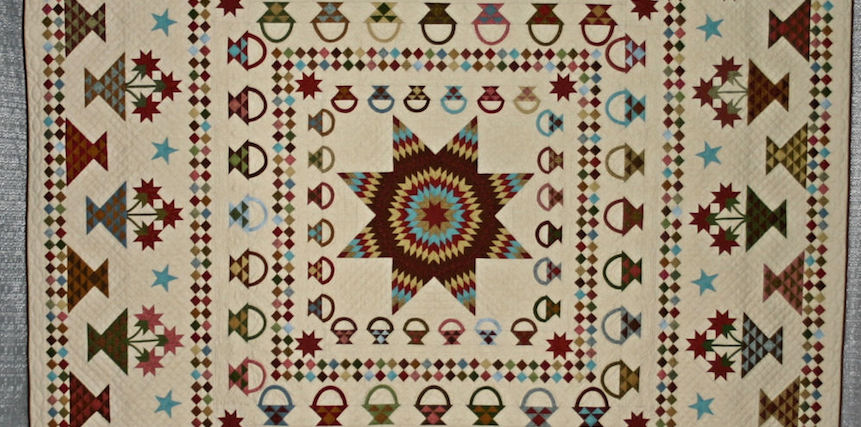
Emma Parker (EP): This is Emma Parker, today’s date is November third, it’s 2:15 and I’m here conducting an interview with Kathleen McCrady for Quilters’ S.O.S. Save Our Stories, a project of The Alliance for American Quilts. Kathleen and I are at the International Quilt Festival in Houston, Texas. Kathleen, will you tell me about the quilt that you brought today, or that you’re talking about today? Kathleen McCrady (KM): Okay. Well it’s called Star Medallion with Ninety-Six Baskets. It’s made, there was a quilt made about 1880 that was published in a magazine and I thought that it would be a really neat thing to do, to make a quilt like that. It’s hanging in the show today, and it’s won a third place award. I live in Austin, Texas and we had a show last year and it won best of show in Austin [Texas.] so it has some recent history. EP: Why did you choose this quilt to talk about in our interview today? KM: Well, because first of all it’s here, and second of all I can’t carry quilts around with me, so they agreed for me to use this quilt, it was easier for me to do that. EP: Do you enter a lot of quilts in shows? KM: I have in the past, and I do, sometimes in our own show, I’ve not had my quilts judged and sometimes I do, it just depends. This is the first quilt I have entered here in about three years. I’ve just haven’t entered. EP: How many quilts do you have at the show here today? KM: I have this one of course, and in the new quilt book that’s called Texas Lonestar Three, I have three quilts in that book, and one of those quilts is here. The Center for American History in the University of Texas has a collection of memorabilia that I’ve donated to them, and they have an exhibit here and I have four quilts in that exhibit. EP: Goodness. KM: One of them is the Texas Sesquicentennial quilt. In Texas we celebrated the sesquicentennial in 1986 and it was the banner for that exhibit. One of the quilts is called 60s Op-art Quilt. The top was made by my mother-in-law in the 60s, and the quilt top was given to me and I quilted it and it’s hanging in the show. The, my, when my husband and I were married fifty years, my kids and family secretly had blocks given to people to do of state bird and flowers and each family put their name on one of those blocks and so that quilt was given, the quilt top was assembled for the anniversary and that quilt is here. EP: Oh wow, that’s wonderful. KM: The fourth quilt, oh, well I think that’s all of them. Anyway, oh I have a, in the, in the I.Q.A. show they have a an auction and there’s a little quilt in the auction that’s about this size of this quilt. EP: So it’s a smaller version. KM: Smaller measurements. It includes this border right here. Only the star is smaller and they’re smaller. EP: Right. What happened to that quilt after the show? KM: Which one? EP: This [inaudible.] KM: Eventually it will come home with me, but they’ve asked me if they could keep it for a traveling exhibit next year, and so it wont come home now but it will eventually, after. EP: Where will it live? Will it live in your house? KM: Yup, it’ll live with me for a while. I don’t have anybody yet designated for it. We’ve done that all, most of my quilts, but sometimes it takes me a little while to decide what I want to do with it. EP: Big decision. KM: Yes, it is. EP: How long have you been quiltmaking? What age did you start? KM: I learned to sew when I was about nine years old, and made, tried to make a dress of course with my mom’s help, and I’ve embroidered all when I was a kid. I learned to quilt, my mother quilted when I was a teenager and I learned to quilt on the quilts she would have in the frame, but I didn’t piece quilts until after I married and started my own scrap bag sewing for my children. My husband’s mother was a quilter, and she gave me tops and you know, things like that. I’ve been quilting probably about sixty years. EP: How many hours a week do you quilt? KM: It’s really difficult to say. I try to quilt, presently I can’t quilt but about forty-five minutes at a time, I try to save my hands, I would quilt all day long if I could, that’s the part I enjoy the most. It’s kind of mesmerizing, you’re not, you know, it’s not any, you just, I don’t know what it is about it, but I just love the quilting. EP: It’s rhythmical. Do you, are all your quilts handquilted? KM: No. The quilts I’ve made for family and kids to use I have longarm quilted, I don’t, I can’t, I’m not going to do that, I’ve got too many kids to do that for. [coughs.] Excuse me. EP: How about piecing? Do you machine piece your quilts primarily? KM: This quilt is hand pieced. Most of mine, well not say most, most of my quilts that are in shows are hand pieced, but sometimes I do machine piece quilts. I don’t enjoy the machine piecing like I do, I like to sit and you know, we watch ball games and we watch shows and have, always have something to do. EP: Do you have an earliest quilting memory? Do you remember learning to sew when you were nine? KM: Yes I remember that. Actually, there’s a family quilt and it, there again that quilt is in the Center for American History, that lists my mother’s family and it belonged to my grandmother made it, and in that quilt is a block that has my name on it and six years old on it, now I don’t remember that, I’m sure I didn’t make the block but you can tell by the embroidery that I did the embroidery [coughs.] I don’t know. Well we’re both hooked up I was going to get some water, next time somebody comes by we’ll have them– EP: We’ll flag them down. Do you belong to any quilt groups of guilds? KM: Well we have Austin [Texas.] area quilt guild in Austin [Texas.], of course I belong to the A.I.Q.A. here in Houston [Texas.], I belong to the group that’s doing this Save Our Stories, I did belong to the quilt group in Paducah [Texas.] but I don’t do that anymore, and one that publishes that book every year of people’s research. EP: The quilt study group maybe? KM: Yeah. EP: Do you think it’s important; do you enjoy belonging to those communities? KM: Yeah. EP: What are your favorites; do you have favorite techniques or materials? Do you use exclusively cotton or do you appliqué? KM: Yes I appliqué, and I enjoy appliqué, and I enjoy piecing and I don’t know that I could make a choice there. I try to use 100% cotton fabrics in my quilts that I hand piece and make. Early on in the 60s, 70s we didn’t have that choice because of polyester coming in and also at the same time, the polyester batting was available and when it first hit the market, I thought that was the best thing that ever happened because it was so easy to quilt, but it has its drawbacks now. Occasionally I used a blend because it’s easier to handquilt, the cotton, for my hands, its just a little, you have the resistance of the cotton, but I’d love, if possible have 100% cotton, but depending on what the quilt is going to be used for. This quilt has a combination 80/20, and it was a whole lot easier, even then it was hard to quilt because the background of this quilt is really dense and it was a little bit difficult to needle, you know. EP: Where do you get your quilting supplies? Do you have a local quilt shop? KM: We have in Austin [Texas.] we have two shops in my area of town, and there are others south in Austin [Texas.] and I don’t shop in those, I did drive recently to get some fabric that I wanted that they had and the other one didn’t, but no I shop at those two stores, and sometimes I order from Hancock in Paducah [Texas.] occasionally, not always, but occasionally. EP: You said that handquilting is your favorite part of making a quilt, are there any parts that you don’t like particularly or that feel like chores? KM: Yes, making the back, and putting borders on [laughs.] EP: What is it about borders? KM: Well, you got to measure, you’ve got to cut, you’ve got to fit that border to this right here and sometimes your piecing on hand by hand or machine and that inches, it just somehow it doesn’t match up [laughs.] and you want to be sure the two sides are equal and the two tops are equal and you have to really watch it. EP: There’s a lot of math involved. KM: Lot of math, lot of math. EP: Where do you, do you have a special room in your house for quilting or what is your studio like? KM: Right now, I do, with we of course our kids are all married and away from home and I have a quite a large room that at one time was our den, and we decided to use our living room to live in, and I’d use this room for this purpose, and so I’ve got enough room spread out that it sort of gets a mess all the time, but I can keep it all in that room. EP: Do you have a design wall? KM: I have a design wall that, flannel on it, it’s a wonderful tool, wonderful tool. EP: What’s the process of designing a quilt? Do you start with a pattern that exists already? Pick a fabric you like? KM: It depends. I’m a traditional quiltmaker by whatever, because that’s where I come from. It does not mean that I’ve not made quilts that deviate from that, but it’s not my favorite. Unless it’s something I really want to have a little piece or a pattern of, then I just use, sometimes I draft my own, sometimes I look at a picture and draft it from there, sometimes I use a purchased pattern if I want to. If it’s already done, why do it over, you know? EP: [laughs.] Let’s see here, this is, here’s a question I’m not sure what it means but, how do you balance your time? KM: Well– EP: Do you ever find that you have to– KM: I have all the time I need that I want to do this because I don’t have family to have to do for anymore except my husband and myself. On the other hand I have to balance my time with what physically things I’m doing; I can’t cut with a rotary cutter long at a time because I’m going to use this arm and this elbow and this back and I can’t sit at the sewing machine for, I could do it all hours, but I can’t do that, so I have to, you know, I have to just kind of time myself, and when I handquilt I have to time myself because I would sit there until I, but I can tell when I’m just about ready to quit, then if I don’t quit, then I will lose that. I have to be pretty hard on myself and say, “You have to stop now.” EP: Has quiltmaking impacted you family? Has it brought you closer together or does it drive anybody nuts? [laughs.] KM: As much as I do in my house, you would think my husband would just be really upset with me, but he never has been irritated by it. He grew up with a quilting household. No, my family has, of course they’re the benefit of most of my quilts, and I’ve made baby quilts for all the grandchildren, a baby quilt and a bigger quilt. Now I’ve just finished, I have two great-great-grandchildren and I’ve just finished the second child a bigger quilt, she had a baby quilt so now this Christmas when we have our gathering she’ll get her big quilt. She’s about, she’s three, she’s three. EP: That’s a wonderful gift. So do most of your quilts do end up getting given away to your family? KM: Yes they do, yeah. I’ve sold a quilt a time or two, I don’t make them to sell, but and I give them away. EP: Do you make them with a certain family member in mind? KM: Yes many times I do, especially the grandchildren. I make it something that would be appropriate for a boy or appropriate for a girl, or vice versa, yeah. EP: Do you sleep under a quilt? KM: Yes I do. EP: Do you sleep under one of your quilts? KM: Yes, when I went, I own some antique quilts but I don’t sleep under them [laughs.] I’ve always had quilts on my bed, and I’ve nearly always have quilts on my bed as the top cover with dust ruffle or something, which is the way my bed is now. EP: Do you change that often just according to your whim? KM: Yeah. I’ll get kind of tired of it after a while and I’ll go get another one [laughs.] EP: Change of scenery, that’s excellent. What do you think makes a good quilt? KM: Well I look for, I look for color balance in a quilt, I look for workmanship in a quilt, but now that does not mean that people who don’t have the skills that their quilts aren’t meaningful, that’s not it at all, but personally if a person isn’t a quilter, then they need to improve themselves as they go along and of course the first quilts you make are not going to be that top quilt. The use of color, the way that the quilt, of course in a show, a lot of time it’s the way the quilt hangs, if it’s cut so good, it’s going to hang straight, mine up there now is a little wavy. EP: Uh-oh. KM: A lot of times it’s the uniqueness of how people use fabric and of course a lot of people are making quilts that are uniquely theirs, they designed it, you know all of that and a lot of things makes a good quilt. I think you have to look hard to see a quilt that’s not good in some respect; you always can say something good about a quilt. EP: Do you have favorite colors and shapes you like to use in your quilts? KM: I don’t think you could see in the quilts I’ve made that there’s a line of the same color in all of them, probably not. I, in these last eight or ten or fifteen years I’ve gotten so I’ve just loved turquoise, that color, that light, it’s kind of, it’s not the dark, but you k now it’s kind of mellow, and I gravitate toward that, I’ll buy a little piece of fabric when I see one [laughs.] but I’ve never made a whole quilt out of them. EP: That’ll be the next quilt, turquoise quilt. KM: [laughs.] EP: Do you have, do you have favorite quiltmakers or quiltmakers you admire particularly? KM: Yes I don’t know if I could name any one person, I’ve had Katherine Anthony, you know, her daughter, well anyway, she makes, Katherine Anthony was a quilt shop owner here in Houston [Texas.] in the early 80s and she and I got acquainted and she helped me in a lot of ways in of course I already quilted by then, I had been a long time but she just helped me kind of fine tune a lot of things, and she, I got into appraising quilts through situations I knew about with her and she helped me along with dating quilts and but of course I admire a lot of these people who do work that is just exemplary, it’s just wonderful to see, and young people that’s coming in it too, want you to keep on keeping on. How long have you quilter? EP: I’ve been quilting only about three years now. KM: Oh have you? EP: I’m hardly a, hardly a good quilter but I do– KM: Well, you can’t expect that all, that’s a gradual thing. Did you have quilting in your family? EP: I didn’t. KM: Oh really? EP: I’m the first one. KM: Well congratulations. EP: But I hope I’m not the last. KM: No, you’ll pass it on. EP: You think so? It always does seem like there’s a really big community of quiltmakers in Texas. Do you feel like living in Texas has affected your work in anything? A Texas look to your quilts? KM: Not really, no. I don’t think that you could look at, unless you have something Texas in it. The funny part about, well I have to show you the quilt that’s in the book, up here on the table, it’s a state flowers used with state flower fabric, with every state that has their flower, and the Texas block in that quilt is blue bonnets and but I put in, it’s a basket, it’s a basket and it’s got the flowers in it and I put a little Texas flag at the very top of that. My granddaughter, oh I guess she was probably twenty by this time, I had not quilted that, and I don’t remember why she would have been looking at that quilt top, and she says, “Grandma you got that flag backwards,” [laughs.] and I said, “Oh my goodness, I hadn’t even noticed it,” I had just turned it back and after seeing it in the book up here, and they’ve got a little silhouette in the book, if I’d of had that flag backwards, that’d been awful. EP: That’s so funny [laughs.] Have you ever used quilts or quiltmaking to get through a hard time? Is it therapeutic for you or just so much fun? KM: Yes, therapeutic, very therapeutic. Yes I’ve used it to get through some pretty rough times. I’ve raised four kids, and they’ve had their days [laughs.] EP: That’s challenging. KM: Yes, yes. EP: That’s wonderful. Are there other reasons quiltmaking is important to your life? Do you feel like you’re part of a tradition? KM: Well, I feel like I’m part of a tradition, but it’s the medium that I enjoy the most. I’ve tried all kinds of craftwork from you know, decoupage and knitting and well just about anything to keep my hands busy, but I always come back to quilting. I have to come back and I don’t do, don’t get out of that vain much anymore. EP: Do you think quilts are important to American life or women’s history? KM: Oh my yes, oh yes. Quilts have been a connection between families, especially the ones that are made of, names on them. You read in quilt history books, I have a very large collection of quilt history books, I taught a class in my studio in the back when I had it all out there, I set up a studio with, for dating quilts, and I had examples of different times periods and so I would buy any state history quilt book as it was being published and of course every state has quilts in it that you just oh, die for. I don’t, I taught a class in, of quilting, an overview of quilt history for about six years I guess, and I couldn’t take but eight students at a time, my space, but in 1995 I think it was, maybe it was ’95, I decided that I just didn’t want to obligate myself to being tied down to doing a class like once a month or whenever I was doing it. So I had, I collected quite a large mass of stuff, and in 2002 or three I donated, I started, there’s a, connected with the University of Texas there’s the Center for American History who takes donations oh for everything, water [inaudible.] histories, and truckloads of stuff from [inaudible.] anyway, I became acquainted with the people there, and I don’t remember, oh I think I do, I’m trying to think how I ever got connected with that, maybe through Nancy and Carrie because Kate Adams was the director there, she’s retired and is now working back for them part-time, anyway, she took one of my classes. So then I began to wonder what I’m going to do with all of this stuff, my kids can’t, you know, it’s not their [inaudible.] you know, so I had amassed all these publications and monthly magazines and all of that stuff and guilds history and so in 2003 I believe it was, I made a donation there then, and then 2004 or five, I donated the whole, the whole collection of stuff to them. EP: Wow, I’m sure they were thrilled. KM: Keeping, I kept some of the antique quilts that I had collected, and I bought some antique quilts after that even, but I’m just about, just now fixing to do my last donation then I’ll have all the quilts taken care of. They’re being appraised right now and sometime in November they can pick up the rest of them so they’ll all be taken care of now. EP: What’s your next project, your next quilt you’re working on? What are you working on right now? KM: Actually I’m working on something right now that I’m frustrated about. EP: Oh no. KM: I can’t, I have, I’ve never done a, people buy kit quilts and to piece or whatever the fabrics already chosen for you and everything, I had never done one and I got to the place, when I buy fabric for a quilt, I’ll buy like, maybe I won’t need but a quarter yard and I’ll buy a yard, or maybe I’ll buy two or three yards and I won’t need but one, so I have all this fabric left and I thought, “You know, if I buy a kit, all that yardage is done for me, I won’t have all this excess,” so I bought a kit. It was a piece quilt and it had pretty colors and red and blue and everything in it, and that’s about six months ago before, and then I kept thinking, “The next thing I do I’m going to start that,” well, when I got the fabric out to cut it, they had filled that kit with a collection of brown Civil War quilt fabrics and they weren’t the color of the picture in the kit. EP: Oh no, uh oh. KM: They’re dark and they’re, and I’m fussing the whole time about these dark pieces. EP: You had been misled. KM: I was so, and I thought, oh but anyway, I’ve got it to the place now to put the borders on, but. EP: But it’s not what you thought it would be? KM: It’s not what I thought it’d be. The most fun quilt I’ve done recently is a Texas quilt made out of Texas fabric. In September, Moda, do you know who Moda? EP: Yeah. KM: Okay, Moda, I didn’t know about this either, Moda had manufactured or at least they bought, they had a collection of all Texas fabrics. EP: Oh, I didn’t know that. KM: I don’t know how many. They have this state wide shop hop and then they have regions within that. I don’t do shop hops, never have and I don’t intend to, but one of the quilt shops that I go in to, went in there in the middle of September and here’s this quilt on the wall, just the top, and it’s made out of these Texas fabrics and it’s just the most attractive, the fabrics is just so pretty and she just, she designed, every store was supposed to design something that they you know to use with it, and I stood there and looked at it, and I thought, “I want to make that quilt.” By this time, see a lot of fabrics had already been sold out, so she didn’t have the background fabric and we call a shop in south Austin [Texas.] and they have, still have some, so they’ll hold, anyway, it’s got a center medallion and it’s got, there’s prints that are little blocks that were in the fabric that’s all Texas things, like a steer, like a flag, like blue bonnets, like oh Alamo [Texas.] was in it, you know it’s just all the historical stuff. Then the outside, the outside border is a dark border that is black but it’s got blue bonnets in it, it’s just the neatest thing, and then around this center part it’s got little, it’s got diamonds two inches finished, and I had time with those because you had to make a strip, you know, but anyway that’s what I’ve had, I enjoyed that. EP: Sounds like a fun quilt to make. KM: It was, it was, and I could use what fabrics I wanted out of the collection, they weren’t just you know, like she would tell me, “If you need this much of that one,” and still I have fabrics left over [laughs.] EP: Do you have a big stash? KM: Not anymore, not really big, big, because I’ve tried to [inaudible.] down and not just buy gobs, I used to go to Hancock or Paducah [Texas], I just to go up there in Hancock [Texas,] and I’d come with boxes of fabric, I’ve made a plunge, I mean a what do you call it when you give something away? Anyway, twice now, my daughter this, one of my daughters is with me today, she was, she decided she would when she was fifty, she wanted to quilt, she did, she could do sewing, but anyway she thought she wanted to make quilts. Well, we, I divided my fabrics in a hurry, then she got a job, she’s a nurse, and she got so she couldn’t, didn’t have time to do that, so we, you know fabrics laying on the shelf is not going to do much good. In Boerne, Texas which is about sixty-five miles from us, they have a women’s prison, and I have a friend that lives there, and she knew about them doing projects, so we took a lot of the fabric up there. EP: That’s a great use. Is your daughter the only, is she the only– KM: Only quilter– EP: Only quilter? KM: Yeah. She made, she’s made two whole cloth quilts, and she loves the quilting too, and she’s left-handed. I have a granddaughter that’s in her thirties and she wants to learn, she’s made, been making, trying to make a quilt, but she wants, the art things appeal to her, so she’s kind of going that route, and I gave her my little sewing machine recently because she didn’t have a machine and so right now she’s the only one that’s picking it up. Of course my daughter-in-law had, when she married my son, she made her clothes at that time, and she was, could sew, and she got interested, in fact she took a class from me when I was still teaching quilting, and right now she, it led her into a business, she’s a vendor in the show here. EP: Oh, wow. KM: Her tent, She’s Scarlet Today is the name of her business and it’s mostly red work, and so, and I’ve done a lot of embroidery for her along for examples and things. EP: It stays in the family. KM: Yeah. EP: That’s fantastic. Do you have any thoughts about quilting in the future? What do you think will happen? What do you hope will happen? KM: Oh I hope that, I hope that it, well I don’t think it’ll ever go away, I don’t think you know, the quilting in the thirties and forties was a, when up to World War II then it sort of faded away in the fifties and sixties, which you don’t know anything about, and when I was quilting, when I was, in 1950s when we moved to Austin [Texas.], I quilted some during that time and my neighbors thought I was the craziest thing in the world, but with this world wide communication of shows and things like this, I credit Nancy and Carrie for keeping this alive, they’ve promoted quilting and had quilt events, basically all over the United States and in Europe for a while and I think that’s done more to keep it alive than anything. EP: Well thank you so much for your time. I’d like to thank you for allowing me to interview you today for Quilters’ S.O.S. [Save Our Stories.]– KM: Well thank you for doing that. EP: Yes, and so our interview is concluded at…
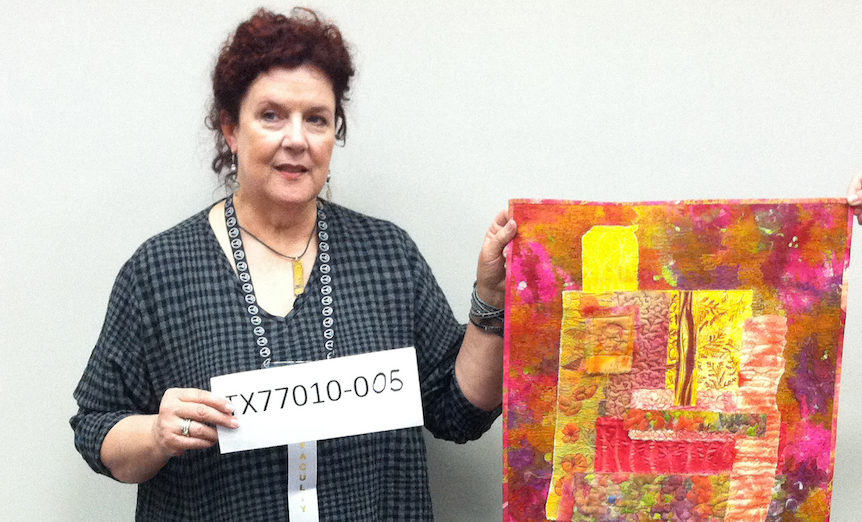
Jamie Fingal (JF): OK, I am Jamie Fingal and we are here at the International Quilt Festival for QSOS and I am interviewing Leslie Tucker Jenison who is in the Lonestar Quilt Book. Let’s talk about the two quilts that you brought today. Are there titles of the quilts? Do you want to do one quilt? Two quilts? Leslie Tucker Jenison (LTJ): I’ll talk about both of them. I’ll show one and talk about it in more detail, how’s that? JF: The title of it and the size of it. LTJ: The one that is hanging up behind us here is called “Childhood Garden.” I can’t tell you what year it was made, which is embarrassing. I think it was [laughs.] 2005. It was, no it was 2004 actually. I’ll just briefly talk about this one. I brought two quilts that I thought were sort of milestone quilts for me. This particular piece I guess I would call it a grief piece. It was done about a year after my mother passed away. My mother was the last person in my family of origin and so I started, I was really trying to capture some memories from the place that I grew up, which I no longer live in. And one of the important things about that place was our garden, and that was important to my mother, and it was an important interaction we had together when I was really little, and so this is a memory piece about that, that’s what that is about. The other piece that I brought is a piece that was the first in a series called “In Vitro.” And this piece was important for me because it was kind of a breakthrough piece in terms of a style that I am working in more frequently now. It is, both these pieces are pieces that I created by hand-dyeing and screen printing all the cloth. This particular piece speaks to both parts of my life, kind of coming together which is that I am also a registered nurse, and I don’t practice anymore but some of the things that happened as a result of being a nurse, I think have influenced some of the imagery I like to look at. So I thought that was important, and that’s why I brought that quilt. JF: Where did you get started in quiltmaking? LTJ: Well actually, my grandmother, my paternal grandmother was a quiltmaker. She was, lived in a small town in North Central Kansas and she was the town seamstress. She always had a quilt in the frame. I unfortunately did not learn at her knee but I think that having a quilt in the frame all the time when I was young, growing up and visiting her, influenced my interest in quilting. Fast forward when I was in the clinical setting at the hospital I worked in inpatient obstetrics and one of the women who worked on the night shift would come in early for her shift, who was a quiltmaker, and she would always bring her quilt. I realize now after having children she probably came in early so that she could have a few minutes to herself [laughs.] but I was very interested in what she was doing. It really appealed to me and she took me under her wing and really mentored me and that was in 1979. So although I started quiltmaking then, I was sort of a frustrated quiltmaker who was working full-time and teaching part-time and raising three children. Needless to say I didn’t have a lot of time to be really productive as a quiltmaker. But I continued to do it. When when we moved to Texas in 1997, that became a more important part of my life. And then as I transitioned from being a person who was commuting back and forth to do caregiving and also at that time my children were getting old enough that I had more time, I began to devote more time to my art. JF: So when did you make the leap from being a traditional quilter to art quilting? LTJ: I would say that happened in about 1990 or 1991. And it really was an evolution although I’ve never met a quilt I didn’t love and I have a very strong love of all the things about traditional quiltmaking. Every aspect of it appeals to me. I think that part of my desire to do something different was just to create something that was unique, be it from the pattern or design work of the quilt; also I became much more interested in surface design, working with unique pieces of cloth that I had dyed or screen printed. And that’s sort of when that happened: fast-forward a few years later when I moved to San Antonio [Texas.] I had absolutely no idea that I was moving into such a hot bed of surface design activity and that was just a very fortunate happy accident for me. JF: Do you have a signature style in your work? LTJ: I would say that I do although for many years it was not clear to me exactly what that meant and I’m not sure that I feel that it’s important to define that too carefully. I think that my signature style is anything that comes from my own hands. And so the style of my work will change and it will depend on what I’m interested in, what I’m obsessing about, at the time and that will go for two or three years and then I switch gears. So I’ve come to learn after having made more quilts that having a particular style may not be as important as staying true to myself, working with intent, and creating the work that I feel needs to be created. I believe that is my signature style. That may be a little esoteric but– JF: No I think it’s important to evolve and change– LTJ: Yes and I don’t want to be making the same thing today that I was making in 1979 or even five years ago. I mean, I would just get bored. And sometimes it’s sort of in retrospect that I realize, whoa that doesn’t look anything like these things over here! I just realized because of doing an interview with somebody recently that I’m making all these pieces that look very architectural suddenly. Because he said ‘Are you working on an architectural series?’ and I went, ‘I guess I am.’ [laughs.] I didn’t even know it. JF: Do you do all kinds of different styles like pictorial and portraits and abstract? Or mainly concentrate your efforts on one aspect? LTJ: I’d say that my quilts tend to be more abstracted than representational. Although again, it varies. I’m very attracted to organic shapes: one of my big obsessions that I spend a lot of time looking at are the effects of pressure on objects, whether they are manmade or natural. I am really fascinated and obsessed with how things fit together or what happens as a result of pressure so I’ll look at columns, cracks in the pavement, cracks in buildings, how rock piles form up, drift wood. I’ll study those things over and over again and they seem to repeat themselves not only in what I design on textile but also the quilting itself. I also believe that there’s a tie-in to how things look under the microscope; I am fascinated with the juxtaposition of the microscopic to the overt. I could look endlessly at those kinds of objects and never get bored. JF: That’s great. On your surface design; are there certain things and techniques that you do in surface design that you think that sets you apart from other people? LTJ: Well I don’t think anyone has invented a new wheel and I have a very wise artist friend who said she became very excited when she was working on her graduate degree work and thought she had invented a whole new technique. Her professor patiently listened to the whole thing and then said to her, ‘Well it’s been my experience that if you think you’ve invented a new technique, you just haven’t done the research.’ So although I do many known surface design techniques I think that one thing that I maybe tend to lean toward more than some are that I like to use objects that have already had a previous use many times to make more marks. So it’s not uncommon to see me dumpster diving or picking out a certain container at the grocery store because of that shape of the edge of the lid, which then subsequently becomes a mark making object for thickened dye or paint. I’ve done a lot of things that at the beginning were not deliberate, it was an interest in seeing another use for that object or seeing the potential for use in an object. So I think that’s one of the things that have happened especially in the last four or five years that is another obsession. I am good at having obsessions apparently. JF: What drives you to create art quilts? LTJ: Art quilts, because they’re textiles. I think that there’s this incredible, intimate draw toward textiles and that makes a textile piece, namely a quilt, very unique. I think that human beings are just naturally drawn to working and wanting to be closer to textiles because it’s the second thing we feel on our skin after we are born. We feel human touch first, and the next thing that hits our skin is a textile. And I believe that that is a very innate attraction. For me, part of the attraction of the textile, in terms of a work of art, is that with a quilt, whether it’s something I am going to sleep under or something I am going to look at that is hanging on a wall, is the fact that you are able to add yet another layer of design by the quilt line is extremely appealing to me. And I think the dimensional quality of a quilt makes it head and shoulders unique over any other piece of artwork. JF: Is there a particular quilt artist that you’ve admired and are inspired by? LTJ: I’ve been inspired by many quilt artists over the years and I think that it would be unfair to say once in particular. JF: Give me three. LTJ: Three? I will say that in the early 90s the person that inspired me the most was Debra Lunn. I don’t know if any of you know Debra Lunn, but she was really one of the people who pioneered a lot of the hand-dyed fabric. She was the first person I ever came into contact with who did her own surface design. It was in the early days of her business, she began to dye her own fabric because she couldn’t find what she wanted and she was working on her masters project and I met her early on when she started out and she just incredible inspiring to me. I would say early on the other person was Libby Lehman, and it’s because Libby was, although her work was somewhat traditional, she also colored outside the lines. She was probably one of the first people at the quilt festival whose work really spoke to me. I am very inspired by Hollis Chatelain. I think that she has danced to the beat of a different drum and I believe that her painted quilts and using her own imagery have taken quilts, elevated quilts, to another level. Those are three that just come to mind without having thought about it in advance. JF: That’s good. There are several steps to making a quilt, is there one particular step that you enjoy the most? LTJ: No, actually. And I would have said I love all of the steps, and they’ve all become almost equally important to me. Probably twenty years ago I wouldn’t have made that response because I started out as a traditional quiltmaker, I loved piecing quilts but I didn’t like hand quilting very much. I mean I did when I was doing it, but when I figured out how to do machine quilting, and figured out how to make the machine quilting unique to my style, that became as important as anything. And thirdly, for me this whole process starts with idea to translation onto cloth. The making of the cloth for my quilts has become as important to me as the construction or piecing of the quilt and the actual machine quilting. Each step is equally important to me. JF: Tell me about an amusing experience that has occurred from your quiltmaking or teaching. LTJ: An amusing experience? This is where I wish I had looked at it ahead of time. That’s mean [laughs.] An amusing experience– JF: I’m sure you can think of something. LTJ: Well– JF: Maybe not. LTJ: Can we come back to that? JF: Yeah we can. LTJ: OK. Let’s skip this one. JF: That’s the trick question of the day. LTJ: An amusing– JF: In your artistic life, I know you belong to series of organizations, what organizations do you belong to and do you think belonging to these organizations is valuable to your artistic journey? LTJ: I belong to the Alliance for American Quilts. I think that’s a very important organization to belong to and the reason, the main reason that I personally feel that it is important to belong to the Alliance is that I think it’s so important to document stories of the whole gambit of quiltmakers because I feel strongly that women’s history has not been well documented. Although there are male quilters, I do believe obviously most of the people who make quilts are women, and I think it’s a very interesting lens through which to look at history. I feel very strongly about that. It’s one of the many things that the Alliance does that is very important to me personally. I am a Professional Artist member of the Studio Art Quilt Associates. I belong to the Surface Design Association. As well as the local organization, which is, the Fiber Artist of San Antonio. Well I guess I also belong to the Modern Quilt Guild now too. JF: How do you think the latter organizations help you with your artistic journey? Like the Modern Quilt Guild? LTJ: I love the energy of the Modern Quilt Guild. I think it’s fantastic. There’s a lot of enthusiasm, there’s a lot of sort of carving our own path, and it’s traditional work with an eye toward the future with the color selection, with adding one’s own personal touches, and I like being around that. I think it’s great. I just think it’s fantastic. The Fiber Artists Organization I belong to, and I failed to mention I’m also a member of the Art Cloth Network, which is a small organization that’s a juried organization that is created to elevate art cloth, which is a little different from quilts, but it’s to see art cloth as an entity in and of itself. I think those are important because being around people that are creative helps you not work in a vacuum. It helps to elevate your own energy to get feedback or exchange ideas; I think it’s a good thing. I think it’s a good thing to be able to support other people as artists, to offer some of your own resources or gifts that you have, and to get them back. I think anytime you give information, you get more back than you ever thought about giving. I think it’s important to be involved in those things. JF: What other areas of quilting are you involved in? Such as teaching, curating, quilt collecting. LTJ: All of the above. I’ve been a collector when I could do that. I love collecting work of people that I admire. I’m particularly happy when it works that I have the opportunity to buy in a fundraising event toward another cause, such as the American Cancer Society’s fundraiser. I think that it’s always a good idea, and it supports an organization that I believe in so it’s all good. I’m also a curator; I’ve curated number of shows with my teaching partner, Jamie Fingal. I also was a member of a little cooperative gallery in San Antonio and we curated shows with a focus on fiber artists. I had some experience curating for the gallery; I’ve done several online exhibitions as a curator and we’ve, you and I, have curated four exhibitions together. And then we are teaching together as faculty at quilt festivals and also mixed-media retreats. All of the above, but I haven’t been teaching all that much until the last couple of years because I had children at home and I had deferred that until I had more time to do that. JF: Getting back to quilts, what do you think makes a quilt artistically powerful? LTJ: I think a quilt that’s artistically powerful is artistically powerful for the same reason a painting would be artistically powerful, or any other piece of art. I think the principles of art apply to a quilt. You have to have value range, composition, a good color balance, and you have to have a focal point. I’m speaking more directly to art quilts when I say this, but to some degree that’s true of any quilt. I tend not to differentiate what I would consider good artwork that’s an oil painting or a textile piece. I think it’s all the same. JF: Have advances in technology influenced your work? LTJ: Yes they have. Part of that has to do with the access to digital reproduction of imagery. I am photographer, my photography informs my work very frequently, and very directly my photography is often integrated into my work. Access to better reproductive technology onto textiles has, it’s not exclusively what I do but it is influenced how I can create and interpret some of the things I want to interpret. So that is certainly a part of it and I believe just access to more information as we all have for especially the last ten years or so certainly has an influence. And I think it has affected the genre as a whole because back when I was still living in the Midwest, I would come to quilt festival because it was where I had access to the newest, best stuff. Now there’s the internet, it has become a great equalizer for people who need access to supplies that they might have had to fly to Houston for. Not to say that flying to Houston isn’t wonderful because we are all tactile people and we love to see everything up at the show. But still, I think that has influenced people as they do their work. JF: How many different kinds of fabrics do you use in your quilts? And what do you use? Like cotton– LTJ: I use cotton. I use silk, a variety of silk: silk broadcloth, silk organza, silk charmeuse, silk cotton combination, bamboo. That’s pretty much all of it isn’t it? JF: What’s the most unusual thing that you’ve used in your quilts? LTJ: The most unusual thing? Well, I have several of those but I will say that I have discovered kind of by a happy accident that I can take my Oil of Olay facial wash cloths that I use every night to take my makeup off, which I know sounds kind of disgusting, but I accidentally ran them through the laundry a few times and they didn’t fall apart, which made me feel like there was a potential for something else to happen to them. I took them to the studio one day and I put them underneath the silk screen with some thickened dye, and oh my goodness wasn’t that fun. I found that they took dye beautifully and while I was paying attention to what was happening with the facial cloths, I started to notice that the marks I was getting in between these facial cloths was pretty interesting too. I was getting two for the price of one, I was getting this drop cloth that, sadly, sometimes the drop cloth is better than the actual project, but I was getting two for the price of one, that I have done a lot of work with. My old FedEx and Priority Mail envelopes take acrylic paint beautifully and they stitch beautifully and they melt really wonderfully, so that. I have also done a lot of stuff with shredded paper, and I have done a lot of stuff recently with paper that I have laminated to sheer and then screen printed over. I’ve got a lot of stuff going with paper and cloth now, which is really interesting. There’s a real interesting textural appeal to me about that. JF: What do you think makes a good quiltmaker? LTJ: A good quiltmaker? JF: A great quiltmaker. LTJ: I think you need to work with intent. You need to be true to yourself and you need to just get in there and do it. I think you’ve got to get on the beast and ride it. I don’t think you can get better at anything, I don’t care if it’s playing the piano or making a quilt or sitting at a sewing machine and sewing, if you don’t do it. I hear people that lament that they wish they were better at fill in the blank, and I say, ‘Just do it.’ The joke in our studio, I share studio space with several other textile artists, and the joke is just do the work. I think there are very few people, very few artists of any genr,e who were hit by lightening and woke up one morning and could go in and paint a museum quality painting. This is just not how these things work. You just have to do the work, you have to keep doing it and be persistent, and that’s it. Eventually you’ll have a few ah-ha moments. Sometimes when you’re the most frustrated, some of the best things I’ve made, I believe in my own opinion, have been things that two hours before I was ready to wad up and throw it in the garbage bag because I was so frustrated and then I tried one more thing, I just kept pushing it and whoa, something good happened and I got excited about it again. I think that’s the nature of the thing, I just don’t think you can get better unless you do it. JF: Do you plot out your quilts or do you just kind of, fly by the seam of your pants? LTJ: Oh I try to plan them out, believe me, and it never works out for me. I usually start out with an idea. I am not a person who sits down and sketches out and comes up with a few weeks later with exactly the thing that I thought I was going to have, oh no I couldn’t be that lucky. I usually have an idea, and I will start working at it and it I’m fortunate, it will lead me to the end. Although sometimes it’s not without great angst involved. Usually those are the things that I’m saying when I am the most frustrated with them and I’m ready to walk away, those are usually if I just keep pushing myself, those are the things that end up being successful pieces in my eyes. I would love to think that I could do that. Occasionally it has happened, but oh if I could only figure out how to bottle that I would be really happy, but it doesn’t ever work that way for me somehow, or rarely. JF: Tell us about your studio. LTJ: I have two studio spaces that I work in. Primarily, I am very fortunate to have a large space in my home, which isn’t ideal for everything I do, but is wonderful for most of the things I do. It’s not a great wet surface design studio, but it’s a great design studio where I have my sewing machine and design board and my cloth and so forth. I can do a small amount of screen printing there, but I don’t have a great sink to work in. I also share a studio space with several other textile artists in San Antonio. The space is called Art Cloth Studios; it’s shared by several textile artists. I am very fortunate to have access to that because if I really need to make a big wet mess, I can go there. JF: Do you have a design wall? LTJ: Yes I do. I have three 4×8 pieces of building material that I have wrapped felt around. I don’t have them attached to the wall and I think eventually when I redo my studio, which is in the mix in the next couple years, I’ll have some design walls that will be permanently attached to the wall and then I’ll have a couple I move. Having walls that move is very helpful to me because I need to have a larger surface to work on for flat. I like having the flexibility of being able to move them around, and they’re lightweight so they’re easy to move. JF: Tell me how you balance your time. LTJ: Balance, what’s that? It’s much easier for me to balance my time now that the last pup is out of the box. My youngest child is a senior in college now, I don’t have obligations, family obligations that take me out of state anymore, that’s been true since 2003. It has been easier for me to focus on being a fulltime studio artist and my husband is very supportive of that. He has encouraged me from the getgo to pursue my work and do what I want to do, and I am very fortunate that I am in that position and I’d never take that for granted. One of the gifts that my mother gave me after her death was that I was given the gift of time again, and so I have a long hallway that leads back to my studio, I’m not going to cry, but every day when I walk back there, I thank her for that. JF: Do you teach quilting? LTJ: I do, I don’t teach it very often. I teach a variety of things that dance around it, I guess. I have taught free motion quilting. I’m a little afraid to teach it in a place that I don’t have good technical support because although I can help anybody with a Bernina problem– JF: [inaudible.] LTJ: Thank you. I’m going to try not to let this become a problem I love teaching free motion quilting, but I discovered really quickly when I did a two-day quilting class a couple of years ago, that I just don’t have a good technical skillset for machines that I’m not familiar with, so I was really glad that I was in a quilt store and I asked if they were going to be able to help me if somebody had a question, and sure enough they did. Although I said I wanted people to have some kind of working familiarity with their machines, often they didn’t and I would have been in trouble if I’d been someplace without a technical support on hand. I love teaching people how to do that work and I think it’s very satisfying. As a teacher it’s very satisfying to see people have those ah-ha moments and I would say that about anything that I teach. In my former life as a nurse, I did community health education for a lot of years, and I think that helping people have those ah-ha moments (and it doesn’t matter what it is: it can be anything),and it’s such a pleasure to be able to facilitate that, that I always feel like I get more than I give when I teach. JF: You talked about the other mediums, kind of that you have done painting, what are the other ones that you’ve done, and how have those affected your quilting? LTJ: I think they all inform each other. I’ve been a photographer forever, and I don’t know that I’m that great but I do it for my own pleasure and so I think that that has been helpful because I believe that it helps me really look at things. I think that’s one of the best things about being a photographer is that you really look at things. I think the other thing is that in looking at things, you’re thinking about things, and you’re thinking about composition etcetera. I think that’s been very helpful. I’m also a painter, although these things tend to take more dominance or less depending on what I’m focused on. I do both oil and watercolor. I haven’t done oil painting for a number of years now, but I was very focused on that for a number of years to the exclusion of everything else. I’m currently participating as a contributing artist in the Sketchbook Challenge, which is an online project, and it has been great for me personally because it’s held my feet to the flame in terms of drawing more and doing more watercolors. I believe that any of those things inform the other, it doesn’t matter what you’re doing and sometimes having something other than that particular focus is a really good outlet because I found that often it I’m stuck, if I’m working on something and I’m frustrated because I haven’t quite figured out how to interpret that thing, if I just breakaway and go to something else, I will often find that it lets me see what I need to see about the other project. I’ve learned to honor that. It used to drive me insane about myself, but I’ve learned to accept and honor that process, that that’s the way it needs to be and if I just allow it to happen, and quit being so freaked out about it, what needs to bubble up will bubble up. JF: How many hours about a week do you think that you donate all that you’ve spent quilting or getting teaching packets ready and curating? LTJ: Well it depends on how close to a show or retreat we are, doesn’t it? I think that I probably at least spend 30 hours a week at it. I really consider myself a full time studio artist. Whether it is physically creating a quilt, doing the quiltmaking, writing, doing photography, thinking about those things, whether I’m writing for a magazine or I’m writing for myself anecdotally, it’s pretty close to full time. I don’t say as job, I mean that sounds dull and boring, but I spend a lot of my waking time thinking about it and it could be when I’m driving down the street, it doesn’t necessarily mean that I am in my studio 30 hours a week but I’m always thinking about it. Call it an obsession, if you will. I call it a lot of joy. JF: Have you ever won any awards for your work? LTJ: I have. I won best of show in San Antonio in 2004 for a piece that I’m very proud of and I have been part of several collaborative pieces that have been recognized here at the Houston Quilt Festival. JF: Do you sell your work or do commissions? LTJ: That’s never been a driving force for me. In fact, I had to, someone had to practically wrestle a quilt away from me a few years ago. I’ve never been too concerned whether I sell my work, although my husband made enough fun of me over that one episode that I decided that maybe I should stop being that way about it. One of my painting teachers said something very important to me, she said, ‘Your work is like your children, you need to let them go.’ I think that’s true and I think that when you have the ability to let them go and with the caveat if you need them back for a show or whatever, you have the option of doing that, it makes it easier to let the children go. My husband was making fun of me because I truly did not want to sell a piece, it just had a special significance to me, you know what I’m talking about, and he said to me with this look on his face, ‘Where is it now?’ and I said, ‘It’s rolled up in the closet,’ and he said, ‘Wouldn’t it be better is somebody was truly enjoying that everyday?’ and I said, ‘Yes, [laughs.] okay I’ll sell it.’ And I’ve never regretted doing to but to actively offer things up, I’m happy to sell my work, but I don’t market my work as much as maybe I should. I don’t know, that’s not important to me. JF: I know that you use kind of unusual backings on your quilts; do you want to tell us about that? LTJ: Yes I do have quilt, I do have major quilt back vanity. I admit it. I really want my quilt backs to look good. When I quilt my work, I use almost exclusively MonoPoly thread, because I like the dimensional quality of the thread but I don’t really want to change bobbin thread that much. So it’s really laziness and combinations of vanity that have sort of made me evolve to MonoPoly. I really like to have interesting, crazy cloth, sometimes it’s my own cloth but more often than not I’m really kind of addicted to all this crazy, commercial, novelty cloth. If I find cloth and it just amuses me in some way, I don’t even think twice, I just buy it, and I always buy at least two to three yards of it. Then at some point it will become the back of a quilt. I like to make a couple of medallions on the back that go with the front and put my documentation on the back that way. JF: What do you write on your labels? LTJ: I put the title of the quilt, if it’s made specifically for something or someone I will put that, my name, the date that I completed it, and then up on the sleeve of the quilt I will put my email address, my address, my phone number, etcetera. I put that on there, although, you know, I think it’s important to have it on there for contact purposes if it’s lost. I put so many addresses on my shipping, it’s insane. But anyway, it’s on there. I think the main things are to put your name, the title of the quilt, and the date that you made it. Perhaps the location should go on there, I don’t know, I never have, but it’s always on the sleeve. JF: In what ways do you think quilts have special meaning for women’s history in America? LTJ: I think that they have special meaning for women’s history in America because like I said earlier, I think that it’s an under documented subject for one thing. That is how women told their stories; that has been a mechanism for women to tell their stories, it has been a mechanism for women to stay connected to each other. Back when people were going across the prairie in a covered wagon, and they were leaving Ohio to do that, and they knew that they were probably never going to see these people again, their friends would make them a friendship quilt, a signature quilt. They would be able to have that with them and carry that with them and it was a little part of those friendships and those meaningful times that they had with those female friends. I think that that is an incredibly important thing and it’s too bad we don’t know more about those and I think that people told all kinds of stories in the block patterns that they created. The Kansas troubles block, for example. I think of all those patterns that had a very specific meaning for people back in the time and they had no other way to communicate those feelings. I think we can all learn a lot from looking at those things. JF: What is the smallest quilt you’ve made and largest quilt? LTJ: The largest quilt I’ve made, area wise, is probably a king size quilt. The smallest quilts have probably been the postcard quilts. I made a million of the postcard quilts that we sold as a fundraiser for the American Cancer Society event. The king size quilt, on a commercial machine, you know I don’t recommend doing that too often: it’s a little bit daunting. Probably the craziest size I’ve ever made is lying on the floor behind me here but we’ll get to that in a minute. JF: How many quilt projects have you been involved in? LTJ: Oh, that’s a tough question. I’m going to say, somewhere around a dozen in different pieces. I did a few when I lived in Kansas, I can’t remember exactly how many. I have done several with an Austin art group and a couple of collaborative two person quilts. So, around a dozen and change. JF: So what do you think is the key element in working with a group of people to make a quilt? LTJ: I think you really have to have thick skin. I think the process of working in a collaborative piece is that you have to leave your ego at the door, and you have to realize that your vision may not be the same as everyone else’s and you have to be willing to let people cut your stuff up or paint over it, or whatever, because we’re pretty brutal with each other really. I think it’s sort of like going and having your work critiqued, Entering shows, people say, I hear people say all the time why they’re afraid to enter a show because they are afraid that it won’t get in, . I think you just have to step outside yourself and be a thicker skinned person because you’re going to have an opportunity if you do it. You’re going to learn a lot in the process. When you work collaboratively, you learn that process like you do when you enter a show. If you’re willing to take a chance and enter a show, you’re going to get feedback: whether it’s just the blunt ‘I’m sorry, we didn’t want to take your quilt’, well that’s ok, it gives you an opportunity to go back to the drawing board and look at it and ask yourself if there’s something about this quilt that needs to be readdressed or is it just that it didn’t play well with others, which often we know as curators is the case. It’s not about the quality of the piece, it’s about the collective body of work, and this particular thing didn’t fit in. You have to step back from the plate and ask yourself those questions, and I think working collaboratively is the same thing. It is really a slash and burn situation in our Austin [Texas.] group: I mean we will go in there with our little offerings and they maybe get re-cut into several pieces before we’re done and you just have to accept that that’s the way it’s going to be, it’s for the piece, not about you and your ego. JF: How do you think that you’ll be remembered for quiltmaking? LTJ: I have no idea to be honest with you, I have no idea. I think that my children will be happy that I made the work that I did. I think that they’ve been very inspired by just being around it, I don’t think that they want to be just like me or anything like that. I think that what has happened, I hope, is that by pursuing the things that I’ve been very passionate about, whether it’s working in women’s healthcare or working as an artist, I have worked with full intent, with full passion, with full energy, and I want that to be an example to my children. Hopefully it can rub off on some other people along the way. At the end of the day, it sounds very selfish to say it, but at the end of the day I really have to be working for myself and if the work pleases others, if the work inspires other people in any way, then that makes me very very happy and that’s important to me but it’s not what drives me. JF: So its 5:55, do you want to go back to that funny question? The– LTJ: Well what popped in my mind was– JF: About an amusing experience. LTJ: I’m sure there are several. The one that popped into my mind was in Cincinnati [Ohio.], when we were sitting waiting to get back into our classroom. You may have another idea. JF: Oh yeah. LTJ: I think that what I would say about the funny, you know there’s lots of funny experiences that we’ve had along the way but we being you and I, Jamie and I, in our first position as faculty members for the International Quilt Festival, we knew we were going to be teaching classes in the city of Cincinnati. Because it was the first time the festival had been there, they had a big party for us. We were given two wine tickets each and I guess we looked like targets because of the people who were at the specific table, and when everyone else was leaving they were dropping their extra tickets at our table, and there was a band playing and we were dancing a lot. We had a great time, let’s put it that way. We just really had a lot of fun, I mean we didn’t do anything that was too embarrassing but we did have a good time. And the next day, we taught our class starting pretty early in the morning. We broke for lunch and then when we came back to teach the afternoon part of the class we were waiting for them to come unlock the classroom door. We were sitting on the ground and I guess we probably looked like we had a pretty good time the night before or something because these women walked by and looked at us and gave us a meaningful look. [laughs.] And said, ‘We saw you last night, we know why you’re sitting down now on the floor.’ [laughs.] And I thought, uh-oh, so that came to mind but if you have any other ideas what I should talk about– JF: Something amusing? [inaudible.] [laughs.] LTJ: Yes we do have a good time when we travel together and we’ve done lots of crazy things that surviving the runway for ‘make it university’, including wearing unusual headgear and a few other things. I think that it’s safe to say that when we have attended festivals together which we’ve been doing for a number of years, you and I, and we have taught together, we have not lacked for having a good time. I think no one would accuse us of ever having a bad time when we’ve taught together and that’s– JF: You’re being really serious. LTJ: We’re not very serious and we don’t take ourselves very seriously but mostly we are about having a good time and having fun. That’s kind of my motto, don’t postpone joy and this isn’t a dress rehearsal so you better have a good time. JF: Did you have fun doing this? LTJ: I have no idea what I said but I think I had a good time, yeah. [inaudible.] [laughs.]…

Heather Gibson (HG): Today is July 23, 2003. This is Heather Gibson. I’m talking with Lo Mao Moua. Let’s start talking about the things that you have made for your family since we have them sitting in front of us. Can you tell me about the money belt and what it was made for? Lo Mao Moua (MM): This is one I made for my daughter. The money belt, they usually come out with two bags on the sides. The money belt in Hmong custom is just part of the jewelry you prepare for your sons and daughters for weddings and special occasions. It is passed from generation to generation. Each family member should have something like that. HG: Can you tell me when you made this? MM: Well, I’m not finished yet. I’ve put it together for the last couple of days, and I haven’t been working on this one since then. It’s a lot of work. HG: Can you tell me the steps involved in making this? MM: First of all you have to cut the white part here as a snail. It’s about two and a half inches of white fabric. Then you cut and you appliqué a very, very fine stitch under. This is just embroidery, like a snail embroidery. You embroider that, and after that you put the stripe outside here. This is also done by hand in a very fine straight line. After you finish, you put the bead and the silver coin on so it will come out like this. Usually you always wear two belts and two on the side. Some people like to wear three bags, two on the side and one on the back. It doesn’t mean everybody has to have one. But another part we use on our regular outfit. One set of the outfit has to have two of this to go on the red panel. The green panel goes in the front and the red panel goes in the back. The needlework goes in the front and shows all the Hmong needlework. The jacket usually we do for the boy. Back in our country because we are not wealthy, usually we don’t put the silver coin on. But in this country we are okay because we work hard and we do put silver coin on. In our culture, every mother that has a daughter has to get one of the baby carriers to pass onto the first grandchild. It doesn’t matter ten daughters you have. So this is just a regular single block that you cut and piece together. You make it as a snail to become a baby carrier. HG: Tell me about the colors you used in this. MM: Our color is black, red, green and yellow. That’s our color. So this is the traditional color. HG: Is that for Hmong in general or White clan? MM: Pretty much for Hmong in general. The other Hmong group is the Stripe group. They don’t use a lot of bright colors like this. They use more toward black and navy. Mostly Hmong people use these colors. Sometimes a little bit paler colors or darker colors. The colors are always red, green, black and yellow. It doesn’t matter what you do, it’s always that color combination. HG: Is each baby carrier you make different? MM: No, pretty much the same. HG: Is that just for your family? MM: Well, everybody does pretty much the same. In this country, we have more outfits for the daughter. In our country we at least had one. The needlework we usually work to put like a belt and another panel in the back is for like a special occasion like a New Year or wedding. Whoever can’t do that that means they are not a very good mother or very good daughter. I learned when I was very young, maybe about five or six years old. We see our mothers sit down and do it and we just go and start doing it. In this country every boy and girl has to go to school, but in my country every boy has to learn farming and every girl has to know how to do needlework, cook and clean. It’s just two different lifestyle traditions. HG: So in this country, is it still a sign of respect to sew for your family or is that changing? MM: It has been changed quite bad but we still keep tradition a little bit going to the children, to pass on to the children. Especially to our children. We don’t care what the children are going to do especially because I’m still generation from Laos, and I need to pass to my children. HG: Did you teach all of your children to sew? MM: They are not interested. I teach. See, I do the Amish quilts. They would help me to mark my quilt. They would quilt for me. Because it’s something just plain working on. They would do my drawing for me if I teach them. But would I put them to sit down stitch by stitch, the answer is no for my children. I have two girls, they not interested. HG: What about when they were smaller? MM: When they were smaller they were interested. They want to know what you are doing. After they go to school, intermediate school on, they just forget about it. HG: Do you think they will become interested as they get older? MM: No. The answer is totally no. Not for my children. But I like to keep a piece. This I keep for my children. [holding up story cloths.] I always keep traditional like this, and the big piece up here, is a lot of these pieces. HG: Did you make these story cloths? MM: I make some smaller ones because I don’t have time to make the big ones. This is made by my aunt. I told her to make for my children. HG: Did she make this in the United States? MM: I think this one she make in California. No, no, this one was made in Thailand because I told her to make for me. This one I keep for my two sons because it has a lot of the traditional everyday Laos, the refugee story to Thailand, all of it ended up in this piece. HG: What is your aunt’s name? MM: My aunt is Me Lo Thao. HG: What are some of the things going on in this story cloth? MM: The story cloth right here is everyday life. This is where they forced the Hmong people to get out of Laos, so people are walking or by car, crossed by Mekong River, Communists come fighting them and then they moving out. They cross the Mekong River, that’s the capitol of Laos. They cross the Mekong River to Thailand. When they get to Thailand side, they stay in the camp. The Americans came and interviewed them. They are boarding a plane and they end up in the United States. HG: It’s so interesting how it moves from one side to the other. Were the other ones she made pretty similar to this in size? MM: Let me get the other one. [brings out other cloth of similar size, gray with blue trim.] This one is just everyday life. HG: And this is also made by your aunt? MM: Yes, the same person. HG: How much time would this take? MM: This one she made in California because when she had the children go to school, the children still little. She told me it was almost a year before she was done because the children go to school and stay home. This is the Stripe Hmong. The uniform is black and blue. This is everyday, New Years celebration. That’s a treasure for these big pieces, I tell you the truth. HG: Is your aunt a Blue Hmong? MM: White. That’s the Blue Hmong, the White Hmong, and the Stripe Hmong. [pointing to various embroidered figures on the cloth.] HG: How do you use these? MM: Just put them on a wall. HG: Have you had them hanging in the house before? MM: Not in this house. I’m saving them for my children. If anyone wanted to buy, I could sell them, too, because I can always have her make another. The only problem is I have to pay more for her to work on a big one like this because I myself don’t have time. HG: Is she still sewing? MM: She does a little. You know when they not making Pennsylvania [quilts.] they do a little. She lives in Wisconsin. That’s my aunt, my father’s sister. I do a little one. I just don’t have time to do the big one. I still do some. HG: Is there a type of sewing that you enjoy the most? MM: I still enjoy to do appliqué. Something like this one. I enjoy piecing together. HG: Do you use a sewing machine for piecing? MM: Yes. HG: Do you do the quilting, also? MM: I do some. As you know, I do as business now. I have a helper, an Amish lady. HG: Do you bring things to them or do you work together? MM: I bring items and she brings them back to me. HG: What is this pattern? MM: Country Bride. HG: Can you tell me about it? MM: Country Bride is the name of the magazine coming out in 1982. She designed this pattern [referring to Rachel Pellman]. They have this pattern on the cover in 1982, or 1981. HG: So it’s not an old pattern. MM: No. No earlier than either 1981 or 1982. HG: How do you choose fabrics? MM: Well, I have been working for a long time with the Amish people. You just have to know how to choose what colors will blend together. It is very hard, but when you work you learn how to put it together. The colors are very important. Sometimes you follow the market. Whatever colors are on you just have to catch those colors to put into a quilt. HG: You mean whatever is popular at the time, you use? MM: Yes. Like back in ’80 until ’90 the pastels, blue and peach, were very popular. After ’90 the darker colors were very popular. Two years ago the watercolors, the teal, the green were popular. You just have to catch them in the market to sell. HG: This is lovely. Is this pretty typical of what you do? MM: Oh yeah. HG: What about the size? MM: You can make all kinds of sizes because people look for all kinds of sizes. My husband is a very, very conservative person, so even I make quilt but he doesn’t allow me to put quilt on the wall. I say, ‘I made quilt, I should put quilt wherever I want.’ He say, ‘Oh no, the house is going to stay as open as possible.’ I couldn’t put a quilt on the wall. HG: So is it not traditional for Hmong people to have things hanging in their houses? MM: No. It depends. Some people you might. Like Pang Xiong. She likes to hang a lot of things on the wall but not my husband. My husband will hang very nice pictures on the wall but not paj ntaub. I say, ‘My paj ntaub is a lot of hard work.’ He says, ‘Not in the house. We can use as a quilt but not in the living room.’ HG: What about your daughters and your sons? Do they have paj ntaub hanging in their homes? MM: Yes, my daughter does because I have some for her because they bought a new house and they have a big hallway. Everybody loves it. She has open stairs above and you can see the whole story cloth. My husband just doesn’t want to, and besides, this house doesn’t have much wall. Maybe someday in a new house. HG: Would you ever use the bright pink that you use for the paj ntaub in the Amish quilts? MM: That’s not going to be marketable. Like those colors are special to the market [pointing to the blue and gray story cloths.]. Our colors would be bright color like those [pointing to photograph of children seated on bright red paj ntaub.]. That was made by my mother-in-law for us. Those colors we make special for the market. Slate blue, pretty much we use a lot of slate blue. Our whole entire house comes with slate blue because that’s the color they choose for the market. That’s the color I choose. You can tell my house is in tans and slate blues, that’s why I make those colors. HG: Where do you purchase the fabrics that you use? MM: You can purchase in town here. I can get wholesale a lot because I do a lot of Amish quilting. A mile from here there are a couple of stores that sell. HG: And your threads and needles as well? MM: The thread is no problem, but embroidery thread I cannot get in this country. I have an aunt who lives in Thailand. That was back before 1990 that she was living in Thailand. I can always get thread, each time I buy a lot and now I have enough to use for many years. HG: Is it special because it is silk? MM: It’s just nylon thread, but the colors do not fade. It dyes very good and the colors are very strong. Like my embroidery, the thread is very strong. When you wash, the colors do not fade. Like those I can wash many, many times and the colors do not fade. [pointing to story cloths.] But this you wash and the color will go. [pointing to Country Bride.] HG: How did you learn to sew? MM: Just like I told you before when I was about four or five years old I saw my mother doing it and I just learned it. Even when we lived in Laos, we had a business like a little department store. You just make a couple money each piece, we don’t really sell. Until you get in Thailand. I had a year in Thailand that was just eat, sleep, and that’s it. Nothing else. We did a lot of hand embroidery. Our costume, everything is embroidered. HG: Was that to sell? MM: In the beginning it was just for ourselves because we lost everything back in Laos. We were the first 2,400 Hmong flew out from Laos. We come out and just settle. Whatever you can carry to get in the plane. In the first couple of months we just replaced what we lost. But after that, a lot of tourists come to the camp, too, so we start doing it for the market. When I came to this country, I worked for ten years before I went back to needlework. I came to the states in ’76 and in ’77 my husband and I got married. I was working until 1980. At that time a lot of the Hmong in Lancaster were sponsored by the MCC. [Mennonite Central Committee.] Because we do needlework all the time, they say, ‘But it’s too little for the market. Can you do something bigger?’ The sponsor just taught Hmong women to put pattern together. They have a group that formed the group in Pennsylvania here from Philadelphia. They called it Pennsylvania Hmong Craft. It had a grant from the state to run a program until ’81, when the grant was over. We still have a lot of the Hmong needlework that we collected from this area to sell. They asked if anybody would like to take over the business to help Hmong sell. Nobody else do it so I decided I’d take it. I take it and help Hmong to sell for many years. Even now I still help to sell some. Until ’87 when I quit my job and started to do my business full time. Between ’80 to’90 I just did part time, like I did maybe a show once a month or special occasion. I had a lot of children home. HG: Where did you learn your business skills? MM: I had experience back in Laos because when I was eight or nine years old I was already helping my mother in the market. When I was twelve or thirteen my older sister got married and I had to take the business over. So I do have the idea of how to run the business. Even though I did not go to school in this country because when I came here in 1977 my English was poor. I didn’t even know A, B, C. I didn’t have the choice to go to school because of my age. I was seventeen at that time. They wouldn’t put me with little children to learn A, B, C, but I couldn’t go to high school either because of my language. My parents were in Thailand at that time, so I just decided to go to work at the Hilton Hotel as housekeeping. I just picked up the language from where I worked. I went to ESL classes for three months. Back in Laos, I went to school. When you go to school, you learn how to pick up how to read and how to write. HG: Do you plan on teaching your grandchildren to make the paj ntaub? MM: I would love to, but I don’t know how much they will be interested. HG: Has your work changed at all in recent years? MM: The business does go down. Everything go up but when you finish the [inaudible.] it just go down. I don’t know why. It must have to be the economy and maybe things going on. Business does go down. I used to have a little business. I opened a little quilt shop for seven years. By that time I had four kids in four different schools. My older daughter was not driving yet, and I had to run them back and forth to their activities between school hours and weekends. I just really couldn’t do the business. Some days I had to close the shop three times to drive my children back and forth to school for sports practice. I just decided it was too much. We talked with the children, ‘What do you want mom to do?’ The children said ‘Why don’t you close the shop? Come home and go to craft show every once in a while and we’ll help you to do it.’ HG: What year did you close the shop? MM: I think ’82 to ’89. HG: Would you ever open up a shop again? MM: No, I’m ready for my grandchildren. A lot of people probably say ‘[don’t worry about it?].’ But when I came to the United States, we have to work to fight to survive. My husband and I had to fight a lot to work hard and raise children at the same time, try to survive in this country. We know that if you don’t have a babysitter, it’s very, very hard to survive in this country. So I’m ready for grandma. If I have grandchildren, I’ll take care of my children. My children will go to work and have a better life than I do. That’s how I plan to do it. HG: Will you go to where your grandchildren are? MM: No, my two sons will probably live here with me. Our people, you probably know a little bit, that the son stays with the parents. Not live together anymore, but close by so we can have the children and wherever the son goes, the parent will follow. Live close by and we take care of the children. My daughter, she has in-laws to take care of her children. So for my two sons and my in-laws, I will take care of their children. HG: Do you communicate often with the in-laws that are taking care of your daughter? MM: Yes, we give a call every once in a while, ‘How are the kids.’ Last month we had my grandson for ten days. My daughter and son were going back to work and he is only nine months old. But we miss him, so we said, ‘Okay, leave for us.’ Since we were going to the wedding we took him back. We share the children. We feel that my daughter’s children belong to their in-law’s family, and my daughter in-law’s and my son’s children belong to us. We love the children, but that’s how we feel. HG: Do you travel often? MM: Oh, yes. HG: Where do you go? MM: All over the place. We have family all over the country. My daughter lives in Georgia and my parents live in South Carolina. I have ten sisters and three brothers, so they live in almost every state that we travel to. Saturday we leave for California, and we were in Minnesota the first week of July. In March we were in South Carolina, and we were in Georgia. So we travel a couple weeks. We go to Washington D.C. I have a sister there. HG: Do you try to schedule your craft shows around family visits? MM: No. When I go for visit, it is just a visit. No business. We have larger family. We like to go, just sit down, talk, eat, laugh, do things together. HG: The income that you create from your business, does that go towards buying more supplies or anything specific? MM: The quilt business we invest a lot of money in. On average, we invest at least 450 per quilt. For me, I only sell for 550, so I make very little profit. I don’t pay the rent for the shop anymore. When I had the shop my quilts had to be more high priced. But now that I have my business here, the average you put into the quilts is 450. The money will go right back. I make very little profit on the quilts, but it’s something I enjoy, piecing the quilt, appliqué, creating new designs. I enjoy doing it. HG: You said you create some of your own designs? MM: Yes, like this one [Country Bride.]. The original design is only the pattern in the center. But if I want to do more, that’s my own creativity. And like with this one [larger Country Bride.], the pattern itself is only the center part. I created my design, put more outside, to make the quilt look more pretty. And I create more corner to the quilt to make it a combination of appliqué and piecing. This I call Country Bride combination. So, that’s my creation. You just do whatever to make the quilt look so pretty. Really, when you buy the pattern, it’s just the center part. They don’t have patterns that come out like this. I do what I need to do to make the quilt look better, nicer when you put it on the bed. HG: What about this appliqué at the top? Is that typical? MM: This comes with the pattern. When the lady does the design for the center, she does this, too. If I want to make it a little bit different, I can do that. HG: So this part would be where the pillow is? MM: Yes, where the pillow is. If you want to see how it goes on the bed, I can show you. [interview continues upstairs, looking at a quilt in Mrs. Moua’s guest room.] MM: [tape begins mid-sentence.] …usually individual pattern. But because I liked it I just made more pattern, put together and called it “Dream of a Sampler.” See, you have one quilt and you have nine different pattern. HG: Did you quilt this one, also? MM: Yes. I do a lot of quilting myself. HG: Is that by hand or machine? MM: By hand, everything is by hand. HG: How important is that to you? MM: You have very nice appliqué, but you put a couple stitches from the machine, it costs less. Like this one is 99 percent done by hand. The only part done by machine is the block like this, putting the blocks together, but the rest is done by hand. HG: If you are selling it and the value would go down, is that because the customer would know? MM: They would know. You have to let them know what kind of quilt they got. Like this one I would say 99 percent done by hand because appliqué, quilting done by hand. But the other one I would tell them 80 percent done by hand, because the corner here is pieced by machine. So they pay for what they get. Like that one will go to 660 but this one will go to 550. HG: Even though this one is larger? MM: It’s the same size, but just a different style. This one the corner is not done by hand. The quilting only is done by hand. The block is piecing by machine. But if the four corner done by hand, you’ll go up to 650, also. Usually, when you use the machine a little bit it will lose value a little bit. HG: Do you talk to your customers directly, or do you go through a quilt shop? MM: If my customer come to me, I will tell them what kind of quality they get. When I put the quilt for consignment in the shop, the shop is responsible. I have nothing to do with those because they have them made perfect, and that’s the explanation they give to everyone. All the quilt is all hand quilted. Like this one is hand quilted. The value will be there. You just tell them the corner is piecing by machine, but the quilting is still done by hand. So I still say 89 percent done by hand. Just a certain part of the quilt is done by machine, piecing by machine. HG: Do you make any labels for your quilts with your name on them? MM: No, because I do to the market. Like what I have here is a Country Love. That one’s a Country Love. Also all done by hand on that one. HG: Those bows are wonderful. MM: Yes, that’s the most expensive quilt in town. HG: Really? MM: It used to sell for 1600 dollars. HG: The way that I found you was through John Volk’s website, and he has your name on there for the quilts that you’ve made. So, that’s a unique situation? Most people don’t do that? MM: Right. Just like many years ago–I tell you the truth; the Amish people here don’t do appliqué. They only do quilting and piecing but after ’80 Hmong women settle in this area, the appliqué quilts start and they make lots of top to supply for the shops in this area. But since the Amish people doesn’t want the public to know that the appliqué tops were made by Hmong women, they hiding their secret for many years until a lot of people find out that that’s not true. They should give credit to Hmong women in this area, and they make an article and they find out. Did you read that article? HG: Well, Jean Henry wrote one [1995.] and Trish Faubion wrote one [1993.]. MM: That’s why I picked up the business, from Jean Henry. HG: Did you meet her through ESL? MM: No, with the grant is always Jean Henry and Doris. They hand the business out to me. A lot of people find out that the needlework is not done by the Amish people but made by Hmong women. They feel that the credit should go to the Hmong women. They keep hiding. John Volk is one of the people not hiding from the public whoever do the top or do the pieces. John usually comes here and purchases the quilts from me. He usually comes and pays 550 because it’s still much lower than the market out here. HG: And he buys them from you finished? MM: Yes. Some finished, mostly finished. HG: May I ask what other shops you quilt for? MM: I do it for a lot of shops in this area. I do an average of 50 to 100 quilts per year for Kutztown Festival. HG: When is that? MM: In July. It depends. Some other year if I have a lot I send lots, if I have little, I send little. My quilts I do mostly for Kutztown. Good quality, hand quilting. I consign to the shop in town here. Since I had a shop for a while, I still have customers coming back to me; buy a couple for their children. And I go to craft shows. I bring traditional Hmong needlework. Most of the Hmong needlework I do now is purse, that type of thing. HG: Do people still bring paj ntaub for you to sell for them? MM: They still bring some for me to sell to them. HG: Where do they come from? MM: This area pretty much. We still have a few elderly. I have a sister in Wisconsin. Wisconsin doesn’t have a big market for Hmong needlework. Still a lot of older people do the needlework and they send them to me. I send their money back to Wisconsin. HG: You said Wisconsin does or does not have a big market? MM: Does not have a big market. Minnesota does. HG: Why do you think that is? MM: I guess everybody goes outside to work. It’s not something that you earn income easily from needlework. It has to be people know the needlework by you. You said you went to the Houston quilt show? HG: Yes, in 2000. MM: There should be a Hmong woman in that show. Did you see her? HG: I didn’t see her that year, but I wasn’t aware of Hmong textiles at that time. Do you know her name? MM: I only know one person that travels around to quilt shows, a cousin of mine from Michigan. HG: What is her name? MM: La Yang. HG: What about when you first moved to Lancaster? Was the community very receptive? MM: Oh yes. HG: Friendly? MM: Friendly. Their culture is pretty much the same as our culture because especially we live surrounded by Amish people. The woman stays home and does cleaning and has children. That’s what Hmong life is all about. The wife is home, raises children, does cooking and cleaning. The husband is the one responsible to go out and work and come home. HG: Do you ever sew with them? MM: They come here for picnic. I’m probably the only Hmong people they invite to their own wedding. Usually, Amish people don’t invite outsiders to participate or wedding but because I’m very good to them. I usually help take them to work, pick them up, whatever they need, and I do a lot of quilt work for them. When she got married, I was invited to the wedding, but I’m still not allowed in the Amish section. I have to go to her grandma, her aunt and uncle left the Amish, and they come. I can watch them, but I’m just not allowed to eat with them. Then I invite them out here for picnic, for barbeque. HG: Speaking of weddings, you recently told me about the wedding you recently prepared for. Can you tell me the steps in preparing for a wedding? MM: Especially for our Hmong culture, always have negative and positive, it depends on how the girls behave and depends on how the family petitions. Like if you have a daughter running away, that means you’re not going to have a big wedding. You just going to kill pig and boil it and eat it. [side one of tape ends, interview continues mid-sentence.] Then you need to go to the house. You need to have two elderly people on our side, and the girl’s family has two elderly person. They discuss how the wedding will go. Usually a lot of Hmong people pay a little price, a dowry. Usually, a lot of Hmong people, I don’t know if you call it a dowry, will pay a little price for the girls because if you pay a dowry that means the girls parents will have to do the dinner. It doesn’t matter if it is big or small, they do it and it’s done and that’s it. Then when they take the girl home, they will do a reception to welcome the daughter in-law home but if that person, the girls and the boys, for us, us because we are Christian. I told my children, sex is not allowed in the family until you get married. I want to have white wedding, but you must be good girls and good boys. In April, my husband and I and my son went up to Minnesota with the two elderlies to discuss with her parents that, ‘My son like your daughter, and your daughter like my son, and we’d like to get her for our son.’ The settlement has been done on April. Now we set up a wedding date, when would be a good time? Like my daughter, I don’t pay dowry. But they say ,’Because we only have one daughter, we want to have a good reception, no matter how big or small.’ In that case, my husband and I get the reception. We have to do to value what they give to us, so we just have to prepare as best as we can. We go to restaurant and have a good buffet there for a couple hundred people. We don’t have a lot of entertainment going on because we are Christian, no alcohol allowed at the wedding reception. They have a nice wedding at a church. We do not take the girl home when we settle the wedding. We leave the girl home with her parents for a couple of months, until everything is ready. That’s one way. But if you run away and follow the boy, then you come and pay and there will be a little dinner. The boy’s parents pay for the wedding. HG: Do you usually speak Hmong at big occasions like that? MM: Yes. HG: Will you teach your grandchildren? MM: Yes. HG: Will they speak that with their parents in the house? MM: Yes. My four children speak Hmong fluently. I do not feel that you should lose your language. You always have to know your language. If you are Hmong and you do not speak Hmong that means you aren’t Hmong anymore because you lost your language. That’s the most important thing in life. That doesn’t mean you can’t speak English. You live in this country; your language will be the second language. English will be your first language but it is still not your language. It doesn’t matter how many generations. HG: What other things would you like future generations to remember? MM: First of all the language, and also the culture. They should keep as much as possible. My husband and I raise four children in this country. It’s very, very hard. You have to compromise with the children and the children have to compromise with you. The children have to compromise to do things together. We do not allow you to go out at night, and if you want to go, go as a group and you’ll be fine but not one by one. Our people–one thing that I dream and I wish that we never lost is we entertain a lot of people. Do you care for a glass of water or tea? HG: Sure. [interview pauses as Lo Mao Moua goes into kitchen.] MM: One thing I would not let my children forget is to entertain your guests. With Hmong people, it doesn’t matter where you’re from, if you’re the same people. At lunchtime, you should cook lunch. Dinnertime, you should cook dinner to entertain people. That’s one thing that’s very important to Hmong culture. HG: What about the cooking? Is that something that you want your children to remember? MM: Yes. My children have to know cooking. I have two daughters and my older daughter is a pharmacist, she is getting her doctor degree next June. She wanted to take the first four year medical student. Before she go to college, I said, ‘You can have all the money in the world but if you don’t know how to cook and you don’t know how to clean, I don’t think you will have a happy life.’ Unless you want to marry to different people. But if you wish to marry Hmong people, first you have to know how to clean and how to cook, second thing you have to be able to have children, third thing you have to be able to take care of them plus your job. That’s how hard Hmong woman is. You can make all the money in the world, but if you don’t know how to cook or clean, and don’t have children for them, to Hmong people you are worth less to them. That’s one thing that I teach my two daughters over and over, that’s the only way they are going to have a happy life. It is very important to our people. Cooking is very important. HG: Would you start teaching them to do things like that when they are very small? MM: Very young. My daughter I start when she was five years old to do the dishes side by side with me. Until they know how to pick up the knife, how to chop the vegetables, how to cook the rice, they have to do it. My two sons, they have to know how to clean the house. The only part I don’t allow them to do is the toilet. Other than that, you have to know how to clean. Not for us, but for their own benefit. In our country, usually men, their responsible to make money for their families. But the wife is home, not working. They can do that. In this country both of you have to work to survive. The husband, he helps. But if the wife knows how to clean and how to cook, she’s home and she can pick up from there, but if she comes home late, gets home and it is late, work eight hours and come home late and wait for your wife go eight hours, come home and raise the children, clean the house, do the cooking, it’s not fair. HG: Is that how it is with most other families? MM: Yes. HG: I’m sure it helps them remember it later in life. MM: Yes. Like on Saturday we have 250 out here for lunch. We do all the cooking, cleaning, everything. We prepare ahead for the reception here. HG: You said your daughters helped with your sewing sometimes? MM: They do the marking of the design. HG: That would be to help you with your business? MM: Yes. HG: Do they have your quilts on their beds? The ones you’ve made in the Amish style? MM: Yes. HG: What did you use on your bed when you were in Laos and Thailand? MM: Blanket. No sheet. HG: Would it be a blanket decorated with paj ntaub? MM: No. Just a regular blanket. It’s too much time to do paj ntaub. Back in our country, we don’t have time. The only thing you can do is your outfit, that’s it. You work year round on your farm, raising pigs and chickens. You didn’t have time. HG: Do you send things you’ve made to your relatives around the country? MM: Oh yeah. HG: What types of things would you make for them? MM: All my brothers and sisters each have a wedding quilt which I made. HG: And you have ten sisters? That’s a lot of quilts. MM: When the wedding comes I make them a quilt. Some, they get more than one. HG: What types of designs would you make for them? MM: Mostly my family has those Country Bride designs because that’s what I like the most. HG: Do any of your brothers or sisters make quilts or paj ntaub? MM: I have three sisters that make purse, clothing. My number five sister, she helps me to do the appliqué work. HG: They have businesses as well? MM: They work and do this as a hobby. HG: Okay, so they work jobs and then in addition to that and taking care of their families, they… MM: Yes. HG: How do they find the time? MM: Our women work hard. Like myself, I get up at 7 o’clock. I clean up the kitchen, whatever dishes we have then just start working. At dinnertime my husband gets home and I make sure he has dinner. After dinner clean dishes, no TV, then go right back to work. That’s what all my life is like. Very few times I feel tired. HG: Do you have relationship with other Hmong women that make Amish quilts in Pennsylvania and Ohio? MM: I know a few women here who take the tops to Ohio, but I myself don’t do it. HG: When I was talking to Pang Xiong, she showed me how she measures without any tools for the paj ntaub. I’m sure that you do the cutting by memory. What about the Amish quilts? Do you use measuring tools for those? MM: Yes. The Amish quilt has to be exactly inch-by-inch. The appliqué doesn’t but still it has to be the same pattern all the time because how you work for the market. For the Hmong work, you just cut whatever you want. HG: But it’s so much more difficult, it’s hard to believe. MM: Usually you just cut the first pattern and you put that pattern over top and cut from that. In this country you use tools, but mostly for Hmong work you don’t. HG: So did you have to learn to use measuring tools when you came to work for the Amish? MM: If you go to school, you learn math. That’s very important. A lot of Hmong women here don’t do the piecing by themselves because there’s a lot of math. A lot of Hmong women don’t know math. They’d rather do the appliqué than the piecing. The piecing is also very important because you have to have the exact measurements to have it come out. Mostly the inch must match one inch to another. You cannot make it shorter or longer. HG: I read about a woman, [Tong Lor.] who combined paj ntaub blocks with Amish-style quilts. Does that sound familiar to you or is there a market for that kind of thing? MM: No, the only lady who does that is Emma Witmer. She does that. For myself, I do some. When I sell it, that’s it, whatever I have. HG: In Jean Henry’s article, there was one picture where you had a quilt; your daughters might have been holding it up. It had paj ntaub blocks and hearts quilted in it. Is that correct? MM: I have to look at the picture. I don’t know which one because I do for many groups. I do for Time Magazine. I do for Philadelphia Inquirer. HG: Do you have a record of things that you’ve done for magazines? MM: Yes, I do. Let me see. One lady from China came and studied about Hmong culture. [Lo Mao Moua leaves to find her folder of articles.] HG: Tell me about your project for the United Nations. MM: These three people [pointing to article.] collect all the fabric around the world and they do the design to put into the quilt. They bring to me, and I’m the one who put the appliqué stitch together. They do their own design. They collect all the fabric, whatever they want the quilt to look like, they cut the pattern for it, then they bring it to me and I finish the quilt. HG: Where is the quilt now? MM: I have no idea. It’s been around the world. I know after United Nations it went to Canada and went to Europe. After that, I don’t know. HG: [looking at photograph taken of Lo Mao quilting on porch with buggy in the background.] I think I’ve seen this picture online. What quilt is this? Flower Basket? MM: I sold that quilt. Yes, Flower Basket. This picture is from Baltimore. [looking at a photograph of Lo Mao at her booth.] HG: So you sell a lot of animals when you have your booth. Why is it that both you and Pang Xiong do that? Is that something you learned in Laos? MM: No, it’s just something we pick up easy. You do something. I do something. It’s just easy. HG: They’re so wonderful. Do they sell well? MM: We sell for a lot of children. I also do the quilting for that. [United Nations quilt.] I do the quilting and I do all the appliqué. HG: That’s quite an honor to do a quilt for the United Nations. How did they find you? MM: [pointing to photograph.] That’s her. She found me. I don’t know how she found me. HG: What does your husband think of all your success? Is he very proud? MM: He’s alright. He’ll never be proud of me. Whenever I cook for him, he gets fed, that’s all he wants. Our Hmong men, they are not proud if they have a successful woman. So, you know that. HG: Are your children proud of your success? MM: Oh yes, my children are proud more than my husband. HG: It must be exciting to have a mother who has been written up in newspapers and magazines. [phone rings and Lo Mao speaks to her oldest daughter in English.] MM: That was my number one daughter. HG: Number one is the oldest? MM: Yes. HG: I won’t tie you up too much longer. MM: It’s alright. HG: Were you surprised to become so successful? MM: Yes. I wish I could do better, but I’m happy who I am. I can do more if I want to, but I can’t do that because I have to please my husband also. I can’t be Hmong and do what I want to do. If he says I can’t travel, I won’t travel. He’s a very nice guy. He understands. When my children were little, he said, ‘No, the children need you.’ But now I do more travel than before because I can go to Washington, D.C. by myself. I go to Ocean City myself. I go to New Jersey myself for business. HG: Who else should I talk to in the area? MM: Pretty much everybody comes to me. With other people there is a language difference. HG: So it’s a small community here? MM: No, we have a large community. But mostly they are not interested. They do a lot of work to Hmong people but not to big market, or they’d rather do it for themselves. A lot of people find me here because no other woman will do it. [tape cuts off and restarts as Lo Mao is talking about the large story cloth made by her aunt.] HG: Did you live in Vientianne? MM: I lived in Vientianne and I also lived in Long Cheng. [pointing to story cloth.] That’s the general’s house, and my house would be about here. HG: How did you aunt’s husband get this picture? MM: Because they lived there. HG: So he just remembers everything. MM: It’s not many people who don’t remember. HG: How many rooms would these houses have? MM: We only do like three section house. Like a long room, one section kitchen, living room one section, then one section bedroom. You just divide that section into four bedrooms. We don’t do stairs like in this country. HG: Can you tell me about the interview going on [interview depicted in story cloth.]? MM: That is the interview to come to the United States. HG: Is that something that you went through? MM: Yes, something that I went through. HG: What was that like? MM: They just ask you who you are and what is your parents working. Why you want to go the States? HG: Did you have much choice as to where you would end up? MM: None whatsoever. After a while you can move wherever you want. HG: Do you feel like this was a good area for you? MM: Yes. Especially to raise children. HG: You were happy to come to the country? MM: Yes. [interview stops as pictures are taken and restarts.] A lady just called me yesterday and she say, I saw you use your name as a PA Hmong Craft. I say, ‘Everything I do it. I just used that name, but everything I do it.’ HG: How many hours a day are you sewing? MM: I usually do whatever needs to be done, I tell you the truth. If I need the sewing to be done, I do the sewing. If I need my animals to be done, I do my animals. Mostly at night I usually come and sit with my husband up here to do my batting and my cutting. HG: Will he help? MM: He helps sometimes. He works eight hours a day, but he does help. My animals need to be cut, he does that for me. HG: Do your kids help you with the animals? MM: Oh yes. They stuff my animals. Just laying down and watching T.V. They want to watch T.V. They have to stuff my animals for me. HG: Did you ever pay them a little bit? MM: They never work outside until now. Summertime just do for me. I supply whatever they need, whatever clothes they want, money spending but they don’t get paid. HG: What about the Hmong New Years Festival? Is that big here? MM: Not for us because 90 percent of our people here are Christian and we do not celebrate New Years in the traditional way. We go to a more Christian celebration. We still celebrate Thanksgiving, Christmas and New Year together. …
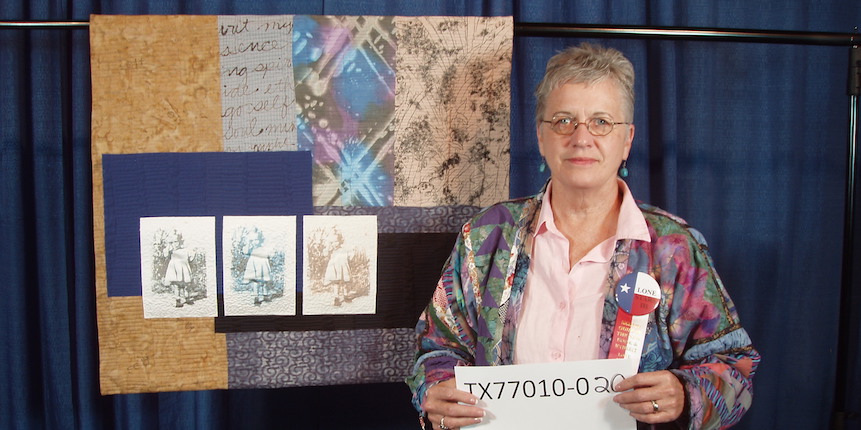
[addtoany] [space height=”10″] Cindy Dollar Brown (CDB): Perfect. I was hoping we would get away from that; we had a lot of background noise the other day, didn’t we? This is Cindy Dollar Brown, and today’s date is November 5th, 2011, it is 12:28 PM and I’m conducting an interview with Mary Ann Littlejohn for Quilters’ S.O.S. Save Our Stories a project of The Alliance for American Quilts. Mary Ann and I are at the International Quilt Festival in Houston, Texas. Mary Ann, will you tell me about the quilt you brought with you today? Mary Ann Littlejohn (ML): The name of this quilt is Self. I was going through a rather dry spell in my quilting and I had printed out a photograph of myself taken when I was about four years old, it was stuck on my design wall. One day I was so frustrated I just picked it up and (I don’t normally do this) I just started talking to myself. I said, “Self, tell me what to do with you? I know I can make a quilt with you, tell me what to do.” Then I decided to take the photograph and try a new process that I had heard about recently. With my injet printer, I printed on the back of an inkjet transparency. That side doesn’t dry instantly. To transfer the image I burnished it onto the fabric,. That’s what inspired the quilt. I went further with the word “self”. I looked up all the synonyms in the Thesaurus and wrote them on a piece of fabric and that’s included in the gray part. Then over in the gold I rubber stamped the word self a few times, that’s it. CDB: How does this reflect you now? ML: Well one thing it sort of, it represents a journey in some ways. The quilting in it is something new for me and that’s something I look forward to doing more of. That worked and I was very happy with it. CDB: What was the process that you used in the quilting? ML: It’s just straight lines, in rows, but there’s space between the rows and make the design you actually see. CDB: What meaning does the quilt have for you? ML: That I got started again. CDB: Had you taken some time off? ML: Yes. I just hadn’t done anything for a while, and it got me going again. All I needed was my self. CDB: Why did you choose this quilt to bring to the interview today? ML: Well, it has some more meaning too. The picture was taken when I was about four years old and we were living in Arizona after World War II and my father had returned from the war. In my mother’s hometown, Pomerene, Arizona, the women had set quilts up under the trees at the church and they were out there quilting on this beautiful spring day.The small children were playing under the quilts, and I could remember rolling around, playing, having a good time under the quilts, and looking up through the quilts and being able to see the geometric lines of where the seams were, thinking that was neat. I also thought it was really fun when somebody asked for scissors or thread and they threw it across the quilt and we could see it bounce. Even at that age I took away, a sense of community and the women having a good time and sharing — sharing their creativity and sharing their lives. It has just has a lot of meaning. That photo of the women quilting is actually in the Arizona book documenting the Arizona quilts. CDB: Did you have family members who were quilters, part of that quilting circle ML: My mother. CDB: Your mother was a quilter? ML: Then if you wanted to go beyond that, she was related to eighty-eight of the hundred people in the town, so if you went to cousins and aunts and [laughs.] CDB: It was a community. At what age did you start quiltmaking? ML: I made my first quilt back in about the 70s but that was really a poor attempt. I think it was a Family Circle pattern that was a single Carolina lily block for a queen sized quilt, and it was purple background with lime green and orange, hideous, and big fat batting. Quilted without a walking foot, but it kept us warm I guess [laughs.] CDB: So you used that quilt? ML: Oh we did, yes. CDB: Did you keep going after that first attempt? ML: No, not really. I was doing a lot of garment making, and I’ve always done a lot of other crafts and stuff too, and I guess that was about the time we moved to Saudi Arabia. We didn’t have quilting things available over there, we didn’t have the colors and fabric to quilt with at that time. we did later but not then. I also went to work, shortly after going there so I didn’t have as much time. I didn’t start quilting again until I made another poor attempt at a quilt when my granddaughter was born in ’86 or ’85 something like that. Again polyblend, cottons, satin stitch, the triangle was cut out of a cereal box, but it was for my granddaughter so I enjoyed that. Then another leap to 1992, after the Gulf War, I was living in Dhahran, Saudi Arabia, and the women there started up a quilt guild that just really took off. The women who had evacuated with their families during the war brought back books and techniques and we all just had a grand time quilting; we met once a week, and were able to put on a quilt show every year. That’s when I really started quilting. CDB: Were there teachers, mentors, within that group in Saudi Arabia for you? ML: There was one who was a master appliquér, Ruth Meyer, who had blocks in Elly Sienkiewicz books and won her competition one year, so she could guide us some, but mostly we were self-taught. We bought all the books, we all subscribed to Keepsake’s medley of the month so that we got new fabrics, and we mostly taught each other. We couldn’t bring in outside teachers. CDB: Do you have any special stories about those blocks made back then? ML: Actually I do, the way I got into the quilting guild. I had a friend who had broken her knee, and needed transportation to go to the grocery store and pick up her mail, and everyday when I went to pick her up, she was doing something, sewing something. I said, “So what are you doing?” and she said, “Well we have this quilt guild and we do a block of the month.” I think she said she had to do a minimum of four. You put your name in the drawing and then you get to take the blocks home if you win. I said, “Oh,” it’s a bowtie block, nice little straight lines, I could do that, maybe I’ve got some cotton fabrics, she probably gave me some muslin, I don’t know, and I made my four blocks, took them to the guild meeting the next night, and I won about a hundred blocks, and I played with those for a long time before I put them together, arranging them. That was really my start in quilting. CDB: You made a quilt out of those bowtie blocks? ML: I did. CDB: Do you still have that quilt? ML: I surely do. CDB: Do you use it? ML: It’s my nap quilt. CDB: Very good. How many hours a week do you spend quilting now? ML: Recently about a quarter [laughs.] of an hour, but last week I probably spent a dozen hours or more quilting. I’ve had a lot of dry spell. I used to quilt with a friend, Connie Fahrion, who lived nearby every Thursday and that was really great. We were both at about the same stage, traditional quilters just entering the art quilt world, so we were able to mentor and critique each other. She has become a very dear friend and we still depend on each other to critique and be honest about what we’re doing. CDB: What do you do for creative inspiration to get past those dry spells? ML: Recently I’ve actually been doing some exercises that don’t even involve sewing in one of the books I have. There are a number of books out there about how to get, jumpstart your creativity and I have been working through one. It’s interesting sketches, quick sketches and drawing, and you cut out pictures to make inspiration boards and things like that. CDB: Do you have a background in art? ML: No, I do not. We did not even have an art class in my high school. We had a tremendous band program, so I had music, but no art. CDB: So you’re self taught? ML: Yes. CDB: How does your quiltmaking impact your family? ML: They see it as something that I love to do. They understand that. My husband once told me, “I don’t always like what you do, but I love to watch your face when you tell me about it.” He gets it and he certainly allows me the space and time and doesn’t fret about the money or anything of that sort. My daughter has become a quilter, and my granddaughter has done joint projects with us. CDB: Do you work with your daughter at all? Do you guys collaborate on any of your quilting projects? ML: We have, we have collaborated on several quilts. She is president of an organization of six thousand people made up of children who grew up in Saudi Arabia They have a reunion/conference every other year. Starting back in the mid 90s she made a quilt that she put in their auction and it was by far the highest priced item in that auction. Of course they wanted to do one more the next reunion and she’s probably done five of them. We have collaborated some on that, but it usually had to do with the design and getting started, she actually executes it, and adds her own touches. I think one time I had to do some bindings or something, but she essentially finishes it. CDB: Are there specific themes for those quilts or how are those quilts developed? ML: They all have some sort of Middle East theme or something that would remind these kids of where they grew up. One of them was what we called a prayer quilt, Muslims have prayer rugs that they put down on the ground to pray five times a day. They have a pointed arch at the end that they points toward Mecca. I found some stickers for children to teach the prayer ritual they do They bow and I can’t tell you what all they do, but I often wonder what they were doing. It is a ritual four times a day were they kneel and stretch out and stand again, repeat…. It was even translated into English. I printed those on the fabric with my little laser printer, and used those as the center of log cabin blocks that I then worked into a quilt which looked like a prayer rug. I actually sold patterns and gave the people the printed images to put in the quilts. All of Marie’s quilts for them have had some sort of Middle East theme. One of them was 1001 Nights, based on some stamps that Dubai published some years ago. What else has she done? One of them had Saudi money printed on it. We picked a block with rectangles in it. Not many blocks have rectangles and, when she put the first four together, it looked like a mosaic floor. That was a little serendipity. Right off, right now I can’t think of the others, but they always had a Middle East theme of some sort. CDB: How have the places that you lived affected your work as a quilter? ML: Well obviously that has and all of our travels during the twenty-three years we were there have affected my sense of art. I learned a lot about the art of calligraphy. Calligraphy’s very important to the Arabs and it is really beautiful. I learned to do some calligraphy myself in English, not in Arabic. I just think I have a fairly broad way of looking at the world. CDB: Do you incorporate the calligraphy and other elements into your work that you do now? ML: I don’t incorporate any of the calligraphy because I no longer can hold the pen for very long to write. I have had to stop doing that. CDB: You mentioned using a laser printer, what advances in technology have influenced your work? ML: I started actually one of the things that isn’t really technology. When I first heard of paper piecing, we didn’t have all the things in Saudi Arabia that people in the U.S. had access to. I started using airmail paper that came in pads to print out my foundation paper pieces. It was great because it tore very easily, you could get it off. Somebody told me that was an innovation, back then, but then, of course, shortly after that, everybody was doing it. I started printing things on fabric, labels and things, I mentioned the prayer quilt, I did some printing with a laser printer, it was kind of problematic sometimes I jammed the printer. It cost seventy-five dollars for the repairman to open it, and he could not understand. They knew American women were crazy, but why was she trying to clean inside it [laughs.] I also got to be computer literate on my job before we left there, so I use a computer and digital camera extensively. I was not a photographer until I got a digital camera and I’ve just taken photos all over the place and realize if you take enough, some of them come out pretty good and some of those can become inspiration for the quilts, or get printed on fabric to go into quilts. CDB: What are your favorite techniques and materials that you use? ML: I think my favorite part of the process is the quilting. I just love to quilt. Well I’ve always liked to sew and I think I love the hum of the sewing machine; it’s very soothing, meditating. That’s my favorite part, and I tend to over-quilt a quilt because I enjoy the quilting part so much. CDB: What kind of machine do you use? ML: For the quilting I use a Juki with the stretched arm, most of the time. If I’m trying to do anything with a zig zag, I have various other machines. CDB: Are you a collector of sewing machines? ML: I seem to be [laughs.] CDB: What quilt groups do you belong to and what do they bring to your quilting, or what do you bring to them? ML: I was a member of the Quilt Guild of Greater Houston [Texas.] and I served as an officer and on committees there for many years, I’m no longer a member of that group. I’m a member of the Houston [Texas.] Area Fiber Artists. We use any fiber medium and quilts are included. I’m the webmaster there. I recently helped, to hang our annual show. I have a small critique group, there are six of us, one of them is the Connie that I used to sew with every week. Now she has moved two hours away, which is really painful for me, and we’ve become like sisters and we’ve done projects together. At our monthly meetings, we get together and just enjoy show and tell and entering some contests, that sort of thing. CDB: Do you enjoy entering contests? ML: I do, but I don’t enter a lot of them, because I live in Houston [Texas.]. If I enter something in the Houston [Texas.] show and happen to get it in, I can just drive across town and drop it off, I don’t have to pack it up. I’ve only entered a couple of shows where I had to send it somewhere. It’s not something I have to do, I’m, I’ve gotten over some of my competitiveness. CDB: What kinds of awards have you won? ML: I’ve some awards in guild shows. I haven’t won anything in Houston [Texas.] yet. CDB: Is that a goal? ML: If it happens. CDB: Have you ever been a judge or on a jury for a show, and what was that like? ML: I judged the Fort Bend [Texas.] quilt show, the portion of their county fair, maybe three times, which was interesting. CDB: What was interesting about it? ML: At the county fair; we were instructed to give mostly blue and red ribbons, and give more blue than red, and everyone got a ribbon. So if you didn’t get blue or red, you got a white ribbon. Having been in Houston [Texas.] and seeing the way they give awards in Houston [Texas.], that was quite a change. CDB: How is it in Houston [Texas.]? ML: Well they don’t give out very many awards, but you don’t get very many ribbons. The county fair, you’re going to get a ribbon. CDB: [laughs.] Tell me about your studio where you do your creative work, what’s it like? ML: It’s a bedroom upstairs in my house, it has a little bit too much furniture and so it’s kind of hard to get around in. I have two machines set up on tables that are next to each other so that I have a large open space to hold a quilt for quilting. I have a wall of cabinets with fabric and more. Then I have a large drafting table, old fashion drafting table, on wheels, that has plastic boxes stacked under it, sort of different ways, it holds other piles of fabric and things around. I have a flat screen TV in there, and I can listen to music. Then it spreads into the bathroom that goes from there to my office, which has a lot of storage. I have stacks of plastic bins in it that have all the paints and brushes and stamps and all that stuff. CDB: You know where everything is? ML: Pretty well. CDB: That’s great. ML: I know which pile it’s in sort of [laughs.] CDB: Are you a collector of fabrics? ML: Absolutely. CDB: Do you create your own? Oh go ahead. ML: Yes, I do create my own too. I’m really moving away from using commercial fabrics, but every time I decide that I’m just going to pack them all up and donate them, I need one, so they’re still there, but some of them I think may go away pretty soon because I’ve begun to realize I have so many in there, I don’t know where to start, and that’s difficult. CDB: What processes do you use when you create your own fabric? ML: I’ve dyed fabric, which I love to do but I don’t have a good place in my house to dye fabric. My laundry room is so small, I tend to spill the dye rather than on the fabric. I’ve done some painting on fabrics, some dyes, blueprint process on fabric, of course inkjet print some fabric, I now have a Thermofax machine to make silk screens, I have rubber stamps, lots of fun things to play with. CDB: Do you use a design wall? ML: Yes, I do; I have an eight by eight foot design wall that’s covered with a flannel sheet and it always has something up on it. CDB: What is your design process as far as the steps you take when you’re coming up with a quilt? ML: Unlike some people who sketch out a quilt and decide where everything goes before they start, I can’t seem to work that way, probably because I think I can’t draw. So I’ll pick a few pieces of fabric. I may select my color palette from a photograph or a magazine advertisement and say, “Yeah I like these colors together,” and start pulling out fabrics that match that, put them on the wall, just play with them, move them around a little bit, maybe put something else on there, maybe take down what I started out with. Sleep on it, come back the next day and see if they look different when you come back and get a fresh look. I work improvisationally, not very much is planned out. CDB: What do you think makes a great quilt? ML: One that speaks to you, with good design elements, color, good use of the color, and I really appreciate attention to the details that make a piece hang correctly and show correctly. CDB: What do you think makes a quilt artistically powerful? ML: Artistically powerful? Well certainly design elements and color are the, would be most important. CDB: What makes a great quilt maker? ML: Somebody who loves fabric, and is willing to step out the box and keep learning things. The same friend who was making those blocks for the quilt guild way back when in Saudi Arabia was a school teacher. While she was teaching me to make my first two or three quilts, she said, “Mary Ann, you need to learn something with every quilt you make, so push yourself just a little bit and learn something,” and I carried that with me. So explore new colors or something, to give new life to what you’re doing. CDB: Do you have any other philosophies that you follow when you’re quilting? ML: Well maybe it’s not really a philosophy but I took a Nancy Crow weeklong workshop early in my quilting career or life I guess you could say. She kept telling us, “keep focused, keep focused” and I actually have a sign on my wall in my studio that says, “Keep focused,” which I probably could find it if I looked for it [laughs.] CDB: Do you follow that? ML: Not very well [laughs.] I try, it’s just a reminder and I think, “Get back to it Mary Ann.” CDB: How do you feel about machine quilting versus hand quilting? Do you have a preference? ML: Well I, because of a pinched nerve I can’t hand quilt more than a few stitches, I learned that very early on, then I discovered machine quilting and I thought, “If my grandmother had been able to quilt on the sewing machine, she’d have done it.” CDB: You mentioned Nancy Crow, do you have other mentors or quiltmakers who have influenced you? ML: Another weeklong workshop that had a lot of influence was with David Walker and that was probably mostly spiritual. You know, you’ve got it in you, so just do it. CDB: Why is quiltmaking important to your life? ML: I’ve sewn all my life and I guess I’ve always liked fabric, and I think actually fabric is one of, I’m stealing a Michael James quote, “is one of our first sensory experiences because they wrap us in cloth after we see the light,” I’ve always loved to feel fabric, and must get on, I’m rambling [laughs.] CDB: I love when you ramble. Why is quiltmaking important to your life? ML: When I started quilting, again in the 90s, I felt like, “Oh my goodness, this is what I was born to do,” and I pretty much quit my garment making, I just love the whole process, and not having had any art in school, everything was new. When you’re middle aged, about retirement aged, and suddenly there are all these new things to learn. I’ve been taking workshops and classes, both in techniques and art and design, ever since and I think it keeps me a little bit younger. I’m never bored, let’s put it that way. CDB: In what ways do your quilts reflect your community or region? ML: All of the Middle East influence, I don’t think I’ve ever done anything that reflects Texas, no, not really, well, yes I did one, well, I’d been to Saudi Arabia for a visit in the Spring, and of course everything there is sand color, even the houses. When we came back to Houston [Texas.] the second week in March all the camellias and azaleas were blooming. They were so beautiful. I had an inkjet print of camellias and I remember, I very quickly made a piece. Everything was so beautiful, the colors around me and because I was happy from the trip I’d just been on.That one definitely reflected Houston [Texas.] not that anyone could tell, but I know it. CDB: Have you done any that reflected your childhood in Arizona? ML: Only this one. CDB: What do you think is the importance of quilts in American life? ML: I think over the years it’s certainly been a way for women to express their creativity, sometimes with very little money to keep their families warm. For instance, my mother kept a journal while my father was away during WWII. My mother and father wrote letters to each other during that time and kept them all. In there she talks about what quilt she’s making or the next one, the next design that my grandmother, her mother, is going to make. So they actually were planning these things and I thought, “That’s exciting,” that these poor, I mean my grandmother was a dirt farmer, she lived a very hard life, but still she got to play with these pieces of fabric and make something reasonably beautiful for her family to sleep under. I think it’s just a wonderful way to express their creativity. CDB: Have you ever used a quilt or quiltmaking in a difficult time? ML: I have a couple of times. One, I started making a quilt as my mother was dying. I picked up a fabric that I knew she would love. I was making a quilt about her and it was just a theme fabric with flowers and vegetables and things in it that I paired that with some music fabroc, because she was a piano teacher, organ player in church. The quilt was very much about her. I couldn’t finish it immediately after she died. I guess it became my grief quilt, but it’s a very happy quilt. I was kind of sad when I was working on it. Then another time after we had retired, where am I going with this one, I can’t remember. Oh, I did some group therapy because my husband and I had left our home, we left our job, we moved halfway across the world again and it was a depressing time. We had a wonderful time in Saudi Arabia, and had wonderful friends, and I ended up doing some group therapy. A year or two later when the center where I was in therapy was doing some fundraising, I offered to make a quilt for them, and they said they didn’t want it for their fundraiser, but I made it anyway. I used their logo which had a house, that had two or three people in the house and one of them was stepping out of the house. When I asked the director what she would like in her quilt, she said, “We mend hearts,” and so I said, “Okay.” With my inkjet printer, I printed clipart of all sorts of family relationships, you know, religious, babies, grandfathers, drunks, the whole bit, and pieced parts out of this fabric with the clipart into mended hearts. When I presented it to the director and she said, “Well tell me about it,” and I said, “Well, you know, I used your logo,” and she said, “Oh no, tell me about it,” she said, “All that stuff is in there for a reason,” and as I begin to tell her about it I realize that I had worked through a lot of things while making that quilt. Even today, they use that quilt in their intake room with families because she said, “Everything we talk about in there is in your quilt.” CDB: Do you have any amusing experiences related to quiltmaking or teaching? ML: One that’s not quite amusing but it was shocking at the time, I was teaching a class and just using a rotary cutter and no rulers, and I watched as the women in front of me said, “So I just close my eyes and cut?” She was cutting with a rotary cutter toward her hand [laughs.] “Oh no you keep your eyes open.” [laughs.] There had probably been other amusing ideas of the things, but, I’ve been asked some strange things about my quilts sometimes. CDB: Oh really, can you think of any funny questions people have asked you? ML: Well of course most of the world thinks they’re blankets, and you try to tell them what it is you do, and they just, they don’t, they can’t grasp what you’re talking about. Right now I can’t think of more. CDB: Do you get into the dialog between art quilting and traditional quilting at all? ML: No, but I think it’s very narrow minded of traditional quilters who just turn their nose up at the art quilts, or think they’re not quilts. If that’s the way they want to stay in their little niche, that’s fine with me. Some of the traditional quilts are very beautiful; I appreciate the workmanship there too. CDB: How do you think quilts can be preserved for the future? ML: Well certainly through your project, and by storing them properly and educating the world that they’re not blankets. CDB: Do you have any quilts that are ones that your mother or grandmother made? ML: I have one that my mother made, but none of my grandmother’s. In fact I don’t think my mother had any quilts from her mother, they all got thrown out when the house was cleaned out or something, and I think they were probably in very bad shape too. Oh, we have a quilt made out of, out of Garanimals knit fabric that my husband’s aunt made. She lived near a Garanimal factory and used to go dumpster diving to get the t-shirt material out so we have a quilt made out of Garanimals fabric [laughs.] That’s kind of a, that’s a period quilt too,. You can tell by looking at it. CDB: Kind of like your orange and lime green and purple. ML: Yes. CDB: When we spoke last, you told me about a special memory of your mother’s hands, was very special to you in your quiltmaking, can you tell me that story? ML: My mother was interested in genealogy. Both my mother and father, a university professor, were interested in the documentation of things. She went to a quilt show in Tucson [Arizona.], where they were documenting the old Arizona quilts, and was absolutely fascinated. I think she volunteered to help with the photography and stuff, and help hold the quilts for the photography, and became quite close to the women who was the project manager or whatever she was. She probably helped her find quilts among her many, many relatives, and that sort of thing. Toward the end of the project, they made a video. They came to my parent’s house, in Tucson [Arizona.] and then they went to the little town near Tucson [Arizona.] where she grew up, a very small town, about a hundred families. As they drove into the town, my mother said, “Oh, there’s cars in front of cousin or Aunt so-and-so’s house.” They stopped and went in, and there was a quilt set up there where the women were sitting around quilting. My mother sat down and quilted with them, with the videographer filming. They’re chatting about their families and their gardens and just having a good old quilting bee, so some of that was in the video. Then, after she died, I realized that the hands behind the credits in the beginning of the video were my mother’s hands quilting. CDB: Do you still have that video? ML: I think it’s at my daughter’s house. CDB: What has happened to the quilts that you’ve made? Do you sell them? Do you give them as gifts? ML: I’ve sold some, I’ve given a few as gifts, I’ve done a few commissions, I have a closet full. I do show quilts, I have a relationship with a gallery in Round Top, Texas which is a lot of fun; I’ve sold some through there. The quilt that’s in the new Lonestar III Texas quilt book was sold through that gallery. CDB: Is it hard to give them up? ML: I have a few that I will not sell. One of them that I love, I didn’t do the design it was actually a block of the month, I have in my living room and everybody that walks in will go by it. I love it. That one is just really special because it was a lot of work. Most of them I would sell, this one, I don’t know if I would ever, I’m not ready to sell that one yet, let’s put it that way, but I have very few that I wouldn’t sell, unless because some of them aren’t great quilts that’s for sure [laughs.] They don’t all come out like we think they’re going to. CDB: Is your first improvisational quilt one of your special ones that you wouldn’t give up? ML: Oh yes it is [laughs.] When I took a Nancy Crow weeklong seminar in Brussels, Belgium, it was actually my first formal quilting class. This was a five day Nancy Crow improvisational workshop. I was out of my mind, I don’t know why I did that. I was so out of my box, I mean it was painful. At the end of the first day, when Nancy came around, she didn’t do a lot of critiquing, but she came around and she asked me why I was looking so puzzled and frustrated, and I said, “Well I’m trying to put a border on this quilt,” and she said, “Why? What’s wrong with the way it is now?” “Oh okay.” Then of course we went on through the rest of the week and at the end of the week, when each teacher had her students put their work up for people to look at, she asked me what I was going to do with that piece and I thought, “Well I don’t know, I mean it’s not a quilt yet, not sure how I would quilt it. She said, “Well you’re not going to just put it in a UFO basket or something are you?” and I said, “Well, no, I kind of need to study it,” and she said, “Because if you are, I would like to buy it.” I was so shocked, I thought, “I think I need to keep this around to study a little more,” and I did not sell it to her. So it’s now framed and on my wall and I tell people, “It’s the quilt that Nancy Crow offered to buy and I kept.” [laughs.] CDB: What do you think is the biggest challenge confronting quiltmakers today? ML: Time and money [laughs.] For some people it’s the money, for me it’s time. CDB: How do you balance your time? ML: Not very well. I’ve had too many volunteer jobs for the last two, maybe three years, but I’ve realized the toll it’s taking and one of them is coming to an end on Monday [laughs.] CDB: Well I think we’re coming to the end of our time. Is there anything that I haven’t asked you that you want to make sure gets said on this interview? ML: I can’t think of anything, you did a wonderful job. CDB: Thank you so much. I’d like to thank you Mary Ann Littlejohn for allowing me to interview you today for the Quilters’ S.O.S. [Save Our Stories.] oral history project. Our interview concluded at 1:09 PM….