by Emma Parker | Sep 5, 2016
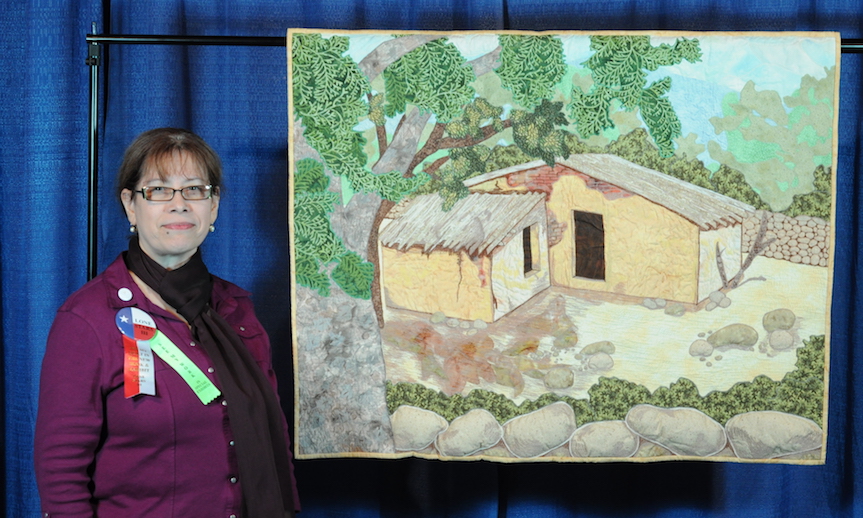
Mary McCarthy (MM): This is Mary McCarthy, I’m here today the 5th of November 2011 the time is 2:21 P.M. and I’m conducting an interview with Mary Ann Vaca-Lambert. This is for Quilters’ S.O.S. Save our stories, a project of the Alliance for American Quilts. Hello Mary Ann. Tell me about the quilt you brought today. Mary Ann Vaca-Lambert (MAVL): The quilt is called El Rancho de los Comaleros and is dedicated to my grandfather Secundino Vaca. He actually came from Mexico, he walked over from Mexico and this is where he was born and where he lived. Where it is at the base of the mountain, that’s called Comalero. There are local ranches at the base of that mountain that are called El Rancho de los Comaleros which is where it gets its name. I made that in 2006 in his memory, or 2007 rather. MM: What kind of special meaning does this quilt have for you if any? MAVL: Basically in 2006 I was diagnosed with cancer at the age of 49 and when then I was told that I needed to have surgery. Then I realized that I was also already had tickets for the Quilt Festival. Then I decided that I needed to schedule the surgery early enough so that it would not interfere with coming to the Quilt Festival so that was in August. It gave me enough time to recuperate to come and as I was going through the festival, when I saw the quilts that were in tactile architecture, and they had given me only 15% chance of living for a year, so when I saw the quilts, I knew that there was one thing I needed to do and that was to make this quilt because it was an important place for my grandfather there. It’s something that I felt real strongly about doing, so that next, you know right after that, I started thinking about it. I started it in December, I finished it in January of the next year in 2007, then I saw the Tactile Architecture call for entry and I entered it, and it was accepted, so it was a great year. MM: Why did you chose this quilt to bring today? MAVL: Because it’s what started it out for me. MM: What do you think someone viewing this quilt might think about you? MAVL: I can’t presume to know what they would think but I would hope that they would just enjoy the scene. MM: Do you have this quilt at home or does it hang somewhere else? MAVL: It hangs at home, but it has traveled in Tactile Architecture for a year when I did put it in other shows. MM: Do you have someone in your family who quilted? MAVL: Yes, my grandmother quilted and my mother as well but not very much. I think they both just made a few quilts. MM: How did you begin quilting? MAVL: I began because of my cancer and I needed a way, a mechanism to heal and it seemed very logical to do that and so that’s why I started quilting. MM: Do you have a painter’s background? That looks very painterly. MAVL: I have a Bachelor’s Degree from Sam Houston State University [Texas.] in Studio Art with a Concentration in Ceramics, but I do have a Masters, Master of Arts also from Sam Houston with Concentration in Drawing and Print Making. MM: Are you working on a quilt now? MAVL: Not this very minute other than I’ve got several in my head that I’m going to be working on. MM: Are they more traditional quilts or art quilts? MAVL: I prefer art quilts, they really, I totally respect the traditional quilters but it’s very tedious and so exact that there’s so much math involved that that just gets behind me. I really like doing this very free-form sort of quilting. MM: You said something about your grandmother’s quilting, do you have any memories of quilting as a child? MAVL: I remember my favorite quilt was a pink quilt that had these little tiny pink flowers on it and I just loved that quilt and I had it for years and years. It was my favorite quilt growing up, yeah, which she had made. MM: Do you have other quiltmakers in your family at all? MAVL: No I don’t. I’m the only one actually at this point. MM: What do you find most pleasing about quiltmaking? MAVL: The process, it would have to be the process; from the conception to the drawing and design and to the implementation and the delivery of the piece. MM: Do you belong to any art groups? Art quilt groups? MAVL: I belong to the Austin area [Texas.] quilt guild and the Austin Fiber Artists and the Studio Artists Association, Studio Art Quilters’ Association. MM: Do you have any favorite techniques or materials you like to use? MAVL: My favorite techniques is thread sketching or thread painting, you know to create the lights and the darks and shadows and light bouncing off of the subject matter. Raw edge appliqué, mostly because the raw ridges of the fabric I think show the hand of the quilter and the texture that’s involved. MM: Do you have a studio that you create in? MAVL: My studio is what would be the study of the house, you know the houses a lot of them have studies now. While mine is my studio and it has you know bookcases with books for reference and bins with my fabric in it and cutting table and a wonderful TV that my husband gave me for my quilt shows. MM: How do you balance your time with quilting and work? MAVL: It isn’t easy. I find that I don’t have a lot of time or not the kind of time I’d like so I usually just do them on the weekends. MM: Do you have a design wall up in your studio? MAVL: No I don’t, I usually draw my work on paper or I’ve got a large roll of paper, then I draw it out on my cutting table which is pretty good size. I also like the foot charts, you know that they use in businesses, because they’re a good size, they’re pretty close to that size. It’s real easy to draw on them and it’s sticky on the back so you could put it up on the wall if you wanted to do that. But no, I don’t have a design wall; I don’t really have the space. All of my space is taken up you know, with other things on the walls. MM: Have you used a computer to help you quilt? MAVL: No. Other than taking photographs maybe then occasionally printing the fabric, you know ether I’ll take a photograph and I’ll print something but sometimes I’ve used that. MM: What do you think makes a great quilt? MAVL: I think the love and care that goes into it. I don’t think it really matters what is looks like, but what the person intended to make and the joy they got out of making. I think the use of it, I think that is really what makes a great quilt. MM: What makes a quilt artistically powerful for you? MAVL: For me it’s on the instant message that you receive from looking at a quilt. That it can also be as, it can be very simple or it can be dramatic and be more in reference, but I really feel that beauty is in the eye of the beholder so anything can be a beautiful quilt or a successful quilt. MM: What would you say makes a great quiltmaker? MAVL: I would think that would be a person that really just enjoys what they’re doing and doesn’t labor on what other people think of their work, but I think it’s a feeling within. The success that they feel is an inner joy. MM: Is there a specific artist that has influenced your work? MAVL: I would have to say Georgia O’Keefe and Marc Chagall are two of probably my biggest influences through my art, although they’re not quilters. MM: Is there a quilter who has influenced you? MAVL: Geez, you know I’m not very good with names so I’m going to have to pass on saying there’s a particular quilter you know, that has influenced me. MM: How do you feel about machine quilting versus handquilting? MAVL: Well let me put that the other way around. I think that people that have the patience and the skill to do handquilting are fabulous; I mean they’re just awe inspiring. However that is not me. I’m afraid that that’s not something that I could spend a lot of time doing. I really like instant gratification and I think that’s one of the reasons I like thread sketching because I know I can take a blank piece of fabric, not even thinking about what I’m going to do, put it on there, look at it, and I could draw, since drawing is one of my mediums. It feels very natural to put a pool of thread and just start moving the fabric when you know, so I guess that’s why I really gravitate the quilting on my machine. MM: Have you tried longarm quilting? MAVL: No I have not, although I have friends that do that and they do beautiful work, but I don’t think that’s for me. MM: Why is quiltmaking important to your life? MAVL: Because is one of the means of healing, it’s a way of helping me through living with cancer and it’s very inspiring, its very comforting, and it’s the one way that I’ve been able to find a good marriage with my skill and the love of fabric. It was, and I don’t know why I didn’t do it sooner, I mean once I got started doing it I just, it was like a bell went off and I realized, “Oh my gosh this is what I need to be doing.” MM: What do you think about the importance, or non-importance, of quilts in American life? MAVL: I think that by far they are the keepers of history of day to day life. They have brought forward that history through the use of their materials and the themes, the designs, their inspiration, their reuse of materials; probably the first recyclers. I believe quilters are the first recyclers because they did continuously reuse, reuse, reuse fabric or whatever materials they had available and they would continue to do so although the trends are changing. Quilters are still documenting history, not just pictorial, went through the reuse of the materials on the quilt that they were using. MM: How do you think quilts should be used? MAVL: Well one, for comfort, for beauty, for joy, and in any way for shelter, any way possible. I don’t think it really matters. MM: How do you think quilts should be preserved for the future? MAVL: Through preservation, through documentation, through taking photographs, maintaining a history. MM: Have you made quilts for your family? MAVL: No, well I actually have made a few lap quilts for my family. I have made a few other quilts that were pictorial quilts for my family. That’s about it. MM: What’s the biggest challenge confronting quiltmakers today would you say? MAVL: I would think the cost of the materials. With so much innovation I think a lot of head cost of the materials, like cotton, is going up and I think it sometimes can be difficult you know to spend so much money. MM: Let me go back to the design of your quilt. Have you tried dyeing fabric on your own? MAVL: No because of the chemicals involved I try to stay away from the exposure of chemicals. MM: Does that include painting on the quilt do you think? MAVL: No because the textile paints are already mixed and a lot of the dyes you have to mix and wear respirators which I can’t do because respirators are meant to go over your face and I breath through my mouth so anything that has dust or particulates that you can inhale, I stay clear from. I think with an already mixed medium it’s easy to use. MM: Does this quilt hang at your house? Have I asked you that? MAVL: Yes it does. MM: Let me ask you, is there something you would like to expound upon or something you would like to continue talking about? MAVL: I believe that one thing that I would like to say is that my family has been extremely supportive and my wonderful husband, Mark, Mark Lambert that has been right there for me and one of the things that I remember him saying in 2006 when he came home one day, I had got I don’t know out of bed, when I had gone into my studio and I was working he said I would be okay because I was in my studio cutting fabric. That was back in the beginning of my recovery, so you know, I think he has just been instrumental to where I’m at today. MM: I’m getting ready to close, is there anything else you want to say or anyone else you want to mention? MAVL: Yes, my wonderful cat Joey, he is my companion for 22 years and spent so much time with me in my quilting room as well as my baby Mia, my other cat that recently passed away. They two were very important. MM: Thank you. I’d like to thank you formally, Mary Ann Vaca-Lambert for allowing me to interview you today for the Quilters’ Save Our Stories oral history project. Our interview has concluded at 2:43. MAVL: Thank you so…
by Emma Parker | Aug 24, 2016
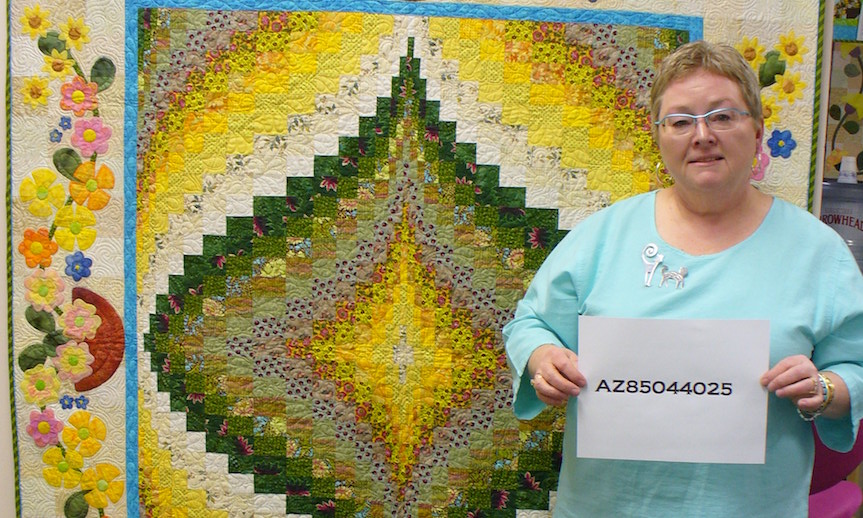
Lenna DeMarco (LD): This is Lenna DeMarco. I’m here with Nancy Landon. We’re recording her on Monday, March the 19th, 2012 in Tucson, Arizona, in her shop, the Cactus Quilt Shop. Nancy, tell me about the quilt you brought today. Nancy Landon (NL): My quilt today is called “Palo Verde Spring” and I chose that name because I wanted to make a quilt that reminded me of the Palo Verde trees when they are in bloom and it’s a cloud of yellow. So, I designed it so that there was a lot of yellow and green. LD: What special meaning does this quilt have for you? NL: Well it just reminds me so much of the beautiful desert in the spring which is the most beautiful season in the desert. LD: Now you’re a designer and a teacher and a shop owner. Why did you choose this particular quilt? NL: Because it’s my favorite right now, my current favorite. And it’s an original design so I felt it would best represent me as a quilter. LD: And how do you mean, what is it about it that represents you? NL: My, that’s a hard one. Well, I love color and this is a very colorful quilt and I’ve been described as a very colorful character [both laugh.] So I thought a very colorful quilt would be good to represent me. LD: Now you are a quilt teacher. What are your plans for this quilt? Are you going to teach it? NL: Oh, I’ve taught it. It’s been a class here at the shop for about three years and I always teach. It’s a pattern that I’ve published as well and I teach my quilts at the class before I write the pattern so that I can try out the directions on a guinea pig group of quilters before I go and publish it. LD: And you find that you’re changing and tweaking the pattern and stuff as you’re doing this each time? NL: Each time I teach the class. Yes. And then I figure out how I need to best organize the words so that someone who’s never made a quilt like this before can sit down and accomplish it. LD: It’s a beautiful quilt. Now, it’s pieced and appliqued. Is this a method that you like to use a lot? NL: Oh yeah, most of my patterns are a combination of the two. Piecing and applique. LD: Well now how did you first get interested in quiltmaking? When did you start? NL: Oh golly. I had my first quilting class when I lived in Germany in the mid 80’s. I married my high school sweetheart who joined the Air Force and took me off on a big adventure. And we happened to be living at Ramstein Air Force Base and all of the wives of the men that were in his office at the time would get together and have a coffee evening. And we decided that instead of just getting together and talking, we would share hobbies. And I was knitting at that time and I was to teach knitting. And someone else did cake decorating, hand calligraphy, et cetera, et cetera, but the very first class we chose to share was quilting. And it was the Georgia Bonesteel method of “Quilt as You Go” and within weeks of finishing my first quilt and dragging it everywhere with me, every meeting I went to, every ball game I attended, I had my quilting with me and people would say, “Oh, can you show me how to do that?” and I was happy to share, so– LD: So, was it a woman within the group who taught you to quilt? NL: Yes. Yes, it was one of the other gals. LD: Okay, great. NL: Yup. LD: And about how many hours a week do you quilt? Do you get a chance to do that? NL: I quilt at least an hour a day. LD: Even with running the shop. NL: Even with running a shop. That’s why I watch TV in the evening. I do a lot of applique and so I can sit in front of the TV with my work in my lap and listen to the TV. LD: Well now you learned to quilt as an adult, but what is your first quilt memory? NL: Well there were no quilts in my life as a child. My mother was a young woman of the 50’s and quilts were old-fashioned and she had no part of it. And so the family quilts had been folded up and put in a cedar chest. And I didn’t even know they were there until I was in my early 30’s. And then Mom and Dad were getting ready to retire out to Green Valley, Arizona and she was cleaning out and decided, ‘Okay, I don’t want these.’ David and I were coming back from Europe to move to Idaho, so I was in Wisconsin. My sister was in Wisconsin. Mom sat us down and said, ‘Okay girls. If you want these, fine. If you don’t, I’m giving them to the Goodwill.’ And she came up with 3 quilts. And of course Jane and I both wanted the same one, which was a Trip Around the World. And so we had to draw straws. LD: And she won. NL: And Jane won. She got the appropriate length straw. And so Mom said to me, ‘Well because you didn’t win the quilt you wanted, you can have the other two.’ LD: Oh how nice. NL: Yeah. So I’m happy to lose a competition like that anytime. So I got the other two quilts. One was a many Trips Around the World that my dad’s grandmother had made. And the other quilt was a green Powderpuff or Yo-Yo quilt that my mom’s grandmother had made. So I became the recipient of a quilt from each side of my family. LD: So now do you still have these quilts? NL: I still have them. And when I do my trunk show of antique quilts, those are the first two quilts I talk about. So that’s what started me on collecting old quilts. LD: Okay, so you have a fairly extensive collection of old quilts? NL: Um hmm. Umm hmm. LD: What is it about old quilts that attracts you? ‘Cause you do make new quilts. NL: Oh I do make new quilts, yes, but I love the old quilts, I love the stories we don’t know about them, I love the fabric, I love the beautiful handwork that went into them, and I love saving them and enjoying them. And I think that quilters are looking down from heaven and going, ‘Thank God someone who appreciates quilts has this one!’ [both laugh.] LD: Now you’re a little different from most quiltmakers in that you have a shop. How does this life style impact your family? NL: Well I didn’t open the shop until my children were all grown. The youngest was in high school, she was still a senior, when I was inspired to open a shop. And then in college she actually worked weekends in the shop with me. And she is a quilter too. LD: Oh great. So you were making quilts before your shop? NL: Oh yes, oh yes, I was quilting. When we moved back from overseas I had been sharing the quilting and teaching small groups over there and was a member of a small guild. There were only 27 of us, Americans. There were two German ladies. LD: Oh. NL: Cause we were in Germany. We moved back here to Tucson in ’95. And I wanted to find quilters. So I found the guild. And within a year I was president of the guild. [laughs.] LD: It’s a great guild here. NL: It’s a wonderful guild. That’s where I made all my first friends. And I heard that they needed a part time person at one of the other shops which happens to be five minutes from my house. And I was hired to work weekends over at the Quilt Basket and people would come in from the northwest side of town and say, ‘Oh my God, I had to pack a lunch and I’ve got my sleeping bag in the car. It’s so far! When is someone going to open a shop on the northwest side of town?’ So that little seed of an idea was planted. I knew I loved spending time with quilters and I’ve always loved fabric. I sewed my own clothes from the time I was ten. LD: So now how long have you had the shop– [inaudible.] NL: I’ve had the shop over 14 years now. LD: So, what have been the biggest challenges for you as a quiltmaker and quilt shop owner? NL: Well, finding time to quilt. [laughs.] Because people think, ‘Oh, you’ve got a quilt shop. All you do is sit around and make quilts all day.’ No, that’s not what you’re doing. But I get to spend time with quilters. I meet the most amazing people. I get to pick out fabric. The colors, and the feel of the cloth and everything. That’s part of what drew me to making quilts. LD: One thing I’ve noticed about looking through your inventory is that you have reproduction fabric as well as very contemporary fabric. Why did you choose to go that way? NL: Well my very first love were the reproduction fabrics. Those antique quilts always, I love antiques. So still I gravitated to the textiles and the old quilts. And so the reproduction quilts, the reproduction fabrics were my first love. Both the 1800’s and the 1930’s. But not everybody wants reproduction fabrics. LD: Really. NL: So, with a name like “Cactus Quilt Shop” I knew that I needed to get fabric that was southwest so we actually have more southwest fabric than anybody else in town and that’s what we sell the most of. Then, the batiks are just so yummy. Everybody loves batiks. LD: Oh right, yes. NL: So they’ve sort of taken over. We’ve got quite a lot of batiks. And the brighter tones and the brighter colors are what appeals here. Through the years I’ve watched what sold and I could figure out what my customer base was looking for and so that’s what I try to supply. LD: The quilts are very bright [inaudible.] hung around and lots of color and lots– NL: They’re very happy. LD: Yes they are. Well, speaking of happy and sad, have you ever used quilts or quilting to get you through a difficult time? NL: Oh sure. LD: Tell me about it. NL: Let’s see. When I was a brand new quilter and my husband was a fighter pilot and it was the late 80’s and he was doing that flying to Libya thing? Where we went to drop bombs on Libya. And I didn’t know what was going on. And so he’s gone off doing something he says, ‘I can’t tell you what’s going on, this is a special exercise,’ and so I’m quilting my brains out. Quilt, quilt, quilt. That’s what got me through that. And I have found that any time he had to go off to war. And since that episode he’s been to every war that we’ve done: the Bosnia thing, and the Gulf War the first time and the Gulf War the second time. He went three times that time. And when he went to the 2nd Gulf war, the one we’re just now trying to extricate ourselves from, I actually designed a happy quilt, “Arizona Wildflowers.” It’s a light colored background with lots of green, yellow and orange. LD: Have you been involved in any of the projects for the veterans or wounded warriors, the quilts of valor? NL: It’s not to make them, groups work here, I donate fabric. LD: Well, can you tell us about an amusing incident with a quilt? NL: An amusing incident. Oh golly. An amusing incident. LD: Or with your teaching. NL: Oh there’s so many different things that could be considered amusing. [laughs.] Can’t think of anything right now. [both laugh.] LD: Let me ask you this. What do you find most pleasing about quiltmaking? NL: Most pleasing. Oh golly. Well I love to applique. That’s my favorite thing now. And– LD: Are you self-taught? NL: Self-taught applique. Yes. Yes. And when I took my first class, I was shown one method of applique and I hated it. Freezer paper on the back, press the edge, I couldn’t get a smooth curve to save my soul. And I was never going to applique. So when we arrived here and I made my new friends in Tucson I was just piecing and they were appliqueing. They were members of a group that went up to the Quilted Apple in Phoenix with Laurene Sinema, who became one of my favorites and a great inspiration. LD: Everybody in Arizona. NL: Yes. Yes. But I told those gals I was never going to applique. Never ever, ever. And I discovered interfaced applique where you draw the design on a light interfacing and sew on the line all the way around, cut it out, slit it and turn it so all the edges are pre-done. And that light bulb went off and oh my God a whole new world was– LD: And is that the method you use– NL: And that is my preferred method, but now I teach, um, we call it “Applique for Dummies” [LM laughs.] which is the interface method and fusible with blanket stitch. And then I also do traditional needleturn so, but now it doesn’t matter. So I’ll applique anything. LD: Anything that’s not moving, right? NL: Yeah, that’s right. That’s right. LD: Is there any aspect of quilt making that you don’t enjoy? NL: I don’t think so. I love the rotary cutting. I do templates. I don’t have the time, because of the shop, to machine quilt and practice to get to be as good at that as I would like. So I quilt by check. I give it to a longarm quilter and I pick it up quilted. LD: Oh okay, alright. NL: And if it’s a small enough project I will hand quilt it myself. LD: Now do you, as someone who does own a shop I’m sure you’re constantly getting new products, that sort of stuff. Do you like to use all the new technology and the new methods that come out? Do you try to use those? NL: I try it at least once, to make sure I understand the product. Unless it involves a computer. [LD laughs.] I’m pretty much computer free, in my life. I’d rather quilt. So I find. My husband does all the computer work for me. So if it involves a program on the computer I’m hopeless. But if it’s a hands-on quilting product I generally try it. So that I know if it’s a good enough product to have in the shop. LD: Now, do you hand quilt? NL: I hand quilt. LD: Hand quilt. Wonderful. I know that you’re so busy with the shop, but are you part of any kind of a guilds or art groups or like that? NL: Oh yes. I’m a member of the Tucson Quilters Guild. I’ve been president twice in the 17 years since we’ve been here. I love the guild. And I’m a member of a bee. Once a month I go to my bee. We have all kinds of groups that meet here. My favorite is the Baltimore Ladies of Tucson where we sit and applique and do actual Baltimore style applique. We have another group that I’m just trying to get started here in the shop as well called AAA, Almost Always Applique [both laugh.] And then I’m very active with the shop owners group. So in southern Arizona all of the quilt shop owners get together and we plan a shop hop every 18 months and share ideas and talk and– LD: Because of this exposure to so many influences, has your style evolved over the years you’ve been here? NL: Oh yeah. LD: How has that happened? NL: Oh, I think that I have developed more technique. My quilting is definitely better. And so I try more intricate ideas. My very earliest patterns don’t look anything like my later patterns. LD: In what way have they changed? NL: Well they’re, I think they’re becoming a little more sophisticated. I still love folk art. That’s my basis and I always call my designs “Folk Art Southwest” but they’re definitely a little more sophisticated than they were when I started this thing. LD: Now one of the questions we like to ask is tell us about your quilt studio. I’m sitting right here in your shop so I’m assuming this is your quilt studio. NL: Well, nine times out of ten I start right here in the shop. So I don’t wash my fabric before I make a quilt. LD: Oh okay. Why is that? NL: Well because I’m cutting it off the bolt. [both laugh.] And I discovered Shout color catchers so when you are ready to wash your quilt you can throw in a color catcher and any dye that’s going to come out goes to that. So that’s a–thank God for those. But at home I have one of the bedrooms and I have a long table in front of the big window with two baskets for my cats and my Bernina sewing machine. I love my Bernina. And I’m surrounded by fabric. Took the doors off the closet so I can see it. It’s on shelves in the closet. And then behind my table is a large cutting area with an ironing board on the first side. LD: And do you have a design wall in there, too? NL: Yes, yes, there’s definitely a design wall. LD: Do you think that actually enhances your creative process, to use a design wall? NL: I pretty much see a quilt in my head before I start designing it. I have an idea and then as I do elements of it I’ll pin it up. There’s multiple layers on my design wall. I’ve had to take things down and rearrange when there’s a new idea. Right now, I’ve got four different projects pinned in various spots. LD: The sign of a creative person. NL: Yes, yes. LD: Let’s talk a little bit about craftsmanship and aesthetics and that sort of stuff. What do you think makes a great quilt? What do you think makes a really excellent quilt? NL: Attention to detail from the very beginning. Learning to cut accurately, sew accurately, so that all the points come together. LD: So you’re the quilt police. [both laugh.] NL: Ah, I guess I’m the quilt police. And but I learned a long time ago as a quilt teacher and my favorite is teaching beginners– LD: Why is that? NL: Well, I love to see that light come on. They, everybody wants to make a quilt and they think, ‘Oh, this is gonna be a snap. I can do that.’ And they realize that they have to really pay attention to what they’re doing and about week three that light comes on and they go, ‘Oh my God! I think I can get this.’ So I love seeing that revelation in their faces. I love to help people pick out fabric and take the mystery out of choosing fabrics for their quilts. LD: I think that’s–to me that’s the hardest part. NL: Yeah. For a lot of people it is. But I also learned that I can’t make everybody hold the same standards that I have. Quilting is–you have to love it. And I want people to love it. So, if their points are crooked, well then that’s fine. The finished product. As long as they have enjoyed the process and learned something and want to continue and go on and make more quilts then I’ve done my job. For my own quilts, what makes a fine quilt is making sure that my workmanship is as good as I can make it. LD: But in terms of aesthetics or artistic elements, what do you think makes a powerful quilt? What things do you look for? NL: Contrast. LD: Contrast? How? Explain that. NL: I want to see, I know that there are people who like blended quilts but for me to see the pieces and to be able to recognize what is going on in a quilt requires a little bit of contrast. And so that is what draws me to specific quilts. LD: What do you think makes a quilt appropriate for say a museum collection? How would you define that? NL: Oh, again, that perfection. That you just don’t see everyday. There are quilts that we want to sleep under and love and wash and let the cat lay on it and the kids pee on it and– [laughs.] LD: [laughs.] It’s okay, you can say that. NL: –and then there are quilts that we don’t abuse everyday. And those are the ones that end up in museums. There’s also a place in museums for a quilt that’s loved to death. LD: [inaudible.] NL: Yes. LD: Are there any particular quilt artists or just artists period that have influenced you in your work? NL: Folk art. I love the folk art. I can see that influence in most of my work. But as for an artist, oh maybe [pause.] Van Gogh. LD: And why that? NL: Well, he, he had a way with color. And I love that; that color. And so of all the artists he was probably my favorite. And I look at his work and it’s more folk art than some of the other artists from his, and Picasso. His work would make great quilts, [laughs.] great quilts. LD: Is there any particular quilt artist or designer that has influenced you? NL: Well, Laurene Sinema, definitely. Any other quilt artist. Helen Frost. LD: Helen Frost. How are those people–I mean they’re both Arizona artists. I mean, how have they influenced you? NL: Well, Laurene opened my eyes to the possibilities of applique. I learned a lot from her. So that was, that was amazing for me. Helen, as a piecer, she has so many good tips on piecing accurately and quickly and so I have learned a lot from talking with Helen as well. Other quilt artists, oh I love Piececake, the [pause, inaudible,both laugh.] LD: We can fill it in. NL: Okay. Sorry. LD: Well, let’s talk a little bit about the function and meaning of quilts in American life. How do you, in what ways do you feel like your quilts maybe reflect your community and the reason you’re in it now. Do they on a general basis or periodically or– NL: Well, my quilts are made specifically to remind me of Arizona. When I opened the shop I couldn’t order or purchase patterns for the store that were, that reminded me of Arizona, of our community, of our landscape, and so I started making them myself. And my very first one was called The Old Pueblo. I was actually trying to recreate Jean Wells’ quilt called My Town. It was on the cover of her book Willow Wood. And I realized I didn’t want it to look like hers. I wanted it to look southwest so I changed it. So she’s another one who’s been a bit of an influence for me. Again we’ve got that folk art deal. LD: Right, right. NL: And then my second pattern that I published is called “Dove of the Desert” and it’s a Mission. Mission San Xavier. So I tried to recreate in a simplified way, our environment. This one back here is called “Pretty Rita, Prickly Pear” and the block is a traditional block called Prickly Pear and then I just played with it. LD: Now where we are in Arizona, we have so many Snow Birds and retirees, people coming from the East Coast and that find our environment very exotic. What’s their response to your patterns and designs and fabric? NL: They love them. We sell a lot of the patterns to people who are visiting from other parts of the country and who want to take a little bit of Tucson home with them. And none of them are so elaborate that people look at them and say, ‘Oh, I could never try that.’ So they’re generally doable. LD: What do you think is the importance of quilts in American life? NL: They’re comfort. They’re comfort. They give us comfort. I think that’s why in our economy today, with the economy being so bad for a lot of people, out of work, et cetera, my shop is still a success. Because people want to quilt. They want that comfort. And they have something to show for that activity at the end. It’s creative and we’ve got something to show for it that can be used. LD: Very typical of women’s work, I think. NL: Oh, yes. LD: In what ways do you think quilts have a special meaning for women’s history in America? NL: Well, you know one of my favorite sayings is ‘Anonymous, Thy name is woman’ and quilting and needle arts in particular give women who may feel they don’t have a whole lot of power or whatever, an outlet, a creative outlet, and then they’ve got something that they can use. And our history, no matter where we turn with women’s history, needlework and sewing and quilts always seem to be a part of it. LD: What do you think is, what happens to the quilts that you’ve given to your friends and family? You know, have they been used or what has happened to them? NL: Well, hopefully they’re being used. I know we made a baby quilt for my sister-in-law and she put it on the wall. The label says, ‘Wrap your baby in love and wrap her in this quilt.’ And it’s on the wall. So I always hope my quilts are being used rather than nailed to the wall, but–. LD: So, the majority of quilts you make–are they art quilts or are they– NL: They are to be used. Each quilt is a work of art [laughs.]– LD: Absolutely. NL: But I want them used. LD: [laughs.] Absolutely. What do you do about storing and preserving your quilts? What steps do you take to do that? NL: Well, right now a lot of them are hanging on the walls of the shop, but once they go home, I rotate them on beds. And we’ve got one bed that must have 15 quilts on it right now. Yeah, just stacked up. I have a lot of quilt racks. They’re on the back of everything. LD: What do you think is the biggest challenge confronting quiltmakers today? NL: Coming up with money to buy fabric. [both laugh.] Other than that, finding time, I think, finding the time in our busy lives to quilt is probably the biggest challenge we all have. LD: Now, you’re also a quilt historian. We’ve talked about that and how you admire antique quilts and quilt. What do you see in terms of the changing style of quilts and how it reflects women’s lives over the centuries now? NL: Um hmm. LD: What do you see quilts today saying about today’s women as opposed to 1850’s? NL: Okay, I think something that I don’t carry a lot of here are the “potato chip” patterns, the quick, down and dirty, fast quilts because I want people to stretch and learn and try a technique and I love the traditional techniques so we have a very traditional focus here. So I don’t do those fast, quick quilts here. And I find so many quilters want to do that. They just want to turn out those quilts because we’re on high gear. Everybody’s going faster and faster and faster. And so I try to counter that by teaching the traditional skills and encouraging people to try those hard and fast successful quilts that we’ve been making since the 1850’s. Baltimore quilts is a big one that we’re doing here in the shop now. But I think that we go through cycles and the traditional stuff–there’s a whole market for it. And ladies are coming in and they’re wanting to do that. And another shop in town pursues the go cutter and the big pieces, and that’s not what I want to do. And that’s not what I hope quilters will do. But that’s what I see going on right now in quilting. LD: Now you were just inducted into the Arizona Quilters Hall of Fame for the past 2011 and this is our final question. NL: Oh my. LD: Yes, it’s been fast and fun. What would you like to be your legacy for the quilters in Arizona and for quilters in general? How would you like to be remembered? NL: I would like to be remembered for sharing quilting with anybody and everybody who is interested in it. I think that’s why I like to teach the beginners. I get them hooked. [both laugh.] But I think that’s what I want to be remembered for, as someone who was, who shared quilting. LD: Well, thank you Nancy. It’s been a delight– NL: Oh, thank you! LD: –and we are so happy to have you in Arizona– NL: Thank you. LD: –as a member of the Arizona Quilters Hall of Fame. I’m so thrilled that you’re part of this and thank you so much. NL: Oh, I can’t get enough of it. [both laugh.] LD: Thanks a lot. NL: Oh wow, well that wasn’t bad. LD: Not at all. NL:…

by Emma Parker | Jul 1, 2016
[addtoany] [space height=”10″] Ellen Cavlett (EC): Patti will you tell me about the quilt you brought today? Patti Nethery (PN): Okay! This is the latest quilt that I made and it always seems that my latest quilt that I made is my favorite quilt. I am kind of big on red, white, and blue even my business logos and everything are red, white, and blue. I saw this pattern several years ago and I wish I could remember today the lady that came out with this pattern, but she has a couple of books out and called Braided Quilts and I named mine, Braid in America since it’s more of Americana theme. The quilt is 95-by-95 and it’s the first time I’ve ever done the braided technique and I just really like the quilt. It is one of my favorite right now and as I said my latest quilt is always my favorite quilt. EC: I think that’s a great idea! So you make your own quilts. Do you do your own quilting on it? PN: Not on my big quilts that I’ve made. When I do wall hangings or table toppers or something small I do my own quilting but, I feel like I’m much better at the piecing and picking the fabric than I am quilting. I have a couple of friends that do long arm quilting and so usually one of them will do my quilting for me. EC: That’s great! What special meaning does it have beyond that you just like patriotic quilts, is there anything extra special about it? PN: I guess in today’s world I feel like in America we could be more patriotic and I have been on this bandwagon the last couple of years. I ararted a new company this past year and I was trying to come up with a company name for some rulers I developed. So I came up with my company name, “Ruler Revolution” kind of a take off of the Revolutionary War. I got to thinking since I already like red, white and blue, I’m just going to use red, white, and blue in my business so, I guess I’m just a red, white, and blue nut! [laughs.] EC: Very good! That’s why you chose this quilt of course to bring to the interview. Let’s see, what do you think somebody that looks at this quilt, a stranger that walked up, would think about you? Conclude. PN: I don’t know! Hopefully they would think I have a little bit of talent, that I can put colors together. However, I will tell you this quilt was in a show recently and it was a judged show and the lady that judged it said, “too much red, white, and blue fabric.” Well that was my intent![laughs.] EC: How do you use this quilt? Do you use it? PN: Actually right now I have it laying on my guest bedroom bed folded across the bottom. My guest bedroom is more where I display my quilts. I have decorated in neutral colors so I just swap out the quilts in the room. EC: But do you have any other plans for it, like entering contests? PN: No, probably not. It will just be one that I will use around the house in my guest bedroom. EC: Tell me about how you got interested in quilt making. PN: Back in 1998 I had moved from Dayton, Texas to Conroe, Texas and I had gone to work at a bank as a commercial lender. One of the ladies that I was working with invited me to lunch one day after I had been working there for about two weeks. We went to lunch and we were talking and the conversation lead into sewing and she was asking me if I’d ever quilted. I said, “oh yes I tried that early on, decided I didn’t like it”. I was into making clothes, garments and things for the house she says, “well you really ought to try it, it’s different now than when you tried it the first go around”. She invited me to a guild meeting and I went. Libby Lehman, somebody that was really well known in the industry was the speaker and she did a really great job so it kind of sparked my interest. The same co-worker/friend invited me to go to her Saturday Bee with her and so there just happened to be an opening so I was accepted into the Bee. From there it just kind of took off! It didn’t take long to get me sucked in! EC: You’re addicted to it! PN: Oh yeah! [laughs.] EC: Obviously you were an adult when you started quilt making. So about how many hours a week do you quilt? PN: Well, since I started inventing my rulers last year it’s kind of cut in a little bit to my actual real quilting time but I would say about ten hours a week. I try to get into my sewing room and piddle around with fabric and designs. EC: And of course you said that you worked outside the home too. PN: Yes. EC: So you have two jobs. PN: Yes. EC: Okay. What’s your first quilt memory? Would it be hearing Libby’s lecture? PN: No, actually my first quilt memory goes back to 1977 or 1978. I had a friend that also sewed and we went to JoAnn’s which back then it was called, hmm.. EC: Cloth World PN: Yes, Cloth World. Anyway, she was buying some fabric to do a little quilt and I had just had a baby and I thought, ‘Well that’s going to be a cute little quilt! I’ll make that quilt too and we got up to the checkout counter and she had bought all this extra stuff. I had just bought my few little things that I needed to make this little duck quilt. When they rang up my friends purchases, she had bought a hundred dollars worth of fabric and I’m like, ‘Oh my gosh! She just bought a hundred dollars worth of fabric!’ [laughs.] I was so impressed that she was buying that much fabric. The little duck quilt was actually one of my first quilt projects. EC: A little duck quilt for the baby, oh how wonderful! Um, are there other quilt makers in your family or friends? PN: Actually,, my grandmother was a quilter which was my mother’s mother and of course she made quilts out of whatever scraps she could get a hold of and my grandmother was more of a utility quilter. EC: Hmm PN: She really didn’t get into fancy designs or patterns. Whatever she had, that’s what she made the quilt with. EC: Did you ever help her, like sticking the pin? PN: Well I remember when we would go visit, she would have a quilt frame in her dining room and she would drop it down. I remember as a child my aunts would help her do some hand quilting as I’d crawl around under the quilt, but I never did quilt with her. EC: That’s neat. Does quilt making impact your family like, like your husband? PN: Now it does! [laughs.] In fact he’s back in our booth. He’s been really good about it. He enjoys watching what I come up with and he’ll wander in the sewing room every now and then and ask a question about, ‘Well if you turn this this way, what happens?’ or ‘Turn this that way’. He’s kind of vocal on about what he does and does not like. EC: So he gives you a few suggestions here. PN: Yes. Sometimes I ignore him though. [laughs.] EC: What aspect of your quilting do you enjoy the most? PN: I think what I really enjoy the most is coming up with the design whether I design it or I use somebody else’s design and then the chase of the fabric and piecing it together. After that I don’t care what happens to it, just bring it back to me when it is quilted and then I’ll put the binding on it. But, I like the chasing of the fabric, the design and the piecing the best. EC: So the quilting is what you don’t enjoy, the actual act of quilting is not your favorite part. PN: It’s not my thing but I love beautiful quilting. EC: Yes Maybe it’s because I haven’t practiced, but I like for it to be perfect and I know I can’t do that perfectly so I let somebody that has that talent do it. EC: Do you belong to any art, like any quilt groups? PN: I actually belong to two guilds, I belong to The Conroe Golden Needles Quilt Guild and I belong to The Woodlands Area Quilt Guild and then I belong to two different bees. EC: Very good! So you belong to several things. PN: Yes. EC: Have new advances in technology affected your work? PN: I’m sure they have but I cannot really put my finger on it right now. I guess that’s one of the neat things about quilting, things are always evolving whether it’s new designs, new fabric, new gadgets. There’s always something coming along, so as a quilter I don’t think you have the opportunity to get stagnant in your work unless you choose to. EC: What are your favorite techniques and materials? We’ve sort of covered that but I have this specific question. PN: I guess they run the gamut. If you ask my husband, he’d probably say rulers. [laughs.] We were in my sewing room one night and he was counting my rulers. I have some ruler racks on my sewing table and he just started counting them and he finally said, ‘do you realize that you have sixty rulers here?’ and I just thought to myself, ‘I know I have sixty rulers there but the rest of them are in the box that you can’t see.’ [laughs.] EC: Good thinking! PN: I would have to say rulers. EC: Did you invent the rulers that you are selling now? PN: Yes, I did and they are in the process of being patented. EC: Describe your studio or the place that you make your quilts. PN: Okay, I work in a little room about the size of this booth. It’s a ten-by-ten room, it’s a one person sewing room and the way I have it set up is I have my cutting center right out in the center of the room but it’s against one wall and you can walk around the cutting center on three sides. Then I have bookcases and a pattern file cabinet on one wall. Next I have my sewing machine on another wall. I used to scrapbook but I haven’t done much of that lately. But, I have the scrapbooking center on the fourth wall. I have a design wall that’s right above my sewing machine. EC: Oh good that was going to be one of my questions! Is it permanently affixed to the wall? PN: Yes EC: And where do you put your fabric? PN: I’m sorry? EC: Where do you put your fabric stash? PN: Um, my fabric stash is in, it’s kind of grown to where it’s sort of encroached in every closet, [laughs.] in the house. But basically I keep it in closets. I don’t keep it out just for the fact that I don’t want it to look messy plus it gets dusty. EC: And it fades. PN: Yes EC: How do you balance this time, we kind of touched on that too but just specifically how do you balance your time? PN: I don’t sleep very much! [laughs.] I’m usually on the go all the time, I guess I’m kind of a type A personality where I’m busy all the time. I rarely watch TV. If I have the TV on in my sewing room I’m listening to it, I’m not watching it. But basically I’m busy all the time. Quilting is a relaxing hobby for me so rather than sitting in a chair like some people and watching the TV relaxing, I relax when I’m working in my quilting room. EC: That’s great. How do you use your design wall? Tell me what it is for. What is your process is in using it. PN: The way I use it, in fact right now what’s on my design wall is a Christmas baby quilt for my new granddaughter that I’m working on and then some ribbons that I’ve won on quilts. I keep them up in the corner and that keeps me inspired I guess. Then on the left hand side there’s different little ideas that I want to do and I always keep my little binding instructions up because I don’t know what it is about that ending piece of binding that invariably I will cut it wrong every time. And, a lot of times when I’m working on a project, I cut the salvage off just in case I need more fabric, I’ll hang the little salvage strips up there. EC: Great idea! What do you think makes a great quilt? PN: You know a great quilt can be one piece of fabric that has a ton of quilting on it, so can quilts that have jewels and beads and tiny pieces of fabric. I don’t know! There’s so many beautiful quilts out there. I guess I really haven’t met a quilt I didn’t like. EC: And so what do you think makes it artistically powerful? PN: To me, and this is probably because I don’t have an art degree, but to me I think the more stuff they have on it a lot of times makes more of an impact. Although I do realize that sometimes simple can send a message too, but I guess in my eye the more embellished it is. EC: What specifically as a quiltes do you feel influenced you? PN: I would probably say the ladies that I quilt with in my bee. One of the bees I’m in, we basically do our own thing but we’ll share ideas and thigs. It is called the Smokin’ Needles Bee and has been the most inspiring. Everybody is very talented in the group and we feed off of each other and then we have one lady that get’s us all in a “rah rah” spirit on different things and in fact the quilt on display down here (Houston International Quilt Festival) is because of Peggy that is in my bee. Her name is Peggy Richards. She was encouraging us all to take a Judy Niemeyer class and there’s nine of us, or at the time there were nine of us in the bee. One other lady and I had not signed up to go and I’m like, ‘gosh the quilt had too many pieces in it, I’ll never get it finished’ and you know, just making up all these excuses. Then I thought, ‘I don’t want to be the only one in the bee that doesn’t get to go for the three days and have a good time so I kind of bowed to peer pressure and signed up. And that’s why I’m here today because of Peggy Richards! EC: Wonderful! PN: Yeah! EC: Are there any other quilters that also have, besides in your bee, but I mean nationally know quilters or whatever that have inspired you as well? PN: You know I guess I have probably through the years picked a technique from this one and that one and, and of course I watch Fons & Porter on TV, and I watch Nancy Zieman. I’ve taken classes from Libby Lehman and from Carol Doak. I guess I’ve really kind of picked and chosen different techniques not really remembering maybe where I got them but probably in that scope is where they came from. EC: Great! Do you have anybody specifically whose works draw you to them? PN: I really can’t say that I do because like I said a while ago, I like all quilts. It’s not that I’m really drawn to a specific quilt, I just like them all! EC: How do you feel about machine quilting versus hand quilting? PN: I think both of them are an art form. I’m not divided on them. Look at the quilting on this quilt, I think it’s beautiful but I also think that hand quilting is beautiful. EC: You like quilts. PN: [laughs.] Yes! EC: Why is quiltmaking important to your life? PN: You know I have the best friends because of quilting I think. I’ve often thought if I hadn’t started quilting, course I’d moved to a new town and even though you say you’re going to keep in touch with your old friends, when you move you still every now and then pick up the phone and stuff but it’s not like you still live in town with them. And the cool thing about quilting, it has created just a huge circle of friends for me and with my new venture that I’m in with my rulers they’ve all volunteered to come work in my booth and one lady, Rosann Gilbert, took it on herself to schedule everybody! [laughs.] She just jumped right in there and you know in today’s busy world, there’s not a lot of friends that would do that. Most friends would just tell you I will see you when you get back home. EC: Do you thi-, what do you th-, what ways do your quilts influence your community or the other people in your life? PN: Since I belong to the guild, I guess I bring some kind of joy when I do a show and tell. I guess when people look at them and it’s like, ‘well if she can do that I can do that!’ and maybe provide a little inspiration. EC: Do you, what way do you think that quilts have had an importance in history of women in America? PN: Women I think have an inherit need to create something, whether they are creating a home, a recipe, a quilt. I think what quilts have done with women is, like it’s done for me, it’s created friendships, it’s giving quilters a way back during times of war, to get their mind off of their daily struggles that they’re carrying. EC: Do you have a, do you sleep under a quilt? PN: In the winter time I do. On my side of the bed, my husband said it’s too hot for him. [laughs.] EC: How do you think that quilts can be used generally? PN: I think they can be used generally in either decorating. I know there’s a lot of projects out like the Linus Project. There’s the Quilt of Valor that I think can show appreciation in a lot of ways as well as comfort. I think quilts are a very versatile item. EC: How do you think you can preserve quilts for the future? Or how a person can. PN: I’ve read all the information about what you’re supposed to do to preserve a, [laughs.] at home and so far I’ve not done a very good job at doing that but I think it’s marvelous that we have throughout the United States museums and how they go about preserving them for our history. I’m thankful there’s people out there that have taken it upon themselves to do that. I’ve really not been part of that group. EC: What’s happened to the quilts that you’ve already made for friends or family? PN: I’ve given away quite a few quilts and then the ones that I keep are in my guest bedroom and in an antique china cabinet. It has a rounded front on it and I keep them displayed in it. EC: So they’re part of your decoration too? PN: Yes. EC: Uh, what do you think is the biggest challenge confronting quilt makers today? PN: Challenge? The first thing that just kind of pops in mind is probably our recession that we’ve gone through. I know quilters typically are more fluent. I’ve read the surveys and stuff but there are a lot of quilters out there that are not affluent. I recently had a booth at a show and actually had several women that came by my booth that said that they were quilters and they’d come to the show but they had come to look at the quilts because they had recently lost their jobs so they weren’t really purchasing anything at the shows. So I would think probably our recession. EC: Have you ever participated in a quilt show? I’m not talking about entering it, helping set it up or something beside your bee’s I mean. PN: Yes, I did one year. I helped hang quilts and then I worked down here one time as a white glove lady turning the quilts. EC: That’s fun. Uh, do you ever go out of town to see quilt shows, not just to, to be a vendor? PN: Yes. I’ve traveled around to see some quilt shows. I’ve really not traveled outside of the state to see quilt shows but I have been to some of the other Texas quilt shows. EC: Very interesting. Is there anything that you would like, a comment that you’d like to make about your quilt making or your quilt life to add to this? PN: I’m just glad that Linda Davis asked me to lunch that day, cause I don’t know where I would be now if she hadn’t asked me to lunch. EC: That’s great. Well thank you so much! Um, I’d like to thank you Patti for allowing me to interview today for the Quilters SOS: Save Our Stories oral history project. Our interview concluded at 3:36. PN: Alright. I thank you ladies! I appreciate…
by Janneken Smucker | Jul 14, 2016
[addtoany] [space height=”10″] Explore and listen to Rosemary Kimball’s interview by clicking open a segment title and selecting “Play Segment,” or by searching either the index or…
by Emma Parker | Aug 25, 2016
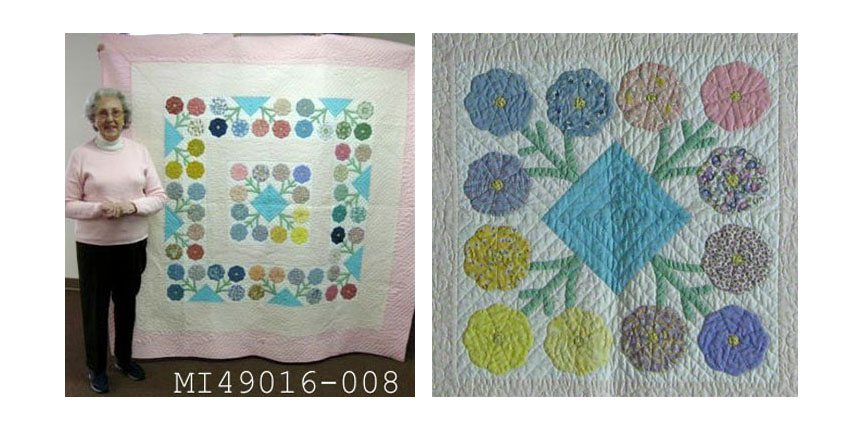
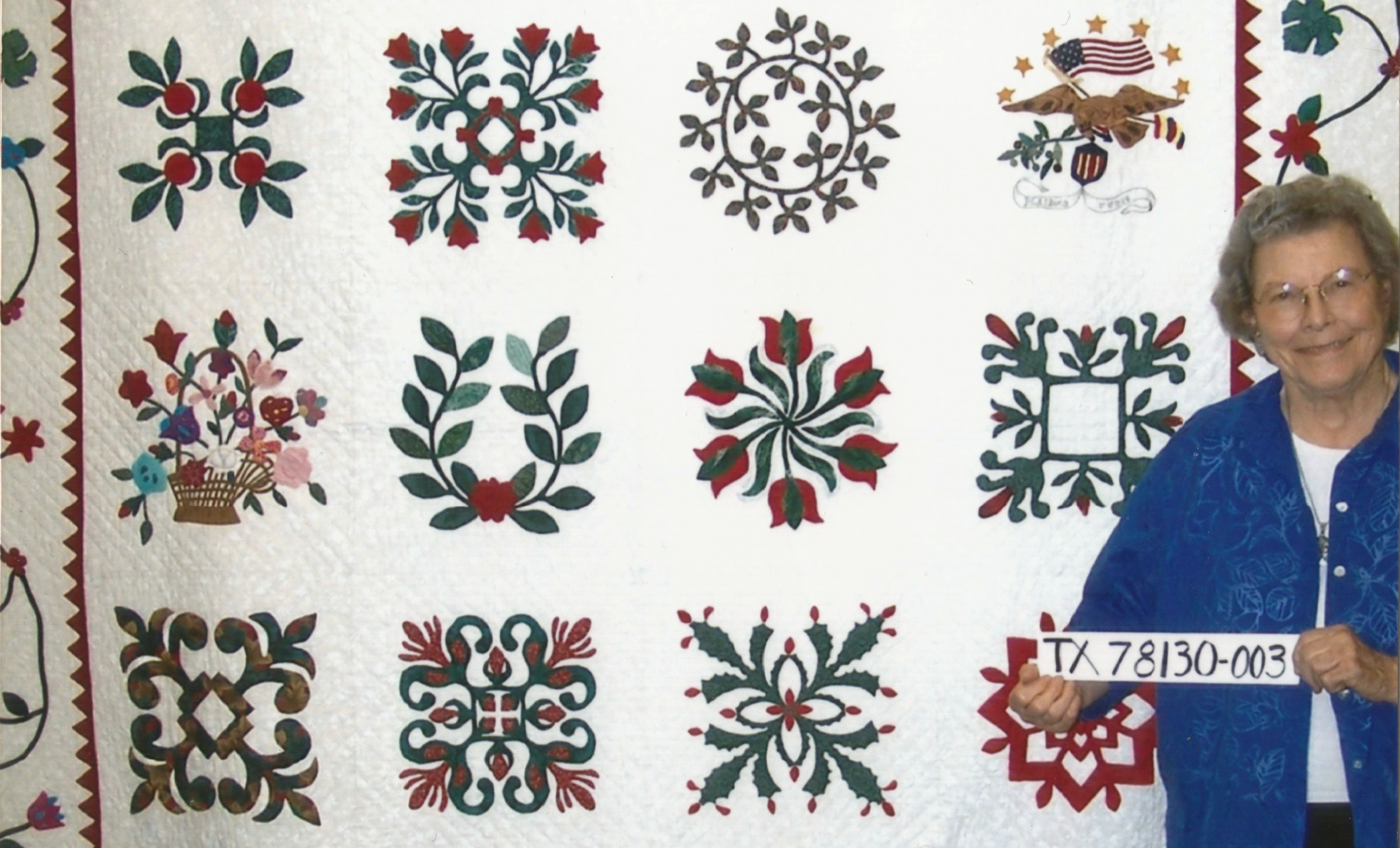
Phyllis Jordan (PJ): This is Phyllis Jordan. Today’s date is September 27, 2012. It is 12:50 p.m. and I am conducting an interview with Rouye Rush for Quilter’s S.O.S. Save Our Stories project in the Sophien [Sophienburg.] Museum New Braunfels, Texas. Rouye, tell me about the quilt you made today, or you brought today. Rouye Rush (RR): Well I, my sister drove from Houston [Texas.] to spend the night with me in San Marcos [Texas.] and we drove to Austin [Texas.] once a month, for 12 months, and took a class from Beth Kennedy, on appliquéing, and I made the Baltimore Album quilt I brought today. And that was in ’93 or ’94, I can’t remember which year. And we didn’t, of course there are more than 12 blocks, so we had to do some at home, and that did not include the border. I waited three years before I decided what kind of border I wanted on it and I finally finished it in ’97 and hand quilted it myself in ’98. And I believe it was in the New Braunfels [Texas.] Quilt Show either in ’98 or ’99, I can’t remember. PJ: I know this has special meaning for you. Tell me about why this is so meaningful. RR: Well, maybe because my sister and I took the classes together and she’s gone now; but, it has special meaning, but I have several quilts that have special meanings and it was hard to pick out a quilt to bring today, but I finally decided to bring this one. PJ: Well, we thank you. RR: I have already given it to one of my children, so, I don’t even own the quilt anymore, but she lives in the same town so. PJ: Does she put it on a bed? RR: Yes. It’s on her bed in her guestroom and has been for several years. PJ: Good. What do you think, if someone saw your quilt. reviewed your quilt, what do you think they might conclude about you? RR: I have no idea. PJ: And you use this quilt, your daughter has it in her guestroom. Is that correct? RR: Uh huh. PJ: Good. Tell me about the, your interest in quilt making. RR: Well, it started early in the ’60’s and ’70’s. I have a friend who told me that she started quilting about the same time and she said I was a closet quilter. I’d never heard that phrase before; and, she said there weren’t any quilt guilds. There weren’t any quilt shops and I didn’t have any quilting friends, so I did quilt. My mother quilted, but, she didn’t teach me to quilt. I’d see her quilting and my grandmother quilted, but I didn’t live close to my grandmother and she made ugly quilts, I thought, cause she made, you know, quilts out of old suits and heavy things, so they used them. They were not pretty quilts. And I always looked at the magazines. I ordered patterns out of the Fort Worth Star Telegram [ Fort Worth, Texas newspaper.] and the newspapers would have a little pattern for maybe 25 or 50 cents and I would order that and start quilting. And I didn’t have a lot of time cause I was raising a family at the same time. PJ: Do you remember how old you were when you started? RR: Well, let’s see. How old I would have been? I was born in ’22, I’m about to be 90, and so in the ’60’s I was probably 30 years old or 35. But, I started with kit quilts and after Christmas the big department stores would have their needlework sale and I’d always go to Houston [Texas.] to the big department stores and buy a kit quilt. And that is a quilt where they have the material and all the fabric in there. You had to cut it out, but it was kind of like ‘Paint by the Number’ [a painting kit that included numbered paints and a canvas/drawing with areas numbered corresponding to the paints.] It had a number on the backing and you’d put that number on that number and then appliquéd around it. They were mostly, I always bought appliqué quilts and then I’ve made two cross-stitch quilts that way. I bought kits and they were already marked and I cross-stitched them. So, I made four or five kit quilts in the ’60’s and ’70’s before I ever branched out and– PJ: Came out of the closet– RR: Came out of the closet and bought fabric, and of course there weren’t any quilt shops; but, there were fabric stores that mostly sold fabric for dresses and things like that, but they had a few cottons, and so I would always, and a lot of my [inaudible. ] quilts were polyester cause that was what was available. PJ: From whom did you learn to quilt, or did you teach yourself? RR: Well, I took a lot of classes, after they’d begin to give classes, but I just kind of taught myself. PJ: Had you been a sewer before that? RR: Yeah, I had sewn. I had four girls and so I had made a lot of their clothes and I had saved their scraps cause I had planned to make a “Dutch Doll” quilt for each one of them, out of the fabrics that were theirs, but, by the time they all grew up I couldn’t remember which fabric was which child, cause a lot of them wore their hand-me-downs. So, anyway, I did make a “Dutch Doll” quilt; but, it has all kinds of fabrics in it. PJ: About how many hours a week do you quilt? RR: Well, I don’t quilt that much. I’d like to quilt more than I do, and I don’t quilt as much as I used to, cause I used to hand quilt and I have stopped that; but, I try to quilt two or three hours a day if I can; but, I’m very busy. PJ: I know you are. RR: I belong to a lot of organizations and do a lot for other people, so, I don’t have very many free days at home all day long. PJ: Let’s pause. [ recording paused: new track begun] PJ: Rouye, what’s your first quilt memory? Do you have any memory– RR: Well, we used to take a vacation every summer and go see my grandmother, my mother’s parents; but, on the way we stopped at one of my daddy’s aunts, because when his mother died, when he was about 12 or 13 and this sister of his mother raised him; so, we always stopped in Sweetwater, Texas to see her. And she was a quilter. And I never saw her quilt, but, when we’d go there she’d say ‘Would ya’ll like to see what I’ve done?’ And she had a cedar chest full of quilts and they were beautiful quilts and I was maybe 12, 13. I can’t remember how old, because we stopped a lot of summers there and visited, but I can remember her quilts and I’ve wondered what happened to them, but, they were beautiful. And as I said, my mother made prettier quilts than my grandmother but, she never really, she just sort of make up her own patterns and she used what she had on hand. She never really bought fabric to make a quilt– PJ: This is your grandmother never bought fabric? RR: My mother– PJ: Your mother never bought fabric– RR: Oh yeah, my mother would buy fabric; but, not planned and never had a pretty pattern. She’d just make quilts mostly. PJ: So you, did you learn how to sew from her also? RR: No, I guess I taught myself. Well, of course she helped me with some of my sewing when she lived close to me later in my life; but, early on I didn’t live close to Mother, so she couldn’t help me much. PJ: Well, I know you have a lot of friends that are quilters. You belong to a Bee, is that correct? RR: Right. PJ: And you also belong to a guild. RR: Um-huh. I used to belong to three guilds. I belonged to the San Antonio [Texas.] Guild, and the Austin [Texas.] Guild, and the New Braunfels [Texas.] Guild all at the same time. But, San Antonio just got too far to go and it lasted too long and I got discouraged and quit. I still belong to Austin [Texas.] and San Marcos [Texas.], I mean New Braunfels [Texas]; but, I don’t go to Austin [Texas.] much, because they have a night meeting, so, I don’t drive at night in Austin, but, occasionally they have, every quarter, they have a day meeting and I go to those sometimes. PJ: How many people are in your Bee? RR: About 15 to 20. PJ: Did any of your girls become quilters? RR: No. PJ: They didn’t have to, because you were giving them– [both PJ and RR laugh.] RR: I had one daughter who’s sort of interested in it, but, she’s still working, and she’s beginning to get arthritis in her hands and her therapist told that her quilting was bad for her, that she should knit, and we both used to knit. I mean all of my girls knitted and I did too. I knitted before I ever started quilting, but, anyway, she decided she’d take up knitting again. So she’s knitting; but, I always thought that when she retired she may quilt. But, she’s the only one. The other two are not interested in it at all. PJ: Have you ever used quilts to get through a difficult time? RR: Um-huh. I have. I started to bring that quilt. I made a butterfly quilt when my youngest daughter; they just diagnosed her with kidney failure and she had to go on dialysis when she was just graduating from college and that was a very difficult time for her and for me, because, she was very mad at the world because it was ‘Why me?’ and she was so young and everybody at dialysis was old. So I took this quilt and I started. It was funny because I’d get home and I’d have to rip out half of what I did while I sat there while she was on dialysis. But, she had to go three times a week and be there four or five hours at a time and– PJ: Yeah. RR: So, I nearly named that my dialysis quilt; but, I didn’t, because I put aside and finished it later. PJ: Do you have any amusing experience that’s occurred from your quilt making? RR: What kind of experience? PJ: Amusing. Has anything funny ever happened? RR: Oh, there’s a story by every quilt I made; you know, some of them terrible, some of them funny. I can’t remember anything particular, but, I have such a habit of starting the quilt and I get bored with it and put it in a box and put it up for awhile and finish it maybe years later. PJ: What do you find pleasing about quilt making? RR: Oh, everything. I like picking out the fabric. I like cutting the fabric. Maybe I like that best of all, because I don’t finish them very well, sure takes me a long time. PJ: Is there any aspect that you don’t enjoy? RR: I don’t like finishing them up. PJ: Now, what are you saying? Putting on the binding– RR: Putting on the boarders and the binding and of course I liked it when I quilted them, but, now I get them ready and send them to somebody else to quilt. PJ: Have there been advances in technology in quilting that have influenced your work? RR: Oh, yes. As I said, when I first started you had cardboard, you cut cardboard patterns out of cardboard, and traced each piece. I’m binding a quilt now that I made back in the ’60’s and the blocks are about three-fourths of an inch or an inch big and I traced around each one with a pencil and hand did all those pieces, and there’s probably a thousand pieces in that quilt. And now there’s rotary cutters and plastic and a lot of things that make it easier. PJ: Can you tell us about your studio, or the place that you create? RR: Well, I have a guest bedroom and all it has in it is the couch and everything else is quilting. I have an ironing board and a sewing machine and a cutting table. So when I’m having company, I really have to get in there and clean up so they can get to the couch. PJ: Do you have a design wall? RR: A small one. PJ: How do you go about designing quilts, or do you usually use patterns? RR: I don’t ever design one. I just use patterns. PJ: OK. Let’s pause. [ recording paused: new track begun.] PJ: Rouye, what do you think makes a great quilt? RR: Oh, I guess the colors and the pattern. PJ: OK. RR: It depends, and it depends on what you like. PJ: Do you feel that some quilts are artistically powerful? RR: No, I don’t think so. PJ: OK. RR: I guess some of the art quilts are, and, I don’t particularly like art quilts. I like the more contemporary quilts. PJ: And traditional. RR: Traditional, yeah. PJ: OK. In your opinion, what makes a quilt appropriate for a museum or a special collection? RR: Well, different types; some applique, some pieced, and of course, some art quilts. I think variety makes better museums. PJ: OK. What makes a great quilt maker? RR: I don’t know what does that. Practice, I guess. [laughs.] PJ: If you, like go to Houston [Texas.] at the quilt show [yearly, Houston International Quilt Festival.], when you see the works of other people, what are you drawn to? Which ones catch your eye? RR: Well, I love applique best; but, I’m so intimidated by Houston [International Quilt Festival.] because they have so many wonderful quilts. I can’t believe some of the women who’ve made those quilts. PJ: And men. RR: And men, right. PJ: Which artists have influenced you? Or which quilt makers or teachers if you choose a pattern? RR: I don’t think I have a special. PJ: Why is quilt making important to your life? RR: Oh, I can be just working away in my house and I will drop anything to go in my sewing room and work a little while, cause I just love it; and, I’d rather be doing that than housework. [both PJ and RR laugh.] PJ: In what ways do you think your quilts reflect the community or the region. RR: I don’t think they do. PJ: OK. RR: I just make a quilt because I see a picture or like the pattern. PJ: What do you think about the importance of quilts in American life? RR: Well, I think it’s wonderful and of course it’s grown so in the last 20 to 50 years. you know. It’s a big industry now. Lots of people making quilts and I’m so encouraged about the young people who are making quilts who have families and a lot of the ladies work. I do not know how they make quilts, and work, and have a family, and do all that. I didn’t work outside the home very much. I did a little bit, but not much, and I didn’t have that much time to quilt. PJ: Yeah. How old was your youngest, when you started? Do you remember? RR: Oh, I don’t remember, let’s see. Probably 10 maybe. PJ: So you were juggling things, also. RR: Yeah, I used to do it mostly at night after, and my husband was gone a lot. He was in the Air Force some, and then he was in business and traveled some, so, when he was gone, I’d quilt at night when the kids had all gone to bed already. PJ: Do you find it relaxing? RR: Yes, very. However, I get tired now and I have to quit that too and go do something else. PJ: Are there any ways that you think quilts have special meaning for women’s history in America? RR: Well, yeah, it’s come a long ways; but, long ago there were beautiful quilts just like there are today. I go to museums and see quilts made in the– I just went to England this summer and saw quilts that were made in the 1800’s that were beautiful. PJ: And you went to the U.K. [United Kingdom.] Quilt Show; is that where you went? RR: Um-huh. And also went to two museums where they had old quilts, cause the lady I went with was very interested in old quilts, antique quilts. I’m not particularly interested in them. I like to see them, but I don’t care about owning them or, and I’ve never bought an antique quilt. PJ: Do you find that there are any patterns that call to you of those antique quilts necessarily? RR: No, but some of the patterns are still good that were good back then. PJ: How do you think quilts can be used other than putting them on a bed? RR: Well, a lot of people are making smaller quilts now and hanging them on the wall. Using wall quilts, using them as table cloths on the end table or dining table. And of course, I’ve seen in magazines some of the quilt teachers have quilts all over their house, hanging from the stairway and different places. So, they use them for all kinds of decorations. PJ: Well, you’ve used them in the community, right? I mean, you’ve made some for charity, is that correct? RR: Oh, yes. PJ: Do you have any idea how many total quilts you’ve made over your lifetime? RR: No, I probably have 35 quilts at home, right now, and I have five children and I’ve given all of them three quilts. And then, I’ve helped make a lot of quilts that I’ve given away. I’ve worked on two or three projects for wounded soldiers and we take quilts to the hospital in San Antonio [Texas.] and then I’m in the Austin [Texas.] guild and I’ve forgotten where they take them, but they have a, where they go to Fort Hood [US Army Post, at Killeen, Texas.] or to one of the hospitals in San Antonio [Texas.]. And then, we’ve made quilts for the Women’s Shelter [San Marcos, Texas.]; our Bee made 12 quilts last year for the Women’s Shelter cause they had added on to it and they wanted twin beds size quilts. So, we made 12 quilts for those beds. PJ: And where is that shelter located? RR: San Marcos [Texas.] PJ: How do you think quilts can be preserved for the future? RR: I really don’t know, just be careful with them. Don’t put them down and let the dogs sleep on them. [both PJ and RR laugh.] I just put mine, I mean I’m not particularly– PJ: Has that happened to you, that somebody’s let a dog be on one of your quilts? RR: No. I decided that I was going to give my grandsons all a quilt when they married and I made a quilt and hand quilted it when my oldest grandson got married. And some of my friends in the Bee said, ‘I would not give a hand made quilt to a girl you didn’t even know.’ Because I didn’t know the girl, they lived, my grandson lived in San Francisco [California.] at the time and she had lived in Chicago [Illinois.] and she moved to San Francisco when they got engaged and married. And I had met her and that’s all. I didn’t know one thing about her. And they said ‘What if she doesn’t take care of it?’ And I said, ‘Well, I’m going to give it to them, I don’t, you know, what they do with it.’ And I just thought ‘Surely, she won’t.’ And they didn’t have a dog at the time but of course everybody said ‘They may put it on the floor or take it to the park and use it as a picnic quilt.’ PJ: And did they? RR: I don’t think so. I don’t know; but, I gave it to them. [RR laughs.] PJ: What do you think is the biggest challenge confronting quilt makers today? Or are there any challenges? RR: I don’t know. I think everybody makes a quilt that they like and what they’re capable of doing. PJ: OK. Let’s pause. [ recording paused: new track begun.] PJ: Rouye, how do you make selections for your quilts? Do you do fabric first or pattern first or both at the same time? RR: Sometimes both at the same time; but, that’s interesting, because one year the San Antonio [Texas.] quilt show had for their donation quilt, and it was made by Ethel Howie, who was, I think, a Hawaiian or Eastern, she had married a service man overseas and come to the States [United States.] but, she was a wonderful quilter and she had made the donation quilt that year and I loved it, mainly because of the colors and the pattern. And I asked her about the pattern and where she got it. She told me what magazine. I said, ‘I take that magazine; I don’t think I noticed it.’ And I went home and looked in my magazine and there it was; but, it was a different color and I did not even, never had, I turned the page, didn’t even look at it good. So, color I think catches my eye more than anything else. PJ: Do you ever buy fabric without an intention of making it into a quilt? RR: Oh, yes. I have a drawers full of it, that I bought 10 years ago, and now I go back and think ‘Why did I buy this?’ Now I don’t like it particularly and I try to use it up. If I find a pattern I could use it, I don’t have quite enough, so, I’ve got a big stash, which I’ve got to get rid of, so my kids won’t have a garage sale and have to sell it for a, ten cents. PJ: Well, Rouye, we thank you very much for allowing us to tape you today. The time is 22 minutes and 48 seconds. Thank you. RR: …