QSOS Interview with Sarah Abright Dickson
[addtoany] [space…
[addtoany] [space…
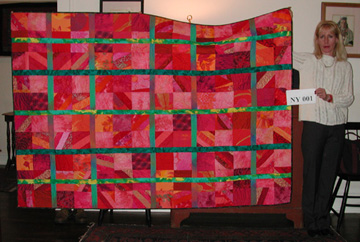
Bernard Herman (BH): Today is November 30th. This is Bernie Herman from the Quilters’ [S.O.S.-] Save Our Stories for an interview with Adrienne Yorinks from New York City. The time is approximately 11 o’clock. Adrienne, could you please start by telling us about the quilt you brought today? Adrienne Yorinks (AY): This is called “Tartan Number 3: A Midsummer’s Daydream.” And I’m doing a series of tartans. I’ve found it a fascinating format to use because it allows me to focus on different ways I work and has a built in way of “grounding” the piece. What I mean by this is if you look at the definition of Tartan in the dictionary, basically it is a woolen cloth with a woven pattern of straight lines of different colors and widths crossing at right angles. So it makes a perfect structure to do the kind of piece I want to work on at that time. I’ve been called an abstract expressionist by a few people viewing my work, and I am most moved myself by the abstract expressionist. My favorite artists are Mark Rothko and Robert Rauschenberg; Rothko for his incredible ability to capture mood in color and Rauschenberg for his sense of collage. I have always loved collage. My inspirations when I work are color, fabric, and subject matter. This piece really is about color. And I love summer. So, I just had to do a piece that was exciting, in reds and oranges. It’s to me a very happy piece. I will use cotton, a lot of vintage fabric, and anything else that strikes me. There’s a lot of silks and mixed blends that I’ve used together in this piece. BH: And this is one of five that you– AY: It’s in a series to date of five. I’d like to do a lot of them. The first one is called–I can get a picture of that if you’d like. “Tartan #1: Autumn Light” and then “Tartan #2: Fractured Octagon,” “Tartan #3” is this one, and “Tartan #4: Daybreak.” “Tartan #5” was picked the show at the Quilt Festival in Houston as part of the millennium quilts. And it’s a smaller piece. One of the subject areas I’m interested in is animals and particularly monkeys and animal abuse. I really love monkeys and I detest the way they are treated in laboratories and zoos, for the most part. So that piece is called “Tartan #5: Let Me Go.” I used those words particularly because they are from a famous song. Many times in my work I will use phrases or expressions that will get to people on different levels. BH: Now each of these works within this geometry, but also color is key to each of these and how do your color-design qualities work from quilt to quilt within the series? AY: First of all color motivates me and inspires me more than anything else when I am choosing fabric either to buy or for the particular piece I am working on; what mood I am in as well as what the piece dictates to me. What this series addresses on one level is the psychological impact of intersecting lines regardless of the subject matter or the mathematical or geometrical properties of the intersecting lines. At times both psychological and mathematical properties are evident. While working on “Tartan #1,” I was astounded at how visually; depth was becoming the most important part of the piece. For me the depth created a lot of psychological content. I felt that the vintage floral on white background created a clearing that was blocked off and secret. This piece is one of my most successful works because viewers all respond to it on a deeper level. People seem to stare more at this one than others and it doesn’t matter what they feel is going on. I am truly happy when my work evokes something deeper to the viewer. I achieved great visual depth in Tartan #1 and to be honest, I am trying to analyze in words how I did it. When I am in the midst of creating a work, I allow the work to take over. It is the creative process itself that creates many times the vision for me. At present I am struggling to articulate verbally how I achieve this for an article I am working on for Quilting Today, and that is much harder for me than creating a new work that has depth. BH: You referred to intuitive practice in design. Could you explore that a little bit? AY: Yes, I do work intuitively. Sometimes, people will ask, because I do a lot of commission work, people will ask for drawings. I am very up front. In the beginning I’ll say, ‘You can look at my drawings but you won’t know what the final piece will look like. I can’t really communicate the final product until a piece is nearly done. I will keep you informed of the process but at a certain point, you will have to take a leap of faith.’ Which has worked because I’m pretty up front and I will try to answer questions as best I can. As the piece progresses, I take a lot of Polaroids. Again, Polaroid photos are awful to look at for the client and I warn them about this too, right from the start. For me, Polaroids give me a lot of information. They allow me to see balance, size and color choices and if a pattern of a fabric is sticking out too much and detracting form the whole image of the piece. I can also see what is working in terms of background to the subject matter and what is receding in the Polaroid to the background. I can then replicated and balance the whole piece. Also, though Polaroids are flat and awful, if I am achieving a sense of depth in the photo, I know it will remain when the piece is finished. My process is highly intuitive. I work on a homeasote wall covered with white felt. Most of my commission work is commemorative, political, biographical or historical in content. I am most known for my pieces that contain photo transfers. I use the wall to move around the images important to the subject, almost like a puzzle. This is how I worked on the commission I did for the City University of New York. In that piece, there were 103 photographs that had to be in the work. I had access to the archives of CUNY and spent several days there culling through all their old printed matter. I can’t tell you how much I love the smell of old reading materials and how much fun it is to do the research. I love libraries. I work this way for all my photo transfer works where I put up all the photographs, balance them out as to size, time period, if important, and balance of color and shape. I will mix black and white photographs with color because it realistically shows the passage of time, particularly when referring to the CUNY commission which commemorated its sesquicentennial anniversary. So I use the board to put up the photographs and then work the base of the quilt around them. I am constantly moving around the elements to fit the design. I was always very good at math. I come from a long line of mathematically gifted people. It was my favorite subject in school. My sense of mathematics now is really more intuitive. I haven’t heard or seen it written, but I believe that if you have a mathematical mind, balance and color are a part of that, I believe that’s where I get my sense of color intuitively and how I place the parts of the puzzle together. The most fun part of the project for me is the beginning of the design on the wall. That is truly exciting and I can work straight for twelve hours and not notice the time at all. BH: Would this fall into your abstract category? AY: Yes, I guess this could be called abstract, expressionistic. It’s interesting when you are labeled a term like abstract expressionist. I am quite flattered and though I kind of understand what they mean, it is still hard for me to talk about my own work that way. I guess this piece is more traditional in a sense. BH: How would you describe this quilt as traditional? It’s a tough use of the word. AY: The “Cherry Blossoms” piece is to me somewhat traditional. BH: Actually I should add that in fact you’ve brought several quilts here and as we talk, we’ll move through these. So, we’re going to now take a look at “Cherry Blossoms.” AY: “Cherry Blossoms” is a second in a series I am working on which is very different for me. The series deals with works with one object repeated. The first in the series is called “Them Apples” and depicts many versions of Macintosh apples. That’s a smaller piece than “Cherry Blossoms” and if I had to say which of the four works we have seen today is most traditional, I would have to say “Cherry Blossoms” is. It stems from the wealth of quilt making in terms of a block with an object pictured on it; let’s say of an appliqué–traditional appliquéd quilt, but it’s fairly contemporary. BH: Well, in fact, it’s not traditional appliqué in the sense that it actually has physical depth to it. AY: Yes, that’s true. BH: And there’s a third area of work, wouldn’t you say, on the one hand is abstract expressionism, and then within the idea of tradition is the second, and the third category is the narrative. AY: I guess narrative in my illustration work, in that I’ve gotten into illustrating books since 1998 and that’s very much narrative and very exciting and different for me to work in. BH: Talk a little bit about the relationship between your quilts and your work as an author and illustrator. AY: I didn’t pursue illustration, I was pursued which is wonderful in a way, because I didn’t think I could do that. I don’t draw people or my work is not traditionally for children’s books so to speak. I was approached by Lisa Holton who is the publisher for Hyperion Books for Children. She had seen a one woman show and just felt my work should be in children’s books and she hooked me up–my first project–I was very blessed. My first project out I worked with Marian Wright Edelman, who is probably one of the most genius people of all time. And I had to illustrate – which is a tough thing for any illustrator, I think–a speech she did in June, the first, in 1996, in front of the Lincoln Memorial. So illustrating a speech first thing out was very interesting. I used a lot of photo transfers in that work. When I first started to work–I like to work big–so this is where I had to be stretched as an artist. I have very good far vision and like to stand back in front of a large piece and fell enveloped by emotion, mood or color. This is what I love about Rothko. I can stand in front of his paintings for half an hour just absorbing how it makes me feel. I thought originally on “Stand for Children,” that I could create one large piece that could be photographed in details for the book. What I discovered through the process is that when using photo transfers for illustration work, there are a lot of problems. First there’s the gutter of the book where a lot of information can get lost. And also that if you’re using photo transfers, it is best to work close to the actual size of the book for the clarity of the image. I have learned to work proportional to the actual size but usually work a bit larger I just like to be able to fit more into the piece that will become a page. I learned on my second book that I prefer working 100% bigger than the actual trim size. I also am always challenged by art directors. The first one I had kept changing her mind and made it very confusing for me. So learning to work to the scale of the book has helped a lot. I adore illustrating books. I’m in the process of illustrating two books for very young kids. It’s been gratifying to me as an artist and has increased my awareness of content and information in a small piece. It’s great as a quilt maker or textile artist because textiles are so vivid. I mean, you know as a painter you’ve got cobalt blue or white. I have used fabrics from 1820 in the book that I did based on an essay by Eugene O’Neill–“The Last Will and Testament of an Extremely Distinguished Dog.” And I really wanted–I had a tine piece of 1820 fabric that was gorgeous and for a lot of people who love vintage fabric, at times its hard to use in a piece because it’s so rare. I use special fabric now because they’re going to be produced in books, which is very exciting to me. And you have all those years of fabric. I have used fabrics from many different countries in my work particularly in the CUNY commission which has at least 28 countries represented, I wanted to represent as best as I could the student population of today which has students from all over the world. And “The Alphabet Atlas” which is an alphabet book based on geography–Australia, Brazil, Canada, etc. I used all the fabrics from those countries where I could get them. I called the embassies. And it made it exciting visually for the kids because you immediately with the motifs of those fabrics produced in those countries–Australia, for example are egocentric in a positive way; their fabrics really denote their wildlife and their culture. There are honey possums in their fabric which only exist in Australia. So, it is very exciting for a kid to see that and for me to use them. And the African fabrics are exquisite too as are the Japanese. It is very exciting to use fabrics from all over and what a wealth of palette you have as a textile artist. It’s just fabulous. BH: Actually, you’ve raised two questions that will spring out of this. One is that is if you could describe for a moment what sounds like your fabric library and how you go about compiling and organizing the fabric library. And the other which is very different is the idea of the quilt as a medium for print illustration, which is the fact that quilts get illustrated, but they don’t get conceptualized as the meaning for illustration. What are the challenges of working in a medium which is not generally thought of as being central to book illustration? AY: Let me address that and then go back. Should I do the second question? BH: Either way. AY: Well, what’s interesting about and I could talk about the “Alphabet Atlas” in particular. Fabric is so compelling that even though design wise, element wise it reproduces really well, people love the book the “Alphabet Atlas.” When they see the actual quilts they go, ‘Oh, my God they are so much better.’ Because when you’re working and even though the production department at Winslow was fabulous and they put in way more expense than what most publishers will do, they are very cheap now. But Winslow was great. For Thailand, I had a friend from Thailand who gave me three of her skirts that had gold in them–very hard to reproduce that beautiful, delicate, gold embroidery fabric – and they did it as best they can. It is difficult in terms of color and it’s difficult in terms of texture. And I am now working with a company called Endographics. The process to get from textile art to reproduction is interesting. What I have done in the past is I get photographed by a wonderful photographer for quilts and textile art, she can light it beautifully. She creates a 4 X 5 transparency which in a sense becomes the original art and then from them they make the book. What I am doing now, even though she is very good, she doesn’t get the depth of the stitch work that one would want in reproduction to really show that it really is a piece of textile art. So, Endographics is a company that will do digital photography both in European mode and American mode and they have been working and testing it out in the book I’m in production now called “Everyone Sleeps.” They are trying to balance the lighting with the texture because if you light the whole surface you lose the texture. It’s a very hard compromise and they are working with me directly to get to that so it’s been an interesting and frustrating process. My favorite art director is at Winslow and he loves my work so much, whatever I bring, he just loves. He was frustrated himself how it still didn’t describe no matter what he could, what the original looked like. So, he put batting in book. If you look at the “Alphabet Atlas,” it’s batted. [laughs.] And Barnes and Noble they loved getting it, it is the softest book. He wanted to show that this is a textile medium. Design elements work, the colors work, the textures are working hopefully the product will be even better, that we can get those two things–still there is nothing better than the original piece of art. BH: The point about light and photography is very well taken. What you get if they’re fully lit is they flatten out. And if you use raking light is you create these very art Topographies. AY: Hot spots and dull spots, that’s what happens exactly. BH: Let’s go back to the first question which was about your library of fabrics. AY: I kid people that I used to carry scissors because I like your tie. I don’t do that but I used to kid them, I don’t but I get fabric from everywhere and the funny thing, and I’ll talk about one wonderful project that I had the experience of happening while doing the last book. But, old fabric is getting harder and harder to come by, because people are buying it up and E-Bay like every other antique market has ruined antique fabric. When I first started which was about eleven years ago now, I could get a box of 1930’s fabric for about $100. It’s just a difficult time. I would still pay it if the fabric is great. But, it’s just frustrating because I don’t like to work with scraps I like big pieces. So, I have to tell of one instance that happened with “The Last Will and Testament of an Extremely Distinguished Dog.” It’s a beautiful essay written by Eugene O’Neill, written from the perspective of his dog Blemie, a Dalmatian, who is dying. It was written in 1940 and I wanted to use mostly antique fabrics, because it would give the sense of the seriousness and somberness I wanted in the book. I used photo transfers of my own border collies. While working on the book, I had to go to Fitchberg, Massachusetts to do a workshop at the library there. Coincidentally, there was also a quilt show going on so I decided to go. There was a wonderful vendor there and I bought 3 yard pieces, at a wonderful price, of 1885 fabric and then I went to the Textile Museum in Lowell, Massachusetts later that day and there was a card in the case that said–it had three of the fabrics that I had bought that morning that were mourning fabrics. Now I never knew that there was such a term, that there were actual fabrics that people would bring to the widows that they would use for their clothing. I had just viscerally felt that they were perfect for my book and they were indeed mourning fabrics. And I was so excited by myself jumping up and down in front of the glass case and luckily they didn’t take me away. But, I was so excited to find that again there is so much more passion and emotion in fabrics. Viscerally you know what they are even before you have a name for them. I have one other story to tell you and that expresses the amazing power and emotional content in fabric. I was commissioned to do a piece for the well-known illustrator, Maurice Sendak and while I was showing him possibilities for design, I brought out a quilt I had done that had all thirties fabrics in it. When he saw it his jaw dropped and he said, ‘Those are my mother’s dresses.’ He was born in 1928 and he remembered the patterns from his early childhood. Perhaps as an artist he was more susceptible to recognizing them, but he remembered them as his mother’s dresses, he had visceral memory of those fabrics. So, what we do is very exciting, it’s just a wealth of history, texture, color and emotions. I love textiles so much because it’s such a wealth of passion. BH: How do you organize your library? It sounds extensive. AY: It is actually. I do it by color basically. It’s fairly organized. I have had some transitional moves so even though my paperwork and files are in a sorry state, I do have my fabrics organized. I arrange them primarily by color first on large open shelves. I do put my vintage fabric, if it’s particularly special, on another shelf and my conversional fabrics which I use so much for my illustration work are on three shelves by themselves. I have a lot right now because I am currently working on a book for National Geographic on America and like “The Alphabet Atlas,” it will contain many conversational prints. I wish I had more. I do use it a lot. I don’t believe in not cutting fabric. Some people save it– I cut it. I just get it out there and use it. If I love it, I just use it immediately, because first of all you never know–a year from then if you’ll even love that fabric the same as when you have that passion at the moment. So, by color and if there are large pieces I put them on another shelf. So, I have shelves and shelves of color arranged fabrics. BH: Could you talk a bit about your influences? How you actually began quilting? AY: I think I always wanted to live in the 1800’s. I always sort of echoed back to that time. I was always drawn to fabric. As a child I actually did a lot of doll clothes. My mother didn’t sew and I taught myself. I always liked to play around–I either watercolored or I did doll dresses. So, I always liked color and design. It wasn’t until I moved to North Salem in 1989 that I saw a little notice about a quilt show and guild right in my neighborhood, that I thought, ‘This actually exists.’ I just wasn’t aware that guilds existed. I had started sewing in Manhattan a couple of quilts, but I didn’t know they had to be quilted. I was just putting together fabrics. I also had my first major–big, big career was I had a grooming business in New York City and I was the Galloping Groomer and I was known for my scarves. Every animal when they were clean and blow dried got a scarf. And I knew it was time to transition when I was much more interested in the scarves than grooming of dogs. But actually I worked for Stephen and Kathy Graham, son of Katherine Graham–his wife’s name is Katherine too–of the Washington Post. They have a five floor house on 78th Street and I did six of their cats. I got directions what cat personality had what fabric so that was fascinating. I had another fascinating career, but I’m really glad this one took over. Scissors are the same. I really like scissors, so I think that’s part of it. My influences again, I go back, my mom was really into art and she took me to museums as a kid which I’m really blessed, but I was the only one in the family who wanted to go. So, I was exposed to all kinds of art and incredible paintings living so close to the city, as a child. And I think that was very good influence on my life. BH: So, you’re influences are really coming out of painting and fine arts and not out of quilting– AY: Right. BH: So, how did you get to quilting with those two and prior to discovering the guild in North Salem, New York? AY: Well, I was always good with my hands. I did watercolors as a kid and I was really good with dogs. And I wanted to live in another time period. Well sitting around in a quilting bee and it was really exciting when I moved to Westchester and I learned that it’s no longer called a quilting bee but ‘stitch and bitch’ and that was just great for me. That was fun. And I guess I was always fascinated with the past and I guess that’s what drew me to quilt making. And also the fact that because of it’s nature if you’re working on a quilt and it comes out lousy your cat or dog are going to love it. It’s not a painting where you’re going to have to stick it in a closet. Someone will love it, which is kind of a neat thing. BH: You’ve mentioned twice your interest in the past particularly in the nineteenth century. What draws you to the nineteenth century? AY: I don’t know – that’s a good question. I really don’t know why I’m drawn to that era, but it seems to always come back at me. I was always struck by a couple of coincidences in one’s life–if one calls them coincidences which I do. The first really large commission that I got was from City University of New York and it was for their sesquicentennial–their 150th anniversary that was 1847. And then I did another piece that people have really loved that I believe you saw which was “Resistance to Tyranny is Obedience to God” and that was 1848. Then we bought a farmhouse a few years ago that had a smokehouse labeled 1848 on it. For some reason I keep going back to that time period. I think it was a very exciting time period for women. The strength of women at that time–thank God that we have equal rights in a sense, because if we had to do it today I don’t think we’d get them – those women were so strong and passionate and really brilliant women, in an interesting time with abolitionists. It was a very powerful, political time and I think that’s what draws me to it. The first city university–free university for everybody was formed then and that’s exciting to me. So I think it was an exciting time period. And now all of a sudden, I’m being represented by a gallery and the building again was built in 1848. So, I don’t know what’s that’s about, but I tend to dwell in that era. BH: Part of what you describe is almost a kind of tension. On the one hand is this engagement with the nineteenth century and the world of quilting but when we look at the quilts, these are very contemporary. Can you talk a bit about that negotiation of the contemporary and the Victorian? AY: That’s interesting. Well, I am living now [laughs.] so I guess you are culture and time bound in a sense. And I think that respecting the past and where we came from and to put it into my own. I never negate those brilliant designs. I call myself a textile artist because it suits me in terms of financial and the acceptance of the world that I want to be with my art. But, I relish the beginnings of quilt making, I am from the beginnings of quilt making, but also I am a contemporary artist. I don’t know if that explains or not. BH: We may return to that. AY: Okay, I’ll try to get it better. BH: You also refer to your interest with dolls and doll’s clothes. Could you talk a bit about that? AY: Yes, as a child I was. I did a couple dolls for a while when I first started quilt making. As a child I loved dolls and I had a whole fantasy world with my dolls and their outfits. They had to have very cool outfits. I actually went back to dolls when I first joined the guild and I did a project called “Broadway Dolls” and we were given the remnants of Broadway costumes and we made dolls that were raffled off to fund AIDS research. So, that was a wonderful project. Mine got raffled off and it got bought by a famous opera star. I did an opera diva from this incredible sequined remnant from a gown from Broadway. I haven’t really done dolls since 1982. I’m caught up in the quilts right now but I do like dolls. BH: I want to go again in sort of two directions here. One of these is–we’ll start with the question–are there other quilters whose work you admire at this point and time? AY: Yes. BH: And a distinction you had drawn earlier today and then elsewhere between quilters and textile artists. AY: Quilters of today are textile artists. BH: You draw a distinction about nomenclature. AY: Nomenclature is what we are talking about actually. We are always going to be caught up in nomenclature because of our language. It is unfortunate in a sense but important, we were caught up in nomenclature about women and we are going to be caught up in nomenclature for the rest of our lives, about races and religions. So, we’re going to get caught up in functional art versus high art, which again I’d rather not have the nomenclature. I also think that part, because it’s a woman’s art, so to speak and it’s a functional art, financially it’s not respected enough. I don’t think that’s right. So, in a sense do I really care what I’m called. Eventually, no. If they pay me enough money I don’t really care. But, I think also that I want to be recognized by a full audience not just a quilt world audience. I think that’s really an important distinction. I am recognized now really by both. I’m all over the place in terms of my work and I think that’s why I have a broader base and recognition. I think Emiko Toda Loeb considers herself a quilter and I think she’s brilliant, brilliant, wonderful design person. There are several people I love. I don’t know what they like to call themselves. I think it’s somewhat personal, but it has to be defined in your information if you want to get what you want out of your work. And I do want to be considered an artist first, who uses textiles. BH: In another interview with Gretchen Echols, she actually describes the liability of using the “Q” word – which is quilt. What is your thinking about that? AY: Well, it’s interesting. It slaps you in the face both ways. It slaps you in the face again financially and being considered a woman’s thing and it slaps you in the face in the opposite way from quilters, because my work for a lot of quilters is not true quilts. They are three layers and they’re batted and yes they are quilts but they’re not really. I had a one woman show at the Citigroup Center in New York City last year. I have a following of quilters who come to all my exhibitions. But there are always a couple of “fans” who are committed to me yet always seem to say something negative. I am trying as an artist to remember the forty wonderful comments and forget the two bad ones, but I still tend to remember the negative ones. The exhibition showcased my large works as well as the pieces I did to illustrate my books. So my “fan” wanted to comment on one of the original ones from “Alphabet Atlas” which is 16″ x 21″ framed in UV protected Plexiglas, clearly a piece of textile art which is what the show was labeled. I think the piece was “Greece.” She really liked it but kept saying, ‘It’s not a quilt. How am I going to put this on my bed?’ ‘Well, it wasn’t meant for your bed–but if you want to take it home and put it on your bed and pay me it’s okay with me.’ But, it’s sort of like that, you get slapped both ways. If you’re doing something innovative in your own niche and you might as well say what you are–and I respect the whole field. I have no issues. I’m not political that way. I love Amish quilts. I was honored in the exhibit, those are the most exquisite quilts I’ve ever seen. I don’t know what all the other contemporary artists call themselves; I would call them contemporary artists, though. I do think it’s a far reach and I don’t think any of those were meant for the bed. BH: To what extent do you think the medium is feminized–the medium of the quilt is feminized and that very quality keeps it on a kind of fine arts margin? AY: That’s a good question. I’ve been interested and I’ll talk about something personal that happened to me and is very interesting to me. My work has always been liked by men and women and I have been thrilled. It’s taken seriously. It’s not just looked over. So, I reach both genders which I’m excited about. I’ve reached all age groups and economic groups and I’m really excited about that. I think it’s unfortunate that there is a gender issue still in this country. But, I think there are so many issues in this country. I think women’s work–which sewing always was–even though there are some incredible art quilts even from the 1800’s. It is just not considered true art. I’m not answering this really great. I just want to be seen as an artist and then you can go into that I’m a woman and that I’m Jewish, that I’m brought up in New York. That’s okay, but I would like to be considered an artist first. To go back–the wonderful experience at Citigroup Center was I was seen by everyone that works at Citigroup Center and I had incredible comments, like they didn’t want the Pineapple quilt which was in this exhibit to leave the building. They really wanted color, they loved it. And also I had from my illustration work for Stand for Children, I had the elevator man come up and kiss my hand and say, ‘Thank you, thank you, thank you for your work. You have made us so happy the last couple weeks.’ And I was touched by that more than most of the other comments that I touched somebody as an artist, and it didn’t matter. He might not have kissed my hand if I was a guy, but he really loved my work and I think that is important. BH: You just mentioned that you’d like to talk more about some of the experiences that you’ve had and this would be a good time to do that. AY: In– BH: In terms of the reception of your work. AY: Well, I had one wonderful experience in February, I spoke at a school. I do workshops and I do lecturing for seven to ten year olds in a lot of libraries and for librarians. I was with seven to ten year olds and there was a huge snow storm before that so I couldn’t pick up some of the work I usually bring for kids. I like to usually bring in all kinds of fabric and let them touch them and I couldn’t get them from my storage. So, I had to bring what I had which actually was my Pineapple quilt–the red quilt I call “Tartan #3” and I had a piece called “Midnight” which is really about the time midnight. It is very dark and has elements of twinkling and flashing lights and stuff and I figured that this was all I have to show them and one of the pieces from “Alphabet Atlas,” which I usually show that belongs to the children’s series in the children’s books. But, these are sophisticated quilts – “Midnight” is a fairly sophisticated quilt and so is “Midsummer’s Day Dream” I didn’t expect kids to react to it. And “Pineapple” I didn’t expect them to really appreciate that. I brought those quilts to these kids and they were mesmerized and they talked. I did something sort of fun with them I said, ‘Well, what would you call this piece [talking about “Midnight”.]. What does this look like to you?’ And they came up with, ‘It’s dark.’ ‘It’s late at night.’ They knew what it was and they picked out things. I had some conversational print–money fabric–and they go, ‘Late at night they rob you.’ And I had these comments from kids, looking at very sophisticated work–not my children’s illustrations and they were thrilled. They picked out the colors. It was a wonderful experience for me, because I always think very highly of children, but I never thought this would go over with them. Now I know I have to bring big pieces. That was exciting to me to learn that. BH: I want to come back to a question I asked earlier, but we strayed away from. You talked about your influences in terms of fine arts but are there other contemporary quilters that you particularly admire? AY: As I mentioned, Emiko Toda Loeb and my other favorite contemporary quilter is Nancy Crow. I respect what she has done for the field of quilting and the power of her art so much. She had a great exhibit at the Museum of Contemporary Crafts, in New York City a few years ago based on “Chinese Souls” in reaction to the massacre in Tiennemen Square. I was mesmerized by her work. What I think is interesting here is that the way Nancy Crow works is so different from me. It is much more cerebral approach to her art as she designs the work and she is not involved with the process. My process as an artist is in the actual working of the piece so I find her fascinating. There have been a couple of pieces I did that came directly from a mental idea and I loved working that way but most of my art draws from the actual working experience. I was just asked to do a piece with the Manhattan Quilter’s Guild and there are some very talented women–all of them are very talented and I love all of their works. They have very different works. I do love the Amish, the wool in particular, I could cry in front of one of those pieces. I get excited by quilts of all kinds, there are of course some I’m going to be drawn to more, but there is not a category I dislike. BH: What do you think makes a great quilt great? AY: Design. Immediate impact. Color. If it’s a quilt of conscience, the subject matter and how they addressed it. And I do love comment quilts, statement quilts. “Resistance to Tyranny is Obedience to God” was Jean Ray Laury’s pick of the best new statement quilts of the century. I was really honored, because I love her work. And that’s another quiltmaker. And I think she considers herself a quiltmaker. I’m not sure. I just read that she had been doing it since 1956 and I was born in 1956 which I thought was very interesting. She chose my work and all of the quilts in that exhibit were spectacular and I loved those. I either like whams of design or, if I really have to say what I don’t like–I don’t like muddy things. Muddy that have no impact. Pink and blue quilts are not exciting to me. I like baby quilts, people can make them with love and that has a real value to me. The African–the slave quilts are really amazing to me. There was that exhibit. I think it was called “Who’d have Thought It.” I was blown away by that show. Those quilts have so much power and emotion in them. You feel that the person, probably long gone from this earth still has their energy imbued in each stitch and piece of the fabric. I am moved by quilts of conscience and particularly those early quilts that show the struggle of women and the hardships of their lives. They are still speaking to us in their work. BH: Could you talk a little about narrative quilts and comment quilts? AY: One of the first quilt shows I saw was in New York City by the Manhattan Quilters Guild and there were several Quilts of Conscience. It immediately got me excited about the possibilities of quilts and textile art and how I could use my own voice. I was fascinated by the potentialities of the medium: a soft medium that could express difficult subject matter of be a true medium of self expression for so many people. I have seen many quilts that portray the feelings of women and their life experiences from menstruation to divorce to their love for their departed family members, to a Holocaust Quilt I saw at the Jewish Museum in New York, that had embedded yellow stars from the Holocaust, it was so moving, to Liturgical works, the works of women of color and their feelings about their life experience, to the several quilts I have seen that women have done cathartically and to use in healing when going through breast or cervical cancer. All of these quilts validate our lives. In my own work, I have exhibited many of my photo transfer works as “Still Life Documentary.” I really like the title because I can encapsulate my own experience and historical information in a very personal way for myself. I love “rewriting history” from my own perspective. I am in the process of creating several works that deal with the subject of cruelty towards monkeys. I have my BS in animal behavior from the University of Wisconsin in Madison and I worked both in the monkey lab as well as the Vilas Zoo. I do not like laboratories and also feel that many zoos give non-human primates the worst enclosures, so I get very angry about that situation and am putting it into my work in the monkey series. I also am appalled at the cruelty of stealing primate babies and killing their moms and actions of poachers who are making ashtrays out of the hands of gorillas. I cannot believe the cruelty towards our closest relatives in the animal world and hope the works I do about this will reach people. I think a couple of pieces in the show are fascinating because they are about women’s feelings–about their bodies–about themselves and I think it’s important. BH: This is the show at the Durst– AY: Yes, the Durst show. It was wonderful to see those pieces. I’ve always been somewhat political and I think it’s vitally important to comment on things that you are going through personally or that we are going through in the times we live in. I loved doing the piece for the AFL-CIO because it shows where we have come as a country and yet how far we still need to go so that everyone is recognized for who they are. I feel very proud as a textile artist to be asked to do a piece for the AFL-CIO to celebrate their commitment to civil rights and how intertwined civil rights and workers rights are. They commissioned me to do a large piece that could be turned into a poster and notecards for them to sell on their website. And Milton Avery did one of theirs and then there was a folk artist who did another of their posters. They found me from the book stand for children. And I was contacted by Donna Jablonski who is the head of publicity I believe is her department. I always say I’m lucky because I’m the middle child, because I can work well with others because I had two conference calls, I was shaking with seven board members from the AFL-CIO and I’m good politically–although for New York, I’m a little liberal. But that was a lot of agendas. When you’re talking about photography and what photographs to put in to represent AFL-CIO you’re talking about a lot of agendas. I didn’t know from the voices who was who. It was an incredible commission that I’m very excited about it and I will send you literature. What they wanted from me was to celebrate the commitment between workers rights and civil rights. And when you think about it, because I took a long time investigating that, they are totally connected. Women would not be where they are today without workers’ rights. We had to deal with civil rights–where did they come from–workers’ rights and civil rights are totally intertwined and so it had to echo back to Martin Luther King, Jr. And yet politically that was fascinating because even though we had to echo back to Martin Luther King, Jr. we were careful about what photographs one uses. We have to have respect–because some of the photographs were very painful for some of the people on the board. It was fascinating to me because though we’re all so culture bound. What photograph is worth a thousand words and what does it mean to each person, so we had to be very careful. What is fascinating about what we’re celebrating today with the AFL-CIO is that 40 years it was about white male and then it was about men of color and now it’s really about women of color and children are affected too by workers’ rights. The whole piece really we’re talking about women getting their rights in the workplace. It was just a fascinating project. I was so nervous about it, I sent off the quilt to them and I didn’t hear for three days and I’m a little nervous. Did they like it? Did they not? I called finally and said, ‘Well, what did you think?’ and she said, ‘I cried. I never had any idea–I cried.’ So, to make the AFL-CIO cry is something. And now it is hanging in their headquarters in Washington and it is a poster. I’m excited that I could bring quilt and textile art into that market–in a sense. It makes us all look good. The more broad you become as textile artists, the better it is for the world of quilts. It just increases our footing actually. I think. And my little goal for myself is to get in really odd buildings. I’m in City University, I’m in the AFL-CIO. They’ve come to me. I would have to think about where else I should go. BH: Do you have a short list? AY: I have to think about it. I should make my list up for January. Where do I want to look? I mean something really different that we can do here. Let’s get them everywhere and be really respected for this incredible American art form. BH: That’s a nice segue to a question. How do you see the role of quilts in the larger fabric of American society today? AY: Well, it’s interesting with the AIDS quilt and what that did. It brought more recognition. We’ve gained five million people in the last couple of years – all of a sudden from 15 to 20 million quilters in this country, that’s exciting. And then all of the reactions to September 11th. I think that more and more we’re going to be drawn backwards into things that mean something to people. And people are becoming more home oriented because of the trauma of September 11th and the downturn in the economy. I think people are realizing that there is more to life than money, that the value of commitment to activities that offer more in a spiritual or artistic way is worth so much more. I do think we’re going to grow in this field even bigger, first in quilt making and textile art. Animals love quiltmaking–they do–particularly hand quilting, which I like to do some type of hand work all the time, although I do occasionally do use machine. But I do think that we’re going to grow, first in quilt making and textile art because fabric is not that expensive. You can have a blow-out time and spend a hundred dollars and you’re not going to buy even a sweater for that. For a hundred bucks you can go into a fabric store and be drooling. It’s a very cheap still wonderful experience. I just think it means more to people. And I think people are more into hand work for their babies and their families. They want to leave a legacy. I think we’ve become such a strange society in a way. I think we’re going to go back to what is important to each of us, to our family and what we want to bring back. What is our legacy? Money doesn’t mean so much as it used to, because there is never going to be enough of it these days. I think people are beginning to see that there are more valuable experiences. Quiltmaking–it’s American, you know we have jobs and then we have quilts and I think that’s important. We’re becoming very patriotic as a country. And I think we are echoing back to that– BH: That’s a wonderful summation. I’d like to thank you very much. AY: Thank you. BH: Thank you for your time today and perhaps the opportunity will afford itself that we can follow-up with a second conversation. AY: That would be great. BH: So this is Bernie Herman and Adrienne Yorinks in New York City on the thirtieth of November concluding our first New York interview for the Quilters’ S.O.S.– Save Our Stories. Thank…
[addtoany] [space height=”10″] Meg Cox (MC): This is Meg Cox and I’m conducting an interview with Alex Anderson for Quilters’ S.O.S. Save Our Stories a project of The Alliance for American Quilts. It is now 10:42 A.M on Saturday November 5th and we’re conducting this interview on the convention floor at Quilt Festival. Now as usual, you’ve brought a touchstone quilt, you brought a special quilt, so why don’t you tell us why you picked this one? Alex Anderson (AA): Why did I choose this quilt to bring today? I consider myself a traditional quiltmaker, although I’m going into new venues, which is very, very exciting but typically I’ve been known as the Star Lady, and handquilter. So this particular quilt was made entirely by me, I didn’t even have a celebrity stunt sewer do the binding [laughs.] and it has machine pieced stars, hand appliquéd and handquilted. MC: What do you think someone seeing this quilt would think about you as a quilter? AA: What would I think if somebody were viewing this quilt, of me as a quiltmaker? I’m pretty simpleminded [laughs.] I mean it’s a classic patter, but it has a contemporary twist to it. You would know that this pattern A Rose of Sharon was not made one hundred years ago. You would know that it has been made probably around the turn of the century and I also love that it has hand dyes in it. [announcement on loudspeaker.] MC: What do you do with this quilt? What is your plan for this quilt? AA: What do I do with this quilt? Most of my quilts are working quilts. This particular quilt was created for my book Beautifully Quilted by Alex Anderson and it was a book that was written to talk about how much I love designing quilting motifs. I studied under a women named Lucy Hilty who is no longer with us, but she was a driving heart beat for us in the San Francisco Bay are [California.] She was a Mennonite woman who didn’t care much about creating the quilt top, she cared about creating the quilting designs and I’m not sure if that was my tenth book, but it was kind of in there, I knew that I had to document the lessons that Lucy taught me. For me, when the quilt is quilted, that’s when the true soul is, I’m going to say a wrong word, breathed into, the quilt. Is that correct English, Meg? MC: I’m not sure, but it sounds great to me. AA: Okay [laughs.] The quilting to me is where it is happening, especially when you’re sitting at the quilt frame; this magic. MC: Alex, can you tell me your first quilt memory? AA: My first quilt memory, I can tell you what it is, but I don’t remember it. My first quilt memory was brought to my attention about ten years ago. There was a women who lived next door to my mom and dad and her name is Mrs. Kelly and Mrs. Kelly was a multi-talented woman and when I met up with her, you know years later, when I was a little girl, I would come over and sit under her quilt frame. For eighth grade graduation in high school, she gave me a silver thimble. Who would have ever guessed? I met up with her later and she called me on the phone and she said, she’s a lawyer in the Monterey Bay area [California.] and she said, “You’re famous!” and I said, “And you’re smart!” [laughs.] MC: [laughs.] What age did you actually start quiltmaking? AA: Quiltmaking was started in seventy-eight. I was a student at San Francisco State University [California.] My degree was in generic art with kind of heavy design influence. One month prior to graduation, I found out I was a unit short. I had just done a paper on quilting at American Folk Tradition for a children’s class I was in. So I went to my counselor and I said, “If I do a quilt, in this one month, will you give me the unit that I need to graduate?” and she said, “Yes.” So I called my grandmother, who had started a hand pieced grandma’s flower garden in the 1930s and she was thrilled to send it off to me. I went and got cotton batting with seeds in it, I got Laura Ashley upholstery fabric for the backing, and this giganto quilt that I was going to do in one month, ended up being the size of a bathmat. Grandma was profoundly disappointed, but despite all odds, a quiltmaker was born. MC: That’s wonderful. What about the second one? Did that take a while to get through? AA: The second quilt? No, because I was, she asked what about my second quilt. I was supposed to be a weaver for life, but I found my home at the quilt frame that my dad made for me from stolen lumber from the neighbor’s yard [laughs.] and every night I would just come and quilt, quilt, quilt. The second quilt was actually a quilt, an Amish quilt that I made in Lucy Hilty’s class, where I learned how to draw feathers and cables and all those beautiful motifs that we still love today. MC: Are there other quiltmakers in your family other than your grandmother? AA: Are there other quiltmakers in my family? Interestingly enough, I kind of think it skips generations, but I know on both sides, the grandmothers dabbled in quilting, not seriously, but after both grandparents had passed away, both sides, we found my grandmother’s frame from one side in the attic of the other grandmother. We gave it to a museum in Sister Bay, Wisconsin. I’m kind of sad I didn’t hang on to those four sticks but I suppose it’s better that it’s where it really belongs, it’s in Dorr County [Wisconsin.] MC: That’s wonderful. When did you start teaching? AA: So when did I start teaching quiltmaking, about thirty seconds after I started making quilts, because you see I just discovered it [laughs.] I went to a church group and I taught, I don’t even know what, and then I was keeping one step ahead of what the students wanted, and if somebody wants to teach quiltmaking, I say, “It’s great,” find a group of people who want to learn, and just share your knowledge. MC: So what was the class? AA: So what was the class that I taught? I haven’t a clue [laughs.] MC: But then you went from that onto television? Can you talk about that? AA: So there’s a giant leap between when I started quiltmaking to when I went and got on television. There was a lot of teaching that went on. I was, I taught at Cotton Patch, Lafayette, California and Empty Spools store in Alamo, California, and I had the opportunity to put other, my quilts, in other people’s books. The first quilt that I had published was in Quilts, Quilts, Quilts by Diana McClun and Laura Nownes and it was a star quilt on black background, solid fabrics. That was a light bulb moment for me, because at the time in the San Francisco Bay area [California.] there was a war between art quilters and traditional quilters and it was really ugly. I wanted to be with the cool guys, that were the art quilters, but I kept finding myself drawn to the traditional medium and Diana saw that quilt of mine, this simple saw-toothed star quilt, and said, “Can we have it for our first book?” and that was a light bulb moment for me because I realized it doesn’t matter whether you’re traditional, whether you’re art, or you don’t even know where you fit in, all that’s important is that you are a quilter. I was kind of a generic quilter, teaching stars and how to draw the motifs and all that, and I was down at a show, Road to California put on by Caroline Reese in Southern California, and I was approached by Stephanie Kleinman who worked for Weller-Grossman Productions and she came into my class, and she wanted to know if I’d be interested in hosting a television show. And I said, “I can’t talk right now, I’m teaching a class, let’s meet at lunch,” so we couldn’t find a private place until we scored a bus bench, kind of like Forrest Gump [laughs.] and we had ourselves a conversation. I really was not interested in being on television; I just wanted to be able to be a professional quilter. So I said, “Let me think about this,” and I flew home that night, and John was in the kitchen fixing something that might look like a dinner, and my kids were watching television, at the time my son was probably early high school, my daughter junior high, pre-junior high, and I walked in the house, and I said, “You’re not going to believe this, somebody wants me to do a television show.” It’s the first time my kids ever cared what I did for a living, all of the sudden quilting was becoming important, and I remember walking through the family room to the kitchen, and I looked at my husband John, and I said, “I don’t want to do this,” and he looked at me and he said, “I’ve never seen you back away from anything. I’ve seen you make twenty quilts for a book, for books, in three months. I’ve seen you meet every single challenge,” and he said, “When you’re an old lady, in the old people’s home, sitting on the front porch trying to teach the lady next to you how to quilt, you’re going to be very sorry that you missed this opportunity.” So it was through my husband’s encouragement that I went forwards. MC: That’s wonderful. AA: And Meg that makes me want to weep right now [laughs.] Kidding. MC: We’ve got the Kleenex, don’t worry. AA: Yeah [laughs.] MC: Can you, we’ll switch channels then, can you tell me about an amusing experience that occurred during your quilting or teaching of quilting? AA: An amusing experience that’s happened during my quilting. What isn’t great about this industry, I can’t, I will just say what’s so amusing is that this is the universe’s joke, that I’ve been able to write all these books and have a TV show because I graduated with C- from Livermore High School [California.] MC: Oh. AA: That’s the joke [laughs.] MC: What do you find pleasing about making quilts? AA: What do I find pleasing about making quilts? I knew you’d ask a question kind of like that, so I’m going to preface it differently, then you can re-ask it if I don’t answer it. I have found that in quiltmaking, there are certain things that really have made a difference to me along the way. In the beginning it was when I had my first sewing room, and we took the bed out, and it was all mine that was really a wonderful moment. I remember when I got my first Bernina, I mean we didn’t have money, we didn’t have money at all, I borrowed the money from my dad. I remember when I was first published in Diana’s book, and Laura’s book, and the journey has continued to amaze me. I remember when I could go into a quilt shop and not have to worry if I could feed my family and be able to spend twenty-five dollars on fabric, but now the thing that is so pleasing to me about quilting are the people. And that’s why I love what you’re doing here with S.O.S. [Save Our Stories.] because we are an incredible community and I don’t think there’s anything else quite like it on the planet, so to me it’s the people now. MC: Would you talk a little bit about techniques. Now you are, the queen of handquilting, but can you talk a little bit about your journey in terms of technique and material? AA: Okay as far as my journey of technique, I did start out as a traditional quiltmaker. Love the handquilting, fell into the star lady, and that was actually because in Diana and Laura’s book, Quilts, Quilts, Quilts that wasn’t really included in the sampler. My journey has been taken, has taken a really abrupt turn lately, and it’s very interesting to watch because I don’t know where I’m going, but I know I’m doing something a little bit different. And at this point, my journey is taking me away from teaching and putting me back into the student role. Right now on my frame at home I have a silk Dupioni silk, that’s very arty, kind of like my quilt for the Alzheimer’s movement for Ami Simms, it’s full-size and yet it’s handquilted so it’s kind of like taking the old, and integrating the new to it. I think that’s one of the things we love about quilting, is that it’s not a journey that has an end. The more I know, the less I know, and I think that’s what continues to make this so exciting. MC: How has technology influenced your quilting? AA: How has technology influenced my quilting? A lot, a lot. I’ve learned things in the last five years that I didn’t know my brain could even process and I think technology, the thing is the internet. We are now connecting quilters worldwide. I’ve had the delicious pleasure of being in Africa this past year and meeting with a guild of which it was the first generation of quilters. I had the opportunity to go to Costa Rica and meet with the first generation of quilters and the internet I think is taking our community and just reaching it so far out there, and yet it’s making out community smaller, and smaller, and smaller. I also think digital photography is something else that’s really important. I was trying to put together something, and I went back to try and find college pictures of me, and they just simply didn’t exist because we didn’t, I didn’t have the money to process the film. Now with digital photography, you have people here from all over the world, snapping away their heart’s content, and then they can go to wherever they live and share these pictures either in person, or on the internet, so I think digital photography is a big deal. MC: So you mentioned that silk Dupioni, so would you say that the materials and the techniques that you’re using are different now? AA: I mentioned that I’m working with soup [laughs.] strike that from the record please, silk Dupioni and do I think that globally techniques and all that are changing? Oh definitely. I look here, this is on video, or on audio, but across the way I’m looking at a quilt that is just covered with crystals you know, and it’s changing at a very rapid speed. I think the rules have all been broken or open and there’s not the way that those of you who perhaps started quilting thirty years ago, if you didn’t do it the way that teacher said, you might end up in jail [laughs.] I’ll join you there. MC: Yeah. Would you describe your studio now, your place where you do your quilting? AA: I love my studio where I’m working now. My first studio, I even have a hard time saying that because it sounds so important, and it’s just my playground, my first studio was an extra bedroom with a bed in it, a guest room, and it was after taking a class from Nancy Crow, I came home to my husband and I said, “You know, you’re right, this needs to be, stay the guest bedroom, I’m going to move into the living room and claim that as my own,” and the bed was out the next day, so that was my first studio. The second studio, it was in Pinole, California, we purchased a second house, moved, and it was downstairs and it was quite large. It was long and skinny, but it was large. But then we had to move to Livermore, California, where I was raised, and the real-estate was a little bit more expensive, and so my studio became the largest extra bedroom, the kitchen, and the laundry room. My first book was written in the laundry room. I thought we needed to move, but my dad said, “Look, you’ve got some space right behind the house here, you could add on.” So I went and visited other quiltmakers’ studios, Yvonne Porcella, Freddy Moran, to name some of the people you might be familiar with, and I made a list of the things that I wanted. Then I went to an architect and I said, “It had to be under 500 square feet, because at 500 square feet, we had to pay more taxes. So my studio is 498 square feet, and it’s pushed to the back of the house, through my daughter’s bedroom, which is now my office. I’m so glad I had other people look at the plans, it is the place where you will find me even if I’m painting my fingernails. I love that spot. MC: That’s great. With everything that you do, are you, do you find it hard to balance your schedule? Do you find, we all have trouble finding enough time for quilting, but is that especially difficult for you? AA: With everything I do, do I have time to balance my quilting time? Yes it’s very, very difficult but I do quilt. My mom calls the back, my studio, my studio, not my sewing room, the factory, because she’ll come back there and see me sewing but in the end, when the day is over, and I’m done writing articles for the magazine or working on the website, or traveling, being here with you, and my friends, my friends and family, I find that at four o’clock in the afternoon, that’s where you might just find me, sitting at the quilt frame. I’ve just now put another quilt on the frame, it’s been a long time, and I have vowed that I will always have a quilt on the frame, because that’s where I get centered. I’ve got to have that to go to and it’s been a long time since I’ve made that promise to myself. MC: That’s great. What about machine quilting? Do you do much of that? AA: Machine quilting, yes I’ve learned to machine quilt and I think it’s really exciting that there’s something that you don’t know how to do, I think it’s important to learn to do it because I feel as quiltmakers we have a tool belt, and every technique and tip that you learn, can go into that tool belt and you can pull it out when you need it. So yes, I really like machine quilting, but I will tell you this, I also know I have x-amount of time, back to the time thing, and if I can pay somebody to do something better than I, I will do that, and I will give them credit too. For instance, I, we have the things we love and the things we don’t like, I really don’t like binding quilts, so I bind my checkbook, it’s a matter— MC: Except for this quilt— AA: Well this one I did it all. As a matter of surrounding yourself with the people that love to do that things you hate, then you love to do the things they hate, and that’s how we all get along, right? MC: Tell me this; did you ever use quilting to get through a difficult time in your life? AA: Did I ever use quilting to get through a difficult time in my life? I’ll bet that’s when Carol started crying, yeah. MC: Most people. AA: That’s a very good question. For me, it was very difficult on 9/11. I was separated from my children and my husband. I was in Dorr County, Wisconsin with my mom and dad. I was to fly home and host a quilt show at Quilting in the Garden at Alden Lane, in Livermore, California, an outdoor quilt show and we packed up a pickup truck and drove cross country. The pickup truck had jump seats in the back, so this was kind of amazing to do this with your eighty-year-old parents and I was horrified being separated from my children and John. When I got home, all the quilters started making quilts, and if you can remember, Houston [Texas.] International Quilt Festival was, you know what, a month and a half later and there was an aisle that went all the way down the length of the convention center with quilts on both sides with people responding to this horrific situation that had happened in the United States. I went to my sewing machine and I was paralyzed. MC: Really? AA: I couldn’t sew. All I could do was pick up and do red work. I couldn’t, so I think for me, the opposite happens, and that was an extremely interesting situation, when I could come to quilt festival and market and see what people had done, and I retreated. MC: How long did it take before you sort of thawed out? AA: Probably, how long did it take before I could get back in the groove, probably about six months? I will also say too, that after I had each child, well let’s start with Joey who’s my oldest, I lost my creativity for a year and I have warned other pregnant women that you could do, this might happen to you, and don’t freak out because you’ll get your groove back on. So when my daughter than was born, I gave myself permission to not be creative for a year. I’m opposite of the pack [laughs.] MC: What do you think makes a great quilt? AA: What do I think makes a great quilt? Wow. I don’t think I can define that because a great quilt might be the best of show, it might be something that documents something, or it might be Katie’s quilt, a young women who is my daughter’s best friend, or one of her very good friends, and two years ago Katie came to me, age twenty-six, and said, “I want to make a t-shirt quilt.” Or no, first it was, “Will you make me a t-shirt quilt?” No. So, we had a quilt day at my house, where my daughter and Katie made t-shirt quilts from their college, St. Mary’s, and at the very end, I looked at Katie and I said, “So what’s your next quilt going to be?” and she goes, “Well, I’ve decided it’s going to be a [inaudible.],” [laughs.] and that t-shirt quilt is the most important quilt. What was really great, I have a little bit of goose bumps going on here, Fourth of July, this last Fourth of July, she’s been quilting a year and a half, and she comes up to me and she goes, “Guess what?” and I said, “What?” she said, “I taught the lady who lives above me how to quilt.” That t-shirt quilt is a great quilt. MC: I totally agree, but what makes a quilt appropriate for museum would you say? AA: Oh what makes a quilt appropriate for museum? You know, I don’t know. I do know that I’m really impressed that Yvonne Porcella got the San Jose [Texas.] Quilt and Textile Museum to accept her work, because you know a hundred years from now, who knows where these quilts are going to be. I do know that probably my quilts are not appropriate for museums [laughs.] but you know it’s probably the masters, the masters and their quilts. MC: So among quilters out there in any kind of genre or style, whose work are you drawn to in particular? AA: Okay so whose work am I drawn to in particular? I don’t think I have a clear answer on that, I really don’t think I have a clear answer on that because I like the diversity is just incredible and I love everything from the antique quilts, I love the new things, I love, I just kind of love them all. MC: Whose work has influenced you, whether it is a quilter or another type of artist? AA: Whose, what quilter has influenced me? One of the great things about being a professional quilt teacher and traveling is that everywhere you go, you are influenced by what’s going on in that area, and then you’re the lucky one that gets to sprinkle that fairy dust in another area, but I do have a story. About four or five years ago, Jean Wells, who owns the Stitching Post in Sisters, Oregon, and who I consider a very good friend, called and asked me to teach, she has retreats that are not during the outdoor quilt show. And I said, “You know Jean, why don’t we co-teach a class together?” I can’t believe I’m telling this story. She had just started a whole thing with opening your creativity, design, color and all that, and I had just discovered a couple of cool techniques. So she said, “Let’s co-teach a class together,” and so I flew up there, she put me up in a wonderful facility and we co-taught for two or three days. What was happening during that magical three day class was that she was profoundly influencing a new direction I was going to take. So that was kind of a delightful moment and the best part was that I got paid after for teaching [laughs.] MC: Why is quiltmaking important to your life? AA: Why is quiltmaking important to my life? When I discovered quiltmaking, I’m an artistic person, I’m not an A+ artistic person, but my parents are artistic in their own way, my father is a woodworker, my mother lives a very artistic lifestyle meaning she could come in and arrange my furniture or hang the pictures, she can, she lives beautifully. I dabbled in all the textiles, in fact we even found a picture of me sewing at my grandmother’s knee at about age five, stitching. At the other grandmother’s knee at probably the same summer, knitting, knitting didn’t stick, but stitching did. I started sewing in about fifth grade, my eight grade graduation present with Mrs. Kelly’s silver thimble was a sewing machine, but when, then I learned bobbin lace in college, I learned crochet, all the wonderful different avenues of art. But when I sat down at that quilt frame and completed that first quilt, graduated, and then sat down again, it’s like yesterday, I found my home and it was just as clear as could be; that’s where I belonged. MC: Can you try to analyze that or tease that out at all about what is it about that, that lasted when the others didn’t? AA: What is it about quiltmaking that made it stick? I really don’t know what’s made it stick. I do know that you can control it, and unlike woodworking which I’ve done, I’ve actually made my children’s cradle and it ended up in a fine woodworking annual catalog, you can make a mistake and you can’t pull it and squish it and get it back together, there’s forgiveness in quilting. Also, when you create a quilt, in your mind you have an idea of what it’s going to look like or the direction you’re going to go, but like children, they take on their own life. So it’s kind of an interesting evolving journey that just continues, continues, continues and I want to reiterate that I am taking classes now. I am a student and so even in thirty-three years I think that’s how long I’ve been quilting, I realize there’s a whole genre out there of things I want to learn. MC: Now you are nationally and internationally known, but do you feel that your quilts at all are representative of your region or come out of your community in some way? AA: I’m internationally and nationally known, and do I feel that my quilts are, could be regionally identified? MC: Yeah, or reflect your community in some way? AA: Or reflect my community? That’s a tough question because in the San Francisco Bay Area [California.] there’s a lot of stuff going on and so I guess I kind of, my quilts do have a look to them, but in our area we have been very, very lucky because we’ve had Roberta Horton, Mary Mashuta, Diana McClun, Freddy Moran, Judy Matheson, Gay Perry, and I don’t want to skip anybody but we are in a really wonderful area of the United States to be in, so I’m not even sure you could tact anything. MC: What do you think is the importance of quilts in American life? AA: What do I think the importance of quilts is in the American life? Well I do think that it’s one of the crafts that is uniquely identified with us. I own quilts that were brought, that were family pieces, I don’t know who exactly brought them over, but gratefully they’re in our hands, but what, I go to places like Costa Rica, like I mentioned and it’s first generation, I mean here we have the delicious, delicious history of generation after generation after generation after generation. I think that’s why it’s so important. I also think that quilting has documented events in our history, like the Civil War quilts, like the Underground Railroad, like 9/11, as no other media has, medium. MC: I’m curious, what happens to your quilts? Obviously you make them for magazines, but I’m sure you make them for family and friends. What happens to your quilts? AA: What happens to my quilts, do I make them for family and friends? Not really [laughs.] I have what I call my important quilts, the ones that I know kids will fight over and then I have the quilts that are earning myself a living, yes I made my son and his wife a wedding quilt because I knew everybody would talk badly about me if I didn’t [laughs.] and I’m making one for my daughter who is getting married on New Year’s Eve. I have these quilts and some of them are like the ones the kids are going to fight over, some are pretty good, some are okay, and some are horrible. So right now I’m trying to decide what to do. The ones that are horrible I will probably give to a shelter, I’m in a cleaning mode, I don’t even want my name attached to them. Then I have the working quilts, and what I’m doing with those are after their done earning a living, and they’re good quilts, I am not parceling them out. For instance, after Katrina, I put up a thing on my website if you gave any amount of money to the American Red Cross, your name would go in a hat and somebody would win this quilt and I think we raised like about $14,000. For the Japan tsunami earthquake, Ricky Tims gave a free pass to one of his retreats and I threw in a quilt, a good quilt, and we made $35,000 for the American Red Cross. I’m still not getting rid of these quilts fast enough [laughs.] This is the latest plan, and I’m telling you this because Marianne Fons told me this, for my daughter’s wedding, I’m going to have a bridesmaid shower, and I’m going to give each bridesmaid a quilt and then let them fight over them, kind of like what are those things called? A white elephant thing. I’m going to hang onto the important quilts to share, to help earn my living, and then the good quilts that really aren’t helping, I’m going to start getting rid of, it’s time to let them go. MC: What do you think is the biggest challenge confronting quiltmakers today? AA: What is the biggest challenge confronting quiltmakers today? Couple years ago we would’ve said bringing in new quilt, younger quiltmakers, but I’m thrilled about the modern quilt guild, they’re doing their own thing. At Quilt Market you saw all these young women and I see them facing the struggles that I faced as a young mom, being a quiltmaker. I would say right now in history, right now it would be the socioeconomic issues and quilt shops having to close down. I think our industry, despite what’s all going on in the world, is relatively alive and healthy and if all of us commit to bring in one quiltmaker, just one quiltmaker, then that quiltmaker is going to pass her fairy dust onto somebody else just like my Katie Coons. MC: To kind of wrap things up, Alex, how will you be remembered as quilter? AA: How will I be remembered as a quilter? The good news is, is I’m on the internet now with Ricky Tims at thequiltshow.com because it’s really who I am. I was, I had a persona that was dictated by Home and Garden Television, that I needed to be, and that’s really not who I am. I’m a little bit, have a little bit of a wild side, if anybody knows me. I think how I hope, I hope how I am remembered is somebody that opened the door of quiltmaking to another person and by the magic of me having to fall into that television opportunity, I was blessed that particular incident. It will not be for my quiltmaking skills [laughs.] MC: Is there any question that I didn’t ask that you wanted to answer? AA: Is there any question that you didn’t ask me, that I want to answer, no, but thank you for not asking my weight or age [laughs.] MC: Okay this is Meg Cox, and I want to give a great big thank you to Alex Anderson for doing this interview today and doing it on the Festival floor, we don’t usually do these things in a big public setting and we are concluding the interview at 11:18 A.M. and thank you very much. AA: Now I want to say to you people before you leave, this is a really important thing that is happening here. We had a thing called quilt days back in the eighties, where states would document quilts that were coming in and we were collecting history like that, it was farily unorganized. I know how much I appreciate the quilts of the 1800s and even the turn of the century and we simply do not have the information on it. What is going on now in our community is seriously profound and important and so if you would be willing to donate money to this so they could continue their cause, if you would be willing to be an interviewer, I want to throw this in off the record, that my daughter who’s getting married to Jerry, I found out Jerry’s grandmother is a quilter and is interviewing people, Save Our Stories, happened to interview Mary Kay Davis who works with us at thequiltshow.com. This is a very, very important thing that this organization is going and we must support them and help spread the word. I want to hear, “Amen, sister.” MC: Amen, sister. I’m going to give you a chance to ask Alex a couple of questions, but just a little bit of business here….
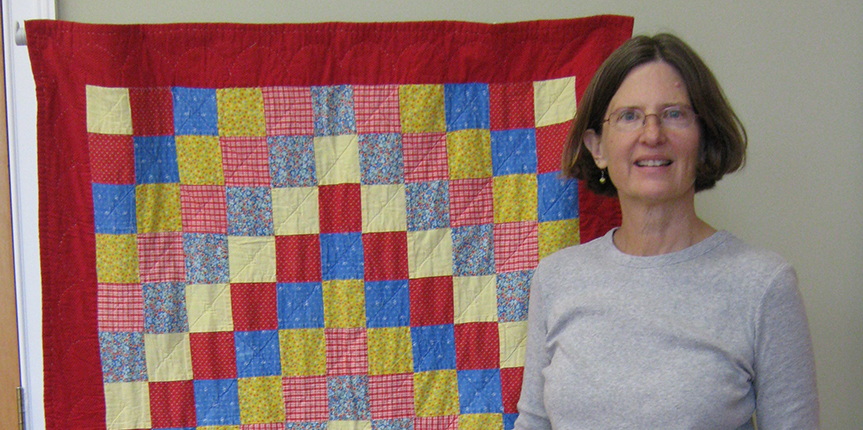
[addtoany] [space height=”10″] Amy Milne (AM): This is Amy Milne. Today’s date is October 21, 2010 and it is 10:27 a.m. and I’m conducting an interview with Alice Helms for the Quilters’ S.O.S.–Save Our Stories, a project of The Alliance for American Quilts. And we’re here in the Alliance office today in Asheville, North Carolina. Alice tell me about the quilt you brought today. Alice Helms (AH): This is the second quilt I ever made. It was made in 1989. I made it for my nephew Justin Rahm, my sister’s son. It’s a crib quilt. It’s about 38 inches by 52 inches. It is a Trip Around the World pattern. It’s made with calico fabrics that are primary colors. My sister had requested primary colors. That was going to be the theme for his room. So that’s what I used and it is hand quilted sparsely. It’s the second quilt I ever made–the first one was tied. So this was my first attempt at hand quilting. And I’m wondering how I did that when I look at it now, because it’s very–the fabric is very loose. I wonder if I even basted it, or I know later when I would hand quilt I would use a hoop, but I wonder it this was even stretched on a hoop because the fabric is kind of loose and puckery which has caused a lot of wrinkling and wearing. It’s quite worn out. It looks much older than 21 years old, to me. And in fact, at some point–I want to say Justin was maybe 3 years old or 4 years old–the binding wore out. I think that in the original quilt there was no quilting in the border and the binding just wore out. And my sister called me up and she said, ‘You know he loves this quilt and it’s been washed and washed and washed. And he drags it around. And now I’m getting worried because the binding is actually just opened up. And his little fingers and toes get in there and it’s just making it worse,’ and ‘What can we do?’ So she was living–they were living in Atlanta, Georgia and I was living in Connecticut. So I said, ‘Well send it back to me and I’ll see if I can fix it, maybe I can replace the binding.’ So she had to have a little talk with Justin and say, ‘You know, we’re going to pack up the quilt and we’re going to send it back to Aunt Alice in Connecticut and she’s going to fix it. And then when it comes back it’ll be all new and, you know, it’ll be better.’ And I guess he was a little apprehensive about having his quilt [inaudible]. But they sent it off and when I got it I was remembering that I just replaced the binding–but now that I look at it, it appears that I replaced the whole border and just did a sort of front to back binding on it and quilted it. And then I sent it back to him. And a funny story that came out of that was a couple years later my sister called me up and she said, ‘Justin’s stuffed Barney has a hole in it. One of the seams is opening up.’ Now Barney is a dinosaur that was a very popular children’s TV show at that time–maybe it still is, I don’t even know–but at that time a very popular TV show and people would get this stuffed Barney stuffed animal and he had one and I guess the seam was opening up. So she said, ‘The seam’s opening up on his Barney and you know he’s kind of upset about it,’ and ‘Do you think you can fix it?’ And I said, ‘Betsy you know how to sew, you can sew a seam.’ And she said, ‘No. He thinks that you’re the one–you’re the only one who can fix it. So he’s willing to give it up. He’s willing to put it in a box and mail it back to Connecticut for you to fix it.’ [AM gasps in awe.] So [inaudible] came in a little box and I went out and I bought a spool of purple thread and stitched Barney up. It was probably like a one-inch [AM laughs.] seam that was open but the stuffing was starting to come out. And I sent it back and who knows–anyway, Justin has had many quilts from me over the years–he’s my only nephew. And he had this crib quilt, he had a quilt that was a single bed size that I made for him when he was 8 or 9 maybe. And then around the time he graduated from high school he wanted a–or his parents wanted him to have a t-shirt quilt. So I took his t-shirts and made him a quilt with those. Now at the moment all these quilts sit in a closet–he’s in college now, a senior in college. But I’m hoping, you know, some day he’ll have them and use them. You know maybe when he has his own family. But this pattern I got–I–I wanted to quilt for many years. And I’ve been fascinated with quilts and I wanted to make a quilt but it was a little daunting how to get started. And I’d seen an article in, I think it was in one of the women’s magazines, about this quilt-in-a-day technique. And it was an article about these women that all went to some high school gym at 9:00 in the morning and they learned this technique and at 5:00 in the afternoon they walked out with quilts all made. And I thought, ‘Wow, you know, I could do that.’ So they had a place you could, you know, send in a dollar or two dollars and you could get this pamphlet on how to do this technique. And that’s what this is. And not that I did it in one day, the first one I made–the first quilt I made was also this Trip Around the World and then this baby quilt was the Trip Around the World quilt-in-a-day pattern. And I think I made a couple others after that too. But it just involved, you know, cutting your fabric in strips and sewing the strips together and then slicing those to make the squares. But of course when I made this I didn’t have a rotary cutter, I had never heard of a rotary cutter. So it was laying the fabric out and I think I used a yard stick to kind of measure and draw lines and cut it with the scissors and sew it together. But I was quite proud of myself at the time. I was pleased as punch when [AM and AH laugh.] I finished the first one. And now when I look at it you know it’s just humbling. [AM laughs.] AM: Why do you say that? AH: Because it’s–it’s so poorly done. [AM and AH laugh.] And it’s just–it’s inadequately quilted as I was saying before. And I think–you know, although it–although you learn from that because you realize why quilting needs to be a certain minimum distance apart to maintain the quilt. And there are places where I can see the seams started to open up. And I wonder about that because it was actually stitched on a machine. But there are places where I’ve just kind of taken sloppy stitches to correct that. I probably did that when the quilt came back to me for repair. AM: So when did you get the quilt back? AH: So he–this was his baby quilt. And then when he was finished– AM: I mean did you get it back for the interview or–or do you have them, or does he still have them? You said they were in a closet. AH: Right. I got it back for the interview, yeah. I hadn’t seen it in years. And I was sort of thinking about what quilt I could really talk about and this was the one. And I have to say I was shocked when I saw it. [AM and AH laugh.] I remembered it differently. [AM and AH continue laughing.] AM: Do you think this is still your–you’re shocked by the workmanship and how different it is from what you do now. But what about the style, are you still doing traditional patterns? And do you still get pattern books and follow them? I mean what other ways have you–do you see this as being, you know, representative of the changes that have occurred to you? AH: The fabric. The calico fabrics. AM: Uh huh. AH: I don’t know if we even really see these anymore. AM: True. AH: If they’re in the quilt shops now, I certainly don’t notice them. So I think that’s a big, big difference. But really,the way I remember it is that was all that was really available to us at that time is kind of that big pattern big fabric kind. I guess you could get solid fabrics. But if you wanted 100% cotton this is what you got. So that–that’s really different. I still like traditional patterns and I still like Trip Around the World–I don’t have any problem with that. AM: It’s very sweet that you became the sewing authority and [AM and AH laugh.] all sewing had to go through you. I mean that’s a really sweet way that the quilt connected you with him. AH: Right. Because it’s hard to build a relationship with a child when you’re–I don’t know, a thousand miles, seven hundred miles, whatever it is, apart. Maybe see each other once a year. AM: Yeah. AH: It’s hard to have a relationship or have an identity with that child. So I felt really good about that. And I hope–you know, and I hope he has fond memories of that too. AM: Uh huh. And especially something that obviously his mom couldn’t sew. But you were the one who–that was something different that you could provide for him that she couldn’t–or she, you know, didn’t–chose not to because that was special. AH: Right–right. So she promoted that. AM: Uh huh. [AM and AH talk at the same time.] [pause for 8 seconds.] AM: You were talking about pointing out places on the quilt that were sort of crudely sewn or whatever. If someone saw this and your name was on it in a quilt show or somewhere else would you feel–would you be hesitant to show it? I mean do you have that same sense now that sort of expectations about–I mean is it okay with you if people see imperfections in your quilts now– of course they wouldn’t be like this but–because this is one of your first quilts, but– AH: That’s a good question. AM: How sensitive are you to, I don’t know, people’s sort of–not judging, but sort of reacting to your craftsmanship? AH: I can’t be too sensitive because I’m not perfect. [AM and AH laugh.] I think all of my quilts are flawed and I’m not a perfectionist. So I really have to try not to be sensitive about that. And hopefully, like anything in life, you know people aren’t going to be, you know, cruel about it. AM: Right. AH: Openly critical. They might ‘tsk tsk’ in their head, but I think most quilters started with something like this. I’ve heard many stories from other quilters where they talk about their first or second quilt, so I don’t think it’s unusual. It’s humbling for me to look at this. To remember that, you know, that it’s been an evolution. That it’s been a journey. So I think that’s good. When I thought about which quilt to bring to the interview, you know I have one that I really like that I made a couple years ago that I hand dyed the fabric and I designed the quilt and I laid it out and I put it together and it’s got, you know, embroidery stitches on it and it’s more contemporary, but you know, what fun is that? [AH laughs.] That’s sort of incorporating what we know and do with quilts today and this is really, for me, what quilts are all about. It’s a better story I think. AM: Yeah. It really shows that within a quilter’s life there are quilts with long stories that have long strings attached to them, and others that maybe have short stories but maybe the artistic work itself is more meaningful but the story itself isn’t. AH: Right. I guess what I’m saying is, you know I’m just realizing this now, is that the connection we make–the human connection we make–to me with a quilt is more important than the artistic value of it. I never realized I felt that way but I think that’s what I’m saying. AM: Yeah. So I know that you don’t have–didn’t have quiltmakers in your family, you told me that before. So you–what prompted you to seek out this–what’s your first quilt memory where you just sort of went, ‘Oh I love that, I want to do this’? AH: Well yeah, that’s fascinating and I think about that a lot. [AH and AM laugh.] I ponder that a lot. I never had quilts in my house when I was growing up, nor can I remember any in relatives’ houses. I must have seen a quilt when I was growing up in someone’s house somewhere and it just didn’t make any impression on me. But when I was in college, so this was the early seventies, I went to visit my aunt, my mother’s sister, and I stayed with her. And in the guest room she had twin beds and she had these beautiful quilts on the twin beds. And I can remember walking into that room and really kind of being taken aback and thinking, ‘These are beautiful.’ And they were Double Wedding Ring quilts made with scraps and kind of a white muslin background. And I remember asking her about that, ‘Where did you get the quilts?’ And she said, ‘Oh I’ve had those. I got those before I got married. Those are really old.’ And I remember at the time thinking, ‘Gee, that’s funny,’ because I was in and out of my aunt’s house my whole life and she never used those quilts before. And now in this new home she was in she had put them on the guest bed. Of course I know now that in the early seventies that was the beginning of the quilt revival. So no doubt she probably–my aunt is very aware of trends and fashion, and very conscious of that. So no doubt she was aware of this and thought, ‘Oh I have some quilts. I’m going to pull them out and start using them.’ And I’m just imagining that that’s how that played out. But I do remember that as a sort of pivotal moment for me in recognizing quilts and just being really taken with it. But a funny story about that is a couple years ago I was visiting my cousin, her daughter. And we were talking about quilting because she’s dabbled a little in quilting. Now I haven’t seen my cousin in, you know, thirty years. She lives out on the west coast. And I said, ‘You know I always remember those two Double Wedding Ring quilts that your mother had on the guest beds.’ And she said, ‘Double Wedding Ring?’ And she said, ‘Well, I have the two quilts–I have those two twin-sized quilts. Let me show you. I still have them.’ And she pulled them out and they were Grandmother’s Flower Garden and they were on a light blue background. They were scraps, but totally wasn’t what I remembered. And I said, ‘Okay, was it possible she had–?’ ‘No, these were the ones she had on those beds.’ So I had sort of reinterpreted the memory as being a different traditional quilt pattern. But she still has those quilts and she is trying to figure out a way to use them because they’re a little damaged now from having been folded. They have just real–kind of bad wear spots where they were folded and [inaudible.]. I thought, ‘Isn’t that interesting how I re-imagined those quilts?’ AM: Based on what you know now about–you know–you know, patterns now, so– AH: Yeah, because at the time I wouldn’t have known one pattern from another. So that was in the early seventies and I think it just stuck with me and whenever I would see a quilt I would be taken with it. But I didn’t know anyone who made quilts. I guess I would occasionally see them around. There was something in the town I lived in in Connecticut where their historical society, I guess once a year, would have an antique quilt sale. And they would have it in the fall and they would set up tents outside. And they would have, I guess antique dealers would come in with their quilts for sale. And I remember going to that and just being dazzled by these antique quilts. And many of them were red and white. I can remember that. It would be the fall because there would be all that sort of golden sunlight coming on these quilts. And I would just be–just really dazzled by them. And they were so expensive. You know they were thousands of dollars. [laughs.] And I just wanted to own one. I think my first–actually now that I think about it–I think my first inclination was to own a quilt. I don’t know that I first thought I wanted to make a quilt. I wanted to own a quilt. I wanted to own an antique quilt. And eventually I did buy a quilt from that antique quilt sale. But it was, you know, the one I could afford so it was, you know, like a 1930’s quilt. [AM and AH laugh.] It was, you know, $300 or something at that time. But I felt it was affordable. I didn’t like it nearly as much as any of the others. But it’s a scrap quilt and I still have it. I don’t use it but I still have it. So I was taken with looking at quilts and wanting to own a quilt. And then I guess, eventually, when I learned you could make a quilt in a day, [AM laughs.] I thought, ‘Well, that might fit into my lifestyle.’ [laughs.] So I started quilting. So I made my first quilt I think in 1987 or 1988. And until I moved to Asheville in 2005–Asheville, North Carolina–from Connecticut, I never knew another quilter. I taught myself how to quilt. I read books about quilting. We didn’t have a quilt shop. I got quilt catalogs. So it was just kind of a solitary hobby for me. AM: Yeah. AH: And I made, you know, I made myself a couple of queen-sized quilts. And it would take me a year and a half maybe to make a quilt. Because I would hand piece it and then I would hand quilt it. And I didn’t know that there was any reason to want to do it any faster than that. I was working so you know if I did an hour in the evening–an hour of quilting–that was a lot. So it would take me a year or more to make a quilt. But it just was always something I would have in the basket to work on. And I made a lot of baby quilts. Everyone I knew who had a baby got a baby quilt. I made myself a couple quilts. And I started–was starting to dabble a little bit in wall hangings or table runners, those kind of things. AM: So at what point then did you start meeting with quilting groups or quilting friends? AH: When I moved to Asheville, North Carolina–we moved here, I don’t know, I think it was on July 20th or something–and the Asheville Quilt Show was on August–whatever, the first week in August. And we went over to The North Carolina Arboretum where they held the quilt show. And I had never been to a quilt show before. And my husband and I went over there and I was blown away by the number of quilts and the variety of quilting styles. And they had information about joining the Asheville Quilt Guild. And I thought, ‘Oh.’ Because we had retired and we moved here so now I had lots of time. And I thought, ‘Well, I’m going to, you know– quilting is one of my hobbies I’m going to join the Asheville Quilt Guild.’ So I sent in my money, my dues, and I went to the first meeting. And it was really exciting. I was new to the community. And I wasn’t quite sure–they were meeting in a church–and I wasn’t quite sure where it was and I was a little unsure of finding it. And I was driving up Haywood Road in West Asheville looking for this church and I started seeing women walking from all directions to the church–holding quilts. [laughs] And I thought, ‘Well this must be the place. And people are actually bringing quilts. They bring quilts.’ Because I wasn’t quite sure what you do in a quilt guild. I thought, ‘Okay, they’re bringing armloads of quilts. That must be it.’ So I went and they had a speaker. And they had show-and-tell. And that’s why the women were bringing the quilts. And it was just wonderful. Women got up like third graders when we had show-and-tell. [laughs.] They were all so proud of what they had done. And the other guild members were so supportive and appreciative and I think that show-and-tell was–it was sort of the missing link for me in quilting. The affirmation or the validation aspect of it–sharing with other quilters–I never knew that. It was a solitary hobby for me. Although you know I would give quilts to people as gifts and they would always be very pleased with them and appreciative but it’s different when you get up in front of a big group of quilters. But that was a wonderful experience for me. And I think a real change in the way I viewed quilting. AM: What year was that? I don’t know if you said. AH: 2005. AM: So not that long ago. AH: Right. Five years ago. AM: Do you–so you belong to the Asheville Quilt Guild. Any other quilt groups you belong to? AH: Yes. I belong to a bee. The South Asheville Bee. My friend Ann and I started that bee– maybe two or three years ago. And we meet at Earth Fare Supermarket in South Asheville in their community room. And we meet twice a month on a Thursday morning. So that’s been really great because it’s a small group. There’s you know eight or ten of us. Usually about eight people come into the meetings. So that’s been really nice. AM: So do you all–I guess you can only speak for yourself–but do you consider yourself an art quilter ever? [2 second pause.] AM: You do? AH: Yes. AM: You do. Okay. AH: I do make art quilts. I do. I probably have made just about every kind of quilt. Not a quilted garment. I haven’t done that. I’m not really interested in that. AM: What point did you consider yourself an art quilter versus a traditional quilter or hobbyist quilter? When did that change and why do you think that perception of your style changed–or your–? AH: Well see that’s interesting because I do consider myself a hobbyist quilter. But when I say I would consider myself also an art quilter I mean because I make quilts that are meant to be hung on the wall and not used for any other purpose. AM: Right, that’s an important distinction. You can still be a hobbyist quilter and be an art quilter. But it’s more the utility versus– AH: I think for me in setting out to make something that’s purely–enjoyed purely through viewing it. Bed quilts–you know, you want it to be soft and you want it to be more tactile. AM: I think that’s a factor. AH: I think that the terminology is confusing for me, I think. All the different labels we put on quilters and quilts. AM: It is. It’s hard to–it’s hard to self-label yourself too. AH: Yes. AM: Because whenever the word ‘art’ is [inaudible]. I mean do you hesitate to call yourself an artist or do you consider yourself an artist and quiltmaking is your medium? AH: I don’t know if I would say that. I’d say I’m a hobbyist and I make quilts that are used for comfort or, you know, bed quilts and I also make quilts that meant to be just viewed hung on a wall. And, you know, another distinction is, you know, are you selling quilts. AM: Have you ever sold a quilt? AH: I have not. AM: Do you have any interest in doing so? AH: I do not. [AH and AM both laugh.] I feel really uncomfortable with it. For many reasons. AM: So when you bought the quilt–have you ever bought a quilt from someone else in the guild for instance, or–? You bought an antique quilt once, but have you, since you developed your own quiltmaking, have you bought other quilts? [2 second pause.] AH: I have not. No, I have not. AM: That’s an interesting– AH: But mostly because–not that I don’t admire other people’s quilts or want to spend money on other people’s quilts–but one of the problems is what to do with quilts. What to do with the quilts I make. So I wouldn’t know what to do with quilts that I would buy that other people would make. AM: That leads me to the question do you have your quilts hanging on the wall in your house? AH: I do have some. I do. I have–there’s probably a quilt in every room. But I try not to overdo it. I don’t want to have that super-quilty house. [AH and AM both laugh.] That’s why I try– that’s another reason why I don’t make quilted garments because I just don’t want to be too quilty. I have quilted tote bags and I have quilts my house and I don’t want to walk around with that quilted jacket and wear that quilty–[laughs.] I have a lot of quilted items like–I like to make small things like a camera case. I have a quilted camera case, a quilted iPod case. I just got a new computer and I’m just trying to resist making a quilted sleeve for it. [AM laughs.] AM: Like a computer cozy? AH: [laughs.] A computer cozy, right. I’m trying to resist that. AM: Well, let me ask you this. I think this is an interesting question. I want to see what your response is. What aspects of quiltmaking–let’s just sort of get into the technical stuff–do you not like? AH: I don’t like shopping for fabric. [AH and AM laugh.] AM: There. She said it. AH: I said it. I don’t know why. I don’t like shopping in general. I don’t like shopping for anything really. I don’t like shopping for clothes. I don’t like shopping for food. I don’t like shopping, really. And I’m one of those people–and one of the reasons is–is I’m one of those people that just, you know, presented with too many choices, I’m just paralyzed. So I may know that I may need five different fabrics for a quilt that are different values. And I can go into a quilt shop and I’m just paralyzed. It’s just really difficult to make that choice of fabrics. AM: Well, what’s the part then in the process that you really like? That you enjoy the most? AH: I really like any of the steps. And in fact I’ll say that if I’m using–if I’m going to make something using fabric I already own, and I do like to do a lot with scraps, I save scraps. I don’t have any trouble with choosing from among my scraps. I can take my bin of scraps and empty it out on a big table, spread it out, just kind of paw through it. And I really can just pick scraps, I find that much easier to do than buying fabric in the store. AM: Wow. Very efficient. AH: But I like any of the steps. I probably like cutting fabric the least. But once everything’s all cut and ready to be assembled, I like that. And I always think I love sewing the binding on a quilt. And I don’t know if it’s because it’s symbolic–or you know, that the quilt’s finished or if it’s just an easy task, too. I think it’s a combination of the two, just an easy task. You’re not making any decisions. You’re just throwing it on, just going around finishing. AM: So what does your space look like for your–your quiltmaking space? Do you have a separate room or– AH: I do. Well I share it with my husband. When we–my husband likes to paint and draw and sculpt and he’s interested in–that’s his hobby–he’s interested in a lot of art forms. So when we were looking for a house, when we moved to Asheville and we were looking for a house, we were–really had to have a large space where we could make a mess and spread everything out and not have to look at it and walk away. So our house has a basement, a finished basement, and we have a room that’s about 30 feet by 16 feet and it’s a finished space and we–he sort of uses one half with his stuff and I sort of use the other half and I have many tables, these folding sort of three foot by six foot tables. I have three of them. And I thought they would be temporary–or I thought I would put them up as needed, but they’re always up because you know they have things stacked on them or spread out on them. I have a lot of shelves and I have a design wall. I have a big bulletin board. I have cubbies, I have lots of space to put things in. And it’s almost always messy. [laughs.] And it’s okay, you know. I mean I started quilting–when I made this baby quilt for my nephew, you know, I was doing it in the living room, setting up my sewing machine and then laying it out on the floor. And then having to put it away every time. So and cutting it out on the dining room table and having to finish before dinner so we could eat. So it’s such a luxury for me just to have this space that is so much space and I never have to clean it up if I don’t want to. Although I do, I’m–from time to time you really do have to clean up and vacuum and dust and– AM: So–so– AH: –and put things away. AM: So how much time do you think you spend quiltmaking a day? Do you–do you work in your studio daily? AH: I don’t think I work daily. Per week, I’d say probably maybe eight to ten hours on average. It depends if I’m working on something. I mean there are times when I don’t have a lot going on so [inaudible]. And I also like to do a lot of handwork. I’ve gotten, you know, I started doing everything by hand, hand piecing, hand quilting. And I really resisted machine work because I never felt like it was that relaxing sitting at a machine, pushing fabric through a, you know, a motorized metal machine facing the wall, you know, where–if I could be sitting on a couch, you know, looking at the window, and, you know, just comfortable. I do more machine work now. I’ve gradually started doing more machine work. And now I’m sort of going back again and I’m doing hand quilting and embroidery. I’ve really started enjoying embroidery–you know, embellishing quilts with embroidery. And I’ve started English paper piecing, hexagons. That’s one of my latest passions. Where you–you know, you have this cardstock form and you just baste a piece of fabric around it by hand. And then whipstitch them together. So that, you know, it’s [inaudible] work. AM: Are there any technological advances in the last, you know, since you’ve been quilting, that have really changed your work? [pause for 3 seconds.] AH: Well, I guess rotary cutters would be called a technology, right? AM: Sure. AH: When I first started quilting I used scissors to cut fabric. And then at one point, actually someone I knew gave me a rotary cutter and a plastic ruler, and I thought, ‘Wow, this is great. You know, it’s like a pizza cutter. I can really cut a lot of fabric.’ And I thought, ‘Although where am I going to cut this fabric? I can’t use this rotary cutter on my dining room table.’ You know they hadn’t given me a mat. But I sort of instinctively knew you probably needed a mat or something. So rotary cutting really changed how I do things. Now when I moved to Asheville and joined the quilt guild and started, you know, doing more quilting and was exposed to more different techniques I realized that my 25-year old Singer sewing machine couldn’t do all the things that sewing machines can do today. I was shocked. I thought, you know, you got a sewing machine and you have it for life. You know I had–I had sewn–my mother taught us to sew, my sister and I, when we were adolescents I guess, and we would sew a lot of our clothes. And she had a sewing machine that we used. And then when I was in my early- or mid-20s my parents bought me my own sewing machine. It was a Singer. And I thought, ‘Boy, I’ve got that the rest of my life.’ I mean it was built to last. I mean it still works but when I wanted to try free motion quilting I couldn’t figure out any way to drop the feed dogs so that was a motivation to get a new sewing machine. Although later I found out because I didn’t have a manual for that Singer either, that was long gone. Later I found out though that there was a plate you could put over the feed dogs so I could’ve used it. But there’s a lot of features in sewing machines that are just handy to have. The electronic kind of things. The needle up, the needle down. You know all those kinds of things. The needle threading, and so–I don’t think they’re necessary but they’re kind of nice to have. I haven’t really done anything with computer like EQ (Electric Quilt, quilt design software.) The computer programs. AM: Electric Quilt. AH: Right. But I know a lot of people use that. So yeah, I think it’s–it’s moving along. Quilting is a huge business. So people, entrepreneurs all over the world, have their thinking caps on and they’re always trying to come up with the next big thing, which I sort of try to resist. I mean that’s my nature, I guess, to try to resist every new gadget. But I think many of them do have merit. So, but you know, they’ll stick around if they do. AM: Yeah. It’s just fun to see. As you said, people are always thinking about it, quiltmakers are always thinking about it. So it’s really cool to see good things as they develop. I think it was interesting that you came to–you were talking about how, you know, what makes a good quilt to you, you know, depends on the relationship that’s made with the quilt or it has to do with the per–giving the quilt to the person. But what about–what do you think makes a good quilt just in general visually? Or do you have any sort of, do you notice anything as you’re going through a quilt show about what appeals to you visually? In terms of quilts? And can you apply that sort of as a rule or is it just something that, you know, you’ve noticed that appeals to you? AH: I’m not sure we should apply the same criteria to bed quilts as wall hangings. Because a wall hanging–for me, I guess I would apply the same criteria I would apply to a painting or any work of art. You know, you’re going to look for composition. You’re going to look for color and original design and– AM: Right. AH: All those kind of things. You know, emotion. You’re going to look for that. If it evokes some emotion. But with a bed quilt, I don’t think it has to be an original design to be a good bed quilt. I love traditional designs. And they’re traditional for a reason. They stayed around for a reason. And I think, you know a lot of what’s going to make it a great quilt is how it feels. Or how it actually looks on a bed. You know sometimes you just see these bed-sized quilts and they’re hanging in the quilt show and you think, ‘That is so heavily quilted. That’s not going to hang like that. There’s no way. That’s going to sit on top of a bed like a board.’ You know, it’s not– [laughs.] So you’re sort of viewing it out of context for what it is. You know you’re not experiencing what it would be like when you’re in the bed and you’re pulling it up under your chin. Or could you even grasp that quilt, it’s so stiff? Could you grasp it in your hand? AM: That’s an interesting point. AH: So–yeah. So yeah, it’s just something to think–I think about when I see a quilt show. Because they’re all sort of–I mean I usually judge differently, but– [AH and AM talk at the same time.] AM: So whose–whose works are you drawn to? And it doesn’t just have to be a quiltmaker. Are there any specific artists or styles of art that really appeal to you or types of quiltmaking that appeal to you? AH: I like all types of quilts. At the moment, I’m a huge fan of Laura Wasilowski. [AM laughs. AH laughs.] AH: I love her quilts and it’s really–I’ve made probably five or six quilts using her technique. And it’s, you know, it’s been a big change for me because I never really got fusing before and her quilts are all fused. But her explanation is, you know, for a wall hanging, it just has to hang there. It doesn’t have to be washed, it doesn’t have to be handled. Fusing is fine. And her technique is just so simple and inviting. It’s not exclusive. You know it’s not like, ‘Oh, this is how I make my quilts but you could never do that.’ It’s more like, ‘This is how I make my quilts and I encourage you to do the same. You can do just as well.’ It’s an improvisational style, which I really enjoy. I like the idea of just picking up a piece of fabric with that fusible web already on it and just a pair of scissors and just cutting shapes. I enjoy that. And of course she does both machine quilting and hand embroidery. But I really like embellishing with embroidery. But I think her quilts are just dynamic and I love doing them. And you know I have five or six and I have no idea what I will ever do with them because I–no place to hang them, and they’re wall hangings. AM: Well, that kind of brings me to another follow-up, which is do you give–do you still give– do you still give quilts as gifts? Even in addition to baby quilts, do you give any of your art quilts as gifts? AH: I know I’ve never given an art quilt as a gift I don’t think. I guess I would feel almost shy about that. I guess it would be harder for me than a bed quilt. AM: It’s a little trickier. AH: It’s a little trickier, isn’t it? I was at my sister’s house last weekend, and she had a fleece throw in her living room. And I said, ‘Betsy, why do you have a fleece throw?’ And she said, ‘Well no one ever made me a lap quilt.’ So I think I have an assignment. AM: That is so funny. [AH laughs.] AM: You never should have commented about the fleece throw. AH: But that’s the way I think about it. Why would you have a fleece throw when you can have a quilt? AM: I just have a couple more questions. And one I was curious about whether–we live in the mountains, the beautiful Blue Ridge Mountains and we live in a community that’s very arts-oriented and supportive and there are a lot of other things we could say about this community– do you feel like your quilts are reflective of the community you live in or the geography you live in? AH: Not– AM: Does that ever come into play? AH: Not the geography, necessarily, but I think the fact that we have a very vibrant and active quilt guild here so I’m exposed to a lot of quilting talent in my quilt guild. And my quilt guild brings in a lot of teachers from all over so, in that sense, that I’m exposed to many, many new techniques and ideas. AM: We’re resuming on the second side of the tape. So have you ever pondered–one last question–do you ponder the role of quiltmaking in our culture as you participate in it yourself? I mean do you think about yourself in this time and space as a part of the history of quilting? And how that history relates to other parts of our culture or is it just something you do and you don’t think about that bigger picture? AH: I think about it a lot. But I don’t know that I have a conclusion. [AH and AM both laugh.] I mean yes, I think quilting is huge in this country and maybe worldwide. I guess. And whether that’s just going to–when, you know, 200 years from now when people look back is that just going to be a blip or is that going to continue to grow–I don’t know, I don’t know what it all means. But I really find it fascinating to think about. That so many people spend so much of their time and energy and emotion and money on quilting. I don’t know why. I don’t know what the answer is. But I do–I do acknowledge it, and I do think about it. AM: It is fascinating to think about that it could be a blip. Hopefully it won’t be, but yeah, that you’re part of something that might all be remembered as a curiosity or an oddity. But you know I guess we all get the sense that it won’t be, that there’ll always be a reason to or a motivation to do it. AH: Right. But you know someone may be reading this interview in 200 years and saying, ‘Oh, this is when women did that thing called quilting.’ AM: Right. [AH and AM both laugh.] AH: I heard about this. AM: Well, on that note, is there anything else that you’d want to add that we didn’t cover? AH: No. AM: Ok. Well thank you Alice, this was a wonderful interview. Quilters’ S.O.S.–Save Our Stories interview for the project of the Alliance for American Quilts. We’re concluding our interview at 11:17 am. And it’s still October 21, 2010. [AH…

Explore and listen to Andrea Brokenshire’s interview by clicking open a segment title and selecting “Play Segment,” or by searching either the index or transcript. Index created by Bernie Bronsberg in West Chester University’s HIS 480 Digital History course, Fall 2016….