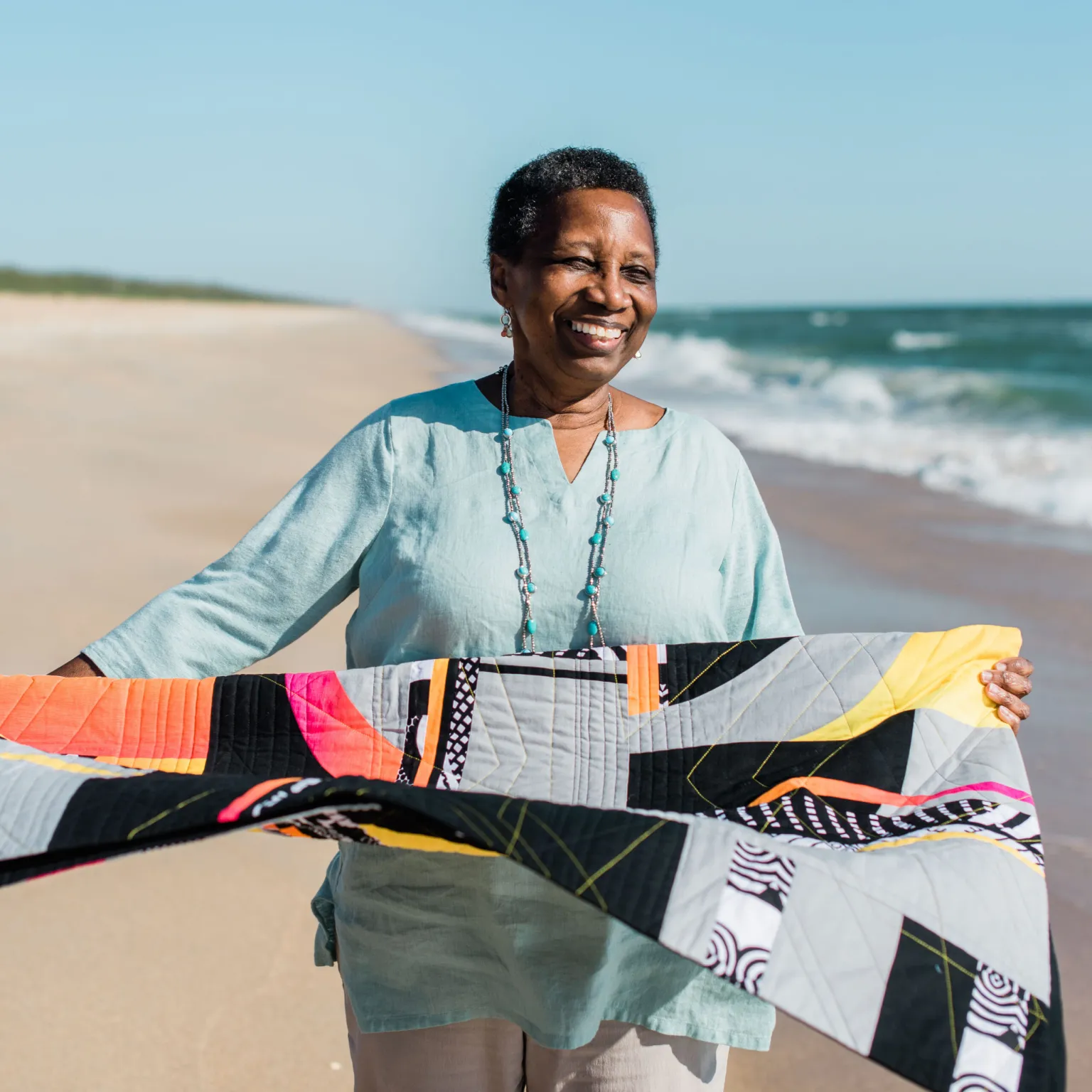
In Memory of Carole Lyles Shaw
Tips for Labeling Your Quilts
From Dee Winter: I belong to a small group that are making some charity items. One of our member’s mother was a prolific piecer. Not so good on the finishing. So we are finishing them, mostly tying, some long armed by friends, and we are going to donate them to the emergency family shelter. The label we are using has Pieced by (her name) and finished by the Sew and Sews. Gives her credit for her part, some for us. None of her chidren wanted any of them until her daughter offered them to us. They are now doing their own finishing.
From Dr. Laura Guertin: Excerpt from Laura’s blog post about this challenge: For this July Challenge, I’m reflecting upon these prior challenges and how I’d like some of my quilts to be remember in the future. I decided to generate fabric labels (printed by Spoonflower.com) for each of the 19 quilts in myStories from the South Atlantic Oceanquilt collection. These quilts mean alot to me as a scientist and a science communicator, so I want to go back and add more to the back of each one. I’ve ordered the labels to be printed on swatches and am waiting for them to arrive. Here is what they will look like, which will supplement my hand-signed/dated/numbered information that already exists on the back.
What is Quilters Take a Moment and Why Should You Register?
Quilters Take a Moment, the QA’s annual educational event is coming up on September 20 & 21 and this year all members can register for free! Just log into your membership portal and click on Register for Quilters Take a Moment. Non-members, you can purchase tickets ($60) or join and register for free via this form. This virtual event is designed to help you document the quilts you make and own. This is a unique event completely focused on tips and inspiration for documenting and preserving your personal quilt history. We often hear: What will happen to my quilts? Will my family and friends take care of them and know their value? The most important steps you can take to ensure your quilts are cared for and valued when you are no longer able to do so is to properly label and document them. Documenting a quilt underscores its value and importance and provides historical, technical, artistic, and maintenance information to the owner and anyone who comes across it. QTM Presentations will be aired live on September 20 & 21 and recorded for viewing through December 31, 2024. Sessions include: Telling the Story of Your Quilt Through Photography – Kitty Wilkin Video as a Tool for Documenting Your Quilts – Lyric Montgomery Kinard An Archive of Your Own: Using Spreadsheets to Describe and Catalog Your Quilts – Rachel Ivy Clarke Documentation as Creative Practice – Hannah Parks Documenting Your Guild or Group – A’donna Richardson Sustainable Routines for Quilt Documentation – Jenni Grover Register for Quilters Take a Moment today!
Announcing a New Membership Benefit
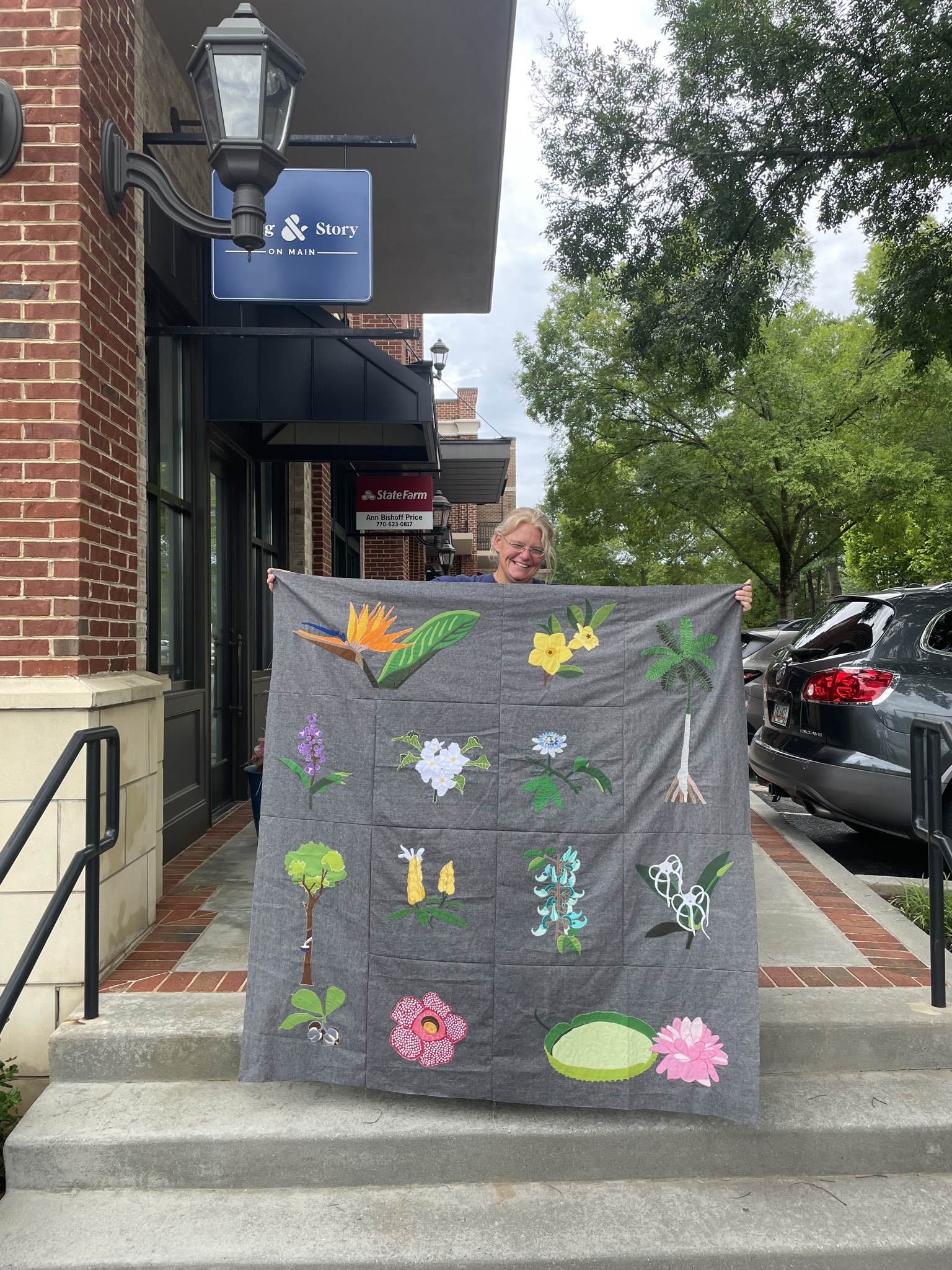
Announcing a New Membership Benefit from Aurifil! Last year QA board co-president, quilter, curator and writer Laura Hopper created a Birthday Block of the Month featuring blocks by nine incredible designers to celebrate our 30th anniversary. It was a huge hit and helped us grow our membership by 32%. This year, co-president Bradley Mitchell and his generous and creative colleagues at Aurifil are gifting our members another Block of the Month! Starting in May we will begin sharing the Aurifil Flora Block of the Month with our members. The blocks, instructions and any supplemental resources will be shared via this newsletter and your membership portal. So if you haven’t yet logged in to your portal, give it a try soon. There are twelve months/blocks in the Flora series and we will keep the BOM archived in your membership portal for at least six months after the last block is released in April 2025. Not a member yet? Join today! The last few years have been a wild ride. We’ve had to stop, adjust, reimagine, reroute, redo. It’s been a challenge, but in some ways, all of the changes have helped us to slow down, to appreciate the beauty that lives right in front of us, and to experience the small things with a more grateful heart. Perhaps it manifests as an unexpected cool breeze on a hot summer day or the sound of a bird chirping outside your window. Maybe it’s a favorite hike just outside the city or maybe it’s a burst of color that provides the perfect distraction on your Sunday morning stroll. A tree, a flower, a bloom, a petal… the sense of calm and renewal that nature provides is often overlooked, but this year, we are choosing to bring that natural beauty to the forefront. Introducing Flora, a 12 month Botanical Appliqué BOM designed by Aurifil’s Kate Brennan in partnership with graphic designer Christina Weisbard. The colors and design of Flora were drawn from 12 breathtaking rainforest plants from the Amazon Water Lily and the Bird of Paradise to the Jade Vine and the Spider Lily. The monthly blocks, allow each of the 12 featured plants to take center stage. While instructions are given for fusible appliqué, a variety of methods of appliqué and finishing will be highlighted. Depending on the month, raw blocks are 12-1/2″ x 12-1/2” or 12-1/2” x 24-1/2”. They can be finished into individual minis or collected to create a finished 48” x 48” quilt.


Block #9 – Georgia Bonesteel
Birthday Block of the Month #9: Georgia Bonesteel
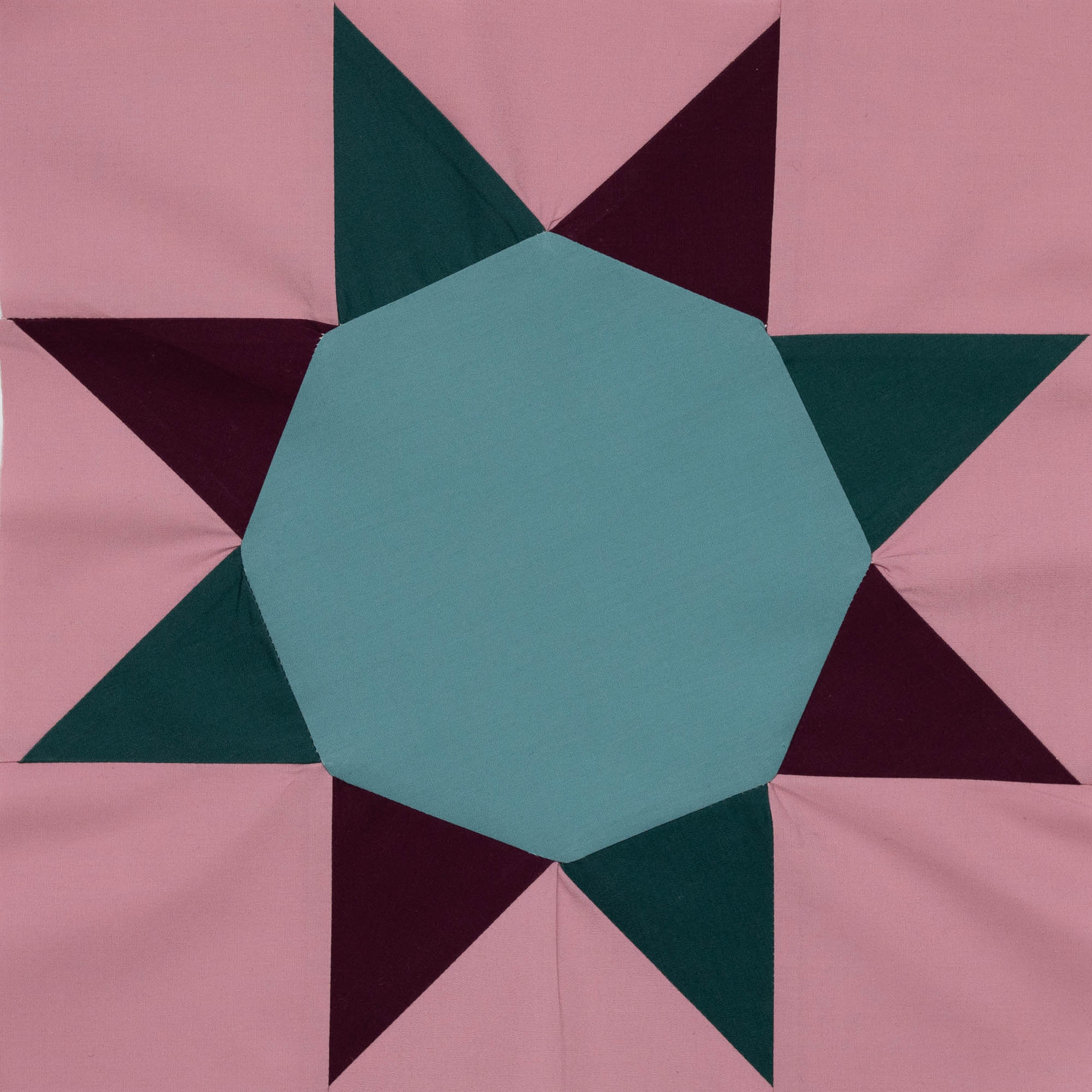
It’s here! It’s here! The final block of the Quilt Alliance Birthday Block of the Month! After nine fun months, we are nearing the end of our quilt. After making the ninth block, all you’ll need to do is assemble the quilt top and you’re done! Quilting icon Georgia Bonesteel designed this month’s block, which we saved for last because it will utilize some new techniques like piecing with templates, floating seams, piecing triangles, and working from the outside in. While it looks complex, Georgia’s designs have a way of being simple and enjoyable. The block is as charming as she is!
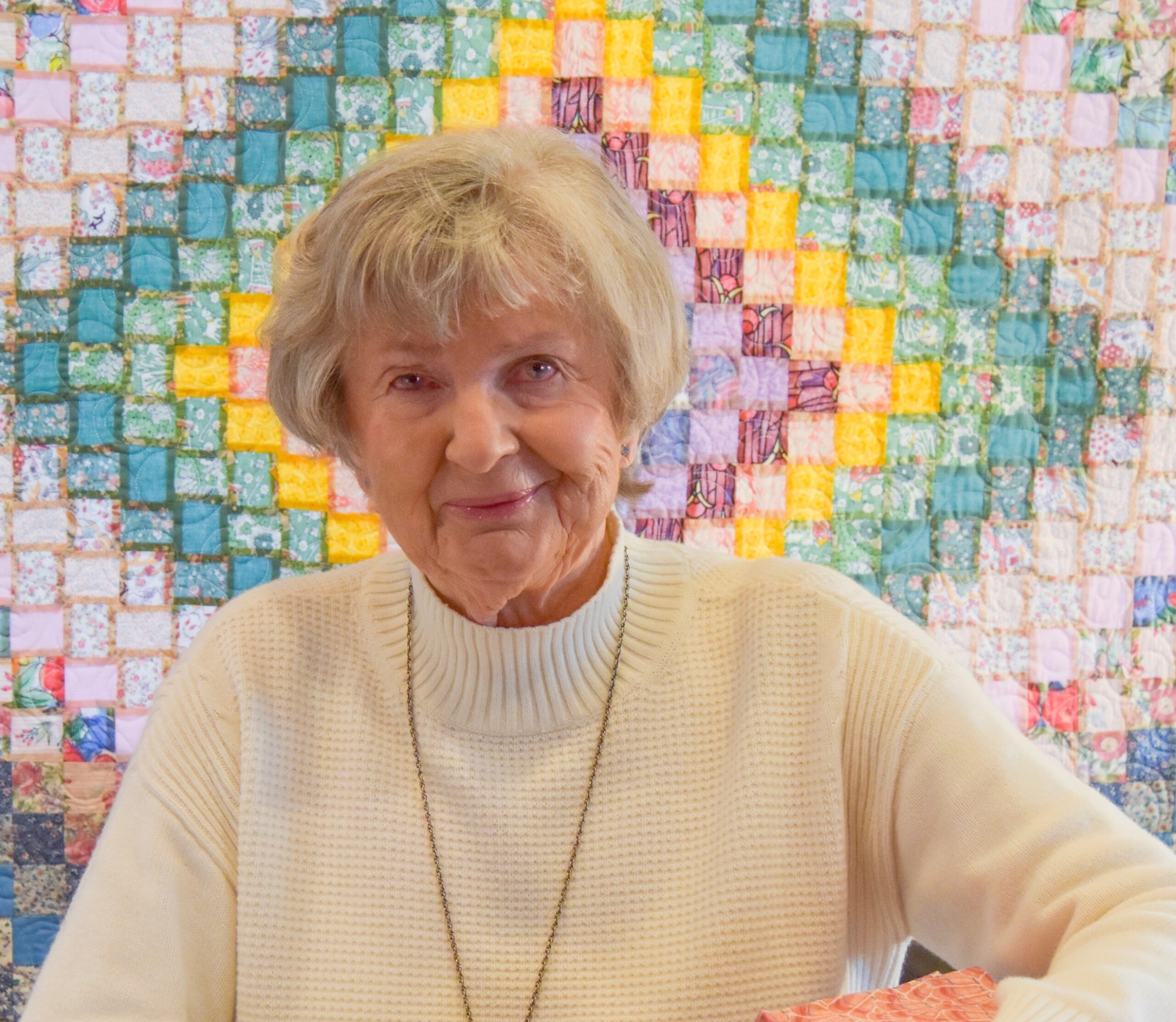
Meet Georgia Since 1978 when her television program, Lap Quilting with Georgia Bonesteel, debuted on North Carolina Public Television, Georgia has been one of the most watched and notable teachers in quilting. Her methods and designs respect traditions and push quilters to explore creativity. Georgia’s most recent book, Scrap Happy Quilts is both a memoir of her life in quilts and new projects and patterns for quilters of all skills. Today, Georgia lives a busy semi-retired life volunteering her master gardening skills to the community and her own garden, while continuing to create quilt projects on a daily basis. You can visit her wonderful website or follow her on Facebook. Georgia recorded a fabulous video talking about her connection to this particular quilt block and even showing a way that you can self-draft the templates for the block yourself. Watch the video below — you’ll love it! Quilters today (like myself) may not be accustomed to quilting this way. It’s wonderful and fascinating to watch!
Georgia’s Top BOM Tips Georgia is a quilting trailblazer and full of piecing wisdom, including techniques that were completely new to me! Here are her best tips for making this block.
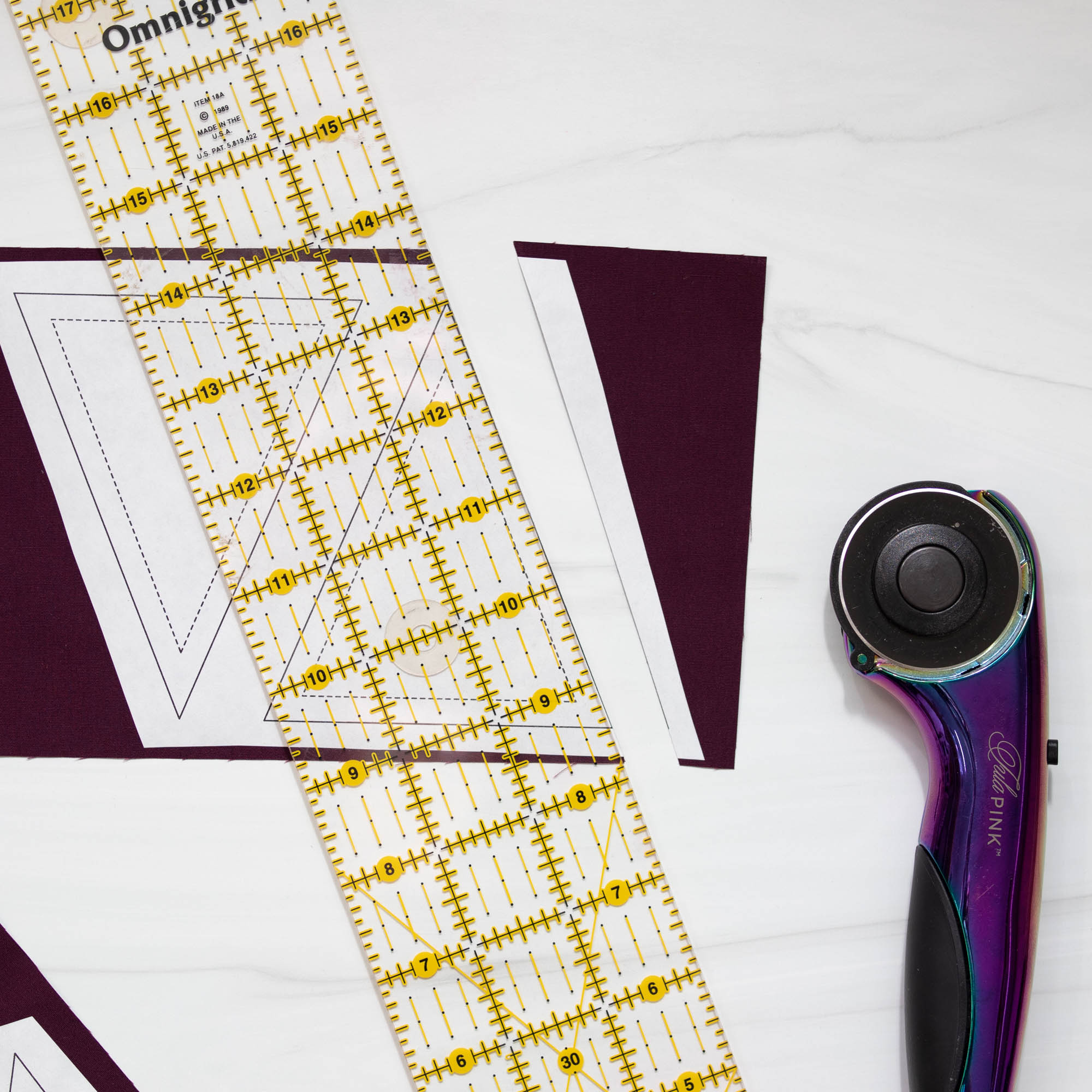
Georgia’s Tip 1: Use Freezer Paper To get accurate templates for the central octagon and star unit triangles, freezer paper is the way to go. Cut the freezer paper templates out with a generous amount of space around them as shown above. Press them to the fabric. Using a ruler and rotary cutter, cut along the solid outer lines of the templates. The dashed inner lines show the seam allowance. An added tip is to use a rotary cutter with a dull blade that you plan to replace, or a rotary cutter dedicated to paper so you don’t dull the blade quickly.
Georgia’s Tip 2: Learn to Draft a Block You can use the templates and measurements in this month’s PDF to complete the block, but as Georgia says, you’re not a real quilter until you can make a block from scratch. Learn her block drafting method in her video included in this blog post!
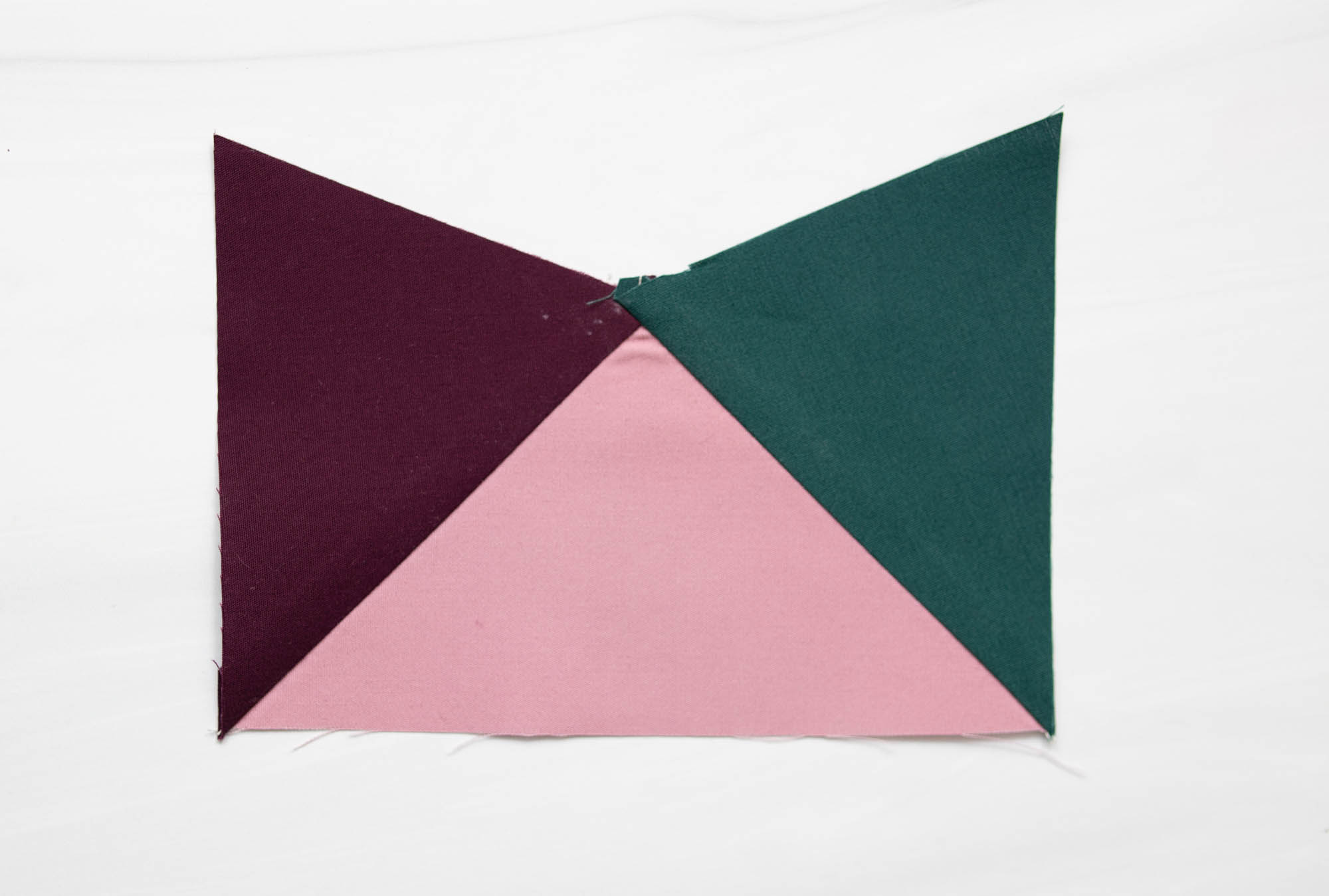
Georgia’s Tip 3: Create 90 degree angles When creating the star units, always match up the 45°angles to create 90° angles. This allows you to sew the triangle units to the corner squares. Pretty clever!
Quilt Alliance BOM Tips Each month, we share our best tips for making the Birthday Block of the Month as well. These tips come to you from our Birthday Block of the Month host, Quilt Alliance co-president Laura Hopper!
Play With Color Did you notice that I used a different color for my center octagon than appears in the PDF pattern? Instead of Color 3, the neutral color, I used Color 2. That’s because during a previous month of the BOM, I made a cutting error and ran out of Color 3 fabric. Oops! It happens to the best of us. Luckily with this block, you have the opportunity to play with color. Use Color 3, or pull in your favorite color from the quilt. Or you could use the fabric you’ll use for the backing or binding! How about using a special fabric that you fussy cut, just like Georgia did in her version of the block shown below? There are so many options! Don’t let the color guide limit you — it’s your quilt so have fun!
Align Star Units Correctly! Speaking of oops, notice something wrong with the star unit above? Yep, I made a mistake. Did I mention that it happens to the best of us? As Georgia said in her tips, the 45° angles of these triangles should be aligned. However, when I picked up my green fabric, I didn’t do that. I accidentally sewed the 45° angle to the center of the pink fabric, instead of to the 45° angle of the pink fabric. That doesn’t look like a 90° angle! Thank goodness for seam rippers because if you make the same mistake I did, all you need to do is rip that seam out and sew the triangle on the other way. Easy breezy!
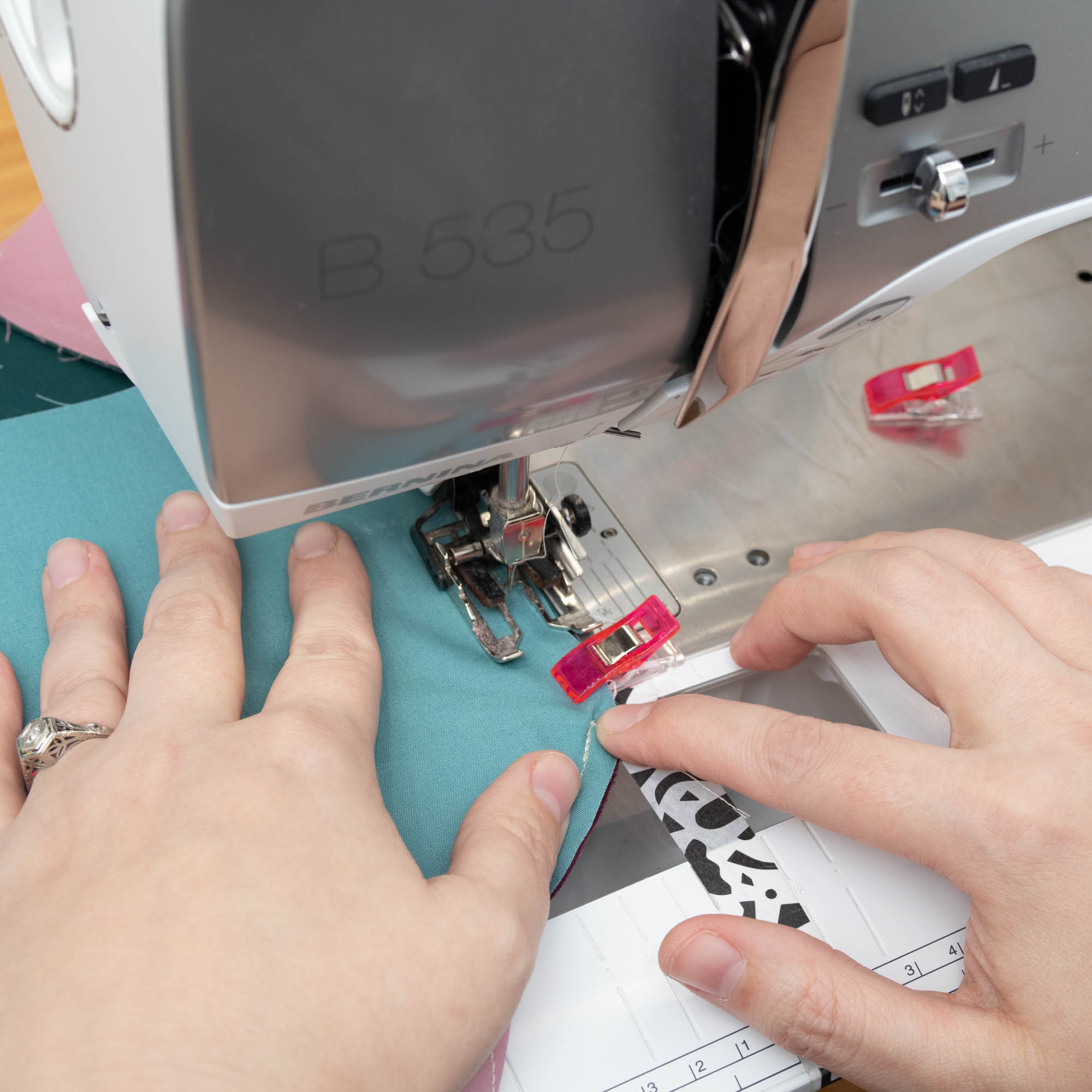
Manipulate Fabric for the Octagon Have you ever made a block from the outside in? I haven’t! This was a completely new technique for me. And I learned a few things while doing it. One useful tip is that to avoid puckers, make sure that the fabric is completely flat. This is a bit hard to do at first! I found that I needed to manipulate the fabric to get the octagon to lay flat on the outer star ring. Here are some pictures that might help! It’s very hard to explain but trust me when I say it’s something that you will get once you get to this step.
Accept Mistakes… or Redo Them It’s possible that with all the fabric manipulation in the world, you may still get puckers in your block. It happened to me! When I saw my pucker, I had a choice to make. I could either rip out the seam and redo it to try and avoid the pucker. Or I could accept that I was learning a new technique and the results were imperfect. If you’ve been following this BOM for all nine months, you’ve probably noticed that I consider myself a precision quilter. I love when points line up perfectly. Making a perfect block is a wonderful feeling…but so is learning a new technique. If there’s one lesson I can leave you with at the end of this BOM, it’s that the only thing you should compare your latest quilt to is the last quilt you made. I help beginner quilters learn new techniques every day, and it’s very easy for a new quilter to compare themselves to someone who has been quilting for decades. You know what happens next? The new quilter gets discouraged. They think their quilts will never look that good. And they give up. For me, quilting is about seeing my personal growth. The points on my early quilts don’t match well, but now I know so many of the tricks that I’ve shared with you along this journey! And that’s how I approached this block. I learned new techniques from Georgia, who has been quilting since before I was born, and this is the first time I ever did them. I left my puckers in as a reminder that I’m always growing. And so that in ten more years, once I’ve practiced her techniques even more, I can see how much I’ve grown. I hope you all share the same outlook on quilting, growth, and learning!
Quilt Documentation Tip Follow Georgia’s lead as one of the most important figures in recent quilting history and document what you do! As a television personality, lots of Georgia’s quilting has been documented on film. Making a video about your blocks or finished quilts is a great way to preserve your story! Learn more about how in the next blog post, focused on documenting your completed quilt.
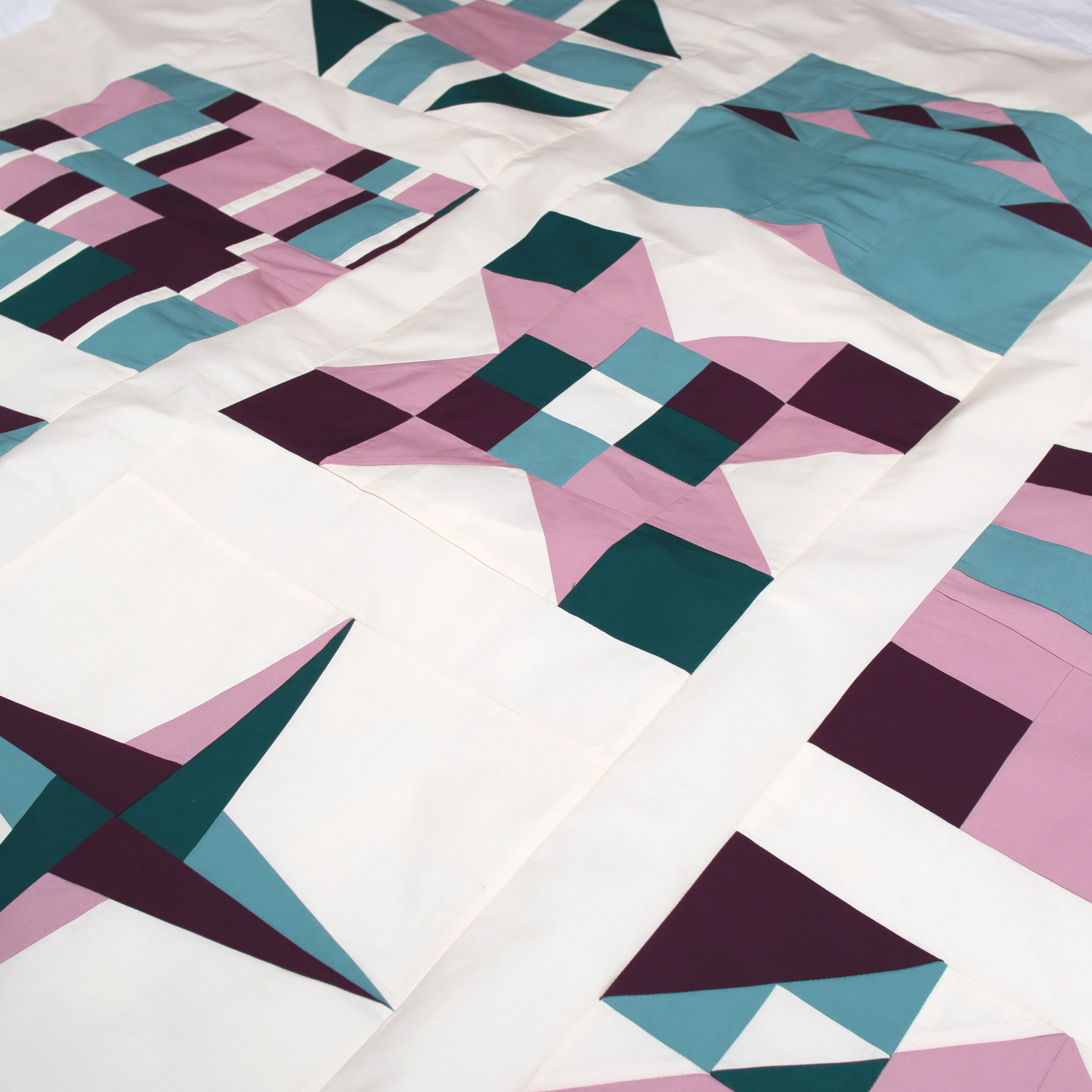
Block #8 – Carole Lyles Shaw
Birthday Block of the Month #8: Carole Lyles Shaw
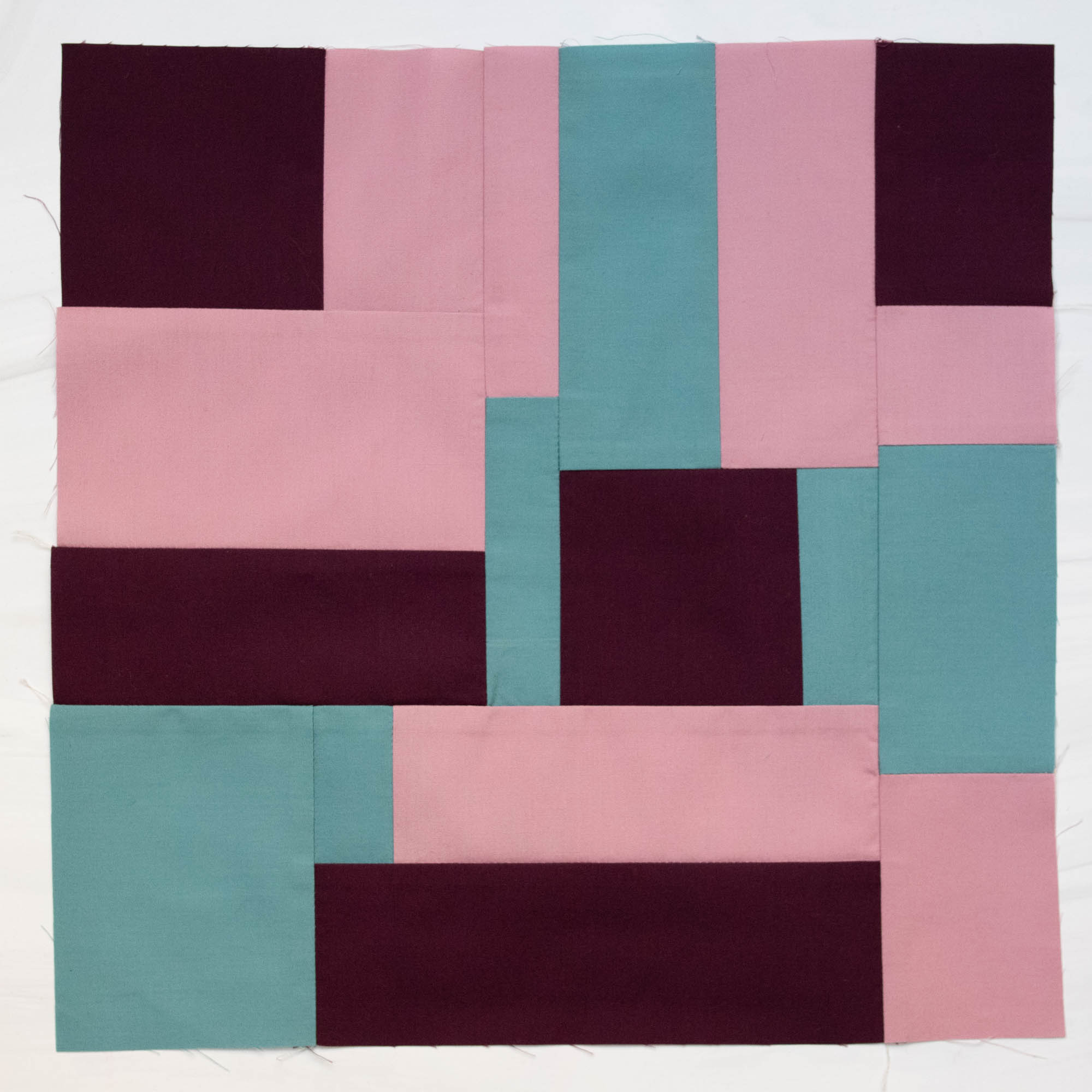
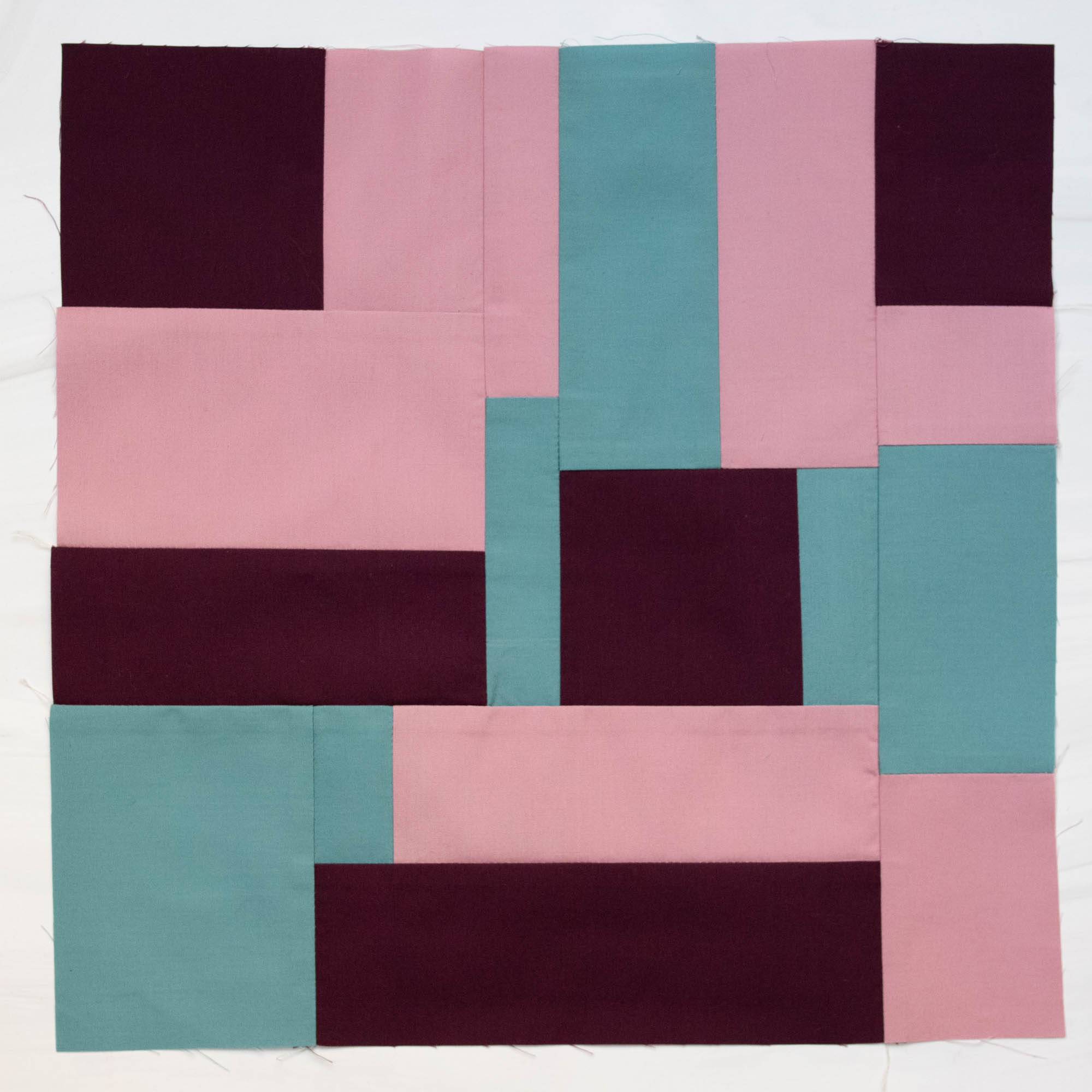
Only one month to go! For Month 8 of the Quilt Alliance’s Birthday Block of the Month, we have a delightfully simple block that creates an illusion of complexity. That’s just one of the many things that I admire about Carole Lyles Shaw’s designs. As a modern quilter, Carole Lyles Shaw beautifully explores movement in quilts. For her Quilt Alliance design, she created a block that uses only squares and rectangles but gives the illusion of complex shapes. And best of all, it only takes about a half hour to make!
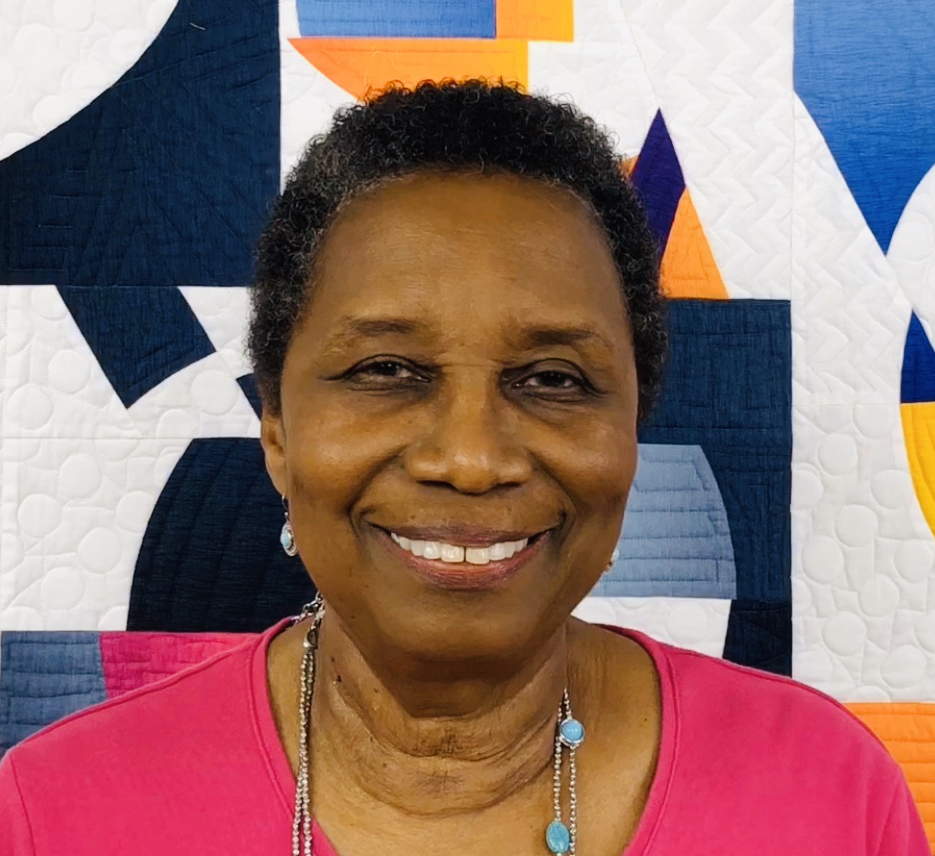
Meet Carole Carole Lyles Shaw is an award-winning modern quilter, fiber artist, and workshop teacher. Her passion is to inspire quilters to explore the fun and creative freedom in making modern quilts. Carole taught herself to quilt so that she could make quilts for her wonderful nieces and nephews. She is drawn to modern quilting because it focuses on bringing individualism and free expression to the quilts made today. Carole teaches workshops to help quilters confidently and joyfully dive into modern quilting. Her students say that her workshops inspire them to let their creative voices shine. You can follow her on Instagram or on her website.
Carole’s Top BOM Tips Each month, our Birthday Block of the Month Designers share their top tips for making the block they designed. Here are three great tips for making this block straight from Carole herself.
Carole’s Tip 1: Sew With an Accurate Quarter Inch Seam Accuracy is important in this month’s quilt block to maintain the illusion of complex shapes. Also, because the block is made of four distinct units (described in the PDF pattern), if your seam allowance is too wide or thin, the units may not line up. If you’re concerned about the accuracy of your seam allowance, use scrap fabric to test and measure a few seams before beginning.
Carole’s Tip 2: Press With a Dry Iron By now, you know that I (Laura) recommend a tailor’s clapper basically every month. I love tailor’s clappers! They work so wonderfully to keep seams flat. However, using a tailor’s clapper requires using steam and there’s a possibility that steam can distort fabric. If that happens, the illusion of this block may also be distorted. Instead of using steam and a tailor’s clapper this month, use a dry iron.
Quilt Alliance BOM Tips Each month, we share our best tips for making the Birthday Block of the Month as well. These tips come to you from our Birthday Block of the Month host, Quilt Alliance co-president Laura Hopper! Here are some reasons I love this block: it only takes about a half an hour to make, the only cutting you’ll do is when you follow the initial cutting instructions, and it looks much harder than it is. That’s the beauty of Carole’s design — a beginner can make it, but it looks advanced.
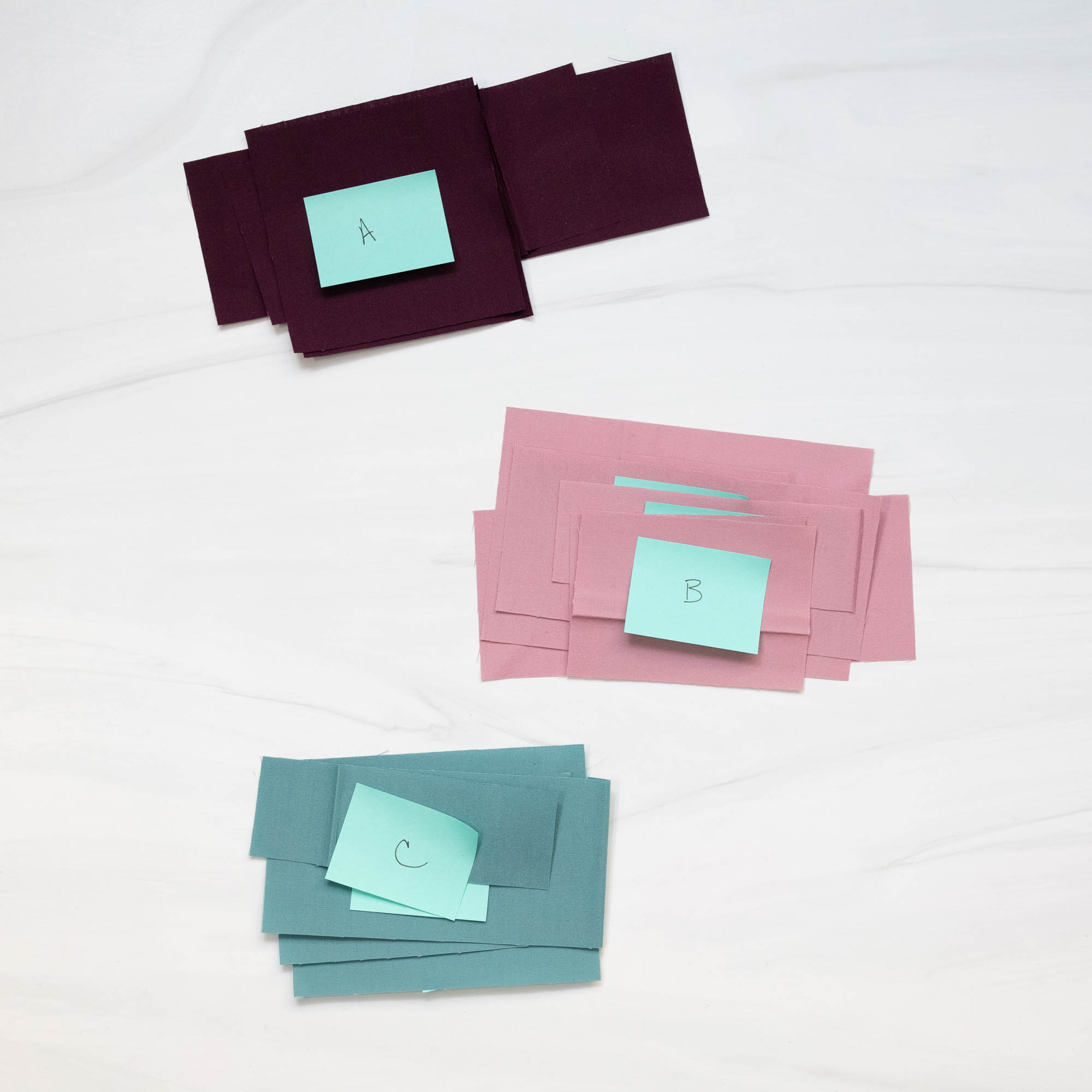
Stay Organized The hardest part of this block is keeping all of the differently-sized pieces organized. The PDF pattern will be a big help, but it’s not the only thing you should do, I recommend using sticky notes or scraps of paper to label each cut piece of fabric to keep track of them. Also important — keep those sticky notes on the cut fabric pieces until they are sewn together, not just while they are in a pile waiting to be put together.
Check the PDF diagrams often! I’m sure you check the PDFs often each month, but for this one, it’s extra important. It can be easy to accidentally piece fabric together in the wrong order. Or when you complete the four units, you may sew a unit upside down. Oops! Avoid having to use that trusty seam ripper and make sure you’re checking the PDF diagrams at every step.
Let Loose and Have Fun You don’t have to overthink with this block. You don’t have any complicated techniques to worry about. This is truly an excuse to sit back, relax, and enjoy yourself. Have a blast!
Block #7 – Bonnie Hunter
Birthday Block of the Month #7: Bonnie Hunter
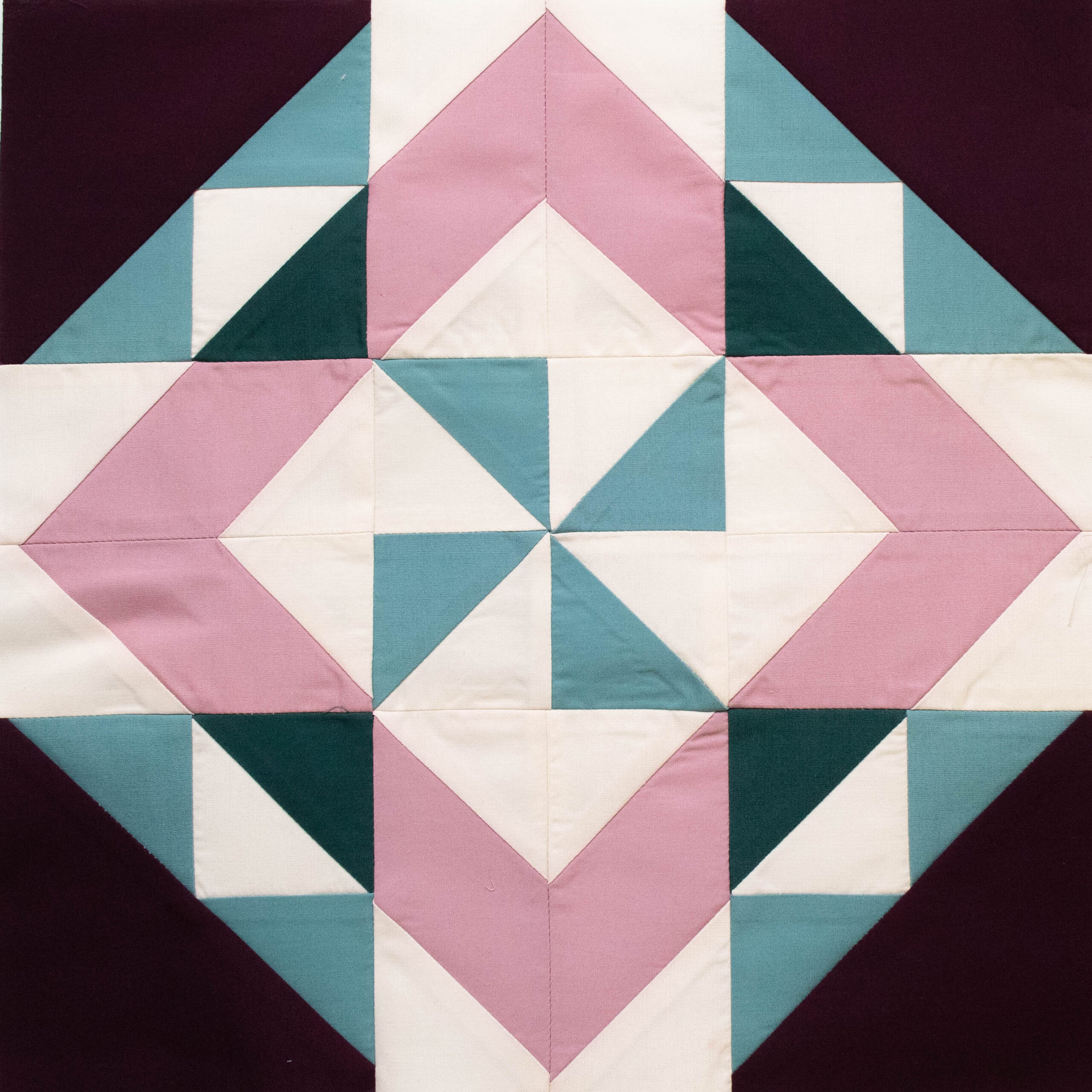
We’re in the home stretch! For Month 7 of the Quilt Alliance’s Birthday Block of the Month, we are starting the final row of our quilt! I can’t believe there are only two months left of our birthday party. This month’s block builds off of many skill-building aspects of previous months, including techniques for precision. Designed by the beloved Bonnie Hunter, this block is playfully called Birthday Girl. And it’s not just the Quilt Alliance’s birthday she’s celebrating — Bonnie turned 61 when she submitted this design for our project! Let’s dive into some tips and tricks to help you create this block as calmly and effortlessly as possible.
Meet Bonnie Bonnie K. Hunter is passionate about quilt quilting, focusing mainly on scrap quilts with the simple feeling of “making do.” Dedicated to continuing the traditions of quilting, Bonnie enjoys meeting with quilters, challenging quilters to break the rules, thinking outside the box, and finding what brings them joy. Bonnie retired from the quilt teaching & lecture circuit in 2020 after the opening of her dream come true — Quiltville Inn, a big old 1884 victorian house turned retreat center in Southwestern Virginia. Catch up with Bonnie’s doings through her extensive website and almost daily blog. You can follow her on Instagram, Facebook, or on her popular website. One of the Quilt Alliance’s signature projects is the QSOS oral history project, an oral history project which anyone can participate in. Watch the video below to see Bonnie talk about her life and her quilts, and keep reading this blog post to learn a tip for how to document your own quilts!
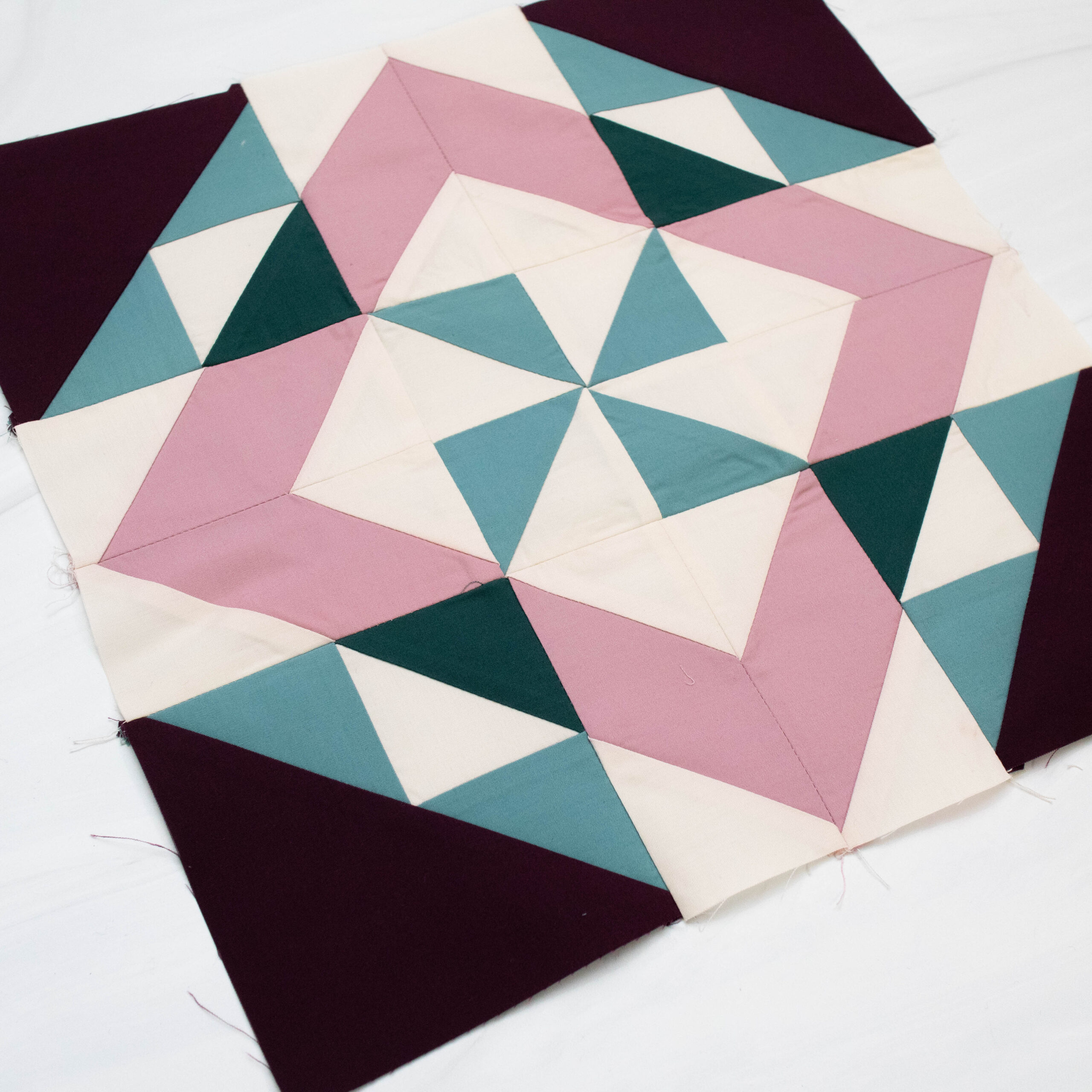
Bonnie’s Top BOM Tips Each month, our Birthday Block of the Month Designers will share their top tips for making the block they designed. Here are three great tips for making this block straight from Bonnie herself. As a reminder, while you’re reading through this post, Bonnie’s Birthday Girl block is made using three block units — a Pinwheel, a Chevron Unit, and a Corner Unit. Let’s take a quick look at those individual components.
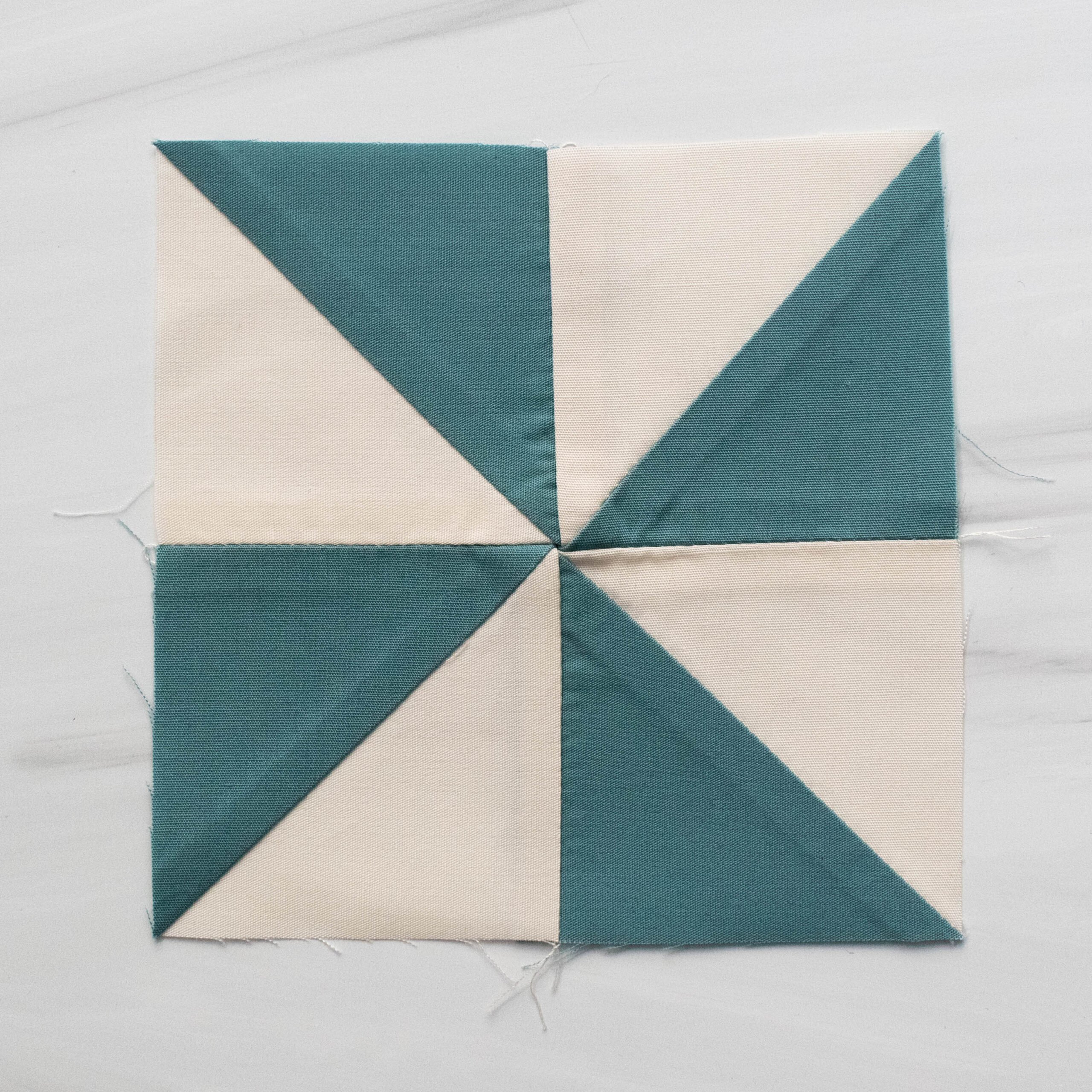
Pinwheel unit
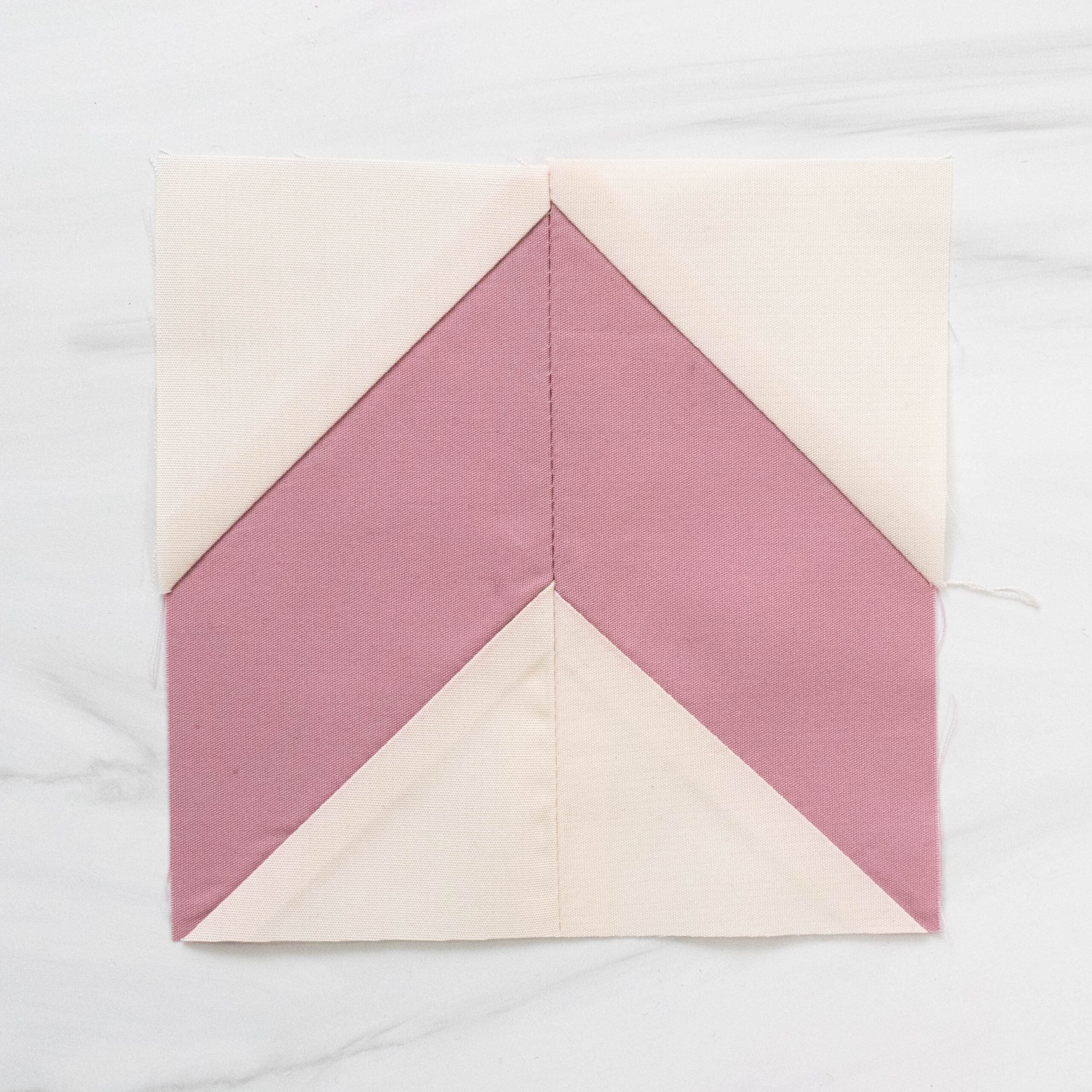
Chevron unit
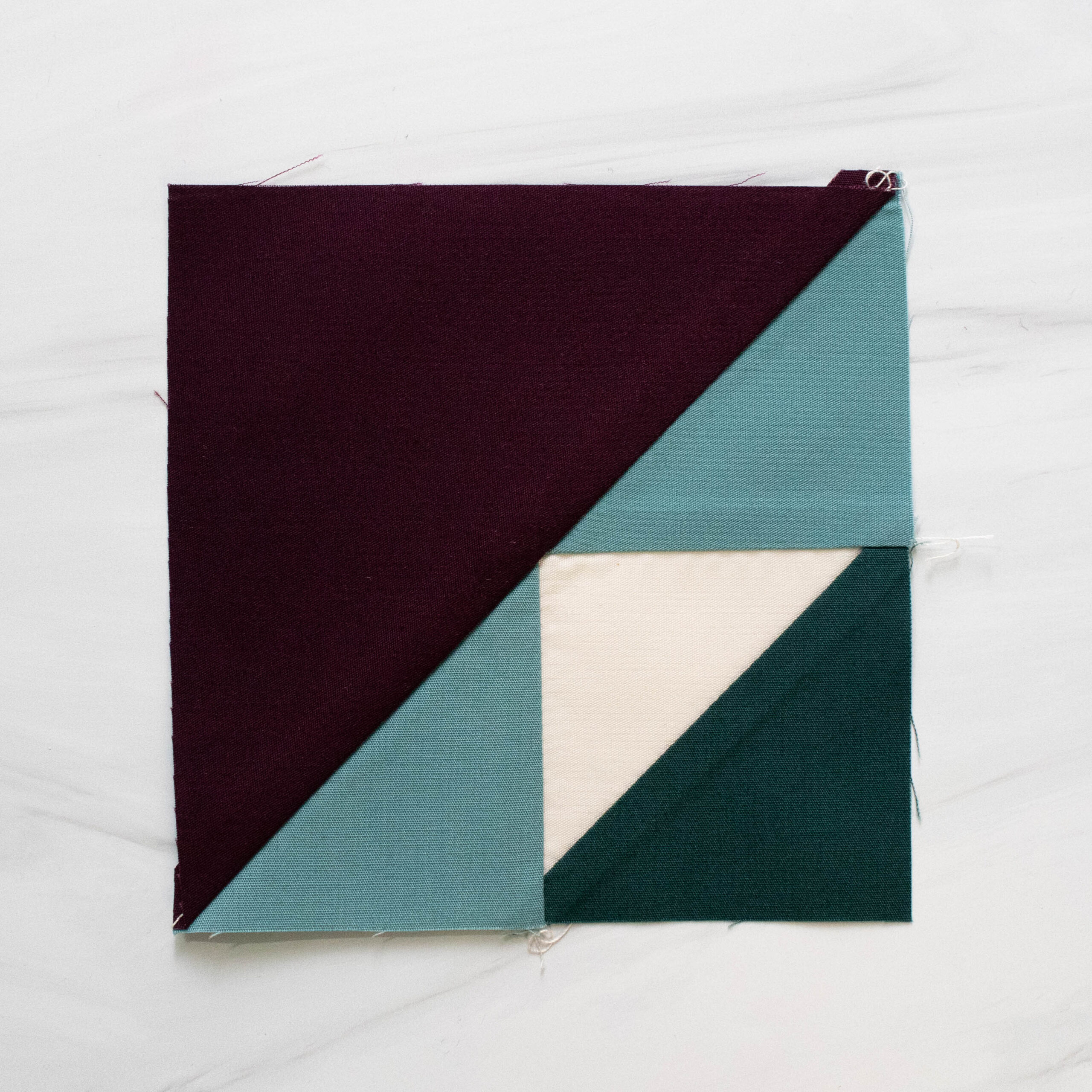
Corner unit
Bonnie’s Tip 1: Trim, Trim Trim As Bonnie says, “My number one tip when working with triangles — TRIM DOG EARS ALWAYS!” Don’t skip this step to save time. It will have a negative impact on the accuracy of your block. This tip will be most important when making the corner unit.
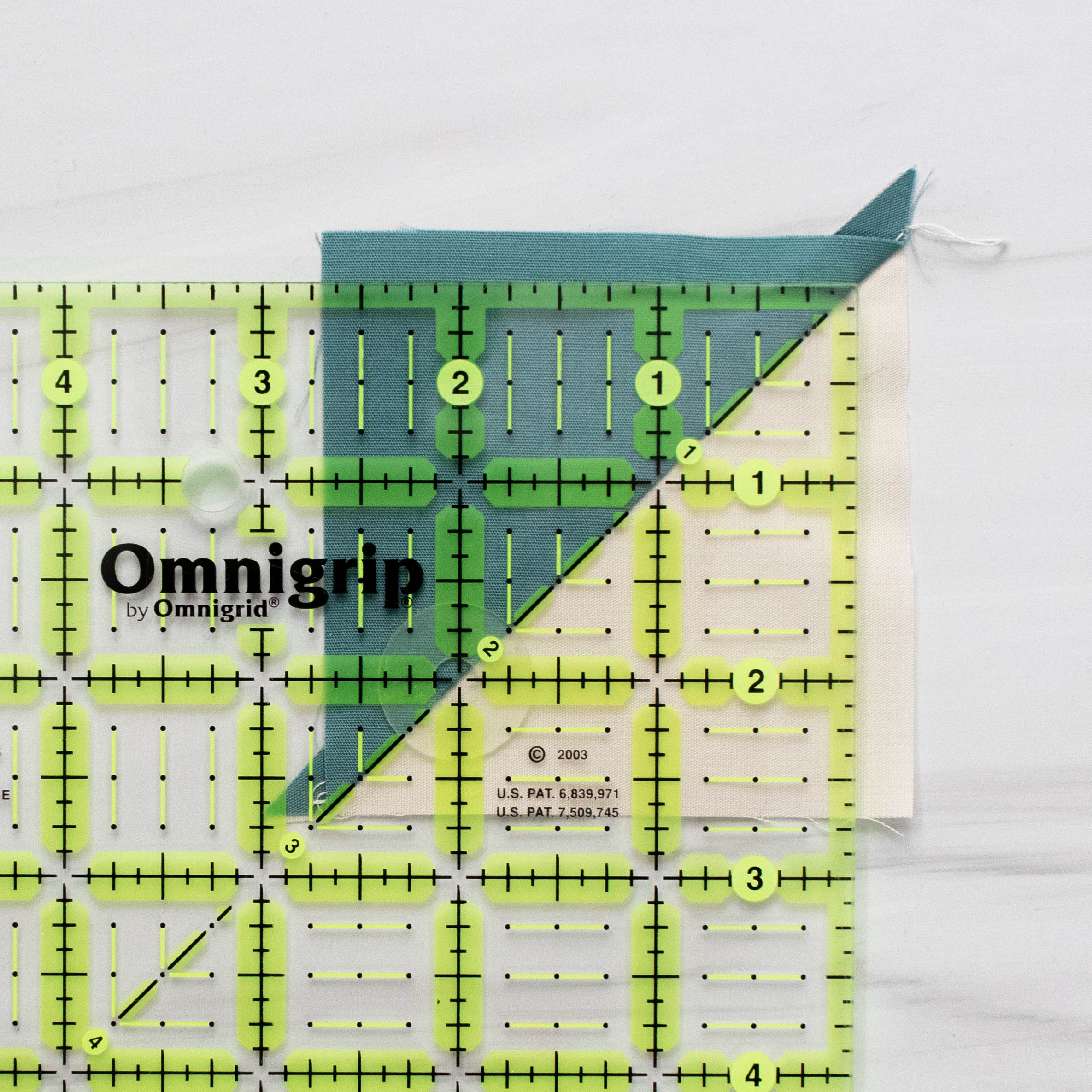
Bonnie’s Tip 2: Cut Accurately Be sure to use ruler lines when cutting instead of mat lines. Quilting rulers are more accurate, and those small ⅛” lines may seem unimportant, but this block uses lots of eighth inch measurements.
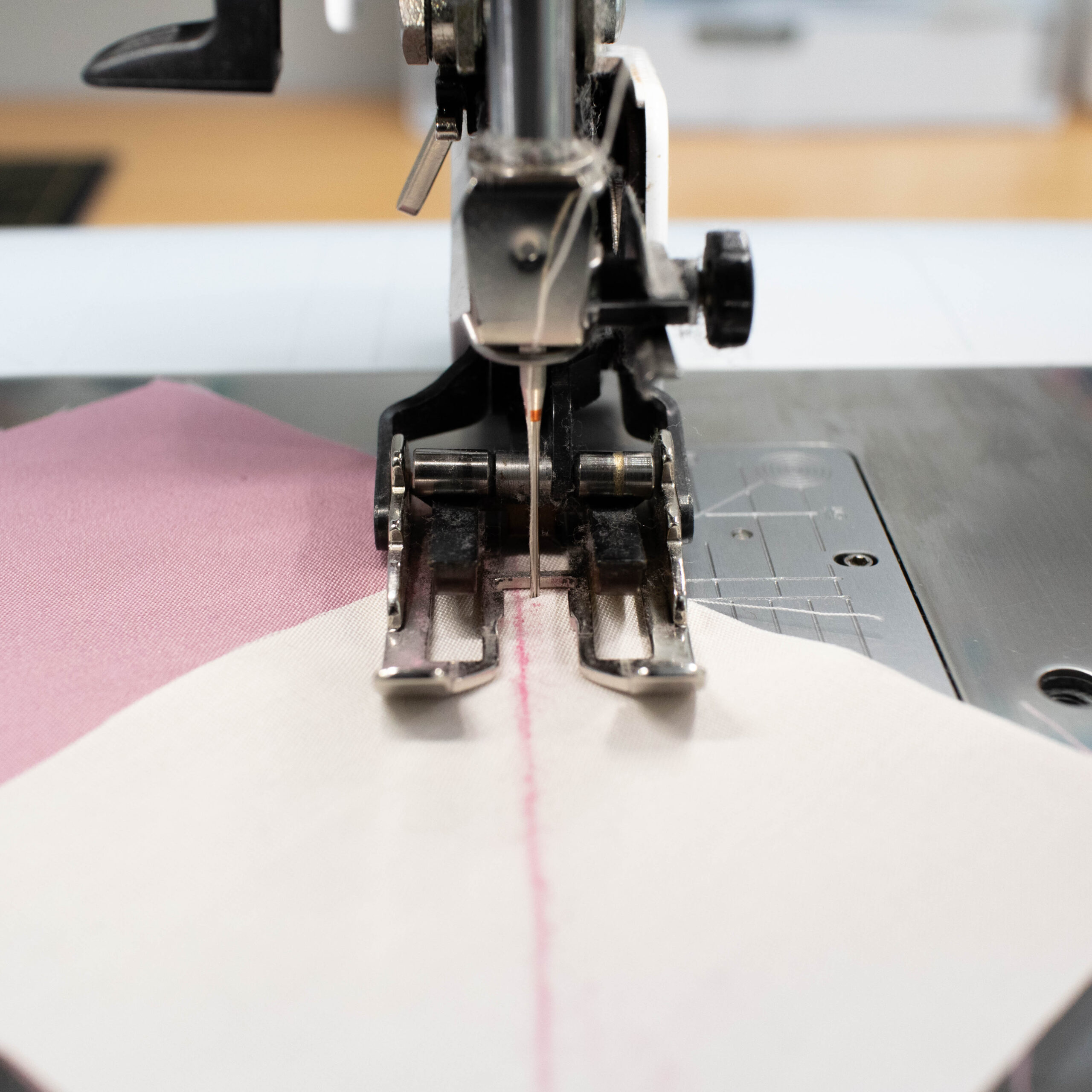
Bonnie’s Tip 3: Don’t Sew On the Line in Chevron Units As Bonnie said, “When making the Chevron Units: If you are drawing a line on a square that will fold over and become the corner triangles, NEVER sew on the line. The line is your fold line, not your stitching line. If you want your triangle to reach all the way to the edges of your base unit, stitch right next to the line – up against the line just barely into the seam allowance. That way your triangle can fold up on the fold line and not run short.”
Quilt Alliance BOM Tips Each month, we share our best tips for making the Birthday Block of the Month as well. These tips come to you from our Birthday Block of the Month host, Quilt Alliance co-president Laura Hopper!
Sew Slow! When making the Chevron Units, your seam needs to be incredibly close to your guideline. To achieve this without sewing directly on the line, slow down while you sew. I enjoy slow sewing — I keep my machine at half speed at all times. But even I slowed down even more when making the Chevron Units to try and focus on accuracy.
Nest Every Seam Possible We’ve covered nesting seams in several previous blog posts, so by now you must be a pro! People often ask me how my piecing is so precise. My best tip is to nest seams! Once I learned to do this, my piecing improved noticeably and I never went back. It is popular nowadays to press seams open. However, doing that does not allow seams to nest and reduces accuracy. Press to the side, ensure that your seams alternate in pressing directions before sewing together, and nest in place. You’ll love your results.
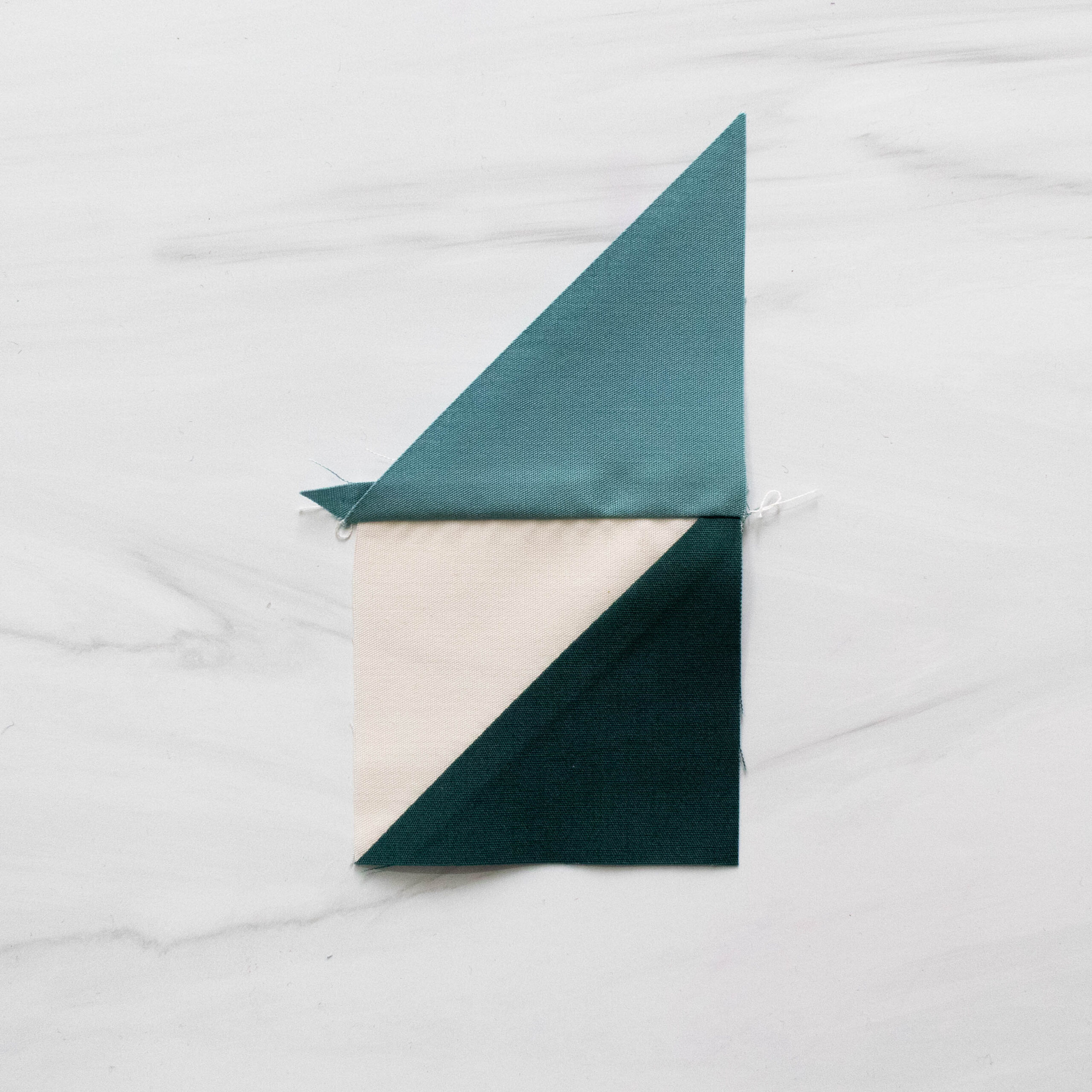
Don’t Get Tripped Up By The Corner Units Look at the picture above. When you get to this step in the PDF, you may think you’ve cut something wrong. I know I did! I double-checked the pattern several times! Typically, when piecing, the two pieces being sewn together are usually the same size. However, when making the Corner Unit, you’ll sew two wing triangles onto a half square triangle (one is shown above), and the wing triangle will be longer. That’s because those long wing triangles are helping to create a seam allowance that will allow you to finish the Corner Unit! Take a look below, left. Do you see where the two wing triangles come together in the center? That’s a quarter inch between the edge and the start of the half square triangle! It allows you to make sure the half square triangle point lines up exactly with the next triangle sewn to the Corner Unit. Check that out below, right.
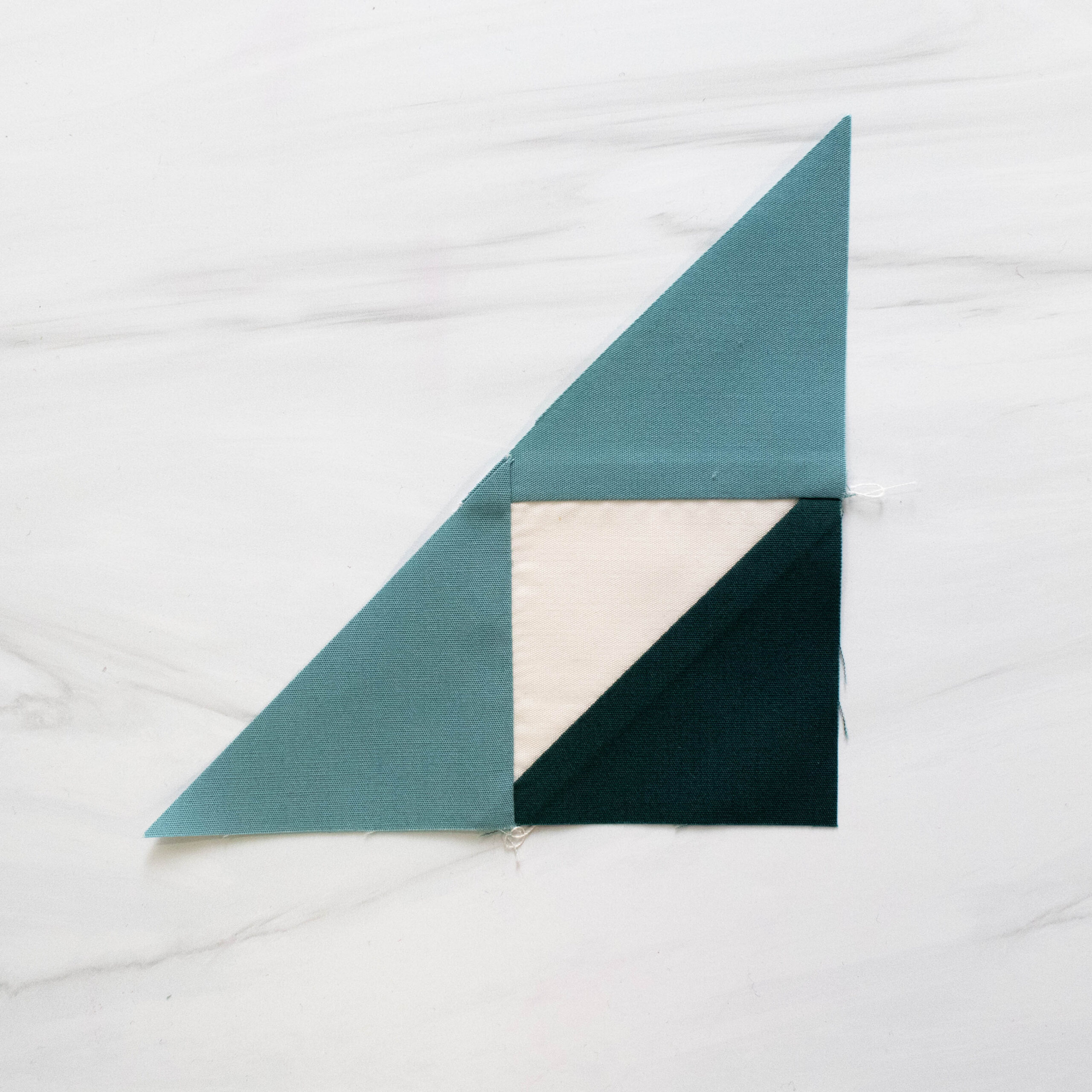
Know Where To Aim We’ve talked about this tip before, too. It’s almost like this block is bringing together so many skills built in previous months! To get the perfect point shown in the Corner Unit above or in other areas of this block, knowing where to aim your seam is crucial. In the image above, you can see where three seams come together. Before sewing the last long seam, there was an X intersection. I aimed for the center of the X to create the long seam shown in the image above, and the result was a perfect point!
Block #6 – Andrea Tsang Jackson
Birthday Block of the Month #6: Andrea Tsang Jackson
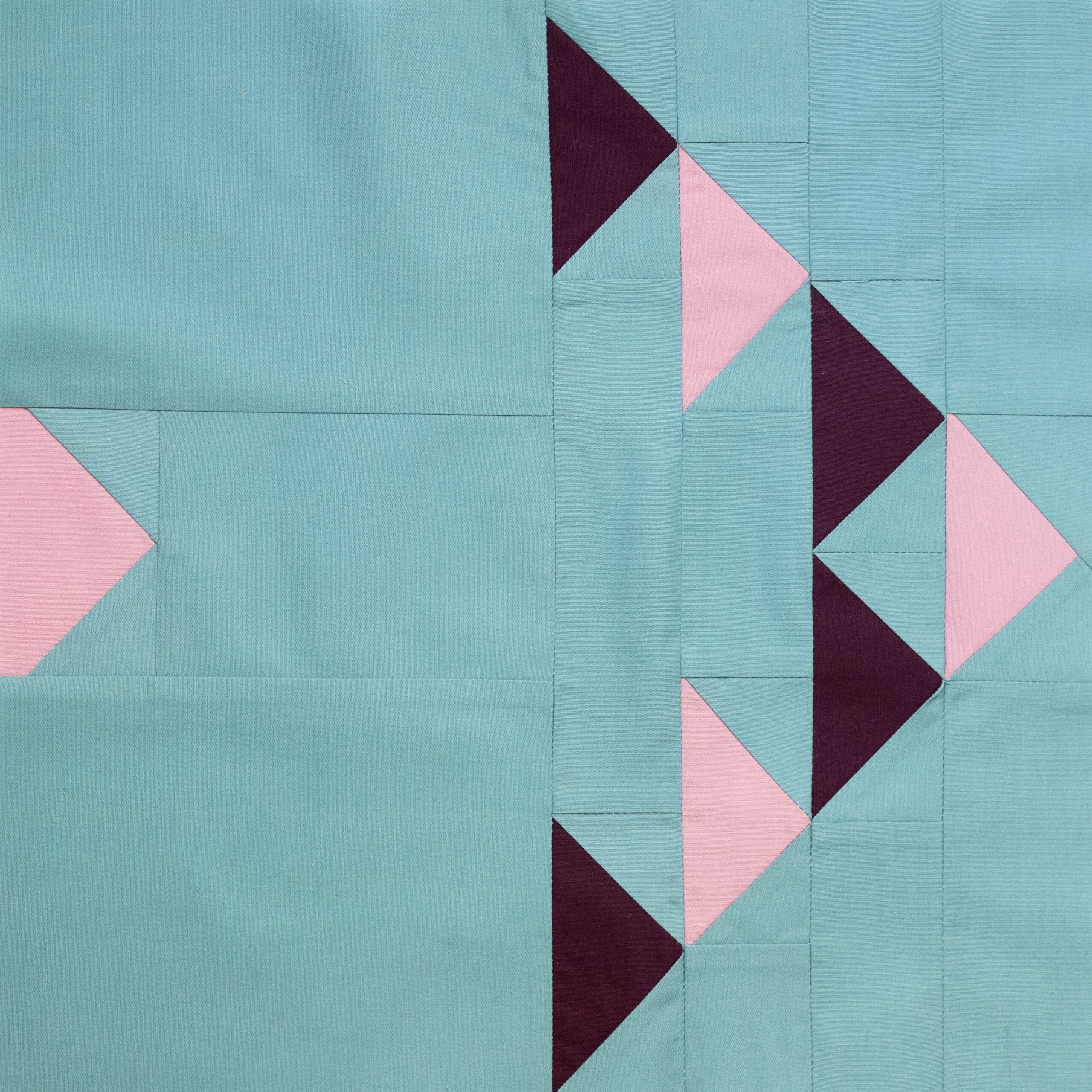
Last month, we practiced accuracy with a no-waste method for making flying geese. We’ll be building on that skill this month as we create smaller flying geese units for this block with a meaningful story. Inspired by her personal journey of starting to quilt by flying solo, before joining a gaggle of quilters in a guild, our designer for this month is the skilled artist and designer Andrea Tsang Jackson of 3rd Story Workshop. Known both as a fine artist and a quilt pattern designer, Andrea pushes the boundaries of quilting through collaborative work, one-of-a-kind design, and larger-than-life public installations. Her work has a timeless quality combined with an effortless calmness. This month’s block is no different. Let’s dive into some tips and tricks to help you create this block as calmly and effortlessly as you can.

Meet Andrea Andrea Tsang Jackson of 3rd Story Workshop is a textile artist, quilt designer, author, and educator based in Halifax, Nova Scotia, Canada. After working in various design fields and settings ranging from architecture to museums, the quilting medium called to her as a way to explore place, belonging, and agency. Her background in architecture has allowed her to understand the design process from a variety of approaches; her training in life has taught her about the beauty in mess. You can follow her on Instagram and find all of Andrea’s patterns on her website. One of the Quilt Alliance’s signature projects is the Go Tell It video documentation project, which anyone can do. Watch the video below to see Andrea talk about her block, and keep reading this blog post to learn a tip for how to document your own quilts!
Andrea’s Top BOM Tips Each month, our Birthday Block of the Month Designers will share their top tips for making the block they designed. Here are three great tips for making this block straight from Andrea herself. Andrea’s Tip 1: Follow Her Easy Flying Geese Tutorial For some new and fun tips about making flying geese, don’t miss Andrea’s no-waste flying geese tutorial. It is such a valuable resource that we included a link in the PDF pattern as well as the blog post! Andrea’s Tip 2: Cut Down the Time It Takes To Cut When cutting the units apart, cut multiple at once using the quickest cutting technique from Andrea’s blog! This tip will cut down your cutting time, especially if you decide to make more flying geese or an entire flying geese quilt after this month’s block. Andrea’s Tip 3: Get the Perfect Trim On Your Geese If you’re making a lot of Flying Geese, a Bloc-Loc Ruler is a wonderful tool to have for trimming them perfectly. However, if you don’t have a Bloc-Loc ruler, keep reading for a step-by-step look at how to trim the geese units with a regular ruler.
Quilt Alliance BOM Tips Each month, we share our best tips for making the Birthday Block of the Month as well. These tips come to you from our Birthday Block of the Month host, Quilt Alliance co-president Laura Hopper! Like last month, my tips for this month are going to focus on making the flying geese units. Let’s dive in!
Sew with a Scant Quarter Inch In Andrea’s tutorial, she specifically mentions using a scant quarter inch. If you’re new to this style of sewing, it’s easy breezy. Instead of aiming for an exact quarter inch seam allowance, you’ll aim for that seam allowance to be just a few fibers smaller. Trust me when I say it sounds harder than it is! Also, don’t forget our tip from last month — know where your intersections are located. In the image above, you can see how to sew a seam through a flying geese X to ensure that you get a perfect point. See how great the point is below!
Block #5 – Suzy Williams
Birthday Block of the Month #5: Suzy Williams of Suzy Quilts
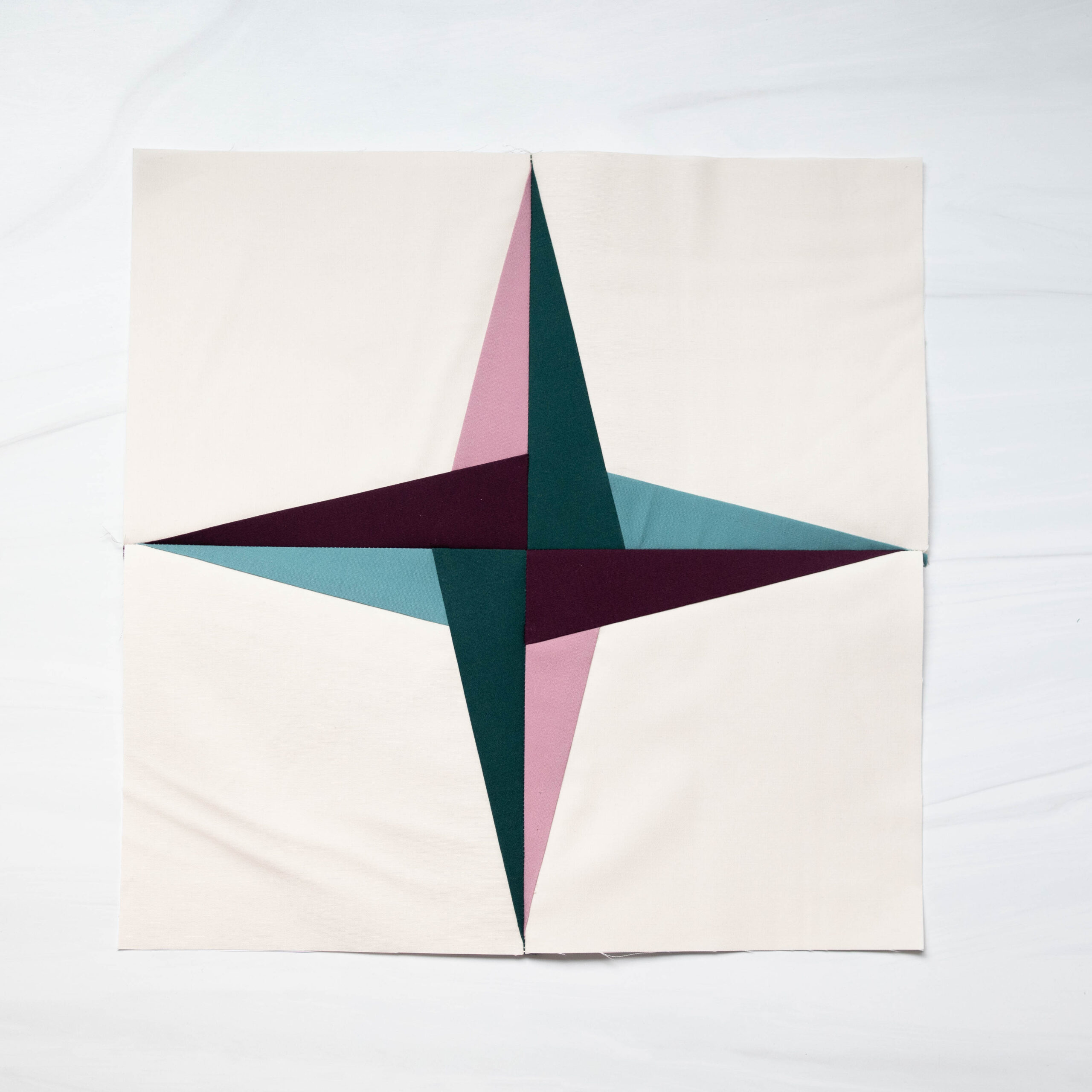
In the first four months of the Quilt Alliance’s Birthday Block of the Month celebration, we’ve had delightful quilt blocks that stretch our skills, and for month five we have something we haven’t seen before in this sew along — two classic quilt blocks coming together to create one new, almost three-dimensional shape! Created using a nine patch and flying geese, this block by popular designer Suzy Williams of Suzy Quilts is so eye-catching, you may want to make it more than once! It’s why this block was used in the introduction PDF for the BOM as an example of making one of our blocks into an entire quilt. And it’s easier than it looks! Let’s dive into some tips and tricks that will help increase your accuracy to get the perfect 3D illusion in your block.
Meet Suzy Suzy Williams is the founder of Suzy Quilts, a quilt pattern company and blog that is rooted in a deep love for the heritage and tradition of quilting and a desire to craft unique, contemporary textiles. Suzy uses her graphic design background to transform conventional sewing into a fresh, personal interpretation of minimal, modern design. Since its founding, Suzy Quilts has published over 60 quilt patterns and over 500 blog posts, growing an organic community of enthusiastic quilters along the way. Suzy is also a fabric designer with Art Gallery Fabrics. You can follow her on Instagram, join the popular Suzy Quilts Patterns Facebook group, and find all of Suzy’s patterns plus blog posts filled with free tutorials and sewing tips on her website.
Suzy’s Top BOM Tips Each month, our Birthday Block of the Month Designers will share their top tips for making the block they designed. Here are three great tips for making this block straight from Suzy herself. Suzy’s Tip 1: Learn from the best! If you’ve never made flying geese before, you may not know that there are multiple ways to create this simple block! In this month’s pattern, we use Suzy’s no-waste 4-at-a-time method. But you can visit her website and learn other ways to create the flying geese units (just be sure to adjust the cutting requirements accordingly). Suzy’s Tip 2: Use a Great Ruler Piecing accuracy isn’t just about your seam allowance. It’s also about cutting! Especially when trimming in the final step of creating the flying geese units, you want to be sure your ruler is a helper, not a hindrance. Check out this post from Suzy’s blog all about different types of quilting rulers to find one that’s right for you! Suzy’s Tip 3: Good Pressing Increases Accuracy Pressing may not be everyone’s favorite part of quilting, but without knowing and practicing great technique, your piecing accuracy can decrease. Accuracy is crucial to this block to create the 3D illusion, so be sure to read this post and watch the video tutorial about how to press seams in a quilt.
Quilt Alliance BOM Tips Each month, we share our best tips for making the Birthday Block of the Month as well. These tips come to you from our Birthday Block of the Month host, Quilt Alliance co-president, and Suzy Quilts team member, Laura Hopper — that’s me! You can read my blog posts on the Suzy Quilts website here. And keep reading for the tips I came up with as I was making a sample block from Suzy’s design!
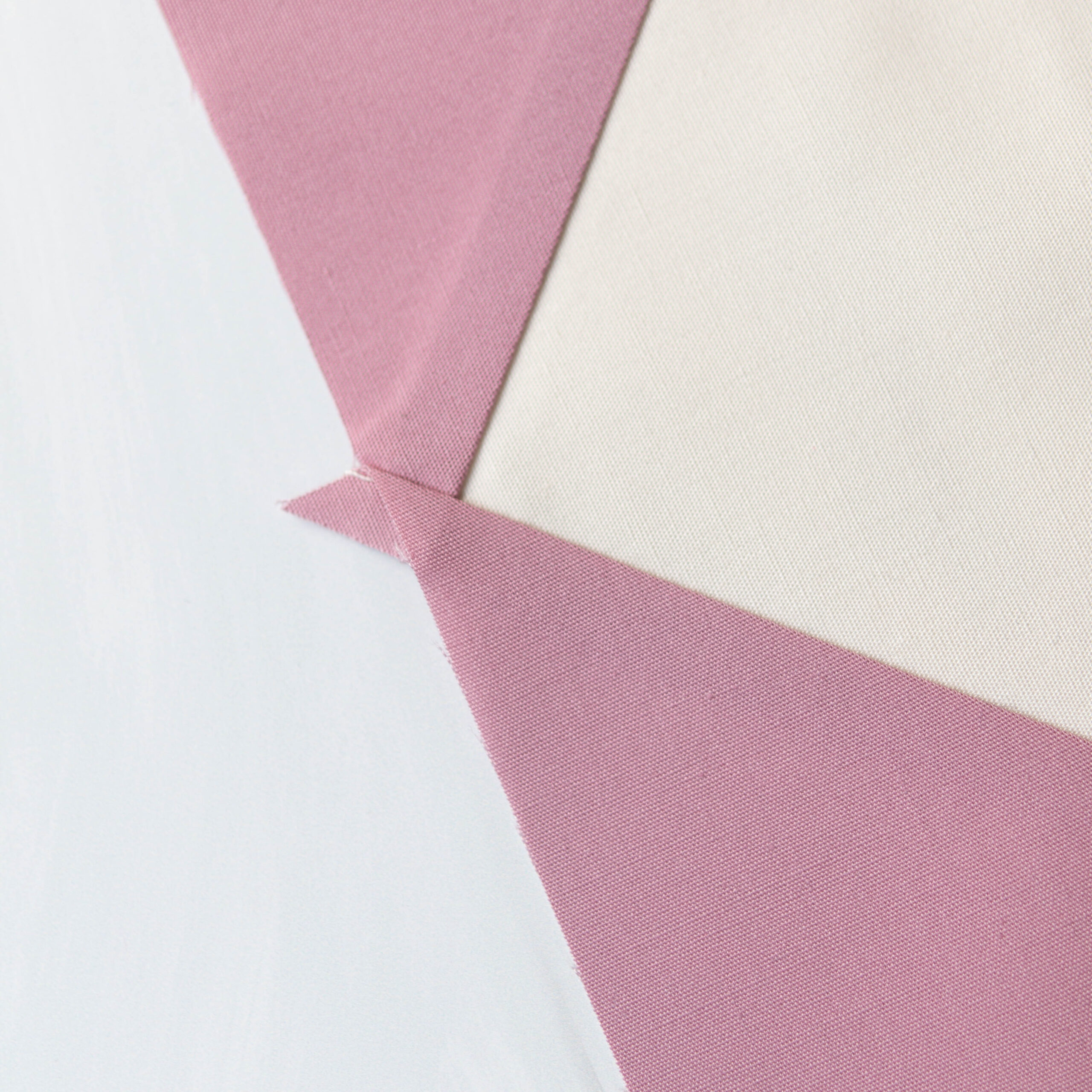
Know Where To Sew Step 7 for creating the flying geese units may be the most confusing part of this block pattern. You know, the one that looks like the picture here. But if you know where your seam should go, it’s much more clear! The picture above shows the two seams sewn on both sides of the guideline in Step 7. Do you notice how they both go to the open triangular spots between the pressed seam and the square you’re adding? Lining your seams up perfectly with those open points is the first tip for getting accurate flying geese.
Finger Pressing Improves Accuracy We’ve gone over finger pressing before during this BOM, but I can’t say enough good things about it. It really works! Pressing seams with your iron right off the bat decreases accuracy because you have less control of how the seam is moving and you also have less visibility to check that the seam is falling exactly where you’d like. With a block like no-waste flying geese, you need every single fiber possible to ensure that you have accurate points. Controlling that seam is a huge help! To finger press, start with the block right side up. Gently use your fingers to fold over the seam as you plan to press it, then gently press down with your fingers until you’re happy with the result. Give the seam a quick press with your iron to set it, then turn it over and press as you normally would (I highly recommend using steam and a tailor’s clapper to set seams on the back). When making no-waste flying geese, I finger press ever single seam before pressing with an iron. The picture above shows how accurate the flying geese points can be with finger pressing! If your points look less accurate than this, try finger pressing the next unit.
Know Where to Aim When Sewing Flying Geese When it’s time to assemble the block, you’ll need to sew the flying geese to other units. Make sure to aim for the intersection shown above! Do you see how the seam is stitched through the X shape created by the flying geese? If your seam runs exactly through that X, your flying geese points will be perfect. Check out the results below! Isn’t that a beautiful point? I just love sewing a seam and seeing this result. It’s so satisfying!
Quilt Documentation Tip Every quilter has a story to tell. What was your first quilt? When did you decide that quilting was your hobby of choice? How has your quilting journey evolved over the years? Or if you’re a brand new quilter, what are your goals? Suzy did a QSOS oral history for the Quilt Alliance where she shares her story. Watch the video while you’re working on this quilt and reflect on your own quilting journey and how you can record it. Have you considered writing your quilting story in a journal and then using that journal to track the other quilts you make? What a wonderful gift for future generations to find!
Block #4 – Sheri Cifaldi-Morrill
Birthday Block of the Month #4: Sheri Cifaldi-Morrill
Learning a new quilting skill can seem intimidating at first. But with a great teacher, you’ll feel supported and flourish! That’s where this month’s Quilt Alliance Birthday Block of the Month designer comes in. Sheri Cifaldi-Morrill, known for her growing and beloved pattern company Whole Circle Studio, is one of the most comprehensive and patient quilt teachers you can find — and that’s perfect for foundation paper piecing (FPP), which we’ll be doing this month! We’ve focused on piecing fabric together for all of our previous months. This month, we’re adding paper as a foundation to create an astonishingly accurate quilt block. But if you’ve never done FPP before, you’re in the right place. Sheri has been a Quilt Alliance supporter for years and she’s here to teach you everything you need to know to succeed!

Meet Sheri Sheri Cifaldi-Morrill of Whole Circle Studio is a designer who creates quilts that are both decorative and functional, blurring the divisions between art, design, and craft. After working in graphic design for over 20 years, she taught herself how to sew and discovered a passion for designing and making modern quilts. This exploration led her to pursue new opportunities and work with her hands to start her own studio business, specializing in the design of custom modern quilts, patterns, surface design illustration, and products. You can follow her on Instagram, find her patterns on her website, and be sure to sign up for her excellent newsletter! One of the Quilt Alliance’s signature projects is the Go Tell It video documentation project, which anyone can do. Watch the video below to see Sheri talk about her block, and keep reading this blog post to learn a tip for how to document your own quilts!
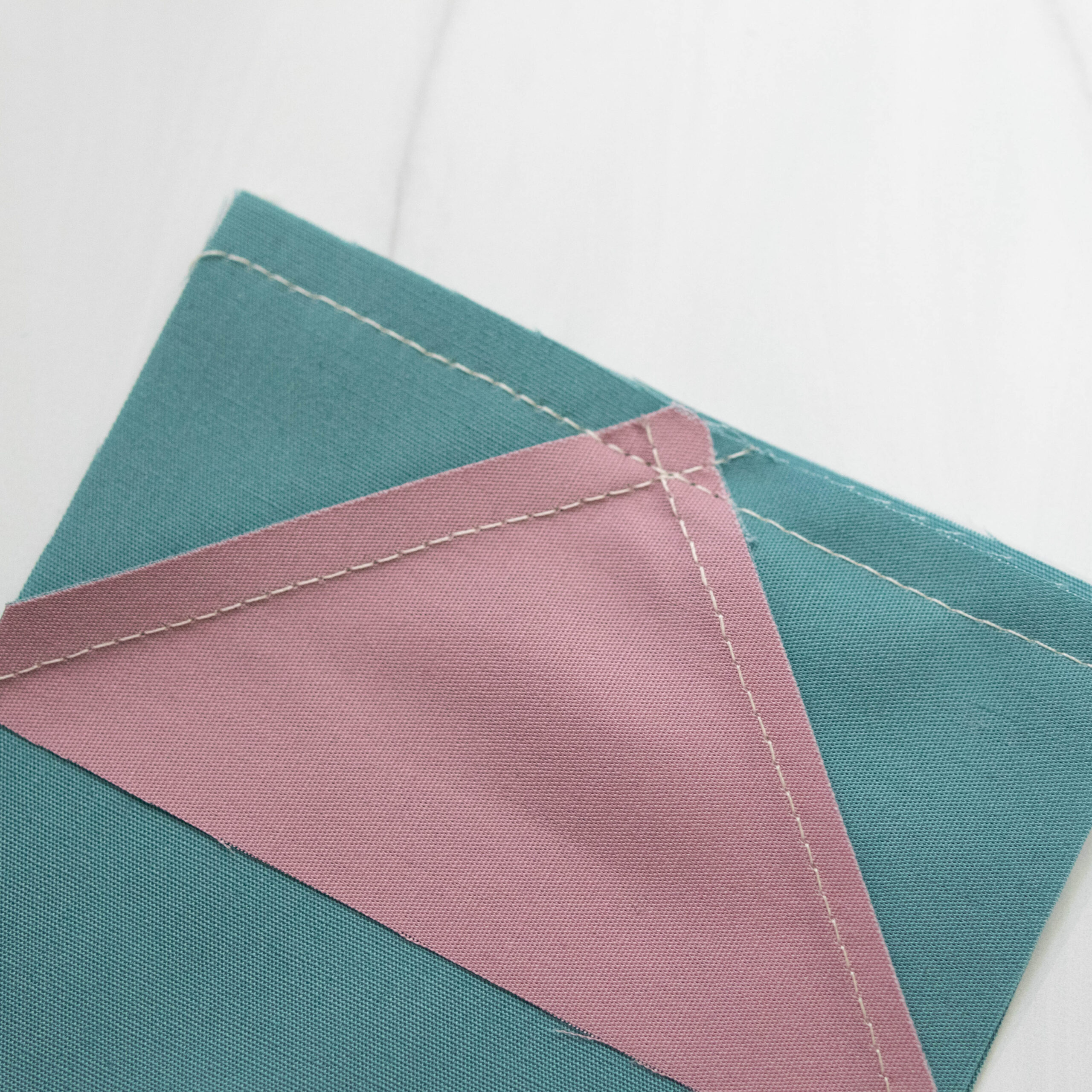
Sheri’s Top BOM Tips Each month, our Birthday Block of the Month Designers will share their top tips for making the block they designed. Here are three great tips for making this block straight from Sheri herself. Sheri’s Tip 1: Learn from the best! If you’re an FPP beginner or need a refresher on the technique, Sheri has an extensive 40-minute free class for foundation paper piecing on her website. I’d recommend everyone who does this block watches the class! While she isn’t making the same block as our Quilt Alliance Birthday Block of the Month, you will learn valuable tips even if you’ve done FPP before. The best thing about this video class is that you’re able to see each and every step of the FPP process on a fairly similar block to the one you’re making this month. Because you are basically sewing upside down with FPP, it can feel confusing at times. The process has never been more clear to me (Laura Hopper, BOM host) after viewing her video and seeing her walk through making 1 FPP template! I’ve done my fair share of foundation paper piecing in the past, but I still decided to watch Sheri’s full video before making my test block. I learned so much and my block turned out better because of it! You’ll see this video referenced in this month’s PDF download as well because it is invaluable to the process of making this month’s block — or making any other FPP blocks in the future! Sheri’s Tip 2: Shorter is Better When foundation paper piecing, reduce your stitch length to 1.5. This shortened stitch length will make it easier to remove paper at the end. It also helps your seams stay strong while the paper is being pulled out. Sheri’s Tip 3: Don’t Be Afraid of your Seam Ripper Have your seam ripper handy and be prepared to use it! Even the most experienced paper piecers will need one at times — including me! One of the things that can be hard to get used to with foundation paper piecing is making sure that your fabric doesn’t move once it’s under the paper you are using as a foundation. As you can see in the picture here, my fabric slipped as I was sewing the mauve fabric to the neutral fabric. Here’s a closer look: Whoops! You can see that things started out well and part of the seam is on the mauve fabric. But as I sewed on, the fabric slipped off of the seam I was sewing. No problem — seam ripper to the rescue! I redid this seam and it looked perfect in the end.
Quilt Alliance BOM Tips Each month, we share our best tips for making the Birthday Block of the Month as well, and this one is funny because our best tip is the same as Sheri’s first tip — make sure to watch her video tutorial on foundation paper piecing! But don’t worry, we have even more tips to help you along the way. Our tips this month are entirely about the neat tools that can help make foundation paper piecing easier!
Extra Tools Aren’t Required — But They Help! If you don’t want to invest in extra tools for this block because you don’t know if you’ll enjoy foundation paper piecing yet, that’s completely understandable! You can make foundation paper piecing work with tools you already have. However, it is a very specific technique that is made easier with the help of a few affordable notions. Here are some that I enjoy. Add-A-Quarter ruler: This ruler has a raised line along one long edge that measures exactly one quarter inch. It is designed to bump up again the edge of a folded piece of paper as you’re making a foundation paper piecing block. It allows you to know that you’re trimming your fabric to an accurate quarter inch. Seam roller: You can press your fabric as you’re working on your block, but if you’d rather not go back and forth to your iron so much, a seam roller will be your best friend. I use mine so much that I splurged on a very nice on from Modern American Vintage. Fabric glue pen: This is a helpful way to secure the first piece of fabric for a foundation paper pieced block to the paper, as Sheri demonstrates in her video. My personal favorite is made by Bohin. Tweezers: Removing paper at the end of creating an FPP block is so satisfying! What a wonderful way to celebrate being finished with a block. However, sometimes tiny bits of the paper can get stuck in the seams. Tweezers can help remove these papers — just be sure not to accidentally pull out any stitches. Tracing wheel: Pulling the paper out at the end of making a foundation paper pieced block can be challenging. Reducing your stitch length is the biggest help, but I also like going over all of the lines on the paper for an FPP block with a tracking wheel which makes little perforations in the paper. This not only makes it a little easier to rip the paper out, but it also makes it very easy to fold the paper while making the block! Note: This will leave little marks on your cutting mat, so use an old one or the back of yours. Check out what that looks like below!
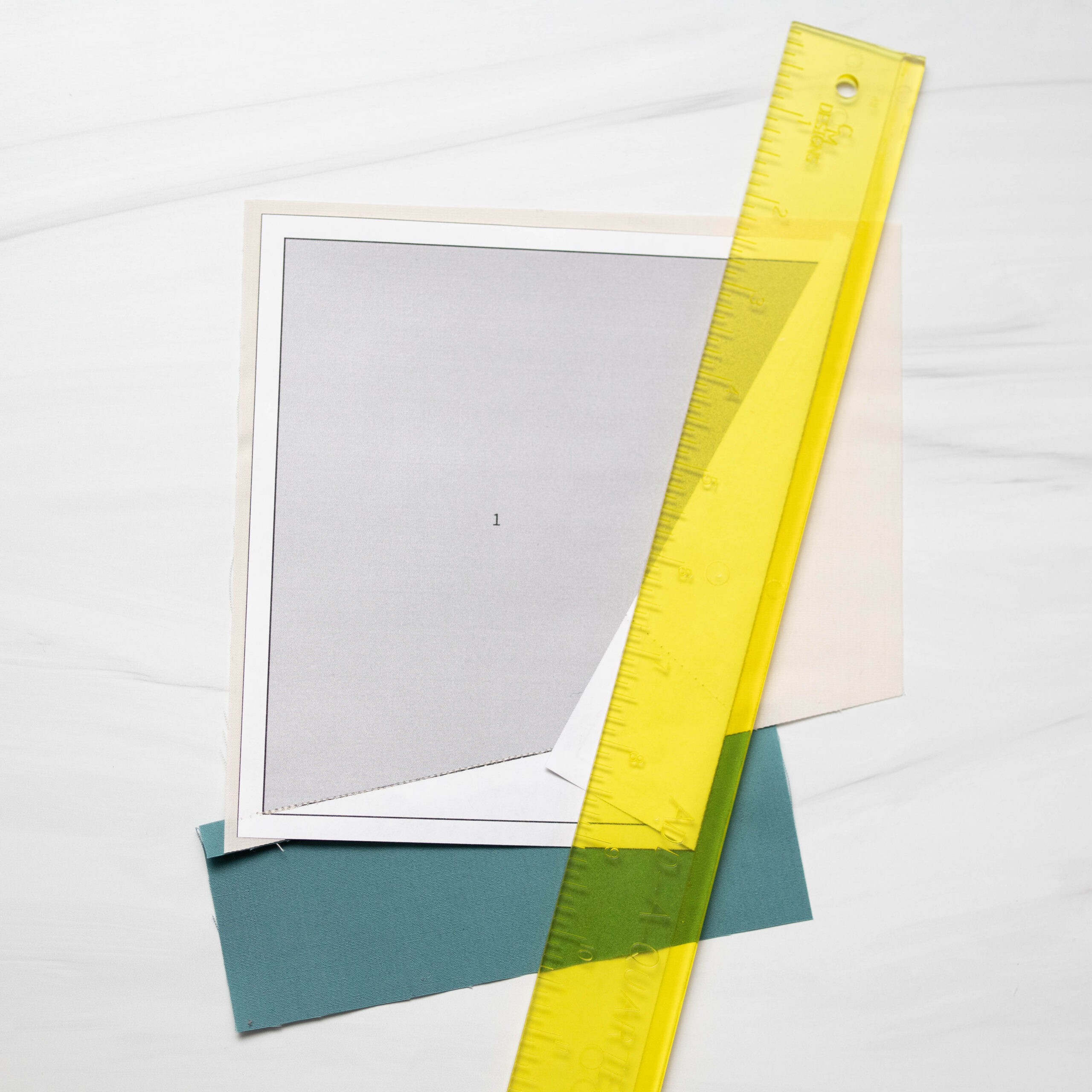
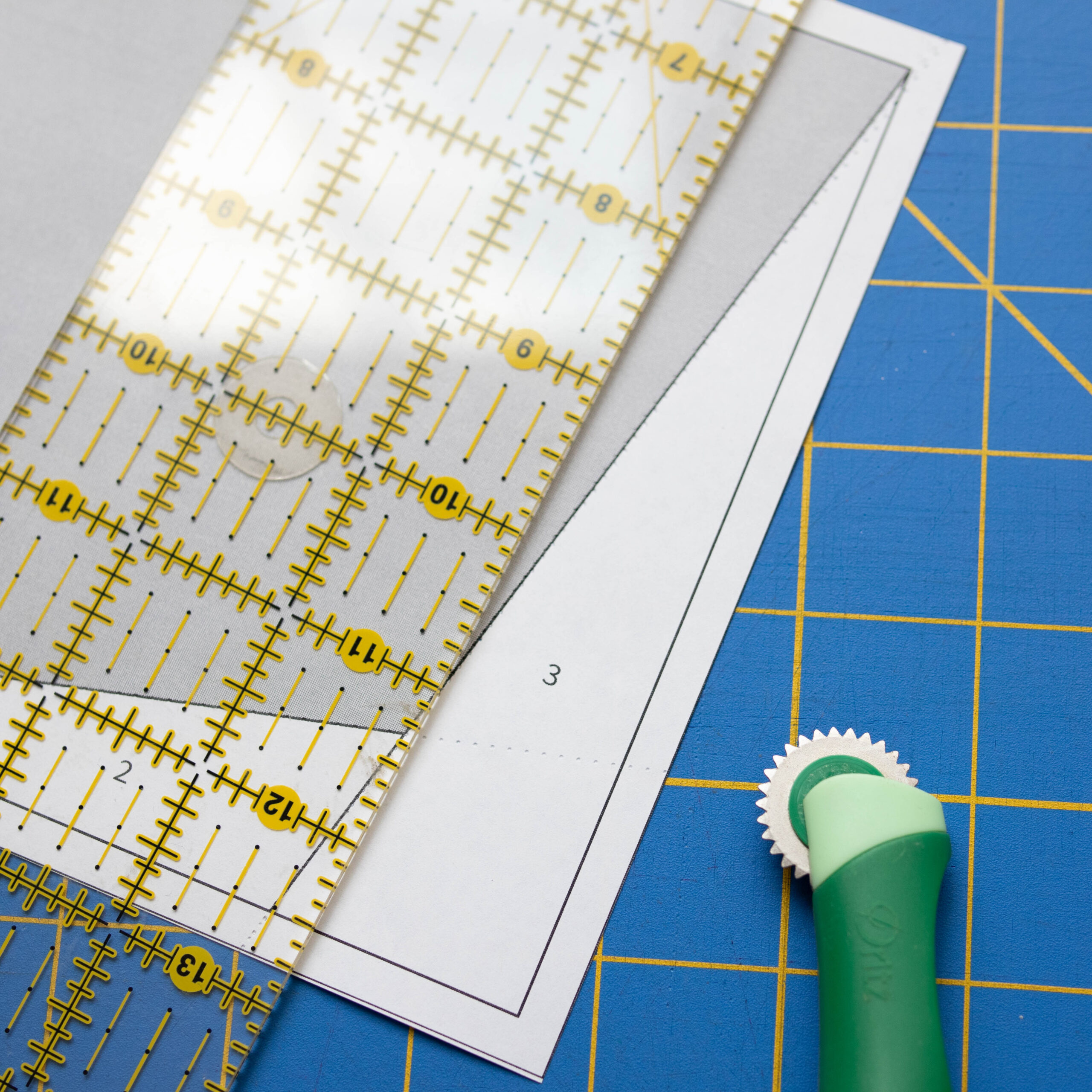
And here’s the Add-A-Quarter ruler giving me that perfect quarter inch. You can see the ridge on the right hand side and how it lines up with the folded edge of the paper. Now all I have to do is trim the fabric to the right of the ruler! Easy breezy! As we mentioned, it’s absolutely ok to skip the extra tools. Instead of an Add-A-Quarter, you can use a regular acrylic ruler. Instead of a new seam roller, try your iron out. Instead of a glue pen, try using a pin to hold fabric in place. And instead of a tracing wheel, try pre-folding the paper. That’s absolutely ok! But these tools which may be new to you will take you far if you enjoy foundation paper piecing.
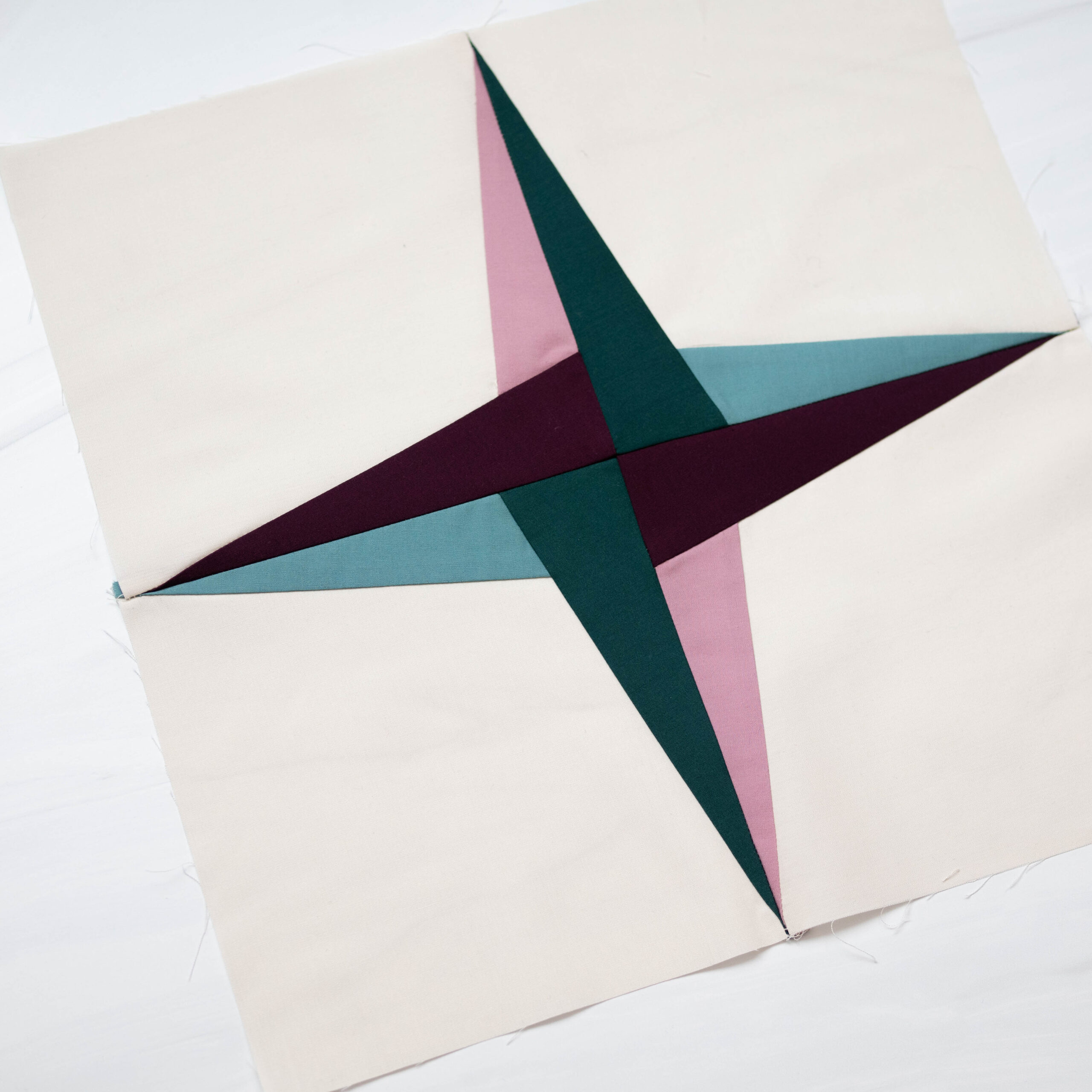
Quilt Documentation Tip Have you ever tried a new technique? It can be a little scary at first — what if it doesn’t work or doesn’t make sense? What if it doesn’t look just like the designer’s picture? Ack! One thing that might help you work through the anxieties of learning something new, while also documenting your process and personal quilting experiences, is to journal or write about your quilts. Check out the Quilt Alliance’s Textile Talk that focuses on writing about quilts! And don’t miss the announcement for our upcoming virtual Quilters Take a Moment event…there may be a workshop you’ll enjoy!
Block #3 – Pat Sloan
Birthday Block of the Month #3: Pat Sloan
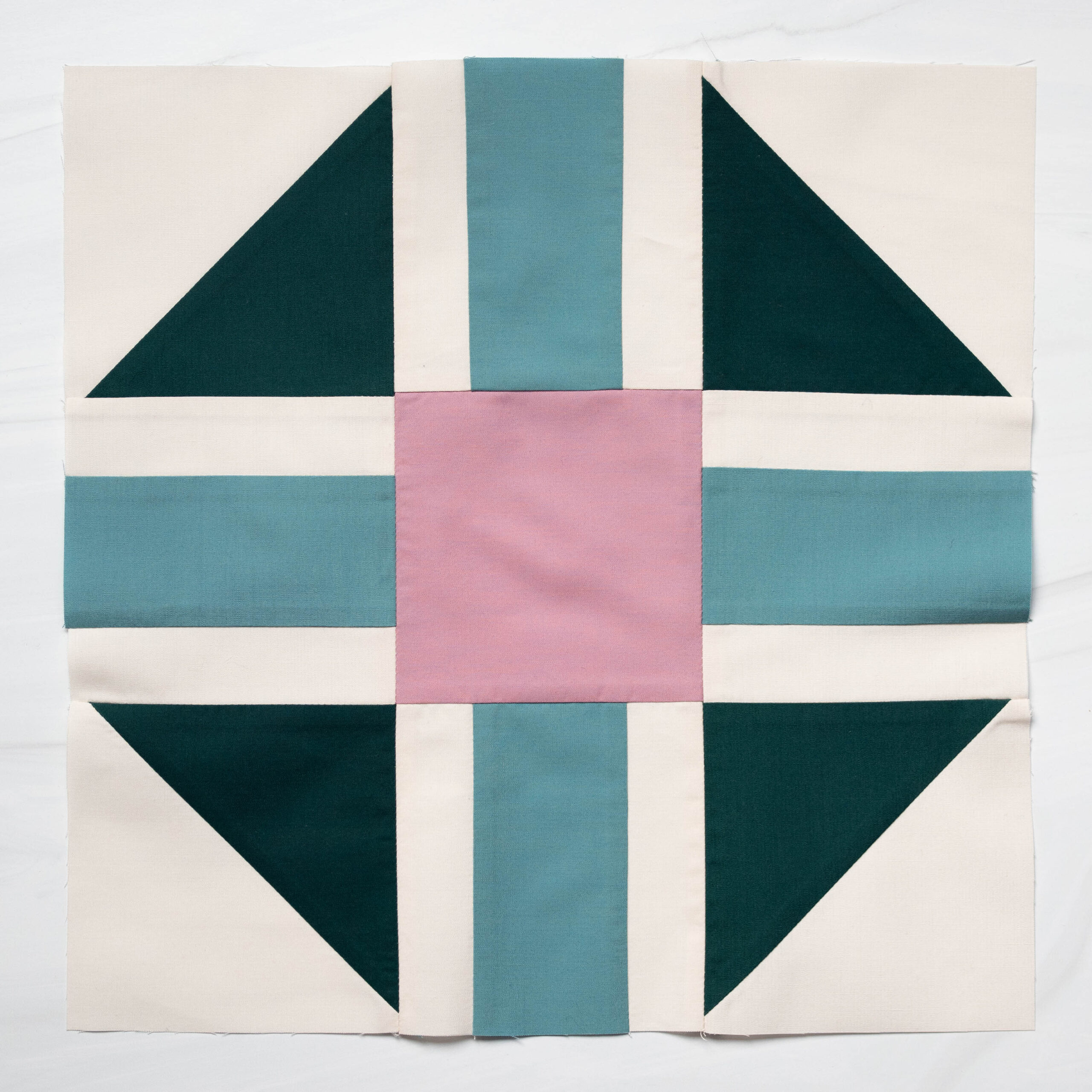
Are you ready to have some fun with this month’s Quilt Alliance Birthday Block of the Month? Our designer of the month, Pat Sloan, knew you needed a smile, so she designed this block she calls “A Dash of Fun,” inspired by the classic Churn Dash block. The Quilt Alliance is an organization that celebrates all quilters. And what better way to demonstrate that than by going from last month’s improvisational block designed by Zak Foster to this month’s block from Pat Sloan which is rooted in quilt history?

Meet Pat Sloan Known as “The Voice of Quilting,” Pat Sloan is a quilt designer, author, fabric designer, and popular podcast host. Her passion is hosting sew alongs and YouTube videos. For 10 years, Pat produced and hosted a podcast for American Patchwork & Quilting Magazine. She’s also the host of Aurifil’s Designer of the Month program and has published patterns independently and through magazines including McCall’s Quilting, Quilters World, and Quilting Arts. With her daily YouTube videos and large internet community, join Pat to be inspired to make quilts that you love! You can follow Pat on her website, Facebook, or popular YouTube channel. One of the Quilt Alliance’s signature projects is the Go Tell It video documentation project which anyone can do. Watch the video below to see Pat talk about her block, and keep reading this blog post to learn a tip for how to document your own quilts!
Pat’s Top BOM Tips Each month, our Birthday Block of the Month Designers will share their top tips for making the block they designed. Here are three great tips for making this block straight from Pat herself. Pat’s Tip 1: Try a Specialty Ruler When making half square triangles 2 at a time I love using the Quilt In a Day Triangle Square Up Ruler, it makes them so easy and ‘fun’ to do! Pat’s Tip 2: Follow Your Own Creativity This month’s pattern uses the same color for the stripe unit, but you can also let your creativity run wild! Audition a few color combinations for the center stripe in the unit. Pat’s Tip 3: Highlight a Fun Print Try fussy-cutting the center block to showcase a favorite print.
Quilt Alliance BOM Tips I had so much fun making this block, and I know you will too! Pat designed a block that is not just fun, but it’s also fast and easy enough for even a first-time quilter to make. Trust me when I say that you’ll be done with this block before you can say Churn Dash! But if you want a little extra help, keep reading for tips that will help your block go smoothly.
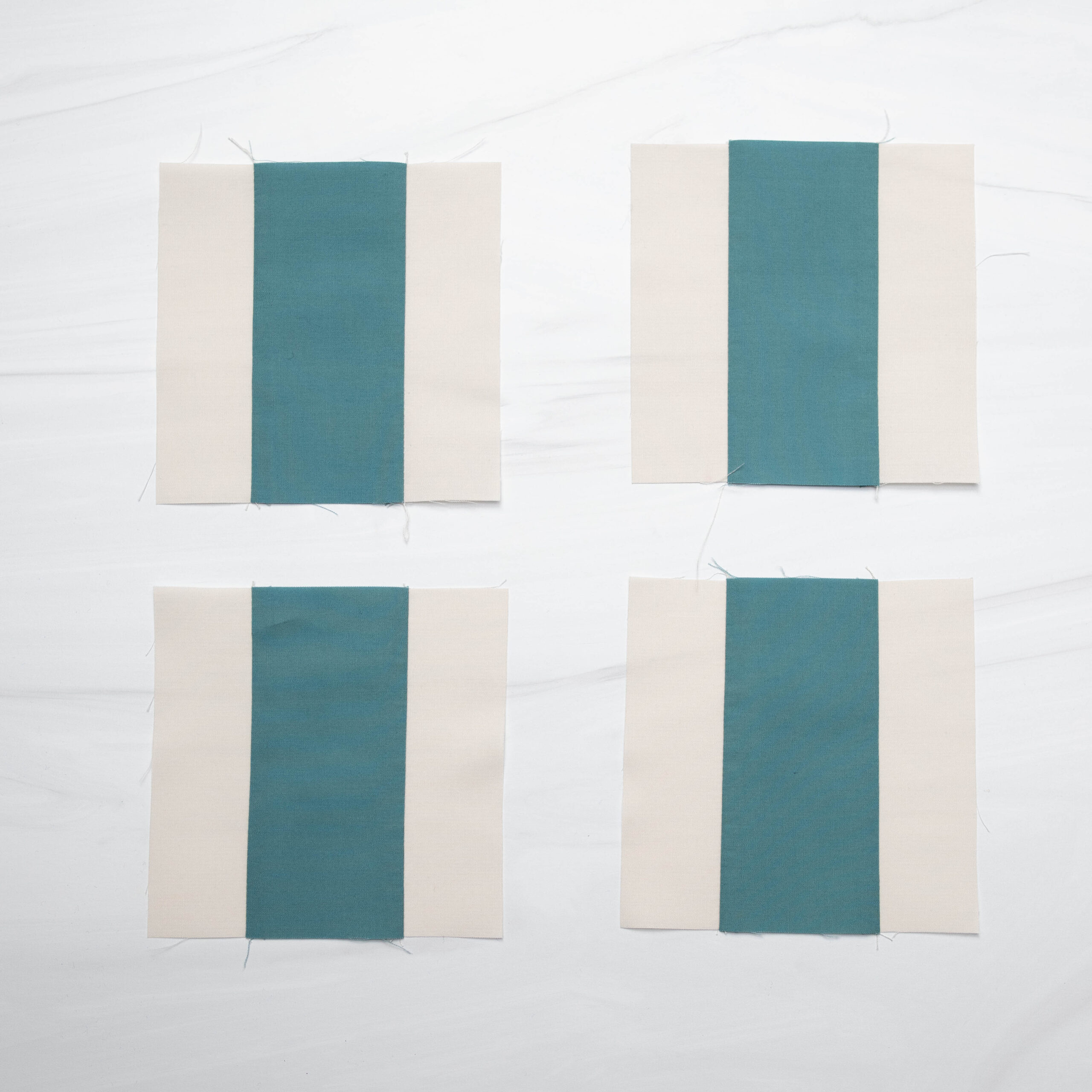
Experiment With Fabric Selection You’ll notice in the PDF pattern for this month that it’s the first time we are not using all five fabrics for the block. That will happen again in future blocks and we worked very hard to make sure that the quilt as a whole looked visually balanced between blocks that use each color and blocks that leave out one color. However, we also love to see your creativity shine! Instead of using the same color for all four stripe units, try using two or even four colors! Instead of using the same color for the HSTs, cut two different colorful fabrics so that you have two different colors. And as Pat suggests, try fussy cutting the center square to highlight a fabric you love!
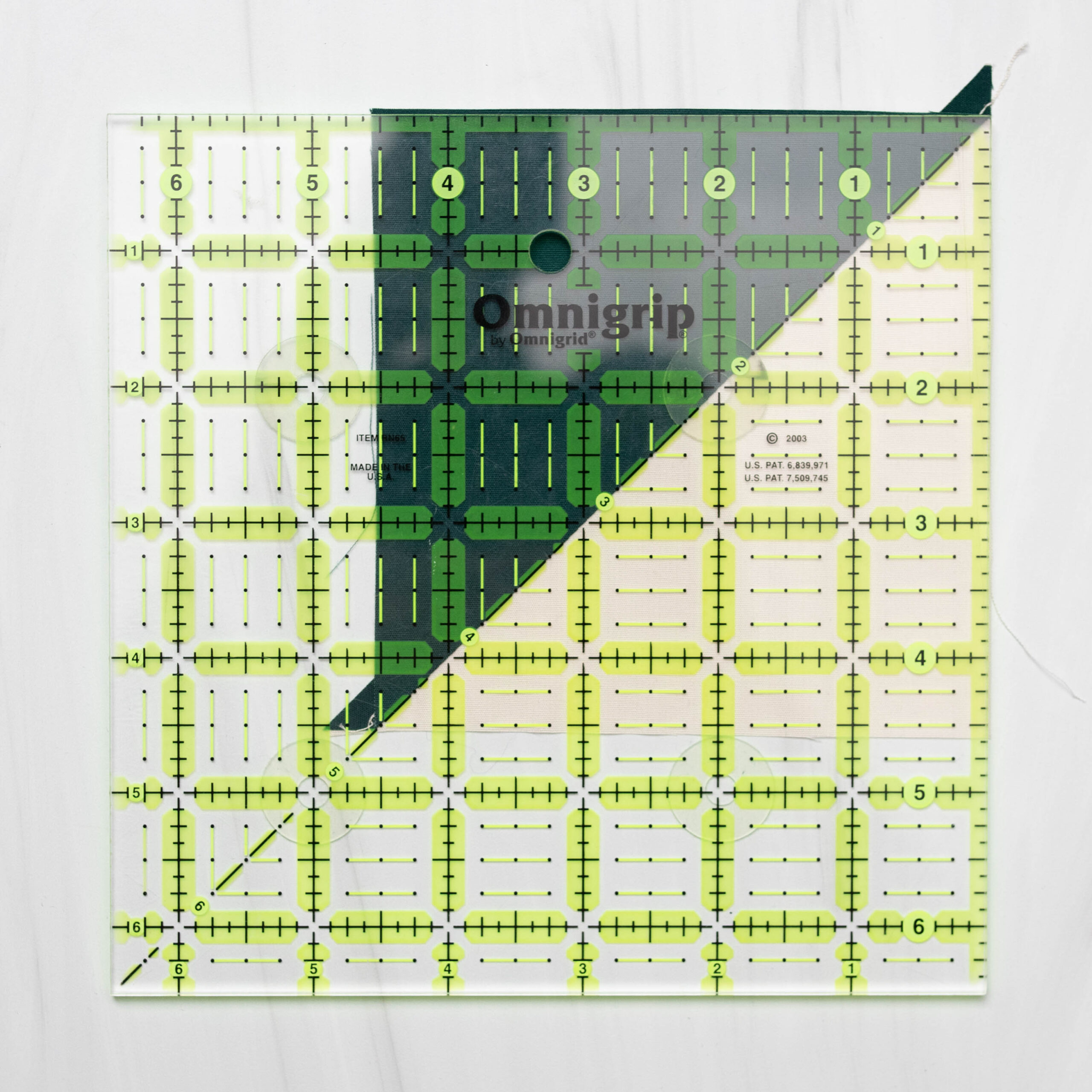
Finger Press the Half Square Triangles The picture above shows the final step of making the half square triangles (HSTs) in this block, which is trimming them down to size. As you can see, you’ll have very little extra fabric when trimming. In order to make sure the HSTs finish at the correct size, try finger pressing the seam before pressing with an iron. Finger pressing will help ensure that you aren’t losing valuable fabric in the diagonal seam of the HST. When pressing with your fingers, you’ll be able to feel if that seam is too bulky, and you can help gently work that out before setting the seam with your iron.
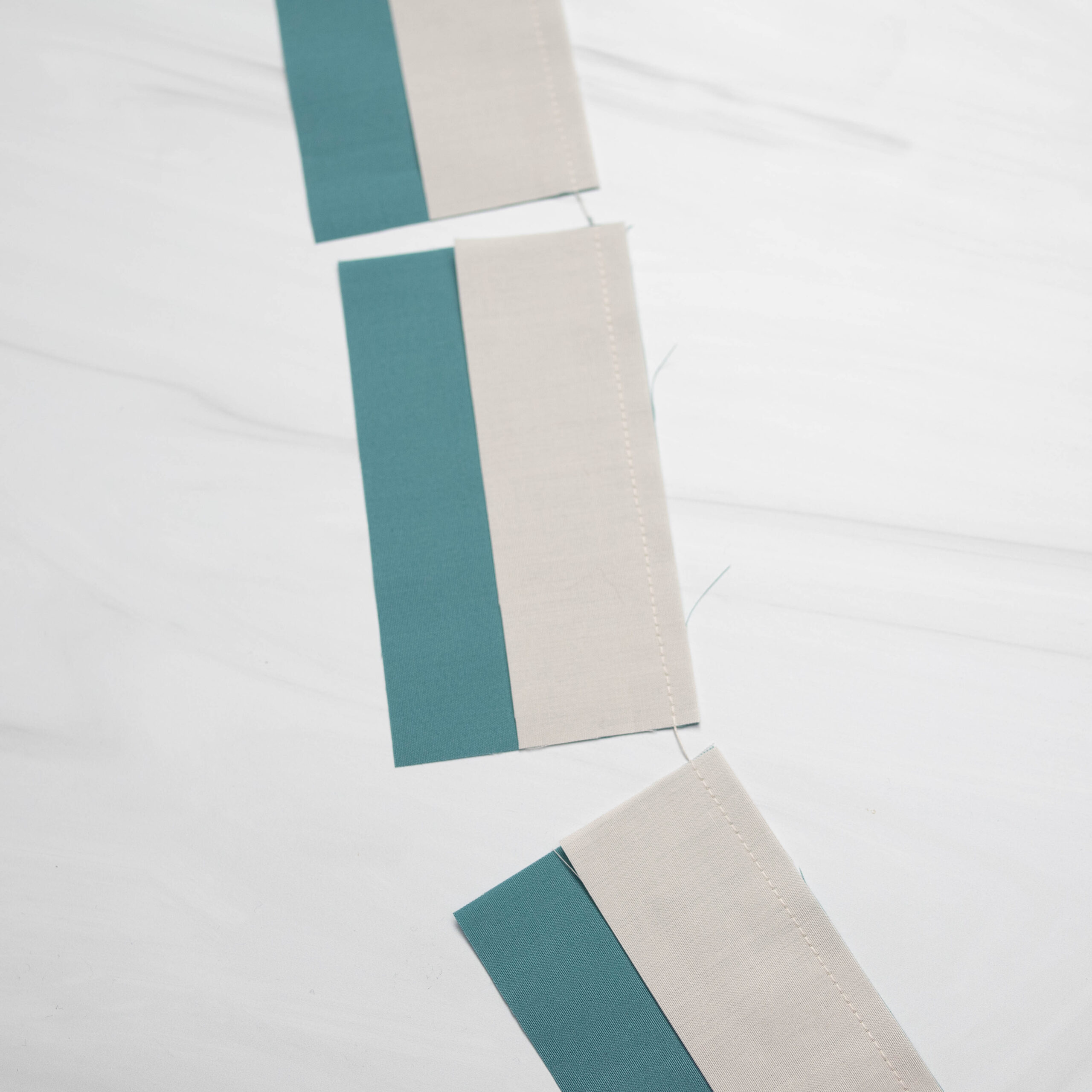
Chain Piece the Stripe Units You’ll save time and have even more fun making this block if you chain piece the stripe units! If you’ve never chain pieced before, click here for a video tutorial.
Quilt Documentation Tip Pat Sloan’s “A Dash of Fun” block is inspired by a traditional Churn Dash block. Have you ever made a quilt inspired by quilt history? Have you tried modifying a quilt block to create something new? If so, consider adding that information to your quilt label! If you keep a quilt journal or photo album, you could even include a picture of the traditional quilt block that inspired your work. For more information about what to add to a quilt label, check out the Quilt Alliance’s guide to making a simple quilt label here!
Community Quilt Days: Place, Culture, Stories and Quilts!
Community Quilt Days: Place, Culture, Stories and Quilts!
Quilt Alliance staff are hitting the road again today with camera equipment, quilt stands, a coffee urn, a fresh batch of Deb Josephs’ tasty homemade cookies and a cue card that reads: “Hi, my name is ____ and I’m telling my quilt story at the McKinney Center in Jonesborough, Tennessee and today is Saturday, May 13, 2023.” Jonesborough is Tennessee’s oldest town, and home to the International Storytelling Festival. You’ll find Tennessee Quilts, a shop and retreat center co-owned by Linda Crouch-McCreadie in the historic downtown. Linda and fellow Tennessean, quilt historian and longtime Quilt Alliance board member, Merikay Waldvogel, were featured last Saturday on the first day of our Community Quilt Days event in Jonesborough. Linda (pictured top right with her first quilt) was interviewed for the QSOS oral history project, and Merikay (pictured bottom right) gave a fascinating lecture on Tennessee quilts. She told the story of Margaret Hays, a Jonesborough woman who designed quilt patterns for Mountain Mist batting in the late 1920’s and early ‘30’s. Rebecca Proffitt, director of the nearby Reece Museum at Eastern Tennessee State University, brought an example of one of Hays’ designs along with another contemporary quilt in the Reece collection by artist Marge Gregg, made in the 1960’s and 2010’s. We’ll resume the quilt sharing and documentation activities today at the beautiful McKinney Center, a renovated 1940 school that was once the grade-school for Black students in Jonesborough until integration in 1964.
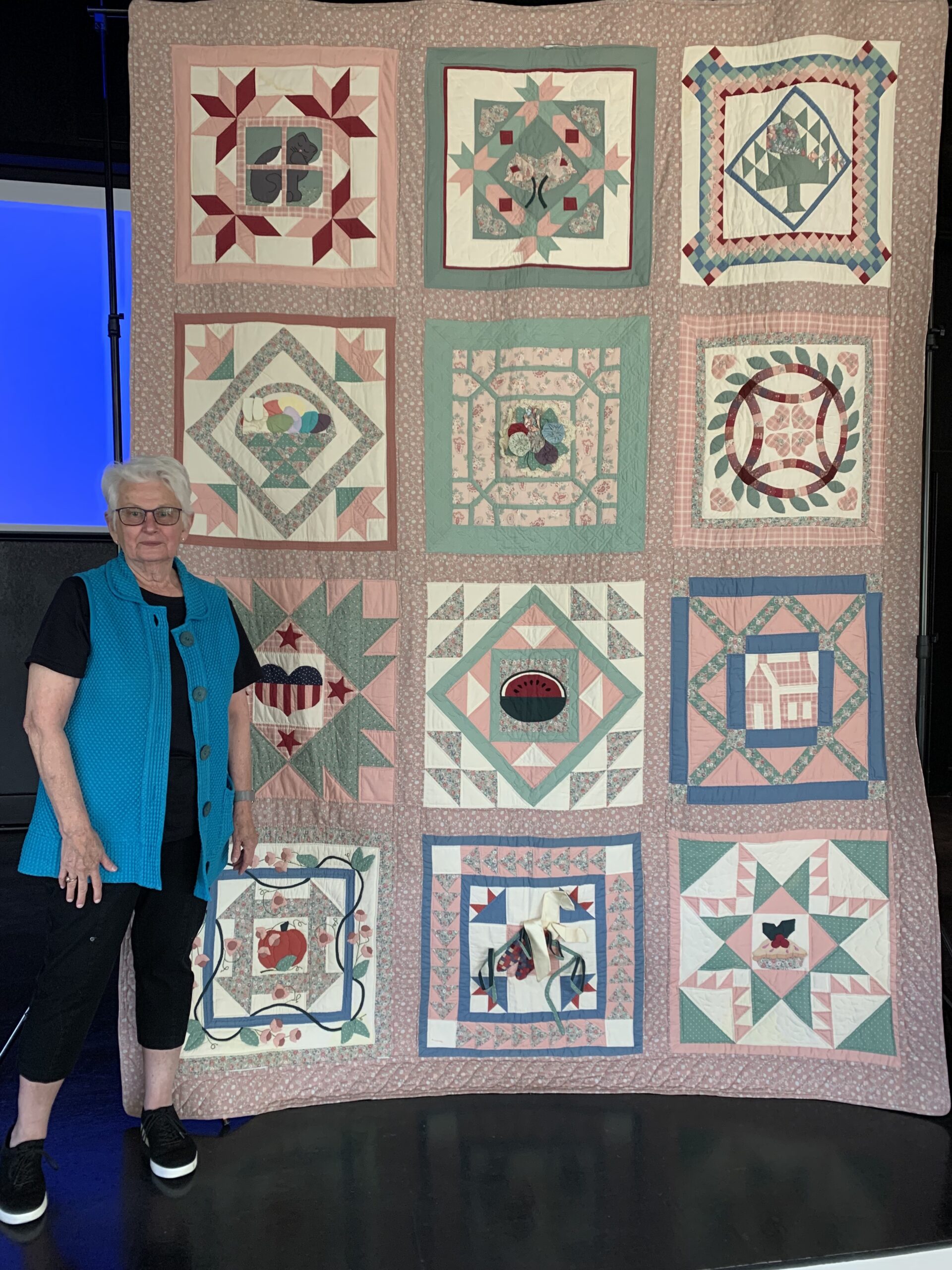
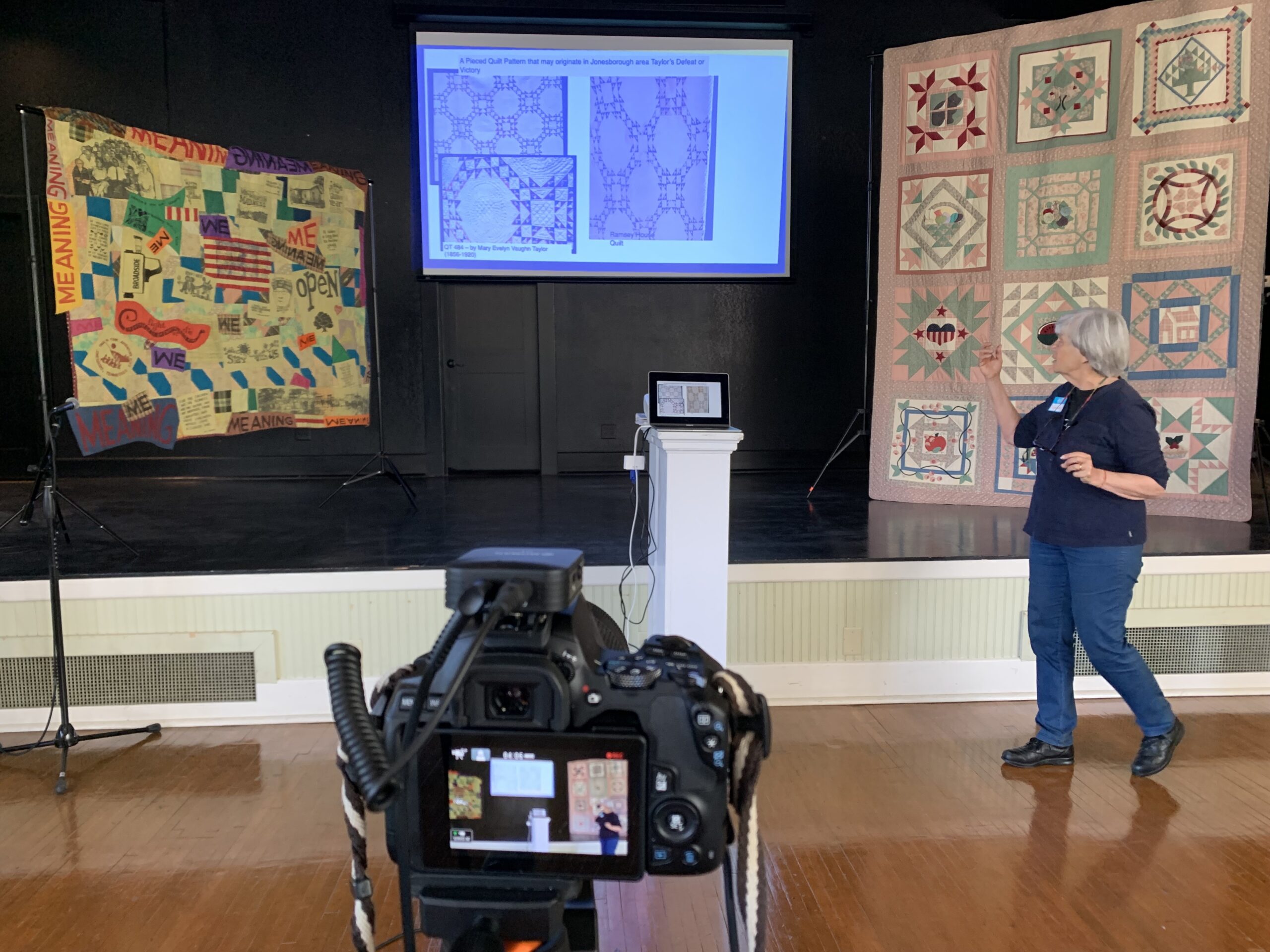
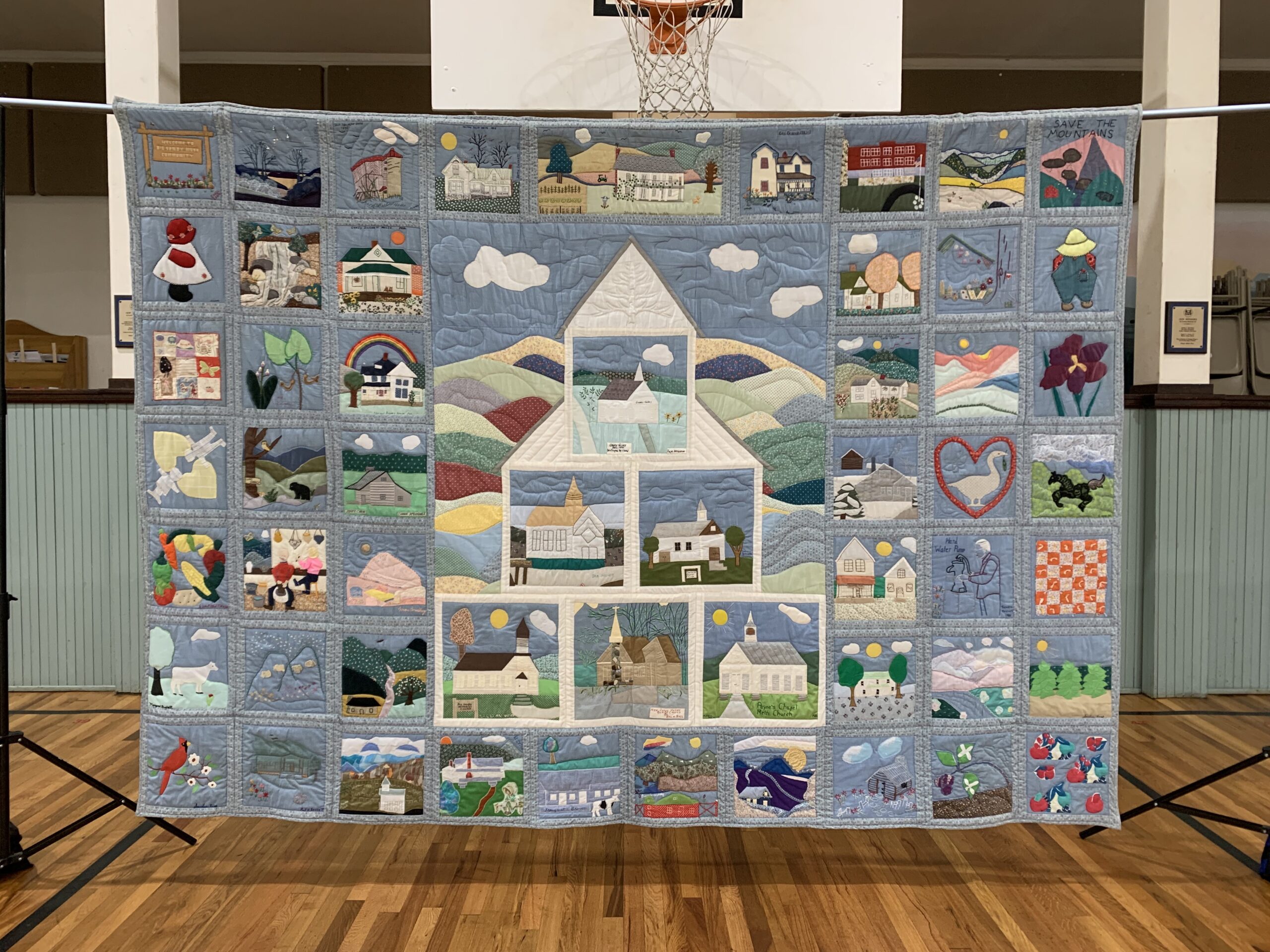
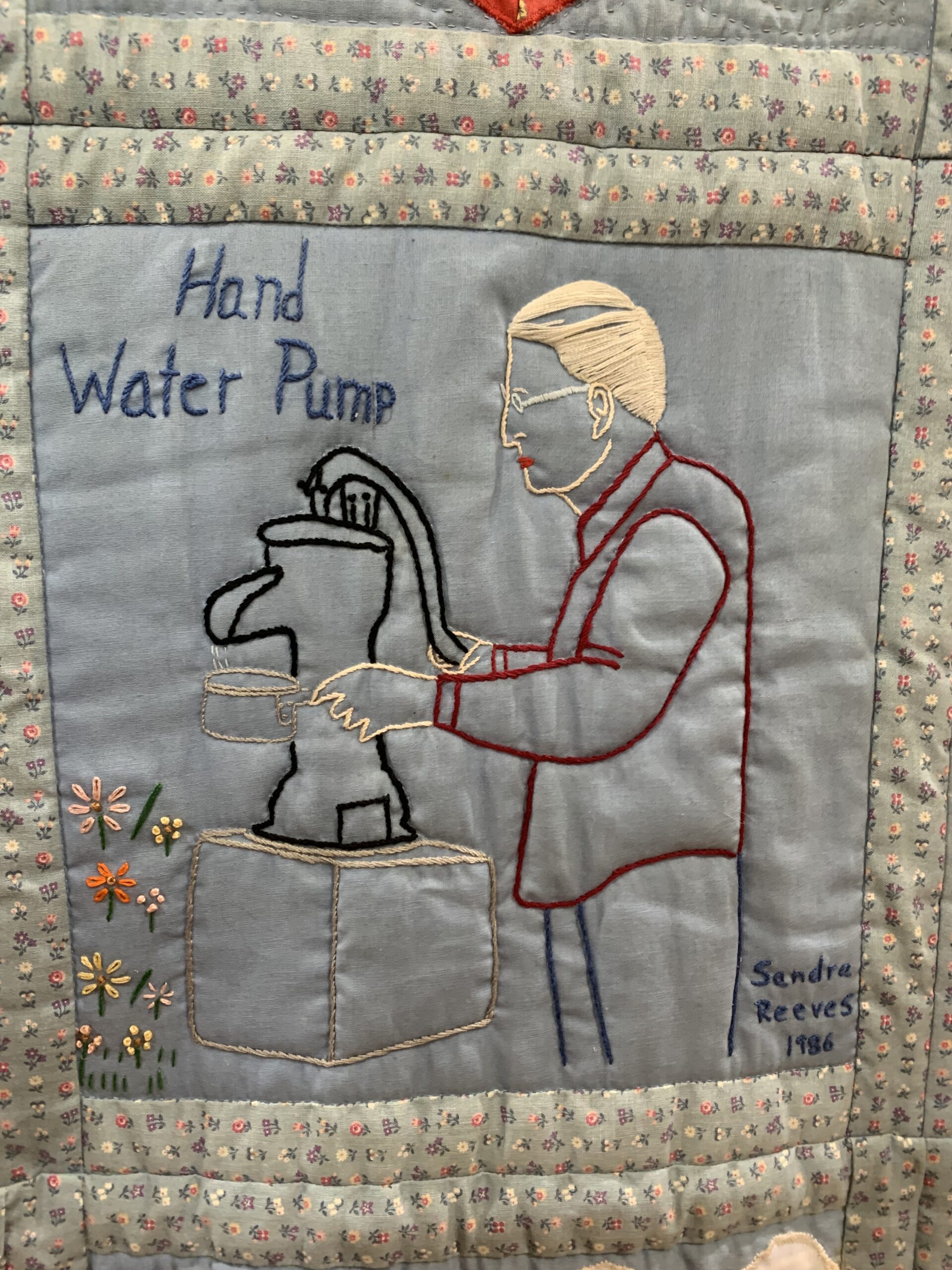
Another renovated school, the Sandy Mush Community Center, served as our event site on April 23 and 30 when we documented quilts, quilters and community history in Leicester, North Carolina, a hilly Appalachian farm community about 18 miles northwest of Asheville. One of the 30 quilts documented was a special collaborative quilt titled “A Celebration of Sandy Mush.” It was made in 1986 by over 40 women in the community determined to show developers planning to build a high-level nuclear waste site in Sandy Mush just how special and beloved their community was. The community’s unprecedented opposition to the dump site caused developers to cancel their plans later that year. The group quilt and other quilts made by Sandy Mush residents hang along the perimeter of the community center’s gymnatorium space. Artist Norma Bradley, a former Sandy Mush resident, and artist and quilt appraiser Connie Brown, played important roles in planning the presentation for this site. Norma and other makers of the collaborative quilt were invited to tell the story of their block and the experience of making the quilt to protect Sandy Mush. One of the makers came with her son and together they shared quilts made by four generations of family members.