by Amy Milne | Jan 30, 2019
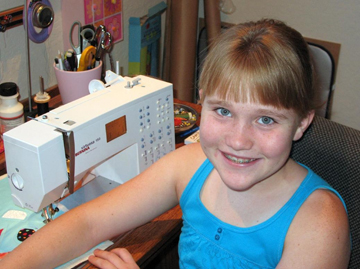
Karen Musgrave (KM): This is Karen Musgrave and I’m conducting a Quilters’ S.O.S. – Save Our Stories interview with Kelly Anderson. Kelly is in Phoenix, Arizona, and I’m in Naperville, Illinois, so we’re conducting this interview over the telephone. Today’s date is December 14, 2009, and it is now 5:31 in the evening. Kelly thank you so much for taking time out of your day to talk to me. Kelly Anderson (KA): You’re welcome. KM: Please tell me about your quilt “My Ladybug.” KA: It was a quilt [clears throat.] that I had made in about October. I used the iron on stuff and so then I ironed the patterns onto my quilt and then I just stitched around it to make it look nice. I dedicated the quilt to my Papa Lyn who had Alzheimer’s. It was in an auction just recently and it was sold for $100.00 and so I’m really proud of it. KM: This is 8½ [inches.] by 11 [inches.]. KA: Yep. KM: Is that the size you like to make? KA: Yeah, it is. It is nice and easy to make. It’s not like really big and difficult to handle. It’s just a really nice size. Yeah. KM: I guess we should ask you how old are you. KA: I’m 11 and my birthday is in October. KM: So you’re just 11, and you’re in 5th grade, is that right? KA: Yep. KM: You dedicated this quilt to your grandfather. [KA agrees.] And you donated it to the Alzheimer Art Quilt Initiative. KA: Yep. KM: Is this the first time you’ve done this? KA: Yes, it is. KM: How did you learn about the Alzheimer’s Art Quilt Initiative? KA: My grandma [Joanne Cunningham.] and my mom [Charlene “Dolly” Anderson.] had been making quilts for it for a while and I just liked how pretty the quilts were so I wanted to try to make one. KM: Very nice. Do you know who won the quilt? KA: No, I don’t. It was a person named Gram, but it wasn’t any of my grandmothers so I don’t know. [note: Gram gave the quilt back to Kelly.] KM: I hope that they love it as much as you did. KA: Yeah. KM: Tell me about your interest in quiltmaking. KA: I think it’s fun, I think it’s a way you can make express how you’re feeling [clears throat.] and you can like show it off to friends and family. I like putting beads on my quilts. I also like looking at other people’s quilts because I think they are just so beautiful sometimes. KM: At what age did you start making quilts? KA: I’ve been making quilts for quite a while. Well when I was younger I used to make them with just the iron on– [pause.] KM: Fusible. KA: Stuff and so those are like some of my first quilts. KM: Who taught you how to quilt? KA: My mom and then also my grandma. My grandma and I used to make dolls together and I have quite a few of them now. KM: How many hours a week do you quilt? KA: Not many because I’m so busy with school but if I can, I usually try for an hour or so. KM: How many quilts do you think you’ve made? KA: Probably around six or seven, maybe around there, maybe more. KM: What is your biggest one? KA: My biggest one was probably the ladybug quilt. KM: So 8 ½ [inches.] by 11 [inches.]? KA: Yeah. KM: You like little ones. Do you like to give them as presents? KA: Ah ha, yes, I made one quilt for my sister as a Christmas present just last year with my grandma, because every year my grandma and I get together and we make Christmas presents for each family member. KM: What did your sister’s quilt look like? KA: It was multiple colors. The main color was black and there were little colorful squares on it and the binding was red and there were star buttons all over it. KM: What is your first quilt memory? KA: My first quilt was making this one, it was probably around the time that my sister was born and it said, I wrote on it with fabric markers, I put “I Love Babies” on it and I put a big heart and these fairies on it. KM: How old is your sister? KA: My sister is now 5½ [years.]. KM: Has she made a quilt? KA: She has made some with the iron on stuff. KM: What does your family think of your quiltmaking? KA: They are really proud of me and they really like it. They think it’s really creative. KM: What do your friends think of your quiltmaking? KA: They like it. I sometimes will bring my quilts to school and after school gets out I’ll show them my quilts and they all love them. KM: What have they said about your quilt being auctioned? KA: They were like really impressed. I told them just a few days ago [clears throat.] and they were all like really, really impressed. They were like, ‘Wow, you did a really great job.’ KM: What do you find most pleasing about making quilts? KA: I like making them for family members and just having the feeling that they’re done and looking at them and seeing my mistakes and also the great things about them. KM: Is there any aspects of quiltmaking you don’t like? KA: Well, sometimes I don’t like how long it takes because sometimes you’ll get this great picture and sometimes it will just take quite a while, but then when its done its always really great. KM: Do you machine quilt your quilts? KA: Yes, I do. Well, I use my mom’s quilting machine and so yeah. KM: Do you like machine quilting? KA: Yeah, I do. I like using the different stitches that they have. Like sometimes I’ll just use a piece of fabric and just go into a room and quilt on it with all the different stitches that it can do for fun. KM: What is your favorite technique? KA: I like ironing on my patterns and then sewing around them because it’s easier to make, to press down and then just stitch around it. KM: Do you satin stitch around them? KA: Yeah, I do. KM: What are your favorite materials? KA: I like using all different kinds sort of and they are all just really nice. KM: What advice would you offer somebody starting out? KA: Well, I’d tell them to make a smaller quilt, to start up small and then to work their way bigger and just to be patient with it and to just be confident that you’ll be able to finish it, but that it will take a while sometimes. KM: Do you draw out your quilts before you do them? Do you sketch or anything? KA: Yes, I do. I’ll take a piece of paper and I’ll usually like sketch them and I’ll try to get them as accurate as I can on the size and then I just cut out my fabric and sew it. KM: Can you describe the place that you sew? Could you tell me about it? KA: I usually sew in my mom’s quilting room. It’s [coughs.] a good size room and it has lots of fabrics and all of my quilts hanging up on the walls. She has a desk where I can sketch out what I’m drawing and then she has her other quilting table where she has her quilting machine. It’s nice and big so it’s easy to work in. KM: Do you have your own stash or do you just use your mom’s? KA: I have my own stash. We have a scrap bucket from other quilts that my mom has made that she has little snippets of fabric in and my sister and I usually use that bucket. I can usually like come up with a good idea with some of them. KM: Do you plan quilts out ahead of time? I mean do you have a long list of quilts you want to make? KA: No, not really. Sometimes I’ll just like get an idea one day and I’ll want to do it. I will plan out the quilt and I’ll make sure I have all the materials and I’ll just do it. Also for the ladybug quilt I thought of the idea and I just had it in my mind as like a ‘to do’ sort of. KM: Why did you choose the ladybug? KA: I just chose the ladybug because I thought it was an easier thing to make, but it was also, it is also one of my favorite insects. I think they’re cute and pretty. KM: What do you think makes a great quilt? KA: I think if you just like put your heart into it and just really have a purpose for it and actually want to do it and it doesn’t really matter what fabrics you use, just that if you put your work into it and it turns out great then you know you’ve got a good quilt. KM: How much time did you spend on the ladybug quilt? KA: All together I probably spent around like 2 ½ or 3 hours, maybe more on the quilt. I pretty much finished it in one day, but then there were also like the labels I had to finish and putting the hangers on it, so, yeah. KM: Why is quilting important to you? KA: I think it’s important because I like to see the look on my family’s face when I give it to them as a Christmas present or when [clears throat.] I get $100.00 to give off in an auction for it, I just like the feeling of like pride that I get. KM: Very nice. Do you have any more plans to donate quilts? KA: Yes. I would like to if time allows but I am in the 5th grade and I do have a lot of homework, but if I did another one it would probably be a caterpillar or maybe a flower. KM: Very nice. KA: Yeah. KM: Very nice. Tell me about your grandmother’s quiltmaking. KA: My grandma, she is like really talented. I just love to look at all of her quilts that she has made. She always puts beads on her quilts and I just think it’s really pretty how she does it. She made this one quilt that I especially like. It’s a little village and she put many, many beads on it and it has like a glossy touch to it. All of her quilts are really pretty. She has different patterns each time and they’re all beautiful. KM: Do you have a lot of beads? KA: Yes, lots and lots of beads. KM: [coughs.] Why are beads your favorite? KA: I like beads because they’re like sparkly and they come in so many shapes and sizes and colors and they can also just like be used to like make your quilts a little bit better and they’re just nice additions to quilts. KM: What kind of beads did you put on the ladybug quilt? KA: I actually didn’t put any beads on the ladybug quilt. I thought of that after I had sent it off. [both laugh.] But if I would of I probably would have put some in the background, probably green to match it and so it would actually look like grass that the ladybug was crawling through. KM: Tell me about your mom’s quilting. KA: My mom, she usually makes bigger quilts and she has put many of them on our beds to keep us warm and a lot of them she also hangs up around the house and they’re all really, really pretty. She has also made baby quilts for friends that are having babies and they’re really pretty. KM: What is the different between your grandmother and your mom’s quiltmaking? KA: I think they’re both a lot alike, but my grandma she usually uses more beads than my mom. But there is this one quilt that my mom made and it has a big sunshine on it and it has lots of beads on it. It’s really pretty. KM: Tell me about the quilt you sleep under. KA: I sleep under a quilt that has cats on it and my grandma had made it for me on my 5th birthday or maybe my 6th birthday. It can cover me all up and it keeps me really warm and I had told her when she was making it that I didn’t want any dogs on it because I liked cats at the time, but on the label she put a few dogs on it. [both laugh.] KM: Does it have any beads on it? KA: Yes, many beads. There is one sun that has a lot of yellow and orange beads and then in the grass and like on the lettering she has beads on it. KM: Do you do any other kind of crafts? KA: Yeah, I do actually. I love art. My mom and I do scrapbooking quite often and I’ve completed one scrapbook that is from our trip to Paris, France, and then I also just sketch a lot and I do origami and I do lots of other crafts too. KM: Very nice. How would you like to be remembered? KA: Just I think being remembered as a nice creative person that likes quilts and loves art because that’s what I am like and yeah. KM: In what ways do you think quilts have special meaning for women’s history? KA: I think that some quilts like they can tell stories like when a woman wants to make a quilt sometimes they tell stories on the quilt with different pictures or they can use them to keep their families warm, is like they live somewhere that is very cold and they need the warmth or they could just make them for decorations in many different places. KM: Very good. You’re very articulate. [KA laughs.] Is there anything that you would like to share that we haven’t touched up? KA: Not really. KM: What do you think your grandfather would think of your quilt? KA: I think he would really like it and he would be really proud of me. Yeah, he was, he would probably be very grateful that I did it. KM: Talk a little bit about him. KA: He was really nice and he was funny. Sometimes we would go to Kansas City to be with them and one thing that I always remember about him is how he would, we had a big recliner chair in their house and he would always sit down there and their cat, Necko, would jump up on his lap and in a few minutes he would be asleep snoring. [KM laughs.] I always thought that was really funny. KM: Very good. I want to thank you for taking time out of your day, your busy schedule. KA: Yeah. KM: And your homework, right? KA: Yeah. KM: I want to thank you for taking time and I appreciate it so much. KA: Thank you. KM: You’re welcome. We are going to conclude our interview at 5:50. KM: This is Karen Musgrave and I’m continuing my Quilters’ S.O.S. – Save Our Stories interview with Kelly Anderson. Today’s date is December 15, 2009. It’s now 5:37 in the evening. Kelly, I thought of more questions so I just needed to get you on the phone and talk to you again. Please tell me about seeing the Alzheimer’s: Forgetting Piece by Piece exhibit. KA: It was the quilt show that I went to, it was in Prescott and I went with my grandma, my mom and my sister. When we got there we met some friends and looked around at the quilts and many of them were really sad. I read some of the entries that the ladies had put on them and they were really touching, but very sad. I liked a lot of the quilts that had the beads on them and I thought that they were really pretty. After that we went into another room and we listened to Ami Simms talk about her grandmother [actually her mother.] and how she had Alzheimer’s and that was also really sad but some stories that she had told were funny and [sneezes.] she seemed like a really, really nice lady. KM: Tell me about some of the quilts that you saw. What was it about them besides the beads that appealed to you? KA: It was just about how Alzheimer’s forget, makes you forget piece by piece and many of them had the, the quilters had cut holes in them because that’s pretty much what Alzheimer’s does to your brain and it just talked about all that stuff and the quilts were based on that. KM: After the exhibit you were interviewed by Ami, right? KA: No, I actually wasn’t. My mom and my grandma talked to her some. KM: Okay. KA: And I just listened in. KM: Tell me about the journal entry you wrote after your grandfather died. KA: The journal entry I wrote the day after he died, I was actually at school and we had been taking a test in the computer lab and I went on to Microsoft Word and I just started typing because I like to write and I was just typing about what had happened the day before and before I knew it I had typed an 8 page long journal entry of what had happened and just remembering how great of a grandfather he was and I was just. In the piece I talked about the fond memories that I had of him and I talked a little bit about Alzheimer’s and how sad I was. I was really pleased with the piece once I had finished it. It was sad but I was happy that I had written such a long piece just about it. KM: Have you seen other quilt exhibits? KA: Yes I have. I have been to a couple with my grandma and mom. Some in various places. I think one was in maybe Houston and those were all when I was smaller so I don’t remember many of the quilts from them, but they were very pretty. KM: What kind of quilts are your favorite kind of quilts? KA: I like quilts that some are like big but also I like the small ones because they’re just like easy to make and you can put a lot of work into them and because its easier to put beads on because you don’t have to cover so much room with the beads [KM laughs.] if you do a longer one, I mean a bigger one. KM: Do you have any friends that make quilts? KA: No, I don’t. My mom and grandma have friends but not that I know of do my friends at school make quilts or anybody that doesn’t go to my school. Some do like latch hook rug projects and do crocheting and stuff but that’s pretty much it. KM: Why don’t you think there are more quiltmakers in your school? KA: I’m not sure. Maybe one reason is because they’re busy with homework and sports and then also they might not think that it’s, they might not like it as much as I do. KM: Do you think you can influence any of your friends to become quiltmakers: KA: I probably could. Actually one of my friends has really liked all of my quilts and some times it seems that she would like to sit down with me and make one, but we have never gotten a chance because whenever we come over to play we just don’t have the time because we don’t get to see each other that often. KM: Do you think you will be a lifelong quiltmaker? KA: Yes, I probably will. I do like to quilt and I probably will carry on once I am older and I plan to make big quilts for other family members and like for beds and other people. KM: Very nice. Is there anything that you would like to share? KA: Nope, that’s it. KM: I really appreciate you talking to me again. KA: Yes. KM: We’re going to conclude this part of our interview at 5:44. Addition: Kelly’s journal entry November 17, 2009 Kelly Anderson Yesterday while I was playing in my room something really sad happened. My dad had just gotten a call from his mom who lives in Kansas City, Missouri. Then mom came into my room. She said that Papa Lyn had died. I was extremely sad. I thought about how it was dad’s father who had died. His only father. Papa Lyn had been a wonderful grandpa. I loved to go to Kansas City to visit him. I always thought it was funny how he always fell asleep in his recliner chair. A few years ago he had to go to the VA hospital in Cameron, Missouri. He had Alzheimer’s. Alzheimer’s is a disease that makes you forget about things. Sometimes we would visit him. He never said much and he was different than before. Every time I saw him in the VA I would think, this disease is horrible. I wish I could do something about it. I finally found out I could help. Mom and Grandma Joanne, who lives in Phoenix, heard of an organization earlier in the month. They made many quilts that the group organizer sold to raise money to help find a cure for Alzheimer’s. The quilts they made were beautiful. I was so inspired by their works of art I decided to make one too. It was a ladybug. Ami Simms, the organizer, saw that I was only 10 when I made the quilt. She wanted to interview me and get it in the newspaper! I was thrilled! In October, Brandy, Grandma Joanne, Mom and I went to Prescott to see a quilt show [Alzheimers: Forgetting Piece by Piece.] for the Alzheimer’s organization. It was very sad. Ami Simms’ mother had Alzheimer’s. The quilts were beautiful, but the statements were sad. A few weeks later in October, Ami Simms took my quilt to Houston for a quilt show. Mom and Grandma Joanne went to the quilt show. They didn’t see my ladybug because it had already been sold. We later found out it sold for $48.68! It was not as much as my grandmother had gotten for her quilts, but it just felt good to have donated money to find a cure for Alzheimer’s. [note: Kelly now understands that it wasn’t her quilt that sold in…
by Amy Milne | May 24, 2019
[note: this interview was conducted as a demonstration to the participants at the training. throughout the tape there are voices in the background from other classes.] Karen Musgrave (KM): This is Karen Musgrave. Today is October 4, 2002. It is 11:10 a.m. and I’m conducting an interview with Linda Claussen for Quilters’ S.O.S. – Save Our Stories project at American Quilt Study Group in Rockford, Illinois. Welcome Linda. Linda Claussen (LC): Thank you. KM: Thank you for coming. Tell me about the quilt that you brought today. LC: This quilt is known as “Bloom.” It’s made with fabrics that came from a variety of workshops and personal expressions and Walmart. [laughter in the background.] And the design block came from a Nancy Halpern class at Arrowmont in Gatlinburg [Tennessee.]. The quilt is dated 1997. The fabrics probably go back five, maybe eight years [sounds of someone taking a picture.] so there was a collection of fabrics that I had [coughing in the background.] plus the Nancy Halpern workshop. They came together to a degree there and gradually worked themselves into the piece. The piece is a little bit skewed and off-center which may be appropriate. I love traditional quilts but I have a sense of feeling like you need to make something new to add to the general quilt vocabulary. KM: So why did you choose to bring this particular quilt? LC: To be honest with you I hadn’t thought about bringing a quilt [laughing.] until I caught the email from Amy [Henderson.] and I was packing in that room and it was on the wall. [LC laughs as does the participants.] They you go and it’s not real big. It wasn’t hard to juggle. KM: How do you use this quilt? LC: It hangs on the wall in one of the bedrooms. [5 second pause.] KM: Okay, what are your plans for the quilt? LC: It will probably stay with us. I have two rooms that I circulate small wall quilts through. Some of them are quilts that I’ve made. Some of them are quilts, and I treasure these, my friends have made that I have been able to either have given to me which I love or buy, whatever. But I enjoy those. Some of them are some ethnic textiles that I think really are reflective of the things that women do and I enjoy that too. KM: So you collect ethnic textiles? LC: No but when I find something. No a lot. I’m not an active collector. I guess you would say as a quilter I’m relatively unfocused. I do quilt and I’m interested in quilt history. I have participated in Quilt Tennessee Project in–was it? 1986-87. I’m part of a guild and a quilting bee. My activities range back and forth. I’m not very intense in any–well periodically I’m very intense but quilting is kind of my personal part of my life and sometimes it sits off by itself and sometimes I’m very involved in it. [four second pause.] I have in the past enjoyed workshops in places like Arrowmont. I tend to prefer long term workshop a week or something like that as opposed to a short experience. And, again, this quilt was from that kind of experience. [laughs.] KM: Have you used quilting to get through a difficult time? LC: Oh yes, oh yes. I’m sure everybody has a feeling that quilting kind of trans–almost like a Zen feeling when have–when you can focus yourself on a design process, you can step away from issues that you can’t resolve right at the moment. Maybe you can resolve the design process and maybe you can’t. And other times just the physical act of quilting; the rhythmic quality of it and so on is a kin to taking a walk and it’s a pleasure. There have been times when I’ve had a big quilt on a frame and set aside maybe an hour or a physical block to design. That serves a period of stopping you and giving you a sense of stepping out of the pressures that you are dealing with and then get back in there and slug it out or make dinner. Whatever, answer the phone. KM: It’s hand quilted? LC: This one is hand quilted. I have some friends in my quilting bee who do fabulous, fabulous machine work and I admire some much what they do but the machine–piecing is great because you can get a quick fix and you can get the design done but the quilting on the machine to me creates a lot of tension and that’s the opposite of hand quilting for me so I do prefer the hand quilting. I’m not a particularly good quilter. I’m not a competitor. I know that there are always people out there. I don’t play bridge. I don’t golf. [audience laughs.] I will enter my quilts in competition because that is a nice thing to do but I don’t make them for competition and yet I understand that with some of my friends that is what drives and they get wonderful results for them. It’s just not what I need. [coughing in the background.] KM: Let’s describe the quilt a little bit. Tell me a little bit about the quilt that we have here. LC: Well, [sigh.] it’s a random block that we developed in Nancy’s class. I had several fabrics; [coughing in the background.] a category of fabrics that I felt went together well color wise and so on. This [pointing to an area on the quilt.] came from an indigo dye class that I took at Arrowmont and we did other things too which I have completely forgotten. This indigo dye here is from Jim Lyle’s who was a long time member of our quilting bee for a while. He had an indigo dye workshop. Jim–some of you may know that he’s since died. His dye techniques and dye recipes were very well recognized. This friend of mine dyed for me–what do you call it? It’s a silk screen? [KM hums yes.] A silk screen done by a woman Martha Craig who is in Jonesboro, Tennessee and it was on white muslin which didn’t have much personality. I felt if you’re going to bloom where you’re planted, you need some color. Joan McGuiness did that for me. These funny little guys are a rainbow packet that came from a couple that were outside of Denver. What is their name? [someone from the audience says, ‘Micheal Bulance.’] Michael Bulance. They were boxers of all things. They’re obviously polka-dots but cut up they have some funny continuity. Just a funny relationship with fabrics. I almost think of it as kind of a conversation. I’m not quite sure what it says but the room where it is, it’s warm and sun shining through it and that pleases me. [KM and LC talking at the same time.] KM: I noticed you have a lot of– LC: I wish I–Yeah. I don’t know if I have anything. I probably don’t. I’m not very good– once I get near the end. I have a little trouble following through. [laughs.] I know you should always label your quilts and so on and that’s probably a good discipline. I–when I get toward the end, I’m ready to race to the end and go on to something else. But anyway, it was a fun quilt to do. And to be honest with you to be looking back at it, I feel like I need to establish another relationship like this; another conversation. Who knows I’ll go back and find it out? I remember I got that fish fabric in a Walmart in Huntsville, Texas while I was staying with my sister-in-law [coughing in the background.] and I’ve haunted Walmarts ever since to find that same material and never have; a little piece like this. [points to piece of fabric in the quilt and shows the group.] KM: [whispers.] Very nice. So what do you think makes a great quilt? LC: I think there has to be a kind of energy behind it. I’m very turned on by color and how colors interact with each other. Manipulating the design so that the color makes sense has to happen. [loud voices in the background.] You can take every color there is put it on unless you make them kind of converse with each other they may be overwhelming. There is a fine line between–well there is a fine line between chaos and being bored that I like to find. I suppose that’s why I tend to back away from repeating a quilt that has already been made because in a sense, ‘hey that’s been done.’ And yet on the other hand you have a very favorite quilt that cannot have it so you start out and try to make it and well I always get a little off the subject there anyway. You notice that my cat is here too. [pointing out cat hair.] [laughter from the audience.] But we love him. KM: So your cat sleeps on the quilt? LC: No. No. Those people who have cats just know that their presence is made known as you travel and so on. They take care of your mind. KM: How to do think quilts have special meaning in women’s history in America? LC: I remember when I first met Merikay Waldvogel, she and Bets Ramsey had a quilt day of some sort in Knoxville. At the time Merikay was at the Knoxville Women’s Center. They scheduled a day where they asked people to bring in quilts; either quilts they had made or quilt that were in the family. And I had two quilts that had been in my family and interestingly enough they were exactly alike. [KM whispers, ‘How did they do that?’] My mother did that. They were part of the Little Women quilts that were in Ladies Home Journal. Mother made two twin size quilts for my bed. I brought one of them in and Merikay thought that was just fabulous and I thought, ‘Whoa, [laughs.] this is a surprise.’ I never met anyone that was that excited about it. And I also in the side of my head had the feeling that, maybe a prejudgment or something, quilts were a feminine expression. Somewhere along the line–and I was thinking about my older son, you tend to deal with your kids and I knew I couldn’t make him a Dutch doll or a Little Women quilt but I did find a tractor quilt pattern so it began to develop that I realized that quilting was a whole wide vocabulary of designs and expressions. And I think to me it is really intriguing that women all over the world have an infinity for fiber work one way or the other and I think that common thread so to speak that goes through it is really fascinating. I’m sort of skipping around a whole bunch things aren’t I. KM: That’s quite all right. LC: But at any rate, I became interested in Bets and Merikay and those of you that know them realize what kind of wonderful presentation they make and I thought, ‘Wow, this is really good.’ And at the time the Quilts of Tennessee Project was coming on and AQSG was in Gatlinburg and it was just a whole new doorway opening to me. I didn’t feel quite so silly as some of my family and friends thought I was when I was making these quilts. So that was a beginning. I was fortunate to find a guild that I enjoy, even more fortunate to find a group of women that meet every week–Thursday Bee. And we’ve had experiences over a period of 20 years. I have been truly, truly rich. There are four of us at this point that are now I guess you would call charter members which sounds scary but we have wonderful women who come and are a part of our experience doing all kinds of fiber work. And as I said I was interested in quilt history project. Some of us got stirred up about, I don’t know if I want to even bring this up, the Smithsonian licensing reproduction quilts made in China. And our Thursday Bee group was instrumental in explaining to the National Museum of American History that we really didn’t think this was cool and we came to an agreement that I think settled that issue regarding that specific Chinese reproduction quilt situation. And we were able to raise money for a quilt showcase that still stands on the–I think it is on the third floor of the Smithsonian and has a rotating quilt going through there. So we became a little pillar of political activism because Merikay was almost arrested for protesting [laughing.] the issue. After that we had a couple of good years dealing with Jim Lyle’s fabrics. Now Jim is a professor–was a professor at University of Tennessee and his hobby was finding and working through preindustrial dye techniques. And he came to a guild meeting with a rainbow pallet of fabrics that just made our fingers itch and we thought, ‘Wow.’ Fortunately Jim’s wife said to him, ‘If you think I’m going to make a quilt for you out of these fabrics, you’re nuts. I have other things to do.’ And Dale does other kind of textiles. To make a long story short, Jim ended up coming to bee for a period of about two years and those of us that were in the bee at that time made what we called a Tennessee heritage quilt. Thursday Bee prides itself in not having too many rules. We called ourselves a loose group. The quilt itself had two rules. We had to use Jim’s fabric and the blocks in the design came from the quilts of Tennessee Research Project. Those were pre1930 quilts. [applause in the background.] That’s kind of a bizarre thing together but we had quilt turned up in the project that kind of a crazy quilt and we used that as our justification for putting all these blocks in the same quilt and we had a blast. It was wonderful and we’re proud of it. At the moment we’re looking to place it in the East Tennessee Historical Society. And other projects that came out of that group–let me kind of think. We’ve done some other things. Right now we’re looking at becoming an advocacy group for the textile collection in the East Tennessee Historical Society. So it’s kind of a spotted career in textiles and fabrics and so on. I do it for my pleasure. I do it because I enjoy it. I do a lot of quick and dirty baby quilts. My feeling with a baby quilt is that I would much rather see a quilt that after the child turns five is a little ragged, chewed on the corners than one that has been up on the wall. And that’s not to say that I don’t appreciate the truly fine–and actually like I said my baby quilts are quick and dirty. I don’t spend a lot of time on them but I do transfer a lot of love and affection and it’s great because you can use all these funky fabrics and colors and let loose with them. Where do you want me to go now? [laughs.] KM: Wherever you want to go. LC: Wherever I want to go. Okay. KM: What is your first memory of a quilt? LC: I’m not really sure. It’s probably those Little Women quilts that Mother made. We–I remember going downtown Newark, New Jersey. Those were the days of department stores. Life is different now but I remember going downtown to Haynes into the fabric department and looking for the little figured fabrics for the dresses and I remember Mother making that. I never was able to get across to her that I didn’t like the kind of sage green background on those quilts. I still don’t like it but it’s okay. There were those and to be honest I kind of forgotten as I came away from home. I kind of forgotten about those quilts per se and the fact that Mother made them. Mother was a good needlewoman. She and my grandmother taught me to knit, crochet, you know the whole nine yards. My grandmother was Danish and she was primarily responsible for making sure I had these skills that seem to be necessary for anyone. I’m good at some of them and some I find tedious. I grew up making my own clothes. I wouldn’t think of doing that now and I honestly take pants to the cleaners if the zipper has to be repaired but I can remember one time seeing one special fabric on the back of a pattern magazine and wanting that fabric and trying to get it. Well it never did work. I think it was a pale blue background and had ice skaters on it. I don’t know what I would have done with it but I wanted that fabric and to be honest with you, I have not gotten over wanting that fabric. [laughing.] It’s just an affinity I have. I suspect I may be more of a fabric collector than a quilter but at any rate that always requires more. When Mother died–she died in 1975, and I guess I had been given the Little Women quilts before that. We don’t remember that but in her things a year afterwards I found a Dresden Plate that she had started. It was just the blocks and then–what was the name of that pattern? It’s not Trip Around the World, something like that. Another she had cut out kettle cloth. I don’t know if all of you remember kettle cloth. It was like iron. [laughing.] I had a couple maternity dresses out of that and I was able to wear through all three kids. But Mother had made these blocks kettle cloth and I thought, ‘Hmm, that’s interesting.’ Now at that point I did not know how to make a quilt and it never even occurred to me to try to find how to make it. So I found some more kettle cloth and put alternate blocks and was able to make again two quilts alike. I wouldn’t show those to you. I really would not show those to you. They were done on the machine. I didn’t even look for a batt. I had an old white blanket I put in between each of them. I quilted them on the machine and boy I had little kids and I was in a hurry. They are like iron. They are awful. They are my youngest daughter’s favorite quilts. She has one at the beach house and she has one in the back of her car. And they are absolutely indestructible. [coughing in the background.][laughs and so does the audience.] Afterwards I found out there are ways–I remember going to Bell Buckle and showing Mildred Locks some piecing I had done. She very kindly told me that I needed to keep my seam allowance consistent [laughs.] but very nicely guided me along and made me understand that if you refine some of the techniques that you develop yourself you will be doing fine. To that extent I am self taught. I do appreciate the fine craft of quilting. And fortunately I have some friends that kind of say, ‘Come on. Do it right.’ My friend [inaudible.] who use to be at AQSG was one of those people that would say, ‘Okay you’ve got great ideas just slow down and do it right and you’ll be more satisfied.’ I’ve done a lot of quilting with kids at one point for I guess about five years. I participated with the fourth grade–no actually I used all the grades at a local elementary school, a school where there is one classroom of each grade and through the spring months every kid had the opportunity to make a block. The blocks varied with the kids and they were made into quilts and distributed through a variety of things- Ronald McDonald, the Linus Project, the–what are some of those others? Well at any rate that resulted in maybe 120 quilts that were done out. Kids had a quilt show in the hall and so on and that was fun. I enjoyed it. I can’t get down on the floor anymore. [laughs.] I had to make them on the floor. I felt like I had to anyway. Okay, what else can you stir up? [laughs.] I’m a blank. KM: You’re doing very well. LC: I am? Okay. KM: You are. LC: Well, I have to say I might as well give a commercial for AQSG since I am here. As I said, when I met Bets and Merikay, I realized that quilting was not just something weird that some women did. There is a justification there. There is a discipline behind it, that there was a recognition of the accomplishment that some of our forbearers had done and we really can’t shut guys out. You know there are guys that make some fabulous quilts and I think that and the experiences here at AQSG really made me feel like I was part of something important and I have to say in terms of my maturity and I’ve decided that I’m at that certain point over a certain age that I can do what I want. As a woman growing up, with small children and basically a woman who didn’t work. I think that there was a lot of personal growth that happened through this association with the type of women I met at American Quilt Study Group and my friends at home too. Though it has been an area personally where I felt that I was able to resolve some of my own issues that way. Now what? KM: I think we will conclude. LC: Oh, that’s good. [laughs.] KM: I’d like to thank Linda Claussen for allowing me to interview her today as part of the Quilters’ S.O.S. – Save Our Stories project. Our interview concluded at 11:33 on October 4, 2002. [tape…
by Amy Milne | Sep 28, 2018
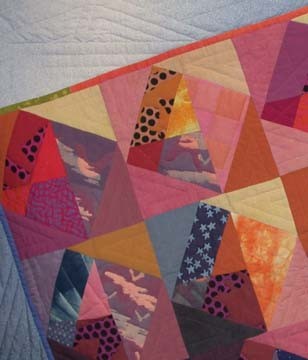
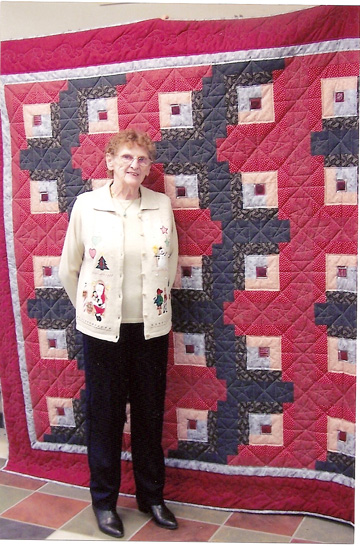
Evelyn Salinger (ES): Today’s December 5, 2007. Margaret Brescia is the interviewee and her number is NM87111.003 and we’re at her home on Albuquerque, New Mexico. Hi, Margarete. Margarete Brescia (MB): Hi, there. ES: It’s nice to have you do our interview today and I’d like to discuss your quilt that you have chosen to talk about. MB: Okay. ES: Would you like to tell us what the pattern is and what you used in it? MB: It’s a Log Cabin, but it’s an unconventional Log Cabin, in a way. It’s about 90 [inches.] by 100 [inches.] I think. And, well the fabric is always a problem to choose that but I think we did pretty good. A friend of mine and I did the same one. Ann did the same one, too, so we picked the fabric. The both of us went and picked hers and mine. ES: And you bought it here locally in Albuquerque? MB: Yeah. And some of it we buy at Southwest Fabrics and the rest you go to Hobby Lobby. ES: Would you describe the colors? MB: It’s in red and gray, different reds and gray. ES: And your quilting of it is unusual. MB: That’s what makes it different. A regular Log Cabin you have a certain way you quilt it. And this one I just did the way I thought I would like it. So I started with the center and come out. And then all the squares are surrounded by little stars. Eight on one square and the other side is only six. I came up with the star because it is on the outside border. It’s kind of vines and star and vines and star. You see when you quilt, then all of a sudden I sat there and I knew there was something missing but I couldn’t figure out. I didn’t want to make any more square lines in it because it just didn’t fit, so I figured out the star and a friend of mine even helped me with it. ES: Did she have a template that you could trace? MB: I got it from Carole [Bonda.] and she got the template for the star. And when she came she said, ‘Why don’t you use the star and put it around in those little holes?’ And that’s what I did. So it turned out very nice, I think. ES: Good. And what do you have on the back? MB: On the back is just muslin. I always put bleached or unbleached muslin on the back because nobody sees the back. And on the back, I think, even if you would like to turn it over, you just have plain white or cream color and you see all the quilting. And to me that is very nice. But that is what I always use. ES: And for whom is this quilt? MB: That’s for my grandson. ES: And how old is he now? MB: He’s about twenty-six. And he lives still with another young man and he won’t take it until he is really on his on, or maybe has his own apartment, which is not very good, because he tried that and that did not work out because of his diabetes. Sometimes, you don’t hear from him and all of a sudden, you think, ‘Oh, my God.’ And so somebody else moved in with him, so now we don’t have to worry about him. ES: When did you finish that quilt? MB: Oh, just a month ago, maybe. ES: I’d like to ask you about your earliest contact with quilters. MB: With quilters, I had a dear friend living behind me and in turn she had an old lady living across the street and she took me once to look at her finished quilts. She had closets full of finished quilts. And one was more beautiful than the other. I said, ‘Well, I’d like to learn that.’ So that friend of mine and I, we head out and we just got our fabric. That time it was less expensive than it is now–and so we head out and started and I made five Grandma’s Flower Gardens. Every little two inch squares–hexagons–I quilted in each one. I didn’t know any better, so the outside is zigzagged and I didn’t know what to do, and she didn’t either. So what I did was a teeny-weeny blanket stitch all around the edge–to get around those zigzags. All five of them. ES: You made five, why? One for each of your kids and one for yourself? Are these still around? MB: They’re still around. ES: When was that would you say? MB: Oh, that was in ’65. ES: And that was where? MB: In Fort Collins, Colorado. ES: So once you got started, where did you do some quilting? MB: Once I got started there, I got involved with the church. They always had about seven quilts in the frame, maybe eight. It all depended. So I went there every day and quilted and that’s how I really got to learn the right way. There’s a right and a wrong way in everything you do. And I had a dear friend. She was twenty years older. And she was an excellent quilter and she showed me the ins and outs of what you should and shouldn’t do. And so, even now when I think of Pearl, I think, ‘Oo oo. She wouldn’t like that big stitch,’ and I take it out again. It sticks with you. ES: Is she the same lady that had the closets full of quilts? MB: No, that’s a different lady. She just was in church. She was there already when I got there. But she quilted until–Good heavens–she died when she maybe was ten days before a hundred and she quilted until the month before. You don’t see so good any more then, but she was not as excellent then as she was when she taught me, but she still did it. And she still enjoyed it and came every day. That was nice. ES: And your children were in school at that time, so that you were free in the morning. MB: Yeah. So I was free. Every morning I just went from eight to noon, or thereabouts. The kids did not come home for lunch, so I was there then in the afternoon. ES: And for whom were all those quilts that you all were working on? MB: We actually had a system, like if anyone had a quilt, any quilt top. Some of them were very old and we actually had to put little tulle, like wedding veil, and you had to put that on top because you could not repair it because it was so very old. And so we put the tulle over and then quilted it. The way it went, people brought it in and then someone was there figuring out how much is the cost and what the backing and the batting. And they figured all that out and then the people were told that’s what it costs. And if they agreed, they left it there and it was put in a frame and it was quilted. And if it was finished, then the people paid and the church or our group got the money and we bought new batting and backing and things like that. So it was self sustaining, the whole business. Or we bought new, or we made pajamas or things like this for the children’s home in Denver. And that money went towards all those things because we had to buy stuff. A pretty good system. And there was always people coming. Most of the time on Thursdays was quilting day, so to say. Or if you couldn’t quilt, you could do other things. But I got there every day because I enjoyed doing it. There was someone else there doing something else, maybe. ES: And on the quilting day, that was more of a general meeting when more people came? MB: On Thursday then everybody came and the quilt frames were full of people. ES: Very nice. How did you learn to sew, to begin with? MB: Oh. When I was about fourteen, at the time I wanted to be a seamstress, hum? But it would have cost three marks, which say was three dollars a month, and there was no money in my family. We could not come up with the three marks a month. So, I just gave up that idea and went into a little factory which made down comforters, pillows, or comforters with wool batting inside. And I was at first taking care of the books like you make samples. And they were sent out to people and you had to take care of how much you used and what it cost, what number it was, and all that. And then later on I was taught all the steps in the whole little factory. And there was mattress making and there was, as I say, down comforters, and the other comforters and each one was a different way of doing it. And I learned all those things. And I was there for three years, was employed there. ES: Starting from when again? MB: When I was fourteen. And I worked there for three years, and then I went to a different work. ES: This was some good practice for you for later on. MB: Yeah. And it really came in handy later on. I had a friend and her mother was a quilting partner also, and she knew what I was capable of. And that friend of mine had a business making drapes. So sometimes I helped her out, but she also had to–with the drapes came the bedspread. And she had to go to Denver to have it done. And then it was done–sometimes it wasn’t the right size and it was very bad because she had to eat it. You know if the customer says, ‘It’s too big or too little.’ So her mother said, ‘Well, why don’t Margarete do it?’ And so I got me a big machine, one of those free arms with no feed dog in, and I opened up a business. I made it very simple, just the top was always supplied by the decorators. They were the best decorators in town. And so they supplied the top fabric and I supplied the rest. You couldn’t make a mistake, because the decorator materials, you needed about twelve yards and one yard was anywhere from sixty dollars up. So, you couldn’t afford to make a mistake because then I would have to pay. So any way, [laughs.] I never made one, luckily. But you really have to check and recheck before you do, especially as you start out. ES: So this was a huge project. MB: Yeah. I had a great big table about 140-145 by 110 and I prepared it on the table and then I put pins all over the place. So if you have a big bubble and sometimes with big batting, not skinny batting, the thicker batting. If you had that on your lap with all the needles sticking in you, wee it was a pain sometimes. But later on, I figured for eleven years, and then I couldn’t do it any more, it was just too heavy for me, and I didn’t want to employ anybody because what you do is not what the employees do. I didn’t want to do that, so I just gave up on it. ES: You are really adept at machine work, but now which do you prefer–the hand work or the machine work? MB: That was a different item what you made, I mean, bedspreads, they are made, just for that purpose. You buy the fabric with the flowers in it and it’s just one big sheet. But quilting is an entirely different thing and I would never, ever have one of my quilts machine quilted. Never. Because it is silly, first of all you snip them all to pieces and then you put them back together and it is so much work in it. Why should you machine quilt it? And the old quilts can’t even, if you have to quilt them, they can’t stand machine quilting any more because the material is too brittle. I would never advise and I’m doing it for people, and there’s no one that I know that’s doing hand quilting for other people, for money. ES: But you will do hand quilting for other people. MB: And I still do it. But, you know, sometimes they come and then well they don’t realize how much it will cost, which is not outrageous because I’m charging the same thing as the church up North charged. So, it’s a very reasonable price and well, then all I have to say is, if it was my quilt, and especially an old one, it’s some grandmother that handed it down to you, you wouldn’t want that machine quilted. I say, ‘Well, it’s up to you,’ but I rather would hang it just like this on the wall.’ I think in any business, you run into all sorts of different people and they kind of–I’ve had them come back and say, ‘Yeah, I can do the binding.’ After fourteen days, they come back and say, ‘Can you still do the binding for me?’ To save a few dollars, but then if I can’t do it, I can’t do it. If a plumber come and charge you whatever, you can’t say, ‘Oh, I do it myself.’ If you don’t know how, you can’t. Different people. ES: Nowadays, there’re a lot of people doing machine quilting. MB: Nowadays. Oh, my gosh. Almost everything, wherever you go outside class [Bear Canyon Quilters.], there is nothing hand quilted in the whole shop. And there are walls and walls of quilts. ES: They look so beautiful. MB: They look very beautiful, yes, but it defies the purpose of doing something what has been done a long, long time ago. Even then they didn’t do it for show. They did it because they needed something warm and they had something made it out of. But now, well, different people. ES: What is your favorite part of the quilting process? MB: [laughs.] Quilting. I don’t like to fit them together. I used to do so many fit them together. I don’t like that anymore. Oh, boy, I just did one–actually, I did three of them. ES: The garden one? MB: Two of the them, the beige one and the flower garden and the one in green. But, [Laughs.] I don’t like to do it anymore. ES: They are appliquéd. MB: Two of them are appliquéd. I like the appliqué. But you still have to fit them together because you have small pieces when you appliqué them and you still have to fit them together but quilting, any old time. ES: When you do your quilts, do you use your own patterns mostly? MB: No. If somebody says, ‘Look, this is a nice one,’ I don’t want to make another one, but most of the time it’s because somebody made it and you thought, ‘Oh, that’s nice.’ I like to do that. And for the quilting, you find out, even if somebody brings you a quilt, and they don’t know what they want done on it, you find out while you are sitting there quilting, you have a little bit done, they you think, ‘Oh. There’s something missing still.’ And then you go back and do that over, to fill it in, so it really is the way I would like it and I am sure the other person would like it, too. ES: Who have been the recipients of your quilts? MB: My kids. Almost all of them. Some of them don’t have it hanging on the wall any more but one of my daughters, she has one. She has a great big house. One is just a window wall and the other walls are big walls, high walls. So there’s three big ones hanging up: a real old one and a Dresden Plate, and an embroidered one is hanging down. In the hallway upstairs, she has the whole hallway full of Southwestern. ES: Are the Southwestern ones mostly wall hangings? MB: Yes. All sorts of different kinds. And then she got those racks, you know. She has two racks full of them and she has a big tub where she has the folded up ones in there. She’s got lots of them. She has the most of them, the other ones have some, but not as much as she does. And she enjoys it. ES: How much time do you spend with your quilting, would you say? MB: Well, a quilt may be 90 by 100. It takes me maybe five-six weeks to quilt, just the quilting, not what you do before. ES: That seems very fast. MB: Yeah, I’m still pretty fast at it. ES: How many hours a day do you spend? MB: Sometimes, now it’s up a little bit. My eyes do not want to do it in the night anymore. But it used to be, I always sat there eight to ten hours. And if I couldn’t sleep, I got up again and I did another few hours. So, lots of times, long hours. And it didn’t bother me, but now my eyes just don’t want to– ES: It would take some of us a year, when it takes you six weeks. MB: Yes. But if you sit there every day, mostly every day, I do. Sometimes you go some place. But if you keep on doing it, then you can get it done better. And if you just sit there talking with somebody, [laughs.] then you get nothing done. ES: That’s true. Do you quilt on hoops or frames? MB: I used to quilt on hoops. Up North we had every year a quilt show. And there was one quilt what a whole group made for raffling off later on. So it went to each one’s house. And then you did whatever you wanted to do on it. I had a big hoop, one of those oval ones, and I quilted on that. I didn’t like that. The frame, the one I have now, it’s pretty easy for me because I have cogs on it, one on each end. All I do is put it in, tighten it up, and then put the next layer on, roll it again, and so forth until I have all three layers there and they are all attached. And then I start quilting from the beginning, at one end, and then I just move it along until I come to the other end. I really like that frame. I used to have it just on quilt stands, and they were clamped with four beams. You have to have a big room and that I don’t have any more. But then I could do it because I had the big room downstairs. Now, if there’s no quilt on the frame, then I use it as a work table. I put a sheet or thin stuff up there and then it’s a work table. That’s nice. But that frame is really nice. ES: Would you tell us about the Bear Canyon [Senior Center.] Quilters and how you got started with them? MB: Well, I moved here about nine years ago and I went down to the Center and what I thought I wanted to do was learn Spanish. Since I’m living here now, I thought I would learn Spanish. And I came down there and it was a big sign that you had to have prior knowledge of the language, which I didn’t. So there was something in session and it was a French session. So I thought, well, and so I went in and I listened to it and I could understand everything, but then came the part they had to write things down. I never wrote, I was able to speak it, but I could never write things down because that’s not what I learned. So I just went and then I saw the quilting room so I thought that would be a good idea, since I know how to sew, I know how to do things like this. And so I started there and I have been there nearly every time–I can count on one hand what days I missed. ES: Like when you travel. MB: Whenever I’m gone, then that’s the only time I miss, otherwise I haven’t missed any days. And on Saturdays, we go and do the Ronald MacDonald quilts and I haven’t missed one of those either–maybe one or two. And I enjoy doing it and it’s a real nice group. They’re all really nice people and each one has her own qualities. Each one is different. And it’s amazing how twenty-five different people can get along well. ES: And there you have the format again of working several quilts at the same time. MB: You can work on whatever you choose. And some of them are in [the frame.] a long time. ES: When you only have three or four hours maximum once a week, you can’t get very far and fast. MB: I used to go there, at eight o’clock. I was there. But now I don’t do that any more because most people don’t even come in ’til nine thirty, sometimes, well, then you don’t get nothing done. ES: You don’t usually put your quilts in there, because you do yours at home. MB: No, I have always just worked for everybody else. I have never put a quilt in and I will never do one either. ES: Do you have advice for new quilters? MB: Well, the only thing I can say is, whatever you do, it you do it from the beginning, if you start a quilt and you be precise with your first step on the quilt and you are precise throughout what you are doing, you don’t wrong. It has to be exact, otherwise the next step–ach–this is big and this is small and it doesn’t match up. And if you know that and you ought to know that if you are a quilter, then you can’t go wrong. It’s nice for being there, for companionship and it’s nice. You do have to be exact and you have to enjoy what you are doing, otherwise there’s no sense to it. If somebody says, well you have to sit down and quilt, uh-uh, it has to be something what you enjoy doing, then you will get better and better at it. It’s not naturally given to you. You have to work at it. ES: This has certainly been a big part of your life. MB: Yeah, it has. And it always has been and I think I couldn’t even imagine just sitting down doing nothing. [laughs.] It just isn’t possible. You are so used to doing something all the time, that you can’t do without it. Whatever it is, but you got to do something. And I’m not a big fan of reading, especially with the eyes, you know, so you don’t like to do that any more. It’s got to be a very interesting book if I’m going to read it. ES: I’d like to know if you have any quilt stories to share. MB: Well, the only one I think would be worthwhile telling. [laughs.] My son lives down in Florida in the panhandle, Pensacola, and the last hurricane was Ivan and we just got finished moving into the house, and I went back home. I think a month later the hurricane came. And it took the whole house, everything. And my son called after he quieted down, and he said, ‘Well, yeah, the house is gone. The furniture is gone. Eeverything is gone. I can buy all those things again, but I can’t find and what is gone also, are the two quilts you made for us. Those I can’t replace.’ So my daughter in Washington, she called me, and she said, ‘Whatcha doing?’ I am doing nothing right now. I have no quilt in the frame. And she said, ‘Get busy and make another quilt for Augie, because they can’t find theirs.’ So I went with my daughter-in-law what lives here and we got the fabric and started on it and made another Hawaiian. The one what was lost was a Hawaiian quilt and I made him another one and I gave it to him at Christmas. Well, the quilts, later on when they sifted through everything, and they found all sorts of things, uprooted. They found the quilts, both of them, with the stick still attached. You know, where you attach it to the wall? The stick was still attached in the top end and it was found wrapped around a tree. Both of them. Now they were so dirty and, uh, it was terrible, so they took a power sprayer and they attacked it with all sorts of things and they got them all nice and cleaned up. I have the pictures to show, where half of it is done and the other half not clean. So they’re hanging up again now. ES: Good. What kind of quilts were those? MB: One was a Hawaiian quilt and the other one was embroidered quilt. The Hawaiian one I actually bought the center. It was just small, maybe a yard by a yard. We found it in Hawaii, in Honolulu and my son saw it and he liked it, so he asked me, ‘Could you make that into a big quilt?’ I said, ‘Well, yeah, I guess I can.’ So I worked around that. The pattern what was in there was dolphins, and crabs and all sorts of things, and I worked around that part and made the whole outside. The outside has waves and dolphins swimming. ES: Are they embroidered on it or quilted in? MB: No, they’re appliqué. It’s all appliquéd. And it’s quilted around half an inch apart. You know, Hawaiian quilts, you don’t stretch them like we stretch ours. They actually have them laying on the table. They would quilt on that. But it turned out very nice. ES: What colors did you have? MB: The waves were light blue and then the dolphins were grayish blue. And the next one, I had different colors, but I had to do the whole thing, so in the center, which was what we bought, I put just a circle of dolphins. ES: What color was the center? MB: The background was off white, I think. The dolphins, again, they were different colors and the waves were different fabric and different colors, too. But in the center, I made a big circle, about a yard, and big dolphins swimming around. ES: That’s wonderful that they found that. MB: Yeah. He was very happy. He didn’t know, they didn’t know, that I had made another one. So on Christmas, we were up in Washington, there was a big package there and they opened it and they were really surprised. Although they found the other ones, but it didn’t matter. [laughs.] ES: Now you have pictures of that. Do you keep pictures of your other quilts along the way? MB: I have books of pictures, but lately, the last few years, I don’t have a camera myself and it was always a bother to ask somebody to take a picture, so I didn’t take pictures any more from a few years back. But I used to make so many of them for people. I had a friend, I made, twelve of them. ES: Twelve of them! MB: Her first one was a Wedding Ring. And I said, ‘Pauline, how can you pick a Wedding Ring.’ ‘Well, it looked so good.’ And she was a very precise person, so it was just perfect. The next one, she said, ‘Guess what?’ She had another Wedding Ring because one daughter-in-law wanted one like that. And then she had old ones from her mother and her mother was actually just as precise as she was. Her quilts were laying down flat, the tops. Beautiful, she did beautiful work. So all together I did twelve, and the number thirteen was when she came and she brought me a little one and then I said, ‘Don’t forget your quilt.’ She said, ‘Oh, no, no, you’re supposed to quilt that.’ I quilted and I sent it to her. She used to live here and now she lives in Washington State. And there were quite a few people what had old quilts and sometimes I made eight or ten of them for people that dug them our or found them at garage sales. I made lots of them, I still have the pictures, but most of them the past few years I haven’t been doing too many of them. Even if I do, I don’t take pictures any more, because later on, who wants to look at the pictures? ES: You have certainly been a prolific quilter. MB: And I, again, you’ve got to enjoy what you’re doing, otherwise there is no sense in punishing yourself. And it would be a punishment if you consider doing something what you really don’t want to do. ES: You certainly do a beautiful job, you have a good sense of color and your quilting is exquisite. MB: Thank you. ES: And you are so fast, as well. MB: If you do it a long time–I feel sorry sometimes because if I look at what someone does, then I think, um, it would be a whole lot easier if–you know. A grown-up person does not want to be told what they’re supposed to do, even if it would be a whole lot easier for them. It’s a big advantage if you know what I learned through forty years and why not pass on some of that knowledge if it helps someone else. But most people do not want to know. ES: Thank you very much for doing this interview today. It is very interesting. MB: Thank you. [interview concluded around…