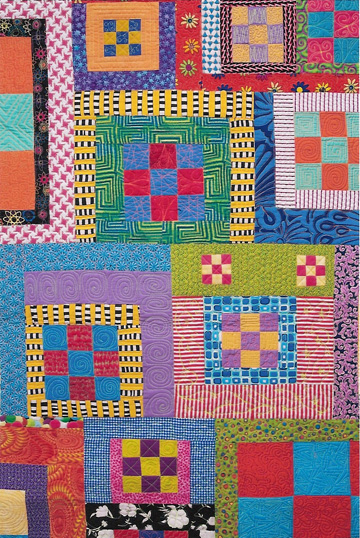
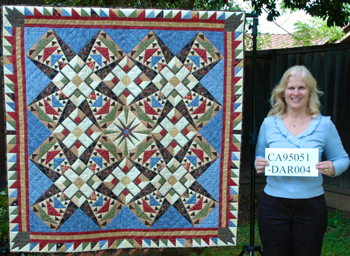
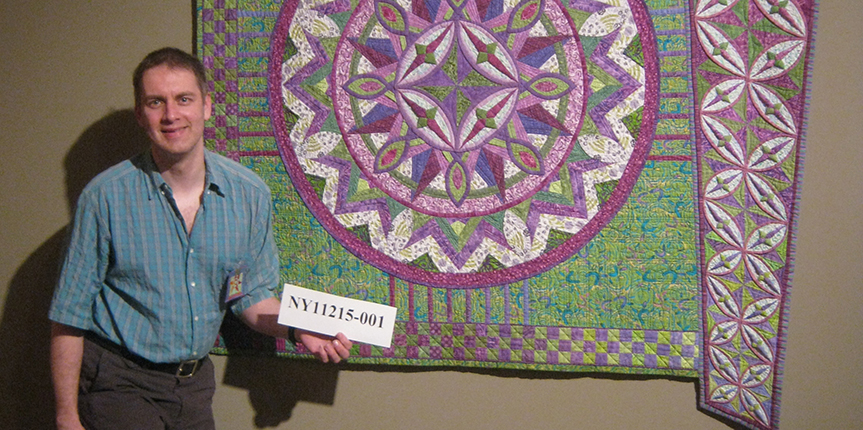
Karen Musgrave (KM): This is Karen Musgrave and I am doing a Quilters’ S.O.S. – Save Our Stories interview with Maria Shell. Maria lives in Anchorage, Alaska and I live in Naperville, Illinois, so we are conducting this interview over the telephone. Today’s date is October 9, 2008 and it is 1:15 in the afternoon. Maria thank you for doing this interview with me. Tell me about your quilt, “Boxy 9-Patch” that you chose for the interview. Maria Shell (MS): I, we had talked about this, that I kind of wanted a different quilt, but in the end I think it is the first quilt that I have been working quite a bit with innovative piecing, like nontraditional block settings. In traditional quilts, you have quilt blocks, and then you put the sashing around it; and then you put the border around it; and I really didn’t want to do that; and I had tried a couple of different ways of doing this; I call it kitchen sink quilting. I think I am jumping around a bit. KM: That is okay. MS: When I first started quilting, I really felt like I couldn’t just–I have three boys and at the time I was in the middle of having them and I wanted to quilt all the time, and I felt like I couldn’t justify quilting unless I was making a quilt for someone. I belonged to this play group through Parks and Rec in Valdez, Alaska and all the moms would make a quilt block for a mother who was pregnant with a new baby. I’d gather all the blocks, and I would be the person that would put them into a quilt. One of the women who was teaching me to quilt was an older woman. She was a grandmother and she would bring her granddaughter to this play group, and she introduced me to Gwen Marston’s book called “Liberated Quiltmaking.” And she said, ‘We don’t have to put these regular sashes on the quilt. We can do whatever we want.’ And so I really find that is important to me. You know the rules, but then you get to break them. I started just doing this crazy stuff, where I would put in other blocks, but there is a method to it. I would build the blocks into strips, so as long as you end up with strips that are the same length you just attach them. I started teaching this technique at the quilt shop in Valdez, and people were interested in it, but they were kind of intimidated. So I thought I’m going to do a dummied down version, which is what “Boxy 9-Patch” is. It is just nine patches, which is about as simple as you can get, and then strips of different sizes and lengths and shapes, and I would build those out around the nine patches. I guess the other thing that is interesting about this quilt is when we moved from Valdez to Anchorage I started teaching at a quilt shop here called The Quilt Tree, and I had someone call me and ask if she could buy a quilt. She didn’t end up buying the quilt, but it made me think, oh maybe, maybe my stuff is good enough that I should send it out. I had some of my pieces professionally photographed and “Boxy 9-Patch” is the first one, not the first one to be accepted into a show, but the first one to get a ribbon and it got first place at the Albuquerque Fiber Arts Fiesta so it is a special quilt to me for those reasons. KM: Did you machine quilt the quilt? MS: Yes, which is another, sort of, I guess interesting story. I learned how to quilt in Valdez. My husband and I moved up to Alaska because he works on the water, and we are from Kansas, and there is not a lot of water there. We got married and decided we would seek our fortune in the final frontier, so we drove the Alcan with our two, my two cats. We got married in Las Vegas and then we kind of hit the road. He was–at the time, he worked as a mate on a tugboat, and he worked in the Prince William Sound which is the waterway that is near Valdez, and I was in Anchorage [which is a six hour drive.] going to graduate school to get a Masters of Fine Arts in Creative Writing. (He worked six weeks on, and then he would be off for three weeks if we were lucky.) So, I was working on my thesis, and I finished my thesis which is a collection of essays and then in the middle of that we had our first child, and I was like I can’t handle living in Anchorage (with my husband gone six weeks at a time). I’m here all alone without any support system, so he took a portside job in Valdez, and we moved from Anchorage to this remote Alaskan town of four thousand. It is on the road system which is something. Not all small towns in Alaska are on the road system, so you can drive out, but in the winter time you can be stuck there, and it snows. The average snowfall is 360 inches. It is the snowiest sea level town in North America. Anyway, Alaskans like their hobbies, and you have to have indoor hobbies (because of all the snow and cold). So, I had always wanted to quilt, I’d sewn since I was little. I started sewing when I was four and then my mom allowed me to use the sewing machine when I turned ten, and then I made all my own clothes. I think there are really two paths to quilting and one of them is sort of I made all my clothes in high school and the other is I’m an artist and I discovered fiber is a valid medium. So there are these two paths to quilting, and that is another thing I really think is interesting about being a quiltmaker. Anyway, I had always sewn. I worked in a costume shop in college making costumes for operas, but I had never made a quilt. I wanted to. I checked out books in the library and tried to make one on my own but, I didn’t get the quarter inch seam. [This was all before the Rotary Revolution. Years later.] I took my first class at the quilt shop [in Valdez.], and I really haven’t, just didn’t look back. I was supposed to be trying to get my essays from graduate school published, and all I wanted to do was make quilts. So then I started teaching at the quilt shop. Valdez only had one longarm quilting machine in town and that machine was at the only quilt shop called The Calico Whale. The woman who owned the machine decided that she was going to move to Wasilla, which has been in the news lately because that is where the Republican Vice Presidential candidate is from. Sarah Palin. KM: Yes. MS: Vicky (the woman who owned the longarm machine) told us–we were talking at the shop and she said, ‘If you guys can figure out a way to buy the machine, I will sell the machine to you.’ It was the teachers and the owner of the shop who were just chatting about it. She said, ‘You guys can buy this old machine and then I will buy a new one when I move to Wasilla.’ She was opening a yarn shop in Wasilla. So the owner of the shop and one of the other teachers and my self pooled our money and we bought this machine together. At the time it was probably about seven years old, but didn’t have a stitch regulator on it. Kind of a basic Gammill longarm machine. I taught myself how to quilt on it and “Boxy Nine Patch” is quilted on that machine. I actually went down–I had an opportunity to go down to Texas and take some classes with Linda Taylor, and that was really helpful. It didn’t have a stitch regulator on it, and for me it makes a huge difference. So when my husband found out that the company he works for wanted to move us to Anchorage, we were very excited. Valdez is really small for me, and I was, I was really anxious to meet some other quilters that were interested in doing things that push the boundaries of traditional quiltmaking. This wasn’t really available to me in Valdez. So when we moved here [back to Anchorage.] I knew I wanted to own my own longarm machine and take in quilting for people. We bought a house that could allow us to have a longarm machine in it which is really nice, so I started quilting for people. But, and this frequently happens, longarm quilters get very burned out on quilting for other people.. I really have a small client base that I work with now, and if I don’t have any quilting to do [which hasn’t happened yet!] I will take in a new client but for the most part I’m kind of booked. So I did quilt that quilt. KM: How, how do you balance your time between quilting for other people, quilting for yourself, are you still teaching? MS: Yeah, I teach at The Quilt Tree. That was a huge problem, because I like to do good work. When someone gives me a quilt I want to honor it, I want to do the best thread work on it that I possibly can, and I was getting way behind, and I kind of had a little-mini breakdown last March, and I sent all my clients an email saying you are in line but that doesn’t mean that you, like say you are number three in line, that doesn’t mean that you are going to get your quilt next week because my oldest son may break his arm, or my husband may leave town for two weeks and it is just really hard to balance everything. There were quilters that took their quilts back, most people waited and I’m just now finishing up that pile so it feels pretty good to have done that. Now I try to quilt six customer quilts a month, and then the rest of the time I either am working on class samples or making quilts to send to shows. KM: What is, how do you use “Boxy 9-Patch”? MS: I’m sorry. KM: How do you use “Boxy 9-Patch”? MS: I don’t. KM: How do you use it? Does it hang on the wall? MS: No. [laughs.] Well it has gone to several shows and now I think eventually it will go on one of the walls in our house, but right now it is stored with my other quilts. I’m hoping that it–actually this spring I may teach it as a class so it probably will be hanging up at the quilt shop. KM: Now it is 51 inches by 63 inches, is that typical size for you? MS: Yeah, I like to make kind of big wall quilts. 60 inches by 80 inches I would say is a big size for me, but in that range there, 40 inches by 50 inches, big wall size. I guess I feel lucky that I can do bigger quilts because I do have the longarm machine. It allows me to do pretty intense thread work. KM: Talk to me a little more, you talk about the importance of the stitch regulator. Explain a little bit more to me about that. MS: The longarm machines sits on a track system. With a regular sewing machine you move the quilt underneath the machine. With a longarm, you move the longarm machine over the quilt so you are actually moving the machine, and it sits on a series of rollers that allows you to move it 360 degrees. You can stitch big circles with it. Now, just like on a home machine, when you are quilting you don’t use your feed dogs, and the stitch size is determined by how fast you are hitting the gas, which is your foot pedal, and how fast you are moving your quilt underneath your machine. If you get either one of those things going too fast or too slow you are going to end up with these big huge stitches or a bird’s nest on the bottom. Non-stitch regulated longarms work this way too. The speed of the machine must match your movement of the longarm machine over the quilt in order to get a good stitch. So you have to pace yourself, both of those elements have to be in sync in order to get a nice even stitch. With a stitch regulator, you can tell your machine I want twelve stitches to an inch and it will do that. So no matter how fast you move it is going to compensate by stitching slower or faster in order to guarantee twelve stitches to an inch. KM: That has made a huge difference in your quilt–quilting? MS: Yeah, the thing that really makes it for me is that I can actually stop what I’m doing, say I’m using a ruler, there are these big thick acrylic rulers longarm quilters use for stitching around. They are like rulers quilters use for rotary cutting, but they are twice as thick. You move your longarm around the ruler, say it is a circle ruler, and you use it to get a nice clean curve. If I want to make a complete circle with the stitch regulator on, I can actually move my machine to get like a quarter of a curve, stop, the needle will not go up or down as long as I am still, and I can move my hands or move the ruler and then continue stitching. It is as if you could–on a home machine reposition your fabric while you still have your foot on the pedal. If you stop moving your fabric then your needle is going to go, it is going to stitch up and down and form a big bird’s nest on the other side. That doesn’t happen with a stitch regulator. KM: Very nice. MS: It is, it allows for a lot of control and people can do really intricate work. KM: What does your family think of your quiltmaking? MS: They have always been really supportive of it. I think my husband is. His family they are artists on his side of the family. His mother’s family owned a circus back in the day when circuses were the thing, and his grandmother was a Ziegfield Follies girl, and his grandfather was a big band musician, a trumpeter in Dean Martin and Jerry Lee Lewis’s band, and my husband’s mother is an artist for Hallmark. She is a three-dimensional, she does ornaments and sculpture work for Hallmark, so they, his side of the family are very artistic and so he grew up with–his mother was, you know she worked when he was little, she worked at home a lot, and so he was used to, that was the environment that he grew up in, having a mom who had a studio and was making art. It is, I think makes sense to my husband, like it is not odd, like ‘Why don’t you get a regular nine to five job?’ And fortunately he has a good job that so I don’t have to make a bunch of money, because that would be an issue. Quiltmaking at least at this point in my career is not necessarily a lucrative job. KM: Describe your studio. MS: It is awesome. I, well I guess I started to say this to my husband [speaks to son, You don’t want these gloves, okay.] Can we say while I’m interviewing that I also have a four year old that? KM: Um, hum. [MS laughs.] It sounds like he wants to go outside. MS: Outside and play in the snow, so he is getting all geared up now. So my husband, I think he is very artistic as well. His main art project is our house which is, he made this really nice studio for me and he helps me a lot with color and he names all of my quilts. It is kind of–and actually the kids get to name quilts too. Which is kind of, they enjoy doing that. KM: What kind of names have they come up with? MS: I had them name almost everything, but I told the kids a while back that they could each name a quilt and so my oldest son, immediately, he is ten but at the time he named the quilt, he was still very into Pokemon so it is. The quilt is called “Spinda” which is a spider Pokemon and the quilt is from a pattern called Paper Weight, and it is a contemporary version of the Spider Web Block, so it is kind of interesting, I mean he didn’t know that, he didn’t know it was a Spider Web Block, but he could see that it looked like a spider web and Spinda is the spider Pokemon, so it is called “Spinda” and that quilt actually went to several shows. It went to Paducah, and it went to went to Denver National, and Machine Quilters Showcase, but and I love the quilt. It has one of the things I really like to do is that I have an intense fabric collection, fabrics from the depression era, feed sacks. I have a good selection of psychedelics from the sixties and seventies, which are probably my favorites and the modern fabrics and hand dyes and I like to put them all together. If you look at “Boxy Nine Patch”, you can look at that quilt; you can see there are fabrics from the 1920’s in the quilt. I don’t know where I was going with that. KM: [laughs.] Other names? MS: Other names, well my husband, we both, he is a deadhead. Well, I think he still thinks he is a deadhead, but we are actually kind of older than that now. He likes to name things with references to the sixties. One of my quilts is called “Owlsey’s Owls” and it is a pretty neat quilt. It is at Houston right now. I took a class with Roberta Horton. Actually I got a chance to take three days of classes with her and it was really just an amazing thing, and out of that class I started using fabric, like within the fabric. These owls are on a tree and the owls are made out of paisleys and Christmas ornament fabric for the eyes, so (I started) taking novelty prints and other prints that have a motif in them and using that motif in a way that it wasn’t necessarily intended to be used. There are leaves that are used as feathers and daises are the claws for the owl’s feet. So I don’t know, “Owlsey” was the Grateful Dead’s LSD supplier. So that is the name “Owlsey’s Owls”, and another quilt that he named is called “A Hofmann’s Obit” which is also an LSD reference. Huffman was the inventor of LSD [and he died this year.], and that quilt is all thread play. I just finished it and it looks like–it is on black. It is a whole cloth quilt and it looks kind of like the galaxy. I drafted swirls on freezer paper, and then I put them on tissue paper, and then I, I stitched through the tissue paper. I laid out the quilt fabric on my longarm, and then I laid the tissue paper over it and then I stitched the swirls to get the outline, and then the swirls are filled in with micro-fill of different colors coming in curves and circles in and out of each other, so it looks kind of like the Aurora Borealis, or the Northern Lights, but done with thread. KM: Tell me about your studio. MS: My studio is, the thing that is really nice about it is that we have a split level but the previous owners built a big entry way onto the front, some split levels you come in and you have to go up or go down immediately, but they built a big landing. It is like a mudroom on the front of the house, so you come in and there is the mudroom and then if you go downstairs there would be, if it wasn’t my studio, a big living room with this 1970’s lava fireplace, and my husband took this room and he built workspace up over the fireplace so the fireplace is no longer there (well, it is there but you can’t see it!), and he built shelves underneath it so I’ve got, ‘oh I’m not doing a good job here.’ I’m going to walk into my studio. The first thing is that I have a vintage Rocketeer Slant-o Matic Singer sewing machine that is on the landing there and it is, these are amazing old sewing machines that have a real atomic 1950’s design to them, and that little machine sits in the front there and then over to the left I have an antique wardrobe which is where I store all of my clients quilts so they are protected. I have batting and stuff, and then I just have sort of industrial shelving going around the perimeter of the room, the kind that you get at Costco, big metal shelving and I have tubs, mostly clear tubs and they are all categorized and labeled. I am pretty tidy in my work. I like to be able to find things pretty quickly. I had everything in tubs, but this summer I actually went through and labeled everything because I was tired of trying to find a tub because it wasn’t labeled, anyway, they are all labeled. In front of those industrial shelving units, my husband made this design wall that goes in front of the shelving. I can lift the design wall off its hooks and get to the tubs behind or I can have it hanging there. It is pretty standard design wall made from pressed wood, and then we have batting and flannel over it so I can pin things onto it. Behind my longarm, where the fireplace is, I have another big design wall. It is a little harder to get to, so I have a little stool. I can put things up there, and they will be up for a while. I can look at it, I’m not necessarily messing with what is on that design wall, but I’m looking at it. The other design wall is one where I will more likely be moving around things. Underneath the design wall behind the longarm is a nice shelving unit that has all my longarm tools and books. I have like a work space right behind me, when I’m working on my longarm I can turn around and I will have rulers and books and my sketch pads and that sort of thing are all back there, and then the shelving underneath I store the rulers and stuff. And then as I circle around my room, I have my fabric storage is in another unit that Walt built. Walt is my husband, and I have that all organized. It is nice to look at because I organized it by the rainbow, all the colors are in their set places, and then one of the things I really like and I don’t know, I am surprised more people don’t do this but I have a–he built me a countertop space and on top of that is my rotary mat and I have a light box and Thermofax and all those things are there on that countertop and underneath it he built me shelving units that I have these plastic tubs. They fit fat quarters, I like to buy yard and a half lengths of fabric, and I will wash it and then a yard of it goes into my flat fold storage and then I quarter up, I make two fat quarters out of the other half yard ,and those are all in these tubs that slide in and out. Kind of like an index system, an index card system. I can pull out a tub and I can look all through all my oranges and see what I’ve got, then and I can shove it back in and pull out another one. Next to the cutting table are rolling carts that have all my small spools of thread, and then my big spools of thread are on what are those called? Pegboards. Then I have my sewing machine which is on a–eventually Walt is going to cut the top so that I can set my machine down in it, but right now I have this old, it is really old wooden desk that I like because it has those two little wooden boards that you can pull out on the sides like, so I can actually make a U-shape area to work in with my sewing machine. I have my ironing board and then I have another cutting table. So that is my studio. KM: How big is it? MS: It is the size of a nice size living room. It’s big and the funny thing is it is in the traffic pattern of my family which is awesome, and at times it makes me a little crazy because they tend to–like I’m looking at it right now I’ve got a giant Rescue Heroes submarine thing and I’ve got a big tub of blocks and a Darth Vader costume. I’ve got all this kids stuff. My oldest usually does his homework in here when he gets home from school, so they are very much in the studio with me, it’s not shut away. You come in the front door and you walk down to my studio and then actually the door to the garage is on the back side of my studio so when my husband is working on the house it is this constant traffic pattern through my studio. The funny thing about when I first started quilting I took over the dining room table which I think a lot of quilters do. They take over the dining room table and it gets to be this sort of point of contention that the family wants to eat dinner and you’ve got your quilting all over the place. We lived in this house that had a lower level that wasn’t finished. The previous owners, this is in Valdez, had moved the washing machine and dryer downstairs so my husband converted the old laundry room, which you know, most people’s laundry rooms are really small, into a sewing room for me. It was big enough for me, no one else really could be in there at the same time but it was neat. He made a little cutting station, I had my tubs up high so I could store things way up high in the room and then I graduated to this, which to me is luxury. KM: Sounds wonderful. MS: Yes it is, it is a nice space. It is not, like Carol Taylor, I look at her studio online and it’s, it’s not like that, it is pretty industrial but it is very functional. KM: It works for you. MS: It does. KM: Whose works are you drawn to and why? MS: Well, Carol Taylor, I really like. I like piecing and although I’m doing more appliqué. I really like people, I like the works that sort of straddle the traditional but are contemporary. Work that takes traditional blocks and really works within the tradition but pushes those boundaries. I love Pamela Allen’s work, and I love and I’m not sure how to say, is it Susan Shie or She? KM: Shie. MS: I love her work. I don’t even know how to do what she does. It is just so amazing to me. KM: Do you belong to any quilt groups? MS: Yeah, I belong to the Anchorage Log Cabin Quilters Guild, or actually we are not called a guild, it was one of those crazy Alaskan things, we don’t like to be called, defined by anything. It is the Anchorage Lob Cabin Quilters, Inc. No guild in the name. That’s probably the only, well I belong to SAQA and I belong to the Machine Quilters, I don’t even know what they are called, International Machine Quilters Association, I think that is right. Yep, and I think that is it. [I also belong to Fiber Artists for Obama. We made an amazing quilt. I did the final pieced border on the quilt, and then quilted it. It is going to be shown this year at Houston in an exhibit called Patchwork Politics. I’m pretty excited about this.] KM: Why is belonging to a group important to you? MS: Well it was really important when I moved from Valdez to Anchorage. I think I kind of acted like a nut about it because when I first moved here, it was just like I wanted to meet, I just wanted to meet other quilters and now I’m kind of like okay I’ve met people, I can go back into my studio and hunker down, but there was a point where I really wanted to interact with other people that shared my passion. KM: What is the group like in Anchorage? How many people? MS: I don’t get to go. I used to, I had babysitting arrangements so that I could go to the guild meeting, but I don’t have those now, so I will start going to the meetings again next year when my youngest goes to kindergarten. The way it is set up is that they have, they meet the first and third Thursday of every month and then if there is a fifth Thursday in the month they do comfort quilts where they make quilts for the women’s shelter, the homeless shelter, and it is a really nice program that they do. Tuesday and Thursdays, I think it is 10:30 to 12:00 and they have a business meeting on the first Thursday and then the third Thursday they have a program of some sort. It might be visiting quilter’s studios or it might be a shop hop or it might be someone coming into town, or someone from the organization doing a trunk show and then there is also an evening meeting on the same first and third Thursdays but they are much more informal. They do a lot of challenges and block swaps and it is more of a social gathering. The evening group is more of a social group and the day group is the get it done group. KM: What about SAQA, Studio Art Quilters Associates? MS: Yeah, I am. I just heard about it and I went to the website and I thought this is really interesting, and so I joined. Part of why I joined is well because I wanted to be part of their chat room because they have a chat–they post things and I thought it–I belong to the QuiltArt Chat Group, which is another online sort of people post quilting messages and talk about their quilts and what they are doing, and someone there said they really liked this SAQA group, so I thought because I wanted a group that was maybe more focused on just talking about quilting and not so much talking about socializing, or I wanted more information from other quilters about quilting. I joined that and we actually had a couple of regional, like Alaskan meetings, and I’ve only been able to go to one of them but I convinced a couple of my friends from the guild to join and they have gone to the other meetings and said it has been really good. There is actually one of the women in that group is on the board of SAQA, Nelda. Nelda. [Warkentin.]Yes? KM: Yes. Very good. What advice would you offer someone starting out? MS: Well it depends on what you want to do with quilting. I think that some people–since I’ve moved to Anchorage I’ve really started thinking of myself as–and I don’t even know, the whole what you call yourself is kind of interesting. I like to call myself a quiltmaker but if you call yourself a quiltmaker then people think that you just make things that go on the bed, they don’t necessary think that you make something that goes on the wall, but I’m not really comfortable with calling myself an artist and then quilt artist I don’t know, it is like, so that’s, I don’t know, that is an interesting thing that people talk about within the community but I think if you, there is so many directions that you can go with quiltmaking. It is very honorable I think to be a classical quiltmaker and focus on craft and being, just creating meticulous beautifully crafted work and then there are other people that are more just free wheeling and now we have so many things that we can use to make quilts. You can glue every thing. You don’t even have to stitch it. There are people that glue their bindings on I mean, it’s a really a dynamic time I think to be a quiltmaker. KM: What do you think is the biggest challenge confronting quiltmakers today? MS: Well for fiber artists I would think. Right now, I think being taken seriously. I don’t know why I feel like I always chose, what I want to do, is always like the outsider art form in a way that it is, and it’s hard for me. This is an example, I was writing about it this morning, I’m working with an architect and design company to–they are going to make a quilt and I’m going to quilt it for them, and the quilt will be used as a fundraiser for Habitat for Humanity and I’ve been a supporter of Habitat for Humanity for a long time and I’m excited about doing this. [But I am also wary of the project because I had a bad experience with an architect.] This summer I worked with a woman who is an architect briefly, I didn’t take on the project because it kind of made me feel bad. She wanted me to do something that wasn’t constructually possible. She didn’t understand the art form, she wanted me to make, to do this quilt, it wasn’t, just wasn’t going to go together. It was like as a construction unit it wasn’t going to work. She didn’t want to pay me what it would take for me to do it, and I really felt insulted like she didn’t understand that, she may be an architect, but I’m a quiltmaker and there is value in that also, and it was a really I don’t know, like how do you get people to respect quiltmaking? KM: Good question. MS: They don’t necessarily understand. They will say, ‘Make me a quilt. Why won’t you make me a quilt?’ It is like this is hours of my life. KM: Materials are not cheap either. MS: No, they are not. I don’t think people fully understand. People in my world, my husband or my family understand, but regular people just sort of, you know, don’t get it. A couple of years ago an interesting thing happened when I went back to visit family in Kansas. We go back almost every year. My friends all know that I’ve been focused on making these quilts. I’ve gone kind of berserk about it. Anyway, I gave my friends a sort of presentation of my quilts, and it was kind of like for them, I could see in their faces it was like, ‘Oh, she’s not going to make me a quilt for my bed, or for my dog to lay on. That is not what she is doing. It is something different.’ Most people don’t even know we are out there making these amazing things. I guess it’s just where we are at right now. KM: When did you move to Anchorage? I guess we should get a timeline going here so that we have a little better understanding of your journey. MS: We moved to Alaska twelve years ago and we were three years in Anchorage, and I didn’t quilt then we moved to Valdez and it must have been, I finished my thesis in 2000, so in the fall of 2000 I made my first quilt. We were there for seven years from 1999 to 2006, then in 2006 we moved back to Anchorage. So we have been back here for two years. KM: Do you think you will stay in Anchorage? MS: Yeah, my husband has a pretty interesting job. He is the director of marine transportation for western and interior Alaska for a company called Crowley Marine Services, and he is in charge of delivering heating fuel to all of western and interior Alaska. It is a challenging job for him because the waterways, they are, they can only deliver fuel when the waterways aren’t frozen, and these are places that don’t have road access, so the only way they can get their fuel is by boat or by plane. He finds it very challenging and stimulating, and I don’t think he will have that kind of opportunity somewhere else. It is a little bit difficult for me because I feel like I’m so far removed from things because I live up here, but as my kids get older I feel that less and less. KM: Do you get to go to like Houston or Paducah or– MS: I have actually gotten to go to Machine Quilters Showcase twice because it is in Kansas, and I’ve kind of coordinated it so that I can go back to visit family, and I can go to the show. I’ve done that the last two years and that has been really awesome. I don’t know, I do I dream someday that I will get to go to a big show, I can’t. Someday it might happen. It is hard. My husband, because he works so hard and we have three boys that there, somebody has to be home with them and that is me so. That is another part, interesting thing about quiltmakers. A lot of the women sort of come into their–hit their stride when they are older because they have been the primary caregivers. KM: Is there anything else that you would like to add before we close? MS: [long pause.] I don’t know. You know it is interesting. I guess when I first started quilting I was working on my thesis, I was supposed to be polishing it up and sending out these essays, and I just kept stealing time to quilt, and I was really conflicted over it. I didn’t understand that it was actually, that I had found my passion and how lucky someone is to have that happen. A friend of mine said, ‘Why are you torturing yourself? You obvious want to be making quilts. Why don’t you just make quilts?’ But at that point I didn’t. I didn’t think of it as an art or as a–I didn’t feel like it was a valid thing for me to do and over the course of these eight years I’ve really come to terms with that, and that is really it’s awesome to know and my family supports it and I have this lovely studio and everyday I get to come into my studio and make quilts and I’m pretty lucky. Yep, so I guess that’s it. KM: That is good, that is excellent. What do you think makes a great quilt? MS: I like a lot of energy. I think, yeah that is a hard thing. I’m a big fan of the Gee’s Bend quilts and every time there is a quilt art discussion about whether or not Gee’s Bend quilts are art, I’m just like, ‘How can it not be art to take old worn out jeans and make them into something that you can look at for a long time?’ To me that’s the definition of art, and I guess that to me is a good quilt. Something that holds your interest in whatever manner it does that, if it is by making you feel calm or by making a bold statement. Yep. KM: “Boxy Nine Patch” certainly makes a bold statement. MS: [laughs.] Yeah. KM: Terrific. I want to thank you for taking time out of your day to talk with me, and we are going to conclude our interview and it is now…
[vc_row][vc_column][vc_column_text][addtoany] [/vc_column_text][/vc_column][/vc_row][space height=”10″][vc_row][vc_column][vc_column_text] Explore and listen to Marilyn Mowry’s interview by clicking open a segment title and selecting “Play Segment,” or by searching either the index or transcript. Index created by Matt Gilberg in West Chester University’s HIS 480 Digital History course, Fall 2016….
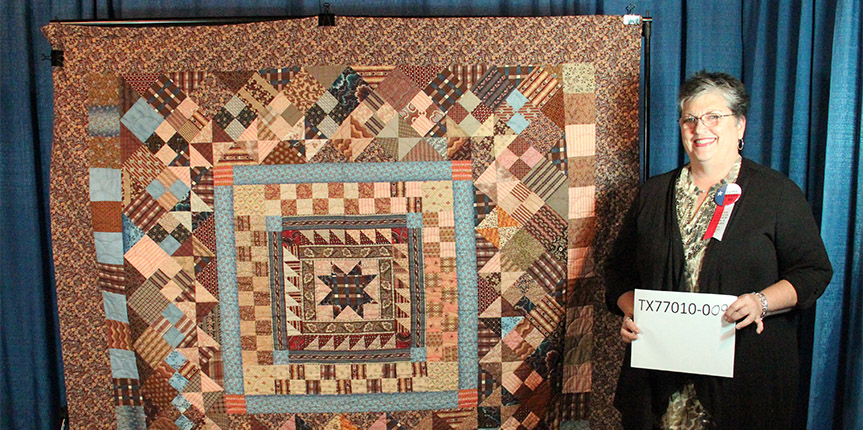
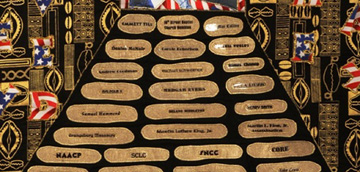
Karen Musgrave (KM): This is Karen Musgrave and I’m conducting a Quilters’ S.O.S. – Save Our Stories interview with Marlene O’Bryant-Seabrook. Marlene is in Charleston, South Carolina and I’m in Naperville, Illinois, so, we are conducting this interview over the telephone. Today’s date is March 6, 2009. It is now 9:05 in the morning. Marlene, thank you so much for taking time out of your day to do this interview with me. Please tell me about your quilt “They Paved the Way.” Marlene O’Bryant-Seabrook (MOS): “They Paved the Way” has really been a wonderful experience for me. Like others all over America I would image, and I know those abroad, I was just glued to my television set on the evening of November 4 [2008.] and because of previous experiences, I was prepared to watch the reruns until the wee hours of the morning and all of a sudden about midnight it was announced that Barack Obama had been declared the winner with well over the 270 votes that he needed. It was just stunning to me that this young African American man had just become the 44th President of the United States. I can’t really fully describe my emotions at the time. I was elated, I was overwhelmed, I was speechless but I didn’t cry, I just became what I would describe as rather somber because I was born in the thirties and so I remember very vividly the indignities of Jim Crow and the sacrifices that were made during the Civil Rights Movement and before that. The first thing that came to my mind was that he had not done this on his own, that he was standing firmly on the shoulders of many who have paved the way for him. I went to sleep knowing that there was a quilt in there somewhere but it was further off than it ended up being, at least in my mind. I know that is what led me to the title. The next day really, I started just jotting down names, I brainstormed incidents that I had remembered and just started them on a sheet of paper which I planned to add to in increments, but still that quilt was further away. Then, it was on the 15th of November that I received a call from Roland Freeman and I had been in other exhibitions with Roland, including his groundbreaking “Communion of the Spirits,” and so he told me what his plan was. That he wanted to have 44 quilts created for an exhibition [“Quilts for Obama: An Exhibit Celebration of our 44th President” at the Historical Society of Washington, D.C. from January 11 to July 26, 2009.] that would be in place during the inauguration. Then he said what I just considered to be impossible, he said that the quilts were due in Washington [D.C.] by December 15. I immediately answered, ‘I’m leaving town next week to spend Thanksgiving with my children and their families. I’m going to leave there on Saturday for a week in Myrtle Beach. I get back home on Friday afternoon and leave Saturday morning to attend a SACS, ,which is the Southern Association of Colleges and Schools conference, in San Antonio and I will not get back home until December 11 so I can not do that.’ Without taking any break in the conversation, Roland told me, ‘Well that is not what Obama’s slogan says,’ and so I replied, ‘Well let’s hang up so I can get started.’ That is how this journey for “They Paved the Way” took place. I then started thinking about it, in fact by that time I had accumulated a list of about 67, 68 names and I knew that because he said that he wanted 44 quilts, I thought that I would focus on just 44 names. I started to delete some of the names and I found that it was easiest to do if I concentrated on just the Civil Rights Era because some of the names were persons who had been earlier than that like the Pullman car porters and etc. I decided to concentrate on the Civil Rights Era and then this would limit my names to just 44. As I was doing that, I realized that if I included some of the major organizations they would cover some of the people on my list, so that is when I included the NAACP and SCLC, which is Southern Christian Leadership Conference and SNCC, which was the student non-violence organization, and CORE which was the Congress of Racial Equality and a lot of the persons on the list fell into those organizations. I was finally able to pare it down to just 44 names. Then I selected a black and gold African print that I had in my stash that has cowrie shells all over it and the reason for my wanting to use the fabric with the cowrie shells is because of its rich history. I became fascinated with cowrie shells in the early 1990’s when I learned their history. The cowrie has been used as primitive money as far back as BC as evidenced by things that they have found in caves and etc. It was at one time the most popular currency used in Africa. In fact, the Europeans were astonished when they discovered that the Africans preferred the cowrie shells to gold coins. Through the years, different countries stopped using them. What I found that was very interesting is the fact that the British did not stop using the cowrie as currency with their trades in West Africa until 1807, which was when they stopped the slave trade and then their need for cowries. I felt that the cowrie on this particular quilt would be rather powerful. I had done a sketch because I was going to use bricks, bricks came to mind immediately when I thought about paving the way, but when I started working I realized that the bricks presented a problem because bricks have to be uniform in size and so that made it difficult to stick to the 44 because as I came down, and I was trying to do it in perspective, and so as I came down each row got wider and that meant that I would have to add additional bricks if I had to keep them uniform in size. I decided that I would use the concept of stepping stones which could be random in size. I could make them whatever length or width I needed to fill up the space and so that is how the stepping stones came into place. I then looked at the gold on the fabric and it was just such a vibrant gold and I remembered immediately that a few years ago I had purchased an interesting fabric that is called Etal, it is spelled E-t-a-l like metal without the m and what it is is an actual metal that has been applied to a substrate that allows it to be cut with scissors and sewn. I used it for my stones because I felt that gold was a precious metal and it represented the precious lives and the blood, sweat and tears that had been a part of the whole journey. Then I worked on that quilt diligently for several days before I started on this series of trips that I had to take. I think one of the only reasons I was able to complete it is the fact that about two years ago I purchased a small sewing machine that permanently resides in the trunk of my auto. I knew that I was gone a lot, which means I did not have a lot of time that I could really devote hour upon hour when I’m working at home, but I found it worked perfectly in a hotel room or when I’m on other trips where I have all I need, access to a table, a small table, the nightstand in the hotel and an outlet, electrical outlet. I had that with me and so I did the top of the quilt, the top of the part that had the stones on it and just lightly glued them to the background and then covered that with a piece of tulle that I pinned onto the top and took it with me. It kept everything intact during my trips, to Columbia and Myrtle Beach and by the time I got back from there, I had it pretty much in focus so that I would have time to complete it after I returned from Texas. The one thing that I have made perfectly clear with people when they have been ‘wowing’ about the fact that it was done in just less than 30 days is that it took just as many hours to make this quilt as it would have taken if I had worked on it for three or four months, because I literally worked on it some 18 hour days. I would remember sometimes at two in the afternoon that I had not eaten breakfast. At that point when I realized what I was doing and becoming concerned, I placed the ironing board in another room so that periodically I would have to get up and go to it, because otherwise I would just sit there for hours. I’ve spoken with other artists who were in the exhibition and I discovered there is not that much difference in our stories. The names and geographic locations change but many of them said that they did the same thing, they even took time off from work or as one said that she missed church and asked God to forgive her for it because this quilt had to get done. When I attended the opening at the Historical Society of Washington on the 11th of January [2009.], and spoke to other quilters who were in the show, we just decided that our mantra had become “Yes, We Did,” because the quilts, even in that brief time, were awesome. KM: What are your plans for this quilt? MOS: That is interesting. It will become a part of my collection. I am thinking about reassessing my, what has been to this day, my lack of interest in selling my quilts. Even though I have sold one or two, I just have wanted them to be a part of my legacy to my children and my grandchildren and I have held on to them. What I have found happening is that I’ve become very, very attached to them while I’m making them and they become almost like my children and then I find it difficult to part with them. But as I’ve mentioned earlier, I’m reassessing that. I know that I can only hold on to so many of them. I would like to mention something that I just thought of in reference to the quilt and the cowrie shells. At the bottom of the quilt, if you are looking at a photo of it, you will see that there are shells attached and I just, as I said I just am fascinated with the cowries and there was a cowrie print and I wanted real cowries at the bottom, so I got them out and I painted them gold and I selected thirteen that were just about the same size and sewed them at the bottom and those thirteen cowry shells represent the thirteen original colonies, which I know had a lot to do with them having been built with free African labor and so I felt that also tied into the sacrifices made for the Obama presidency. KM: Is this quilt typical of your style? MOS: Yes it is, except that I would not say that anybody would walk into, as I can with the work of a lot of other artists, I can’t say that someone would walk into a room, see a quilt and immediately identify it as having been made by Marlene O’Bryant-Seabrook. Anyone who has seen my work and anyone who sees my work, after they have reflected for a while, will realize that there is a commonality and that commonality is that there is a lesson in that quilt. All of my quilts have lessons tucked in. Sometimes they are subtle and sometimes they are very overt because I think we bring to quilting what we have and what I have is that I am a third generation educator and so from the beginning I wanted my quilts to do more than just attract people because of their colors and etc., but they would walk away from my work having taken away some lesson. KM: Tell me about your interest in quiltmaking. MOS: That’s interesting in and of itself because with all of the quilters that I have met, I’ve learned that I’m one of the few who did not have any previous quilting experience. Most of the quilters I’ve met told me about generations of quilters in their families and I lack that. My grandmother never made a quilt, my mother never made a quilt. I learned after I became a quilter that my great-grandmother who died when I was about three years old and who had been a former slave quilted, but of course none of those were around. I’ve searched through the family for the last 20 years and no one has any one of those. I grew up not even knowing about quilts. I can’t actually recall, I have tried, and I can’t actually recall having seen a quilt in my home during the time that I grew up and so quilting was totally off of my radar. I did all kinds of other things. I learned to crochet when I was eight years old. I’ve knitted. I’ve tatted, smocked, done ceramics, done macramé, all of these kinds of art forms. I was in a school at one point that I was doing some observations and the health [home] arts teacher I think they called her was teaching a group of young ladies who were in a class for the mentally challenged how to cross stitch and I had never seen cross stitching. I had embroidered as a child where you had the little X’s marked on the cloth and you just followed the lines, but I had never seen someone sitting there with a blank piece of fabric, which I later learned was the aida cloth, but looking over in a book at a graph and then creating something on this blank cloth. I became fascinated and there was one little girl in the class who seemed to be having a difficult time and I asked the teacher if she would show me and I would go and help this child and I did. When I left that evening, the teacher gave me a little graph of an apple and a blank piece and my red and green and brown floss and I went home just like a child and I got home and did not stop until I had cross stitched this apple. Then I started going to craft shops and looking at the graphs and picking out some of the things that I wanted to cross stitch and I had done maybe two pieces and on another journey through the breezeway of a high school, I saw a quilt that was being raffled by the mothers of the football players and each mother had done one square that was cross stitched and the other mothers had pooled their money and paid for someone to use these squares to create a quilt. There was this gorgeous cross stitch quilt that was called a “Charleston Quilt” and it had all these different scenes of persons and places, but not really so many person as there were places like the Citadel and the College of Charleston, the churches, for which Charleston is famous, about the only persons were maybe someone sitting in a carriage being drawn around the Battery. It was called a “Charleston Quilt “and so I decided that, wow, this is what I want to do. I want to make all these cross stitch squares and then I was going to call the school and find out who had done that quilt for them and contact that person to do one for me. Then I started noticing that so many of the graphs were of African American people and so I changed my focus from doing a “Charleston Quilt” to doing a quilt that was named “A Record of a Rich Heritage”, but as fate would have it, shortly after I came up with this concept, there was an article in our local paper and I looked and there behind this woman were three or four different cross stitch quilts on the wall. When I read the article, I learned that this wife of a naval officer who had just been transferred to the Charleston Naval Base was an avid master quilter and that she had just opened a shop in the back of an antique shop that is west of Charleston in an area called West Ashley. She not only made quilts herself, but that she would put these cross stitch squares etc. together and make quilts for people. The next day when I left work I went directly to her shop and told her what I wanted and was so excited when she told me that she also taught quilting and a class was starting that evening at 6:00. I rushed home, made provisions for my children and was in that class. That’s how I started quilting. My intention was to take that eight week class and make this cross stitch quilt. When I got to class, I discovered that was not her plan. Her plan was first to teach us how to quilt and that was going to be done through creating a sampler on which there were some squares that were appliquéd, some that were pieced, some that were quilted, quilting on a solid white background, just the varied kinds of experiences so that you would learn all these different techniques. I put my cross stitch quilt on the back burner and took that eight week course. Of course after I finished it, the cross stitch was the very, very first quilt that I made on my own and I was just thrilled with it to the point that I really intended that would be the only quilt that I ever made in my life, and it was maybe three or four years before I made another one. KM: What made you take it up again? MOS: A woman out of Brooklyn, New York named Marie Wilson called me because she was in Charleston visiting a friend of 30 or 40 years who had just retired and moved back to Charleston and she knew someone who had seen my “Record of a Rich Heritage” quilt here in Charleston and who told her that if she ever came to Charleston to get in touch with me because they wanted her to see it. She called me and I told her that would be fine. Her friend brought her here and we started talking to the point that I realized the friend was bored and I told the friend that she could leave her and my husband and I at the end of our visit took her home, but Marie Wilson was just so impressed with this quilt and she was talking about the length of the stitches and the fact that I had a scalloped edge on this first creation. She just went on and on and on about the workmanship in this quilt. Of course that meant nothing to me at that time either, as I said, we took her home and in about a week I received this packet from her and in it were all of these magazine articles and photos of her work. I learned that I had been in the presence of a nationally known master quilter and did not realize it and so that caused me to look at my work differently. I felt that if this woman with all of her experiences felt that I was a quilter then perhaps I was a quilter and that is what caused me to go back to it. The interesting thing was within two weeks after her visit I got a call from a gallery in Manhattan asking me for permission to have that quilt in an exhibition. This was I believe 1992. I sent that quilt on and that was the beginning of my exhibiting. [In 1993, it was included in the book, “Contemporary Pictorial Quilts” by Wendy Lavitt.] All of this was with my first quilt so it excited me and I decided that maybe I needed to pursue this more. KM: Tell me about your creative process. MOS: Interestingly most of my quilts come to me in my dreams. They come sometimes fully executed, in color and for many years–I mean long before I started quilting when I was doing other kinds of creative things, I would always wake up in the middle of the night and jot down what I had perceived because I had learned that if I did not do that by the next morning I would remember that I saw something but I would have no idea of what it was like. Now, when these thoughts and dreams and perceptions come, I immediately wake up and do a rough sketch, just enough to trigger my memory the next day. I usually even put the time. Some of them have become quilts, some of them are still in my packet of quilts to do, and I look through them sometimes and I see 5:13 a.m. Washington, D.C., not even at home but where ever, if I’m out of town and this happens, I will jot it down and do the time and the place that the inspiration came. “They Paved the Way” did the same thing. If you remember when I mentioned talking about election night, my first concept probably would have been something about shoulders because that was my thought, my thought was President-Elect Obama standing on the shoulders, but this idea, once I named it “They Paved the Way” the idea of having a walk, a paved walkway appeared in my dream and most of my work comes that way. Because it comes that way, I consider it a gift and I realize that nobody else will interpret my gift exactly as I will and so I feel obligated to do it myself. KM: What are your favorite techniques and materials? MOS: Except for silk, I guess the lasting thought of my initial class has been my preference for cotton because as I told you the class was in the back of an antique shop and before we started the class Helen took us in the shop and showed us some antique quilts there and her point was to show us that in a lot of the old quilts where they used a lot of different fancy fabrics, like in Crazy Quilts, she showed us that many of the pieces had disintegrated or were beginning to fade in color and etc., and a constant was that the cotton portions of the quilt remained almost intact and so I still have a preference for using cottons because I guess I’m egocentric enough to hope that they will outlast me. Now I would image if I’m just making something for the fun of it, it might not matter but to date it has been cotton in terms of fabric. Now in terms of techniques, I am experimental. I read QuiltArt [listserve.] and subscribe to the Quilting Arts Magazine because I’m fascinated with all of the new techniques and tools and products and I buy them as if when they announce them, in three weeks they are going to be not selling them again, so as soon as I learn of them I want them and so my stash of tools and materials and products is quite vast. But when I get ready to do something, you know if I wake up in the middle of the night and I have a concept and I want to get up early the next morning and start it, in most cases I have what I need. If I had not purchased that Etal two or three years ago, I would not have even thought of having it to put on this “They Paved the Way” quilt. Ironically now it’s no longer being manufactured but I have gold and copper and silver and one other color, I think it might have been aluminum that was being sold at the time that the man was making this fabric. My technique varies depending upon what it is I want in that piece and I will do whatever it takes for me to get what I have perceived. Some of my quilts will have commercial fabric in it, it will have fabric that I have hand dyed. It might have fabric that I felt a need to do some painting on, like with the fabric paintstiks or other paints. It just really is led by my vision of what I want it to look like and so I’m not tied down to any techniques and I’m not turned off by any techniques. KM: Do you belong to any art or quilt groups? MOS: I don’t belong to any guilds that meet regularly. I do belong to the Quilters of South Carolina because its been maybe 12 or more years ago I was reading the morning paper in Charleston and it stated that very next day a state guild was going to be started in Columbia, South Carolina, which is the capital of South Carolina and about a two hour drive and the thing that caught my attention was that they were going to meet once a year. I got up the next morning and drove to Columbia to join this guild that promised me it was going to meet once a year. They have kept pretty true to that. That was a spring meeting and so we annually have the spring meeting, which this year in April is going to be in Charleston because it moves around the state and they try to move to the lower part of the state and then the upper part so that no one has to make these long drives annually. A few years later they had a retreat at a wonderful facility and it was so much fun, it was a three-day retreat, Friday to Sunday and it was just so much fun that has remained in place. That happens in the fall, either September or October and so now it meets twice a year, which still I find is something that I want to do. I have never wanted to join a group that met monthly because I don’t quilt that way. There have been periods where I have not quilted in terms of actually having fabric and threads in my lap and hands for maybe a year. Now in that time period, I perhaps have had quilts exhibited, I have perhaps done lectures on quilting and related subjects in various places around the country, I have attended quilting conferences or exhibitions like I’ve been to Houston and etc., so I’m still in touch with quilting but I don’t have to physically quilt daily, monthly, yearly to still feel that I’m a part, a very integral part of the quilting community. I’m also a member of the Women of Color Quilters Network. I was one of the early members because when I met Marie Wilson, she had been one of the earliest members and she immediately put me in touch with Dr. Carolyn Mazloomi who has become a dear friend. Early on, in the early nineties, I became affiliated with that group of women and those two are really the only two organizations that I am a part of. KM: Whose works are you drawn to and why? MOS: I don’t have a favorite person whose work I’m drawn to. There are just so many artists whose work I see and I just am in utter awe, Hollis Chatelain comes to mind and I’ve met her and talked with her and seen her work up close, not just through pictures and I’m just fascinated with her technique and her command of her technique. More recently I’m fascinated by the work of a younger artist that I’ve met through the Women of Color [Quilters Network.], Carolyn Crump, who is an artist that just does tremendous work but I tend not to focus on anybody’s work because I don’t want to be personally influenced by it. I find that I have long memory and if I became attached to somebody’s work, I think almost without realizing it, I might find myself wanting to do what they do. For example, another person whose work just fascinates me is Penny Sisto. A few years ago I had the opportunity, along with some others, about five or six others, to go and spend a weekend with Penny in her log cabin home/studio [Indiana.] because I had just been fascinated with the incredible faces that she does and I like faces. Penny showed us exactly how she executes her faces and except for coming away with her sharing of some of the places where she had gotten some of her fabric that she used for the faces and my having ordered some, that is as much as I’ve done with what I learned about her faces. I still am fascinated by her faces which she does with a lot of stitching, etc., but I have not wanted to duplicate that. KM: How do you want to be remembered? MOS: I want to be remembered as a quilt artist who took the time to do the research that was necessary to share important stories through quilts. I started that from the beginning of my quilting. This is long before I started with the computer and I would spend hours in the library researching before I even attempted to do a quilt. I did a series of quilts, they are called “The Gullah Series” and I’ve spent untold hours researching the Gullah culture and its connection between the Sea Islands from Jacksonville, North Carolina to Jacksonville, Florida and Bunce Island in Sierra Leone [West Africa.], because when I did the quilts, I wanted to be sure that anything I included would be accurate. Now I rely on the internet more but I still do very serious research. I’m an educator who quilts and so the same approach that I used when doing my dissertation, the thorough research, I bring to quilting. You just bring what you have. For example, I was having breakfast with a friend in Columbia a few years ago and during breakfast she asked me had I ever heard of a female Buffalo soldier and I hadn’t and so she began to second guess herself. She said, ‘Well I was looking at the History Channel last night and I did fall asleep but I think I heard something like that.’ When I left there, I was in route home and in the two hours on that interstate, that stayed in my mind. I was not home half an hour before I was on the internet and I discovered that it was true and that is now a quilt. [With permission from the National Archives, copies of her enlistment and discharge papers are a part of the quilt.] It was the story of Cathay Williams, who was a cook, but learned that the males that the African American males were being paid more and so she disguised herself as a male and served two years. That’s what I want to be remembered as having done, as having quilts to share unknown stories. KM: Is there anything you would like to share that we haven’t touched upon before we conclude? MOS: I really cannot think of anything. I think during this process we have covered so much of what I have done and what I want to do. I would image that the one thing that I might want to conclude with is that I have approached quilting from the dual focus of an educator and an artist and so, while I want people to really, really appreciate the esthetic beauty of my work, and I try to use the best workmanship, I also want them to remember the stories. KM: I think that is a great way to conclude. I want to thank you so much for taking time out of your day and sharing with me. You were wonderful. We are going to conclude our interview at…
Joy Combs Spence (JS): My name is Joy Combs Spence and today’s date is April 26, 2010. This is 3:00 p.m. I am conducting an interview with Mary Kay [Carrico.] Davis in Sunnyvale, California for the Quilters’ S.O.S.-Save Our Stories project. We are doing this through the American Heritage Committee of the California State Society Daughters of the American Revolution. Mary Kay Davis is a quilter and is a member of the Santa Clara Chapter. Mary Kay, I would like you to tell me about the quilt you brought in today, “It’s Never Pointless.” Mary Kay Davis (MKD): Okay. Originally I designed the quilt back in 2004 for a Moda Challenge. The challenge was to use their fabric which was about twelve different neutrals and create your own design and then you could use any other fabric you want, but it still had to be Moda, on the top of the quilt. So this was the first time I’d ever really done any sort of design of my own, not using someone else’s pattern. And I think I went a little bit crazy because I included so many teeny, tiny little triangles. The center blocks are sort of a prairie style; I don’t know what else to call it, and then the outer blocks are just ascending triangles? I guess maybe you could call them birds of flight. The point of the quilt for me was more about the piecing. The quilting is pretty rudimentary it continues the motif of all the triangles and that’s why it’s called “It’s Never Pointless” ’cause just about anywhere you’re going to set your eye, you’re going to see a triangle or a point, some sharper than others. This quilt has been a lot of fun for me because a lot of things have happened to me because of the quilt. A lady saw the quilt at a show and she asked me to be in her book and so she sent me a letter and asked me to be in a book called, “100 Tips from Award Winning Quilters” [by Ann Hazelwood.] and that was very exciting for me, I’d never had anything published before and she asked me for a quilting tip and I talked about using rulers, I think. And then I–it gave me enough confidence when somebody liked the quilt for me to submit it to a bigger quilt show and I submitted it to the Road to California quilt show. I think it was in maybe 2006 and it took 1st place traditional in the wall quilt category. And so that was very exciting because then I went down to the show and I saw the quilt hanging in the show and I got a blue ribbon and that was a lot of fun. And, not too long ago, the National Quilt Museum in Paducah, Kentucky, asked guilds to send quilts from the Pacific Rim–so California, Oregon, you know, the coast–and just to submit quilts and I thought, ‘Well, I’ll do that, but everybody’s going to submit a quilt.’ In my guild, [Santa Clara Valley Quilt Association.] we have almost 500 people in our guild, [laughs.] and they called and they said ‘Your quilt’s been accepted.’ And what that meant was I got to see my quilt hanging in the National Quilt Museum in Paducah, Kentucky. So once again I got to get an airplane ticket and fly out to Paducah and have my picture taken in the museum and it was very exciting. I had never been to Paducah before. I had never been to the museum before and the quilt’s just been great. It’s done a lot of things for me. JS: I’m interested in the fabrics that are being used in the quilt. Suppose you tell us about that. MKD: Okay, so originally the neutrals were the basis of the quilt, which was kind of fun because you know they go with everything; but then I needed to find some sort of a focal fabric, and I went to Carolea’s Knitche in Sunnyvale [California.], my–one of my–favorite shops at the time, and they had that black fabric with the floral print in it and I really liked that that just, that called to me. So I tried to pick all the other colors out of the black focal fabric and I think that sort of tied it all together. JS: So what colors do you say we have in this quilt? MKD: They’re fairly soft or muted like a maybe a chambray blue, and a soft red, and a very soft green, highlighted by the black and then the neutrals kind of give it a little just of a background. JS: What kind of a setting would we put the quilt in if we were going to put it into a room? MKD: Oh my, I don’t know. It’s a pretty traditional quilt. I don’t know I’d probably put it into my family room [laughs.] JS: Beiges, blacks? MKD: Beiges, blacks, oh I think against a beige wall. I had it on a beige wall at my house, and it stands out pretty well. I wouldn’t put it on a really dark background. JS: Well, I feel that this quilt has a special meaning for you. Did you–how do you feel about it now that it’s hanging and been traveled around and more people have seen it? How do you feel about it now? MKD: Oh, it’s kind of dear to my heart. It was one of the first ones I’d ever designed. It gave me confidence to do more things and I think I think of it more that way that it gave me confidence to do try other things and to try new things. JS: Now, why did you choose this quilt to bring to the interview? MKD: I choose it because it was one of the first ones I’d designed and I’m being sort of repetitive here, but I took some chances on it. I tried some settings I hadn’t used before, on-point. I was fairly new to quilting when I started this. I’d only been quilting a couple years and it was stepping stone for me to move on to do other things. JS: How do you think someone viewing this quilt might view you as a quilter and as a person? MKD: I think they’d say, ‘She’s pretty traditional.’ [laughs.] They’re not going to go, ‘Oh, abstract.’ Maybe not so much more about–it would be more about the piecing than the quilting, I think. They’d go, ‘Oh, she likes to do her piecing. She likes little, tiny pieces.’ Which I don’t really like but I think they–I don’t like piecing them, but I think they look really good once they’ve been pieced. JS: Well, your smallest piece looks to me like it’s one inch in diameter. MKD: Those, those are pretty tiny. [laughs.] JS: And to piece that and to have it work out as well as it has is a kind of an original thought I think. [Mary Kay laughs in background.] It’s very beautiful, very beautiful indeed. I like the blue background, mostly, and it seems to make the other colors stand out. Is that how you felt about it? MKD: Blue is my favorite color. It was going to be in there no matter what. JS: Now, how do you use this quilt in your everyday life? MKD: Well right now it’s being stored on my son’s bunk bed. I have found since that I’ve made a number of other quilts and I try to rotate them. And so things come out and things get put away. JS: Do you have any further plans for display of this quilt? MKD: If I had another wall, it would probably be up all the time, but I’ve run out of walls. JS: Do you plan to enter it into any other contests? MKD: I actually just did and in an odd way. [Joy laughs in background.] There is a contest currently going on, on a website [www.accuquilt.com.], to design a block for a barn wall and they said it had–they’re going to be 20’ x 20’ painted on a barn. I think in Nebraska. So I took a portion of the quilt, which is actually made up of about nine of the blocks, and I edited out some of it and I used it and I submitted four of the nine as a single block and we’ll see if it gets painted or not. JS: Mary Kay, what do you think makes a great quilt? MKD: A lot of it for me is about color. I seem to be struck by color. In fact this quilt is a little bit unusual for me because it fairly muted. I like really bright colors and I like things that just sort of–they stand out and grab you and it could be anything too. After I see the color, the original design. I’m always fascinated by amazing quilting. Where do they come up with the idea for how to quilt something, because that’s something that stumps me. You know, I might–I can piece forever and I’ll lay it down and or I’ll put it on the design wall and I’ll go, ‘I have no idea how to quilt this quilt.’ And I know that there are people that design their quilting first. They’ll figure out how they’re going to quilt it and then they’ll design the quilt around it and I’m just–that’s very difficult for me. JS: What do you think makes a quilt artistically powerful? MKD: Again it’s the color, the design, sometimes it can even be about the size. I recently saw some miniature quilts, you know, 12″ x 12″ and I was just stunned by the workmanship, and the craft, the craftsmanship of putting together those tiny little pieces and then you’ll go see a quilt that’s the size of a whole wall and you wonder, ‘How did they fit that in their sewing room or under their sewing machine?’ Things like that fascinate me–how things are done. JS: Well now, this quilt is 54″ x 54″ would you consider putting it into miniature? MKD: Not on your life. [Joy and Mary Kay both laugh.] JS: Well you have so many small, small pieces but it would certainly be a challenge wouldn’t it? MKD: It’d be fun. [laughter.] JS: Whose works are you drawn to and can you give a reason why you like them? MKD: I was recently looking at Sharon Schamber’s work. She’s won a number of awards and I’m just–I was looking at one of hers today. She called it her competition quilt in process, or something like that. And she does just fabulous–I believe she’s a longarm quilter, I think that’s how she does it. She had white and the most intricate quilting and she did it all in black. So the contrast and just knowing you couldn’t make a mistake. That to me, and again, how did she come up with these quilting designs in her head? I wonder, did she plan it out ahead of time? Caryl Bryer Fallert is another one. She does beautiful color. Her colors are so beautiful, and she does a lot of interesting piecing, curved piecing. I’m always fascinated by that and I don’t know if I have any particular favorites. I just see a quilt that I like and I like it. [laughs.] JS: Are you drawn to the Amish– MKD: Yes. JS: –style? MKD: Yes, again, that’s about the colors again and the design is very simple and the color is pretty much what makes it and, of course, the hand quilting. Again, just absolutely fabulous hand quilting. JS: How do you feel about machine quilting versus hand quilting? This is a burning question in many quilters lives and then we’ll get to the longarm quilting next, but right at the present time, how about machine quilting versus hand? MKD: Well, I’ll have to tell you a story. When I first started quilting, I took a quilt-as-you-go class. It was my very first quilting class. And I didn’t know what to expect, and I had this wonderful teacher. I took it at the Granary [in Sunnyvale, California.], her name was Leah Jespersen, and she taught you how to use templates, and she taught you how to do everything the old-fashioned way, if you want to call it that. And, the new way with rotary cutters and she taught hand quilting. And I didn’t know it but I thought it was a class like high school and you had homework and you had to finish it. And so I hand quilted that thing in four weeks. I thought you had to have it done at the end of class and that was the last thing I ever hand quilted. [laughter.] Since then, I’ve taken some classes on machine quilting, which I really enjoy and in its own way has its own challenges. I would love to be able to hand quilt. I think it’s absolutely beautiful. I for one don’t have the time and I tried to practice but I just never got any good at it and when the machine quilting became more popular and more accepted, I think it was just easier for me to do. JS: Well this has beautiful machine quilting, I must say, because you kept very close to the master fabric and that I think adds to its beauty. Can you tell us what sort of tools that you use in this on your machine? MKD: I just have a regular home sewing machine. I love my walking foot, because it keeps the layers all together. Once in a while, lately, I’ve experimented with some of the fancier stitches on my machine. You know, maybe a little bit of a–oh, I can’t think of it–oh maybe a blanket stitch or a buttonhole stitch. I tried to get outside of just straight stitches lately. JS: Feathers, all that sort of stuff? MKD: I’ve tried to do feathers. I’m not very good. The quilts I’m working on right now, I’m going to do some floral motifs. We’ll see how that goes. [laughs.] JS: What about thread? MKD: Pretty much just cotton thread. Lately I’ve started to like something called King Tut [from Superior Threads.] thread, which I think maybe I just like it because I’m fascinated by Egypt, but it’s a nice cotton thread. There’s a million threads out there. Mostly I just stick with cotton. JS: What about the size of the needle? MKD: You know that’s interesting too. I’ve tried different ones lately. Some people tell me to use a jeans needle which has the bigger needle for the quilting. Lots of times I use something called a Sharp, a Microtex Sharp, which is just kind of, not so much a universal needle, but seems to work well for piecing and quilting. I’m not into the really fancy threadwork so I don’t go– JS: So what kind of machine do you have? MKD: I have a top of the line–used to be top of the line–it’s a couple of years old now [laughs.] They change so quickly, Viking, Husqvarna Viking. What is it? The Designer SE. [Joy agrees in background.] But, it’s still just a home machine and even for all the thousand of stitches, I pretty much use about ten. [laughs.] JS: You do have a [inaudible.] keeping up your machine, however, keeping it oiled and in good condition and to a beginner that is the most important thing is to have a machine that was workable. MKD: And I’ll tell you the other thing to always keep in mind, change the needle. I know people [Joy laughs in background.] who never change the needle. I change my needle at least after every project even more often than that. The funniest thing I ever heard was when a lady came in and said can’t figure out my machine’s not working and she hadn’t changed the needle in twenty years. [laughs.] I don’t understand that, but– JS: Maybe she thought she didn’t have to? MKD: I guess. [laughs.] JS: [inaudible.] I guess if you had an everlasting needle that would be great, wouldn’t it? MKD: I wouldn’t want a doctor working on me with the same needle [laughs.] JS: Now, what about longarm quilting? MKD: I think the people that do longarm nowadays do absolutely stunning, stunning, work. It’s art, it’s artistry. I’ve actually had my son try out some of the longarm machines lately and he’s actually fairly proficient on it, but I can’t afford one of those right now. [laughs.] Or I don’t have a home for it either. JS: In what way has the quilting–[pauses.] I’m sorry. In what way has quilting affected your family life? MKD: Well, it’s interesting because I have two sons and you wouldn’t necessarily think they would get too involved, but actually from a very early age they’ve been hanging out with me. Took them on their first Shop Hop [stopping at various quilt shops over a given period of time.] when they were very young. I had to bribe them with Game Boys [hand held video game machines.] but they came. They know what a fat quarter is. They know to stay out of the sewing room sometimes when Mommy’s quilting. [laughs.] But they do help me. Lots of times with basting my quilts because if it’s sort of large I need to have a couple of extra pair of hands so they know, they know how to baste a quilt. I have had them do design work for me. One of my sons actually designed one of my patterns, one of my quilting patterns, a quilting motif for me, because he’s a pretty good artist. And lately, as I mentioned, he’s been trying longarm machines out at the different quilt shows and I think he could be very good at longarm if he choose to do that. In fact he would like to have a machine to maybe get a little employment maybe? JS: That would be nice. MKD: Yeah, yeah. JS: [clears throat.] In what way do you think quilts are important to American life? MKD: You know, it’s funny I think they sort of bring families together in an odd way. I recently made a quilt for my mother-in-law–she just turned 90–and I had made one for her when she turned 80. I didn’t know I’d be making one for her when she turned 90. And, it was so much fun because of the Internet age, so here I sent her this quilt which was fun, but then her granddaughter took pictures of her opening up the box and showing the quilt and then she put that out on Facebook [an Internet social community.] so that I got to see the pictures so the whole family was involved in seeing this quilt and learning about the quilt, and I think that was a lot of fun. And there’s also family history. She also–my mother-in-law–sent me a box of blocks and some of them weren’t in such good shape and–but, she had eight that were in good shape and one that wasn’t so good, so with today’s reproduction fabric I was able to make one more block. It was a maple leaf block; so I could make her a quilt with the nine quilt blocks, but I ended up keeping it. I couldn’t give it away. So I made her another one. [laughs.] JS: Well, now that we are almost at the end of our interview I would like to learn a little bit more about you personally. Now, do you collect or sell quilts professionally? MKD: I collect the ones I make. I can’t afford some of the others that I’d like to have. [laughs.] I don’t really sell my quilts. If someone wants one generally, if they’re willing to pay for the–I’ll make it for them. The time involved nobody could afford anymore to pay that kind of money for a quilt. JS: What about membership in a quilt group? Do you do that? MKD: Oh, I belong to my guild, the Santa Clara Valley Quilt Association, and I think it was about two years ago helped them design their opportunity quilt, and I was–I don’t know what you call it–the featured quilter at their quilt show in 2009. So that was a lot of fun. And then I’ve joined a lot of different organizations, the Alliance for American Quilts, I recently joined. In fact, I just participated in one of their contests with the blocks my mother-in-law sent me. [Joy laughs in background.] And, let’s see, the National Quilting Association, I try to join them all because I figure, even if you don’t participate in everything, you’re contributing money to help them out and keep them going so I like to do that. JS: But it also keeps you aware of what’s going on in the quilt world as well. MKD: Uh huh. [agrees.] JS: Do you teach quilting? MKD: I sometimes teach at the quilt shop. I teach at the Granary, which is ironic because that’s where I took my first quilt class. I’ll teach there on occasion. Other than that, no, I’m pretty much a homebody for that. JS: And tell us about your awards, because I’m impressed with that. MKD: [laughs.] I’ve won a couple of awards and as I mentioned to you earlier it’s because I just keep trying. I figure you can’t win an award if you don’t enter the show. And I also figure you can’t have a show if you don’t enter a quilt. So, I’m actually–I feel very kind of strongly about that. About people, ‘Oh, I will never enter my quilt into anything because, you know, it will never win anything.’ But then, if you don’t do that nobody ever gets to see anybody’s quilts. So, I think you should always enter. I’ve won a couple of awards, one of the most fun awards I’ve ever won was a contest I entered a couple of years back for P&B; Textiles. They had a contest similar to the Moda challenge where you had to use their fabric to make a quilt top and the fabric was designed by Alex Anderson, and the first prize was you got to meet her and it was national contest and the only reason I did it was because I was very competitive with another gal in the shop and she said she was going to enter. [Joy laughs in background.] And, so I had to enter and then she didn’t. [laughs.] And, it took first prize–I won the grand prize. And it was very exciting. There was money involved and she [Alex Anderson.] came to our store and that was great for our store. [The Granary.] We had–you couldn’t even get in. I don’t know if you came that day but you couldn’t get through the door. So she gave a talk and I got to wear a tiara; it was a lot of fun [laughs.] But the best part about that was she, Alex Anderson, then asked me later on if I like to include a quilt in one of her books. So I designed a quilt for one of her books. It’s a Dresden plate design. And that was included in one of her books and since then we’ve been–and we’ve become friends and now I work for her on a part-time basis. JS: Oh wonderful. I think that’s– MKD: So, that was very fun. JS: So, now you’re becoming such a professional. MKD: [laughs.] JS: Do you have a room that you work in or and a design wall? And do you have all the accoutrements that go with creating? MKD: So that’s a funny story too. When we were remodeling my, our house, that we’re in now, it was a very small house, it was 1200 square feet and we were trying to make it a little bit bigger and we had a very large living room designed and I kept looking at it going ‘Why? We never go in the living room.’ And at the very last minute I asked my husband if he couldn’t put up two more walls and make a room. There’s no closet, it’s just a room and he said ‘Sure, grumble, grumble.’ And I live in that room now. It’s my sewing room and he built me a wonderful sewing table with a built-in so the machine can go up and down. And, I don’t have a design wall. I have design floor, [laughs.] which is the foyer of my house. And, my children just know not to walk through the foyer and even my dog is trained to walk around anything on the floor in the foyer of my house. JS: Do you think the wall versus the floor, do you think the floor versus the wall is better? MKD: Absolutely not. [laughs.] I would love a wall. Maybe some day. JS: I have a question about your quilts and patterns that may have been published. Do you have pictures of those or do you have books of those? What have you been published in? MKD: Oh, I just realized that the quilt we’re been talking about has been published in the “100 Tips from Award-Winning Quilters” and I mentioned the Alex Anderson, “Neutral Essentials” book. I was also recently in the New Quilts from an Old Favorite: Burgoyne Surrounded contest and I was a finalist so they included my quilt in that and I actually got to go back to Paducah and see that quilt hang in the National Quilt Museum and that was a lot of fun. It was really fun because it was our 20th wedding anniversary and my husband went with me [Joy laughs in background.] So that was a lot of fun to see that. I actually have my own little pattern company called Threads on the Floor [www.threadsonthefloor.com] Yeah, because I always have threads on my floor along with my quilts on the floor. Where I just design a few patterns that I sell at The Granary in Sunnyvale and sometimes I teach those classes. And I’ve been in a couple of calendars and here and there. JS: What do you think is the biggest challenge confronting quiltmakers today? MKD: Time, money [laughs.] I don’t know if it’s the same for everybody, but I talk to a lot of quilters and if it’s true that you always have a project going you’ll never die, no quilters will ever die, because I always have six or seven projects going on. I can’t seem to–I’m not a ‘start to finish’ person. I’m a ‘Let’s work on this, oh that’s kind of boring, let’s go work on this.’ Or, I have to do something for the shop where I have to squeeze in a sample or do something else. So, I’m always looking for time and I’m not good at sewing at night so I’m usually up in the morning trying to get something done. Or I have my kids help me now, which has saved me time as well. So. JS: Now, you say that we’re balancing time with money; how do you do that? MKD: Well, I work in a quilt shop, that helps with the money. I think. [laughs.] I do have a couple of part time jobs, and mostly, truly to support my quilting habit. And I try to look for bargains and I try to use my stash. I’m sure all of us have nice large stashes, and so I try to use that up or I’ll trade with my friends. Or something like that. JS: I would take it that your family is most supportive. Is friend-husband supportive also? MKD: My husband is great. He has no problem with me buying anything if I use it and I mean that in every sense of the word. He’s the one who encouraged me to buy the good sewing machine because I didn’t want to spend that kind of money, but it’s been a blessing because now I finish my projects and so he’s just happy if I finish the project, and if I’m happy–and you know it keeps me motivated. It keeps me going. JS: He sounds like a keeper to me. MKD: He is. JS: Mary Kay, is there anything you would like to add to this interview? MKD: No, I think we’ve talked about just about everything. JS: Well, I’d like to thank you, Mary Kay, for allowing me to interview you today as part of the Quilters’ Save Our Stories. Our interview concluded at 4:00 p.m. on April 26,…
[addtoany] [space height=”10″] Amy Milne (AM): This is Amy Milne and I’m here [static.] and I’m here with Michael Michalski and we’re at the National Quilt Museum in Paducah, Kentucky. It is Wednesday, April 27, 2011 and it’s 6:20 p.m. I’m here to interview Michael for the Quilters’ S.O.S.–Save Our Stories project, which is a project of The Alliance for American Quilts. Let’s start by talking about the quilt that we’re sitting in front of, which is a quilt that is a part of the exhibit here. Tell us about your quilt. Michael Michalski (MM): [heavy static.] This is Cosmic Plum, the quilt I created for the 2010, did they call it 2010 or 2011 New Quilts from Old Favorites. It was Orange Peel, so it has lots of ovals and football shapes on it. I started designing a quilt that was very traditional but since this was going to hang in the Museum, I hoped, I really wanted a piece of modern art. So I kind of tossed that aside and went in a whole new direction and, keeping some of the shapes, but really changing proportions and trying to come up with a unique color scheme, it’s graduating tones of green and purple and I achieved what I was seeking for, to make something that is definitely not a bed quilt, meant to be viewed and thought of. Also, lately I’ve been doing lots of three dimensional so, some new three dimensional techniques which I came up with in the process, which you really shouldn’t try something new in the quilt that you’re putting out there for competition, but I did, and having now done it I could probably do it quite well, but first ones were a little rough. AM: What were the parameters of the contest? MM: The contest was to do somehow reference the orange peel block which is simple to do. All you have to do include the football shape or orange peel shape in the quilt somehow and it just needed to be between fifty inches and eighty inches in each dimension. Other than that it is entirely up to you, what to do with it. AM: No color constraints? MM: No color constraints, no fabric constraints. I think it was nothing perishable on it, so other than that it’s pretty open. AM: What inspired you for the color scheme? MM: The colors, well, being orange peel it started out orange and green which I figured people were doing a lot and then when I decided I wanted to shade it, purple is really a color you can get lots of variations. Grayed-out purple is nice as opposed to grayed-out orange, which looks a little sickly, so I switched the orange parts to purple. I like green. Orange, green and purple are a triad so it really gives some friction, in a way, and so I just left out the orange, leaving the purple and the green. It wasn’t meant to be a calm in any way, it was supposed to be a little more energetic. AM: Yeah, it is. And you won an award for this quilt? MM: I won, I came in fifth place which for my first time I was quite excited. I just was trying to get it so it would be hanging in the Museum. AM: Is this the first quilt that you, so it’s the first quilt you’ve had in a museum– MM: First quilt I’ve had in a museum. AM: But not the first contest you’ve entered? MM: No, I have entered several, start with something small; there was the Keepsake challenge which, my normal, ‘I can do this in three weeks.’ And if I do this in three weeks, and there was no way, so one the one I put in was a little rough and each challenge you get a feel of what they’re looking for, but I have my own style, so I’m going to keep to that style. I knew it wasn’t quite the kind of thing they go for, but it was good just to get one in there and Keepsake has been around for so long that it’s really something you’ve always, one of the things I’ve found always is, I wanted to have another Keepsake challenge and I have. And, which is good because somebody else fell in love with that quilt so I’m going to loan it to a show somewhere else. It’s always nice to have quilts around to loan to people, which I really don’t, because quilts I make, I make with intention of a gift or a raffle or something. I really don’t have any of my own quilts, except for baby quilts, handmade for demonstrations. AM: What will happen to this one after the show? MM: This one? Well, it tours for two years and then I get it back. So I will have a major piece, it’s a loan. At first I was thinking I would sell it, but that’s the thing. I really don’t hang on to anything. I really should start hanging on to things. AM: Do you sell your quilts? MM: I don’t make them to sell. What I do, people ask me to buy a quilt. People ask me to make them a quilt for them to buy. So, that’s how I sell quilts. But, I don’t make a quilt and say– AM: This is for sale. MM: this is for sale. Because there are so many, between people asking and contests and things I just want to try, I don’t really–it’s like I would like to, a big goal and enter a major show someday, but that takes so much time to make a quilt of that quality that, putting the time aside to do that just seems such a big task that that’s a future project. But, like all things, yes I would love to make quilts to sell. People keep saying, ‘Why don’t you do that?’ You’d buy them, there’s not that much time. [static.] [space height=”10″]
[space height=”10″] AM: What kind of feedback have you gotten on the quilts? You just came here for the first time for our interview so this is the first time you’ve seen it hanging on the wall. MM: The first time I’ve seen it. I’m amazed. Especially since this is the first time I’ve seen it since I put it in a box to send it away. As usual, you’re putting the final stitches in when you should be looking for the post office, so at that moment your thoughts about the quilt are not the greatest, you’re not looking at it. I’m really impressed that I achieved what I was setting out to do. Of course, being my own quilt, I go right to the spots where I’m like, ‘I wish I’d had time to fix that, and what I tried to do there could have been done a better way.’ But, all in all, it really did exactly what I intended. AM: Would you say this quilt represents an important milestone in your quiltmaking career at this point? MM: Yes, because this is the first time I went solely with the, just trying to make a quilt just for me. Most other times, yes, I get to do what I want to do. But I have to keep who’s buying it in mind, or who it’s being given to in mind and this is the first time I get to do exactly what I want, when I want to do it. A lot of what I do doesn’t fall within traditional quiltmaking necessarily, so you can’t do it in bed quilt, necessarily or just surprise somebody with it. AM: Is this the biggest quilt you’ve ever made? MM: No. My union does a yearly raffle and they’ve raffled quilts, it’s been ten years, now. About five years ago, I knew what was going on but I didn’t really participate. It was also just when I was beginning quilting and finally about five years ago was when I really got committed to quilting and started designing my own, things like that. They asked me to take over the project the last five years, so that’s a queen-sized quilt every year, of an original design, and I have help in the sewing, but, we’ll get into this later when I talk about my career, but I have this big sewing resource behind me. AM: I can’t wait to hear about that. Let me ask you just some technical questions about this. When people look at the picture of it, it is machine pieced and machine quilted? MM: Yes, domestic. I do not have a long arm. I had a lesson, but I don’t own one so that means hiring time on one, making the time to go there. There are so many aspects of quilting that each of them take so much time to master, like, ‘Yes, I want to do this, and that.’ But then you have to set aside time to learn it and perfect it before using it, so right now I just concentrated on piecing and domestic machine quilting, different ways to do that. AM: And this is commercial fabric. MM: Commercial fabric. People ask me if it’s painted and no, that’s commercial fabric, which I had a small piece of it and it was perfect and search the internet and I found some store that had it, five yards left. Talk about luck. I’m glad I did because that is the perfect fabric, I think. AM: We talked earlier today, Michael, all kinds of quilting, the contest that’s here at the AQS show and we were talking about how you manipulate the shapes, the pieced and appliquéd shapes so you used the Electric Quilt software to modify? MM: I use Electric Quilts, yes. Computer is very helpful because you can put the shape in there and start contorting it and come up with all different aspects, although now I’m starting to find limits on what I can do with the computer that, I’m actually starting to move back to drawing because you can roughly get down exactly what your ideas are and then spend the time to try and translate it on the computer. Computer works in different ways than your mind does, so it takes time to make the computer do what you want it to do. [static.] And it also may be that I’m not adept enough on the computer. I’ pretty smart, but that’s another skill. You could spend all your time learning to do advanced drawing on the computer, but that way I’m taking a step back that, maybe, technology. You have more artistic freedom keeping things simple, as opposed to. But that’s a very recent discovery of what I’m trying to design now. That is no way I could draw it on the computer, so it’s on paper. AM: Let’s talk about, now, [static.] about where you’re coming to quiltmaking from. Let’s start by asking, I know that you said you have family members who quilt. MM: I personally don’t know any family members that quilt, but someone on my mother’s side did, because my mother had a couple of quilts they made. So there were quilts. I knew what quilts were, and that this was made by a relative and it’s something special. It was like, ‘Yes, you can go out and buy one but, you know, being great mother’s it’s eighty years old or something so I don’t know. I haven’t seen it in years. She has it packed up special somewhere. I really should ask to see it again. AM: But you remember– MM: I remember the colors. I remember it really had, now I know it’s a thirties kind of thing about it but then I didn’t know what was. But it’s very, very special and it’s probably all hand made and all that, put together. Since I’ve been quilting I’ve not seen it. AM: So what led you to start making quilts? MM: I taught myself how to sew as a teenager, to make my own clothes, just for, you know, I’ve always been creative. I took craft classes very young and all that sort of thing always, playing around with whatever was laying around the house, making crafty items. I learned how to sew and now my career is in costumes, so knowing how to sew led into that. I was always interested in theater. Do you want the long story version of how I got into this? AM: Yeah. MM: I did plays in high school, but I was also very interested in chemistry. At that time it was like, ‘Well, theater is not a profession. It’s something you do for fun.’ So I went to school for chemistry, which I loved studying but then I had two internships, discovered it’s not really the career for me so I fell back on theater, which I’d done, but not studied in any way and with my background in sewing, costumes came very easily. So I ended up doing wardrobe and then went to grad school for that and ended up in New York and then sewing was my career in a way. I don’t make the clothes. I take care of the clothes, but I still have the background for making them, so I could. And you end up remaking them or something falls apart and you need to over sew so you do use it in some ways. Then I got out of making my own clothes, a, it’s so much easier to buy them. Yes you don’t have the creative input. So I started doing home dec but that wasn’t very satisfying and I decided to make my mother a quilt, which I’m finally finishing twenty years later because somebody else wants to buy it. It never was finished for her and she recently found out about this and she was like, ‘Well, that’s good I didn’t really like it.’ [AM laughts.] It’s not her style. I made her another quilt instead, which she really loves. The first one was brown and navy because that’s what her bedroom colors were at that time, but that’s when she was living in a barn, so it’s kind of like the barn determined the colors. When she got in a house and got to choose her own colors she’s more into pastels and stuff. AM: So she got her quilt? MM: She got her quilt. It just wasn’t the quilt I started making. You know, your first quilt, me starting with a–I was making a king because I asked my brother what size quilt was on her bed so he measured it, that she had a king-sized quilt on a queen-sized bed, so here I was making a king-sized quilt, Lone Star, and Log Cabin, and I was using half-inch seam allowances because that’s what she used in garment making and I lined everything because at that time, that was even in ’91, even then the quilt fabrics you got were not hat good quality. They were too sheer to really hold up, so I lined everything. So it is so thick, I started hand quilting it and I gave up, in a box and a year ago I took it out to show somebody. She wanted a Lob Cabin quilt so I just brought this out to say this was kind of a Lob Cabin quilt and it was like ‘I just want to buy that one.’ So that was okay. So I’m finishing it and she’ll get it soon. AM: It came full circle. When do you find time to quilt, because currently you’re working on what? MM: We did the musical on Broadway, [sighs.] going strong after seven years and hopefully that many more. It’s good to have a nice, steady job. It’s a full time job so that time is taken, but at least you know, especially in this economy, a, and b, in the arts in general, having a steady income is not always something you can count on. So I’m very lucky I don’t have to worry about that. Outside of work, all my time is spent quilting, pretty much. And I also quilt at work during my breaks, being in theater there’s a place to sew, so I have a place where I can go and sew during the show, during my breaks, or between shows. So actually that’s a good productive place to work because there’s no distractions as most people know from trying to work at home, there are just so many distractions. For you, even more so. So there, there is nothing else to think about but the quilt and I get a lot of quality time in at work as opposed to home. If I consciously say I’m only quilting, it’s fine but trying to deal with these other things that need to get done as well. So I quilt many. People ask what I do, ‘Is this like two full-time jobs?’ There’s my vocation where I earn money and my avocation which is what I really want to do, which is make quilts. AM: And luckily they’re related. There’s a thread there, no pun intended. MM: Yes, they’re both related to fabric in one way or another, so they have cross-over knowledge and that’s part of what I’m trying to do more to in my quilts, is using clothing techniques in quilting. When I first started it was trying to make a quilt like a garment which does not work, but now it’s using things you use in clothing making as parts in a quilt. AM: That’s really interesting to me, how you’re going back and forth between the two. You are one of the founders of The Broadway Gentlemen’s Quilting Auxiliary. Tell us about that. MM: There are two other gentlemen who are both actors and I’ve worked with each of them and they work with each other, but not all three of us working together. So we knew about each other’s quilting, and we’d talked about it and it was like, we should formalize some sort of getting together and talking about this as opposed to just whenever we crossed paths, so started exploring other peoples; there are actually quite a number of people on Broadway who quilt and they were like me that were solitary quilters until five years ago I called it quilting in a vacuum, where I was self taught. I learned from books. I did this all on my own, really had nobody to discuss it with, so that somehow we can get together and talk about quilting. So, put the word out and we got quite a number of people to join. We also got people who joined for different reasons. We formed this on Facebook, which is very interesting, trying to use new technology in an old way, because we were just trying to have a place for all the quilting people interested to easily contact each other. But people didn’t quite understand what it was, that they thought it was an on-line group when really it was just the front for the real group, so we had people joining from far distances away who–we try to explain it. And then we had Broadway gentlemen join because they thought it was a Broadway Gentlemen’s club, not realizing it was a quilting club. On paper we have forty members, but it’s pretty much like twenty who are quilters and twenty who are friends and supporters. AM: Yeah, which is important. MM: And some of them are crafty in other ways. We have a knitter and we keep on saying we’re going to expand this just beyond just quilting. AM: And do you get together for meetings? MM: We have a monthly meeting on a Sunday morning before work. We just talk quilts. Our mission statement was charity and fraternity, so not only getting together monthly and sharing and every month we have an exchange of some type, but also, we always have an on-going charity project of some sort, even like we just made the Oxford Quilts of Valor, was just last month and before that we had a couple month project of we made strips that somebody assembled for a charity he’s interested in and we just started a block collection. Every month we’re going to have a block-of-the-month. Everybody will make their block, will go in a box. When anyone has a charity project they want to do they can just take however many blocks they need from the box. AM: Oh, great. You talked about you’re a self-taught quiltmaker. Do you remember what books or websites or people you sought out? MM: Of course this was way before websites, ’91. Books, of course, I can picture them but the names I cannot quite remember, but it was things like, it was before Stack-n-Whack®, [Magic Stack-n-Whack®Quilts, Bethany Reynolds, AQS, 1998.] Sixty-five Easy Quilt Blocks. [Easy Machine Paper Piecing, 65 Quilt Blocks for Foundation Piecing, Carol Doak, Martingale Co., 1994.] This is just the beginning of rotary cutting, so even my first Log Cabin quilt was draw out all the logs in pencil and cut them out. All the diamonds were cut out with templates because that was before I really knew the innovations in cutting and as soon as I discovered the rotary cutter I then changed. AM: Did you take classes after you taught yourself the basics? MM: Taking a couple of classes just to be around other quilters, not necessarily because I went there to learn something new. Well, I took a class, maybe ten years ago. I was buying an apartment and I actually chose one which was sort of near a quilting store which soon went out of business. But after moved there then I took a class there just to meet other neighborhood quilters. Then recently I took a design class to try and free up my artistic side. In some ways I am traditional because I work geometrically but I want it to be a modern geometric, which, actually, this, New Quilts From Old Favorites was a good way of demonstrating that. It has always been an inspiration, this contest, because it does take the traditional but it looks at it with a modern eye. Not that everybody here can see all these quilts, but you wouldn’t call them traditional. AM: Right. MM: That’s why, and I know it’s a later question, but a very early influence is Michael James. That was his, I don’t know what you call it, his stripe period where he was taking stripe fabric and cutting it up and sewing it back together in these incredible shapes and it was just–not that’s exactly what I wanted to do, but that’s the feeling that I wanted to go toward that, yes, it’s geometric, but you don’t look at it and say, ‘Oh, it’s a bed quilt.’ AM: [static.] But it’s a modern, what was the term you used, it’s a modern traditional? MM: Modern traditional. AM: That’s a neat way to define it. When was the first time you taught a class, because I know you’ve taught before. MM: Another interesting story there. A craft store opened around the corner from me and I went in there a couple times, bought some fabric and all that. I walked in there one day and I kind of recognized the person behind the counter and it turned out it was someone I went to school with and it was her store. She’d never been in there when I’d been in there before. I told her I was quilting and she said, ‘Oh, great. We’re looking for a quilting teacher. It’s kind of like, okay, I don’t really consider myself a teacher, but it is, it’s the basics of quilting. It’s like, ‘This is cotton fabric. This is a rotary cutter.’ And even though I’ve had people that have now taken it six or seven times, you find people take it and in their first class they find out it’s never enough, so you get the ones who just want to keep taking it and taking it, and the ones who don’t even quite finish the first project, partly because they find out how much effort goes into making a quilt. They think, ‘Oh, I have a friend who’s having a baby so I’ll make a quilt.’ Even though we’re doing the beginnerest of projects, although I don’t teach traditional, I teach modern. I make my own patterns for the class to teach what I think is something simple, yet looks contemporary. But, they still keep making these very simple patterns and I’m trying to convince them to take the next step of coming up with your own ideas, which is difficult. Even though when I was in high school I thought I’d be a teacher until I realized, ‘Oh, that means I have to talk to people.’ [loud static.] So it’s kind of like teaching really isn’t me but I think I have a lot of knowledge I can share. I definitely want to try to share my enthusiasm but sometimes it gets frustrating when I can’t quite get the idea across and, of course, your first quilt they expect to come out perfect and when it doesn’t they get, ‘Why didn’t you tell us?’ I keep saying, ‘Your first one won’t be good, and b. it’s all about, using a sewing machine, it’s all about the feel, and it takes time, especially quilting.’ I sit down and show them and it’s nice and even and then they do exactly what I do and it’s not even. It’s like, it just takes time. Obviously, to some people I’ve passed on the enthusiasm, which was the whole idea. AM: Have you ever given away or sold patterns? MM: Not yet. I had a pattern appear in a magazine from another contest, but it was a web extra, so who even knows how many people saw it. I mean they saw the quilt in the magazine. But, recently there was the Ricky Tims challenge which design a quilt with five of his fabrics and I won that, so that quilt will be published eventually, but as they are now in the midst of show season, they are swamped. AM: Does that include a pattern of the quilt? MM: Includes a pattern of the quilt, very interestingly, I still own the rights to the quilts and the design and they’re just licensing it to use the pattern, to publish a pattern. So, I will have a pattern out there. That quilt is actually part of a series I’m working on which, some day, would be interesting to make a book or a series of patterns from this. It’s the same pattern, you just add more elements to make it more complicated. The first one is a simple block, but then you can add this, and you can add this and it gets into my three-dimensional techniques as well as paper foundation piecing because you get exactly the shape you want, so I’ve come up with ways to do Y seams on foundation paper piecing and things like that, which I’m sure somebody out there does it but I’ve never run across it, so that’s something I’d like to pass on somehow. They often say what you do in class is what you should do the patterns for and all that, but what I do is not the same as what I teach, so I can’t take what I’m trying to develop and use that as a class because that’s not the kind of quilting they want to be doing. AM: But this quilt that we’re looking at is in a book. MM: Is in a book. They published the New Quilts from Old Favorites book, [New Quilts From Old Favorites: Orange Peel, AQS.] and, yeah, it must be the first book. AM: So that’s a first. MM: That’s a first. There was the quilt in Fonz and Porter and the on quilt show [inaudible.] as the Quilt Life Magazine, which did an article on our quilt guild. It was interviewing the three founding members and we each showed a few quilts so I’ve had some quilts there, but this is the first book, which is real exciting. Everybody else is real excited; so many people have asked do you still have a copy? It’s like they don’t quilt but they want a copy because I’m in the book. AM: [inaudible, static.] I thought of something as you were saying that. At home, I would imagine, you live in Brooklyn, [New York.] I would imagine your space is not huge. MM: No, 850 square feet, two bedroom apartment, pretty typical. AM: How do you quilt at home? MM: How do I quilt at home? Well, I used to live alone, which was great because everything, everywhere, but recently I’ve started having roommates for company. I work in the theater and there are a lot of artists out there who really can’t afford their own place, so it’s more like I give people who would like to live in New York and can’t really afford it, someplace to live. But part of the things they know they have to live with my quilting. It’s part of the agreement. There’s two bedrooms, but they both have a fabric wall as well as all other sorts of craft materials which don’t even get touched anymore because–I used to crochet a lot and that’s just kind of been put aside. And sew on the dining room table. There used to be fabric in every corner but I try to get rid of some and just go through, reorganize the apartment, find lots of different places for shelves and now, at least, there’s not fabric underneath the sofa and under the chairs. [AM laughs.] Then, when I’m in the middle of a project that’s all spread out, but now, having someone else there it is a conscious effort to try to keep it somewhat under control. Sew on the dining room table, caught on the kitchen counter, layout on the living room floor. AM: You make it work. MM: Make it work, yeah. The design wall, the wall of the dining room which right now is just pinned to the wall which over time will probably not be a, you get little holes there which are easily filled, but–and this is the apartment which I bought with the intention, some people, especially in New York, they don’t plan on staying very long, or, ‘This is only our apartment until I get the apartment I want.’ Well, I bought this apartment, this is where I’m going to live as long as I’m there, I’m retiring, at least not for another eighteen or twenty years. So that’s where I’m going to be so if I want to put a design wall in the dining room, I’m going to put a design wall in the dining room. I might as well do it, since I use it for that anyways. Make it official. AM: Right, permanent planned, how to sustain your quilting. MM: Yeah, on the back of the dining room table is by the apartment door. I’m going to make the back of the door, you know it’s a metal door, so I a design I do with magnets. I’m going to make it a cork board and then I can just pin, you know you get magazine pictures and all that. AM: Do you have a website, or a blog? MM: I do not. I got on Facebook for the sole purpose of having some place to put my quilts as people ask to see them. I can have them look at me there, but I don’t blog. Again, that comes with the, I’m not comfortable with my speaking, I’m also not comfortable with my writing. And, it’s another time commitment, another thing to learn, all that sort of thing. It may come to that someday, but right now I like sharing what I have done but I’m not into it for the purpose of self-promotion. I’m not trying to make it a career. [sharp static.] I’m not trying, necessarily [sharp static.] trying to get people on my band wagon to do things as I do, just trying to share the enthusiasm. Which you can do with a blog, I understand. AM: You’re doing it through Facebook, though. MM: Right, but partly on Facebook you meet so many other people in quilting you just spend time looking at websites and talking to people and all of that. That just takes time away from sewing. I limit parameters. I get home from work late at night. I get an hour for sewing, an hour to do whatever something like that I want to do each night, which isn’t very much you can do in an hour. AM: It seems that’s why you’re successful. You set aside times and you’re disciplined about it. MM: Most people say, ‘How can you get so much done?’ Well, the only way to get it done is to get it done. AM: To plan ahead? MM: I don’t go out that much. That was a choice. I finally realized I have to. I tried to do both and you can’t do both so, right now at least, my priority is, I have so many ideas [papers rustle.] I want to get as many as I can out. AM: You mentioned that Michael James was an inspiration. His work is an inspiration to you. What about his work, [MM: yes.] you described it as along the same lines, sort of the modern traditional– MM: His I wouldn’t call traditional other than he worked in it as a traditional medium, but his is definitely modern. There’s no traditional about that. Actually, recently he has gotten more blocky so even though there’s no way it’s traditional it’s more in traditional terms because it’s more blocky as opposed to that time, his stripes and abstract shapes. AM: Are there any other quiltmakers, specific quiltmakers, or just types of work that really appeal to you? MM: Types? Well, I’m drawn to what I like to do, which is modern traditional. I’m definitely more into geometrics than pictorals. I’m definitely into piecing more than appliqués, so that’s what I’m drawn to. As for quilters, this is where it would have helped to have written names down. She’s a French quilt designer, she does– AM: We’ll look it up and add it in brackets after, but describe– MM: I want to say Porcella, but it’s Yvonne Porcella. But Judy Neimeyer, Judy? Names are not my… Everybody says that but really I could be standing in front of somebody and not know their name. Her with her, kaleidoscope is not quite my style, the way she does– AM: Paula Nadelstern. MM: Paula Nadelstern. Boy was I far off on that one. She has her kaleidoscope, cutting fabric and putting it back, but she also does kaleidoscopes from pieced fabric, which is definitely along my lines and so that’s the kind of quilt and that’s this French designer does those. I’ve actually seen vendors sewing her patterns at the show today, so it’s popular. But there’re also advanced patterns which are part of the quilting world today. You have this wide span from the beginners to advanced people and you’ve got a lot of different range to cater to. AM: Would you say, then, a certain amount of complexity really kind of attracts you to a quilt? MM: Yes. I don’t like simple. That’s part of my, what I set out to do is make, find a way to do something simply that doesn’t look simple. But it usually ends up not being simple. Because I do things, yes I do it this way, but I really want it to overlap the other way, which makes it twice as hard. If I just changed it slightly it would be easier but that’s not what I want. That’s also, the kinds of quilts I teach is, they’re modern and people look at them and say, ‘It’s not apparent right away, how you made it.’ And that’s it, with so many people quilting today you get so many different ideas that a lot of people are coming up with their own way of doing something. So that’s what I try to do with them, is to look at it and there’s a trick that makes it simple, but if you don’t know the trick you think you’re piecing all these things together and so you know that’s not the way to do it. AM: I’ll have to say I saw a lot of people standing in front of your quilt in the exhibit today, so it feels like people are, you can almost hear their wheels turning, trying to figure out how you did that quilt. MM: Even I looked at it today and I was like, that almost looks like it could have been painted or something else, but, no, that was sewing lots of itty bitty pieces of fabric together on paper. It wasn’t anything else. It was plain old traditional paper piecing. AM: You mentioned about painting. When I look at this quilt, we’re looking at now, there are a lot of parts of it that seem painted to me. MM: People have asked me that and I was quite surprised because no, that’s all fabric and finding fabrics that shade together and also it’s fabric that was hard to find. It looks like a stamped fabric, but it was a commercial print of ten years ago, or something. AM: We talked earlier about quiltmaking has traditionally been mostly women, a part of women’s history and now more and more there are a lot of men quiltmaking, including you. Have you, through The Broadway Gentlemen’s Quilting Auxiliary, is that an issue that you talk about? MM: No, because while there are men’s issues involved, the kind of men’s issues we deal with are so kind of all of Broadway issues, with any artistic community which, oh we didn’t talk about this, we can talk about this, where men are predominately gay. Men’s quilting world is very well split between gay and straight, but we still have the same kind of issues of juggling; yes, quilting is not traditionally a men’s role and most men just kind of did it in private. Now all of a sudden they’re all discovering each other and that’s more the community of, a, yes, I can do this, too, and there’s no reason they can’t and men’s perspective is different than women’s. Not necessarily that are necessarily [inaudible.] he right quilts, but their perspective on things in general are different than women’s, so that part of Facebook, discovering all these other male quilters out there, and we talk and it’s not about quilts, it’s just about being a man who quilt. AM: Do you feel that you are, with the publication in this book and the fact that you want some challenges, that you’re sort of gaining a role of somewhat of a leader, or maybe an inspiration would be a better way to think about it? MM: I don’t even know if it’s an inspiration or just a way of being visible because back when I was starting there was very few. There was Michael James, there was John Flynn. Recently there’s been Ricky but that’s only been eight years or something, so twenty years ago there weren’t many at all. And, also, many of them were more on the business side of it and they ran their wives’ business or they designed the fabric but they weren’t the quilters, themselves. So, now, it’s more of the making it that we’re there, making us more visible so people will know we’re there. We’re not trying to be separate or anything, it’s just another facet of the quilting world. AM: Do you feel that your quilts represent any part of your community. Do you think that someone who looks at your quilts would think of it as an urban quilt or someone with a background in theater? MM: I wouldn’t say urban quilt. Not urban quilts because my colors aren’t urban. I’m drawn to color and especially gradations. I love rainbows, but to put a rainbow on a quilt is just too much. [both laugh.] That’s something I’ve learned over time is learning how to play with that idea but not to represent the whole rainbow. I look at my quilts and I see either someone with an architectural background which I don’t have exactly.. It comes from the scientific background and there are actually, and I really admire the quilters out there who really base their quilts on science. They take formulae or a biological something and make it into a quilt that highly represents it. I’m just kind of sadly representing math or science, but not in an overt way. Well, most quilts involve math in some way buy mine are really math heavy in figuring out how things go together. AM: That’s really interesting, your background in chemistry and just through the whole connection between science and art and how it affects it all. MM: Yes, which it is. AM: Is there anything else that I haven’t asked you that you would like to talk about? MM: We talked about what we were going to talk about and so many things came up, and now what did we cover and what did we not cover? Right now I can’t think of something that we haven’t covered. AM: One question I didn’t ask is have you ever used quilts to get through a difficult time, or as an activity to occupy you versus and artistic activity? MM: Not really. I, like so many people, have their 9-11 quilt even though mine took five years. [sharp static.] Mine was done by the fifth anniversary but it wasn’t immediately the day after I was thinking about it. But I really wanted it to say what I was feeling and it just took me time. With my process I just wanted to get it exactly right, so it takes a long time. I wish I was one of those people who can just, ‘Hey, this is the idea. I will do it and then go on to the next one and it’ll get the idea clear.’ I concentrate on the one really hard. AM: Do you ever work on more than one quilt at one time? MM: I will have one quilt that someone has commissioned going while I have an art quilt going, while I have a class project going, but it’s hard to do two of the same, because they take different skill sets, one’s being artistic, one is just getting a big something made, but it’s more repetitive work than thinking about how it’s fitting together and what really the colors have to be. So there’s always several going on, you know, things that you started but something more important came up so you decide to do the more important and you have to remember to go back, so it’s not take a quilt start to finish and go on to the next one. AM: Anything else? MM: I’m sure many will come to mind later, but right now that’s, in a nutshell, that’s what I think about quilting right now, besides it is a constant thought in a way. But it’s just me spending more time learning to better express what I’m trying to express. AM: You’re very prolific right now. It seems like you’re really actively pursuing a goal. MM: I am. And you always compare yourself to other people, you see people put out so many quilts. I don’t do that, but then, again, I don’t do things the way they do. That’s fine. AM: That’s right. MM: Everybody has their own way of approaching it and being comfortable in what you do. That way quilting is a lot like life in general. Everybody’s different. You have to be comfortable with what you are, not wanting to be like somebody else. AM: Thank you so much Michael Michalski for letting me interview you for Quilters’ S.O.S., Save Our Stories. MM: Thank you for talking to me. AM: It was wonderful, and we are ending our interview at 7:09 p.m. Thank you so much. MM: Thank…