by Amy Milne | Jul 1, 2019
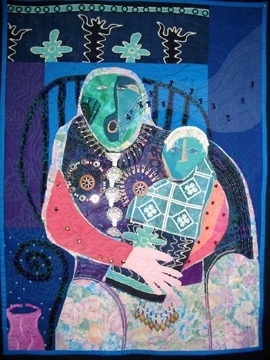
Tomme Fent (TF): This is Tomme Fent. Today is Saturday, December 10th, 2005, and it’s 1:06 p.m. Central Time. I’m conducting a telephone interview with Pamela Allen for the Quilters’ S.O.S. – Save Our Stories project. Pamela is in Kingston, Ontario, Canada, and I am in Sioux City, Iowa, in the United States. Pamela, thanks for agreeing to talk with me today. Pamela Allen (PA): Oh, you’re welcome, Tomme. TF: I really want to talk about your very unique style of quilting as part of our interview today. Maybe you could tell me a little bit about how you got into quilting in the first place. I know you had a lot of prior training in other media. PA: That’s right, I–in fact, I’ve been an artist for about twenty-three years and have worked in lots of different media and in the last, I don’t know, ten years I was doing lots of paintings and collages that frequently, when I looked at them, I thought, ‘Gee, you know, these looks like quilts to me.’ But the down side was that I had no experience in sewing, so I kept putting it off and putting it off until I discovered Lucky Shie, who’s my hero. She’s a fabulous fabric artist who offers a five-day workshop art camp. So I went there, told them what I was doing and what I wanted to do, and her advice was, ‘It doesn’t matter what you do as long as it doesn’t fall apart.’ So I came back after five wonderful days and just started sewing on my thirty dollar church basement sewing machine. And that’s essentially how my work sort of translated from painting collage into fabric collage. TF: Well, your quilts are really unique. One of the things you do that other quilters don’t do is you use a lot of unusual materials in your quilts. How do you get all of those unusual materials to stay on there? PA: Well, I have this theory that if you can drill a hole in it or if you can–if it’s metal and you can use this little gizmo I have to make a hole in it, then you can sew it on your quilt. So having come from a background at one time of making what I call ‘junk art,’ which is really assemblage art, I had masses and masses of interesting artifacts and found objects already in my studio, and I just began sewing them on my quilts. They do have significance for me, but they’re not necessarily significant to the viewer, they won’t have the same significance to the viewer. But it just keeps me interested in my quilt as I’m working to embellish. TF: For example, let’s talk about the quilt that you’ve chosen as your touchstone object today. What’s the name of the quilt? PA: It’s called “Grandmother’s Lullaby,” and there’s a significance to that in that I’m a grandmother even though I’m not a mother, and I have fifteen grandchildren, so this is a somewhat autobiographical quilt. It just shows a woman singing to an infant. TF: When did you make this quilt? PA: I made it quite recently. It’s 2005, but I believe it was early in 2005, in January. The significant thing in–it’s a milestone quilt for me because it’s the last quilt I ever made that didn’t have a proper binding on it. [laughter.] Since then, I learned to make a proper binding. TF: So you said that the materials that you use often have significance to you. How about some of the materials you’ve used in this quilt? I see bobbins and spools and garters and clothespins and keys. PA: Exactly. They’re kind of, sort of autobiographical things, and very literal in many cases. The bobbins, the little spools of thread and so on, are just making reference to the fact that I now sew. It’s also a generic thing because many, many women sew, and the history of women is that we provide our families with clothing or linens and so on, so it has a larger historical meaning for me. The keys around the neck are reference to a woman’s role as chatelaine. Even in medieval times, she may not have had too many rights of her own but one of the rights she did have was that she was the keeper of the keys of the household, so that’s the reference around the neck, plus it’s very decorative. The clothespins also, again, are a reference to a woman’s role as the laundress. The little wheels around the breasts are personal for me because I moved a great deal when I was a child and it was an unhappy thing for me and I often put wheels in because of the transitory nature of life. Now the garters, everybody always laughs at the garters, if they’re women of my age which is middle age, because we remember having to hold our stockings up with these awful garters. And I actually find them humorous and decorative at the same time. Now the eggs at the bottom are, again, a very literal reference to the function of woman, and in this case especially because it’s a grandmother and child. But, of course, this refers to the fertility of a woman. TF: Why did you choose this particular quilt for your interview? PA: I feel that it’s pretty stereotypical of the work that I do. Some of my quilts aren’t as embellished as this one is, but many of them are, and I think I, personally, get a lot of satisfaction and pleasure out of embellishments and I think viewers do, too. They always tell a little story and the viewer brings their own story to it, but I bring a story to it which keeps my interest in the work as I’m working upon it. TF: I see in this quilt both machine and hand quilting. Is that typical of your style? PA: Yes, it is. And again, the hand part, the hand appliqué, does come from Lucky Shie, in that this is her style, as well, and I really, really like introducing this coarser, linear element to my work with bright colors of embroidery floss. So, to me, it’s adding a line that scintillates because of its color and unevenness. I also want to introduce the hand of the artist. I want the artist’s signature to be on the quilt and not that mechanical stitching quality that a machine gives you. But on the other hand, the machine quilting is also important to me because it’s free-motion. I can do whatever I want. I can put–I can literally draw on the quilt with my machine stitching. TF: You also draw, if you will, on your quilts by the great variety of fabrics, not just prints but the different types of fabrics you use. Where do you get the materials that you use for your quilts? PA: That’s right, I do use–I have what I call–other quilters laugh at me because I say I have this pitiful little stash, and by most quilters’ standards, it is pitiful. It’s because I use almost always recycled fabrics. So once a month or so, I’ll go to this thrift shop or go to the Salvation Army and I’ll just go through the racks of Hawaiian shirts and flannels and hideous bridesmaids’ dresses and polyester and rayon, things that traditional quilters really don’t normally use. And I have no compunction about mixing fabrics. This one has cotton in it, commercial cotton. It has rayon sarongs in it. It has lace on it. It has upholstery fringe on it for the hair. It’s got netting on it. I just don’t care. If it looks right, I’ll use it. TF: So how many hours a week do you think you spend quilting? PA: People often ask me that. I work nine to five, Monday to Friday, in my studio. So I go every morning and I spend probably seven hours there and I come home. But I also do a lot of hand sewing at home in front of the television, and even if I’m traveling, I do it in the airports. I do it on trains and things like that. So I would say more than forty hours a week. TF: You sound like you’re very disciplined in your business, in working in your studio every day. PA: I discovered that really early on, that I had to treat it like a job because there was this mystique about an artist, you know going in the garrets and working and being inspired and working, and that’s not the way it is. It is a matter of just working, working, working, working, just as you would with any other career. The difference with me is that I really, really enjoy it, and I have probably lower expectations. I do not expect everything I make to be even saleable, let alone a masterpiece. So I’m constantly producing, but not necessarily work that can be sold. TF: Did you grow up around quilts? What’s your first quilt memory? PA: I did not grow up around quilts. As I said, I didn’t really even know how to sew. I made an apron in grade eight home ec [economics] class. It’s the art part of the fabric that appeals to me. It was only later that I discovered, through the Internet, this huge collegiate–college, really, of fabric artists across the world, but mostly in the U.S. and Canada. And it was that arts connection, I think, that appealed to me, so it isn’t the quilts. The quilt part, in fact, has been problematic for me because over time, I’ve had to really improve. I was really terrible, my sewing, at first. And I got a better machine and that sort of thing and I feel now that I’m sort of okay, sewing-wise. So I kind of came at it backwards. I think quilters, art quilters who started out quilting try to get out of the box and into the art quilting. I came out the other way and I’m trying to get in the box, in the quilt part of the box, just through my skills and my techniques. TF: Have you ever used quilting to help you get through a difficult time? PA: Oh, yes, yes, indeed. And that was the other thing that surprised me when I switched over to fabric because I’m kind of a very lively, up front, kind of hyper sort of person, and I would not have thought that I would have the patience to sit and sew as much as I do, but in fact I discovered it was very therapeutic and it was relaxing, and you sort of go into a Zen mode and creatively, it gives–when you’re doing the hand bit, you’re trying to think about what you’re going to do next and so on, and as far as the therapeutic part, because I work kind of–my subject matter comes from my own life and so on, it’s kind of inevitable that–this year, because my mother died and my sister got cancer, although she’s now in remission, and it’s just been a rough year. And many of my quilts helped me through that because the subject matter of the quilts were about that. TF: What do you think makes a quilt artistically powerful? PA: Well, there are two things that I want to see in a work of art, and I’m talking as a work of art, not a quilt but as a work of art. I want to see the hand of the artist. I want to see the personal process of the artist actually working upon the material. And I also want a personal input into the subject matter. Now, there’s a lot of discussion about being derivative and having other artists influence you and so on, and I am a hundred percent with that. My work has Picasso influences in it, Matisse influences in it, and so on, but I try desperately not to copy or not to appropriate, and that’s what I look for in other art quilts is that personal injection that I know that this person has done something no one else has done. TF: Do you also make any other fiber art objects, like wearable art? PA: I don’t, actually. I was the kind of person who, when I tried to sew clothing, I’d always put the left sleeve in the right armhole, that sort of thing. It’s funny because when I think about it, it sort of goes against my personality. It’s following a pattern. I’m just not that kind of person. So to me, the spontaneous way that I work is perfect for me, and I think that’s why I don’t do clothing or anything that has to fit. TF: Well, I know that you’ve started doing some traveling to teach classes and give lectures to guilds and things like that. How is that affecting your work? PA: How is it affecting my work? That’s interesting. I think as for the content of my work, I’m not sure it affects it all that much, but what it has done is made me very, very happy to have found this genre. The more people I meet, the more I teach, the more traveling I do, I’ve discovered that it’s a huge–I was going to say sisterhood, but there are many men in this. It’s a collection of like-minded people who are so generous and fun and we share common experiences and that’s really affected me in my teaching and so on. I enjoy teaching, so that’s also good. TF: In what way is quilting important to your life and how does that differ from other types of art that you’ve done? PA: I think it doesn’t differ from other kinds of art, but I feel as if I’m–I feel as if I’ve found my niche with quilting. So whereas before, I was often anxious and worried about, you know, ‘I’m not as good as everyone else,’ or ‘I’m not on the cutting edge,’ and all that sort of stuff, that all went out the window when I discovered working with fabric for the certain reasons that I mentioned before, that it’s–actually it’s relaxing and it makes me happy, but also because I just enjoy it so much. I really enjoy going to work each day. I think about what I’m going to do next. When I come in my studio, I’ve got lots of colorful fabrics around and past-made quilts that please me. So I think that’s that same thing. TF: You mentioned that you don’t follow a pattern and you do really free-form work. What suggestions would you have for quilters who haven’t tried that type of work that would allow them to become a little more free. PA: Yes. It’s not a matter of technique. Even now, I try to analyze my own way of doing things, and it’s not technique, it’s attitude. And it’s sort of ‘in your face’ attitude, in a way. Like, ‘Take out the fabrics, throw away your rotary cutter, use your scissors as if it were a drawing tool, and just lay your shapes,’ and just confidence that, ‘Oh, if that doesn’t work, take it off, put something else on, or if some of it works, put something else on the part that doesn’t work.’ Just the confidence that eventually, it will work. And you just sew away and you quilt it and you are happy with it. It sounds pretty simplistic, doesn’t it? TF: It makes it sound very easy to do. It makes me wonder why more people don’t give it a try. PA: I wonder, too, sometimes, because quilt–now I do make a distinction between quilters and art quilters, and art quilters presumably are making art and a function of making art is to open up their mind and to be–I call it ‘stream of consciousness.’ You do one thing which suggests that you might do something else and then that suggests that you might do something else, so it’s always a creative and open-ended process. And when people get bogged down with, ‘I’m making this plan, I’m cutting out templates, I’m arranging it on my background fabric,’ it seems to take all the spontaneity and creativity out of it. Now, I couldn’t possibly work that way. I think others might benefit by sort of throwing out the templates once or twice and their patterns once or twice, and just sort of go with the flow, cut with scissors, choose the colors you like that aren’t on the color wheel, and that sort of thing. TF: Are all of the quilts that you make for display, or do you also make quilts for use, like bed quilts and lap quilts? PA: Yes, well, I would say all of my quilts are for display. I have made two quilts for snuggling and I vowed that I would never do it again. And the nature of the way I work, because I do raw-edge, hand appliqué and so on, the one I made for myself to sort of snuggle under for television, when I wash it, it becomes more and more and more like chenille. And the mixture of fabrics I use, they’re not all washable, so that has deterred me from doing bed coverings. TF: Have you made quilts for friends and family? PA: I have, yes. I do smaller things, but I do things. We have a huge family and we’ve got twenty-five people on our Christmas list, children mostly, and I have done things for them, yes, mostly things like appliquéd sweatshirts and appliquéd aprons and things like that. TF: How do you think quilts are significant in either reflecting or preserving women’s history in North America? PA: It is significant. It’s something I’m reluctant to accept, actually, because it’s so stereotypically women’s work, to work with fabric and sew and so on. But in the art quilt genre, anyway, I would say that we are continuing the tradition into the modern era in that now, it’s not necessarily, what’s the word, functional, but rather an expression of – any artist, an expression of how you feel or how you think or what message that you want to give to people. And it’s in a particular genre that’s particularly feminine and has been for decades and centuries. So I’m aware of that and I’m quite charmed by that. TF: Do you have any sense of where your work will fit into the bigger picture of art history? PA: My work? TF: Yes. PA: I don’t know, I think I’m more humble than that. I think my work is art, I do think it’s art. I’m sort of not too humble about that. But whether it’ll make a significant difference, perhaps to the owners of each one, it might, but I don’t think over a long–just as many painters and many printmakers and many other artists in other genres are not going to make a huge impact, they’ll make an impact on the owners of their work, perhaps, and if they teach, they’ll make an impact on their students and the up-and-coming generation. And I do hope that I can make that kind of impact on my students. I have been to enough shows now to realize that–some of the women come up to me afterwards and sort of thank me for freeing them, so I think there’s a niche there that I’m filling, yes. TF: Well, I think your work is amazing and I think it is very important in the history of quilts and will be studied and enjoyed for years to come. PA: Well, thank you very much. TF: Is there anything we haven’t talked about that you would like to talk about in relation to quilting? [pause.] What about the computer, do you use the computer to aid you in design or in any other aspect of your work? PA: That’s a good point. I do indirectly use the computer and actually directly, now that I think about it, because I–this technology where you can use this Bubble Jet Set to prepare your fabrics to take on a computer image, I do use that and I think it’s brilliant, actually, and maybe could be used a little more adventurously by other quilters, as well. And I was also toying with digital collaging and things like that before I began quilting, and I refer to those frequently in designing quilts. My memory of that sort of funny juxtaposition of different shapes and different scales, oddball color and so on, is very available on the computer and that’s why I loved doing digital collage, and I think that did, indeed, affect my imagery in my quilts. And also being on the Internet and talking to other artists, other quilt artists, is a great tool for an artist because essentially, you work in an isolated place as an artist. You’re in your studio and you don’t sort of face-to-face meet people, but having those thousands of people on the Internet who are interested in what you are interested in is marvelous. It really keeps you connected. TF: Well, I would like to thank Pamela Allen for allowing me to interview her today as part of the Quilters’ S.O.S. – Save Our Stories project, and our interview concluded at 1:30 p.m. PA: Well, thank you,…
by Amy Milne | Aug 12, 2018
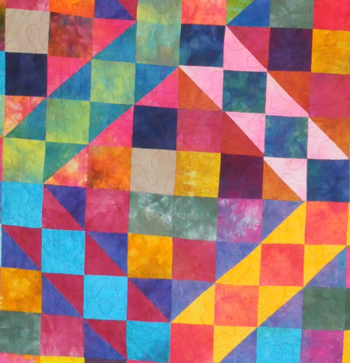
[The interviewee, Richard Tims, is joined on the call by his son Ricky Tims. Ricky occasionally speaks to Richard and Meg to help clarify questions and answers.] Meg Cox (MC): Today’s date is March 21, 2010 and it’s 12:13 pm and I’m conducting an interview with Richard Tims for the Quilters’ S.O.S. – Save Our Stories project. Richard is in Wichita Falls, Texas and I’m in Princeton, New Jersey, we’re speaking by phone and–uh Skype actually, to conduct this interview. And thank you so much for doing this today. Richard, I’ve got a picture of this quilt that–can you tell me about this quilt that you’re using as your quilt for this interview? Ricky Tims (RT2) Let me explain that. [to Richard.] Dad, the quilts that you’ve been making, all of these quilts like that you’ve been making– Richard Tims (RT1): Yeah. RT2: She has a picture of one of those quilts. RT1: Okay. RT2: And she wants you to tell her about that quilt. RT1: I’ll try. RT2: Okay. Tell her what you know about it. MC: So tell me about the quilt. RT1: Well, I don’t know, I just—uh, picked it up one day and made this little block and then I made another little block kind of went with it. I just kind of fell in with it. I’ve made–uh, several quilts out of it. MC: Does this pattern have a name? RT1: No, I haven’t named it [laughs.]. RT2: I would chime in to say that we officially call it “Papaw’s Choice.” MC: Right. RT2: Because it’s just squares and half square triangles, but we did publish that on TheQuiltShow.com under the title “Papaw’s choice,” but that was my name giving it to him. MC: Okay. RT2: I think it’s also loosely based on jewel box? RT1: Yeah. RT2: Yeah. MC: Okay. What do you think, somebody looking at this quilt, what might they conclude about you? What does this quilt tell people about you do you think? RT2 [to Richard.]: What do you think people can learn from looking at that quilt about you? RT1: I don’t know. I never give that much of a thought. It just–I don’t know. [laughs.] RT2 [to Richard.]: What about the colors you use? Sorry, Meg. MC: It’s okay RT1: Oh, I just use any color that comes along and I don’t know that either. I just, just slap it together sometimes. Maybe it look good, if it don’t–don’t suit me, I’ll pull it out and do something else. MC: Okay, what age were you when you started making quilts? RT1: Well, I was gonna say 65. MC: Okay. Why did you start? RT1: Why did I start? Well, I was working with the trucking company and I was working four days on, and four days off and I didn’t have nothing to do around the house but nothing, and I says if Mama can make a quilt at 85, Richard surely you can make one at 65 [MC laughs.], and I started in. And I worked four days off in here by myself and then I’d go back and work my four days and come back work another four on the quilts. Something to play with, pass time away, and it just kept getting bigger and bigger and bigger. [MC laughs.] MC: So do you make quilts now that you’re not working? Do you make quilts every day? What is your quilting schedule like? RT1: Oh, I’ve got a little room out in the back of the house, attached to the house with air-conditioning and everything. I have to go outside to get into it, but I just keep my sewing machine out there and if I feel like going out and sewing I’ll go out and sew a hour, two hours, and come back in and–they, I don’t get no hurry about anything, just kinda go out there and make me four or five blocks maybe and come back in the house and sit down. Television gets bad, I’ll go back out and make another one. [MC laughs.] MC: How many people in your family quilt? I know your son quilts. RT1: I guess my mother was the only one I know of that, uh quilts, quilted. But, uh I kinda copied after her a little bit. And then uh Ricky he come in and he started quilting with us. MC: Are people surprised when you tell them that you’re a quilt maker? RT1: Mmm, well no. MC: What are your favorite techniques? RT1: Oh I don’t know I got one that I made myself but I haven’t got no name for it. It’s just… I wouldn’t know what else to start naming it. RT2 [to Richard.]: She’s wanting to know what your favorite techniques are—what, how—do you like to hand sew, do you like the sewing machine, do you like rotary cutter, what do you like to do? RT1: Oh, I like my sewing machine. MC: Okay, so you do everything on the machine? RT1: Everything on the sewing machine, yeah. MC: Alright okay, and– RT2 [to Richard.]: You use a rotary cutter. RT1: I use a rotary cutter such as that, but I do my sewing on my sewing machine. RT2: Meg, I have I got a question about chiming in. Do you want me to not chime in or–because I know there’s an answer to that question, but he might not know quite how to articulate it. MC: Well if you have a follow up question you think might help get him to a more thorough answer I would say– RT2: Okay, I just particularly know that dad, uh he likes to layer fabrics together and draw his squares and diagonals and does the stitching on that so that he can do sort of quick, quick assembly half square triangles and he’s very good at doing that, but it it’s kind of hard to describe that that’s what he does a lot. MC: Well let me ask you this, Richard, see, the quilt that you brought here has beautiful fabric and it doesn’t have patterns on it, it’s more of a uh, sort of a solid and it might be hand dyed. Where do you get your fabric and do you ever use–is that a fairly typical look to your quilt? RT1: Well, I get Ricky’s scraps. MC: [laughs.] RT1: That’s where I get–that’s where I make most of my–I don’t–I can’t remember ever purchasing anything to make this quilt, but I just get Ricky’s scraps and go from there. MC: And beautiful scraps they are. RT1: Yes, they are. MC: Very beautiful. Let me ask you this, um, do have you ever used quilting to get through a difficult time. In other words, have you had a rough time where it was sort of a therapeutic thing for you or is it just fun? RT1: Is it just what? RT2 [to Richard.]: Is it just fun? RT1: It’s just fun, I just go out there and pass time away and come back in the house and watch television awhile and it gets where I don’t like it I go back out and make another block or two. MC: Now what are your plans for your quilts? When you make a quilt are you making it for yourself, are you thinking I’m making this for this specific person? Talk about where your quilts go. RT1: Oh I don’t have any regular plan for them if I’ve got one made and somebody comes round and likes it and I can give it to ’em. Give it to Ricky, give it to my daughter, granddaughters, my great granddaughters. RT2 [to Richard.]: Sometimes you make the quilt for somebody though. RT1: Yeah, sometimes yeah. RT2 [to Richard.]: Sometimes, for like for I wanted to make that for Brian and you made it in fabrics that Brian would like. Sometimes– RT1: Yeah sometimes, yeah. RT2: But not very often—yeah. MC: What were your mother’s quilts like? RT1: Oh, I don’t know, uh– RT2: Stars, lone stars– RT1: No, she didn’t make lone star–broken star? Broken star maybe. I don’t know, just square blocks most of it I think. Just– MC: Now I understand you made a quilt with Ricky that had a lone star in it, didn’t it – am I right? RT1: Yeah, uh huh. MC: Was that a lot of work? What was that like? RT1: Oh it’s just–I don’t make work out of it, I just twiddle with it every once in awhile and if I don’t like it I’ll pitch it out and try to see if I can make another one. MC: What do you think makes a great quilt? RT1: What do I think makes a great quilt? RT2 [to Richard.]: What makes a great quilt? Successful quilt? RT1: I don’t know much about that. I just don’t have that in mind when I’m working on them. I just–if I like that block I’ll make it, if I don’t like it, well I’ll throw it in the trash. [MC laughs.] MC: In terms of, um, other quilts made by other people are there particular quilts that you’re drawn to or particular quiltmakers that that you, that you feel are really something special? RT1d: No, I just try–I just pretty well stay on the same pattern all the time. MC: Do you ever go to a museum or um a place to see a quilt show to see other people’s work? RT1: I go follow– go with Ricky’s quite a bit whenever he’s having them on show. MC: Has his work inspired you in some way? RT1: Well it helped a lot. MC: What’d you say? RT1: What he’s doing, but, uh I can’t say he’s the one who told me to start. MC: Right. So that was your own idea? RT1: Yeah. MC: Why is quiltmaking important to your life, Richard? RT1: Just something for me to be a-doing. Pass the time away. MC: Do you, um–how do you have your quilts that you–do you keep some of your quilts and where are they, are they hanging on the wall, are they on the beds? What do they mean to you at home? RT1: Oh, I don’t know, I got some on the bed, and I got some give to kids and grandkids and I’ve got– RT2: Got one on the wall RT1: Got one on the wall over there, a little, little quilt. there’s one on the wall. MC: So you have one on the wall in your kitchen? Or is that where you are? RT1: Got in a living area. MC: I see, okay. You’re um, pointing towards the wall and on Skype I can see you’re sort of in a kitchen area. RT1: Yeah. MC: So you’re at what, a dining room table? RT1: That’s the kitchen. To my right is my living room–the den or whatever you want to call it. MC: Oh I see it, over there it’s on the wall, um by some chairs and the television over there so you have that quilt where you can see it. RT1: Uh, huh. MC: When you’re in your living room. Terrific. Um, do you have any idea how many quilts you have made so far? RT1: No, I have no idea how to start telling you how much, how many. MC: You think it’s more than 10? RT1: Yes, quite a few more. MC: Okay. Do you have uh, some goals for your quiltmaking going forward? It sounds like it’s um it’s sort of something you do to occupy yourself that gives you pleasure and you don’t have a quota, but how do you think about it? RT1: Well I don’t know, I just I just make it so it’s just something to be a doing, pass the time away. MC: Right. RT1: And I may go out and I may quilt 30 minutes and I may go out and I might quilt an hour, two hours at a time, I’m just I just kind of roll with the flow. I don’t get in a hurry with it. MC: You go with the flow? Is that what you said? RT1: Yeah. MC: That’s a good way to be. What–do you want your quilts to be preserved, do you think that they will last and be remembered by your family members? RT1: I kind of think they will be, yes. MC: Have you ever given them to somebody who’s not in your family? RT1: Yes. MC: And who was that? RT1: I don’t know, don’t remember but who they are, but I have gave some quilts away to different ones. MC: Do you name your quilts, or not? RT1: Do what? MC: Give them a name? RT1: No, I never name one. MC: Do you put a label on them so people know that have a record that it was made by you? RT1: Yes, yes. MC: Now what about finishing your quilts, do you do that or the quilting part or– RT1: I just I just do the quilting top and then I’ll take it down to a quilt show and let them–a quilt show, a quilt shop and let them make it—quilt it up for me. MC: Okay. Do you think that quilts are important to American life? Do you that that’s the thing now to be quilting? RT2: Ask that one more time please, Meg. MC: Yeah. Do you think that quilts are important in American life? RT1: Oh, I think so, yes. MC: Yes, you do. Okay. Is there, um anything else you want to say about your quilting and uh how you want to be remembered? RT1: Oh, I don’t know, I’m not much of a–uh, on telling things like that. Don’t know much about that. No, I just kinda roll with the flow. MC: Okay, alright, well I think that um–that’s a good place to end. I want to thank Richard Tims for allowing me to interview him today as part of the Quilters’ S.O.S.-Save Our Stories project and our interview concluded at12:29 pm March 21, 2010. Thank you so much. RT1: Okay. MC: Thank you. RT1: Thank…
by Amy Milne | Aug 12, 2018
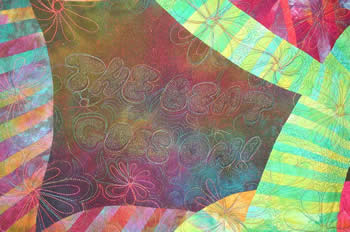
Barbara Beck (BB): I’m Barbara Beck and we’re at the Houston Quilt Festival interviewing Ricky Sims. Wrong? Jo Francis Greenlaw (JFG): It’s Ricky Tims. BB: Tims. Ricky Tims (RT): T-i-m-s, it’s Tims with one ‘m,’ thank you very much. BB: Thank you and it’s 3:40, November 3, 2000. I’m glad to have you here. RT: Thank you very much. BB: Yes, you make quilts. RT: Yes maam, I do. BB: Tell me about your quilt which quilt did you bring today? RT: Well I–the main quilt I brought for you to see today is a quilt that is a new quilt of mine it’s called ‘The Beat Goes On’ and you’re wanting to see this? BB: Yes, yes we are. Come on and let’s spread it out. [rustling from quilt.] Tell me about this quilt. RT: I’ll tell you about the design of the quilt first. The design of the quilt is a central heart which is sort of string pieced together in red hand-dyed fabrics. Surrounding that heart is sort of a turquoise blue and chartreuse green ribbon that’s just wrapping around it and then there is a rainbow colored ribbon that just flows through the whole surface of the piece. The entire quilt is made from hand-dyed fabrics and then it is quilted with sort of flowers that look like they might have been flowers from the sixties and then stipple quilted in between that. The quilting is mostly metallic threads but not all metallic threads and that’s the design of the quilt. The name of the quilt is called ‘The Beat Goes On’ and I made this quilt–I began making this quilt eight days after I had quadruple bypass surgery. I had the surgery on April the twenty-fourth of this year, 2000, and eight days later I was working on this quilt and finished the top four days later and then I quilted it. It was to commemorate that significant event in my life. I was home five days after the surgery. I had written my thank you notes and I said, ‘I’m going crazy sitting in this chair, I can sit in my chair and sew.’ My dad who was also a quilter. Hint-future question–my dad who was also a quilter was there and my mom was there. They were taking care of me as I was recuperating so when I went down into that studio eight days afterwards I did not know what I wanted to do but I knew I wanted to sew and less than five or ten minutes later I had drawn three or four little stylized hearts and I thought that I’d just make a little heart quilt and by noon that day I had pieced the entire center heart. Drew it full size on the freezer paper and started string piecing it onto the paper. Now when I do that technique I typically tear my fabric strips and just organize them so then I can have them all ready to go to just flip and sew, I don’t need to have the rotary cutter to do those strips. But every time I would fold the paper back and trim off the seam allowances to the proper size it need to be I would have this little leftover scrap of fabric that was maybe a quarter of an inch wide or something and had these little strings. I would turn around to sew the next one and turn back around and it would be gone, and that’s because my dad sat there the entire four days and took every little fabric scrap and put it into the trash. So, I never had one string or one stray thread I had a perfectly clean work area for those four days. And that was pretty fun and I give my mom credit for this quilt too, because while I was working on this she was upstairs making me healthy meals for me to recover from the surgery so I called it the “The Beat Goes On” obviously because after the surgery and I woke up and came through all of that, ‘my heart is still beating.’ Often times my quilts are named after some musical element, not always, but many many times after having grownup as a musician and a professional musician I use musical titles. I was reminded while working on this of the Sonny and Cher song from the sixties “The Beat Goes On” so that’s how it got its title which is also actually trapuntoed into the surface of the quilt. BB: This is just beautiful. RT: Thank you. BB: This is just beautiful. It’s just terrific so tell me what are your plans for this quilt? RT: Well the first plan I had for this quilt was to enter it into the show today here at the IQA. [International Quilt Association.] I entered this quilt and my other quilt. I entered two quilts into the show. Only one of them got in. This was the reject from the show. The one that got in won the Pfaff Machine Artistry award for $5000 so you go from here to here ya know you might get one in and you might not get one in but, anyway, that’s the story behind this particular quilt. BB: Tell me about when you started quilting? RT: How I got involved in quilting? BB: Yes. RT: I began quilting in 1991 as the result of acquiring a sewing machine from my granny. My granny was my mother’s mother. Her name was Bertie Marie Newsom and she lived for years in North Texas in a place called Lake Kickapoo. I was born in Wichita Falls, Texas so I wasn’t far from Lake Kickapoo and I spent most of my time with my granny. I loved being at the lake, fishing and swimming, and working in her garden. When I was a child, I remember her sewing on her Kenmore sewing machine. She made nothing that I remember that was fancy in the way of a quilt or a garment. She made practical things and she patched things and she reused things. And when she did make a quilt it was chunks of scraps sewn together usually the filling was done with a wool army blanket and the back might have been a flannel and then she would tie those quilts together and they were very heavy. We used them to sleep under in the cold North Texas winters and we also used them to pull heavy furniture across the floor but in 1991 we are all living in Wichita Falls. My granny had become a widow and we built a house for her across the street from us. In 1979, Wichita Falls had a tornado that tore our neighborhood down and it was after that, that we rebuilt our house but we also rebuilt a house for her that my granny moved into so she lived there from ’79 until ’91. In 1991, I was living in St. Louis, Missouri doing music work there professionally and she had been a widow for several years. She got a phone call– she’s 83 years old–she gets a phone call from a fellow by the name of Pete Hudgeons who lived in Lubbock, Texas. Pete is 87 and he had become a widower and she had not seen this man in at least 15 years and he proposed to her over the phone. And she threw away her cane [laughter.] and she drove four hours to see this man in Lubbock, Texas and they were married exactly two weeks later. After which we had to sell her house and divvy up her belongings amongst her two daughters and four grandchildren. Well, my momma said, ‘What of your granny’s do you want?’ Well, my granny didn’t have nice things and I didn’t want to fight over anything so I said, ‘You let everybody else pick and I’ll take what’s left over.’ And what was left over was her Kenmore sewing machine so the Kenmore sewing machine made its way up to St. Louis, Missouri and it sat in the corner of my dining room for a week or two. My mother had shown me how to wind the bobbin. I thought, ‘well if I know that I should be able to do anything I want to with this sewing machine.’ So I decided that I would make myself a shirt so I drive off to the Cloth World store and I go in and I start looking at the pattern book for men’s clothing. While I’m doing this the voice of my granny and the voice of my mother are both coming into my head. When I was a child they would never made me a shirt because they said the shirts were the hardest things you could make. They made dresses for my sister. They made dresses for themselves but they never make shirts that I’m aware of. So I decided if I’m going to do something I probably should start with something easier. So I turned around and there was a rack of quilt books and one of them was called “Learning to Quilt: Quilting for Beginners” and it had twenty sampler blocks or traditional quilt blocks. At the time I didn’t even know that quilt blocks had names. I didn’t know that there was such a thing a name for a quilt block but I bought this book thinking that I could certainly make a quilt a lot easier than I could make a shirt. Nobody ever told me a quilt was hard. And I’m thinking to myself that a shirt has shoulders and curves and sleeves and a quilt is just flat so that should be much easier to make. I bought fabric for that quilt I started making it by cutting out templates and drawing around those templates with a Bic ™ pen because I couldn’t see a pencil marking and I would do my best to make a quarter of an inch seam allowance. And every one of those blocks ended up being somewhere between eleven and thirteen inches and they were supposed to be twelve. [laughter.]. Well I figured that must be okay because that averages out to be twelve inches and on that same quilt [announcement over the loudspeaker.] and then it came time to sash the quilt and I started putting the vertical sashing in for the rows, the columns I mean, to make the long ones together and I ran out of sashing fabric so I just thought I would go back and get some more of that. When I got back to the store it had been four or five weeks after I started the quilt and of course there’s not anymore of that fabric so I have literally maroon sashing going vertically and green sashing going horizontally. [laughter.] Oh, I could keep going with this story if you want to hear more of it. BB: What size was it? RT: It was a full size quilt or queen size; I didn’t measure but like 96 by 80 or something. A big quilt. BB: What was the pattern? RT: It was a sampler quilt. It had twenty different blocks. BB: So you did twenty different blocks? RT: Twenty different blocks and learned the names. Memorized their names and to this day–One of them was a Grandmother’s Fan. One was a Shoofly. One was a Friendship Star. One was an Ohio Star. One was a Honeybee block, you know. BB: How long did it take from beginning to end? RT: Well– BB: You said it was four or five weeks until the sashing. RT: Well yes, but to get the sashing–actually getting the quilt top together was probably more like three or four weeks because I was really loving this. I started reading every quilt magazine I could get my hands on because I loved it so much. I discovered there was such a thing called a rotary cutter and mat which I never even knew existed. And there were other quilt books that taught methods of doing quilts like that so I don’t know. I started making other projects even while this one was starting to go on to a quilt frame and get quilted. So it might have taken a year before I finally got around to getting the binding on it after quilting it but in that year I had probably made another good thirty or forty quilts of varying sizes. Some of them were very small. Most importantly I would like to say that, that first quilt is the only quilt that I made from a pattern because my life as a musician had been in the creative part of music. I had been a composition student in college and I love creating so I immediately started adapting my own designs and creating my own quilts; the second one through now. None, of them are–are– BB: So, the first one was like the book? RT: Exactly like the book. I think I even put the blocks exactly like the picture in the book. But, past that I went on my own and started doing my own creative type things. And I hand quilted that first quilt. As a matter of fact, it’s at home and there are times when I sleep under it but I keep it a little bit more treasured now because I think of it as my first quilt and there’ll never be another first quilt. So I take very good care of it. This is a funny story—I’ll go ahead and tell you this too. When I hand quilting I did not know a quilter for three months at least and I went into a Ben Franklin store one day looking for fabric and when I got in there, there was this–she wasn’t old, but she was an older lady and she was looking at fabrics. And she struck up a conversation with me and she said, ‘What are you doing back here?’ and I said, ‘Well, I’m looking for some fabric.’ And she wanted to know what I was using the fabric for and I said, ‘I’m making a quilt.’ It was so cute because only a quilter would do this but in one fell swoop she reached into her tote bag and went ‘whoosh’ and there was a quilt and she said, ‘What color border would you put on this one?’ [laughter.] And I went, ‘Ma’am, I don’t know. I don’t have a clue.’ That lady’s name was Ponnie Brinkman, P-O-N-N-I-E Brinkman. And she ended up inviting me to the quilt meeting that night. Now I did not know there were going to be so many people there. I was expecting a little quilt frame and several women sitting around it kind of talking and drinking coffee and that sort of thing. And I ended up in a meeting of 250 of those quilters but as a result of getting involved with those quilters in that guild– while I am self-taught. I learned from them. It’s them individually that I’ve learned from one on one. I was quilting that quilt and I didn’t know how to do anything except what that book said and that was make a running stitch. I stab stitched the quilt for several days, just piercing the needle all the way and then back up. And I was making the stitches exactly like the book. The book did not bother to tell me that the picture they had was a magnified version of the quilt stitch so I’m making my stitches about a quarter inch a piece. I hadn’t seen quilting stitches; this was something I had never in my life. Well finally a friend came over one day and said, ‘I’ve watched my aunts quilt and what you’re supposed to do is get several stitches on the needle rocking it back and forth and then pull the needle through.’ And my friend told me in order to do that I was supposed to be using a much bigger needle so I went and bought a four inch needle to try to quilt this quilt with. As you can imagine, I can’t get three stitches into this quilt before the needle is stuck in the quilt so I’ve got my tool box out–I’ve got a pair of pliers. I’m doing anything I can to try to quilt this quilt the way it’s supposed to be quilted and really that’s the roots of how I began as a quilter. And it wasn’t until I got into the guild that I started asking people about needles sizes and so on and so on and so forth and I found that really the smaller the needle size the better your quilting stitches will be but I was using a fairly large needle at the beginning of this endeavor. BB: What aspects of quilting do you not enjoy? RT: [long pause.] I used to not enjoy putting on bindings because I felt the quilt was so done. I was so finished it was all quilted and then you would sew on the binding and then you would sew it on the binding and I would sew it on by hand and that could still take me days and days it would seem to get the binding on. I didn’t enjoy that. But now I use this machine type binding you’ll notice on this quilt. I love putting these bindings on so I really have to tell you there is nothing that I don’t like about the quilting process. I love the designs; the fabrics; the top. I love the quilting part. I love the binding part. I even love making the sleeves. BB: Tell me–my daughter-in-law thinks you’re wonderful– RT: Okay. BB: She saw you a couple of years ago. Tell me how you came to what–the way you do it–how you put the quilt together? RT: How I put– BB: You know you draw on the design– RT: You know what; there are so many ways to put a quilt together. My philosophy from the beginning was and this is what happened that first year I was reading every magazine I could. If there was a technique I didn’t know anything about, I would try that technique. And I wouldn’t make a full sized quilt I would just do enough a small piece or something to learn the technique. The more techniques I had in my little bag of tricks when the design came to my mind I could go from that repertoire of tricks to create that quilt so the more you know – the more you can create. I sort of am settled now into only a few things that I’ll tend to do. One of them is called “Quilting Caveman Style,” that is not anything other than a name but it means cutting and sewing fabrics using a rotary cutter and mat not planning a seam allowance and not using templates and not measuring anything but just creating an improvisational design and it could be representational. I could make a flower, or a house, or a bird or whatever, a fish, just doing this method but it’s not a precise method of sewing. I also do “flip and sew” method with the design on freezer paper and when I want to be precise and I need to be accurate then I use that particular method. I can do other things but those seem to be the two methods that I tend to use most because I like working with curves. And so the freezer paper helps me with precision curves and the “Caveman” method I can just create spontaneous curves. BB: Tell me about this other quilt you’ve brought. RT: Well I brought things to just spark some questions, I guess. This little quilt is–was done “Caveman” style. The heart quilt we’ve been talking about was done on freezer paper drawn full size and “flip and sew,” let me just say that. This quilt–these squares were just randomly cut and actually they were part of a larger quilt that I had made and there were some leftovers so I just set them together sort of on point and had fun with this quilting design which really can’t really describe on tape but it’s a non-stop quilt design. The entire–everything inside there is non-stop quilting by the way I did that. BB: Tell me how you did that. RT: Okay, I did this, this, this, and then here, here, here, here, here, here, here, here, here, and here, and then the outside ones here, here, here–. BB: And Ricky is going around each flower with his finger showing how it goes. RT: Right. Good and I go on to the outside ones and once I got back to here then I can do these outside ones– BB: That’s lovely. RT: And then these inside ones and then it’s done so–and then I can start stippling and so the thing of this–the thing of note on this quilt is the binding once again. I used to hate doing bindings. This is a scalloped binding and it looks like the scallop is a fold that’s put on the quilt and then the binding is put on that–[BB: “uh, hum.”] in actuality the scallop is put onto the binding and the binding is put onto the quilt and I quilt in the ditch between the scallop and the binding. There’s a line of stitching you can barely see running right along the edge of that quilt so there’s not a single hand stitch anywhere on this or this or the quilt that I won with here at IQA [International Quilt Association.] today. This quilt has a little bit of history that I would like to share– BB: This is another beautiful quilt flower RT: This is a small quilt–probably a–18 by 24 inches or something like that and its name is “Tulip for Chantelle Number Two.” Yes there is a “Chantelle Number One.” And I’m going to tell you the story of Chantelle. When I was in England teaching for the first time in 1997, as I was jet lagged, they drug me to a beginning quilter’s class. I wasn’t teaching, just observing. These beginners didn’t know much about quilting but the next morning the teacher called and said, ‘One of my students just called and she wanted to know who Chantelle was last night.’ And she had said ‘What do you mean who was Chantelle?’ And she said ‘Well, Ann brought Chantelle and I thought I met everybody but I didn’t meet anyone named Chantelle and right towards the end of the evening you said Ricky brought Chantelle and I still hadn’t met this ‘Chantelle.” And the lady started laughing and laughing and she said, ‘No, no, no. I said, ‘Show and tell. Show and tell.” So Ann had brought ‘show and tell’ and Ricky had brought ‘show and tell.’ Well, the hostess that had arranged my trip to England, I wanted to do something nice for her so I made this quilt or rather a quilt like this one, in my “Caveman” style. I just cut and sew the pieces randomly, not knowing exactly how they are going to turn out but I ended up having this little three pointed tulip with a stem and two leaves and I ended up giving it to her. And as a joke I called it “Tulip for Chantelle.” Okay so it’s a tulip for show and tell, right. When I got home, I wanted one for myself so I made this one so I call it “Tulip for Chantelle Number Two.” Well whenever I had the opportunity to send one of my previous prize winning quilts to England to enter in one of their shows, I thought those ladies would get a real kick if I sent this little piece over just for fun to go with that. About three weeks later I got a phone call and I could not believe that my other quilt, the large quilt had won two blue ribbons at this national show in England but I was stunned whenever I found out that this little quilt had won judge’s choice award. And it was only really sent over as a joke for those ladies. It features what has now become one of my trademarks as well and that is called “bobbin quilting.” You will notice that in the flower and in the two frames there is a black sparkly thread and that black thread is really too heavy to go into the top of the machine and work well so it’s put in the bobbin and then I have orange thread in the top and quilt with the wrong side of the quilt facing me. Usually people say, ‘Well then how do you know where to do that?’ because that fills in those frames. In this case, I quilted in the ditch first from the top with the orange thread all the way around and once I’ve outlined all those wavy frames then I can just turn it over and fill in between those. Sometimes I don’t want to see that quilting in the ditch stitch so now I use the wash away water soluble thread. Quilt in the ditch again, flip it over. I can still see where to do the bobbin quilting and then when the quilt is wet that all dissolves and you have no idea how it got marked just sew it on the back so I use two different methods to do that. BB: It’s lovely, just lovely, it’s beautiful. And you have another one there, is there another one? RT: Yes, there’s one more here. This small piece is from a new series that I am and becoming more and more well known for that I call “Harmonic Convergence.” Now, we already talked about my closeness in involvement with music so the word “harmony” would be a musical term but what happened was I was working on the back of quilt one day and I wanted to use some of my hand-dyed fabrics that I didn’t like very well. And so I chose two fabrics that were spirals. Now this is something similar to what you’d see on a modern pop t-shirt with the spiral going around it. I had two of those and I didn’t particularly like them so I figured I could use both of them on the back but when I put them side by side I thought I was looking at two owl’s eyes, just kind of going crazy. So I started thinking what could I do to those two pieces of fabric that would break that up and I decided to slice them into strips starting at the center. I had two fabrics laying side by side and then starting at the center I cut a one inch strip and then a one and a half inch strip and then a two inch strip and then a three inch strip going from the inside and to the out. Then I took the skinniest strip of this piece and moved it over into this and I sort of started sorting these pieces into each other and suddenly the spirals were flying into each other and it was amazing. So then I began developing a new idea and I have an entire series of quilts now based on this. I have instruction patterns that people are using to do this series. And this particular piece that I brought is a very basic, simple example of that work. BB: Did you cut this “Caveman” style? RT: This is done with a rotary cutter, a ruler, and a mat. So this is a one, one and a half, two, two and a half, three inches. It is done precisionally. There is no tearing involved but look if you will you’ll notice–to see the two fabrics. Find this fabric and notice that it will just jump over this bar. This is the same fabric now jumping over here and you see yes it is still flowing along. Jump one more. It’s still the same fabric moving across and finally it ends with this little piece. But just go the opposite direction and you’ll see that this one just moves right into that. So this fabric–these were two little squares and they just fly into each other. BB: That’s just lovely– RT: And in order to create this one little extra seam I cut an inch off of the top. I sliced the quilt and I rotated it 180 degrees and just sewed it right back into the quilt. It’s truly the easiest thing and when I teach this class in a day the students will do two pieces more complicated than this but they do two quilt tops in a day. BB: Did you quilt this bobbin– RT: No, I quilted the rayon threads from the top and what was left over I flipped over and quilted on the back with the metallic thread from the bobbin. BB: Okay, tell me what you think makes a great quilt? [announcement over the loudspeaker.] RT: Well, I probably–You caught me with a question that I have to think about. BB: That’s good. RT: I–first and foremost I want that quilt to reach out and grab me visually. I want the overall statement of that quilt to hit me in a big way. I tend to like quilts that have large, powerful, impact of designs as opposed to most traditional quilts that are maybe lots and lots of little blocks that create a kind of lattice work or something overall. I find those beautiful but then they’re going to have to do something other than that to create an explosion of design for me. The way they’ll use their color or something and then make the overall thing very compacted. That’s the number one for me. Second for me, I then am going to want to see pretty much how the workmanship of the quilt is. Is it crisp? Is it clean? Is it neat? Are the stitches good? And is the workmanship good? And all of those kind of things would come secondary to me, the use of color, fabric and so forth. BB: Seems to me–seems to me that you are very good at this and it came to you very quickly. RT: Yes, it did. It did. BB: And you really enjoy it. RT: “Simple Gifts” is a quilt of mine I made in 1996. It was here at festival in 1996 and won the second prize. It won a second prize in the AQS [American Quilter’s Society; Paducah, Kentucky.] festival. It won best machine quilt at the NQA [National Quilting Association, Inc.] show that year. It’s the quilt that won two first prizes in UK. [United Kingdom.] It was selected by one of the panelists last year as her hundred and first choice for the “100 Best Quilts of the 20th Century.” [special exhibit at International Quilt Festival 1999 and book.] Interestingly enough, I know this is probably sounding like bragging and I don’t mean it to because I am so grateful for this incredible thing that found me nine years ago but that quilt was my first large machine quilted quilt. And it won a best machine quilting award at a national show and people say you must have practiced, and practiced and practiced to get there and I didn’t. It just came to me. And people say, ‘How could that happen?’ I’m guessing that having been a pianist since I was three years old I have pretty good eye-hand coordination, so manipulating that quilt under the needle with free motion quilting is very–it just came natural for me because I think of the piano background. This quilt for example with the flowers quilted on it. There is no marking. I don’t mark the quilt in any way. I didn’t mark this quilt ahead of time, just sew it. That’s the way I do it. BB: Tell me how you feel when you’re quilting. Tell me how you feel about this whole experience. RT: Well I’m working. I like seeing it. I get excited and I sit back and look at it and sometimes I feel I need to give up and then I get inspired again, and then I want to go out and you know, I want to ride my bicycle and take a walk or do something and come back again. I love it. I watch t.v. while I’m doing it. It’s when I’m at home doing it. It is just what I’m doing. In light of what I’m doing showing quilts at exhibitions and in the way that it has now become my profession, full time, to be lecturing all over the world and giving workshops. I really feel that it would be a waste of me if I didn’t give it back And at venues, shows and guilds and so forth that allow me to share what I have back with the world that’s where I share. So if my quilt–if that is hanging and it moves somebody–if it inspires somebody then it’s doing the job I would want it to do. I truly do not believe that it is not right to gloat over a win. ‘Aren’t I great because I made a wonderful quilt that has been recognized,’ because the judging process is still subjective. A different set of judges could come up with different quilts to win; that still have just the same amount of merit to win. So you can’t gloat over a win but you also can not beat yourself up and pout if your quilts are not winning awards or you didn’t win an award. It doesn’t mean the quilt isn’t valid. The most important thing for me and the reason I entered the shows is because I want the quilts to be seen. I want people to experience them. That’s a way of sharing. BB: Is there anything I haven’t asked you that you want to tell us about? RT: I don’t know. BB: I think we’re running out of time. Unidentified Person (UP): I had a question. I wanted to ask about your father and his quilting? RT: Okay, that’s a good question. The same week I began quilting in 1991 sort of by mistake. I called home that weekend and my dad had retired. We thought we would get him into stained glass or something like that but when I called home that weekend and said, ‘What are you doing dad?’ He said, ‘I started making a quilt this week.’ And he ended up making a traditional broken star quilt with all those diamonds. The finished quilt is 104 inches square, so it’s huge. His mother at the age of 85 had made him and his two siblings a broken star quilt so she made three of them. He decided that if she could do that at 85 he could do it at 65 after he retired. He made the top all by himself and he did a wonderful, wonderful job and since then he’s made about ten quilts. He doesn’t usually hand quilt them himself. He sends them out to have that done. There have been times when my mother has hand quilted them. My dad has tried to hand quilt them but my dad’s hands are–well they didn’t work that well for him but when it comes to the precision patchwork it’s amazing. His quilts are very scrappy. They’re very traditional. Many of them are samplers because he would go, ‘I had fun making this block, now I’m going to try this block,’ and he’d have enough blocks to make a quilt so many of his quilts were samplers after that. He and I have worked together. His brain understands it. My dad is 72 now and he is not quilting as much any more now after my mother retired. They’re out kind of traveling now. He doesn’t have as much time at home by himself but it’s been amazing. And then another point of interest since we’re saving our stories– another point of interest is that when my nephew married, a couple of years later they were expecting their first child and as a result of me quilting and my dad quilting, he wanted to make the baby quilt and he did. And now he’s involved in quilting and sewing at some level as well. He’s made two or three quilts and doesn’t think anything about it. He is currently Mr. Mom but before the baby he was a prison guard and my dad was a retired truck driver so the stereotypes are a little bit broken in our family since we have three generations of men quilters and none of the women really quilt. BB: How’s granny doing? RT: Good question. I usually get two questions like that. Do I still sew on my granny’s sewing machine and is she still alive? My grandmother passed away in 1993. She was married to Pete for two years and Pete passed away one year later. He was 90 and she was 85 when they passed away. Then in 1994, I bought a used sewing machine from a sewing dealer. It was an older model Pfaff. I used my granny’s up until that time. So that was three, three and a half years. Then I started on this other sewing machine and now I have more sewing machines so– BB: Yeah, how many sewing machines do you have? RT: I’ve got four, four right now that I can count. They’re handy. Is there something else you wanted to ask? UP: I do have many more questions but we’re limited to a forty-five minute format. And I’m not sure how much time we have. How much time do we have? BB: I’m not sure, what time did we start? RT: 3:03 or 3:33 Another Unidentified Person: The first question was asked at 3:33. RT: See, so we have time left. BB: We have a couple more minutes left. UP: I’d like to hear about how it was–what it was you did before you became a professional teacher and quilter and what that conversion was like? RT: It–the funny thing about that is that it’s not a conversion. It’s an add on. People who know me now, know that I have been able to put music and quilting together in one package. As a musician–well I took my first real–well I taught through high school, teaching piano. When I was seventeen years old I had been awarded several musical awards. I was also hired as a conductor of choral music for a church in Wichita Falls. I was seventeen and I worked my way through college doing that and teaching piano and then I became a performing artist. I began working in studios. So I had been doing conducting. I had been doing commercial work and I ended up in St. Louis, Missouri to be a professional recording engineer and music producer. I did the original music for this company. And they did commercials, jingles, small film scores, and whatever. I was writing music professionally and then that company finally–it closed actually and I bought the recording studio and I built a recording studio in my home and continued to work free- lance which basically means I didn’t have a job. And it was during that time I started quilting because I had all that extra time on my hands. A year later I was hired as a choral conductor for one of the larger churches in St. Louis, Missouri. I built that program up to the point that when I left that job in 1998 I had an eighty-five voice chorus with about 30 piece orchestra. We had just released our third CD and it was released on a national classical album, doing Vaughn Williams and Rutter and Handel and those wonderful people. I loved conducting. And the first thing I did. And it was during the time that I was there. I was continuing to quilt and starting to teach a little bit more and more and I realized that I could probably do this full time. And I made the break to do that. In the interim I also conducted the most significant night of my life. It was the night I conducted the St. Louis Symphony Orchestra and a community chorus of about 85 singers to do a Midwest premier of a choral work that went through the seven stages of grieving. And we benefited three area health organizations that dealt with terminally ill patients. It was a phenomenal night and I literally took every penny I had in retirement and the next night we came back together and I invested in the recording of that event so that the music would continue to heal and give hope and comfort to others, long past the night of the concert. That recording is still doing well. It is something that even if I never did anything else in my life. That was why even during my heart surgery, I did something important in this world, it’s okay to go now if I need to. So now I incorporate music in my quilting. All of my quilting lectures incorporate either my piano playing, sometimes singing. I do a presentation called “Celebrate the Century,” it’s an historic perspective of music and quilts and in thirty-three minutes you get 250 historical facts, 50 songs and you hear all about quilting and history – decade by decade. So everything is placed in its own decade and it’s memorized. I have a sound score that goes underneath of it that I composed with it and there is a slide show that goes on behind it. It’s a multi-media extravaganza. And that’s what I did for lunch here yesterday so I’m able to do my music and the product that I market now besides my fabrics are my CDs, that’s recorded that I just told you. I have a solo piano CD. I have the symphony CD that’s recorded. And next year I’ll probably have more. It’s combining two passions – music and quilting and that’s pretty much what people know me for. BB: So you like getting up in the morning? RT: Yes, I do. I think of myself as one of the happiest people on the planet. I love traveling. I love meeting people. I love quilting. I love music. I get to do all of that and have a living of it so I do, I count my blessings everyday. I don’t take it for granted– not ever. BB: It’s been wonderful talking to you. RT: Thank you, my pleasure. BB: Thank you very much. We’ve been talking to Ricky Tims. It is 4:17 PM at the International Quilt Festival, in Houston, Texas. November 3,…
by Amy Milne | Aug 3, 2020
Karen Musgrave (KM): This is Karen Musgrave and I am doing a Quilters’ S.O.S. – Save Our Stories interview with Roy Mitchell, Jr. Roy is in Woodridge, Virginia and I’m in Naperville, Illinois so we are conducting this interview over the telephone. Today’s date is December 29, 2008. It is now 9:08 in the morning. Thank you for taking time out of your day to do this interview with me. Roy Mitchell, Jr. (RM): Thank you so much for allowing me to do it. KM: Cool. Tell me about your quilt “Watermelun Babies.” RM: The “Watermelun Babies”, I’ve always been an advocate collector of black memorabilia and I’ve always enjoyed and I’ve studied the history of African Americans and our background and I wanted to know more. As I have gotten deeper involved into the history, African Americans have always been negatively linked to watermelon and I wanted to find out why. When I did the research I was checking it out and I found out that it was so negative I wanted to make it something positive so I decided to make the “Watermelun Babies.” With the babies I wanted to take the not so attractive look and make it a cute look where it would bring a positive effect to people when they saw it instead of the googly eyes and the large mouth and stuff like that. I started the quilt and I completed the first one, I think it was 2006. I can’t give you the exact dates. KM: That is okay. RM: I completed one and it is two of them, the one that was featured in the National Quilting Association Magazine is the smaller version and I have a larger version too which goes into a little bit more detail of how the characters look. I just wanted to make sure that where we took something that was negative I wanted to give it a positive effect and let people know that it is okay to eat watermelon in public and to enjoy watermelon and eat it the way you want to so that is why I created the “Watermelun Babies.” KM: How did you become known as the Watermelun Man? RM: I belong to a group Daughters of Dorcas and Sons where Ms. Viola Canady is founder and president and when I decided to do this the group said, ‘Oh you are the watermelon man.’ And that is how I actually got the name of being the Watermelun Man. The group there started calling me that, as I was creating more babies. Each week that I would go to the meeting on Tuesday I would have a new baby or new babies and they would look at them and say, ‘Oh! here comes the Watermelun Man,’ so I just got that name. I was the newest male member of the group so as I was creating the babies they just started calling me the Watermelun Man and that is how I got the name of the Watermelun Man, so I took that and decided that was going to be my trade name. KM: How do you use this quilt? RM: The quilt has been in the show, in the National Quilters Association. A National Slave Museum is going to be built in Fredericksburg, Virginia and they would like to display the “Watermelun Babies” quilt. Quilts I should say as they have seen both of them. One of them has never been shown and is going to be on display at the 2009 National Quilters Association show in Columbus Ohio. The smaller one will be shown in Lancaster in March. But this one right here is traveling to different shows. This smaller quilt right has been shown in the school system here to let children know about the negativity and how they can create something that can be a positive influence. KM: What are you plans for the quilt? RM: My plans for the quilt is to have it where it can be archived and one of them will be donated. I would like to have it donated to the Smithsonian museum where it is part of African American history where it can be an influence to others to come and see where something was negative and now you can see a different effect of African Americans eating watermelon. I would also like to see it display in the White House. You can see different ways of the way we have been portrayed as African American people. I would like to have one of them where it is donated into a museum where it can stay. KM: Tell me about your interest in quiltmaking. RM: My interest in quiltmaking started when a friend and I–Faith Smith, she had come to Stafford, Virginia. I was living in Stafford, Virginia and the job was very hectic and I had to commute into the Washington, D.C. area so it took me like two hours, three hours sometimes a day to get to work. I said, ‘I needed to find something to relieve stress. She was coming from Ohio and we went to a State Fair in Manassas, Virginia and we started looking at the quilts and stuff. I said, ‘Wow this one is nice. This is nice.’ We were looking at different quilts but when I saw the price of it was it just unbelievable. The both of us me and her were both like ‘whoa.’ I was like, ‘No way can I buy this quilt.’ I couldn’t appreciate the price because I didn’t understand the details or the thought, the work or anything that went into it. I just say it is a quilt because as a child a quilt you just put on a bed so I never looked at it as an art. It was just something to keep you warm. When we looked at the quilts and stuff and we saw the prices and then we said I could make this, I told her I could make this and so I decided to take a class. I took one at a quilt shop in Stafford, Virginia. I was the only male, only African American in the class and the ladies were so nice to me. Everyone was a beginner and they waited for me to get down the highway. We met once a week and we made the first blocks we made was a Nine Patch and we did the Bears Claw and we made different others, starter things to get us started and then I made a Double Wedding Ring after the class was over and the quilt shop had closed down. I continued to do it until my son was born, and when he was born in ’92 I stopped but I still always had the heart for wanting to do this and I continued to do it just little sewing squares together but not completing anything, just starting it so I can still have my hands involved in it. In 2004 I got back into it, because that is my passion. When I got into it I wanted to create something that was unique and I was sitting in my kitchen. My kitchen is filled with black memorabilia and I said I ought to make something with people eating watermelon and I just had to. I had an artist that worked with me and we sat down and decided to create different characters and I just went on ahead and started doing it. KM: Are they appliquéd? RM: It is a stitching called couching. Ms. Canady, who is the founder and president of Daughters of Dorcas and Sons, she does a lot of couching. She does excellent hand work but she does a lot of couching. She showed me how to do the couching when I first joined the group because I didn’t know how I was going to put these characters together when I showed her. When I did the first one, she showed me how to do couching. Couching is where you use twelve, you can use twelve, six, three, according to how small you want the outline to be and the “Watermelun Babies” have been done with twelve, you use twelve strings and then you use another one to wrap around it, so it is thirteen strings that I used on it. Some of them I’ve used four and some I’ve used just three. It is not to say when people say is it appliqué. It is called couching and it looks like an embroidery machine has stitched around the outline but it is all done by hand. The watermelon quilt is all hand couch and this one that was in the National Quilters Association show was all hand quilted also. KM: You like doing things by hand? RM: I do, but I am willing to try something with a machine. Now the clown that I’ve done, that one was done by stippling, that was done by machine, but the couching, all the outlines of anything that I’ve done has all been done by hand, couching. I do a lot of work with couching. I guess that is going to be my trade mark because Ms. Canady taught me that and she made me perfect it. [KM laughs.] When I first finished she asked me, ‘What is this?’ I said, ‘This is couching.’ She said, ‘This is not couching. Do it again.’ And I said, ‘Okay, I’m going to.’ Each week I kept telling her, ‘I’m going to get better. I’m going to get better.’ And when I did the first outline of couching around the character, she told me to take it apart and do it again. I said, ‘Ms. Canady, I will start over before I take this apart that’s too much work.’ She wanted to make sure I perfected everything that I done. She has been a big influence with me and my work and making sure that I perfected everything. She sees my work, it makes me proud when she sees something and she says you did a good job on this. It makes me feel good because when Ms. Canady gives you the seal of approval, you really got the seal of approval. KM: Tell me about the Kings of Quilts. RM: Kings of Quilts. When I joined the group in D.C., the Daughters of Dorcas and Sons, I was looking to be involved with the males because I know the arena of quilters is dominated by women. Men are not exposed or they are not out, so I decided that I would like to have a men’s group, I knew there were men who did it because I’m one. I knew there would probably be other men who would be interested in this. My son Tre won a contest in school when he did a 1959 Cadillac Eldorado out of fabric. Everyone was fascinated by it and I said, ‘I can do that.’ So we need to have a men’s group. I spoke to Ms. Canady and mentioned to her that I wanted to start a men’s group and she told me what I needed to do. I had guys that were interested, my neighbors and friends of mine who were fascinated by my work and said, ‘I would like to do this. I said, ‘Well I need to start a men’s group.’ So my Dad, who is Roy J. Mitchell, Sr. and my son, Tre and two other men we got together and we sat down and I decided to form a group. Those are the original charter members and then there are three more guys that are also in the group now. We have a group now of about eight. So we are pulling in more men and they want to do it. I would like for this group to grow to where we have more males, where we can be recognized as quilters. It doesn’t have to be hidden in the closet where you can’t take it to the barbershop. I take my quilt into the barbershop and the guys are fascinated by what I’m doing, so it is a different thing, so I would like to try to get the men, you know to bring it on out whatever you do, art work or whatever, it is okay. I myself and the Kings Of Quilts will be doing a project with the school system here in Prince William County and we are going to be teaching forty young men how to quilt, so that will be kicking off in January. It is a young men’s mentoring group and we will be working with them to get them to show the young men how to quilt. KM: How often do you meet? RM: We met once a month. Unless it is a special project, we will meet two to three times a month. At the current time we are trying to get a quilt into the show for the Chapter Gallery in the NQA show so right now we are meeting three times a month. If we have a special project that we are working on we meet more. We are all based in the same vicinity so it is not like we have to commute. KM: How many hours a week do you quilt? RM: I quilt probably about sixty hours. It takes me twelve hours to do one watermelon baby and so I quilt about sixty hours a week. I am working on two projects, three projects right now. One with my son and then my own that I’m working on, so I’m involved with that. Since it is the holiday’s I can dedicate more time, because I’m giving at least sixty plus hours a week. It is therapy for me. I can just go into it, I have a studio in the house and I can just go into it and I can create and design and prepare and see what I can come up with. I put that there, and see how I can change, and I always let my father and son look at it and tell me what could I change about what I’ve done, and I take their opinions to heart and they say, ‘Move this and change that,’ and I will say, ‘Let’s see what it looks like.’ Once I get the final, we say, ‘Okay I will put it together.’ KM: Describe your studio. RM: I beg your pardon? KM: Describe your studio. RM: My studio is about twelve by sixteen [feet.]. I have my cutting table in it. My neighbor across the street made me my cutting table. I’m six foot three so the standard cutting tables that they have in stores is not a good height for me without me having to bend over, so my neighbor custom made a table to fit my height where I don’t have to lean over to cut fabric, as well as my ironing board. I have maybe three feet by six feet ironing board and that way I can lay down a piece of fabric. I have all my fabric separated. I have a shelf that is from ceiling to floor that has all my fat quarters and it has my authentic fabrics. I have fabrics that I hand selected from Africa and I have fabrics that I have designed myself that are in my studio, and then I have a closet with all the bolts of fabric in it, so there I can go in and everything is categorized by color. It is also categorized by what type of print it is, if it is an Oriental, if it is an African print. Everything is categorized so I can go in and if a fabric has more blue then green, then it goes into the blue section, even if it is a pastel or if it’s a print, whatever the dominate color is that is how I categorize it, that way if I’m looking for something with some blue in it, I can get it that way. I have three sewing machines in my studio. I have a window that is six feet wide and three feet tall, and my sewing machine is sits in front of the window and it looks out onto the street from the house so therefore I have lots of sunlight. Lots of sunlight comes into the room. I have my TV. I have DVD player, the VCR. I have an antique sewing machine that belonged to my great, great aunt who was a seamstress. I have her machine in there which motivates me to know that I have part of my history in the room with me. This machine was given to my father when he was a child and I got it when I was twenty years old, and it has moved with me everywhere I’ve been, so that is in my room too. I have the antique and then I have the up-to-date machine. I have my very first machine that I ever sewed on when I made the first quilt. I have that machine and then I just invested in a newer one, so I have that. My room is categorized with everything and it is very comfortable. I have the high chairs. My sewing machine table, they don’t make it wide enough. I’m six foot three so when I set down my legs won’t go under the normal sewing machine cabinets so that is specially made too for me so it can be up off the floor where I have a lot of space between the table and my legs. I’ve had a lot of work put into it so it can accommodate my height, as well as my son, when we both sit in the room together, so I have the machines set up beside each other, that way he can sew and I can watch how he is doing it to make sure he is doing it right. The machines are beside each other so we both can look out the window and enjoy the sunlight and everything as seasons change. KM: Tell me about designing fabrics. RM: We travel to Africa every year and we usually stay for about a month. When I went there, my first time when I went there I saw the technique of how they could tie dye and we call it batik, but the tie dying technique and how they would weave fabric and stuff and I was fascinated and I decided that I wanted to create my own designs, so I have a staff there that I tell them about the colors that I would like to work with and how they could blend them and they do a sample and they will send it to me over the Internet to tell me to look at what they have done and I can say, put more blue or put more green, so I’ve done what I call a mood fabric. It looks like it changes with your moods, but it is the way that blues have flowed down from a darker to a lighter to a greenish color. So that will be going into one of my quilt designs that I am going to be doing in the future. I’ve worked with the textiles, I’ve learned how to do the weaving and also to work with the wax cloth, how to put the wax onto the cloth for designs. I have the watermelon stamp for the wax cloth so I can stamp it onto the fabric with the wax and then tie dye it and the actual babies will be printed in wax onto the cloth, and then you have to boil the cloth to get that wax off and then you have to wash it and boil it again. It is a long process but it is worth it when you look at what you’ve created. I enjoy working with the textiles and we will be going back there hopefully in July of this year, excuse me of next year and working again so I can teach my son how to do it. KM: Where in Africa do you go? RM: We go to West Africa. KM: How long have you been doing that? RM: Since 2004. KM: Very cool. What advice would you offer someone starting out? RM: For someone starting out, if they have the–if they really want to do it then they have to believe in themselves. If they really want to do it. Others may say, ‘Why would you want to quilt?’ And I’m speaking from person experience, when I first started I had people say, ‘Why would you want to quilt? What it is about the significance of a quilt?’ If you believe in yourself then do it. Try it. Once you try it you will find it is therapy, the guys that are in the group, they can’t wait to get home, they say they can’t wait to get home to start quilting. They say, man this is therapy. Anyone that is just starting out, I would say don’t invest a lot into quilting until you find out if this is really what you want to do. Start off, get involved in a group, see what people are doing, do the basic and see if this is something that you want to continue and if it is then invest in your fabric. I wouldn’t say invest in an expensive sewing machine, I would say invest in a basic sewing machine that can do the basic stitches. Different little stitches, but not into an expensive machine until you really find out that this is what you really want to do and it is something that you really want to do then go for it, but you have to believe that you want to do it and believe in yourself. I believed in me, I wasn’t waiting on anyone to say, ‘Roy you can do this,’ or ‘Roy, why did you do this?’ I asked the questions, ‘Why?’ But I found myself explaining more and pursuing what I wanted to do so I didn’t explain any more I just went ahead and did it. Once I started doing it, then everybody was appreciating what I was doing. I enjoyed it. I enjoyed it from 1990 and it is something that is my passion so if you, if you don’t know what your passion is and mine really developed after I got older and I appreciate it more now. Timing is everything, but if you believe, there is so much you can do with it, so I don’t want the people to think it is just a quilt. When you say you want to make a quilt, it is art. It is just like painting a picture that you are going to hang on the wall; you can do the same with a quilt. It is all how you join the pieces together and what you create. As an example, my son did a car and no one was saying that you couldn’t make a car out of fabric. I was amazed when I did it, so when others saw it he Tre really felt good about doing it. When Tre got excited about it, it motivated him even more because of what he had created and people liked it, he wanted to do it. That was a big blessing to me to see that my son was excited because I would like for him to continue on and pass this on. By him being young he will be an inspiration for other young men to want to say well if Tre can do it I can do this too, or I see what Tre made out of a car, made a car out of fabric. That way you can do anything, it doesn’t have to be something that you think you are going to throw on the bed. KM: Is this typical of your size. The quilt, this 40½ inches by 53 inches, is this typical? RM: Meaning? KM: Is it typical, do you generally work in that size? Or what size do you generally work in? RM: I’ve done a king size Double Wedding Ring and that was in the magazine, and that is a piece that my dad, myself, and Tre are going to hand quilt. So this is going to be a quilt that we are going to, the three of us are going to be working on, so this is going to be something that I’m going to treasure. KM: Yeah, three generations. That is very cool. RM: This is going to be something that my father, Tre and I, all three of us are going to work on this one quilt and this will be us. This is, will have a part of us that will always be together, that we did work on a project together just the three of us. Typically the size varies. I’ve done, I have several wall hangings and I have a larger one, the other “Watermelun Baby” quilt I can’t think, is much larger, it has twenty-four, twenty-four squares on it, 12 by 12 [inches.], that one is twenty-four squares on that one. I plan to have that one in the show and that one gives a little bit more detail. I have that one with actual synthetic braided hair that has been braided on the babies head, the characters’ heads. I have handkerchiefs hanging out of the boy’s pocket, so that one goes into a little bit more detail. I have earrings hanging on the young ladies’ ears and stuff. I have that, that one like that. The other one is 61½ by 77 [inches.]- the other “Watermelun Babies.” KM: You talk about this being an art, do you think of yourself as an artist or a quiltmaker or do you even make the distinction? How do you describe yourself? RM: I never thought of myself as an artist, I just thought of myself as a quilter. The more that people saw my work or have seen my work and when I had my work appraised the lady referred to me as an artist. I had never referred to myself as an artist, I just recognized myself as a quiltmaker, but now that I am creating more and more I look at myself as an artist. I create designs and I enjoy bring them to life. For example if I say I want a lady carrying food on her head, I will create her and bring her to life and give her a name. But if you have a vision create it, so I just take what I see and give it more detail and then I create it. I now consider myself an artist, but I’m still a quilter. I look at myself as an artist because I created it, but I look at myself as a quilter too, so I guess I’m a dual person. I’m both. KM: What do you think is the biggest challenge confronting quiltmakers today? RM: Biggest challenge. Learning the technique. The biggest challenge, learning the technique, how to, what to create, where do you get started. You see so many designs, you see so many, so much art work from it, the way people have cut things, the way people have created stuff. The biggest challenge- where do I start? What do I create? You have to have a vision of what you would like to do and know how, have someone who can show you how to do it. Most people that, as an example, the guys in the group they don’t know what to create so they take a standard pattern and they work from there. The biggest challenge is what do I create and secondly what fabrics do I use. I always use 100 per cent cotton and I always recommend that to everyone because that is what has been taught to me and wash it. You have to know how to make a color selection. That is a hard thing after you decide what design you want to work with you need to know what colors would I use and then the next part is cutting, the technique of cutting to make sure you get an accurate cut and it is all going to piece together. Then the next challenge is, are you going to do it by hand or are you going to use a sewing machine? The hardest challenge I feel is the creative side. It is trying to figure out what am I going to make, and secondly I would say is the color selection, what colors are going to make this stand out or make it speak to people when they look at it, what is going to make this, where you say ‘whoa.’ KM: How do you want to be remembered? RM: [laughs.] How do I want to be remembered? I want to be remembered by [pause.] that is a good question. How do I want to be remembered? I would like to be remembered being that I wasn’t afraid of a challenge and of being a male quilter is an area that is dominated by women I did the “Watermelun Babies” quilt with love and want to share it with others. I can say it was a challenge and I believed in me and I want people to believe that if you believe in yourself anything is possible, anything. I believed enough in myself to follow a dream. This is a dream of mine and I want to pursue it and I want to be recognized by ‘I’m the Watermelun Man.’ I want them to understand that growing up as an African American child and growing up during the racism time and saw what I saw it didn’t make me show any negativity towards anyone, but I want them to remember that I took something that was negative and made it positive where people didn’t have to be ashamed of who they are or anything that they did. I want them to appreciate my work that I’ve done and know the effort and the time that I put into it where I’ve learned to appreciate others by being in this field and understanding how much time and effort and give quilters the respect that they should, because it is a lot of work that goes into it and I can appreciate it by being one myself. I just want them to know, there is no such job as a woman’s job or a man’s job any more. Everything is a job and there is no profession that women don’t do or men don’t do. It is just part of our life. Follow your dream. Follow your dream. I followed mine and I want them to follow theirs and appreciate who you are and just do what you do and be the best at it. Be the best that you can be in anything you do, just be the best at it. Success comes with it, and you don’t have to be an athletic player, a rap star, or any other things that you can be, whatever you want to be you can be successful in anything, be that you quilt, be that you, just be the best in what you want to do and follow your dream. Remember you are recognized by your own success and not mans. I want my African American brothers and sisters to be proud of who we are as African Americans and the accomplishments we have made as African American people. KM: How has the quilt world embraced you? You said it is predominately women, so how have women responded to you being a quiltmaker? RM: [laughs.] I have truly enjoyed it. I’ve truly enjoyed it. You go to a function and you are a male, I’ve been, and there are basically no males and you get all the attention. They appreciate you, they are eager to teach you. I’ve learned so much from the ladies that I can not even capture everything that they want to teach me. I’ve heard women tell me they would (the other women) would not teach me this, I couldn’t get that much attention by me being a lady, but you get it all. [both laugh.] It is just me, but I have learned so much and there are so many ladies that want to teach me so much and show me so much. I’m trying to learn everything somebody is trying to teach me and the ladies have said [tape temporarily stops due to low batteries.] In the area of being a male in the quilting industry, I get all of the attention and I enjoy it. The ladies want to teach me everything they possible can and I can’t grasp it all, so I’m taking notes wherever I am, I’m taking notes down. I get hugs, I get affection, everybody wants to say Roy let me teach you this, Roy let me teach you that, and being a male I stand out so they want to, I feel that they want to see me achieve something that has been dominated by women and they are proud when they teach me something and then I turn around and create it. I always give them prompts for whoever has taught me, I said, ‘Ms. So and So has taught me this or whatever.’ My biggest inspiration and person who has taught me the most is Ms. Viola Canady and she has guided me. She has told me Roy do this and so she has embraced me and she believed in me. She told me what I have needed to do and I have listened and she has always told me I’m a good student. So Ms. Canady is like my teacher and I’m the student and she tells me and when I get a grade F I have to bring the grade up. [both laugh.] I have achieved F’s with Ms. Canady and D’s too, so when I get an A, I just love it so I tell her when she looks at my work, I says, ‘You can. You are not going to find anything,’ and she looks at me and said, ‘This is good.’ I said, ‘Thank you Ms. Canady.’ When Ms. Canady tells me that I’ve done good that is the greatest joy that I get to know that a lady such as her, a phenomenal lady, and she is my mentor that when she tells me that I’ve done good. There is nothing nobody else can tell me and that even makes me work harder, it makes me even perfect it even more. My goal is–I want her to be proud of me because she created what I do. She showed me how to do it and had patience with me. She believed in me and she just kept saying, ‘Keep doing. Do it Roy. Do it,’ and the more she kept telling me to do it the more I did it. I enjoy being around the ladies. I enjoy it and they enjoy me being around them so. I always give the ladies hugs and I get all of the affection. KM: Is there anything you would like to add before we end our time together? RM: I would just like to tell the people, tell the world that I enjoy doing what I’m doing and this is, not a hobby, this is a passion. I believe in what I do and I like bringing characters to life. As to whatever it may be, I create them and I bring them to life and I identify them. They get a name as soon as I create them. I want people to know to follow your dream, believe in what you do, don’t ever let anyone say that you can’t always believe you can. Believe in God, say your prayers. I have a prayer that I say before I do anything, such as this interview. I believe in my prayer and it motives me. Have yourself around positive people because you get a positive influence. When you are around positive people positive things happen. Follow your dream. Just follow your dreams and believe in yourself. KM: Would you share your prayer with me? What’s the prayer you say? RM: You want me to read it to you. KM: Yah, yah I would love to hear it. RM: I have to go upstairs for this. KM: That is okay, take your time. RM: [pause.] I had to climb the steps so let me catch my breath. It is called “A Prayer Before I Start Work.” My Heavenly Father as I enter this blessed room I bring your presents with me. I speak your peace, your grace, your mercy, and your perfect order into this blessed room. I acknowledge your power over all that will be spoken, thought, decided, and done within these walls. Lord I thank you for the gifts you blessed me with. I commit to using them responsibly in your honor. Give me a fresh supply of strength to do my job, anoint my projects, ideas and energy, so that even my smallest accomplishments may bring you glory. Lord when I’m confused guide me, when I’m weary energize me. When I’m burned out, infuse me with the light of the Holy Spirit. May the work that I do and the way that I do it bring faith, joy, and a smile to all that I come into contact with today and throughout life. Lord when I leave this place give me traveling mercy. Bless my family and home to be in the order in which I leave it. Lord I think you for everything you’ve done, everything you are doing, and everything you are going to do. I lift your name up with the highest praise of Hallelujah. In the name of Jesus I pray with much love and thanksgiving. Amen. KM: [softly.] Amen. That is a great way to end our interview. I want to thank you for taking time out of your day for allowing me to be with you. We are going to conclude our interview at 9:49. RM: Thank you. Note: After the interview, Roy shared that he had never shared the poem with anyone before. It was an emotional experience for both Roy and Karen. Tre also says the prayer upon entering the…
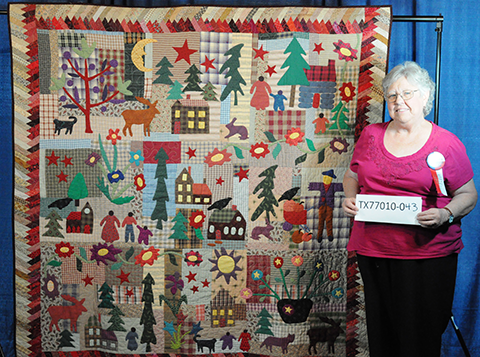
by Quilt Alliance | Dec 29, 2016
Explore and listen to Sharon Gaylord Chamber’s interview by clicking open a segment title and selecting “Play Segment,” or by searching either the index or transcript. Index created by Erinn Brown in West Chester University’s HIS 480 Digital History course, Fall 2016….