by Amy Milne | Jun 20, 2019
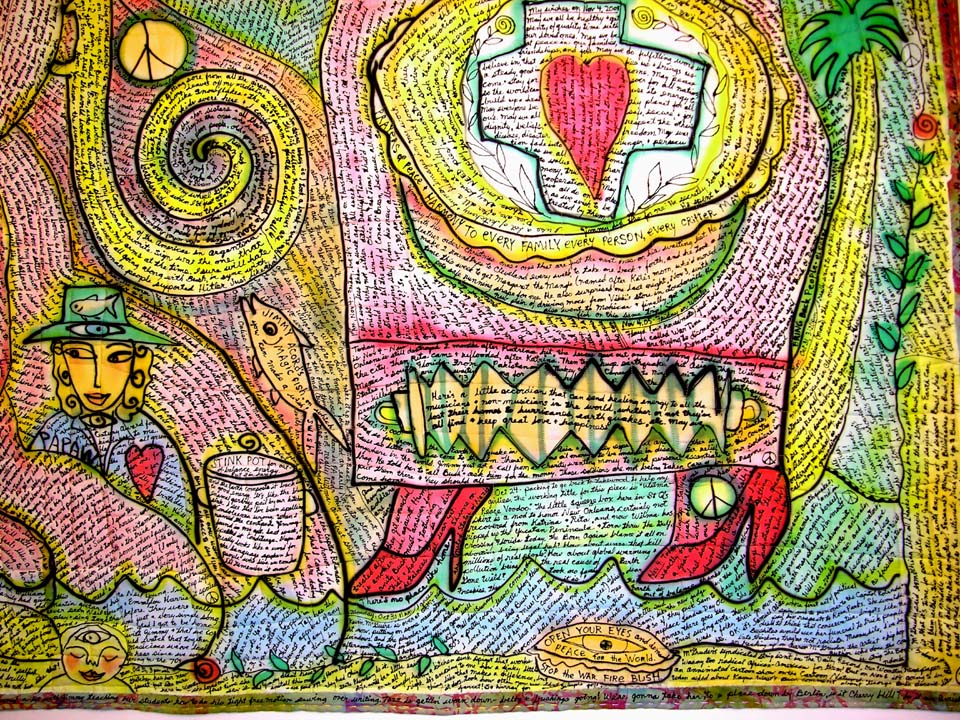
NOTE: This interview took place from October 1-5, 2006. Karen Musgrave (KM): I’m doing a Quilters’ S.O.S. – Save Our Stories interview with Susan Shie by e-mail since we cannot be together to do the interview and we wanted very much to include her in the project. It is October 1, 2006. Susan, thank you so much. Tell me about the quilt you selected for this interview. Susan Shie (SS): This is my painted diary quilt “Wilma (Peace Voodoo),” which I started on October 20, 2005 and finished on Nov 7 that year. It’s 66.5″ height x 66.5″ width, drawn and colored with airbrush, written on with airpen, and crazy grid machine sewn, with one row of hand stitching around the edge and one Green Temple Buddha Boy bead in the bottom left corner. There is even more about this piece on my site at http://www.turtlemoon.com/gallery3/wilma-full.htm. The actual Hurricane Wilma started up around October 16, 2005, four days before I began this piece. It was terrible to think that she would develop into another huge hurricane, after what we’d been through already that Fall, or rather what the Gulf States had been through, with Katrina and then Rita. But there she was, and she ended up being even bigger, bigger than any Atlantic hurricane ever on record. We had more hurricanes in 2005 than ever before on record, too, with Wilma tying the 1933 record, and Beta taking us into the dubious glory of the lead. I had made my big piece “Katrina Blues” in September, and now it seemed my work was going to be about hurricanes for a while, but I couldn’t think of much else. None of us could. Well, war, too. The only good thing I can say about Wilma is that she didn’t hit the same places that the earlier hurricanes had. She did wreck Cosumel and the Yucatan Peninsula of Mexico though, ripping it up there for over a full day of terrible damage. She affected Haiti and Cuba, and then she roared across southern Florida, leaving those people without electric or gasoline for a long time. Jeb Bush promised Florida that they were ready for Wilma, that they didn’t have to worry about being left stranded but it happened again, for whatever reasons. Meanwhile, back in my personal life, I decided to make this piece about the four generations of women in my family: Mom, me, my daughter Gretchen, and my granddaughter Eva, and to show us like Russian stacking dolls. Only it’s hard to do that with bodies sitting in Buddha girl positions, which is how I wanted us to be. So we’re kinda stacked, looking more like a Buddha totem pole. We ended up with saucepans on our heads, and the men in our lives are with us, plus Gretchen’s cat Isis, since Eva doesn’t have a beau yet. She did get the Croup during the making of my Wilma piece though. I put a gigantic St Quilta the Comforter standing on the right side of the piece, to balance the stack of Shie women. St Q has two heads where her breasts would be, but at first I didn’t know who I wanted them to be. That’s rare, as I usually know who everyone is, when I draw a piece. I finally decided they’re my dear friend YaYa Pat and her mother Mary, who were both very sick last Fall. Pat had some mysterious thing going on that they thought might be an auto-immune disease, and her mom had a major heart attack and didn’t seek help for too long. They are both big St Q types themselves, so generous and now they were both too weak to even care for themselves, let alone taking care of each other. So I had St Q there for them, for us, and for more hurricane survivors. (Pat and Mary are both fine now, got well in time to enjoy Christmas, as I recall.) As usual, I did a little writing on Wilma each day, every time I got a chance. I write with my airpen, using black fabric paint, and then let it dry, coming back later to write some more. Current events, like the indictment of Lewis Libby in the Plamegate affair, are part of this piece. Bush’s usual antics. He went to Argentina and got really protested against. They accused him of war crimes, and they said he’s a fascist like Hitler. He smiled and said that this is good, that they’re allowed to express their opinions, because they live in a democracy. Rosa Parks died during the time I was making this piece, and I was so impressed with the things about her life that I’d never been told, before I Googled her and read her bio. Did you know that she was really, really active in the civil rights movement along with Dr. King? This was about the third time she’d refused to give up her seat, and this time finally it got the results she wanted. And she was already back in the ‘colored section’ of the bus, when that teenage boy told her to get up and give him her seat. I’d learned as a kid in school that she was just a working class woman, so tired out; she refused to get up, in the front of the bus. She was an activist all along! I am glad! KM: Does “Wilma” reflect your style? SS: Yes, “Wilma” reflects my current style, which is a combination of emphasis on narrative painted images and written spontaneous diary, along with socio-political commentary. I think my image style has been pretty consistent for many years, but this shift to machine sewing over very detailed surface is the latest change, which began in 2005, with “NEO Buddha,” my first large format quilt made this way. Before that, I’d only made a few small pieces with the unmeasured “crazy grid” machine quilting, and I was usually intensely quilting by hand, with tons of tiny textural stitches, and then beading the daylights out of the pieces. I got very tired of spending many months to sew and bead one painting into a quilt, unable to paint again, until that piece was done. I felt like I was sitting in a corner, sent there by my self, no one else! People would make comments about an experience we’d had together, saying things like ‘Oh, I bet THIS will end up as a quilt.’ But I’d say, ‘no, it won’t,’ because I had to finish the piece I had about six months to go on first, before I could start another quilt. I knew that I was the only person who’d sent me to sit and sew in that conceptual corner, and I started to realize that good art isn’t defined by how long it takes to make. It’s defined by how good it is, when you look at it. My job became to make the machine sewn quilts as interesting as the hand stitched and beaded ones are. That’s where my airpen writing really came to be critical in making it work. This writing with fabric paint is such a rich line I don’t have to hand sew over it. So I can write smaller and write a lot more. My writing has become like a stitching texture, in a way. And I’m content to let go of my hand sewing ego. Now I don’t care if people who see my work are aware that I used to put all that time and energy into the hand work. And a blessing that came out of this more immediate statement type of working is that I can respond to things going on in our world right now, and get the piece done in a short enough time that those issues are still pertinent when people view the finished piece. I am really grateful for that. I think this current style is a natural progression from a very stuck place I wandered into organically, with processes that interested me, but slowed me down, to a place where I could adjust things more to my liking. I am a painter first, then a writer, then a quilter. But I think I’d be really sad if I couldn’t quilt my paintings, had to stretch them on bars and frame them. No, I don’t want to go back to that! KM: What inspired you to make quilts? Is there quiltmaking in your family? SS: I grew up with a mother who sewed all the time: our clothes, the upholstery, drapes, etc, etc. Oh, and quilts. I grew up with 4-H and home ec, besides Mom’s wonderful teaching, and she let me cut loose when I was making doll clothes, so that’s when I could go really wild, break the sewing rules, and create weird things to my heart’s content. But I was mostly drawing, writing, and painting all the time, when I was a little kid. Knitting, too, but I got away from that eventually, probably when I went back to college in my late twenties. Too busy! I had an easel in my bedroom all through junior high and high school, and pretended my bedroom was a “garret,” because that’s where French painters painted, right? I stretched my own canvases all through high school, making some really big stuff. In college I majored in painting, but eventually got pretty sad about how I couldn’t move my paintings around easily, because they were too big to put into anyone’s car. And about then, Miriam Schapiro came to the College of Wooster for a residency, and visited my studio, and we became pen pals. She was going around, advocating that feminists should bring their handwork skills into their studio art, instead of painting like men. Well, it resonated with me, made me realize there was all this stuff I did at home that no one at school ever saw and that if I’d work on UNSTRETCHED canvas, I could roll up my paintings and carry them around. Once I wasn’t working on stretcher bars, I got to thinking about embroidering on my paintings, and then about quilting them. This was really how I started quilting in my studio, even though I wasn’t at all interested in the tedium of cutting all those templates and lining up all those corners, in traditional quilting, which is what my Mennonite and Amish background quilting was all about. I just wanted to just convert my style of painting that I’d been doing on stretched canvas, to loose fabric. I saw quilting as a way to make a painting I could fold up, carry around, add to, and hang up without a frame. Soon I found out that quilts are also a lot easier to photograph than stretched paintings, and are MUCH easier to ship! What I liked the most a in grad school was that I was the only painting major making these weird fabric things. They had a Surface Design major you could do, but I came in as a painter, and I liked being the unstretched fabric painter. If I’d been in Surface Design, I’d have had to find some other way to be myself, going against the grain. I had no idea that other women were making these experimental quilts around the country. Miriam Schapiro was nudging feminist artists to use all kinds of women’s work craft skills in their art, but I don’t think any of the rest of her students were doing quilts as art right then. I don’t know really, since we didn’t really have any way to communicate. Then it seemed like, when I found out about Quilt National, right after I did my MFA thesis at Kent State School of Art, a bunch of women artists were doing quite individual things with studio art as quilts. Wow! That was such a revelation, to learn about this whole thing happening at once, in so many unique ways, in the 80s! I think it came out of the Hippie movement as much as Feminism – the two merging. We hippy chicks had to embellish everything we touched! I have an aunt who still works hard each year for the Mennonite Relief Auction in Kidron, Ohio, in the making of traditional quilts that get auctioned off for disaster relief. They’re the same kind of quilts Mom used to help with at Ladies’ Aid at our church, East Chippewa Church of the Brethren, when I was little. I look at those traditional quilts, and I think of sitting under that quilt frame, watching all those left hands floating along, under the quilt, above me, and wondering how on earth they could make any stitches, when their left hands didn’t even move! That is my first quilt memory! So yeah, maybe they grabbed me right then – the pre-school me! So yeah, it’s in my blood! KM: Do you think of yourself more as an artist or a quiltmaker or do you even make a distinction? SS: Yes, I do make that distinction. I’ve always thought of myself as an artist, not as a quiltmaker, and I think that comes from my choice to move my painting surface from stretched canvas to loose fabric, which I soon decided to stitch, back around 1980. And in college I stayed with Painting as my major, without even thinking about how I could switch over to Surface Design, once I got to grad school. Luckily the profs didn’t ask me if I wanted to switch, but then, if they had, I woulda said ‘no.’ I guess it doesn’t really matter what you call yourself. It’s what you do. To me, if you create, use your own ideas to make something, to express yourself, then you’re an artist. I think if you just follow the directions to a T, then you’re a craftsperson. As soon as you decide you hate following someone else’s ideas, and you bust out and do your own thing, there you are. Behold, another artist. And I think the term “artist” is viewed by our culture as kind of egocentric, like if I say I’m an artist, I’m making some kind of statement about how good my work is. But to me, telling people you’re an artist is no different than telling them you’re a doctor, a bricklayer, a preacher. An artist makes art. What’s most important to me about my work is the image, and what it communicates. I’ve come full circle in my sewing attitudes: getting more and more into hand work over the years, and finally walking away from the Most Patient Hand Sewing Person Award, and moving to machine sewing. I don’t care now if people even remember that I hand sewed, putting so much time and care into all those intricate textures with embroidery and beads. If I had the money, I might hire someone with one of those huge long-arm machines to take over my crazy grid sewing. Although I do get a big bang out of getting lost in the middle of a quilt and not being sure if I’m sewing straight with the piece or at an angle! Could I give that up? Yeah, I could give it up, because then I could paint more and write more! KM: What artists have influenced you? SS: Oh, there have been so many over time, back when I was an official student for all those years! I had my total immersions in Matisse, Egyptian, Picasso, Native American, Chinese, Japanese Ukiyo-e period, more Matisse, more Egyptians, and always children’s art and Outsider art. I’d obsessed on Chinese art so deeply while doing my IS (Independent Study or senior project at the College of Wooster) that people wanted to talk with me about China, when they viewed that work. WHAT? I had been interested in Chinese art because I thought it was so much more nature centered than western art was. I thought it was my feminist stance they should clearly see, through my fanatic use of Chinese art images and even writing characters. Oh, that was my fault, that they thought I was so in love with China and couldn’t see that it was my Nature Centered Feminist style? OK. I like to think that was the end of my deep drownings into other artists’ styles, and that when I started grad school, I was my own artist, a ball of influences from all the art I had worked my way through by studying it and using its imagery so fully. Now I was a Master’s Candidate, not just your ordinary student anymore, so I had to be ME! But all that stuff was like ingredients in me, the particular unique tossed salad that I am. And I think all easily-identified artists are like that. Call us lint balls, salads, stews, whatever name for a collection of influences, but we come out of those student, searching years as our own selves. I also had a long period, starting in junior high, when I wanted to only do realism, and I can do that, sort of. I copied from photos for a while, which helped me in some ways, and eventually I got bored with that, too. As an adult I decided that we have cameras for realism, and that I really like children’s art the best of all, so I should probably let myself just draw in a very relaxed way, much of the time, and accept the first version of a drawn form, as my final one. So I don’t erase or use tracing paper, and I work right on the fabric or paper with permanent drawing or painting tools. That’s about the only thing in life that I do where I take big risks and am a dare devil. Ya gotta be wild somehow. Oh, and I chop merrily with scissors without measuring or planning, most of the time, a trait which made my seventh grade home ec teacher call me ‘scissors happy.’ And she was really trying to shame me. She was proper. My parents had a huge influence on my art, in that my father made a big fuss over my work, and my mother made sure I had art supplies. Dad paid for a three year correspondence course with Art Instruction Schools in Minneapolis, starting when I was in ninth grade. That really showed me that he believed in me, and even when the course drove me nuts, I kept going, because he had put that huge amount of money into my education. I got my diploma from that course in what they then called Commercial Art, plus an extra certificate in Illustration, when I was 16. It really taught me that I didn’t want to ever be a graphics artist! Too tight!!!! KM: Describe your studio. SS: Hmm. My studio is all over the place, with the computer stuff and photo shoot wall both in what could be a dining room, much storage of work in spare bedrooms, and so on. But my REAL studio is in the basement, in what was a rec room when we bought this house in 1990. It’s about 16 x 20, I think, but would be about twice that, if the builder had blasted more rock and not put in a 4′ high crawl space under the living and dining rooms, but instead, had made that area more basement! How I long for that giant mole that digs out the rest! A dehumidifier runs all summer in my studio, even when we have the AC on. I am devoted to nice, dry basements. And well lit ones. I have way too much clutter down there at this point, and a lot of supplies left over from when I was beading everything, but I do hope to really clean it out this winter and have more room to breathe. Hard to believe I used to have up to five students down there for five day live-in art camps! We got a lot of mileage out of my big work table, which is just two sixties wooden closet doors, set up side by side on saw horses, so they become a gigantic table. A couple of smaller tables, a sewing machine cabinet with my 1990 Pfaff on it. A pretty fake oriental carpet hiding some of the really ugly base carpet. Music plays sometimes, but I like to listen to books on tape, during times when I don’t have to think much while working, and sometimes it’s just NPR. Sometimes the studio is peacefully quiet. Tie dyed orange and yellow fabric panels hide a terrible mess on huge shelves, so at least I have that color to enjoy! Oh, when it’s all shoveled out, how I will dance down there! I have lots of fabrics that I keep folded in sorted piles in shelves, but the finished art pieces are on the main floor of our house, in storage bins. I work mostly at the big table, whether it’s covered with plastic and then old sheets, as drop cloths, so I can paint on it, or when it’s all down to the wood again, when I move my Pfaff over to it, so I can wrestle these big quilts, sewing my unmarked grids at random, carefully stopping to remove many little safety pins that hold the layers together for basting. Oh, we also have an airbrush room that Jimmy and I share, in between our individual studios. I usually start my pieces in there, with my whole cloth white cotton pinned up on the paint wall, making my base drawing with black airbrush lines, which are thicker than my airpen lines that I write with, back in my studio later, with the big cotton panel laying down flat on the drop cloth. I usually paint in the colors with the airbrush, too, before going into the main studio to airpen and brush paint. In my studio, on the big table, is where I run my airpen, carefully folding or turning the big panel of painting, to not smear the wet fabric paint just written on with the tiny syringe needle of the airpen, by accidentally dragging the airline through that wet paint. It has happened! So have big disasters, like having the whole paint cartridge blow out of the airpen once, plopping black fabric paint all over part of the written-on painting. I fixed that. I am determined! There is often our sweet old black lab girl dog, Hattie Clementine Spooler, lounging on my studio rug, in her spot, and sometimes our girl cats, too: Marigold and Evil Tulip. My studio would be so much easier to keep clean without these joyful ladies, but there they are. I have a big clothesline that runs diagonally through my studio, so I can put up work to stare at. You cannot put brush painted paintings with fabric paint up vertically to dry, as the paint will just soak down and drip off! But airbrushed paintings, which are more on-the-surface and therefore, more dry from the start, can be pinned up. So can towels from washing my hair in the laundry room around the corner, which by the way is where the water is at for all of our studio work, including Jimmy’s leather work and our airbrush work. I see a lot of gorgeous new studios out there, and that would be really cool to have. If we got to where we couldn’t go downstairs, I guess we’d just work up here in the living room, etc, and ditch the furniture! You always find a way! But for now, the basement is nice, because it’s cooler in the summer, and you can leave a mess longer, only that’s not good! KM: What advice would you offer someone starting out? SS: I’m assuming you mean an artist starting out as a professional in our field, doing this for a living. I’d advise them to talk to plenty of people doing art quilts as a career, so to do that, I’d tell them to sign up for the Quilt Art email listserv, at http://www.quiltart.com, and to get the lists as digests, so their inbox isn’t clogged with a bunch of individual emails. Then introduce themselves on the list, and maybe ask for a couple of pen pals to network with, mentors. That list has over 3,000 people on it, from all over the world, though mostly the US. Extremely sharing people. There’s so much to be said for not having to invent all these wheels all over again. So getting into some networking would be my first advice, and then try to start a support group in your own area, so you can meet regularly with four to six other quilt artists in your area. When I moved part time to the west side of Cleveland, to take care of Eva, I was so fortunate to have a little group develop there, thanks to Tina Rossi-Petrone, from the Quilt Art list. I’d been used to my all-media art group here in my town, and now I had these fiber artists to share work and ideas with in Cleveland, too. We are the West End Textile tArts, or the tArts. Just a tiny group, but what joy and power we have in supporting each others’ efforts. You can’t imagine how much easier and more interesting it is to make your art and get it out, when you have friends in the same boat to interact with. Locally to globally, network! Experiment a while, take some classes if you like classes, make yourself find serious time to work regularly, and have some deadlines to get things done. Have a show deadline or two, but don’t try to enter too many shows at first, because you can get overwhelmed by the paperwork, and get depressed from getting rejected, if your work isn’t ready. If the little support group can find a local place for a group show, that’s really super, because then your group has a common cause, and you have a deadline, too. Oh, and photography! Learn to photograph your work in a serious way, or make sure you can afford to pay a serious photographer to document your work. Give yourself enough time before each show deadline, etc, to photograph the work well, so you never have to send out work that needs to be reshot. And keep good records, right from the start. Keep track of all your commitments, where your work is going, when it’s coming back. It’s a lot! Get enough sleep. Don’t eat in your studio, and marry a rich art patron. Did I say that? KM: You sure did and it gave me a good laugh. SS: Oh, I said that about marrying a rich patron, because people need to realize that this is not a profession you go into, expecting to be able to support yourself in the normal American lifestyle! Tomorrow I’ll happily talk about Jimmy and my relationship. He was a welder when we met, soon to be a full time artist. Since we’re both artists, and neither of us has a sugar spouse, we remind ourselves of our glorious flexitime and other bennies of being independent, since big moola has so far eluded us! KM: And did you marry a rich art patron? Actually, I’d like you to talk about your relationship with your husband and your art. SS: My relationship with Jimmy and our art – his, mine, and ours – are very entwined. I think we’ve collaborated on everything we’ve done, and I can’t imagine it any other way. But it’s a big house, and we just drift in and out of each other’s spaces all day. We’ve never worked side by side at one work table all day. We both like and need our own space, but we fill in gaps for each other when we get stuck anywhere in our processes or have dilemmas to work through. When we met, he started saying how much he wished he could make leather stuff, over and over, and I kept telling him to just do it. So he did. He went to work, made himself some crude tools, used a pair of old boots for his first projects, and before long, had a little studio set up next to mine in our old commune. 1977. I got to helping him on leather orders, making custom leather clothes for a few years, then helping him learn to make garments, when I didn’t have time to sew them anymore, being back in college. In 1989 he started helping me with my quilts by adding leather forms to them, when I was getting teaching offers that let me travel, and I could see his longing. I suggested that his leather would be a great addition to my work, and he started teaching with me. He taught himself and later me, to airbrush, and he taught that in our classes. In 1996, when he started fly fishing, he started fading away from helping me with my art and teaching, because he was now doing custom leather orders for fly fishermen, and THAT was it. He’d found his real calling! Now when I teach, it’s just me going, but I’m not teaching much right now, because I want to really focus on my studio work. Jimmy and I still help each other on our work, but not enough to call it collaboration now. I design his three-letter monograms he hand carves onto the backs of most of his cases and help him with composition and painting. He helps me right back. When one of us is away from home, the other always notices how empty the house seems. We don’t like it. That crack I made about how the new quilt artist should marry a rich art patron, well, that was just to remind people that it’s hard to make money at this art making stuff. Jimmy doesn’t support me, but his orders are pulling us through my dry spot right now, and I’ve done it for him, too. I was thinking that marrying a guy who owns a diamond mine might work, too! KM: Have you ever used quiltmaking to get through a difficult time? SS: Yes, I’ve often used art for therapy, and the biggest example is when my mother died. She’d had Alzheimer’s for so long, couldn’t talk for the last few years of her life, and had almost died of pneumonia twice before she really did die in October, 2001. But I wasn’t ready for it. Are you ever? I had a little solo show coming up in a month and a half, and I’d planned to make some paintings on 18 x 24″ stretched canvases, one for each sign of the zodiac, with St Quilta the Comforter, my character, as the woman in each painting. I started the painting project four days after Mom died. And in painting Aries, it really hit me hard that Mom had been the model for St Q all along. Maybe I sorta knew that before, but now I was going over Mom’s kitchen tools in my head, trying to think of how to draw the Aries kitchen. After Aries, I put cat eye glasses on Mom, remembering a pair of glasses she had for a while, and I painted St Quilta’s face to look like Mom’s. When I came to each next sign in the zodiac, I would rummage around in my mind, going through Mom’s things again for imagery. And I would use instances in Mom’s life to illustrate the paintings. I got them all done in time to make a little Xerox book about her and the zodiac, and had that printed up at Staples, so I could have the books at my show at the Jewel Heart Tibetan Buddhist Center in Cleveland. So I really worked like a wild woman, but that intense immersion in my mother’s life really allowed me to wallow in my love for her, my grief of losing her, and my need to honor her. That little book is partly a biography of Mom and partly a lesson in how each sign of the zodiac works. Later a card company Amber Lotus, found my zodiac paintings on the internet and ended up making greeting cards and a 2005 calendar of their images. You can see all the paintings and their stories on my site at http://www.turtlemoon.com/gallery/zodiac.htm. KM: Unfortunately we need to end our interview as I am leaving for Kyrgyzstan. I want to thank you for taking these few days to share with me. It’s been wonderful. We concluded our interview on October 5, 2006. Susan, thank you so much. SS: Good luck! Bon voyage. Love and…
by Emma Parker | Dec 28, 2017
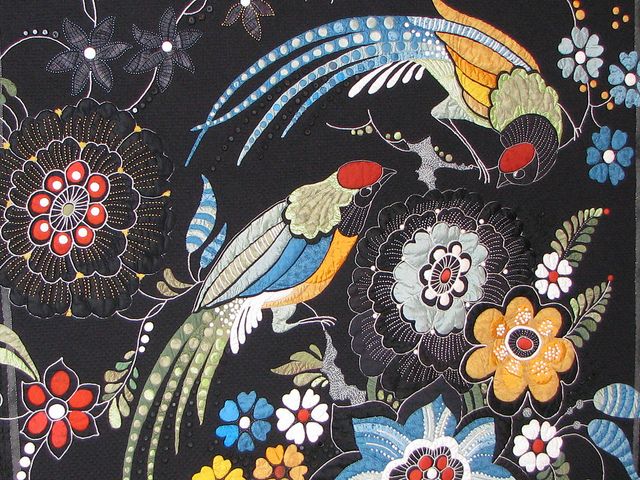
Jana Hawley (JH): No, Okay. Okay, this is Jana Hawley and I’m interviewing Ted Storm-van Weeden, Wegeln. [10:40 a.m.] Ted Storm-van Weelden (TSW): Weelden. JH: Weelden. And would you spell that for me, please? TSW: W-E-E-L-D-E-N, and that’s my maiden name. When you marry in Holland, ‘Storm’ is my husband’s name. JH: So, pronounce your whole name for me please. TSW: Ted Storm-van Weelden. JH: Okay. TSW: Pronounced in an American way. JH: And now say it in Dutch, say it in Dutch. TSW: Ted Storm van Weelden. JH: Okay, very good. Thank you very much. We are here at the International Quilt Festival in Houston Texas on November 2, 2001. I’m Jana Hawley. The scribe is JoAnn Pospisil and we are excited to interview Ted. Can you tell us about the quilt that we are looking at today? Give us some design details. It’s origin. TSW: Well, yes, the quilt is made in a period of 4 years. I started it in September in 1997 and by that time I was not fit. I had a problem with my hands and doctors couldn’t find what the problem was and as I was teaching stress was the diagnose. So I was very upset that I wasn’t able to do anything, almost anything, but teaching, sitting and talking to students, but no stitches. And then I–well a design in my head showed I had to make something in black. And as I live in Holland very close to Delft I went to that company and I found some black Delft. Black Delft is the least known Delft tradition. The blue Delft is more known. And then I also heard that because it is less known it’s not sold a lot and yet it’s one of their oldest designs. They want to end that line of black Delft. [loud talking in the background.] It used to be called the wonder of Delft, because it’s exclusively made by that particular company, that black, like lacquer ware from the East was produced in ceramics so its influence from the East is visible in the design. JH: Asia East? TSW: Asia East. JH: Thank you. TSW: Yes, is visible in the design. And yet it’s very, very Dutch. JH: So which particular fabric are you talking about? TSW: It’s not the fabric, it’s the design. JH: It’s the design, okay. Thank you. TSW: Yes. So I went up to them and I had several opportunities of drawing and designing and they were very accommodating. So I could do anything with designs. And that way I create a new design with their influence in it. JH: Oh, I see. TSW: So the design is Dutch based. And the–well, not fit at all I worked over a period of 4 years and finally I was diagnosed having a neck hernia. It was taken care of and then I healed. So when I started I was depressed, I was sick, I wasn’t fit. It was black and the mirrors represent the tears. So while I had surgery done and I healed, I realized how lucky I was, because the surgery went fine. I could do stitches again and the colors I chose and everything in the quilt you see it’s vivid and it’s alive and the mirrors for me no longer are tears now, but sparkles of joy. JH: So can you explain, we can see the quilt, but for the tape recorder can you just describe the quilt? TSW: Okay. Yes. I’ll try. You see two birds on top of it. And the birds are a bit like, well representing my husband. My husband is the one in the middle center. He is always home-based, doesn’t like to travel. And I’m the one that’s on the go almost ready to leave. The flowers around it are very similar to Delft, typical Delft flowers. It’s just a fantasy. There is not a real flower you can compare to. It’s a decorative piece. And you will see lots of feather-shape and dots and sprinkled mirrors all over. JH: Ok and the borders? TSW: The border. Well the center-piece is an asymmetrical piece. It’s a bit–well, it has a–it’s obvious that it has an Asia Eastern influence. Then there is a border, the next border coming to it is a dupioni silk with padded trapunto border. Then there is a two inch border with a print fabric in gray and blacks, and then there is an outer border with–I think, how many? Is it 5 inch? JH: That’s about 5 inch. TSW: About 5 inch wide, with a grid half an inch away from each other, cross-hatch. And then you will see the outer border with a line of mirrors, a feather-shape with green feathers and a sort of repetition of the design from the inside, but a decorative motive at the end. JH: So except for the dupioni is everything else cotton? TSW: Well, some silks are in there– JH: Silk and cotton? TSW: Yes and beads, a lot of beads. JH: And is it all done by hand? TSW: Yes. JH: And how did you do the mirrors? TSW: Oh, that’s a funny story. I had a lot of–I had a lot of trouble how to control the mirrors and thanks to students I got hold of mirrors sent to me by one–friends, from a friend, from a student that way. So by the time I finally got the mirrors I had a problem how to hold them because when you glue them on top of the fabric, the glue affects the mirror’s paint over time. So I tried to figure what was easier for me to control, and then I cut a dot of fusible material, Ultra-hold from Heat ‘N Bond, and I cut a cut a small, an eighth of an inch square and I put that on a particular spot where I wanted my mirror. Then I added the mirror on top of it and I had soldering iron to heat up the glass mirror and thus activating the Heat ‘N Bond so it holds in its spot. And then I could add embroidery lines and my buttonhole stitches around it. [Jana chuckles ‘Okay.’] So this is shi sha mirror. JH: And do you know how many there are on this quilt? TSW: I know exactly. [both laugh.] JH: I bet you do. [laughing.] TSW: Three hundred and eighty five– JH: Mirrors. TSW: Yes. JH: Okay. That’s amazing. TSW: I traced all my hours because I knew by previous quilts that people always come up to me, ‘How many hours did it take you to create a quilt?’ JH: So how many hours did it take to do this one? TSW: Okay. [both laugh.] I took two thousand and five hundred and ninety six hours to make this quilt. JH: Oh, my goodness. Does that count your research time too? TSW: A little bit of drawing time, but not exact. JH: Oh. TSW: Just the actual time. I had the stopwatch on hand so even when the phone rang I stopped my stopwatch. [Jana: ‘Oh’.] So it’s really hands-on time. JH: So you did the whole thing, you timed it with a stop-watch. TSW: Yes. JH: Oh, my goodness. [laughs.] TSW: I had a record. JH: Oh, that’s absolutely gorgeous. And then it is embellished with embroidery as well. TSW: Yes. It’s embroidered in stem stitches and I used a cotton perle in three different sizes depending on the area where I was. JH: Yes. And then some bead work. TSW: Yes and the beading is done in gradations of size so increasing to bigger and then coming down to smaller sizes. JH: Absolutely beautiful. TSW: Oh thank you. JH: It’s really well hand stitched and the crosshatching, everything, the quilting stitches are beautifully done. Okay. What special meaning does this quilt have for you? TSW: Well, it’s for me. This quilt marks off a period, a dark period, yet rich [Jana: uh huh, uh huh.’] So for me it’s, it’s kind of a rebirth. [chuckles. Jana: uh huh.] And I owe a lot to America. I think everything I have so far done in quilting I owe to America. But also I owe to Karey [Bresenhan.] and Nancy [O’Bryant.], the IQA [International Quilt Association.] Quilt Festival and the Expo because that’s where my quilting career started. JH: Was it the IQA? TSW: It was Karey, Karey, IQA, I think by the time and Nancy. They started in ’88, Salzburg Austria, the Quilt Expo. And it was there that in the audience there was a quilter from Bucyrus Ohio. Her name was Lois Ide. She was there because she was a finalist in that first competition ever held in Europe. Because she was there sitting in the audience and she was passing out pieces of fabric. And I was a young quilter, I had hardly finished one patchwork quilt and I wanted to know more. I was eager for more techniques. So I tried to get hold of her piece of fabric. And she wants the piece of fabric from Holland, but I wasn’t aware that it would be nice to change, exchange pieces of fabric. So I talked a few words to her and promised to send her Dutch fabric. And well obviously she picked up my hunger for appliqué. I asked, there was one shop at that time in Holland, a quilt shop, and I went up to the lady of the shop and I said, ‘Well I made a patchwork quilt but I would love to make appliqué.’ I had seen Quilter’s Newsletter Magazine so I knew there was appliqué done and the words of the lady, I will never forget were, ‘Appliqué is no quilt.’ So I thought well then I had try and go to Salzburg because there I know American ladies are there. They know all about appliqué so when I met this lady in the audience I didn’t know her at all, but she picked up my hunger for more and she invited me to come to the States. So without–I had never been in a plane before, and never left my husband and my kid without being together. I took the plane completely trusting a quilter and I was accepted in her house, adopted like, and she taught everything she could tell me. She shared techniques from her mother and she knew I was a textile teacher. She knew that when she eventually would pass away, her techniques from her mother will continue through me. And that’s what’s happening. So when I went to the United States I had American patterns in my head, everything was America, America but by the time I knew so many techniques, when I was in the plane on my way back you can never thank an American quilter with an American pattern. So I thought, ‘Well I had better, I had better look for something typical Dutch.’ And she obviously liked Delftware so that’s how I got to– I live around the corner in Delft but by that time Delftware is from your grandmothers. You know it’s old-fashioned. [JH: Uh huh.] So I didn’t like it. So we, so I went up to Delft and explained that I wanted to make something in a quilt. And I made her a quilt and the name is “Holland’s Glory” to thank her for every technique that she taught me in my way. And then that quilt was entered in competition in 1992 in The Hague, at the Expo in The Hague. By that time I’d only made that particular one patchwork quilt and two, well kitchen-cloth sized tryouts to try trapunto and to try out some appliqué and then I make this “Holland’s Glory” quilt and that one won Best Overall Workmanship and Viewer’s Choice so then my life changed completely. I quit my job at school as a textile teacher. I could travel. I was invited to come to the US to teach and well I’m a full-time quilting teacher now. JH: And do you teach at home? TSW: Yes. I teach at home, not in my house but in The Hague, there is a classroom where I teach and I’m on a free-lance basis. I am asked to teach whatever. JH: So you don’t have a shop, where you teach in a shop? TSW: I used to have a quilting school [Jana: Uh huh.] for several years. [screeching noise. Ted giggles.] JH: Sorry. TSW: I started a quilting school and by the end I had 12 other teachers. We had a complete program. We had a set of classes in a way a school is done. You are not allowed in an advanced class until you had your previous basics done and checked. And that worked very well, but I was, you know, sitting behind a computer. And I would like to work with quilters and open eyes for design and color and techniques. JH: So when you say you were a textile teacher– TSW: Yes. JH: How? TSW: In a high school. JH: Okay. TSW: It’s on a high school. JH: Like home economics. Okay. TSW: Yes, but totally fine hand work only, so no cooking. JH: Is that still taught that way in Holland? TSW: Well not as much as it was, because the government changed the rules and exclusively textile is no longer done because it’s too feminine and it should be more with all– JH: Gender neutral. TSW: Yes. [chuckles.] Yah. JH: What year was is that you came to America the first time to learn– TSW: From Lois? JH: Oh. TSW: Yes, it was in April ’89. It was a couple of months after–no it was almost a year later, after we first met at the Expo. JH: Now do you specialize in Delft-style patterns? TSW: Well ever since then I appreciate Delft more and more. So after I made the blue one I made a tableau de bleu that was made with an exclusive design from them, a limited edition tile in mind. And I wanted, I was kind of depressed because of the blues [JH: Uh huh.], and I wanted to make a colorful piece. So then I made a colorful piece, an abundance of flowers. By that time I had so many students and it was, well it was a hectic life, but colorful and diversity and everything. I enjoyed life very much. JH: Good. Good. TSW: So. So ya. So it’s sort of that I like Delft and I would like to make a series to represent Delft. JH: Ah, well that would be, that would be– TSW: So you don’t know. [Jana laughs.] I don’t know what the next one will be. JH: Oh. Now tell me what award you have been recognized with this quilt. TSW: With this quilt I have won Best Overall, no, how it’s called, Best of Show it’s called. JH: Best of Show. TSW: Best ya, sometimes it’s hard to recognize a word. Best of Show award, yes. JH: Okay, and then do you have other plans or what are your next plans with this quilt? TSW: I have no other plans except that I will share with my students for teaching purposes. I won’t sell. I think a quilt, my quilt in this type of work and intricacy, I think it should stay in Holland or in Europe [Jana agrees.]. And for me it’s important to share because I can point out where I struggled and they can gain from that. JH: So what do you see as a difference between Dutch and their Dutch woman and their interest in quilts compared to American. [talking and laughing in the background.] TSW: Well I think Dutch quilters most of the time are very–the general public of quilters are interested in traditional pieces though we do have an Art Quilt group coming up very, very much now. We do have very good art quilters as well but the average quilter likes tradition. JH: And it is a lot of American tradition? TSW: Yes, yes. JH: So, how many hours a week do you quilt now? TSW: Well, depends a lot, when I’m teaching I’m teaching most of the time, I can’t do things half. So when I’m teaching, I’m teaching. You know I’m preparing material. I’m developing classes and I do not one stitch for a few months. And then, well it’s mostly during the winter that I hardly do any stitches. Then March, April I will end my classes. I’m fed up with any quilter [both laugh.], my students and that’s my time that I balance my need for stitches and then I work 30, 40 hours a week. JH: So you are a full-time quilter in some sense? TSW: Yes, yes so devoted to quilting teaching and quilting myself. JH: What’s your very first memory of a quilt? TSW: My very first memory of a quilt. Oh, yes I was at a guild, I was at a guild patchwork show and I didn’t particularly like to teach quilting at school. We don’t, we don’t teach quilting. I had to do patchwork the English method over paper [Jana agree.] that was, you had to do that in school, in a high school. And I didn’t like it all because it was too big to cut off material and sew it together. I really hate that, but I did it because the government required I should do it. And then one of my suppliers pointed out to me that, ‘You should go to that so-and-so patchwork exhibition. It’s close to where you live because I’m sure you’ll like it.’ I’ve always been interested in making wallhangings for buildings, nursery homes, so you know as a textile teacher you’re an artist as well. So I make those. But I wasn’t keen to go to that exhibition and I struggled once to make a wall hanging, oh, about 90 inches square. I live, in Holland we have many small houses, so it’ didn’t fit my room and I had to cut it in sections. And then I sewed it together. But then the carpenter had to come to mount the thing. And that’s a thing I don’t’ like. I want to have it completely by myself, made by myself. So one year I finished that huge wall hanging and that lady came up to me twice, stated, ‘You should go to that exhibition.’ And I thought well I’d better go there because the third time she would ask me how it was so I went [Jana laughs.] to that guild. I just went on purpose for that. I went to this guild exhibition and then I was hit, because instantly I recognized this technique solved my problem. I could work in blocks. I could store it. I could wash it. I could sleep under it and it was everything that really make this is it. So ever since then I had a book on my lap and I taught myself how to do any quilt stitch. I was not introduced to it in my education as a textile teacher in any of the quilting techniques. JH: So where did you, when did you first learn to sew. I mean what got your interest [tape makes a noise.] Okay, after that little technology error now we’re going to get started again. Where did you learn to sew? TSW: I really learned to sew; it’s not done in the family. We were a family where fine pen work was much more admired rather that sewing clothes. There was a seamstress who did the sewing for the family. So my grandmother was a lady and I was with her, watching her when she was doing her tatting, very elegant and my mother could not knit at all, but also did some tatting and some embroidery. So when I was a kid I played with threads and techniques and not sewing. I didn’t like dolls. I liked to be outside. I liked to play soccer. I was not a real girl [both chuckle.] But I admired handwork. When I was in my high school I had a very good textile teacher and she let us be creative with fabrics and threads and had creative elements in her class. I picked it up and I did not do a lot of my other homework but I did more on my textile homework. So some day she said to me, ‘You should go to that education in textiles’. I finished my–she was twenty three by that time, when she had just finished her education, was a brand new textile teacher but picked my out, obviously. And I went to that education and finished my school, of course first and then I was, one year before I did my final graduation at the high school and then she died in a car accident. [Jana: awe.] And then I thought, ‘Well it’s her that pointed out you should be a textile teacher and I really owe her everything in my textile career.’ So I finished my education in a very short period of time. I was already teaching when I was half-way during my education in a high school and I have been on that high school for 22 years. JH: So do you do university? Do you have to go to university to be a teacher? TSW: Yes, sort of, ya. It’s not quite a university, but you can compare in years, yes. JH: Okay. TSW: And agree to. JH: Okay. Now we don’t have our quilt in front of us any more, because of the technology problem that we had, but can you describe for us the back of your quilt and then the design principles that you feel make a good quilt? TSW: About the contrast? JH: Yes. TSW: Or we could [inaudible.] JH: Well I don’t think so. I think you need to talk about–I think [both talk at the same time.] Before what we were talking about — TSW: About the contrast. To point out [both are talking at the same time.] Your question about what makes a good quilt a good quilt, is that a good quilt shows a long list of contrasts. You need to have contrast in color but also contrast in shape, contrast in line- for instance straight lines, curved lines. You need to have small elements and bigger elements. You need to have sparkles. And you need to have plain texture differences. So some areas are [inaudible.], some areas are not. So high and low contrast. And once you are a student and you–I add contrasts year after year in your head then you are–you will recognize and pick out a good quilt because the list like it’s a car-check, you know. So when you know your line of contrast, your long list and you can mark off that it’s there. You know you are doing a good job. JH: So it’s something that can be taught. It’s not an innate– TSW: Absolutely, absolutely. I think I strongly believe I hear so many times, ‘I’m not creative.’ And I reply then, ‘The only thing what you need, it’s a good teacher that helps you pointing out with yourself the elements of design.’ And that’s all you need, a good teacher. And one who you trust and you accept criticism, not criticism downwards but point out what you did wonderful and could be done better so that’s how I teach. And I must say I’m very proud because two of my students have–from the Netherlands, both have–were judged in. JH: In this event? TSW: In this exhibition. And you will not recognize my hand in it. They’re– JH: Quite different– [inaudible, both are talking.] TSW: Oh yes, but they are there so I’m pleased. JH: That’s wonderful. What makes a quilt appropriate for a museum? TSW: When you see a quilt and it hits your heart, I would say, that would be for me a museum piece whether it’s a solid quilt, but a wonderful design, the contrast that may hit your eye. Whether it’s white-on-white, but contrast in techniques, but what touches your heart I would say. JH: Do you have a proclivity towards, from hand to machine quilting? What’s your feeling about, about the two differences? TSW: Well, I’m a, I’m a teacher that teaches everything. So I can work by machine though it’s not my favorite. But that doesn’t mean that I won’t teach how to do it by machine and quilt by machine. I think every quilter who likes to do the job, she likes to do that way, I appreciate. And I will help her along her favorite path. But I strongly believe as a quilting teacher that you should have a basis like a tree, having its roots spread out so it’s firm, so when you have design and color and quilting techniques, whether you like to do it by hand or by machine, have them both trained. Appliqué, how many different kinds of appliqué there are, try them all. And eventually when your roots are there in any direction, you have developed your personal direction. And then it’s just opening a drawer and whatever, and you create your technique and your direction. And that’s what I encourage. I’m not one that is teaching on the top, on the outside edges of the tree. I prefer to teach the roots so general. JH: We–when you asked to be interviewed today– TSW: Yes. JH: You could choose whichever quilt you wanted. It did not need to be that quilt. TSW: Okay. JH: Is there another quilt that you would have liked to have also been interviewed about? TSW: One of my quilts? JH: Yes. TSW: Well I don’t–well, I’ve made three or four–[laughs.] a few quilts. JH: Really? Really? TSW: Yes, because it’s so much work and I teach a lot. [Jana: uhuh.] But my first quilt that “Holland’s Glory” quilt is my–my–it marks my period that I start in the quilting world and that quilting took out of my life. JH: Oh. And is it a full-sized quilt? TSW: It’s about 60 by 60, I think. I don’t because – JH: So it’s not a bed quilt. TSW: It’s a wall quilt. It fits a Dutch house. [Jana laughs.] This one doesn’t fit my walls. [Jana laughs.] I can’t hang it anywhere. [both laugh.] JH: So why or what is it about quilting that It’s been important in your life? TSW: The people, the students and the friendship. If it only would be a plain job, so from ‘A’ to ‘B’ I would not quit my job because then I would have stayed at school. But here you have friendship, you have sharing. And it’s the sharing that is the red line throughout my quilting and teaching. JH: It’s a very interesting culture, isn’t it? The quilting culture. TSW: Absolutely. It’s rewarding. It’s the appreciation and it’s the moment in a hectic period of life that you can sit and relax and be a bit selfish, just do your own stitches, whatever technique. JH: My question is what you think about the importance of quilts in American life. Now if you can see that from an outsiders perspective and then maybe also talk about it from a Dutch woman’s life. TSW: Well seen from a Dutch woman’s life to America I see you have much more production. You [both talk, inaudible.] Many quilters I met don’t want to spend a lot of time on a quilt. They want to have it done now. And in Holland there is the opposite. We don’t make big quilts, we have small houses, so we tend to make smaller wall hangings and we focus more on fine techniques. But that’s general. But here you have, you have a tradition in quilting. When I speak to someone in the Netherlands and who is not a quilter, we have no word for quilting. Well the word grew from the southern areas of Italy, France, England. From my country we have no word so there is some history, but not a lot. So it was brought from Europe to America and then since the seventies it was brought back. England has a history, but that’s away from us. That’s a different country JH: Oh, right. TSW: So I think you’re so lucky, you can talk to anyone who knows the word ‘quilt’ and know what a quilt is. We have in the dictionary no word about ‘quilt.’ JH: Oh, really. TSW: No. JH: Bed covering? TSW: Yes, but that’s different– [both talk at the same time, inaudible.] JH: So what will have quilts played in the women’s lives? TSW: So far in women’s life, in America, you mean or both? JH: Both if you think you can, if you want to speak about– TSW: Well I know some about the history how to survive having quilts in America, and that’s what I share with students. But you have so many different kinds of women’s lives and I think speaking for my mentor, my quilting mother, she could not live without doing any stitches. Quilting is part of your life. When you’re a real quilter you are a quilter and you are, well, it’s a no-cure disease [both laugh.]. JH: Would you pronounce and spell her name for us? TSW: Yes, her name is Lois – JH: Ok. TSW: And then initial ‘K’ JH: Ok. TSW: Ide. I-D-E. That’s her husband’s name. JH: Okay. TSW: And she, she is from Bucyrus. Bucyrus. B-U-C-Y-R-U-S, Ohio. [Jana and scribe confer.] TSW: Well, about this woman’s life. [laughs.] JH: Oh. TSW: I think in Holland we do it as a hobby and some of them do more and being an artist or like me being a teacher. But there are not many who live full-time or work full-time as a quilter, whatever. JH: When you look at the demographics here at the quilt show though– TSW: Yes. JH: It’s ninety percent female probably. TSW: Yes. JH: What role is it playing in their lives do you think? TSW: I think it’s the possibility when you have to stay home it’s the only way to express yourself. And it’s a way to be busy and yet to be, it’s hard for me to explain that in English JH: That’s okay, that’s okay. TSW: But it’s not just being busy, but you’re busy in a good way because you make something you can use. JH: Productive. TSW: Productive. So, and, well, I have male students. [laughs.] JH: Do you? TSW: Oh, yes. JH: Oh. TSW: I had a few but for them it’s as important as for a woman to work. But it’s hard for me to say how important a quilt is in a life. I think most of the quilters do it as a relaxing hobby, I would say. JH: How should a quilt be used? TSW: I make quilts that can be washed in the washing machine, put in the dryer and in the spin dryer. My “Holland’s Glory” quilt, when I got it back from a show it was greasy all over, everyone seemed to have touched the trapunto. And I didn’t want–you know it was like a sheet. Grease. So I put it in the washing machine, in the dryer, in the spin dryer. It came out fine. And I would do the same with this quilt. And it’s the way I do the techniques are very, very, strong. You can hardly take anything away from anything. So when I want to take a nap I take the quilt when it’s there and I will snuggle up so even if it’s a nice piece, whatever. I think a quilt is a quilt to be used. JH: [Jana confers something inaudible with someone.] Okay. How do you think quilts should be preserved for the future? TSW: In America I would say, try to find the best quilts from the shows, because they are obviously, they attract people and ask the quilters to part with them or donate or whatever, and store them for future. However my quilt, I think my quilt will stay in Europe. [Jana laughs.] We have no history. [both talk. Inaudible.] JH: Ok, actually that completes our questions for today– TSW: Ok. JH: But I want to know if there is anyting else that you’d like to say that you feel like you have not had a chance to say yet? TSW: Well the thing is that my life changed completely, thanks to an exchange of just a four inch square of fabric. And it’s the stitching the world together. JH: That’s very well done. TSW: Yes, and my quilting parents, you know, they both accepted me in their house. JH: How long did you–was that exchange? How long were you here? When you came to visit Lois? TSW: It was ’89, so over, it’s almost 12 years now, that we are friends. JH: But that initial visit, how long did you stay? TSW: Oh, just a week because it was Easter break from school. JH: Oh, Yes. TSW: But it’s 12 years now and they are in their eighties, and she is almost falling apart, you know, her mind is crispy but she’s you know, getting older and I owe everything to them, and also to her husband, because it’s–I think it’s a big risk he took, for bringing in–for her bringing in a n unknown Dutch girl. And for me a risk to stay with people I really don’t know but she was a quilter so that’s good. JH: You [inaudible.] that way, don’t you? TSW: Oh yes. I had never any doubt. JH: There’s a lot of metaphors in the quilt. Thank you and that concludes our interview with Ted Storm. TSW and JH talk together: Storm van Weelden. [both laugh.] JH: Thank you. TSW:…
by Amy Milne | Jan 28, 2019
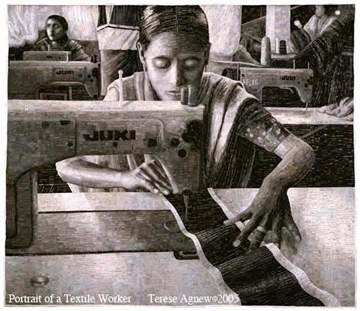
Karen Musgrave (KM): This is Karen Musgrave and I am conducting a Quilters’ S.O.S. – Save Our Stories interview with Terese Agnew. Due to circumstances this interview is being conducted online. I am thrilled to be interviewing her. We are beginning our interview on March 26, 2006. Terese, tell me about the quilt you selected for this interview. Terese Agnew (TA): About five years ago, a friend of mine invited me to go to a talk with two young garment workers from Nicaragua and their host, Charlie Kernaghan from the National Labor Committee. They described working under horrible conditions at a factory that produced clothing for export to the United States. My reaction might surprise you though. Here were two very young women who had been subjected to unimaginable abuses but had still found the courage and where-with-all to speak out about their situation in a foreign country! They said they were proud of their work but they wanted to be ‘treated like human beings, not animals.’ I had nothing but admiration for them; their strength and personhood was unforgettable. I wanted to do something to help but I didn’t know what. Then one day while I was shopping in a department store, I noticed huge signs everywhere–Calvin Klein, Tommy Hilfiger and so on. They were all proper names. I realized that by contrast, the identity of the workers who made those clothes was rarely thought of and often deliberately hidden. I thought that by creating an image of one of those workers using the name-brand labels on the clothes we buy, I might make it harder to forget the person(s) who makes those clothes. I contacted the National Labor Committee and asked if they had any photographs of textile workers that I might use for the project. They had hundreds. I was looking for one that commanded the same respect that I felt for the two women I had met. I didn’t want people to feel pity. I wanted them to see the potential of a generation being wasted. I wanted people to see a beautiful, dignified young woman who, at the very least deserved to be treated with common decency. I chose a picture that was taken by Charlie Kernaghan of a young garment worker in Bangladesh. I think she is very beautiful; she reminds me of my niece Natasha who will head off to college next year. The project began with a massive campaign to get the labels. I started with the Milwaukee County Labor Council, a website, and pretty soon the word started spreading. The Sharon Lynne Wilson Center for the Arts in Brookfield, Wisconsin asked if I would like to have the opening exhibit of the piece at their center and I said, ‘yes.’ They assembled a team of wonderful people who continued to collect labels for the project until its completion. I received labels from all over the country, many from around the world and from people across the political spectrum. Every package I got amazed me-people took the time to painstakingly cut out labels-one by one. Quilters and sewers were of course particularly generous and helpful. I loved the camaraderie they shared with me. KM: This is truly amazing. What was Charlie Kernaghan’s reaction to the quilt? TA: Oh, thank you for asking that. Here’s what happened: Charlie came to Milwaukee with two textile workers from Bangladesh and a translator. They were on a national tour to tell people what was happening to garment workers in Bangladesh. (BAD.) I was nearing completion of the Portrait, so after their talk at Marquette University they came over to my studio. Both of the women were young and very graceful and understandably angry and sad in their talk. When they came in and saw the piece, it was one of those moments when no words needed to be exchanged, they just got it. They knew that I and everyone who had contributed to the piece appreciated them. They both hugged me and I wanted to show them just how many people cared about their plight so I started carrying in box after box of envelopes that were sent with labels for the quilt and letters! Art is a form of communication and I’ve always believed it should be a two-way street but this project became a four-way intersection with intercepting paths fanning out across the globe. Charlie said he loved it and asked me a string of very smart art related questions too. He wanted to know how I created the feeling of recessionary space and how that collapsed into labels at a certain distance from the quilt. Charlie’s a great observer of many things or he could never have taken the poignant photograph that this portrait was based on. KM: Well, this is perfect because I did want you to explain more about the use of labels. How was it working with them? How long did it take you to get enough to finish the quilt? TA: I used the labels in numerous ways to create the image. For example, I used text on a contrasting background as a gradation (such as white on black or black on white), text borders were ironed back leaving a unified block of tiny words to form specific tones, names were used as segments in a line and combined with others like lines in a drawing. To make her soft (in labels) the gradations had to be very subtle. Charlie’s photograph, beautiful and poignant though it is didn’t have detailed visual information at the scale I was working in. I redrew most of it to articulate details that were incomprehensively fuzzy blown up and to accommodate the directionality of label lettering or their ability to become flat tonal planes. I worked a lot on the light quality too. My goal was to render the image so that people would see it as a representation of a real place from a distance of 15 or 20 feet but maintain the experience of seeing it up close as a mass of labels that could easily be from the clothes in your own closet. As to your other question, I needed labels up to the end. In fact, I was so desperate for dark gray labels at the end that a few of my friends allowed me to ransack their entire closets. Luckily by then I was pretty good at removing labels without poking holes in a shirt or sweater. KM: This is so incredible. I truly wish I could see it in person. Where is the quilt now? Where has it been? TA: Right now it is hanging at the Marcus Center for the Performing Arts in Milwaukee. The opening exhibit was at the Sharon Lynne Wilson Center for the Arts in Brookfield, Wisconsin (January ’05) then it went to the James Watrous Gallery in Madison, Wisconsin (Wisconsin Academy of sciences arts and letters), in February of 2005. This past September it was in a show at INOVA (Institute of Visual Arts) at the University of Wisconsin, Milwaukee. The INOVA show was for The Greater Milwaukee Foundation’s Mary L. Nohl Fund Fellowships for Individual Artists. (I won one of the 3 Established Artists awards in 2004). If people want to know where it will be they can check my website (www.tardart.com). The next showing will be back at the Sharon Lynne Wilson Center for the Arts in Brookfield, Wisconsin for their state wide Hidden River Festival September 22 -24. A few weeks later it will go to Mount Mary College for a symposium On Portrait of a Textile Worker, and the issues it raises. KM: As I recall, you began your art career as a sculptor. How did you come to make quilts? And how does making quilts relate to your sculptures, if they do? TA: From 1985 to about 1989 I made large-scale public sculptures with the help of many, many people but by 1989 I felt that the process worked better than most of the art. I decided I had to rethink everything I’d been doing up to that point. I started wondering how to take issues outside of the narrow political framework of predictable oppositions and put them back into the realm of human experience with art. A lot of political art at that time was very confrontational and ended up preaching only to the converted. After a great deal of contemplation I thought, ‘Why would you oppose anything if you didn’t first value or love whatever was being subjected to destruction, injury or ruin? The emphasis was on the wrong thing!’ By chance in 1992, I’d also been making quilts. At first to stay just to stay warm in the drafty building my husband, Rob Danielson, and I had just moved into. But I quickly saw that using the medium to make art opened up an endless variety of construction methods with a vast range of materials. I started working with fabric scraps and thread the way I would have used line and color in a drawing or painting. Quilting had obvious possibilities as a three-dimensional medium too; sometimes I would tack the fabric on with a single stitch so that it would float on the quilt surface, other times I would unravel the cloth for texture. Quilts have a warmth that isn’t just about utility. It’s a medium that reminds us of being cared for, and/or it’s opposite; disregard for people and the nature that sustains us. It turned out to be a great way to address political issues without the divisive go-nowhere arguments that dominate mass media. But I’m getting off the topic of your question. My next piece will be perceived as more of a sculpture than a quilt, but it comes from one of the basic definitions of a quilt: three layers; consisting of cloth and batting connected together. KM: Tell me more. I’m especially interested in hearing your thoughts on this and where you think quilts will be in the future. [there was a long break between this question and TA’s answer due to her schedule.] TA: Well I’m not letting the cat out of the bag quite yet but I will tell you part of the concept: quilts tend to be 3 layers as I mentioned, but why stop there? Why not make one that’s thousands of layers and build an image from the side? That’s the idea I’m working on. Where do I think quilts will be in the future? Where ever quilters want to take them. As far as I’m concerned the sky’s the limit. KM: I agree that the sky is the limit. I just attended the International Quilt Festival in Rosemont and was pleased to see the limit is being tested and accepted into the show. What do you think makes a quilt artistically powerful? TA: I don’t want to segregate quilts in answering this question. Any work of art that’s powerful for people will be compelling on many levels. Form, composition, what something is made of and how it is made become inseparable from the overall concept. Andy Warhol’s serially printed soup cans stop people in their tracks for this reason. It’s a perfect reflection of the impact contemporary production has on our everyday lives. It makes us conscious of details in our surroundings as opposed to reducing them to ambient background. One of my favorite artists is Roger Brown, who would have made a magnificent quilter had he not been a great painter. His paintings are just beautiful. He works with repetition and pattern to show evocative situations that are as familiar as they are alien. His paintings are more like questions or investigations-that’s certainly part of their power for me. KM: I’d like to go back to your quilt. It’s quite large 8 feet by 9 feet. Why did you choose to make the quilt this size? Do you usually work large? TA: I once said “Portrait of a Textile Worker” is just big enough to compete with those Tommy Hilfiger signs. But I don’t think I work that large. Everything I make relates to human scale-I consider how a person would see a piece from a distance and up close. I don’t want my work to overwhelm as much as draw you in. They might seem large because the details are small. I’m trying to show something of the complexity of the world-it’s a very rich place-nothing looks air-brushed to me. KM: I hope that you and your quilt continue to do good things. Thanks for agreeing to do this interview. The interview concluded on June 19,…
by Quilt Alliance | Feb 24, 2016
[addtoany] [space height=”10″] Meg Cox (MC): This is the Quilters’ S.O.S. – Save Our Stories interview with Victoria Findlay Wolfe. We are at her loft apartment in New York City. Tell me about the quilt you’ve brought today to talk about. Victoria Findlay Wolfe (VFW): The quilt that I’d like to talk about is the one hanging over here behind us called “Everything but the Kitchen Sink.” I started it about 15 years ago. I was an occasional quilter, and then I became a mother. There was at a point where I was making a lot of quilts and children’s clothes for my daughter Beatrice. I wanted to make her quilts when she was a baby. But I would never make the perfect quilt for her. I ended up making her about 20 quilts. None of the quilts were ever good enough for my daughter, so I cut them all up and accumulated many orphan blocks along the way from doing so. I was looking at quilts but not really knowing much about making a quilt. The only quilts I had in my house were the crazy quilts my grandmother made. And so that’s how this quilt started, I was trying to mimic what my grandmother did. Mimicking what her process was. Because it was the only thing I knew, from watching her quilt as a child. MC: So you brought this because it speaks to how you became involved with quilting? VFW: It was definitely the start of the obsession with quilting. I had started, if you look at the bottom of that quilt, there is a 14″ strip across the bottom, where I was looking at my grandmother’s work and I was trying to duplicate what she did by using the sewing machine instead of by hand. I got so bored and frustrated trying to do it. It wasn’t my way, so I needed to figure out how to do what she did, but in my own way, so I couldn’t I get frustrated. I couldn’t at the time, and so I put it away in a box for about 12 years. In 2009 I pulled it out and that’s when I had accumulated so many more orphan blocks and then just started playing with it, adding them all into one quilt. MC: What do you think that this quilt says about you? If someone came upon this quilt, what do you think it says about you as a quilter? VFW: That’s kind of hard. I hope they see the learning curve and passion. When I look at that quilt, I see everything that I have learned for about 15 years. I learned techniques that I have never done before. There’s probably about a hundred Y seams in that quilt. Difficult seams. That’s the only way to do it, just go for it. Applique is something that I had not done since junior high school. It’s my learning process, in that quilt, trying to do letters, applique, using up antique blocks I’ve collected. Everything I had went into it, along with my everyday life. Maybe it says, I’m open to the life throws at me? I’m a painter by trade previously so I was trying to figure out the color balance and make it all work. It’s been a complete learning experience so it kind of sums up a wide portion of my life including getting married, having a family, moving to New York, it accumulates everything. MC: How do you use this quilt? VFW: It sits on my bed. It’s the one quilt that I am so attached to, I’d garb it from a burning building. It’s not going anywhere, it’s staying here, it wont’ be sold. It gets used and loved. MC: So your interest in quilting was originally sparked by your grandmother? VFW: Yes, definitely, and by the basic needs of growing up on a farm. My father had an upholstery business in Minnesota and I grew up on a farm in MN. My mother was a seamstress for Fingerhut for a while. I don’t know if anyone knows Fingerhut out here. But that’s why my grandma had all theses quilts made out of polyester double-knit. My grandmother was a crazy-quilter. In MN you had about five of these quilts on your bed, because it’s cold and we did not have heat in our house. We heated our house with wood stoves. So we would have about five of these quilts on our bed and they stayed there all night long. The weight of them is unforgettable and comforting. MC: Was she the only family member who quilted? VFW: No, My mother would make quilts periodically, only after a relative got married, but then she was more of a seamstress. When I started sewing, I had one of those Barbie sewing machines that had a glue cartridge that you would put in and it would put glue dots on the fabric. That really worked well (laughter). Then I moved up from there gradually and would steal my father’s scraps and upholstery sample books. I’d sew them together on my mother’s Singer. I remember him teaching me how to do a blind stitch and I thought it was the coolest thing in the world because you couldn’t tell there was a seam on the outside finishing it up. I thought it was pretty cool cause it looked like my Dad’s work then. MC: Did you ever make a quilt for the Barbie? VFW: I’m sure I did but I don’t remember. MC: So your first quilt memory was probably the polyester quilts on the bed? VFW: Yes and they were heavy. MC: So how much time do you spent quilting now? How big a part of your life is it? VFW: All day all night. My husband’s up in Canada right now, so I would stay up all night if I could. No, really, I sew all day. All day long. I sew when my daughter goes to school, I sew, when she comes home, I quilt when she goes to bed. It’s an obsession, I know and accept that. it is all related to my need to create. MC: Would you talk a little bit about the modern quilt movement and how you seemed to be involved with that? VFW: That’s kind of interesting. I was a little bit clueless to it. It had been around for about six months. Hadn’t heard anything about it. And a friend of mine Amy Drucker, said how come we don’t have this in New York. We need a guild. Let’s do this. Want to do this? Okay and 20 minutes later our site was up and within an hour we had like 20 members. That was 1-1/2 years ago. So within 20 minutes we got all these people on the site and it has grown very rapidly. We have been meeting here in the apt. We have over 150 members on line. We are working on a new web site, The challenge has not been getting more people, new people come each meeting, and community is a big part of it. MC: How do you define, for you, what is it about? VFW: For me personally it’s keeping all the rules open. I consider myself a very traditional quilter. I’ve done it since I was very young. I know patchwork and how to sew by hand but at the same time, as an artist, I want to try different things and I think maybe the modern movement is incorporating that more for everybody, that it’s okay to do your own thing. I think it is all-inclusive, it includes the art quilter, the beginner quilter, the traditional quilter who wants to try something new. The fabric designers are a big part of it, the more color I can get, the happier I am. MC: Can you talk a little bit about your creative process. Were you conscious of that for a long time? VFW: Yeah. We had a talk the other day about how or about why the process was more important to you or the finished object was more important. To me as an artist it is definitely the process. It’s all about starting the quilt, and discovering where it’s going. I rarely have a plan when I start something. I start with one little piece and I let it grow organically. I don’t ever now where I’m going with it, the adventure of it is what excited me. It’s like when I’m working on a painting I’ll start small in the center, and then it gets big as I fill in the canvas… MC: So with a quilt do you start with the color, do you start with the pattern. What is your impulse? VFW: It could be anything. Sometimes it’s a memory of somebody, a memory of my grandmother. This quilt, “Grandmother’s Rocking Chair”, This quilt actually started out as a traditional style quilt with squares, and the orange blocks. I couldn’t make it just be that traditional quilt, I had to see what would happen if I… then played out all the options that made me think of my grandmother. It was just too normal, so I started playing and the next thing I knew I had something completely different. About my grandmother, from watching her sew, sitting in her rocking chair. That would be the inspiration. Or like I said, looking at my grandmother’s quilt for inspiration, a color combination or Anytime I’d say I would never do a purple and gold quilt, those are my high school colors, I hated those colors, as soon as I said that, I made five quilts with those colors. So that is a great inspiration or a starting off point to a great challenge. MC: So you challenge yourself? VFW: Always challenge. I love a challenge. That’s one of the things I love to do most. Sometimes if I’m doing a commissioned quilt, I ask people to give me a word and that will send me off on a tangent. MC: That’s a great segue. How did you get involved in the commission business and do you have your own personal style or how does it work? VFW: It’s been mostly word of mouth. A lot of my painting commissions have spilled over into quilts because they want to know what I am doing with quilts. They are confused at first until they see them and then they want one. I don’t always get a lot of information. I had one person wanted a red quilt. That was the inspiration. So I cleaned all my stash of every red I had. When I do a commission, there’s no deposit required. If after I make the quilt, if they want to purchase it after it’s made, great! It’s okay with me! but I’m just as happy to keep it if they don’t. It’s a win/win either way. MC: And I know as well that you started a community project for quilts. You really are living and breathing quilting. Could you talk a little bit about that? How that got started and where that is now? VFW: That was kind of funny. The blog world is a very interesting place. Those of us who quilt have more quilts than we need. I had some extra quilts lying here and I had a friend who worked with a program called Basics, in the Bronx, who worked with getting homeless families back into transitional housing here in the city. I asked him one day: Do you need any quilts? Thinking I could give him two or three that I had lying around. And he turned around and said: Do you have 700? That was not what I expected him to say, not in my wildest dreams. . So I said, hmmm, I don’t know, let me see what I can do. So I designed a house block and asked people on my blog to make them and send them to me and I would make a couple quilts for them. well a couple blocks turned into, 500 quilt blocks and that turned into 60 quilts, which we then auctioned off and raised over $30,000 for them. MC: You auctioned them of for the organization? VFW: Yes, basically by auctioning off the quilts for them at an organization fundraiser. Then, that had been so successful, that we turned it into an ongoing quilt drive. And so now, we opened it up where you could send in completed quilts. We’ve received over 350 quilts. And we’ve had event days where we go up to the Bronx to each of the different housing units and we hand the quilts to the families in the program. It’s an extremely emotional and fabulous day. We have another round of that coming up, to collect more quilts. And it turns into something bigger than I had set out to do. One needs to always think bigger. MC: Would you talk about, what is the most pleasing aspect of quilting to you? VFW: It’s the process and giving back. It’s just so fun watching all these little pieces come together. I can’t throw anything away. So I save all my little pieces and they grow from nothing into something. That’s what I love. It’s not even so much the finished product. I think by the time I put it on my lap and fix the binding I’m done and I’m onto the next project. From the beginning to the end. And giving them away is even better, good for the soul. MC: Have advances in technology affected your work? What about the tools that you use? VFW: Not much other than my rotary cutter and my scissors. I’ve dabbled a bit on Spoonflower, working with fabric design and that’s always interesting. I’m happy to participate and try a new tool. I feel kind of traditional with my quilts so I have to push myself further into other areas yet. Just when I say I will never do something, I need that boost to try something new, new technology can help me do that. MC: What about fabrics? Where are you looking for fabric? VFW: Anywhere. Clothes. Fabric shops. All the stores. All my friends. MC: What are you favorite techniques? VFW: I used to think that I would never pick up applique ever ever again in my life, but I actually love it. So I’ve been tending to do even more of that, but scrap piecing, my heart belongs to scrap piecing… MC: We are in this big loft in your living area that we’ve taken over and so people cannot really tell that behind this wall and behind this quilt is your studio space where you work. So since we can’t see it, would you describe it for us? VFW: It’s a mess. That sums it up. It’s a couple tables set up in the space, set up for working with all these quilts. I have my tall cutting table and lots of windows all around and lots of fabrics. And one Juki sewing machine. MC: Now you were talking earlier about this building being in the garment district and what it was like when you got here. Would you share some of that? VFW: When we moved into this building the neighboring building that we looked into was still a sweat shop. The history of this area is that is all it was, it was all the sweat shops, as we are part of the garment center. Our building once was also. It just seems kind of funny now that I sit here sewing all day, I joke, that I get so much done because of the spirits of past garment workers. So when people come here and see all the quilts, it’s not me, it’s all the sewing energy of the workers, it’s kind of interesting. MC: Would you tell me if you’ve ever used quilts or quilting to get through a difficult time in your life? VFW: Not specifically…It’s mostly joyous times. Anytime there is a baby in the family there is a quilt being made. Anytime I can share and give something away. I do obsess over a particular quilt I’d like to make. I haven’t made this yet, but I do want to make a quilt for when I die. Is that terrible? MC: Why is that? VFW: Growing up in MN I attended a Native American funeral. Their tradition is to sit with the body for a three days and the body is always wrapped in a quilt. And I thought it would be incredibly personal and special if I made that quilt. I’m happy with a pine box and a quilt. That’s it. I don’t know what that quilt would be. I cannot even decide what to quilt for own my bed, but I think about it all the time. MC: I want to talk a little bit about aesthetics in your work and beyond. What do you think makes a great quilt? VFW: I think all quilts are great. I think that whatever process anyone takes to make something, that’s their process to be respected. We all make for different reasons, and with different processes. There are no ugly quilts. It depends if you are making it for some particular reason that you think you have to strive to do something. If someone doesn’t like what I’ve done. It’s ok. I like that it can just be what it is. Anytime I see a quilt top in an antique store I know someone poured everything they had into it. They worked so hard to make it. And I usually come home with those quilts. I respect the person and their process for making it. MC: What are the works you are drawn to? Are there quilt makers that you admire or are there other types of quilts that you might see in a museum that might pull you in? VFW: I think it’s the ones in the flea markets that I am crazy about. The ones that get passed on out of the family. I love thinking about who that was who sat and put all those pieces together. I find I want to know the story behind the quilt. A quilt needs to be loved. MC: What artists have influenced you? VFW: I am doing a Matisse quilt right now. It’s not the first one I’ve done. So he is the biggest inspiration. Monet, the colors. Kandinsky, the bright colors. And a lot of modern art. I like the parallel a lot between some of the modern quilting now and some of the more traditional modern contemporary painters such as Ellsworth Kelly. Big bold patterns. Amish quilts are modern and contemporary no matter when they were made. Simple. Elegant. MC: How do you start with that? Is it looking at a painting. Are you inspired by that? Is it kind of a cut out? VFW: The cut outs are the easiest thing. It’s just a challenge. I don’t plan, drawing it all out. I just start cutting fabric. Picking up little pieces and just star sewing bits together to resemble whatever it is I’m looking at. They are always free form, whatever happens with them happens. They are what they are. It’s a work in progress and it is fun to do. MC: How do you feel about machine quilting? Do you do your own machine quilting? How do you finish quilts? VFW: Yes I do machine quilt. I struggle a bit with it, But I find it’s building my patience as my skills grow. I don’t have time to hand quilt all my own quilts. I do use long armers. If I have a quilt I really, really love, I have to quilt it myself. It’s not my favorite thing to do, but I’m learning slowly to add new designs each time I quilt a quilt. I just have a regular straight stitch home machine. No long arm. MC: So you’re not one of those dedicated quilters____________? VFW: They are all straight stitch, My Juki’s are fast, simple, and great work horse machines! MC: Why is quilt making important to life? VFW: I like that they (quilts) are going to be around for a lot longer than I am. I like that my daughter is watching me. I know that I am passing it onto her. I enjoy that the quilts will stay in the family. She is 11, which may change later in life! MC: In what ways do you think your quilts reflect your community or your region? VFW: I don’t know. I haven’t thought about that. I don’t know. MC: What do you think is the importance of quilts in American life? VFW: The utilitarian aspect of them, from what they’ve grown from out of necessity, using what they have been to begin with. It’s all true now again. Whether it’s being green, using up what you have and not being wasteful. Everything that quilts started with is as true then as it is now. We must be resourceful not wasteful. MC: Where do you see yourself going as a quilter? Do you have goals, do you take it as it comes? VFW: I take it as it comes. I don’t obsess on making a perfect quilt. I’m not sure I can do that, I’m not sure I want to do that. I prefer to learn from each quilt that I do and move onto the next and see what happens. I have felt recently that my work is sort of changing, or perhaps I’m just growing. But I think it’s just being more open to more possibilities and going back and learning and trying other things that I haven’t done before. Building my tool set of quilter skills. I let it happen and see where it will lead me I am doing a lot more handwork than I ever have done before. I’m curious to see where that goes. MC: Are you teaching others as well? I have started teaching a little bit, yes. I have a teaching website where I show what I do. I show my process, what I do and a lot of people have enjoyed playing along with that and using that also as a way of building something from nothing and using that to start them and that’s been fun to watch other people get enjoyment from that as well. MC: Would you like to be a style maker, a taste maker, a leader in the art of quilting? VFW: I don’t think so, I just want to be a quilter. I just love to do it. I have to “make” being an artist. Whether I’m painting or drawing or making a quilt, or making dinner or learning how to do something else. It’s always about making. I need to do that. It’s all about the process to me. Being a tastemaker or leader in quilting seems less important, I just need to make. If that other stuff comes with what I’m doing, then that tells me I’m in the right place doing what I need to be doing. One of my sites, 15 minutes of play started from that. Being a mom when you have no time for yourself sometimes you only have 15 minutes, just for your sanity as an artist. I needed to do something at least 15 minutes a day for myself. So that is a constant that I keep with me all the time. I do need to make constantly. If I have 15 minutes, I’ll take it. MC: Constitutional imperative. So is that 15 minutes to play, is that what it’s called? VFW: www.15minutesplay.com MC: And that is still active? VFW: Yes, very much so. We have about 100 players on the site. We are constantly challenging each other and giving each other inspiration and supporting each other. Giving each other feedback. Just playing and seeing what happens. You don’t always have to have a plan where you’re going, it’s fine if you have a plan, but often it’s been when people are trying to find a new way, that they tap into their creative process. If you’re looking at something in a different way, you may find new answers to the What if questions… That’s kind of what we’ve been doing. MC: That’s interesting because you are about the making but you are also about making of communities. Are the players, have they become your community? VFW: Definitely. It’s become my community as well as the Modern Guild. It’s all about community. People come together and want to share what they’re doing and get feedback and get praise for all the hard work they’ve put into something. The amount of people that I’ve met through blogs and the amount of friends through the guild, finding like minded people, there is just nothing better than that. Having people around who get what you’re doing and want to do the same thing. You see the same spark in their eye. And you know that they get it. It’s great. MC: So 15 minutes play is not just quilting? VFW: Yes, it is just quilting. Well, quilting and community. Sharing, bonding…and different challenges to work in different ways. MC: Could you share some of those challenges that you think were the most interesting? VFW: Well we just had a solids, strictly solids challenge. Some people had not done that! We used artwork & paintings as inspiration, and they used only solid fabrics and made quilts from the swapped fabric, that was one of the challenges recently. We also challenged people to come up with a tutorial for a quilt block, and focused on specific color challenges as well. MC: It sounds like fun. How much time do they have to complete the challenge? VFW: Usually about a month. MC: What do you think is the biggest challenge that is affecting quilters today? VFW: I don’t know how to answer that. It’s is such a personal thing for everybody. People are having issues with being labeled a certain type of quilter instead of just being inclusive and appreciating craft. I think that’s what I hear the most of all now, especially in the modern quilt world now. Everyone is trying to find their place. It’s all mixed up, it’s awkward. Can’t we all just be quilters? MC: Well, I would like to thank Victoria for letting us conduct this interview today. We are concluding this interview at…