by Emma Parker | Sep 2, 2017
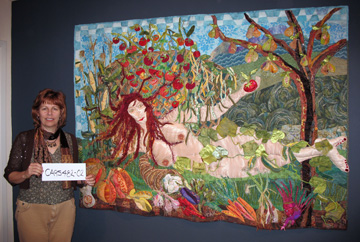
Karen Musgrave (KM): This is Karen Musgrave and I am doing a Quilters’ S.O.S. – Save Our Stories interview with Betty Lacy. It is March 9, 2007. I am in Ukiah, California and it is 1:38 in the afternoon. Betty, thank you for agreeing to let me interview you. Tell me about this quilt that you selected for this interview. Betty Lacy (BL): This is the “Vegetable Garden Goddess” quilt and the idea for this came up, originally it started as a group project that actually never fully got completed. [laughs.] Maybe I shouldn’t say that on tape. KM: I didn’t know that. BL: But a number of us did complete the project, and we started with the idea of just vegetables because we live in a rural area of northern California. Many of us love to garden and so Laura [Fogg.] and Deanna [Apfel.] came up with this idea to do quilts with a vegetable theme. In our group we usually start with a theme and process if this is something the group want to do. Then we essentially go off into our individual design realms and come up with our own ideas on the theme. For me, my process is kind of first putting them to paper and then going from there. I have to say that actually this quilt for me was kind of big, because for one it is a big quilt and two it emanated from a dream. It was a dream of this sensual woman who is naked in a garden surrounded by a cornucopia of vegetables and fruits. I think a lot of times; particularly in our culture nakedness is viewed as something dirty or inappropriate and should be hidden. So I felt like I really wanted to portray her in all of her nakedness, because to me her nakedness is really about showing her vulnerability. Where can we go and be naked to the world. Where can we show our true selves, our hidden selves? Where is it safe especially for women to do this? I want to say historically this quilt emerged right after our vagina quilt series project. That was just a great project because we got to interface with Eve Enster who wrote the “Vagina Monologues”. Our group went on to be part of the film “Until the Violence Stops” with our vagina quilt project that Laura and I introduced. This was a huge boost for us as artists and as women and for Mendocino Quilt Artists (MQA) so it was almost a natural progression to do a vagina quilts and then do this quilt of a naked woman in a garden. So anyway what was fun was I had various people pose for this and then drew the parts of their bodies. So a number of the people in our quilt group, who might want to go unnamed, but I will say that part of the upper part was Ann’s and part of the lower part was Joyce [Paterson.], and I think Laura would be okay with me saying that it was her waist. Laura has this very defined kind of waist. The feet are actually my husband’s, who posed for several drawings. KM: I was going to ask you about the feet. BL: My husband has these great feet. They are just like silky white; it’s like, because he wears boots and shoes a lot. I guess they never get that, you know how our feet get a little worn and torn. KM: I go barefoot. I like to go barefoot. BL: Me too, me too. Of course she has a juicy tomato, better than an apple, which you know you would think, ‘This is Eve in the garden,’ right? It is not Eve. It is actually, I call her Elvira by the way. KM: She has a name? BL: Elvira. She is holding a tomato and it is a very juicy tomato because I am celebrating our juiciness as women. The real juice that we get to be who we are, so there is of course a real sensuality displayed here. You can see the cornucopia coming with all of these vegetables just kind of pouring out from the garden. And she is kind of pouring out in all of her voluptuousness. She has these cucumber leaves in various strategic places. This quilt was hung in our downtown area when we had our vagina quilts there and later she was also hung at our library. People just loved her. She also has–I wanted her to have some pears because Ukiah in this area of northern California is famous for growing pears. There is something about pears and their sensual juiciness as well. KM: They are wonderful. BL: They are wonderful pears. Thank you. You can tell they are pears? KM: Yes I could tell they were pears. I just like the way they glisten. Is that paint that you used on them? BL: No actually I think that is a toile with an embedded. KM: Very cool. A lot of raw edge? BL: A lot of raw edge. KM: Is that typical of your work? BL: I go back and forth. I experiment a lot. You know Laura, one of my mentors of raw edge; she is the raw edge queen. She is amazing. So she kind of got me started in raw edge, and so I did raw edge. Not everybody did raw edge for this project though. It has, some of Laura’s raw edge, one of the cool things is that she uses that raw edge and then you put tulle over it. KM: Is she silk? BL: Actually this is kind of tricky because she is–this old fabric that was brought to our group one time. It was white, it was like old curtains. So her skin is some kind of blend of polyester made from old curtains. This was my first time I was doing much dyeing of fabric. So I literally took this fabric that was white put it in a bucket, and I put everything in my kitchen in it. I put chocolate and I put ketchup, I put tomato juice, and boiled red onionskins. I let it set in there for a couple of days, because I wanted this kind of pinky toned skin color. Oh, and a little bit of tea. KM: It is perfect. BL: Voila. It is perfect, and so she is really perfect for me. I’m really happy with her. KM: How long did it take you to make this quilt? BL: Gosh, well for me, since I work, I happen to be one of those working women who quilt. KM: What is you other occupation? BL: I’m a psychiatrist. I like to reframe this, I work as a psychiatrist. I am not a psychiatrist. Got that. KM: Yes. BL: Good. I would like to retire, but I don’t think that is going to happen anytime soon. You know. KM: Exactly. BL: Got to do something to support your art, you know. So, what else can I say about her. KM: She is like fifty-one by seventy-four, so she is a very large quilt. Do you usually work big? Is this typical size or do you? BL: I like to work kind of big, but lately I have been working a little smaller. I am doing some altar quilts that I’m starting to do now that I really like because they are simple, and quick and easy. They bring me joy. I get angsty over my quilts, especially if they are bigger and take longer. I fuss over them a bit too much. It is kind of like birth to me. My quilt sister Leila [Kazimi.] once said, ‘Quilting is like giving birth in a way, you have to make time for your creativity, you have to labor about the process as well.’ I know you know what I’m talking about. So, she took, I want to say she could have taken six or eight months. When I work, I will also be simultaneously working on other projects too. So that way I don’t get too bored and too obsessed about various details. KM: About how many hours a week do you work on quilts? BL: Well that is also very. KM: An average. BL: It, what I would say is that it varies a lot. I would say some weeks I might do like ten or twelve hours and other weeks I might do one or two. I always have a sketch pad by my bed. I will cut stuff out and keep a notebook of things, of patterns and images that interest me, even colors in the newspaper or magazines. I am not a formerly trained artist. A number of people in our group have formal training in art. I have formal training in science. I was a nurse, and then I became a physician, so I have very little training in art. But I love it. It is my new affair. I tell my friends, ‘I am having an affair with art.’ KM: Do you think of yourself more as an artist or as a quiltmaker or do you even make the distinction? BL: I would say, I, it depends on who I am talking to you know. [laughs.]. It is probably easiest to say I’m a quilter, and that is generally what comes out. But if there is somebody a little bit more learned in quilts, then I would say I’m an art quiltmaker with interest in surface design, texture and color. KM: Do you do a lot of dyeing? BL: I do not do a lot of dyeing. I will do like tea dye and add paint and other textures. KM: Have advances in technology influenced your work? BL: Tremendously. KM: How has it? BL: When I first started I sewed on my mother’s Singer from the 1950’s. She used to make dresses for me and clothes for herself. Very quickly, I think within a year or two in the group, everybody told me, that you are going to need a new machine. I resisted because of my attachment to the Singer, but eventually I realized that this modern computerized machine is something you that would really improve my quilting, quilts and speed with which I could produce. KM: Do you use the computer at all? BL: I use computer with images. Now I’m doing more digital photography and transferring onto cloth. I’m doing right now a sticks and stones study. I go walking around Lake Mendocino every weekend taking digitals of various textures and putting stones and sticks together. Then I take them into Photoshop and tweak them. This has been the biggest change for me this year. I am not big on technological things, but do see their value. Even though, I’m from a science background, I like the science, but I don’t like the numbers. I was never good at math. So that is why with color or dyeing or when they say so much of this and that, forget it. KM: That is interesting. BL. Are you that way too? KM: Yeah. BL: Good, we do have a lot in common. KM: What are your favorite techniques? BL: Simplest the better. The funniest and most enjoyable. I think I struggle probably more so than people in the group. Not only do I not have an art background, I characterize myself as the only one in our group who can’t really sew a straight line. I’m just not an exact person. Matter of fact, the way that I come to joining our group is an example of this. It was 1995 or 6, they did a play called “Quilters,” at our local community theatre. The quilt group was already formed at that point. My neighbor Joyce approached me about doing a quilt for the show. Of course I said yes. But I have never been great about, as I said math or directions. The quilt I did was the “Tree of Life” quilt, which is the last featured in the show. Well it was too small. Lucky for me there were two “Tree of Life” quilts needed because one has to be in the big quilt sampler for the last scene. Since mine was too small to fit in the last scene it was brought out to introduce the scene. Surprisingly Joyce and the others still invited me to join the group. But that is how I would characterize my work. I don’t always fit you know with a prescribed way of doing things. Henceforth the techniques that I use would be anything that entices me. I might look in a magazine and see something that is worth trying. I like to try new things. I am enjoying hand stitching or beading or doing a little extra something to give the quilt a little piazza. That is something that interests me. KM: Let’s talk a little bit more about the quilt group. How many women are there? BL: Eleven right now. KM: How has the group evolved? BL: Well, you know it has changed a lot. The last five years one of the things that we did was give more structure to the group. Originally the group was very loose. I think we would meet once a month and people would just come together and bring their projects and every now and then we would have group projects or kind of challenges or things like that. But over the last five years the group has really condensed its energy and you can see it in our work. I mean I take a lot of solace and inspiration from our group and we have all grown really close together. So I would say that one of the things that started happening was that requirements started to be made. It became more of a closed group than an open group. Before that, four or five years ago, people could come and go in the group, they didn’t have to participate that much Then we started to have more perimeters, boundaries with the group. We generally now get together two times a month, one morning and one evening a month. KM: My group is eighteen. BL: Oh my gosh, yeah and you have to clean the house. KM: Before and after. BL: Before and after, that is right, exactly. [laughs.] The after is the one you really hate, right. But I think again getting clearer boundaries and parameters and really asking ourselves what is it that we really want as a group was monumental. Then we had Joyce’s husband come in at one point and lead us all in a meeting where each one of us was responsible for stating what we wanted and expected from the group and what we as individuals were willing to contribute.. It was a very important turn in our group process. This was actually probably within a year or two ago. We really had to dig into ourselves and ask what each of us wanted as artists. We cleared the air and opened things up. Since that time many of us have been showing our work more as individuals at various shows. Things just really began to bloom for all of us. KM: Where are the pieces that you have shown? BL: Right now I have a piece that I’m really proud of called “Break on Through” at Carnegie Institute, which was very big, very gutsy. I applied to Quilt National. It was not accepted. I think I’m the first one in the group to have applied to Quilt National. So everybody was routing for me. It was hard to get that letter of rejection, but then this quilt was accepted to the Carnegie Institute. Now that quilt is actually going to Sacred Threads. It got accepted there too. Every year or so, you know, usually I will have a quilt in PIQF [Pacific International Quilt Festival.]. KM: When you are collaborating. BL: I really love the collaboration. It is a challenge, but I just love it. The people that I work with are such great artists and it has just been a hoot. It has really been fun. So I was going to say that the quilt that I did with Laura called the “Quilt of Compassion” has gone all over the world and been photographed and been in a number of journals. Quilting Newsletter [Quilter’s Newsletter Magazine.], Quilting Arts and a few journals in Japan. Now we are looking forward to having it rest in a permanent home in New York at either the Police Commission or something headquarters that the Mancuso Brothers are kind of orchestrating. KM: Very cool. Do you collect anybody’s work? BL: I have. I have purchased one of Laura’s quilts and have other artwork around our home that is purchased. KM: I guess I should go back and tell people where you hang your quilt. BL: Elvira. Elvira is hanging in my dinning room, so as you walk in my front door you can’t miss her. You are sitting at the table, which is so perfect to me. And she is sitting or I should say laying right with you behind the table in my dining room on the navy blue wall. KM: Did you know this is where she was going? BL: Yeah. KM: When you finished it. BL: When we finished our kind of remodel, it is like I knew. I have had quilts hanging here, but she just, everybody just loves her. How could you not love her, she is a beauty. KM: You signed it? BL: Yeah. KM: Why did you sign your quilt? BL: Well, you know, I think it is really important as artists that we do sign our quilts. Painters and other artists sign their work so why not quilt artists. I find that I sign most of my quilts as Bettina, a kind of nom de plum. KM: Describe your studio. BL: There are many cards and images of the Virgin of Guadalupe. I’ve always been drawn to the different images of the Virgin. It reminds me of Judy Chicago’s work a little bit. For the longest time I didn’t have a studio. I quilted on our dinning room table after everyone was asleep, late into the night. That was when our son was young. Back then I was stacking fabric in the bedroom in boxes and orange crates and anywhere it could be put. Now I have a wonderful studio in our old master bedroom. As group artists, we won a lot of national shows. I have our published pictures of some of these quilts framed and on the wall in my studio. I have my tribute to Georgia O’Keefe over my main cutting table. What I love most about my studio is its design wall. KM: You chose gray flannel? BL: Yeah it is gray flannel. What do you have? KM: I have white right now. BL: I was debating about gray. KM: I went back and forth. I thought it was interesting that you selected gray. Does it influence your work at all? BL: It doesn’t. There is something about it not being white that appealed to me, I don’t know it just kind of made the piece a little calmer or something, where I wasn’t so focused on that background. I don’t know, I think I would still go with gray, I’m happy with that. KM: I am getting ready to redo mine so that is why I’m. BL: I would go with gray. KM: There is a lot of color in your home. BL: Yes. KM: We are doing the interview in your home, but your studio is white. BL: Definitely, I don’t think I will change that. KM: It is calmer? BL: Yes definitely. KM: Less stimulation? BL: I need less stimulation more and more in my life. That is something I would say that has grown out of being an artist. Something just about, maybe needing more quiet time. KM: I think also it simplifies. BL: Yes simplify, simplify. I would agree. KM: I think at this point in my life I just need to simplify. BL: Not so much stuff. Get rid of the stuff. KM: At least the stuff that has no intense value. BL: Right, that was actually what we did when we remodeled our home. KM: Do you think it is an aging process? BL: I think for me it is related to age and change and awareness of what is really important. KM: Thank god. BL: It would be like never change right, you don’t want to do that. KM: Do you think that has influenced your work? BL: The simplification, absolutely. I am definitely one who likes more abstract work. I like taking original quilt patterns like Log Cabin or Flying Geese and tweaking it in such a way that you are liberating it, simplifying it. Then I equally enjoy running the machine all over it, or cutting stuff in a certain way, slash and burn it, stretch it, color it, manipulate it, just getting down to basics here. Of course doing this in a way that is inviting to the eye with design sense of mind is very important. KM: This is a good time to ask you what you think makes a great quilt? BL: Well I think whenever I approach a quilt; I kind of look at the whole thing and just let it wash over me, kind of like a baptism. Even if it is a small piece, you know, I think I go first to the feeling, what is the feeling that I get? I’m a very feeling oriented person, although I’m trying to develop more of my impersonal side, but I really, I have a lot of feeling and passion in the world and so I want to, I want to be able to feel the quilt. If it is too representational for me, or if it is too like I know exactly where things are, that does not appeal to me at all. I like to have it spark something. Like if you go to a foreign country or you are traveling or something, you want to see something different, so I want to see something different in a quilt, even if it is a Log Cabin. It is something that just has ownership with that artist; it is not just recreated like a Thomas Kincaid or something like that. Does that answer your question? KM: Yes it did. What does your family think about your quiltmaking? BL: I think they are pretty happy with it. I again was more science person so I never thought of myself too much as an artist. I remember when I was growing up, my sister who is six years younger, I’m going to go see her this next week, she lives in San Diego. When she was in kindergarten she won the art award. I still remember the big bunny rabbit on newsprint that she did. Anyway, she won this award and I remember feeling so incredibly jealous an envious of her. I might have even said to myself, well you could never do anything like this so you might as well stick with the tangible world. Art is different; you never know what is going to happen. I think that art and specifically quilting as an art, has led me to a place of mystery and unknowingness like the project we talked about today. I really see art as a journey of trusting more of what is unfolding. That is really powerful. It is really significant being in that science model and having art in my life. It really helps me balance out, because you know for me, as a physician “knowing” is so very important. If you don’t “know” that could be kind of dangerous, and people trust you, they want you to “know”, they expect you to “know”. So I think again art is the great balancer for me. To answer your question about family, I think my family really appreciates that. I think that they see that I have more balance in my life. KM: Do you work a lot on balance? BL: I am always working on balance. Balance in my art, balance in my life, balance. I’m very fascinated right now between light and dark and opposites, paradoxes. For instance, if I am drawn in one way say to speed up and get too speedy, and when I catch myself I try to bring in the opposite energy for instance more calming or doing less. This of course takes awareness and practice and I am not always successful, but I am getting better at it. KM: What do you think about the importance of quilts in the world? BL: Don’t get me started on that, I will just take up, how much time do we have? When we did the vagina quilt project, one of the things that we included next to each quilt was a statement about quilts and their utilitarian nature and concomitant expression of women’s art. So now of course we have men doing quilts, and that is obviously important and fine and wonderful. It is also important to understand quilting history that coincides with women in the arts and in our culture. There is a tradition of quilting that was matrilineal. In my family my great grandmother quilted, my grandmother quilted, my mother didn’t quilt. When I began quilting it felt like this important ancestral connection like something that had been lost and rediscovered. I still feel this way. I think my grandmother’s are so happy knowing I am quilting. KM: I think it is an approachable art. BL: It is approachable art. That is absolutely right. It is not flat, it is not just–it is not hard, it is textural, it changes a lot with light, with your ability to weave it or add an extra stitch or something, it is just so manipulative. There is something again about the feeling; there is this feeling quality of quilts that I have always appreciated. KM: Tell me a little bit more about your vagina quilt? BL: Oh. KM: You keep bringing it up, so I want to hear more about it. BL: I came up with the idea and since I was a little nervous about presenting to the group, I asked Laura, my fellow quilt sister extraordinaire to help. The vagina quilts followed our “Mask” group quilt series. The “mask” quilt series was led by Joyce and Ann [Horton.], who often put together most of our projects. These quilts germinated from the questions what masks we wear as women. Sometimes we do these intensive projects on retreat that will be centered on a question or theme. During that retreat we started to share a little more deeply about ourselves. As it turns out the stories we shared began to address sexual inappropriate behavior. Each of my quilt sisters, including myself, had experienced some form of inappropriate sexual behavior at some point in their life- from indecent exposure to the boss trying to put the moves on you, to rape. So that was pretty remarkable. Shortly after that retreat, Eve Ensler in San Francisco was performing the “Vagina Monologues.” When I came back from that I knew we had to bring this to Ukiah. The nice thing about living in a small rural area is that you get an idea and you get a few people to join you, you have a movement, you really do. So a few friends and theater people started meeting together and we brought the “Vagina Monologues” play here. While the play was happening I decided that okay I’m going to really stretch myself and bring this idea to the quilt group and see if they would consider doing vagina quilts. Then what was fun about that whole project is that, ah, somehow I think the director of our Player’s Theater, Kate Macgruder, wrote to V-Day headquarters and said, ‘There have been these vagina quilts in our little town. So V-day in New York sent a film crew out to film our group and the quilts and the up roar that was happening when they were hanging downtown. We actually had a Vagina Quilt tour. I think it is the only one in the world. KM: Was it positive? BL: Yes. It was an incredible experience that educated people about sexual abuse and really had the town talking. My quilt which some say resembled the Virgin de Guadalupe was auctioned off to benefit Project Sanctuary, a local women’s shelter. The thing that was most exciting for me is that Eve really wanted it. She sent her assistant and essentially had a blank check for the quilt. After discussion we all decided it was best for the quilt to remain in the community. That was really great because the woman, Lisa, who bought the quilt has allowed it to travel to other community events around the US where the film is showed. The vagina quilts have traveled quite a bit over the past 5 years. KM: Have you sold any of your other work? BL: I have sold a few pieces yes. That is probably the biggest one. I do have trouble letting go of my quilts. They all represent something about my life or me at the time I do them. They really do tell a story about my life. KM: It is hard to let them go? BL: It is so hard to let them go. I did do a Katrina quilt this year, a number of us did in the group and those were really fun to do. They were quick, kind of fun quilts. I did this large great African quilt that I really liked. It was a utilitarian quilt. I did let that go. I think it was easier to let that go because there was a purpose to it. But yeah I have a really hard time letting them go. Being raised in my crazy home during the 1950’s, I always felt like I could be forgotten. Quilting has lent a sense to me that I could leave these quilt as my legacy, so I can’t be totally forgotten. I can’t leave my therapy that I do with people. The quilts are something tangible. KM: Do you give quilts as gifts? BL: I do. It is hard; it is still hard to do. But I think I told you I just recently had a friend whose cousin was killed in Gaza in the conflict there, and his name is Mahmoud. He was seventeen years old. My friend Ahmed is an exchange student. I made him a little altar quilt with Mahmoud’s name on it. It was really powerful for me to make. I actually put his name in letters on the front of the quilt. It is in alphabet beads. I put red thread through the beads and cut it short of the edge. This reflected how his life had been taken too early. That quilt was easy to give because it felt like it was part of my grief I was sharing. I know Ahmed appreciated it. KM: Is there anything else that you would like to share before this tape runs out, a couple of minutes? BL: Yes I would say quilting is, as you can tell, kind of a spiritual experience for me. KM: Thank you so much for taking the time to do this interview with me. BL: Thank you Karen. KM: We are now going to conclude our interview at…
by Quilt Alliance | Mar 5, 2016
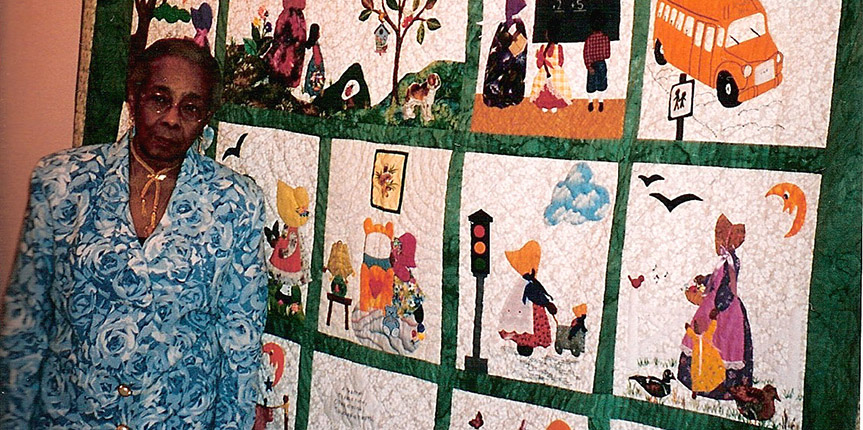
Evelyn Salinger (ES): Today, November 16, 2004, we are having an interview with Carmel Washington in Northeast Washington, D.C. during a Daughters of Dorcas meeting. Her number is 20002-008. The interviewer is Evelyn Salinger. The time is 11:25 a.m. Hello, Carmel. Carmel Washington (CW): Hi, Evelyn. ES: How are you doing today? CW: Fine, thank you. ES: Good. I appreciate your agreeing to do this interview today. First, I would like to discuss what you brought today to show us. These are works in progress and they are very beautiful. Will you talk about the big wall hanging over there, first? Will you tell us what techniques you used there and what it is? CW: This is a wall hanging and I used the stained glass design representing a landscape. I did enjoy doing it and using different colors, different shades and different kinds of material. ES: The colors are certainly the wide spectrum from red all the way to deep blue. CW: Yes. ES: Is this a scene that you made up in your mind or is it some particular place that it represents? CW: Yes. It just comes to me when I noticed in a postcard. And I decided to enlarge, because it was a small card, and make my own, using the design and making it a big landscape that would be a wall hanging, big enough for a large hall–a lot of space there. ES: I think you have some embroidery on there, too. CW: I did put some embroidery representing some grass, some patches, and the butterfly–about life–and the trees. ES: Will you add more embroidery, still, since this is still a work in progress here? CW: Still a work in progress. You know I do have to do the quilting part. And I use the embroidery design at the border. All of my wall hangings have the same kind of embroidery at the border, so to make them unique, and different from everybody else. ES: Can you describe a little bit what you do at the border? CW: It’s embroidery stitches. ES: And it’s designs or is it part of the landscape itself on the border? CW: No. It is just something that I add and distinguish my quilt because I never saw that–People ordinarily doesn’t use embroidery, mix embroidery in quilting, but I did because I used to teach embroidery. ES: Yes. Good. I’d like to talk about the other thing you brought, and it is also a work in progress. And it’s–[interruption: voices.] Would you describe what you are going to make here? CW: This is also–I have some friends who are retired teachers. I decided to do small wall hangings maybe because they have not enough large space on the wall, so that could be all small wall hangings that accommodate two, side by side. Or, if I choose to, I can have enough squares made to make a quilt. ES: Ah. Let’s describe the first one up here. That’s a favorite for some of us. And it’s about a teacher, and it says, ‘A teacher takes a hand, opens a mind, touches a heart.’ And then you have over here, the other side– CW: The alphabet. And the children learning and she has her “My Book.” So they are just in front of the blackboard representing that they are really interested in what the teacher–and I did that because I have been a teacher, myself, for a long time. And that particular design pleases. Some of my friends were teachers and want to think about what they did in life for a living. ES: That certainly speaks to me. The little girl has a lovely braid. There are lots of three dimensional items on this patch. CW: I like to, when I am quilting, to make it as real as possible because I like to create and by doing that, it just makes some kind of personalization and make it as real as I can be. ES: It is certainly beautiful in colors and design. CW: I enjoy matching colors for some reason. I have a sense of color. And sometimes I really go through so many bags of fabric just to get to the right piece that will make the finished product real. ES: Do you have some sort of way of separating the different colors into your different bags that you save? CW: No. [laughs.] I am,that is to say, I don’t think I am really organized. And sometimes I will go through the trouble of going through five, ten bags. And as soon as I finish to put them back, I remember that I need some–I saw something that can help another part of the design and have to go back to find something that I think will make the quilt pretty. ES: That speaks to me, too, especially with appliqué. You need a special little piece some place and you have to search for it. Let’s just describe one more and we hope we will get a picture of these. This one is another one I think is a favorite of people’s. CW: This is a grandmother. That design I did of a grandmother holding her grandson and ready for a bath and his toys and the family, little dog watching. And she is in her rocking chair. ES: A rocking chair on this, even with a padded seat. CW: Yes. ES: In back. And she has a beautiful bonnet with a silk flower on it and lace at the bottom of her skirt. She’s playing with the little grandchild. That’s just beautiful. CW: Yes. I made the sun at the corner of the window. There’s a tree and a bluebird. ES: He’s singing his music notes. CW: Yes. ES: And then the wall over here has a potted flower plant. CW: It’s really like a painting or decorated like a room because she is sitting on the carpet, on the rug and so that work is mostly on the inside. ES: And the floral wall paper, which is a white on white. [fabric.] CW: Yes. ES: And the one thing we didn’t mention was the kite that’s here. What is the kite doing here with the little baby? CW: The baby–she is holding different kinds of toys trying to entertain him and letting him get ready for his bath because we have the towels on the wall, hanging. ES: That is lovely. Thank you so much for bringing this. These are so lovely and I hope to have a finished picture of this when you get done. I was going to ask you, what are your earliest memories of quilts? CW: I really didn’t know anything about quilting because I used to teach embroidery. But it was about fifteen years ago when I saw–I met a lady at the store, and she was buying some fabrics. I saw my first–had an idea what was a quilt. I asked her how she can realize. And she told me that’s her quilting, and she will be the teacher, teaching a group of ladies at a friend’s house, who has a store. So in the back of the store, she was going to teach. And she invited me to be one of the group. So I went. The class lasted six weeks. And at first what caught my attention was in the back of the room. Somebody had a quilt on consignment. I never saw something so pretty. I couldn’t understand how somebody can realize something like that. But she was teaching piecing. And I really had a hard time because we were about twenty-five in the room and she didn’t have the time to pay attention and I’m really precise and I like to do good work. I wasn’t too pleased with what I was doing. After the six weeks, it was really discouraging. I didn’t understand anything. I didn’t know how to put the quilt together, she just was teaching the basics of piecing. Because I didn’t produce something that was up to my standard, being a picky person, [laughs.] and so I decided–she invited me because she belonged to a group, the Azalea Quilters, in Takoma Park. [Maryland.] And so I went and there were a group of ladies in meeting. That’s where I really started doing [inaudible.] but when I found out from the group that you can piece or do appliqué. ES: Aha. CW: And that really–I choose to do the appliqué because I used to do the same thing with embroidery, but using thread, because we were making sheets, tablecloths, and all kinds of linen dresses for the tourists, because I worked at the Department of Commerce in Haiti. ES: For how long did you work for that? CW: I was teaching full time at first, but they happened to close the school where I was teaching. And I got this work to the tourist place where I became the supervisor, working for the tourists. At that time we had we had big–and so I decided to use my technique in embroidery and apply it in doing appliqué. And I just really enjoy doing it and that’s the only class that I had in quilting. I practically taught myself. I still have my first quilt I made and it’s okay. It’s piecework, but the stitches are big. I didn’t really know what I was doing until I realized what is quilting. I would go to the stores and check about the books and the different quilting. So I developed my own method. And at that time also, it was when Georgia Bonesteel wrote a book. And she was teaching on TV the lap quilting method, because I don’t use a frame. And I did enjoy doing the lap quilting. Whatever the size, I mastered how to handle it. To handle a big quilt is not easy at first, but now I think there’s no problem. I used to work on–I was so interested that I was working on five quilts at a time. ES: Oh, my. CW: One every day and change every Monday the back so that way it wouldn’t be boring. I did pretty good because sometimes I would be finishing two or three quilts at a time. And now I just take my time and it doesn’t take me a long time to make a king-size quilt because I am sure of myself and have little finishing. And I don’t like sloppy work. So I will go back and if I see anything that is not to my standard, I will go in–[inaudible.] and so I made my own design. I like to create and make a full scene just out of one design. And make a little complete scene with appropriate different kind of–so I really enjoy creating. ES: Uh-hum. You do pick up little butterflies and birds and things. [bell ringing.] Do you pick those up at a store? Do you have a favorite place where you get all these things? CW: Yes. I used to make a lot of that until I discovered that I can go faster and make different things with finding original things that really enhance the design and make me go faster. And so that’s what I did. ES: Would you at this point describe your day? How do you spend the day at quilting in general? [bell ringing.] CW: Some days, I used to start by seven o’clock and stop for dinner at about one and start again until sometimes ten or eleven o’clock. I was really obsessed with quilting. [more bells.] Now, some days, the only thing, because I am sure of what I am doing, sometimes I can do in two hours what somebody else can do in one day. And I can go fast and precise in doing the work. ES: Uh-hum. Don’t you do other things besides? For instance, you have a routine of exercise and that sort of thing to keep yourself in shape? CW: Yes. I don’t sew all day because I’m just too fast and sure of what I’m doing. Some times I only need two hours. But I do enjoy concentrating in creating. I cannot copy. I’m happiest when I’m creating my own design. ES: Do you find that you dream your design sometimes? CW: Yes. Sometimes I will be in bed thinking about what I want to do. I can see the full quilt. ES: You can? CW: Sometimes I’ll put it on paper. I don’t like to repeat the quilt because I lost interest, because I am not creating any more. I know I lost interest so mostly I have one of a kind design. ES: Do you mostly make large quilts or do you do wall hangings? CW: Wall hangings. ES: I remember the series of women you did. CW: Yes. ES: Each woman was different but would you get bored with that? CW: No, because they were dressed in different African attire, so it was–in fact, I made thirteen, but the embroidery–because the face is lined with embroidery–and that demanded a lot of attention and precision. You cannot have any shaky hands doing that, so I think for now, I don’t want to repeat them, maybe later on. ES: Have you sold some of your works? CW: Sometimes. Just with the idea to buy fabrics. And it used to be an addiction and I had to stop. I would go to the store and come back with three hundred dollars of fabric and really all my pocket money goes to buying fabric, so when I decide to really give a quilt for somebody, a friend, I use the money to supply, because I have a good, large supply of fabric because I don’t like to be making a quilt and go into the store. In fact, I can open the store [laughs.] with so much fabric. And some of them I don’t use. And when I cannot use them, I will give them to my church for bazaar. And also, I gave a few quilts I quilted to my church. So it’s really a very expensive hobby, very expensive. [laughs.] ES: Would you tell us about how you learned your sewing skills as you were growing up in Haiti? CW: Well, in Haiti, the first day, when you go to school, at five, you have a pencil and that same week, you have also a needle, because they teach seriously embroidery because you have to pass the test at the end of your high school. You have to pass the test of embroidery, so everybody has to learn. And I really had a gift to learn so quickly. I can open a book and reproduce what I saw just in the book to the point that I really am pleased to say to be so talented, a given talent. And everybody has to learn how to sew. And I got interested in that and learned and became a teacher after finishing and taught embroidery, not only embroidery, it was a part of my class. I had elementary, I had children between eight and ten, but it’s a part of one of my subjects to teach embroidery in the whole school, not only for my class, but the whole school. ES: Oh, my. CW: It was a challenge, but they had to pass the test, because if you miss the embroidery test, then you have to take everything again. Math and everything, so you’d better try to learn. It’s really, I remember my sister, who couldn’t master. She just didn’t like to do it, but she had to do it. After, when she didn’t need any more, she never touched a needle to do embroidery, because it was a hard pill for her while it was so easy for me. ES: Uh-hum. Did they also teach you sewing machine skills? CW: No. No sewing machines. Just embroidery. Sewing machine part, everybody needs to hand sew. But my sister became an expert in sewing. She was really a good seamstress. She made that as her living. She worked for the telephone company and her office was in our house, so she was there. She had sew hobby so that’s how she learned to sew. And she was an expert while I never liked sewing lessons, so we compensated for each other. She made my dresses and I made her trousseau before she got married. Everything she needed in her trousseau I made that. ES: That’s just great. Do you keep track of all the things you’ve made? Do you keep photos or anything for yourself to remember? CW: I have some photos. I’m not good at taking pictures, but I always have friends taking pictures, so I have a pretty good collection. ES: It’s nice to remember, I think. CW: Yes. ES: Have you entered into shows? CW: We have from time to time, we have a display once a week–but no. ES: You’ve been in the Sumner School show. CW: Yes. ES: Have you ever had anything in the Smithsonian? CW: Yes. They had a display of some vests that I made–but mostly at Sumner. ES: When did you join the Daughters of Dorcas? CW: After I left the Azalea Quilters, in Takoma, because some friend told me about that, I made the change because there were–and it was a nice group. They used to have hired people to do workshops, but they had a lot of elderly. At the end, they liked to socialize more than the quilting, so that’s when I decided to make the change and come to the Daughters of Dorcas. ES: When you go to a quilt show and you see some quilts, what do you look for in a good quilt? CW: For the stitches. I make a judgment about the size of them, because I am able to do the very, very tiny stitches and all the same size. The point I have people asking me, is it by machine? Do they not know I just enjoy doing good work? That when I finish to do a quilt, I don’t need somebody to tell me that it’s a good quilt, or a pretty quilt, and well done. I know it myself. So, I don’t like not well done work. But I know also, that not everybody can do, because also I mix embroidery with my quilting, so make them different. [bell ringing.] I try to help. I have some friends that I help them, but I think it is a really hard process if you try to learn embroidery at a late stage. ES: As a senior citizen, for example. CW: You cannot. [interruption in tape.] ES: Now, about the stitches. You can be very forgiving of some of us who were not brought up doing the fine work. CW: I realize that not everybody can. And I don’t like to criticize them because I am not perfect. And even in my quilting, I make mistakes. I have some mistakes. In fact, I tell somebody, they will not know. But I know when I have a mistake. I don’t judge people because I know that not everybody can do. It’s hard for me to change a light bulb, [laughs.] or to hold a tool to do any kind of work in the house. I cannot do it. So I realize that nobody’s perfect. [bell ringing.] We have to compensate for each other and help each other. Somebody can do something, and I can do something else. ES: What do you think about the machine quilting people are doing now? CW: I will not do it. I won’t even try. It’s pretty for somebody who likes it, but I prefer my method of the quilting. ES: Would you have some advice for new quilters? CW: Be patient. Patience and recognize when you do something wrong. Don’t say, ‘OK, I will do it better the next time.’ The first time, take time, and start over, because if you allow yourself to be careless in the first one, you will never change. There will always be some kind of lacking. So be patient. And have the desire that you want to do it right all the time. You try your best to do it well the first time, because don’t get complacent and say, ‘I will do it later, better.’ You will not. ES: That is good advice. CW: Take time and learn from somebody, instead of criticizing somebody. You learn from somebody. I am still learning. I like to go to shows and have ideas from other people. And that’s why sometimes I bring my work so somebody can learn something from my work, because I am learning all the time. Sometimes in a book, on TV, or I’m interested in what somebody is doing, because we don’t do things the same way. So I always learn from somebody else. ES: And you find by coming to Daughters of Dorcas you are able to get ideas and give ideas? CW: No question about that. Sure. I learn a lot. ES: I know you have expressed that you really enjoy your time by yourself in creating. CW: Yes, I do enjoy, in that once my mind is occupied, it is fine with me. I can do that the whole day, just concentrate, because of the situation if I am alone. I remember one day, it was at Christmas, and I was at home and called my sister to wish her Happy Christmas, Merry Christmas, and I could hear all her children there and they were having dinner, they’re laughing, and while I was here alone. I turned to tears because it was immediately feeling the loneliness, and immediately when I realized that I was being ungrateful and did not appreciate what I had, and I was working on a quilt. When I finished, I thought, well, she has her children, they are happy, but look what I can realize. So I am not completely alone. I have my share of happiness, too, because what she cannot do, what I am doing. I do not have her family. [laughs.] So I realize that I am still blessed. ES: You certainly are. Thank you so much for your interview, very interesting. CW: Thank you, Evelyn. It’s my pleasure….
by Amy Milne | Aug 14, 2019
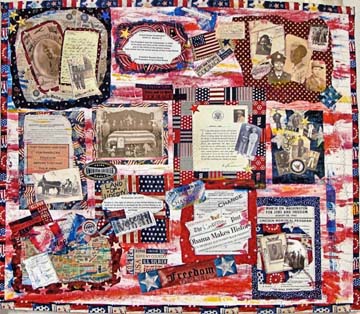
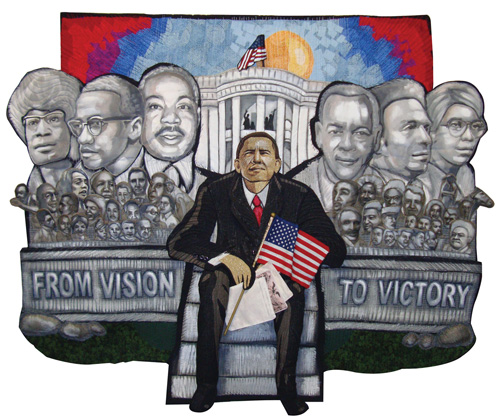
Karen Musgrave (KM): This is Karen Musgrave and I am conducting a Quilters’ S.O.S. – Save Our Stories interview with Carole Lyles Shaw. Carole is in Columbia, Maryland and I’m in Naperville, Illinois so we are conducting this interview over the telephone. Today’s date is January 18, 2009. It is now 10:55 in the morning. Thank you so much for agreeing to do this interview with me. Tell me about your quilt “War and Freedom: African Americans Veterans Hail the Commander-in-Chief, #2.” Carole Lyles Shaw (CLS): Thank you Karen, I’m thrilled to be talking about this particular art quilt this particular weekend, what could be more fitting just two days before the inauguration. This quilt is part of a series of quilts and other mixed media art work that I am creating to honor the memories of ordinary men and women who served in the American Armed Forces, particularly in the early part of the 20th Century and most of the work features images and documents and so forth from 1960 or earlier. I do have some work that will also focus on Vietnam and etc. that will be coming in later work. This particular quilt is scheduled to be in an exhibit that will go up in February 2009 and the exhibit [“President Obama: A Celebration in Art Quilts,” will be from February 9 to March 5, 2009 in the main gallery (King Street Gallery) of the Morris & Gwendolyn Cafritz Foundation Arts Center, Silver Spring, Maryland.] was organized by Sue Walen who had made a quilt documenting or celebrating the inauguration of Barack Obama and then decided in November 2008 to see if she could quickly organize a quilt show because she knew other people were doing similar kinds of works. Miraculously she was able to make that happen and I was one of the people who helped her reach out to people and so forth. This particular piece I actually did not have in progress when she called me. I was doing another piece that I will talk about later on in the interview. But I said, ‘Yes, I will make a piece for this show. I think it is important to have as much art work celebrating this moment in history as possible.’ Now the piece itself is not in any way a portrait of Barack Obama. In fact in this piece, there is no image of him. For me as an artist, what I wanted to do in the art works that celebrate the inauguration is mark the transitional importance and the transformative importance of his election, of his whole candidacy and its meaning to this particular group of African American men and women. People who served in the Armed Forces in the 1940’s and even the 1930’s in some cases are still alive and watching this. Either they are going to come to [Washington.] D.C. and celebrate it as some of the Tuskegee Airmen might do or they will watch it like the rest of us on our TVs warm in our homes on Tuesday. I really wanted to show that there was a group of men and women who would salute Barack Obama as the Commander and Chief of the Armed Forces, which is of course one of his Constitutional roles. In this piece, it is a very dense and content and image rich quilt. It is not very big. It is about 36 inches by 40 inches. What I’ve done is I’ve transferred photographs onto fabric and some of these photographs are from my family collection that I have of my father, my uncles and some of their friends. I have a letter that was sent by the White House to my father thanking him for his service in the Armed Forces and that letter dates to probably the late forties or early fifties. I found the actual letter in my grandmother’s house when I cleaned it out after her death. I had photographs of that type but then I’ve been scouring eBay for a couple of years now buying photographs and documents and metals and I even have a uniform and these are all memorabilia from African American families that have just been tossed away and someone found them when someone’s estate was being cleared out or whatever and they are selling this stuff on eBay and most of it was really, really inexpensive. I have a lot of photographs and I have letters that people sent to their families and their medals and all kinds of things, so I’ve selected a few of those photographs and they are also on this quilt as photo transfers onto fabric. Then I also have some memorabilia and words and so forth that are about the election. I have the absentee ballot that I sent in. A copy of it of course since the original was filed, but I made a copy of it because I was thinking about, ‘You know, I want to keep this some how,’ and I have a copy of my ballot in this quilt. I have some newspaper headlines. One that says ‘Obama Makes History’ and I have words like ‘freedom’ and ‘on the wings of hope’ and the word ‘vote’ and an image of the map of the mall where the swearing in will take place and the presidential parade and so you see a glimpse of that in this quilt. Then I also have a copy of the presidential order signed by Harry Truman in 1948 that desegregated the Armed Forces. I happen to have been born in 1948 so in my lifetime literally we moved from a legally segregated army to a desegregated army although for many years there was still lots and lots of discrimination and limitations of roles that African American men and women could play. I downloaded the first page of Truman’s executive order and I superimposed over that these words, ‘They fought and died for American freedom before they had their own’ and those words, those are my words and to me it just captures once again the honorable service that African Americans have given since the Revolutionary War obviously, even though at the time of the Revolutionary War we were still enslaved legally. Following the Civil War we were legally free but not full citizens. That took many, many more years to happen, and now we have an African American supported by Americans of all colors and walks of life who will be inaugurated into the White House in a couple of days. Some of the words on my quilt are ‘land of liberty’ and ‘stars and stripes’ and ‘on the path to change. Those words, those themes are what I wanted to convey. It is a narrative quilt, a story quilt almost but you’ve got to kind of read it slowly to get the full story. The last piece of documentation that is on here is a copy of the program for the March on Washington [D.C.] at which Dr. Martin Luther King gave his “I Have a Dream” speak and there is a copy of that in this quilt as well. There is a lot of stuff here, personal history, history of people of names I will probably never know because these were just photographs and other memorabilia I bought on eBay. When I was invited to this show as well as to another Obama quilt show which is up right now in Washington, D.C., at first I was thinking, ‘What am I going to do? What will be the message I want to convey?’ I wanted to do something that would link the past to the present and point towards a different future. I knew I didn’t want to do an Obama portrait and I didn’t want to do anything that really just repeated the now familiar iconography that we see everywhere in terms of Obama memorabilia. I wanted to do something that was much more personal and thoughtful about our history as a country and the honor and service and hope that African Americans have had all their lives and throughout the history of this country. I think I will pause there for a moment. KM: Before we talk about the other quilt, #1, [“War and Freedom: African American Veterans Hail the Commander-in-Chief, #1.”] what are your plans for this quilt? CLS: I hope that the show will also travel and go to other venues along with the other quilts in the show, not just my quilt. Beyond that, I have another piece in this whole series that is about African American women that are in the service, not about the inauguration but it is part of the War, Honor, Freedom series that is already traveling in a show. My hope is that this, these pieces along with some of the other mixed media pieces that I’ve done on African American veterans and their service, that some day I will have a show with all of those pieces in the show. I’ve done an artist book already and I’m thinking about doing a second book that I would actually print in a larger series. That book I would take sections or portions of each of these quilts and other pieces and write an essay essentially illustrated by shots from the various quilts and the other art work to really tell the story in my own words and what it means to me, but that is a longer term project. KM: Tell me about “War and Freedom: African American Veterans Hail the Commander-in-Chief, #1.” CLS: Sure. #1 is the quilt that I started when I was invited by Roland Freeman with the assistance of Dr. Carolyn Mazloomi [exhibit “Quilts for Obama: Celebrating the Inauguration of our 44th President,” at the Historical Society of Washington, D.C. from January 11 to January 31, 2009.]. Roland, almost at the same time as Sue Walen, decided to mount a show of Obama Inauguration celebration quilters in [Washington.] D.C. and he was able to secure the [Washington.] D.C. Historical Society building. His show was opened the second week of January, so it is up during the inauguration which is, of course, very thrilling. This piece has the same type of imagery and in fact some of the same images are in both quilts. The first quilt focuses more on the veteran and less on the inauguration event itself. There is no map of the inauguration, etc. I do have some relevant words on it. One of the patches in this quilt is a transcription of the Article 2, Section 2 of the Constitution which says the President shall be Commander and Chief of the Army and Navy of the United States and all the militia of the various states, etc. That is in this quilt surrounded by some fabric that’s wavy red, white and blue flags, the American flags. Another large patch in this quilt brings the service of women veterans a little bit more prominently. I have a couple of photographs, one from the sixties, more Vietnam era and one from World War II and over it I’ve got the letters transcribed that say, ‘She’s a soldier of the U.S.A.’ Now that is playing off another patch in this quilt. I bought some old sheet music, really old sheet music and on the front of the sheet music you see some soldiers marching carrying flags, U.S. flags, and the title of the song is ‘He’s a Soldier of the U.S.A.’ and I often in these works will play on ‘He’s a Soldier of the U.S.A.’ and ‘She’s a Soldier of the U.S.A.’ African American women have not seen the kind of attention, as people talk about the history of African Americans in the military, so I’m trying to bring that history a little bit more to the forefront. I have from very precious memorabilia from women soldiers that was really hard to find but once again I found it all on eBay. There was also another piece of African American military history that I have in this quilt that is about women. There was a woman whose name, there is some dispute about her name but generally she is known as Cathay Williams who served as a man. She was an African American woman who disguised herself as a man and actually enlisted in the U.S. Army during the Civil War. She served for about two years before she became ill and was injured and was mustered out in 1868. It wasn’t discovered who she was, or that she was a woman until she applied for her pension many years later and then it was discovered that she was not a man, William Café, which is how she enlisted but she was Cathay Williams, a woman and there were other women that we know who served in the Civil War and disguised themselves as boys or young men and enlisted. There are probably more that we will never know because they died or they mustered out and no one ever knew. She is one that has been documented so it is known. These two pieces have similar imagery. The letter with my father’s picture is also in this piece. I don’t always have him in all the work but I usually have him or my uncle, something from one of them in the work because it was finding my uncle’s selective service card and the letter from my father and my father’s pictures of him in uniform and his friends, my uncles pictures who was in the emergent marines, finding that material in my grandmother’s house just sparked something in me as an artist. I didn’t know what I wanted to do with it when I found it and it took a few years for it to come to the forefront and come back to life and become part of my art work. These two pieces are related. I don’t think I’m going to do another inauguration quilt, I think I’m done and I think I have several mixed media pieces on the inauguration so I think my inauguration series is done. That is good. [laughs.] I had fun doing them and I can’t wait for the quilts to come back home so I can see them again. I miss them. [laughs.] KM: Is this typical of your work. If you looked at these quilts that people say, ‘Oh yes Carole made them.’? CLS: That’s a very good question. I think they are. I think they, I think they are. I think they are. [laughs.] I keep saying that. Although a couple of people, Carolyn Mazloomi being one of them have commented that this particular series, the series on the American veterans and a couple of other series of works that it is the work that I’ve been doing in the last three years, two years really, is really the strongest, visually strongest and thematically strongest work I’ve ever done and I think that is true as well. Yeah, my style is not very structured, by that I mean you will find very few if any really straight lines and measured out little boxes and squares and my work is not controlled. I love chaos and movement and freedom. I like balance and contrast but I like the stuff to be somewhat distorted and almost moving around. I like people to have to stand there for a while and say wow there is a lot here. I did notice that when the quilts went up at the [Washington.] D.C. Historical Society people said wow there is a lot here, there is really a lot here. I said, cool, great, I’m glad to hear people say that [laughs.] because that is what I’m trying to convey, that there is so much history and we’ve really got to think about it, talk about it, and not lose the history, and it’s all present in the little boxes and bags we have in our attics and under beds where our family history is kind of hidden. The fact that a lot of the material I’m using, nearly all of the material in terms of the photographs and letters and so forth was really tossed away by many people and ended up on eBay because someone else picked them up out of some estate sale and said, oh well you know this has been discarded or sold by some family. Probably discarded, not even sold and then it shows up on eBay and I pick it up for $5.00 or $10.00 or whatever I might have paid. It’s my blessing but its unfortunate that we are as a nation we’ve become a little too ready to throw away history that is not even a hundred years old. Most of this material now may be fifty or sixty years old that I have, the original pieces, some a little older. I try to stay within my budget and when it gets older than that it gets out of my budget. [laughs.] It’s unfortunate that we don’t hold on to our history as much as we should. Maybe this inauguration will help people become a little more sensitive to that as well. KM: That would be wonderful. Tell me about your interest in quiltmaking. CLS: I started quiltmaking in 1990, just on a whim. I was working hard and also in school and I have a bunch of wonderful nieces and nephews and I wasn’t seeing them as much as I used to so I decided on a whim to make them a quilt, each of them. That was quite an ambitious idea for me. I did not own a sewing machine, I did not sew. In the past, I had made a few simple curtains along the way and I think I must have owned a sewing machine at some point, an old Singer probably somewhere. I had no domestic ambitions. I was certainly no young Martha Stewart that is for sure. I went to the library, of course this was before the Internet was so big, and I went to the library, got a whole bunch of books about making quilts and I had seen one small baby quilt that a relative of mine had made for one of my nephews and I had seen that and he had it in his home. It was nothing elaborate at all, it is what we would call a whole cloth handmade, hand quilted coverlet. That was the closest I had ever been to a quilt really. I went to the fabric store, made all kinds of mistakes and started making these quilts. I decided from the very beginning that I just got so bored with the traditional approaches in cutting all the blocks the same size and lining them up exactly and making all your stitches the same, oh I just couldn’t stand it so I started doing crazy stuff even from the beginning. Then the universe provided and I went to an art quilt show and met some local art quilters in the Baltimore, Maryland area and joined a couple of groups, one guild and got a lot of help and support and they just opened my eyes. I also found an old book at the library of art quilts made in the late 1970’s and they were awesome. I met other people around the country and got involved in different networks. I went to the Art Quilt Network meetings in Ohio, two or three years in a row and met a lot of people. I went to Quilt Surface Design symposium. I did a lot of local workshops with people like Jennie Denson and other wonderful quilters. I was really fortunate in my teachers and colleagues because as I started experimenting and breaking the rules or not bothering to learn how to do certain things very well, like sew by hand or anything like that, I ran into people who said, ‘You go for it, do whatever you want to express. You are not trying to be the world master hand quilter, you really want to make art quilts. There are no rules, go for it.’ I was really lucky that I got so much encouragement early on. I know that if I hadn’t I would have just left the quilt community and gone off on my own and done other things. I hear from so many other art quilters who didn’t get that kind of acceptance. Even my quilt guild, The African American Quilters of Baltimore, when I joined, most of them, nearly all of them were aiming towards a more traditional quilting approach and I was one of the first to really start to break out and say, ‘Oh, you can paint the fabric. Oh what about photographs? What about this? What about that? What about no straight lines? What about fusing and not stitching?’ And all that kind of stuff. I would be bringing all these crazy wild wonderful ideas and the group just loved it. In fact, we have a show every two years now and we have been doing it for a number of years. At our most recent show I was standing and looking at the show with one of the other long time members and she is an art quilter and always has been, she said, ‘Carole, do you realize how we have infected the whole group?’ We started laughing because nearly everybody in that group to some degree, even the ones who have these fabulous traditional quilting skills, I mean master level traditional quilting skills, even they are experimenting in some way. We have influenced everyone to be more free to express themselves and some of them are doing photo realism. We are using all of the techniques you would see in any art workshop, mixed media workshop. This group is of course still identifying itself as a quilt group. It was really cool at the show, we just walked around kind of giggling and laughing and saying isn’t this wonderful how we’ve come so far because we are so inclusive of everyone. That’s my story. I woke up one morning with an angel whispered in my ear and said, ‘Why don’t you make quilts?’ Now today of course it is very hard for me to sit down to make a quilt that is actually going to go on somebody’s bed. Every once in a while I have to make a quilt for a baby in the family or for nieces and nephews who go off to college, that is one of the commitments, if you go off to college, if you get married and have a baby, I will make you a quilt. [laughs.] Sometimes it takes a while and they tease me and they say with the baby quilts, ‘Carole we don’t want the kid to be in college before he gets the baby quilt. Would like him to still be a baby,’ and I would say. ‘Okay, okay.’ Those are the ones that I definitely send out to other people to quilt because that is the part of the process that slows me down the most. On my art quilt pieces I generally don’t send them out for quilting. The large ones I sometimes do, but because my quilting is very, very idiosyncratic and it’s part of the surface design and unless I was standing there while they did it, it would be impossible for me to direct someone else to do that. Occasionally if it is a larger art quilt I may send it out for some very basic quilting and then when it comes back I actually add more quilting to it that is part of the surface design. I’ve now discovered some other construction techniques that make it even easier for me to fully quilt larger pieces. By larger pieces, I mean pieces that are bigger than 40 inches by 40 inches because I don’t have a long arm, I just use the regular tabletop sewing machine, so it gets a bit cumbersome when they are bigger than that. It is a lot of fabric to move around and gets very tiring and keeping it all flat is a bit of a challenge but I’ve learned some new techniques using some fusibles and things like that help me do that. KM: Tell me a little more about your creative process. Do you sketch things out, that kind of thing? CLS: I basically never sketch things out. Generally I start with an idea, whether it is one of the art quilts focusing on the African American veterans, well then I probably would start pulling out certain images that I want to build the quilt around. I’ve collected a number of photos of African American veterans with their families, sweethearts, sons, daughters, etc. and I have one wonderful photograph of a man with his whole family and he has a whole bunch of kids and it is just a gorgeous photograph so I think I’m going to do one that is about family, veterans and family. I know I have that idea. I’ve got probably five or six really wonderful images that will be in that piece. I will start by printing those photographs onto fabric and figuring out do I want to print them all sepia. ‘Do I want them varied? Do I want to colorize?’ I might print a photo two or three different ways and then I will put it up on the flannel on the design wall and step back and think about it and then I will start thinking about fabric. Now the veteran’s fabric tends to be the red, white and blue either sort of traditional looking or very modern looking fabrics but still in the patriotic fabric colors and I use the commercial fabrics. I also paint fabrics. For one of the inauguration quilts, I started by taking a large piece of white fabric and I painted it with red and white stripes and then a blue area where we would normally see the stars. I started adding images and other fabric on top of that, so there was a layering on top of a flag essentially. By the end of it, you could barely see the flag underneath but I know it’s there and a close look will reveal it. It’s a controlled design process that I follow in that I know the overall effect that I’m going for. I know the story, theme, idea that I’m trying to convey or the emotion. It is both ideas and emotions that I’m trying to impact the reader with. I experiment with stuff and I will put together maybe a photograph and collage some words and whatever on it and have in a sense a patch and that will be up on the design wall. Then I will keep adding patches and then something might come off and get put away for another piece or never used at all if it doesn’t work, or cut something up and say ‘oh I like this part of what I did but I don’t like the other part so I think I will take this off and put that with that.’ It is my eye but it is my intellectual eye and my emotional eye that is being guided. My physical eye is just the camera lens. I also think about composition and I think about contrast and I think about the eye moving across the surface. I’m not as disciplined about some of that as I would like to be. I study a lot of art. I don’t have an art degree but I study artists. I’m fortunate because I live in an area rich with free and low cost wonderful museums. In my other life, I’m a consultant and I travel to some of the world’s greatest cities. I’m very fortunate there. I try to make time when I’m there to visit a museum or two or three or four [laughs.] and galleries and so I study the work of other artists to see what is it that is drawing me to this, what is it that I like, what is it that I don’t like. I’m not a good draftsman. I don’t draw well so I don’t do a lot of sketching for most of my work. I have made some work that is more geometric and I haven’t done one of those quilts for quite a while now but for those I actually returned to more of the traditional roots of quilting. My geometric quilts I take a shape, a rectangle and then I add some lines to it so I’m drawing a block and then I would scale it up bigger and scale it down smaller and I would make blocks of the various sizes and assemble a quilt but they are all the same core block just different scale sizes. I’ve done some of that work which takes some real planning because you’ve got to make those things fit. [laughs.] That can be quite interesting. Occasionally I will get an impulse to do a more abstract quilt and so I might do something like that. I do a lot of cloth painting now. I love painting and I love collage work and so I probably spend right now maybe thirty, forty percent of my creative time doing art quilts but I’m painting a lot on those and using my own photographs as well. I also photograph the world. The rest of my time I’m doing mixed media, framed collages which may or may not have actual textiles in them. Sometimes I will print photographs on fabric and that will become part of the collage piece, but it is really more about the paint and texture and layering and glazing and transparency in paint, which then I will use some of those techniques on a whole cloth or piece art quilt. If I could, I would spend all of my time in my studio but I’m not at that point financially yet. But, this is 2009 who knows what will happen. [laughs.] KM: Tell me whose works you are drawn to and why? CLS: There is a long list. In the mainstream art world I’m drawn to people like Romare Bearden who is a collagist who is best known for his collage work. Sam Gillian, who is a contemporary painter, just has a masterful way with paint and color and layering and transparency. I was fortunate enough to visit him in his studio last year and he was pouring paint in a very controlled way onto the surfaces and it was just, it just gave me cold chills looking at the work, it was so wonderful. It is the color and the light and that is what I’m striving for even in my art quilts, although it is hard to get a feeling of transparency in an art quilt but I will figure it out without using really thin fabrics since that is not the way I want to go. But in my mixed media work I can do layers and transparency much more easily than in the art quilts. Other artists–Robert Rauschenberg, I love, love, love his stuff. The Impressionist painters. Picasso of course I mean we all owe a lot to him [laughs.] I don’t think any of use can talk about being contemporary artists in this century and not talk about him and the influence he had. I’m, and I’m very indebted to the impressionists, although again I’m not drawing, I’m not doing even that degree of representational art but I think the most recent set of mixed media pieces I did, collage pieces on memories and dreams. When I look at them, they are very impressionistic. Generally in those pieces there are one or two critical photographs but I’ve painted and glazed and layered color over them, acrylic color in very thin washes so that there is a very soft quality and it’s a dreamlike quality, but it is not surrealism exactly because they are not distorted in any way. You know it is a tree. You know it is a building etc., a person, but there is a dreamlike quality the way the impressionists altered our way of seeing the world. Arthur Dove, who is a 20th Century painter, maybe a lot of people don’t know about. I love his work. It’s pretty flat in a way. He has simplified the forms of the world and used flat layers of color in some of his work and I just find them, I don’t know why they call to me, but they just call to me. I don’t think I’m imitating, I don’t know how he has influenced me but whenever I can, whenever I see his work I find myself stopping to look at it. Edward Hopper because of his way of conveying a world waiting, sort of its an empty room but you know that somebody is about to enter or just about to leave and I’m just astounded at his ability to make us feel that with an empty room or an empty window. [laughs.] Some people sitting in a diner. Renee Stout, who is a contemporary artist, who I am drawn to her work because of the levels of symbolism. I’ve been looking at her work for about ten years at least now and she has challenged me to have more complexity and meaning in my work and I owe a huge debt of gratitude to her and she does it in more 3-D. Her work is sometimes assemblages they call them because it is stuff, it is material in a box and if you could touch it you could reach in and move the things around. Of course you are not supposed to touch them. Although I’m not doing assemblage, I do want levels of meaning, layers of meaning. It’s like Romare Bearden when you look at his collages you see levels and layers of meaning and in her work there is a denseness to it of richness and she reaches into the psyche because she studied a lot of religious and spiritual belief systems and they have influenced her, the symbols that she uses in her work. I feel like I’ve got so much more to explore and so little time. [laughs.] KM: Isn’t that the truth. CLS: I know, but I’m no longer just a quilter. Before I found quilting I had taken different art classes at the community college and I had been a pretty serious photographer for a few years before that and then stopped doing that. I even had a darkroom years ago, just dropped it when my other professional career took off and I wasn’t active artistically but I slowly came back to the arts. Frankly learning to make the quilts was a huge boon because it got me back into saying I need to make space in my life for creative work and space in my home and that got me to create a studio and led me into other workshops and got me reconnected to the painting and the collages, all kinds of things. I owe quilting a great debt of gratitude. Although I probably make only one or two traditional quilts a year now. KM: How do you want to be remembered? CLS: As an artist. I want to be remembered as an artist who blended and transformed a traditional form of women’s work, quilting and used it to inform her artistic work. I want to be remembered as an artist who explored important ideas and important themes. Yeah, that is how I want to be remembered, and as a person who had a lot of fun doing it. KM: Works for me. [CLS laughs.] Is there anything else? CLS: If I could, and I do, I encourage everybody I know to find a way of getting connected to something creative. Because I truly, honestly believe that ever person has the ability to express themselves creatively. I’m a consultant and management trainer and I lead retreats for people and so forth but with some groups I actually have them make fabric collages and I give them a few simple materials, scissors, glue stick, pile of fabrics and some cardboard paper and I don’t listen to the people who say, ‘I can’t do this. I don’t know how to do it.’ Some of the people you would think would be the least creative have the most extraordinary pieces of art work in about an hour and a half. I have never seen anyone fail at the assignment, ever. I’ve done it with hundreds of people of all types. I would also like to be remembered as someone who encouraged other people to find whatever it is that they want to bring into their life to be creative with. It may not be art, it could be music. It could be mentoring kids, it could be sports, teaching people to play sports or fly fishing or whatever it is, find something that brings you joy. KM: Is there anything else you would like to share before we conclude? CLS: No I think that is it. KM: You did a fabulous job. CLS: Oh thank you. [laughs.] KM: We are going to conclude our interview. It is now…
by Amy Milne | Jul 5, 2018
Karen Musgrave (KM): This is Karen Musgrave and I’m conducting a Quilters’ S.O.S. – Save Our Stories interview with Carolyn Crump. Carolyn is in Houston, Texas and I’m in Naperville, Illinois so we are conducting this interview over the telephone. Today’s date is January 27, 2009. It is now 9:07 in the morning. Carolyn thank you so much for taking time out of your day to do this interview with me. Carolyn Crump (CC): Thank you so much. KM: You are welcome so much. Please tell me about your quilt “From Vision to Victory.” CC: My quilt was designed for the people that touched my life growing up. As I moved from Detroit to Atlanta to Houston, the people that I have in the quilt are the people that reached me. When I was growing up and I could see what the Civil Rights Movement was trying to do, just the people that touched my life on television or when I watched them in a march. That is why I used forty-eight people that touch my life. I knew there were thousands of people that touch people’s lives or made a different in the movement but these are people that I knew about. KM: How did you go about constructing the quilt? CC: First of all, it was supposed to be that you could work any size you wanted. [CC was one of the 44 artists invited to participate in the exhibit “Quilts for Obama: An Exhibit Celebration of our 44th President” at the Historical Society of Washington, D.C. from January 11 to July 30, 2009.] As I started about a week later, they called and told us that it couldn’t be any larger than 36 inches so I had to restart my process. I still was able to keep some of the heads larger than the other ones since I couldn’t put everybody large and stay within the 36 inches. I wanted them to look like a sculpture and that President Obama was sitting on this statue and just looking into space thinking about all the people that had paved the way for him in stone. This is the first quilt that I have ever painted on. President Obama part of the quilt, was totally appliquéd, but the stone part of the quilt I wanted to look like it was chiseled so I went with painting on the fabric and then quilting the painted faces, but the sky and the grass was totally appliquéd and quilted, but the stone part of it and the White House behind him were painted. I thought it would be easier that way because of the people, some of the people were no larger than an inch tall, little sculptures and it actually was even harder because it was so tiny and to make it look like the person and it took longer for me to try to make it look like it was chiseled in stone with fabric and paint to go back into it and then quilt it. I used the appliqué process on some of the quilt and I used paint and thread on the other part of the quilt. KM: Was it hand or machine appliqué? CC: It was machine appliquéd and then it was put together by hand. When I quilt every part of the quilt is like a little quilt. Each one of those people on the quilt is small little quilts that I connect them by hand. But each part is a stand alone quilt and then put together at the end so you have hundreds of little pieces that make one big quilt. The Obama character, the legs are separate. The arms are separate. The head and the flag, the little sheets of paper and the hand, everything was separate and then put back together to give it more of a 3-D effect. KM: What size were you originally going to make the quilt? CC: It probably would have been about 60 inches across or more and probably 60 inches in height. As I think about it, I really wanted it large so probably it would have been 120 inches long because the six heads at the top of the quilt, that is the size every head would have been and it was almost forty different people on the quilt and then I wanted the bus coming out the quilt for Rosa Parks, which I couldn’t do it that small so I just put her in the quilt, and like with the buffalo soldiers, I put the horse there with him but I actually wanted the buffalo soldiers, horse to be 3-D, I wanted the Tuskegee Airmen, plane to be coming out, I just wanted it to really be a 3-D quilt. Larger I could have made it like that but trying to keep it 36 [inches.] by 36 [inches.] it was almost impossible to do it in the time span we had to make the quilt. KM: Do you plan to make it again and make it larger? CC: Yes I am. I have already started the quilt I have all these faces sketched out. Everybody, the heads and the bus, each little sculpture I had already sketched it out and since I have the sketches already I might as well go ahead and produce the larger quilt it would be totally different than this one. KM: What are your plans for this quilt? CC: It is something I want to pass on to my girls. I’ve started a collection of quilts and I wanted to do this large one and keep it for my girls. I have three daughters [Ashley, Allison and Andrea.] and I want them to have a part of history. I’m actually going to break it up in three parts, the middle part of the quilt will be like the quilt at the museum but it will be all the large heads, it would be with the White House the same size, that will be the middle and then to the right and to the left will be the background and the sky and just the heads and the bottom of the sculpture and the rocks and the grass but I want to do it in three parts and I will give each one of my daughters a part of the quilt. KM: If someone looked at this quilt would they say, ‘Oh yes, Carolyn Crump made this?’ Is this typical of your style? CC: Yes, the background of this quilt and President Obama is my usual technique, but this is the first time, like I said before, that I’ve ever painted on a quilt and if a painter or a collector that collects my paintings they would know it is my quilt but a lot of quilters, they didn’t realize that I started out as an artist. I’m an illustrator my trade and I started painting when I was eight years old. It depends, if you collected my art, you would know that this could have been my quilt but most quilters or people that collect quilts, they wouldn’t have known. I think some people would have figure it out or would think I collaborated with another artist. KM: Do you plan to paint on quilts some more? CC: Yes, because I really enjoyed it. I really enjoyed the process. I just started another technique that it combines my painting, my appliquéing that I appliquéd on top of sheer fabric and under the sheer fabric at the same time that it makes a smooth transitions and it is just something that fell into place and I was like this really is going to look nice and make a great quilt. I was really excited about that. That it is something new and I want to teach people the technique and how to use it because it is really kind of different than anything I’ve ever seen before and I have never tried before and like I said it was just something that just happened. KM: Tell me more about the exhibit. CC: The exhibit, it was so beautiful the day that I arrived and I had a chance to see the different quilts and there were so many people in the exhibit and they were just loving the quilts. I think quilters quilt from the heart. I’ve always been around painters and I’ve been around quilters lately but I think quilters they quilt from the heart. I could tell from this exhibit, it was people quilting from their heart. They just poured out their feelings and what they felt in the moment for the president and history. It was just touching. People were coming up to you and thanking you for giving them a chance to see your quilt and that was the first time that anybody ever said anything like that to me. It just touched my heart, but I think that show was one of the first shows that I could really feel people quilting from the heart and they wanted people to see their work and were hoping that the president one day would get a chance to see these quilts. I think it was a heart touching exhibit. I think, the show, the movement of the struggle for years that we have a chance. What I liked about the exhibit that it was people of all races had a chance to quilt, they all had a chance to show their quilts and I thought that was fascinating also. KM: Do you have any favorites? CC: I liked Linda Gray’s quilt. I liked Dr. [Carolyn.] Mazloomi’s quilt. Dr. [Marlene O’Bryant.] Seabrook’s quilt. I liked all the quilts to be honest. Andréa Cruz, I loved her quilt. I loved all the quilts to be honest. The ones from Hawaii and Africa. I’m a lover of art. I love all art. It doesn’t matter to me who made it, if it is abstract or if it’s realistic or if it’s figurative. I just love art. I’ve always loved art from like I said from the age of eight it is just something I love. I was actually kind of scared to try quilting. I’m a fifth generation of quilters and when you come from a long line of people and this is what they do and they are great at it you don’t want to jump in and be the only one that can’t do it the correct way. I finally tried it. I started quilting doing Hurricane Rita [September 2005.] when it was suppose to hit Houston and that was the first time I start to quilt. They said, ‘The power was going to off.’ So I just started quilting and when it was over I had finished the quilt. It from my heart. In this exhibit, I felt the people’s quilt in my heart. Everybody’s quilt–I just loved everybody’s work. KM: What does your family think of your quiltmaking? CC: They’re proud of me. I have a very supportive family. My first paint set was giving to me by my sister, My sewing machine came from my mother. Everybody, they travel to see the different exhibits. They’re impressed. They love what I’m doing, my friends and family. Everybody is just excited about what’s going on in my life. It is happening really fast. I don’t believe it myself sometimes. I’m wondering if I’m dreaming about getting a chance to exhibit in different museums and in different shows but everybody is proud of me and I truly know I’m blessed. KM: How do you balance your time? You talked about being a painter and a quiltmaker? CC: I just started quilting full time or started doing my art full time and I just have to balance this because my family is very important to me so I do my art in the morning and I have to divide my weeks up. I will quilt three days and I will three two days and when my girls come home from school then I spend time with them and then after they get situated I will start quilting at night or painting. I’m a graphic designer. I do a lot of marketing for artists to help market their work. I usually do that at night or on the weekends if I have any free time, but it is really difficult trying to do both of them because I have client that likes painting and client that likes the quilts so I have to divide my time equally. KM: What are your favorite techniques and materials in quiltmaking? CC: My favorite technique is the appliquéing. I’m in the process of learning how to do traditional quilting. I get kind of bored of doing things the traditional way, you know cutting tradition shapes but I have to show people that I can do it. The appliqué is easier for me but I love doing it, I love using the batik fabric, I like to hand dye my own fabrics. I do a lot of bleach discharge. I love creating, I love fabric and I love paper and it doesn’t matter what kind of fabric it is because if it is something that I don’t like about a piece of fabric I will dye it or I will paint on it. I’ll use markers on the natural muslin, and then I’ll paint different solutions to make it disperse and then I’ll go back with the black marker and draw on top of the markers. I love the look when it’s finish. It gives it a very unique look. KM: Describe your studio. CC: My studio is my garage, so it’s a large studio. I have several shelves that go around the walls, because I block print in one area, I sculpt in another and I have a print station. I have two different studios. I have my smaller studio upstairs and that’s where I quilt. When I’m block printing and painting, and all the other stuff it gets kind of dirty so I do that in the garage. I have metal racks that holds my fabric. Some of the fabric is roll up and put in plastic pails so I can see the different combinations of color and then I put my batiks in the container. I have an area for my thread, an area that I put different techniques that I have tried on a corkboard so I can see my samples and they keep me motivated and give me ideas when I see things around me. KM: Do you belong to any art or quilt groups? CC: I don’t. I’m about to join some now. It was too much working a full time job trying to raise my daughters and do my art on the side and I think it would have been to much to try to join a group, a guild and add something else to my plate. But now that I’m doing it full time the guild [Women of Color Quilters Network.] with Dr. Mazloomi that is the one I plan on joining and there are several other guilds that I want to join. I want to join the fiber guild. I like putting my hands in different pots and make it work for me. KM: Are you concerned about doing this full time? Are you confident? CC: Yes, I am. I’m never one to worry about a lot of things. I put money up for a rainy day. I’ve always been the type that just jumps and do something. It kind of worried me at first because, I have a daughter in college who is twenty-one and I have two daughters in high school, one is the eleventh grade and one in the tenth grade but I just realized if I don’t start now, you know the way the economy is going would I be able to send the other two to college, what will happen to us. I was in the newspaper field, you know what is happening to newspaper with the internet. It won’t be long before that is gone and I realized that with everything going and the cutbacks on the job it was just time for me to just start. I don’t mind taking a chance in life. I’m very ah confident in myself and I just have a lot of faith and I really thought that it was time for me to start doing this full time. I used to do it full time before I moved to Houston. I was in Atlanta, and I made a decent living. We did well and when I moved here I took a job. I didn’t want to start over trying to find new clients so I just started working again. I have been on the same job for seventeen years and it was just time for me to be gone. I had build up clients with my graphic designs freelance and that’s how I pay my bills until my quilts and my art get to the point that it can pay the bills. KM: Good for you. I don’t remember a president inspiring so much art, at least not in my lifetime. Why do you think Barack Obama inspired so many people to create art? CC: The artists that I have spoken with including myself figure this is the best way to capture the way will feel and to remember history or to record history. Artists we draw, we quilt or we paint to record our history and I think so many people was touched by this because this is the first time that a president or any leader has brought people together as a whole. He inspired people stop the hatred, we all really want love each other and I think that listening to him and even seeing him and his wife how they treat each other, it just touches your heart. He made people paint about romance or quilt about romance. They did pictures of him and his wife and hugging and kissing or whatever. He touched people’s heart. It makes you think–I think we paint from our heart. We write from our heart. Or we take pictures from our heart. I think what is in our heart makes us do what we do and that’s what touched me. It made me want to do a series on him because he touched me as a person as an individual and made me want to be a better person. I don’t know too many people that listened to his speeches or came in contact with him that didn’t want to be a better person just because they knew him or touched his hand or listened to his speech. It made you want to be a better person. It made you want to leave a part of history. The quilt that I designed is a part of me and when I’m dead and gone that quilt is going to be here and that is a part of me that I left behind saying this man touched my life KM: How many quilts do you have planned? CC: Actually I have forty-four quilts planned. This is a series that I want to leave behind. Depicting his journey from childhood to the presidential inauguration. I’m working backwards from president to childhood life and I guess it is something I want to leave behind. One day I can do a big show with the forty-four different quilts showing his life and what it meant to America. KM: Tell me about your creative process. CC: When I start a quilt I actually start from a sketch and I might do ten or twenty different sketches on the way I see the way a person’s face should be, I love doing figures and I’ll start with a sketch and then I will do a pen and ink drawing of it, then I’ll break down the different shades of a face and the different fabrics I have to use. Like if the person is a medium brown person I have to find four different shades of fabric that will match the skin tone of that person, the color range with the different fabric, I will find four different shades of red if it is a red top, four different shades of each color and then I’ll break down each shade and I attach an fuse it material. Then cut out the different shape and iron the different colors together. Then I will start to put the different shades together, I will start in the middle of the quilt and I like to make each object a separate quilt so when I put it together it looks 3-D look. I like it to jump off the fabric and some parts to lay flat. You could have hands coming off the quilt or having a fish jumping out of the quilt. It doesn’t have to be a flat object because it has no raw edges. After I’ve quilt everything then I work on a six feet by four feet foam board and I’ll pin and then stitch little pieces together one piece at a time until the small quilt become one big quilt. Then I’ll attached, the quilt to a cotton or felt backing. KM: Whose works are you drawn to and why? CC: Pretty much I study Michelangelo because I like the 3-D look of his work. I study mostly paintings and sculptures and I love all quilters work but I don’t really study any one quilters work per say because I have a photographic memory and don’t want to end up duplicating somebody’s work I don’t want to one day be drawing something and not remembering whose work it is so I try not to. I will study the old masters and how they painted and sculpt and how they made things work for them. Like I said I remember techniques from years ago and I’ll know how to put it together so I don’t really try to study anybody else’s work other than the old masters, Michelangelo and different painters KM: Do any of your daughters do art or quiltmaking? CC: I have three daughters and one likes to draw fashion. She is very good at it and my oldest daughter, she is a painter and we had a show together. In her first show, she sold seven originals and now my youngest daughter is starting to draw. She likes to pencil sketch. So I guess it is in the family. KM: How wonderful. What advice would you offer someone starting out? CC: I tell people to follow their hearts and if it is something you love to do as in quilt, you know practice and study, get books, take classes, and more classes. I tell people put up a still life and draw it, because I don’t really like studying other people because I do know if you study somebody you will start to imitate their style. I really just don’t think that is the best way to learn how to draw. I think everybody could draw. I just think draw is a learned process. I think some people is born with it. I’ve taught so many people to draw. I taught my daughters to draw and my oldest daughter would be a better artist than I am, she really can paint really well. I just think it is a learned process. I do think that people can draw you just have to practice. If you could practice two or three hours a day just sketching. I think you could do anything if you learned how to draw first. I think if you can draw you could learn how to quilt, you could learn how to paint, you could learn how to sculpt, I really think that practicing is the key to learning how to draw. If you learn to draw first, I think the sky is the limit. If you get books and just learn all the different techniques, what makes the different shades, I think it would make a world of different in an artist’s life. KM: Why is quiltmaking important to you? CC: Quiltmaking is important to me because it was something that was passed down to me. My great-great-great grandmother, she quilted and they passed her quilts down and it is something when I quilt I think about my grandparents and I think about my mother and how they quilted to keep themselves warm. They told me that the quilt was so heavy that when they would turn the wooden stove off, they didn’t even realize it was off because that quilt was so heavy that you thought you were laying with bricks on top of you. And when I quilt I think about the stories that my grandparents told us and my mother told us about how when they got home from school they would get in front of the fireplace and quilt. When I quilt I think about this. It brings about happy memories in my life and one day my children will be telling their children stories about me and how I used to quilt and that is just something. I don’t think that when they talk about my paintings that it will be the same. As when they talk about me as a quilter. I think it will be more inspiring to my grandkids one day. KM: What is your first quilt memory? CC: My first quilt memory, are you talking about of mine or my grandparents? KM: Of yours. What is your first memory of a quilt? CC: My first memory was when I was when the hurricane came, Rita was coming to Houston. KM: I want to know when you first you first encountered a quilt. What was your first memory of a quilt? CC: It was my grandmother’s quilt and my grandmother was sick and we went to Arkansas and the quilt was lying on the bed and my oldest sister was telling us the story that she remembered when she would go to Arkansas and they would put the quilt on top of her to go to sleep and how heavy it was. She couldn’t stand the heat and she hated to be under the quilt and she would kick the quilt off and my grandmother would come back and put it back on top of her and when I looked at that quilt and I saw the old clothes that they used to make their quilt and how precise the blocks was and how the points made the diamond and when I would look at the quilt I would think about the stars in the sky and the hands that made the quilt and you know my grandparents’ hands were so rough from picking cotton. I would see the delicate quilt, and I didn’t understand, how those rough hands made something so delicate. I remember the old clothes and my mother would tell us she remembered that piece of fabric from a pair of pants that she tore running down the street to catch the bus for school because my granddad, he drove the school bus and she had to be at the bus stop by the time he came to pick them up or she would be in trouble and she could tell us about the little hole right there, you can see the little hole because she fell when she was playing or wrestling with my aunt. That is the first memory of a quilt, I probably was about five when that story about the quilt happen. KM: How do you want to be remembered? CC: I want to be remembered as a person that loved the arts. A person that tried to help as many people as she could and a person who tried to do what was best for, not only myself and my family but what was best for the world and to leave something, a part of me behind. She really contributed to the world of art. KM: Why do you feel the need to make traditional quilts? CC: Because I get a lot of people saying that because I’m a painter my quilts you know look decent. I can do traditional quilt but it is something that I taught myself and it’s correct but I want to know how to do it the way that the big time quiltmakers quilt because one of my next quilt, as soon as I finish with this series, I’m actually going to do a traditional quilt blended into an art quilt. After that I probably more than likely start to do some kind of traditional quilting into every quilt. I don’t want to be known as a person that makes decent quilts because I’m an artist, I want people to say my quilts look decent because my technique is good, my fabric and the threads, everything works together well. The stitch count of the sewing machine, even when I want to hand appliqué I want people to look at it and say man her technique is good, not because I’m a painter and I can make my quilts look good and I use the same techniques from painting, and I just paint it from thread to fabric. I get a lot of people saying things like this, ‘Oh she is a painter so she is just making it look good because she has training as a painter,’ but that is not the case. I’ve worked hard to learn how to make my quilts look like a picture or a painting. I just want people to know that my technique can be just as good as my design or my paint like technique, what I call thread painting. I want them to know that hey my traditional quiltmaking is just as good and on the same level. KM: What do you think makes a quilt artistically powerful? CC: To be honest, when I look at a quilt, I think about what I feel when I look at it if I get something out of it. The color has to be vibrant, even if it is a totally cream colored quilt, you still have to see something in it. Something has to be powerful in it. The thread has to be powerful in it. The design. I think that to really, really get something out of a quilt or it has to be color or design or technique or you know it has to be one of those things involved in it to make it a strong quilt. Even if it is an abstract quilt, the color has to be there or the design, something has to be in the quilt to make it powerful. I’m a realistic artist so therefore I like to do figurative things, but I have started doing abstracts more because I have a daughter who loves abstracts so I’m doing abstract quilts just to leave them for her but I just think it has to be something in that quilt. Like I said a color or the technique or the design, you have to have one element of those three in a quilt to make it stand out. KM: Is there anything else you would like to share before we conclude? CC: I just think that quiltmaking is such a powerful entity of the arts. In the last five or six years that quilt making has been part of my life I create from the heart, when I quilt I can put more detail or put more intimacy in a quilt than I can when I’m painting because you can use the thousands of fabric. You can use the painting, the thread, the buttons, and the little trinkets. I just think that one day when we look back on the different quilts and the Obama quilts and we see the different parts and what the different artists thought of him and how he touched America and how we used our art to show how he touched us I think that people who saw the show, “The Forty-Four Quilts of Obama,” I don’t think their life will ever be the same. Just seeing the different quilts and the different quiltmakers and even if people had the chance to meet the different artists, I think that life is wonderful right about now and I’m proud and this is probably the first time in my life I can say I really felt like a true American and that is why I wanted to show the flag in the quilt and I just think it is just a good time right now in our lives. KM: I think this is a great way to conclude and I want to thank you for taking time out of your day to share with me. We are going to conclude our interview at…

by Amy Milne | Apr 28, 2020
Le Rowell (LR): My name is Le Rowell. Today’s date is November 12, 2001 and it is 10:38 A.M. and I am conducting an interview for the Quilters’ S.O.S. – Save Our Stories, a project of The Alliance for American Quilts, and I’m here with Carter Houck and we are in her home in Charlottesville, Virginia. So Carter, tell me about the quilt that you brought with you today. Carter Houck (CH): Okay, it’s one of my remade 1930’s quilts. I bought the blocks in Vermont and some of them are feed sack and they were in the usual fashion, buttonhole stitched in black, for no reason known to anyone. And they’re on muslin, very heavy muslin but could not have been hand quilted for which reason I had it machine quilted. I had to take the blocks apart and restitch them because they were not well done shall we say, and I was lucky to find at the quilt museum [Virginia Quilt Museum in Harrisonburg, Virginia.] to matching feed sacks to make the border and I had another feed sack I could cut up for the binding. So it’s all 1930’s. LR: Talk about the feed sacks. What is the history of feed sacks in quilting? CH: So far as I know feed sacks in prints were only manufactured by a company called Bemis Bags in Minnesota and they must have had, of course it was the 30’s and everybody was poor, they must have had a million artists whose work they could tap to get the designs for the feed sacks. They were all designed by women I understand and they just turned out I don’t know how many hundred, somebody is keeping as much of a record of it as they can in North Carolina and they remember, I remember they’re appearing in the late 30’s perhaps or maybe mid 30’s and my father bought his feed in these printed feed sacks and when my daughter was born he gave these to me as he would get them and they made the cutest little dresses for her and they’re very soft like linen. So she liked them better than this starchy stiff fabrics off the bolt, but at seven years old she went from a one feed sack size to a two feed sack size [laughs.] so he had to get matching ones. I’m basically a maker of clothing, not quilts. So that’s where feed sacks came into life. LR: And why is this particular quilt special to you? CH: It’s typical 30’s in every sense. The feed sacks, the terrible black buttonhole stitching. It’s all something that was never done before or after and the butterfly design was everywhere. Any woman who thought she could appliqué and probably couldn’t did a butterfly quilt. LR: So you rescue old quilt tops? CH: Tops, blocks, odds and ends, anything that will make up into a quilt. LR: How did you get into quilting? CH: My background is in fashion and I studied at what is now VCU in Richmond. [Virginia.] LR: And what is VCU? CH: Virginia Commonwealth University. It was when I went to it a part of William and Mary. It was also the only school in the south with a fashion department that was recommended by Vogue’s school directory. And you could write to Vogue at that time and get from their directory a listing of whatever they recommended particularly in the fashion field. I also went to St. Margaret’s in Tappahannock [a town in Virginia.] on the Rappahannock [a river in Virginia.]. LR: Tappahannock on the Rappahannock. CH: Tappy on the Rappy as it was known [laughs.] to the girls in school and when it got time to see about college I knew I wanted to go into design and so I wrote to Vogue and they said the only recommended school in the south is VCU. It was then the College of William and Mary and so I applied and they gave me a working scholarship for part of my tuition and I think it cost a red hot $600 a year then to go to college [laughs.]. So we had a marvelous design department and art department and you could get a two year certification. So that’s what I got and went to New York. LR: And then how did you follow that? CH: Well, at first I worked for Singer Sewing Company as a teacher and they had classes, day and night classes, and I was the youngest teacher they’d ever hired. I was nineteen, and I had to submit work and so forth and so on and was hired as a teacher. And then Singer was not a joyful company to work for and it was very male ruled and they took a dim view of these ladies who knew how to use those sewing machines. And then I went to Butterick Pattern Company and worked for them and I can go on with what I did if you want me to? LR: The designs you did for Butterick– CH: I didn’t do designs, I was a pattern maker. LR: Pattern maker? CH: I was again the youngest pattern maker they’d ever hired and under some scrutiny for that reason, but my patterns seemed to have turned out okay [laughs.] and this was clothing of course, not art of any kind, not quilts or anything, and when I married and moved to Fort Worth [Texas.] I had two children and a tremendous need to get back into my work in some way. So I did a couple of columns on sewing and took them down to the local newspaper, The Fort Worth Star Telegram, which was at that time the largest newspaper in Texas and said brashly, ‘I could do a column on sewing for you and women are all starting to sew again after the war.’ They looked it over and said, ‘Yeah, three times a week.’ So that was neat because I could do it and take care of my children and not leave the house. I don’t think I ever saw the people at the Star Telegram again. I mailed my column in for two years, moved back east and they accepted my finishing a year after I moved east but they preferred to have Texan writers. So then I sort of pulled my credentials together and went to Parents’ Magazine and said, ‘Do you need a sewing column?’ and they said, ‘Yes, we do’ [laughs]. I was very lucky. I mean I just, you know, every time I said this is what I want to do, I could find somebody within the first two people I went to who wanted it, and I think there are not many people who really study the nitty gritty basics of sewing and I had done that in college. I wasn’t a designer with a pencil and a piece of paper. I worked in fabric with a wonderful professor and so that was an entrée always to whatever I wanted to do. LR: And then, talk now about this transition into the world of quilting, because you’re very much linked. You are referred to as an expert. CH: Well, I’m only an expert in that I know something about design and I know a lot about construction. It has nothing to do with the number of quilts I’ve made. It has to do with what I know is in a quilt when I look at it and take it apart and so forth. 1976 of course was the year that quilting suddenly emerged. Now there had been a few people quilting throughout the 60’s and early 70’s, but not many, and when it emerged I was working for a magazine company that had a lot of magazines. I have to search my brain on this because I was doing a magazine on sewing and embroidery and it was kind of a general thing for women who did things with their hands and needles and threads. It was called Ladies Circle Needlework–I have old copies out in the garage–and then when ’75 came around I’d been doing the needlework for maybe three or four years and my boss said, ‘What’s this about quilts?’ And I said, ‘Well there’s only one quilt magazine on the market, it’s a black and white, privately published by Leman in Denver.’ LR: Is that L-E-M-A-N? CH: Yes, it’s Bonnie Leman. LR: Bonnie Leman. CH: Bonnie started her magazine on the kitchen table, she will tell you any day, and it was all black and white. We had color capability at the magazine I worked for. So I said, ‘If we put in a block of color that would be eight pages, we would outdo anything that’s on the market.’ And I had this marvelous photographer that I had already been working with named Myron Miller and he has to be mentioned because he was a big part of what I did and he had gone with me on these scouting trips to find needlework. We always did some articles on needlework in old houses, houses that were open to the public and we would go in and find what they had that they would like photographed and we’d mention the house and that it was open and so forth. We’d gone to one up in Connecticut that had quilts on the beds and they were absolutely spectacular and Myron who has as great sense of design said, ‘These are it! Forget all of that piddly diddly needlework, quilts are really exciting.’ So then I went back to my boss and said, ‘How about a quilt magazine?’ and that was when we started Ladies’ Circle Patchwork Quilts and that, I’m sure, was ’74, ’75. And so it started out four times a year and then I got an assistant, Karen O’Dowd, to work with me and we went to ten times a year. And we had been running exactly twenty years and my boss decided that he was going to get his finger in the pie and tell us how to do a quilt magazine and one day he got very heavy handed about it and I said, ‘You know I just figured out I worked twenty years for you and I’m way past retirement age and I think it’s time you get a new editor.’ [laughs.] At which point he hit the ceiling [laughs.] cause that wasn’t what he had in mind [laughs.], and my co-editor and my art director were sitting in the next room and they said you could hear him hit the ceiling. [laughs.] So that was the end. I mean I did it for twenty years. That was it and in that time, yes I learned a lot. That’s the only reason I’m any sort of an expert on quilts. If you handle them and look at them and photograph them and look up the names and history of them you learn a lot. Has nothing to do with me being a great quilter. LR: But on the other hand your expertise in design and your experience has led you into exhibitions, to judging exhibitions, could you talk about that? CH: Well, I can’t even remember where and when I first judged but I judged for one of the very early Houston shows and the difference between the Houston show then and the Houston show now is something you could write a book about. Absolutely remarkable what they’ve done there. LR: In what way? CH: It’s one of the biggest trade shows in the country of any kind and it’s too big, it’s overwhelming to me, but at first it was a down home quilt show with a few booths with people selling thing and it was all Karey Bresenhan’s idea and she has just ridden it to the heights. She’s done them in Europe. I’ve been to one in Denmark and one in Austria and can’t remember, oh, one in Holland. And there have been others I haven’t been to. But she’s done a remarkable job. LR: Talk about some of your judging experiences in exhibitions, the pros and cons. CH: Alright, some might not need to go into print. [laughs.] LR: Share what you would like. CH: They’re funny, they’re funny– LR: Good. CH: I guess I started judging around New England and there were some big groups of quilting guilds that started putting on shows so they got to be pretty good, pretty early, but there were others that were really down home. You know there was just–everybody and anybody brought in anything they’d made. They weren’t pre-screened or anything like that. If you got fifty quilts in some of them you were lucky and then the numbers mounted and the people running the shows still thought three judges could judge all the quilts in one day, a hundred and fifty, a hundred and eighty, two hundred and ten and we all had to put our feet down and say, ‘Sorry, two days, we can’t do this. We can’t even write up,’ because we like to write a little critique to give to the quilter and you can’t do it in that kind of time. I judged out in the Midwest and I’ve judged in California. Oh, that was a nightmare. We judged six thousand quilts. Three days. Four judges. [laughs.] LR: What was the event? CH: I don’t even remember what it was called. It was some enormous thing. We just weeded out a lot of them and said, ‘We’ll judge these, we won’t judge these.’ And they weren’t hung and people just turned them back for us to look at. It’s a very unfair way to judge. I don’t even want that talked about. You can run a good show if you’re running it for money, but they also got to squeezing the wrong places occasionally like the judging and the hanging and I will say that I don’t think Houston has ever done that. I think they do a good honest job, but it’s a nightmare job to do and all of these businesses that have cropped up, of course, show at all the shows. That’s the new thing after, let’s say, 1980. There were hardly any businesses between ’75 and ’80 in those early shows. I used to judge a big show out on Long Island [New York.], I mean big for the time, and I can remember when they first had commercial booths and there were lots of loose ends and problems and so forth, and then there are still the little quilt shows. We put on one here in Charlottesville–has a few booths. I don’t think they do terribly well because people go to more well stocked places to buy. LR: Are you part of a guild or quilting group here? CH: I’m part of two guilds and I don’t attend very often. I’m part of the greater Charlottesville Guild and the Crozet Guild and I like the Crozet Guild because it is a real down home group and I do demonstrations occasionally for them or something like that and I try to go when I can. They’re a nice group of ladies who really quilt. I mean that’s what they’re there for. LR: Before we leave the topic of your publications, I know there’s one book that’s still available which is The Quilt Encyclopedia Illustrated. Could you talk just a minute about that book? CH: Well, I’m very high on that book because Abrams is not only one of the best art publishers in the country, but they were around on the other side of my block where I lived in New York. LR: Oh– [laughs.] CH: I lived on West 16th and they were on Fifth Avenue at 15th. So that was kind of fun to work for them because I walked past them all the time and then somebody called me from there and said, ‘We understand you could do a quilt as art book for us’ which is what they really wanted. Not anything about how to quilt but just quilts as art. And so we had by then fifteen years of files of photography that Myron had done and so we went back through them and picked out an enormous number of pieces we thought were worth repeating and then they went through them and picked out what they wanted of that. And there were a few we had to leave out because we had absolutely lost all track of the people in those early shoots we did. We hadn’t kept the names and addresses. The names were in the magazines but we had no idea where to track them down and so we were lucky that we got most of the ones we wanted and a very interesting collection and I did the writing and that was it. And it’s still available. It’s a coffee table book. It’s not a how-to. LR: You have many definitions of terms that are used in quilting. CH: Yes, yes, and illustrations of same in the pictures. But it’s color throughout and if you’ve been in the publishing business you know that it’s golden when you get color throughout for a book like this. Because when we were first doing books, the color was in blocks, eight page blocks and you couldn’t move out of that. You could put in two eight-page blocks, but there they were. You couldn’t spread your color through the book. LR: Talk a minute about something you mentioned. You said, ‘Quilts as art.’ CH: Well, it’s an interesting subject because it goes two ways. Obviously people are creating quilts as art. You look at all the quilt magazines now and you will see hundreds and thousands of art quilts being created. But when you go back the other direction, you will realize that quilts were always art in some way. That people, the women who made them, were creating art and didn’t know what they were doing. They just said, ‘Oh, I like the way these colors look together and this line works and this doesn’t and this needs a border and this doesn’t.’ So it’s definitely art from various standpoints. I’m not sure I like some of the stuff that’s created as art as well as I like the earlier ones that were just, I want to say primitive art, but that isn’t quite the right terminology. This is one of my favorites that is art on purpose. LR: And this one you’re referring to is in your encyclopedia book? CH: Yes, and it’s called Hosannah and it was done by Joyce Schlotzhauer on commission for a church. And it’s a, as a matter of fact it’s been up for sale again in the last few years. The church that owned it–I don’t remember–disbanded, something happened, anyhow it’s for sale. And Joyce designed it to hang as a docile in the church for Christmas. And I would love our church to buy it, but they don’t do anything like that [laughs.] They’re all plain white and Williamsburg looking. So there’s no place to hang it, it would be kind of fun for the children. She was a very original quilter, Joyce. She invented something called the curved two patch. Remember? LR: Yes. CH: It was two pieces that you could do a million different things with. I probably have it in there under curved two patch, I’m not sure. But she died a few years ago, much too young. LR: Yes. Here it is on page 56. [Le opens the Quilt Encyclopedia Illustrated and points to the section on curved two patch designs.] CH: Yes, that’s it, that’s just one very simple one of her curved two patch. This quilt I own. [Carter points to the picture of an ‘Ocean Waves’ quilt on page 57 of the book.] LR: And which one is this? CH: Ocean Waves and it’s set the wrong way so to speak. It’s always set diagonally and this was done down in the mountains of southwest Virginia. LR: And this is vertical and horizontal? CH: Yes, it’s a full bed size and it’s got this very thick wadding that they used in the 30’s. It’s very primitive. LR: Talk a minute about some of the quilts in this Virginia area. I know you have been very interested in. CH: Oh, well in the Virginia area they run from ones like that [Carter points to the picture of ‘Ocean Waves’ in the book.], the primitive ones made with feed sacks, the 1920’s and 30’s quilts that were made by mountain quilters to these, that are very elegant, like the Baltimore quilts. LR: Could you describe this? CH: It’s a very fine Broderie perse appliqué and I think this may be the one that took three generations of a family to finish and that’s not as bad as it sounds because of course women died in their twenties often, so then a younger sister or daughter would pick up the quilt later and work on it again. But they’re very intricate and , as I say, the Baltimore ones are the ones that you’re most familiar with but there are plenty of Virginia ones and South Carolina in that same vein, pictorial and Jacobean, very elegant. LR: The term “tidewater” [coastal plain region form the Potomac River south to North Carolina.] quilts, what does that mean? CH: I really have never known. I think Tidewater quilts would be these, the more elegant ones because the mountain quilts are like that earlier one I showed you, they’re pieced and they were made to be used and made to be sold. I can remember when the ladies used to have them hanging out on the clothes line by their house up in the hills here, have four or five quilts hanging out and they were maybe forty, fifty dollars a piece. Pretty well made for that. Tidewater quilts were never for sale. LR: Interesting. CH: They were for family. They were to show what elegant embroidery and appliqué a woman could do. Totally different society. LR: So talk for a minute now then about the trends you see in quilting. CH: They go in all directions now because not everybody goes along with the very modern artistically designed wall pieces that you see a lot of. There are plenty of people just making quilts and they trade patterns and they trade ideas and they improve upon ideas, and there are lots and lots of block by block quilts being done in groups, you know, where everybody does a block and then you put in a frame and quilt it and then you auction it, raffle it, whatever. So there are a lot of those being done. There’s a lot of everything, good, bad, and indifferent. LR: I want you to talk a minute about the leftover fabrics that you have and what you do with them. CH: [laughs.] I think you’re talking about my latest madness with my leftover fabrics. I discovered through my church that there are a lot of children in Central America who have nothing, absolutely nothing. They’ve had floods. They’ve had earthquakes. They’ve had everything that can happen to you. The little kids, until they get sent to school, frequently are virtually not clothed. And it isn’t that warm all the time and it isn’t that comfortable to go around in your bare nothings and so we saw these pictures that Carter Via had at our church and LR: Who was that? CH: Carter Via. LR: How do you spell it? CH: V-I-A. LR: Ah. CH: And so I’ve now dubbed this the two Carters’ program, but he’s a priest who works for the Episcopal Church and who goes back and forth to Central America and has a lot of people who work with him who go. And I called him up and said, ‘What would you think about people making very simple clothes for these children?’ He said, ‘I think it’s a nifty idea and we have plenty of people who can stick them in their suitcases and take them down there so you don’t have to worry with customs and all that.’ So that’s, I’ve got about eight people, who work with me–not all of them every time, we meet every other week and I do a lot of work in between and so does one of the other women. LR: And what is the work that you’re doing? CH: We’re doing dresses and shorts for under school. We do size eighteen months to four or five years. LR: And all from leftover. CH: Leftovers and I thought I was going to get to rid of my leftovers and instead I’m getting more because people donate leftovers now that they know this is a game. So that’s what I’m doing much more than anything with quilts. LR: Back to design just a minute. What do you think makes a great quilt? When you’re judging for example? How would you define a great quilt? CH: Well, when you’re judging, you usually have a breakdown of say twenty-five out of a hundred points, twenty-five for general appearance and design and maybe thirty-five for workmanship and then that breaks down into the putting together of the quilt, pieced or appliquéd and the quilting itself. And then there are a lot of fiddly diddly things like points for the bindings and finishings and whether the quilt hangs straight. If you are judging quilts hung in a show, you usually give points for that. And lots of different things make a great quilt. I mean if we’re talking modern quilts sometimes humor is a great thing in the pictorial quilts of today [Carter’s phone rings and she excuses herself to answer it.] Excuse me. [Le turns off the tape recorder for eight minutes while Carter is on the phone.] LR: We were talking about design elements and what makes a great quilt. CH: Well, if you go back to the Baltimore quilts and those–they’re really embroidery designs and they’re very delicate and very intricate and a lot of them tell you more about the person and the time than they appear to. If you had a, oh what should I say, a guide of them that told you why this woman put in all the strange little things she did [Carter’s phone rings again and she excuses herself to answer it.] I’m sorry. This is one of those days. [Le turns off the tape recorder for approximately a half a minute while Carter answers the phone.] I don’t know where we were. LR: You were talking about design. CH: The design? LR: Quilts and you CH: Design, well quilts are art so they change with the fashions in art and people have thought of some strange and wonderful things in recent years that have worked and some that haven’t. And we have new elements like the Japanese are into quilting and we get pieces of their design ideas working their way in, and one woman whose work I admire a great deal is Hungarian by birth and I see elements of her folk art creeping into her work. And so you know there’s a little bit of everything that gets brought in and people try things that do work and they try things that don’t work. And quilts don’t always need a border. They don’t always need a lot of different things that you think of as being a part of a quilt. LR: Do you see any influence from foreign countries in this area for example? CH: No, not here. LR: Not here? CH: Not here, but you get it in New York, New Jersey area and California and you get a lot of influence from other places. LR: Like? CH: Well like Oriental in California and just, you know, whatever people bring with them, their sense of color. There’s been a sort of spate of very dark modern art type quilts that came in from Germany and that area. And I don’t even, you know I can’t even think what I’ve seen in the European exhibitions, but they’re obviously different and their obviously influenced by what’s familiar. There’s quite a lot of quilting in Israel and quite a lot of that is influenced by their feeling of the sun and sand. So that’s about all I know–everybody borrows from everybody else. Let’s put it that way. So I don’t think you can really label anything as being from a certain area any more as you could at one time when people couldn’t move around so much. I mean the Baltimore quilts were Baltimore quilts and that spread out a little and you find a few of them in Delaware and Pennsylvania and whatever, but. LR: What do you think about the importance of quilts in American life? CH: Depends upon when you’re talking about. They were important as something brought from Europe at first: the English had their quilts and the Dutch had a different take on it, and all the white quilts came basically from France and were originally the clothing. They weren’t bed covers. They were petticoats and things that were all white. And so the migrations have changed. Of course, the Afro quilts that started in the south here, that feeling has spread and influenced other quilters. LR: How would you define the Afro quilts? CH: Usually very strong color and large motifs and often almost cartoon effect of figures, horses, children, birds, everything, but obviously drawn by hand by someone who was not a graduate artist from F.I.T. [Fashion Institute of Technology, New York City.] or some place. LR: Are there changes in the African-American genre of quilts today, do you see a? CH: I think you ought to ask Cuesta Benberry or somebody that question because Cuesta is an historian of African quilts, of all quilts, but particularly African. And I really, I don’t understand the likes and dislikes of African quilts. I’ve heard Cuesta and other African people just say, ‘That is a piece of junk.’ You know that somebody is doing something they think they’re making an African quilt and they’re not. So I really don’t know about them. LR: In what ways do you think quilts have special meaning for women’s history and experience in our country? CH: Not as much as we’d like to think. LR: Why? CH: Because women did all kinds of needlework and they made their own clothes and they made all the clothes for everybody in the family. Quilts were a sort of natural outgrowth of that, you wanted something more attractive to cover the bed than a very heavy wool blanket, and also they were in some cases more affordable if there were enough leftovers from everything else that had been done, that was particularly true in the 30’s, I think–20’s and 30’s. People really did scrap quilts and they really used the leftovers. But prior to that–in the 1840’s–they were an art form and they were done by wealthy women who had time to do them. And then the silk quilts of the late 19th century were sort of impossible little confections that were done to throw over the back of the sofa. During that time they weighted all the silk with lead. It not only made the quilts deteriorate, it wasn’t very good for the women wearing the silk either. Imagine taking a bath in lead every day. [laughs.] LR: Talk a minute about the preservation of quilts. CH: Again this is something that has almost gotten beyond me because when we first started photographing in the bicentennial year, people who had quilt collections, the grand houses and the historical houses of various kinds and a few museums, had then kind of generally tucked away somewhere or, in the case of the houses, they were thrown on a bed to be admired when people came through the house, in the historical house. They were touchable and we could hang them up anywhere we wanted and photograph them. Recently I went with a group of women to view quilts in a museum and they were brought out carefully by two people, one carrying each end of the quilt which was carefully rolled, and one corner was turned back that we could see and I got a commentary on that trip afterwards from one of the women who said the whole trip was wonderful, except the viewing of those quilts left something to be desired. And I thought so, too. I thought what are we doing with these? Why are we preserving them to this extent that they can’t be seen? Now once in a while I’m sure the museum gets them out and hangs them for a show, if you’re lucky enough to get there. But it’s sad to me that it has become such an art thing and not a part of women’s history, not a reality. LR: How would you make it a reality for women’s history though? CH: Well, I would like the quilts that are in museums shown more often. Now even the dear Metropolitan [Metropolitan Museum of Art in New York City.] which tends to be kind of precious about a lot of things, has in recent times had one room, smallish room where they have hung quilts and other textiles. They can hang about four or five pieces in it and it’s been dedicated just to that. That’s wonderful because they can rotate their holdings through there and then every so often they have a really “knock-out’ quilt show. We had one funny episode when we were photographing. Most museums were very generous with us and if we gave them enough prior notice they got an extra person in and people took the quilts out and did unfold them and did allow us to photograph them either hung on a stand or sometimes put on beds in the displays in the museums. We had a lot of freedom with them. But we had made an appointment to go to a museum, I think in Wisconsin, and it was supposed to have a very good collection and when we got there we were told that we had to enter through the shipping department where there was a big dock. We scrambled up on this dock with all the cameras and everything, three of us. We lugged everything into the museum, into the storage where we were supposed to see these quilts and choose ones to be photographed. And this nice lady told us what a lovely collection they had and how beautifully they stored them. They had little narrow long drawers where they could fold the quilts about in thirds and then lay them in the drawer and fold them again and she pulled out a drawer about eight inches and said, ‘Now this is such and such quilt, isn’t it beautiful?’ And then she slid that drawer in and then she showed us the next drawer and after a while Myron said, ‘Now where can we photograph these?’ ‘Oh, no they can’t be taken out of the drawers,’ she said. [laughs.] And this puzzled us a great deal. I mean what are they there for? I’m sure once in a while they have a real bang-up display of them. But if you don’t publicize these things in magazines and books, what then? They had no photographs to offer us. We did have the best lunch we’ve had almost anywhere that day in a nearby restaurant. LR: Our time is just about up so I want to say thank you for allowing me to interview you as part of our Quilters’ S.O.S. – Save Our Stories project and our interview concluded at 11:32 AM. CH: Thank you. LR: Thank you. CH: And now we can see what’s happened in Long Island [a plane crashed that morning taking off from New York City.] [tape…