by Amy Milne | Apr 24, 2019
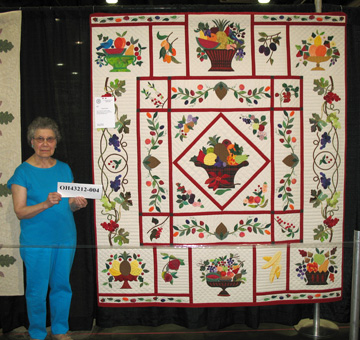
Karen Musgrave (KM): This is Karen Musgrave and I am doing a Quilters’ S.O.S. – Save Our Stories interview with Irene Goodrich. Today’s date is June 19, 2008. It is now 4:32 in the afternoon. We are in Columbus, Ohio at the National Quilting Association’s quilt show and Irene thank you for doing this interview with me. Irene Goodrich (IG): Thank you for inviting me. KM: Tell me about your quilt “Tutti Fruitti.” IG: I have used, I am going to do some reading from here. I have used all or part of eight patterns in the construction of this quilt. The top center block I started in a Baltimore Album quilt, it is from Jeanna Kimball’s Baltimore Album book I believe, and I had that block done for a long time and got sidetracked and didn’t get into the Baltimore Album quilt. As I mentioned, I’m trying to downsize and redo some things and I thought well I’ve got to use some of these things that I have started, so I used that as the basis of this quilt. I dug out all of the patterns I could find on the fruit baskets and I do have a lot of other fruit patterns and so the four corner blocks on each corner are the red back is seasonal fruit of spring, summer, fall, and winter and I started this quilt January or February. Well I’m sorry, I started this quilt February of 2006 and finished it in January of 2007. Construction required four hundred and three hours, and the quilting three hundred and eight hours for a total of seven hundred and eleven hours. I basically built the quilt as I went along. I started with this center portion and the four corner blocks I mentioned that, the center block on point is Winter Basket from, “Baskets, Baskets, Fruit and Flowers,” by Tony Phillips and Juanita Simonich from “Fabric Expressions.” The four corners around the center block are enlarged designs from “Gathering Baskets” by Cindy Blackbird and Mary Sorensen, published in the April of 2001 magazine of Better Homes and Gardens. The four borders around the center are the “Pineapple Passion” block from Robert Callahan’s “Floral Garden” in the February 2004 McCall’s Quilting magazine. The top center basket is Block #10 from Jeana Kimball’s “Reflections of Baltimore” book. The bottom center basket is “Therom Fruit Bowl” by Polly Whitehorn and the pattern is in Better Homes and Gardens’, “Great Appliqué, Wonderful Small Quilts” book. The four berry and cherry blocks on the corners of the center portion and the banana, pomegranate, kumquats and damson plum blocks are from the “Horn of Plenty” book by Kathy Delaney. The grapevine border is a Nancy Pearson pattern, and did I mention that I had used eight patterns. [100% cotton and threads were used.] That is the story of the blocks. Is there something else? KM: Do you work on one quilt at a time or do you work? IG: No I have probably a dozen things that are in progress. If I get bored with one I can go to another. What I mentioned in the earlier interview that I try to quilt three days a week, Monday, Wednesday, and Friday, and the reason I do that, this finger that I put underneath the quilt gets sore so it has to have a day to heal and sometimes on the odds days, like Tuesday, Thursday, and Saturday when I get chores done then I will start to cut out some appliqué pieces for another project or maybe I will have to bind a piece that is laying aside to be bound, or some other phase of the quilt that has to be done. KM: Did you plan this quilt out? Did you decide what blocks before you started or? IG: No. I built the quilt as I went along. I did that center one on point and then I figured out what I had to do to get it square again, so therefore those three little corners from “Baskets, Baskets, Fruits, and Flowers,” then I decided I needed a border around that so that is when I dug out the Robert Callahan pineapple and put that around, and I knew I was going to put the four seasons on the corners, and see what did I fill in with, oh, and I filled in with the other patterns from the Kathy Delaney book, and then I had to do something to two odd size, so I felt Nancy Pearson’s grapevine which is still fruity will complete that. I bound it in red, I thought that would frame it somewhat and then that finished the quilt. My friend, Sharla saw the quilt, the center part of it when I was just starting to construct it. She says, ‘Well I have a dibs on that quilt.’ [laughs.] I said, ‘Well you better wait and see what happens and then you might not like it.’ I think she loves it. KM: Are you going to give it to her? IG: I’m not going to give it to her, she is going to pay me for it. [laughs.] I’m a senior citizen on social security and so this is my way of making some extra money. It is tough. Of course I lost income when my husband died, you know, so it is a little bit tough what you have to pay today to keep yourself going and I’m in my own home, three bedrooms upstairs and a living room, kitchen, dining room downstairs, basement and the lawn to take care of. So you need extra money and that is my way of earning something extra. KM: You are okay with selling your quilts and giving them away? It is not difficult? IG: Not really. I feel very sad when a piece leaves the house but all of my nineteen nieces and nephews and my seven brothers and sisters and my parents all got a quilt. Some of them have two now, some got two quilts. So that took a lot of quilts out of the house and then my last four quilts, my four bed size quilts, outside of the present one that no one has seen that I’m going to put in the state fair in August have been sold. When my husband became ill, I still had several nieces and nephews that hadn’t gotten a quilt, so I called them in and let them choose. I must have thirty or forty quilts stacked up on a bed, so I let them choose and that depleted my supply. When they called on me here in ’05 to do the trunk show, I had to borrow quilts. I had my sister in Maryland to come in with several pieces that she had and then her daughter from Washington, D.C. came in with several pieces that she had, and my sister Ruth and I have a sister in Westerville [Ohio.], they all let me have pieces that they had so I would have enough to do the trunk show. I am trying to build my quilt supply back up because I don’t know when someone will call me to do another show, now what do we do now. KM: Can you make your way to the light? [the lights in the room went out so KM is talking to someone sitting in the room.] IG: Wow, I hope the electricity didn’t go out. KM: No I don’t think so. Oh, it went back on. IG: Oh there it is. KM: Well we had a little technical difficulty that will be in this interview. We were sitting in the dark for a while. That was very strange. IG: We could cut that. KM: We can. IG: That part out. Let’s see, where were we? KM: Oh, the trunk show. IG: Yes I was telling about trying to build my supply of quilts back up. I have plenty of wall hangings, although you can replace the wall hangings a lot faster and I’m constantly making those. I can turn two or three wall hangings a year out. For my fair in August, I have one bed size quilt and three wall hangings and a crib quilt and a table runner. So, even though they are buying the wall hangings, I can replace those easy. Not so quite easy, because it takes longer to do a large bed size quilt, but if someone calls on me again to do a major quilt show, I want to have the supply, you understand. KM: Tell me about how you decided to quilt your “Tutti Fruitti.” IG: My rule sort of is, well not really my rule, but the appliqué is rather elaborate on there, so I just used cross hatching on that, but also I do love to use designs in the solid, to me a quilting design is lost on a print fabric, but when you have a solid I do like to, and then sometimes if I’m in a hurry the cross hatching is the fastest way to get the job done. KM: You hand quilt all of your quilts? IG: So far yes. I hand quilt them all. [tape malfunction.] I said earlier made the remark that hand quilting is going out of style and as you know there are a lot of them being machine quilted, I really don’t like to see handmade appliqué quilt machine quilted, I truly don’t. So I said as long as I’m alive, and another friend I spoke with made the same remark, as long as we are alive there will be hand quilting on our quilts. KM: Do you sleep under a quilt? IG: Yes. KM: Tell me about this quilt you sleep under. IG: It is a cross stitch. A friend that I used to work with had a neighbor that had quilt tops and she wanted to unload them, so she sold me this cross stitch top for five dollars and I quilted it, and that is the one I sleep under. My gift to [my friend.] Sharla [pointing to a friend in back of the room.] here is sleeping under a Lone Star, or is it Bethlehem, they are both similar, which is a Martha or Aunt Martha Rainbow kit that was a present to me from my mother I believe. She is sleeping under that. KM: When did you make that one? IG: Oh my, probably in the seventies. I started in 1968 to seriously quilt, so I probably made it in the seventies. I don’t have all the dates in my head now. KM: I don’t have dates in my head most of the time, so I think you do wonderfully. How many quilts do you think you have made? Do you know? IG: I believe the quilt I’m putting in the fair might be ninety-one. See I’m headed for eighty-three. I just had my eighty-second birthday and I would like to at least do a hundred and I might go over that. I believe it is ninety-one. Wall hangings I believe over one hundred wall hangings, and miniatures is around forty sometime, because I separate each into three. KM: Tell me about making miniatures. How did you start making miniatures? IG: When NQA started having the mini auctions, I don’t think I got in. Do you know how many years they have been doing it? My donation this year is my seventeenth donation running. I think I missed at least the first year or maybe the second year. I just got interested in supporting. I have been a good supporter of NQA from the very start and I do all I can to help them. It is so much fun. [laughs.] It is so much, for instance at the Silver Jubilee, the one in Charleston, West Virginia, well may little, it was four little houses and the, I met her there and she gave me a hug, the head lady of, her name was, her last name is Tate. What is her first name? [Brenda.] Anyhow she wanted it and it was a house quilt, little houses, and so it won Viewer’s Choice. I didn’t know that they were voting on it. It won Viewer’s Choice. It was the Silver Jubilee and so they were doing these silver thimbles, so I got a free $35.00 silver thimble for my prize and got my picture on, or got my quilt pictured on the front of the newspaper in color, which I have a copy of. She was bidding on it and people were bidding against her because it was very popular, but when it got up past $200.00, why she looked at her husband and he nodded okay for her to go ahead and it went for $300.00. The thing of it was when the auctioneer got up front, he said now this quilt is very popular. He said [that.] it is Viewer’s Choice and he said, ‘We are starting the bidding on this at $100.00.’ And I think I made a few enemies, I think I did. [laughs.] It is so thrilling, I just love those auctions and the auctioneers, and when they, you know, you get up and start to get the bidding going and then it is so interesting when one will put their card up and the next one put their card up and there will be a little feud between the couples sometimes. [laughs.] KM: I bet you are happy that the show is staying in Columbus now? IG: Yes I hope it stays here for ever. KM: I thought it was supposed to. IG: Well all I know is that it is going to be here the next two years. I hope it stays here. Of course if it goes out somewhere I will not be able to attend. I just can’t travel any more. KM: How many of the shows have you been to? IG: In the beginning, I think the photo I showed you is in ’78 in Georgetown. I had it on the back of that photo that it is my first one, but I attended two or three. Greenbelt, Maryland and maybe I was at Georgetown twice. I think it was there twice in a row. Then the first when they moved out was in Fort Wayne, Indiana and myself and do you know Marguerite Wiebusch? [KM shakes her head no.] Well she is one of your earlier–she has a low number in NQA and I met her a long time ago. Marguerite, her husband Richard and me and my husband Albert we were a foursome at all of these shows. We would go in, earlier shows, and when they were hung and the powers to be would let us go in the night before and do our photography. The three of them, Margarita, Richard, and my husband were photographers and they would let us go in and photograph. I have a house full of NQA slides. Originals. He was a good photographer. KM: What is going to happen to those? IG: Well I don’t know. I may not be at liberty to say right now but something that I have done, I will just hold it for right now. I don’t know. But I want them to go somewhere. KM: That is a great resource. That should not be lost. IG: I don’t want them, there is hundreds of dollars tied into those things. But anyway, I am losing my train of thought. I had another thought here. What was it? Oh, they would let us go in and do our photography. Once in the DC area there, it was in a schoolhouse and there was going to be some janitors in doing work after hours and so, oh my goodness [lights go out.]. Should I keep talking? KM: Yes keep talking. IG: So one of the ladies in charge engaged my husband and I to baby sit those quilts until the janitors left. So the show closed about probably 6:00 and we were there to almost midnight baby sitting those quilts and she had gone out to get something to eat. She came back around 11:00 or 11:30 to make sure the janitors were gone and everything was locked up. We had the best time, my husband and I. We were there with all of these quilts guarding them and I was appliquéing Lancaster County Rose. Do you know the story of Catherine Eshleman that was a president of NQA in the past and she designed this. She designed this rose pattern called Lancaster County Rose and we had a contest and I think only about four or five of them ended up in one of the shows, but I got a 2nd place ribbon on mine, and let’s see, the Lancaster County Rose, I think, is that the one that they bought at AQS [American Quilters Society.]? I believe that is the one AQS bought for the museum and they had it a couple years before they got the museum built I believe, but anyhow, Catherine designed a pattern and we had the contest, and I was appliquéing then so I just sat and appliquéd on that while we were guarding the quilts. KM: That sounds like fun. IG: Oh it was. Anyhow, we haven’t been there too long and one of the janitors came over and he said, he said, ‘You people can leave if you want to. You don’t have to stay here.’ I said, ‘Oh sorry we had been told to stay right here. We weren’t about to leave.’ So anyhow that is that story. KM: Is there anything else you want to share about NQA? IG: I’m glad to see it constantly growing all the time. KM: It is the biggest show ever. IG: Since the beginning yes, absolutely yes. KM: What is your favorite part of the show? IG: The whole thing. KM: The whole thing. IG: [laughs.] The banquets and meeting all of my friends. I have lots of friends. I have people that they will come by and say, Hi Irene, and I haven’t the faintest idea who they are. I said to her this afternoon, ‘Why hello Irene how are you?’ And when we pass here I say, ‘I don’t have the faintest clue who that is.’ I have been written up in magazines and books and I’m on PBS TV and magazines. KM: Tell me about PBS TV. IG: It was in connection with our research project. They interviewed myself and another lady who is now deceased. Poor thing she died of cancer in her forties and they interviewed both of us in color and every time we turned on PBS people would see us on there doing our bit. Of course that was a long time ago, probably late eighties I image. KM: What were you documenting? IG: I don’t recall what all it was about. They came to my house to do the photography and we put a quilt on a stand in my front room and they photographed me in front of the quilt. I don’t remember all the dialogue or anything. I don’t know where they interviewed Ellen, I don’t know if they went to her home or what. Anyhow another time, CMQ [Columbus Metropolitan Quilters and NAQ chapter.] has a show at [Inniswood.] Gardens, one of our city parks at Westerville, Ohio and a couple years back while the publicity came in and I had a flower appliqué there at the time and so they did a close up on that quilt and that was on TV in color. KM: You have had a lot of adventures. IG: I should have kept a log. I really should have kept a journal. I’m sorry that I didn’t. KM: What advice do you give to someone starting out in quiltmaking? IG: Stick with it. A lot of beginning quilters become discouraged because they don’t do the small quilting stitches or they will pick a pattern that is too complicated. They should start out maybe with a potholder or a pillow with a small design, if they are doing appliqué; a Sunbonnet Girl is good for a beginner, or a large flower and work up to it. I’m a self taught quilter. I was on quilt number 22 before I was doing a stitch that I was pleased with, and of course the more you do, the more you improve. I have a motto; I will not sacrifice good workmanship for speed. KM: That is a good motto. Do you use a thimble? IG: I certainly do. KM: What kind of thimble do you have? IG: [laughs.] I have about three or four dozen with holes in them. I will make my last wall hanging if I don’t die to hang all those thimbles on [laughs.] and I’ve got to think of a good title. My mother hand this brass thimble, if you can get brass ones they last longer, but I’m hard on them. I poke holes in them and the first time I poke a hole, I usually get a hole in the finger. [laughs.] I use different ones, different types of thimble. I have several different varieties. I have a leather one that I didn’t care for and I don’t use it. I try to cover this finger, but I have to have a bare finger under there. KM: Me too. IG: I have to have a bare finger under there. KM: I can understand having to rest then. IG: Yes, it gets quite sore. Most people get calluses. Do you see any calluses there? [shows KM her finger.] I can’t keep the calluses. Some lady somewhere talking about quilting, I might have been, I’ve done a lot of demonstrating at different things. Oh one time in Columbus I lent all my quilts to a charity for children, they raised funds for children, and we had this armory in Columbus, I forget what street it is on, it might be Route 161, and they had a balcony, a real high balcony in the armory and I think I loaned them twenty some quilts and they hung all those quilts around the balcony. I did it free. They raised funds for the children. I can’t think of the name of it, anyhow we have bags all over Columbus that they put the groceries ads in and so my name was on all the plastic bags in connection with this show. But anyhow, somewhere, some lady knew I was a quilter and was talking to me and she said, well let me see your fingers, and she looked at my fingers, and I didn’t appreciate her or her remark and she looked at me and she said, you are no quilter. [laughs.] I didn’t argue with her, and at this armory I got so tickled at the lady that engaged me, that invited me to put the quilts in. She was walking around behind these two old ladies. They had big cards on the quilts of the years that I had made them, and I’m a constant quilter and I have a quilt here from 1970 and over here another one that was 1971 and another one 1972, and the ladies were discussed because they said there is no way this woman can make a quilt a year. [laughs.] So this lady came to me, what was her name, I don’t remember now, and she was telling me, and I said I wish you had gotten me and let me talk to them. I have a lot of fun experiences. Oh, my best win. I won lots of prizes and I’ve probably won around 275 ribbons and I’ve won everything but Mary Krickbaum and to my astonishment last couple of years I was looking at my critique sheets and it said in the corner, ‘consider for Mary Krickbaum ribbon’ and I said, ‘Oh my goodness.’ Of course I didn’t win it, but I’ve won best workmanship, best quilt stitching, best theme quilt, best basket quilt, best of show quilts. I have tons of ribbons, you know they always awarded the ribbon the best of show and I never had to buy bat, I got free bats all the time. Let’s see what else? KM: What do you do with your ribbons? IG: I have them in a big box and they need to be pressed. Well now lately I’ve been giving some of them away. I made a quilt for my youngest sister, she collects owls and I made her an owl quilt. She lives on the west coast, and so I gave her I think three ribbons and there was supposed to have been a fourth of which I never got. I think she framed them. Then my sister, Ruth, one of her daughters-in-laws [Pam.] that lives in Kentucky, she is crazy about birds. I do a lot of bird quilts, and so the bird quilt won about six or seven ribbons and I gave them all to her. Do you know, did she hang the ribbons with the quilt or anything Ruth? Did Pam hang the ribbons on the bird quilt? [Ruth states they are framed.] Are they framed? She probably framed them. She had won seven or eight I think, seven or eight ribbons. KM: Great. That is wonderful. IG: If I had kept a journal I would have all this stuff in chronological order, but I’m beginning to lose my memory somewhat, for instance like just now I couldn’t think of some names I wanted to think of, they are not there. KM: I’m younger and. IG: One of my best friends said, ‘I don’t have Alzheimer’s, I just have half-heimers.’ That is me. [laughs.] KM: It happens. I want to thank you for doing this second interview with me. IG: Well thank all of you who have, I think Janet was behind this. [laughs.] KM: Janet. Well we were very interested in getting some of the histories of NQA because there aren’t anywhere and I’ve been working two years to get Janet to do this. IG: Well I had the old NQA newsletters probably in your archives you have a copy from the very beginning of all the newsletters that you can refer to, but the very beginning ones are very enlightening for anyone that wants to get filled in on some things that went on. I gave the early ones to Janet [White.]. I’m trying to unload things, so I hope she still has them and they finally went to color. I gave her all the black and whites from ’72 and I’m not sure how many years it was black and white and they started doing some color on the front and now they are doing color I guess throughout the magazine, which it is sort of tough to see a quilt in black and white. KM: They are so much better in person than the picture too. IG: They have a ton of stuff I’m sure in their office in the archives. KM: It is time to get it shared with other people. I think since we are in the dark again [lights went out and the room was pitch black, we later found out that the lights were on motion sensors so because we didn’t move around the lights would go off.] we will go ahead and conclude this interview. Unfortunately since I can’t see my watch we won’t know what time, but thank you so much for doing this interview with me. IG: Thank you and I hope I wasn’t a complete disappointment. KM: Oh no, you were fabulous. [interview…
by Amy Milne | Apr 24, 2019
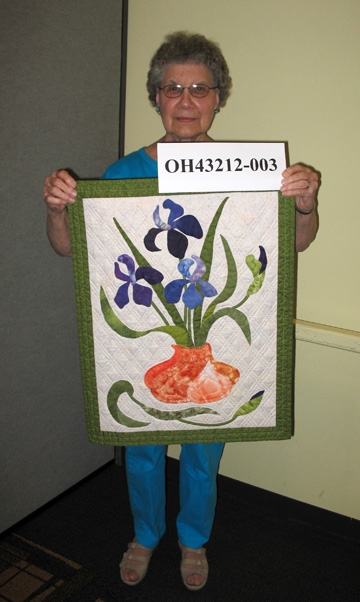
Karen Musgrave (KM): This is Karen Musgrave and I am conducting a Quilters’ S.O.S. – Save Our Stories interview with Irene Goodrich. Today is June 19, 2008. It is 3:25 in the afternoon. We are in Columbus, Ohio and this is a demo interview being done at a training here at the National Quilting Association’s show. Irene, thank you for taking the time to do this interview with me. Please tell me about the quilt you brought for this interview. Irene Goodrich (IG): This here is one pattern of nine in a series of designs by Susan R. Du Laney of Albuquerque, New Mexico and I just love her patterns. She just draws one out right after the other, as well as we would write really, so I have tons of her patterns and I’ve done several of this series, not all of them, but I plan to do them all if I live long enough. [laughs.] I’m just what you call a traditional appliquér. I mark my pattern on the background and I make a template for each color and I baste my edge under and then I match my thread and appliqué them down. I use a #3 hard lead pencil on light fabric to do my marking. I use, well you don’t want this right now, but anyway, I guess that is about all on this one. KM: You can tell me whatever you want. IG: I believe that will do it for this one. But I love iris, so I’ve done may iris pieces. I collect iris patterns. KM: Now this is hand quilted. IG: Oh yes, I do all of my quilting by hand. Someone made the remark that hand quilting is going out of style, and I said not as long as I’m alive. [laughs.] I always put all the information that I can on the back. KM: Let’s turn it over and tell me what information you have put on here. IG: It is my #77 wall hanging. I’m up over one hundred right now. I numbered from number one. I tell it is made by myself and my location, the size of the piece, the content of the fabrics and the threads and the batt [batting.], and the day I begun and the day I finished. The amount of hours in the construction. KM: Wow. IG: The amount of hours in the quilting to equal a total. Then I sign it and date it, and I always date all my pieces on the last day that I put the last stitch in it. I also keep a record in books at home. I have several books, one for wall hangings and one for quilts and one for minis. Put all the information that I can in those on the back. KM: What are your plans for this quilt? IG: I really don’t have any. [laughs.] I really don’t have any plans for it. I do give away a lot, and right now I’m selling a lot. Selling a lot of my items. If someone comes along and wants to purchase it, I probably will sell it because I’m in my eighties and I’m not going to be here forever, trying to downsize. I don’t know if I should say this in here or not, but right now I have either a block or a wall hanging or a full size quilt or a combination of the three in half of the forty-eight states, and some in Canada, and I have a block in Copenhagen, Denmark in a quilt, and I have three wall hangings somewhere in the Orient. I don’t know exactly where they are right now. KM: That is pretty exciting. What do you think somebody would conclude looking at this quilt about you? IG: Well that is hard for me to determine. KM: What do people think about your quilts? IG: I get lots of compliments I know that. Really I’ve gotten a lot of them in this show already. Got one just on the way up here. KM: What did they say? IG: My gorgeous quilts, they saw my gorgeous quilts hanging in the show and of course I always graciously thank them for a nice compliment. KM: Tell me about your interest in quiltmaking. IG: I will start at the beginning. When I was about four and a half or five years old my family had moved and I was getting under my dad’s feet, he had sort of a short fuse, so he screamed at my mother to take that child somewhere and sit her down in the corner out of his way. She took me to the front room of the house, I can just picture it in my mind now, it had a lot of glass in the front and there was no furniture in it. She sat me down in the corner and she got a piece of white fabric and she threaded a needle with black thread. My mother was a good size and I was a scrubby kid. She put some cloth around my needle finger and put her big brass thimble on my finger and taught me how to use the thimble from the very beginning, and she said you want to try to make tiny stitches, so with this black thread on the white fabric, you can see how you are progressing. I took to it like a duck to water and shortly after that she cut out squares and then triangles and put the triangles on each one, she called it squares and corners. Recycling is nothing new to us, then your sugar and salt came in cloth bags and they were sewn together with a chain stitch, so when she used the salt and the sugar she would take out the chain stitch and bleach out the wording in the fabric and dye it. On this particular quilt, she dyed it red. I had the top done before I started school at the age of seven, and it wasn’t a quilt until 1968 which began my quilting career. Let’s see, I come from a line of quilters. My mother would say that when she and her three sisters were going to high school they would always hurry home and get their lessons done so that they could quilt for an hour before they had to go to bed. Both my grandmothers are quilters. None of my sisters quilt, I’m the quilter of the family. It just took off from there. What else do I have to tell you? I seriously got into quilting in 1968. My husband and I didn’t have any children but I had nineteen nieces and nephews and my sister back here had five that were our children, so I began to make quilts for nineteen nieces and nephews. I added seven brothers and sisters and my parents and I’ve been avidly quilting ever since. KM: What made you start in ’68? IG: I was aware that there was becoming an interest in quilts. At first I was the only quilter in the area, but now it is really going great guns, which pleases me immensely. KM: What does your family think of your quiltmaking? IG: Oh they are my greatest fans. [laughs.] They all have their quilts, some of them have two, two quilts, two full size quilts. KM: How many hours a week do you spend on quiltmaking? IG: I’m a widow now and live in this big old house by myself and so I can only quilt every other day because I can not quilt with anything on the finger. I can’t do anything with hands covered, even digging in the dirt, so I quilt Monday, Wednesday, and Friday and then on the other days I do whatever has to be done, wash the clothes, clean the house, mow the lawn or whatever, or get a new project ready. It is my life right now, just keeps me going. I want to mention that quilting is wonderful therapy. Beginning in 1970 when my husband and I had to take care of his mother and she was in our home in bed, and I think beginning in the early eighties my father became ill and for about ten years I had to go back and forth between the states of Virginia and Ohio. I had to get power of attorney for both of my parents and see to their affairs, and then January 31, 1997 my husband had a hemorrhage stroke and going on eight years, well he passed away in 2004, and I want to tell everyone that if you get into a situation like that quilting is the best therapy that you can possibly do. It saved me. KM: What do you find the most pleasing about quiltmaking? IG: Color and the beautiful fabrics that they are doing for us today and all of these wonderful books. When I first got into quilting I think we had two quilt books, one by, is it Marguerite Ickis and the other one was “101 Patchworks” by I can’t think of the author’s name right now. I just marvel at all the books we have and then all of a sudden all these appliqué books that are out there, which is my forte. I would rather appliqué than anything. I don’t like to piece any more. I love to quilt. I do the quilting. KM: Do you quilt on a frame? IG: I do have a floor frame, which I am not going to use any more. I have every shape of hoop that there is, moon shape, square, round, oblong. [laughs.] I use those mostly now. KM: Why did you move to using a hoop and not a frame? IG: It is difficult for me to handle the frame alone now, it takes two people to get a quilt in, but you do I think get your best quilted product on the floor frame, I have always felt that. Mostly I just use about I think a 15″ hoop now and I can sit in my front room and just quilt away. KM: Tell me about your involvement in the National Quilting Association. IG: I was subscribing to a little magazine, it was a needlework magazine called Stitch ‘n Sew. I don’t know if you are aware of it or not and it covered every type of needlework. They later had a Stitch ‘n Sew Quilt Magazine and I don’t think it is available any more or being published any more but I saw an ad from a lady by the name of Ella Anderson out in California and she wanted a store for her calico, where I knew where it was at the Vermont Country Store in Vermont because every October my husband and I spent three weeks vacation up there in the beautiful color leaves section, so I wrote her a short note telling her and in due time she wrote back a ten page letter, and she was telling me about National Quilting Association and I was very interested so I became a member. At that time I didn’t have chapters, I was just a member and now we have the two chapters in Columbus and I’m a member of both of those. I started getting their newsletter in 1972, but anything quilty, well I was very interested. I started out as a collector. When my husband and I would travel I would get the phone book and look under Q to see what there was in that area that had to do with quilting, and I met a lot of people that way and found a lot of sources. For instance, we were in Pennsylvania one time and someone told me that somewhere in Amish country there was a barn full of fabric, so I chased that down and truly it was a new barn with just bolts of fabric everywhere. One time we were going through Georgia and there were signs out around every turn, “Quilts Here,” so we went to this one home and the lady very cordially invited us in to see her quilts and she told me about another barn full of fabric. In this particular one, it was stacked from the floor to the ceiling, so if you wanted a bolt on the bottom it was your task to remove all those bolts to get to the one you wanted, but that was more fun. [laughs.] I’m a fabricolic. In my bedroom there are three chests and a dresser full of fabric and in the closet of that bedroom there is boxes of fabric. In the guest bedroom where my friend is staying, the closet is full of boxes of fabric. In my living room there is a desk, one drawer is full of fabric. In my dining room there is a buffet full of fabric. In a spare room upstairs I have forty gallon bins, six or eight of them full of fabric. I could open my own shop. KM: How do you find everything? IG: I don’t sometimes. [laughs.] I know I have a certain piece in the house and you can believe it or not sometimes I have to go through every one of those storage places I told you about to find what I want. In the meantime I’m growling to myself. [laughs.] KM: Do you plan things out? How do you go about deciding what to place where when you make a quilt? IG: I’m no good at drawing, so I have to use someone else’s patterns, and I always draw it off onto the background and then make my templates and cover it wherever. That is the way I work. KM: How do you go about selecting? How did you decide to make this orange and make three different colors of orange? IG: There is a color sheet and I have always followed her color sheet and I duplicate it exactly. KM: Good for you. IG: Same shade as she has. I know iris come in all colors, but I always think of purple when I do iris. KM: Is there any part of quiltmaking that you don’t enjoy? IG: No. KM: Like it all? IG: Yes I do. KM: That is good. What do you think makes a quilt artistically powerful? IG: You have to say the design, the colors used, and the person’s interpretation of the pattern I suppose. Is that good enough? KM: Sure, you bet. What do you think makes a great quiltmaker? IG: A person that is dedicating to quilting. You have to have the interest to want to do this, the quilt. KM: What do you think about the changes in technology and how quiltmaking has grown? IG: It is very competitive. I don’t, myself follow most of it, I’m strictly a traditional quilter and that is pretty much what I can do. If there is an artistic piece out there, I don’t try to think that I could do it, of course I probably can’t, but I just do what I can do. KM: Why is quiltmaking important to you? IG: I think in the several members of my family there is artistic streaks and mine happens to be quilting. I have three sisters that can paint, or do paint and one still paints, and I have a brother that does woodcarving. He has never had a lesson in his life and you should see what he does. He just does gorgeous things. Our father was a number one carpenter and I think there are some [carpenters.] of the grandchildren or nieces and nephews out there. I heard my sister say this morning that one of her granddaughters is very into art and we have a nephew that writes poetry, so there seems to be an artistic element, if you want to call me an artist. KM: Do you call yourself an artist? Do you feel that you’re an artist? IG: Not a painting artist, but I call myself, I guess a fabric artist maybe. KM: What do you think is the biggest challenge confronting quiltmakers today? IG: I’m not sure if I have an answer for that. I hope they keep it going, don’t let it die. KM: Do you think it will die? IG: I don’t think it will anyway soon. I know they keep inventing new things. We don’t just don’t know how far it is going to go. KM: Do you have a design wall? IG: No. KM: Why don’t you have a design wall? IG: I really don’t have any place for it in my crowded house. [laughs.] KM: In what ways do you think your quilts reflect your community or region? IG: I don’t know whether they do or not. Do they? KM: I don’t know. IG: I don’t know either. KM: Do you belong to quilt groups? You mentioned something about being in the chapter. IG: I’m a charter member of Quintessential Quilters, Columbus Metropolitan Quilters, The Appliqué Society, AQS [American Quilters Society.], and almost in NQA. KM: Why is belonging to these different organizations important to you? IG: I just love quilting that much. Interested in all of it. I want to support it as much as I can. KM: Is anybody in the group like to ask a question? Here is your opportunity. Silence. [IG laughs.] Janet White (JW): Tell us about your relationship with Cuesta [Banberry.]. IG: Yes, have any of you met Cuesta? You know about her I’m sure. She has been a friend of mine for a long, long time. Let’s see, how did I originally meet her? I’m losing my memory on some things in the past. I’m not sure how I first met her but some years ago she came to Columbus. She only had one son and he lived here in Columbus. She came to Columbus this one time and came to my home and Marguerite Wiebusch happened to be a guest in my home at the time and Cuesta has special information. You know the Ohio Museum has the Hatfield McCoy quilt and Cuesta had some extra information on the quilt that they didn’t have and we had made an appointment with Ellice Ronsheim, who at that time was the curator at the museum, so she took us into the warehouse and showed us all those kinds of quilts to Cuesta and her son. He was so patient while his mother was there and we just had a grand time. I visited her home and I suppose all of you know that she was a quilt, one of the top quilt historians. In her home she had this closed in back porch with all of these boxes and stacks and piles of stuff, catalogued properly that she turned over to the museum not too long ago in New York, and she was a likeable person. We corresponded all the time. She sent me patterns and I sent material of mine to her and she made a scrape book about me, and I don’t know what became of it, I am curious of what became of it. She mailed it to me one time to look at and I mailed it back to her. She was a collector of the old kit quilts. She had tons of the old kit quilts and she had, I think it was called American Beauty Rose and she had two of them done by two different companies at the time just alike and I wanted to buy one of them from her [laughs.] but she didn’t sell it to me. I did a quilt for her grandson. I quilted it for her, for her grandson one time. I did a quilt business out of my home. I had to take early retirement because of health reasons and for about ten years I worked on quilts out of my home, repairing quilts, I did what ever they needed. For instance there was a doctor in my neighborhood that all I did three different times was cut out ocean waves for her, three different color waves, or different color waves each time. She was originally from Austria, her mother still lived over there, and she mailed these cut out pieces to her mother, her mother would sew the top and then it would come back to our neighborhood and another quilt friend, Mrs. Ellen Meyers, would quilt them for her. My husband was a photographer and I was so disgusted with myself that I didn’t have him take before and after photos of all of this work that I did. It was so rewarding. Sometimes I would take the worst rag you can image and restore it. I just did whatever was needed, binding, just one little patch or a whole lots of patches and replace fabric and re-quilt, whatever. I discovered that a lot of damage is done by pets, dogs and cats they love quilts. They do damage. That was really rewarding, I enjoyed it so much, but it got to the place where I couldn’t do anything for myself, which was frustrating. [laughs.] I’ve quilted for people and just all kinds of things. KM: Tell me about teaching. IG: Yes I taught appliqué throughout Ohio for several years and I started to work in the Ohio Research Project but I had to quit because my husband became ill so I didn’t finish with that. KM: What did you like about teaching? IG: The love of the students liking to learn something I suppose. I usually had them write out what they thought of what I did for them and I taught a little bit differently. I took some workshops myself quite a bit and when I taught I made up whatever I was going to teach, I made up a block first and then they were all going to do the same block, they would have their supply list and so I made another block right along with my students so that I wouldn’t forget any steps. They liked that. Went over real well. Had I been able to get into quilting sooner, I would have done what a lot of the quilters are doing, travel all over and teach, but I didn’t have an opportunity to do that. KM: How would you like to be remembered? IG: I don’t really know. [laughs.] How I would like to be remembered. Maybe my sister could answer that, how I would like to be remembered. How I would like to be remembered after I leave here? Ruth Shea (RS): As a wonderful quilter is all I know. IG: [laughs.] That is my sister Ruth. KM: We have been talking about thirty minutes, is there anything else you would like to share before we conclude our interview? IG: I don’t believe so. I don’t know if you would like to have this or not. You know I did a Trunk Show for our show in ’05 and this is the write up that Sandy did for the magazine. I don’t know if you would like to have that. KM: We can include this. Tell me about this. It says, “Irene Goodrich Extraordinary Woman and Quilter.” What was the trunk show about? IG: I showed them all the quilts that I had. I had an hour to show them. KM: How many quilts did you show? IG: How many did I have Janet? JW: A bunch. IG: I know when Teri [Henderson Tope.] wheeled them in on the whatever it was she brought them in on, and Pat [Moore.] said, ‘Oh you only have an hour to do the show,’ but we got done in due time and had a question and answer time at the end. KM: What is your favorite quilt? IG: Are you aware of the Simply Delicious by? KM: Piece O Cake. IG: Piece O Cake. I changed it a little bit. That is my favorite quilt. KM: How did you change it? Tell me how you changed it. IG: There is one in the show right now that has the little separate squares. Each block is separated with all of these little teeny squares and I didn’t want to do that. There was no border so I put the fruits on a gray sort of print background and I think I striped them with color, I don’t remember exactly and then I wanted the border so I used Nancy Pearson’s Grapevine border on it. I think I used a plum color for to add some color and I made a regular bed size quilt. It won big at the Ohio State Fair, and that is my favorite quilt. There’s a couple of people out there that have designs on it. [laughs.] KM: Why is it, tell me why it is your favorite quilt. IG: I like to work with fruits and vegetables and it just appeals to me. It was so much fun to do, and I like to make flowers and fruits and whatever I’m doing as much like nature as possible in color and everything. KM: Thank you so much for taking your time today. IG: You are welcome. KM: To come and be my demonstration interview. You did a fabulous job. We are going to conclude our interview at…
by Quilt Alliance | Feb 3, 2017
[addtoany] [space height=”10″] Explore and listen to Janet Miller’s interview by clicking open a segment title and selecting “Play Segment,” or by searching either the index or transcript. Index created by Annmarie Geist in West Chester University’s HIS 480 Digital History course, Fall…
by Quilt Alliance | Jan 13, 2017
Explore and watch Janneken Smucker’s interview by clicking open a segment title and selecting “Play Segment,” or by searching either the index or transcript. Project created by Bernie Bronsberg, Liam Cuccia, Chris Mallee, and Andrew Politsky in West Chester University’s HIS 480 Digital History course, Fall 2016….

by Amy Milne | May 30, 2019
Bernard Herman (BH): We’re with Jean Ray Laury we’re at the Quilters’ Save Our Stories Project. We’re in Houston, Texas and today is November the third 2000 and it’s about 12:30 in the afternoon. Jean Ray Laury (JRL): Okay, I haven’t remembered what I should start with, what I should do. BH: All right, well I have lots of questions after yesterday’s discussion which I thought was just wonderful. And I wanted to start with your writing, is there one of your works that you particularly like above the others? JRL: Yes, probably “The Creative Woman’s Getting it All Together” book because of the way it seems to have given a lot of women the permission to do things and encourage them to value their own time and their own needs. I guess, basically because of the feedback that came from it. BH: What kind of feedback did you get? JRL: Oh, people say it changed their lives and I know that’s an exaggeration but nevertheless they feel that way and obviously they were looking for something and that came along at the right time. BH: Is there anybody in there, who responded that way, whose work has gone on to be well known in the world of quilts? JRL: Well actually, yes, there were many well known quiltmakers in there but when I started I was trying to identify women who already valued their time enough so I knew them as crafts women and quilters and so in a sense many of them had already made that choice. So yes, most of them just stayed in it. BH: Well, I’ve read the book and really liked it. JRL: I have to tell you one man wrote me and said that it was time for me to write “The Son of the Creative Woman,” that would get it all together; that he had found it helpful. I was surprised too. A quiltmaker, who’s an MD, told me one time how it was helpful to him and I said, ‘Really, I had thought men found it easier to set these priorities or to consider their own work valid and important.’ And he said, ‘Oh no, I come home on the weekend and I feel like I have to mow the lawn and clean the garage. And I read that and went home and worked on my quilts starting Saturday morning.’ So that was a surprise. BH: One thing that we do here is ask folks to bring a quilt which you didn’t bring but that’s fine because you brought photographs which are just as good. We talked about some of those yesterday but the one you didn’t talk about, and I hope you don’t mind if I bring this out, is “Nineteen.” JRL: Not at all. That was the quilt for the Oklahoma bombing Memorial show and I was one of the nineteen quilters invited to make a quilt that then traveled commemorating the date of that event. It was interesting working on it. I wanted to do something that picked up those little things that were going to be left at home when the parents, when things went back to normal. You know, there would still be kid’s pajamas around, roller skates– and so those were the objects that I picked out. Those kinds of things that were going to be emotionally wrenching for adults in remembering the kids and I wanted it to be high spirited and I wanted it to capture the spirit of kids. When I started the first one, I got halfway done and it was way too dark, way too heavy so I went back and started changing the blocks, getting them brighter. And this was the third aspect, when it finally got bright enough that I thought it had some of the spirit of childhood in it. BH: It’s still somber I think. JRL: When I look at it here, I think–well yeah, but it was so heavy when I started. BH: Did the patterns for the blocks remain the same in design or did they evolve? JRL: No, they’ve pretty much remained. You know, I wanted to use the pajamas, the bottle and then–I kept picturing those adults finding stuff, you know, in the home. And so I was going to use those and then I did quilt the names of all nineteen children into the border. It hardly shows, but they’re all there. They’re spelled out in long hand. BH: This raises a question in format this seems similar to your use of panels, in other narrative quilts. I’d like you to talk a little about that on a couple of levels. First of all, how has the use of the quilt as a medium for that kind of messages that often bear words? How has that been received? JRL: Oh, well my work is never particularly well received. I think many people see humor as something trivial. You know for me that’s where the real stuff lies. Somebody starts teasing you, that’s when you want to listen. When somebody comes to you with something really serious to talk about you can solve other things while they’re talking. So I see humor as a really essential part of living. But–you know, even with the Sunbonnet Sue books which I think of as really getting to the heart of the controversy of the “traditional” and the “contemporary,” I think most women probably bought the books for their children. And I think illustrations and humor things, often for many people, tend to trivialize the work so I think it is often not taken seriously and that’s okay. Some people ‘get it’ and it’s worth doing it for them. BH: You talk about, sort of a tension between “traditional” and “contemporary.” Would you talk a little bit about that? JRL: I think in my own work, I actually do incorporate it. This Oklahoma Quilt is pretty traditional in the way it’s set together. And maybe the only thing that is contemporary is the use of color pattern or the involving of printed things and words but I think in the quilt world in general there is a lot of suspicion between the two. The Art quilters, who have come to quiltmaking understand the process, and have a respect for it but I think many of the people who have come from a fiber background, and who are doing wonderful work, tend to dismiss much of the quilting world as being a kind of “paint-by-number” sort of thing. And some of it is. I think quiltmaking like anything else meets peoples’ needs at many different levels. And sometimes it’s a social need. They go to their groups or guilds because they want to see people and they want to have lunch together and visit and have coffee. And for others it’s a very serious pursuit. And I think it works the other way too. I think traditional quilters are very suspicious of the art world in general. Most of them– many of them never go to a gallery. I think they’re a little fearful of art and therefore, if somebody comes in from an art background and doesn’t have a quilt background, there’s an uneasiness or a suspicion that’s probably based on fear. BH: What do you think the origins of that fear are? JRL: Well, I think that art has in many ways become separated from a lot of real life. And yet, when some artists bring it back to real life it’s not very acceptable. You know that controversial stuff going on in England with people hauling unmade beds into galleries which I see as really an attempt to make art a part of everyday life again. Maybe it’s gone too far but that doesn’t seem to be working either. I don’t know why there is some much fear there but I think a lot of art criticism and a lot of art exhibits are very esoteric and they are not–I’m sure there are things within them that anybody could understand but many people also make no effort. They don’t go to a museum and listen to the curators talk. They go in and tend to be critical from the viewpoint of their own experience. Because everybody, has that same carload of stuff that we haul along with us and maybe quilt makers are even more so because the work they’re involved in is so traditional. BH: I’m very struck by the ways in which the Art world, with a capital “A,”“ seems to resist quilting as well and you’re suggesting that quilters also at some level resist the Art world. What do you see as the basis for trying to bring those two worlds together? JRL: Well I’d have to say that some of that suspicion is founded on both sides. There are good reasons why not all galleries will accept quilts because partly they may be unaware of what is going on in quilting and if they’ve grown up with quilting and they’ve seen quilts for years, it’s not seen as artistic in the sense of it being personally creative in the way that many other areas like sculpture and painting are. I think part of it is identification with women. I think it’s seen as women’s work and I think that’s really entrenched. I know when I used to do a lot of magazine design work if they wanted a quilt and they wanted something done in wood that went together I always said yes to the wood immediately and then thought about the quilt. Because I knew that the wood would pay three times as much as the quilt and that was because the woodworking was regarded as a male area. And I think that attitude has permeated many things and it’s not necessarily that men feel this way and have foisted it off on women. Many women feel that way or have accepted that attitude towards them. Just in terms of how they value their work. I think another part of it is that men are brought up or raised in such a way that they’re thinking of careers or most of them are thinking of a life’s work. Many women never do. And therefore, the big things that they do in their lives, like homemaking and child rearing are not associated with an income so they don’t tend to equate the time and energy they spend, they don’t equate that with money. And therefore, when they go off in another direction and they produce work and want to sell it, that part is difficult. And it means you’re saying, ‘I’m worth something,’ and that’s difficult for many women because they’ve not been told that. And in fact, many of them have been told the opposite for many years which is one of the reasons I really like working with groups of women. BH: Tell me a little bit more about that? JRL: About working with women? I will say that it’s fun to have men in classes because they’re open and energetic and the come into class when they’re outnumbered by the women ten to one. They’re secure. They’re fine so they’re always great to work with but I’ve noticed if I do a lecture and there are two hundred people in the audience and ten of them are men, fifty percent of the questions will come from the ten men. Now that’s not a criticism of the men for asking the questions. It tells me that the women defer to the men or perhaps they’re not comfortable exposing some ignorance in front of the men but the men are much more comfortable about actively pursuing whatever it is they want to know. I just see so many women who are capable and intelligent and lack the confidence to do their own work. And I think that’s the part that interests me–trying to help them. BH: As a teacher, you’ve had an enormous impact. What I was interested in, in yesterday’s conversation, was that you expressed a desire that were you reincarnated you would come back as quilt historian? JRL: Oh, splendid. BH: That’s sort of interesting. I’d be interested in having you talk about that desire and also what you see as the objectives for quilt history? What should be happening in your mind? JRL: Well, it’s mixed. I’m sort of ambiguous of it. When we did our state quilt search and I was lucky enough to get to write the text for it that meant I got to interview the people who had the quilts. I loved doing it, and hearing their stories, and what they had to say, and digging out the little historical things that related to this period or the date or an event. And it seems to me that research is–it can just take over your life, you know research in one area. And I became aware at that point that that was a direction that I could have found equally exciting and at the same time I know a friend who is a conservationist was scolding me one time about something I had done in a quilt that wasn’t going to last. And I said, ‘I can’t worry about that. I’m not interested in that.’ ‘Well,’ she said, “that’s going to disintegrate in a hundred years.’ And I said, ‘That will give you conservationists your work.” But it–and I know that’s part of preserving quilt history, so I say I’m interested in it and in another sense I don’t show that practical kind of interest in it. And I think that what that comes down to is that I’m not a great quiltmaker, and I’m not so interested in the quilts. It’s the process of quiltmaking. You know I would not want to have a quilt stolen but it wouldn’t–I wouldn’t suffer terribly if a quilt disappeared. The finished physical thing is not the main part of it for me and I know that people feel very differently about that. Most people do very highly value their quilts and maybe that’s a contradiction to what I said earlier about women valuing their work but I like what happens internally. I have probably never done a quilt that I was really satisfied with so when I’m done with one I’m sure I can do better on the next one and that didn’t please me so much that I could stop there. BH: I like the idea of sort of the two phases of work. Work is process and work is product. People refer to some thing as this is the ‘the work’ and some people demonstrate it. One of the things that appears in the world of quilts is how deeply attached the object is attached to the narrative, the story, and if you think about becoming a quilt historian in your second life, unless you’re already in your second life, and that’s going to be your third one. JRL: That could be, yes. BH: How would you see recovering narrative from historic quilts, where we no longer know the maker? JRL: I think what’s intriguing about the quilts where we don’t know the maker or the information is what we can figure out, I think that’s still what we’re looking for. When a quilt comes in that is totally anonymous, somebody bought at a garage sale and you don’t know where it came from–it’s the narrative part we still look for. We look for clues, for the date, names and outlines of buildings or anything so I think that’s really sad if that’s lost but I don’t think that the interest in it diminishes. I’m not sure if I understood your question right or if that’s it. BH: I’m just puzzled by the problem that I see in these interviews with the quilters across the board, how deeply attached the personal stories are to these objects. And I wonder what happens in terms of the future, when that voice which goes unrecorded is gone but the object continues. How do we affect some sort of? JRL: I suppose in a way, if we’re going to think of quiltmaking as an art form then you have to be able to separate them and still have the work on its own be valid. But certainly with painting, a painting is made more interesting when we know the painter and what was going on at the time. However, other paintings survive and we know nothing about them and it doesn’t seem to diminish our enjoyment of them visually. So I don’t know, I don’t know how to answer that. I guess they have to be both and if they’re not both there we’ll draw out what we can from the visual. I don’t think we feel compelled to do that with other things. BH: I think you’re right and I wonder if that’s part of the package of quilts as women’s art and with attention to the art world if somehow all these things aren’t somehow linked. JRL: I’m sure they are, yes. I hadn’t thought about it like that but, I’m thinking you’re absolutely right. BH: Well, I want to shift gears again and talk about your magazine work in the ’50’s and I think continued in the ’60’s? JRL: Yes. BH: I can think of one other–well there are several other American artists that have had a major impact that also published in that venue–Frank Lloyd Wright did designs for Ladies’ Home Journal. [magazine.] I wondered if you would talk about that medium. JRL: Well, one of the reasons that I got into it was because people were going to look at my work. I mean that’s pretty rewarding. And also they were very willing to pay me for it and that was important at that time. And the payment really validated me in the sense that it confirmed that it was okay to do that instead something else. In fact one of the very first jobs I ever had when my kids were little was doing the little drawings for the Pitney-Bowes machines that you put on your envelope. And they paid me like $25 or $30 per drawing; and might take like fifteen minutes to an hour and a half. And I always did those when they came by because that was the money with which I could hire household help–somebody could come in and do all of the chores, the mundane things, so that I could have more time for sewing. And there was something about not walking–you know if you walk into a kitchen and you’ve just cleaned it up and somebody has left their dirty dishes there and some food on the counter, there’s sort of a clue there that they didn’t value your work real highly because they didn’t take care of it. So if you look at it and say ‘so and so will be here tomorrow and it’s not my job,’ then you don’t hold it against that other person either. So I think in a lot of ways it made it easier to be–you know time was always a problem–but when the kids were little I think it made me much more accepting of children’s behavior because I could separate myself from that housework. And so doing those drawings really released me to pursue my own work and the magazines did pay well at that time. I don’t think they do now but it was a good job for me and I loved having them appear. You know your mother runs next door and shows the neighbor and she wasn’t running over with the quilts I did to have at home. And I think in that sense it took it out of what was ordinarily thought of as woman’s work and it was seen as more important because it was in a magazine. BH: Although what you describe is I think classified as illustration and illustration like quiltmaking seems to often operate on the edges of the Art world in the fact that it’s creative, highly conceptual, and involves a level of abstraction which is really incredible, and yet you don’t see the same kind of discussions occasioned by the works of illustration and advertising art. JRL: No, that’s true. I don’t know what to say about that. I agree with you. And there’s I think in the magazine work too–just another point–there were often limitations. Muted colors like violet and rust don’t photograph very well. They didn’t have photo processes that could show those colors so I would be pretty much limited in terms of what would photograph well. Besides which, when a magazine came out the magazine would get all these letters wanting to know where to go get those exact fabrics so if I used solid colors, it was pretty obvious, I used red or green, anyone could go out and find red and green. But if you used complex fabrics or printed fabrics they’re stuck because the work starts the year before the magazine comes out and a year later they won’t find the same fabrics. So those limitations, I guess, affected what you could do. And I think I personally didn’t regard those as my more serious quilts. And I think I probably did view them as illustrative material. And it was done often to fit into a room, although they usually fit the room to the quilt. BH: Did you get feedback on your articles? JRL: Yes, yes I was good friends of the women who were editors. One of them was Roxa Wright, I don’t know if you’re familiar with her, she was the one who started the main interest in the “Deerfield Embroideries”, she had been at House Beautiful, and then freelanced for Better Homes [and Gardens magazine.], and Woman’s Day and so on. She was a wonderful woman; she was just great and had a very interesting history. And she was the one who commissioned the first article. And then, later when she retired, I got to know Deborah Harding who was then a Woman’s Day editor, and that was fun. I was always the ‘country girl’ when I came to New York, and she loved nothing better than introducing me to things I had never heard of so we had a great relationship there. And she was good to work with in the sense that she was open and she would listen and we could talk about an idea and then she would go off in there to do whatever else was needed. Occasionally, it would start–I think I mentioned yesterday–they were going to photograph barns in October so what can we do with barns. There were a lot of possibilities and they loved the hex sign idea, so that led to a quilt with hex signs so it was always a two way thing but the ideas never came strictly from me so for me that was something I did as a job where as most of the quilts I make are not. The commissioned things might be, like for a bank wall, and I love doing that. I love doing commissions partly because they’re usually large scale and they have nice settings. And I often work with just one person – the architect or the designer. I don’t like making things for people’s homes. I’d much rather–I’m too aware of their personal tastes and what they like and I want them to just come and look at things and choose artwork. I don’t want to deal with all that. You know the expression ‘Good art don’t match the sofa.’ That’s– you get into things like that in people’s homes. BH: When you first started out and started moving into the world of the Art quilt and the statement quilt that was really new territory and other people weren’t doing that. They were looking at quilts where they were inclined to do so as art and not the other way around. How did you come to the medium as an art form? JRL: I think when I did my very first quilt, I felt so at home with the material and it was so comforting to find something where I could really control the shape and I never felt that control with other media. And I guess, I just didn’t think–I just didn’t know a lot about traditional quiltmaking and there weren’t quilt makers in my family so I didn’t have either the benefit or the burden of traditional ways of looking at them. So I guess it just didn’t occur to me that you couldn’t do with fabric whatever you were doing. and I always liked graphics because I liked graphic design so it just seemed like an extension of that. BH: There’s no quilting in your family, you were largely unfamiliar what is classified as traditional quilts so how did you pick this medium? JRL: I saw a quilt one time that had been made by a soldier during the Civil War and I can’t even tell you where it is, and I’ve tried to find it. It was in this little museum in Kansas somewhere, a little country museum on the edge of a small town and this quilt had–it was so personal. It was so wonderful and I was so moved by it. The soldier had used scraps of shirt and uniforms and whatever materials he could get and he showed the farm–his farm in Vermont and behind the farm was the pine forest and in front of the farm was the apple orchard and the lane that went by and the family. You know the stair step children and the grandparents. And it looked to me as if everything he ever cared about was in that quilt. And it just seemed like that was what a quilt ought to be. And so when I made my first quilt that is what I had in mind and that is what propelled me, I guess. What drove me to do a quilt. Remembering how simply he had accomplished this colorful, wonderful quilt. And I don’t think I’ve ever seen another quilt that was as moving as that one was. I didn’t even take a picture of it. It didn’t even occur to me that this was going to ever influence my life. BH: One of the things Le Rowell asked me to do with you is to talk to you a bit more about where you came from, I guess growing up in the Midwest? JRL: I grew up in a family of four girls and a somewhat autocratic father. And my mother was a teacher and was very supportive of whatever we wanted to do and helping us. And I could see a relationship between my mother and father in which he made the decisions though my mother often had the wisdom to make the decisions but the call was in his hands. And I think I saw that early on and I saw a conformity in the small town that I didn’t like. You know I don’t know how you grow up in a Republican family and get Democrat or how you know how any of these things come about. When I’m with one of my sisters we can’t talk about politics, or religion, or education, nothing that has significance in the world because we’re so far apart and we’re just a year different in age. Our bringing up was very similar and heredity is obviously the same so I don’t know how people come about looking at the world in different ways but it’s interesting. I’m very conscious of needing to be approved of and liked but there are parts of me that I can’t give up for that. And I think sometimes when I think about my sister I think she needed that approval, community or family or whatever it was. And I know I need that too, but not enough to have it interfere. You know even racial attitudes in a small town–I can remember being in third grade when a minstrel program came to town and being so offended by it and nobody understood what I was talking about and what was the matter with me that I couldn’t enjoy this good entertainment? So I suppose, maybe it was stubbornness but there was always a streak. I didn’t rebel. I was much too docile to ever rebel outwardly or physically but I think I mentioned that yesterday about not liking confrontation. BH: Your quilts provide your medium to make the statement. JRL: Yes, yes. BH: It was great. If you could tell us again about one of your best known quilts of all time, which is “Barefoot and Pregnant.” JRL: Oh, yes. That came from an obituary in our newspaper, when Senator Van Dalsom died they had a little article and they made a reference to him being called ‘the barefoot and pregnant Senator’ because of his comment in the legislature. He always claimed he had been quoted out of context. When you went back and read the whole two sentences, it was even worse. And I just thought nobody should forget who that man was and so that is what prompted it and you know having it in that cartoon format people do read it. BH: Oh, yes. JRL: People who would never have otherwise acknowledged the statement will read it. I mean it seems pretty prosaic now but when I did it, there were women who didn’t like it. I don’t know why. Oh, I think I do know why. I think some of them read that and thought that it was something I had said. I don’t know. BH: That quilt was picked up and reproduced by Planned Parenthood, is that correct? JRL: They made a poster of it as a fundraiser, yes. BH: What did that do to your career? JRL: Well I don’t know that it really affected it except that I really liked seeing the work being–seeing a piece of my work being incorporated in something I felt really strongly about. And some of the letters I got were wonderful. One was from a doctor in Florida, a woman. She and her husband were both MD’s and she had said that she had been fighting this battle for so long and when that poster was sent to her, suddenly she said that here was a way of dealing with it with humor. And it gave her a fresh start. And I think responses like that–you know if there is one like that it makes up for other ones. So they did have kind of a party when they had the quilt installed in their office and so I to go up for that and be heckled and poked at and that was an experience. I’m not one to go out and march in a protest, that’s not my way to protest so it put me in a situation I had never been in before and that was interesting. That didn’t really affect my career, maybe, but I enjoyed that and getting to know that group of people. BH: Well, we’re nearing the end of our time and one of the questions on that sheet– because your work is so well known and you have had such tremendous impact on so many people is what do you think your legacy will be in terms of the quilts that you have made? JRL: I don’t think that my legacy is going to be in the quilts. I think it’s going to be in the encouragement I give others. And I have a real good time making quilts but I don’t have illusions about the value of the pieces I’ve done. I couldn’t not do them. I have a great time doing them, and at the same time I’m always too pressed for time. They’re never as detailed as I’d like, there’s never as much quilting as I want to do. So there is always a kind of dissatisfaction when I’m through. So when you finish a piece there ought to be a sense of accomplishment and finality and real pleasure. And sometimes it’s nice. I can enjoy seeing it done but there’s never real satisfaction, because there’s–I never did quite what I had envisioned. Is that what you meant, is that what you– BH: Absolutely. Is there anything that I forgot or misdirected? JRL: I can’t remember what it was I thought of yesterday. There was something that was asked yesterday that I answered and then I thought later I needed to elaborate on that so if I could put that on the tape I would. BH: Well, thank you for participating in the Quilters’ S.O.S. and I look forward to continuing these conversations in the future. JRL: You’re very welcome and I’ll look forward to that…