by Amy Milne | Apr 9, 2019
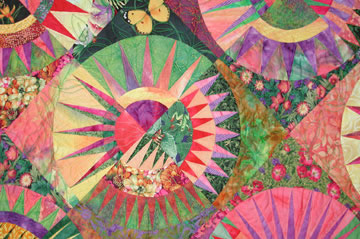
Leah Call (LC): Jean, tell us about the quilt you brought–you have on display today? Jean Wells Keenan (JK): Well, this was a quilt that I made–it took a good amount of time because I also work full time but it really relates to the palate that I see in my garden. I love to garden and zinnias are my favorite flowers and so those flowers really are what inspired the colors in the quilt. LC: Can you tell me when you made this quilt? JK: I made it in 1999 and 2000 and I finished it in June of 2000. I teach quilting also and so the blocks in this quilt were used for class samples and I taught other people how to make these particular blocks. This is a New York Beauty design and all of the blocks are paper pieced but they are different so when you push four of the blocks together you still have a circular shape but the interior space has changed, so you really have that scrap quilt kind of look with more of a contemporary feel to it. LC: It’s beautiful. Can you tell me about the materials you have used? JK: A lot of hand dyed cottons and also batiks and then cottons that–have a garden sort of look to them and there is a lot of green because green is kind of like nature’s neutral. If you notice the greens, there aren’t just yellow greens or just blue greens. There is a real mix of greens because that is what I see when I work in the garden. LC: How do you perceive using this quilt? You know? JK: I own a quilt store and I teach and write and write quilting books and I like to display quilts in my home–it may go over the back of the couch–I have an eggplant color of couch. I will use it for teaching purposes. It is probably going to be in an upcoming book. LC: You have published books? JK: Yes, I have had over twenty books published. I started doing books in, oh, golly, it would have been about 1978. LC: Tell me about your own interest in quilting? When did it begin? JK: I started quilting when I was a young married mother and mother of two and I was teaching Home Economics and they decided that we should have boys in Home Ec. and so I was looking for projects that boys could do. I ran across some patchwork kind of things from England. What appealed to me was the accurate cutting and sewing and the geometric shapes. I thought they would appeal to the boys. They made floor cushions. At that time, quilting was not very popular–this was back in 1969 but I was real taken with putting fabrics together. I have been a fabric person since I was a little girl. I love to sew and so it just appealed to me. I kind of discovered quilting at that time and started teaching how to do it but didn’t have that background in my family or anything. It was just more or less something that I discovered on my own. LC: What is your history with quilting? Did it all begin with your teaching? JK: It did. I found out three or four years later that we had family quilts but my mother had them all packed away in the cedar chests and I didn’t even know about them so I didn’t realize that we had these family quilts and of course when I found out we did, I was very excited. And I found that some of the quilts that my grandmother made were the kinds of things I would chose to make so it kind of gave me a connection with my grandmother and my great grandmother that I didn’t have before. LC: So your first memory of a quilt–would that have been while you were– JK: No, it’s just I discovered it myself. I was twenty-six years old–looking for creative sewing projects. LC: You have described several of your quilt related activities–are there any other activities that you taught or have written? JK: Yea, I, quilting is–I have been very fortunate, it is like my life. I would do it as a hobby. I also do it as a business. I love to teach and see people learn because I have done the teaching and writing of the books. I am sharing ideas and that is really what I love the most about quilting–is what happens with the people and seeing people want to learn and seeing what they do with the fabric and the creativity that happens. That’s really what I love most about quilting. LC: Are there quilters in your family? JK: Well, it turned out that my grandmother and great grandmother quilted but my mother didn’t. You know, she grew up–the World War II era where you didn’t want to sew at that time and you didn’t want to look homemade unless you had to. I just always liked to sew from when I was a little girl and I had a grandmother who sewed and crocheted and did all that and so my grandmother kind of taught me to sew but she didn’t quilt. This was the grandmother on the other side of the family. My daughter is now a quilter and works in the business with me. LC: What aspects of quilting do you not enjoy? JK: I really don’t know. I really like it all. I like thinking up the idea and then collecting the fabrics and then getting started. You know, I get very anxious to get started and start putting my ideas together and see if they work. You change your ideas along the way because not everything is like you envision it but I love that creative process that happens in quilting and how you discover things about yourself. You have to find new ways of working sometimes, you know, or a combination that you thought was going to work color wise, doesn’t and so you have to look for another idea and I just love that process. LC: What do you think makes a great quilt? JK: I think it is a combination of things. Having been a Home Economics teacher, I really believe in things being made well. If you are going to take the time to do then sew it right and be accurate and do a nice job. But, I think, when I look at quilts, what grabs me first is color and design and then sometimes I get up close and there are some quilts that are not made very well but I like to see all of it work together but I probably am more tuned in to color and design and then I see workmanship next but I think it’s as important. LC: What do you feel makes a quilt artistically powerful? JK: It is a combination. You have to balance color and design. The design elements like the scale of fabrics that you chose and how you create texture and how you create movement are all important. Repetition is very essential, repetition can be–all repeated blocks. Repetition can also come in other forms, like in this quilt, you know there are all these points but in this particular block none of them are the same but yet you still have repetition because you’re seeing this kind of shape over and over. And I like more subtle repetition, like when I get to the quilting. I quilted leaves because this quilt had a garden theme. I wasn’t going to put some sort of quilting on here that doesn’t relate the to theme so I really feel like every decision you make in the quilt needs to relate to the theme and the idea that you are trying to pull off and that’s what gives a quilt unity in the end. LC: You talked about this being a garden theme. Have you done other themed quilts? JK: Well I am kind of obsessed with gardening at the moment. I love to garden and I have always been a real outdoor person and like hiking and all of that and have been tuned into nature so I think most of my quilts have a feeling coming from nature because that is where I get inspired from. And I think what has happened with me personally is that you see things in nature that you might not be able to think up yourself like color combinations because it works there then it is going to work in a quilt so I really let that be my guide. And I don’t think I could have done this quilt had I not been a gardener and really tuned into the subject matter that inspired me. LC: What would make a quilt appropriate for museum or a special collection in your opinion? JK: I think it has to be unusual in its design and I think it has to be very well made. I think sometimes it has to do with the history of the quilt–what it was made for, who it was made for or if it was made for a particular event or a time that you know might be historically important but it has to have something special to say. LC: Now, was this one made for this event? JK: Nope, it was made for me and I saw the contest and it fit in one of the categories and so I submitted it. I was just hoping to get in the contest. I have never really entered a contest before. LC: What was this particular contest? I mean this category? JK: It was the imagination category. It was “Wishes for the World” and this probably sounds kind of corny but I just think if we can pay attention sometimes to our surroundings and our environment and see how everything interrelates and gets along, why can’t all the people also get along? It was wishes for the world. It would be nice to have world peace. I think circles represent the world and I think circles are complete and to me when you can get that circle completed so that was kind of what I was thinking about when I made that quilt. LC: How do great quilters learn the art of quilting? Especially how to design a pattern or chose fabrics, colors? JK: Well I think it all comes by exposing yourself to good design and also to what’s out there and sifting through it. You can learn from other people. I think that is probably one of the best ways to learn and I think we are all inspired by somebody. People out there act like they all did it on their own, but we all get inspired by something. I know, for me, I get really inspired by what other people do and customers that comes in my store. I think, in my business, being here and seeing all the ways you can express yourself is very interesting but I don’t think people necessarily started out just wanting to express themselves. JK: Now we will have to get our train of thought going. LC: The pattern in choosing colors? Being inspired by customers? JK: I think when you expose yourself to an exhibit like this, you see a lot of possibilities you might not have thought of. I have been quilting thirty years and I still get excited and see things I want to do and ideas that I want to pursue. It is a very fulfilling process because the time that you spend, you have something to show for it when you’re finished and that is one of the things that I find in my store that people feel so good about what they have done and so many times, they’re making it for somebody else or for a gift. In today’s society being able to make something yourself is very nice. A lot of people just need that. LC: Why is quilting important in your life? JK: It has been important for a lot of reasons. Originally it was an outlet for creativity and then it became my profession and I made my living at it. I educated two children and sent them to college with quilting. Now I am doing retirement, but it has been a way to make a living and I feel very fortunate that I have been able to do it with something that I love doing–that I would be doing anyway so I think I kind of have the best of both worlds. LC: For the record, where do you live? JK: I live in Sisters, Oregon which is in the Cascade Mountains and we only have thirty seven frost free days a year so you have to plant hearty things and do it quick. LC: What do you think about the importance of quilts in American life? JK: Well I think they are a history of American life. You know, they document events in people’s lives personally and they also document events in our history and I think they say things about the social history of our country also but it is just a way to document the people we are and the era that things were made. LC: How do you think quilts can be preserved for the future? JK: Well, I think it is projects like this documentation. I think the oral histories are great and there are so many publications out and you know, those publications have certainly put quilting out in the main stream so to speak because people have been willing to commit to those publications. LC: What has happened to the quilts? Quilts from the family? JK: They have been kept in the family. I have two sisters and we all have some of the quilts and I know that I have already decided who is getting which quilt in my family. I have two children. They are putting dibs on things too, but making sure that the quilts do stay in the family and putting labels on the back is important. You want to be able to document when they made and who made them. I try to really push that sort of idea when I teach classes, too and you know, I just love quilting so much and what it has been able to do and you know through teaching you get to–you have a voice that is differently sometimes than just a local person and so I really try to push those, you know, concepts and ideas. LC: What is the label on this quilt? JK: I can’t remember which one it is. It is not real exciting. It just has for the contest. I will make a nicer label when I get home. It just has the basic information when it was made. LC: What kind of label will you make? JK: It will be gardening and I think I will do some embroidery and then I will put a little bit more of the history of why I made it. This one just has who made and when. LC: Will you document as an award-winning quilt? JK: I will now– [laughs.] I mean I never thought it would win any prizes. I just loved doing it. I was very sad when it was finished because I loved these colors and every single block has a different palate so every time you got to a block you had to decide where you were going to put things and then once I got about half of them finished you get to that stage in design where you have to decide where the quilt is going design wise. I remember getting about half the blocks done and I had only used red once. Well that was not going to look very good if I had only used red once. It would look like an after thought so then I made myself consciously use red a couple more places and then make it dance around the quilt so that it was not all in one spot. As I got down to this area–this is a transition area because you are going from flower to foliage and at that point, I started using green more in the blocks so that the blocks would transition. Originally I thought I was just going to use these blocks down here but when I got to that point it needed that feeling of the ground and what you see when you look through foliage. You know you see wedges. You don’t see exact leaves very often and so I was really looking at what I saw and interpreted this stitch and flip type of piecing and then added the actual realistic leaves to just further and kind of make the point come across. My daughter actually helped me with figuring out the machine quilting. She just started quilting about three or four years ago. She is not intimidated by free motion quilting and I kind of am but I wanted to do it and so she got my machine all set up for me and then I chose to put leaves in the background because it is a garden sort of setting. I would get up early in the morning and go down and quilt then go to work then go home and quilt some more. It was great. It was a fun thing to do. LC: Do both your daughters quilt? JK: I only have one daughter and then I have one son but my son’s quite a gardener and my daughter and I have done some quilting and gardening books. She photographed his garden and so I kind of casually said to him, ‘Well, Jason, you need to design a quilt for us,’ and he said, ‘Oh, I can’t do that.’ And then last month, he said, ‘I almost got that quilt designed for you, Mom,’ so I can hardly wait to see what he’s doing. My kids have just grown up in quilting and both of them are a lot more knowledgeable than I ever realized. I think it is because quilting is a business and they were around it all the time. LC: Do you plan to take this design and put it into a quilt? JK: What do you mean? LC: You said that it was your son’s design. JK: Oh, yes, I’ll figure out something. I think it will be fun. I don’t want him to dictate too much though. It will be interesting to see what he came up with, though and what colors he will work with. I will learn something about him in the process. LC: What would your guess on the results go? JK: Well Jason likes things that are graphically, more simple. I made him a Double Wedding Ring quilt when he and his wife got married and he is the kind who would not like thirty fabrics in one quilt. He would like fewer fabrics and more graphic style. I don’t know what he has designed. We’ll see. LC: Would that probably eventually go to him? JK: Oh sure. I would give it to him. LC: Is there anything that I have not mentioned that you would like to include about this quilt: Any other symbolic– JK: Well one thing that I did because it has a garden theme, I tried to tuck little special things in like a frog here and a butterfly and there is a bumble bee. I suddenly kind of tucked those things that you do see in the garden and just the way I chose the fabrics. I think I lined this quilt because there were decisions till the very end where had I been doing all forty blocks alike once the decision is made. It is just labor and I really like the decision making part of quilting and choosing the fabrics. LC: Can you think of anything else? JK: Don’t think so. LC: Thank you. This has been Leah Call interviewing Jean Wells Keenan, November 3, 2000 for the Quilt Save Our Stories Project. It is 12:00…
by Amy Milne | Sep 28, 2018
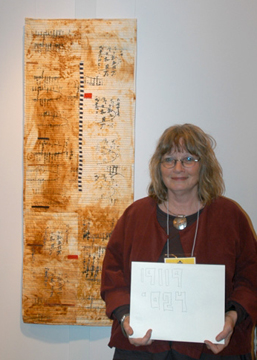
Bernie Herman (BH): This is Bernie Herman on April 8, 2006 at the Art Quilts at the Sedgwick with Jette Clover. We are here to talk about your work and your thoughts on quiltmaking and quilt design. So first of all, welcome. Jette Clover (JC): Thank you. BH: Could you begin by telling us a bit about “Ledger”? JC: Yes. It is part of my Rust series. I lived in Florida for the last four years, up until August in 2005, when we decided to move back to Europe. And I wanted to document this specific time and place. I was planning a solo show and wanted to make new work. And that’s how I got started to rust fabric. Our house was over 100 years old and by rusting fabric with objects that we found in the ground, when we restored it, I got a ‘real’ historic imprint of this place; its DNA so to speak. I was also adding a recent and more personal history to the fabric. I had saved the rusty nails from the plywood, we had to put up to protect the windows and glass doors during the four hurricanes we experienced in 2004, and now I let them make their own rusty tally-like notations on the fabric. I wrapped the rusty objects in fabric soaked in vinegar, and every morning I would check on my rust ‘crop’ and make sure that it stayed moist. I felt like a rust farmer. I made 46 pieces for my show, inspired by the hot and humid Florida weather and the river we lived at. “Ledger” was also printed on rusted fabric, and it was inspired by a Japanese accounting book that a friend of mine had bought. It had an elongated shape and beautiful lettering, from which I made thermo fax screens to print with. It became a piece symbolizing the sum of the days that I lived in Florida. BH: There are a lot of things I would like to ask you to follow up on this, but the first one is, can you talk a bit about the relationship in your creative imagination between art and history? JC: I have a degree in art history. BH: Well, I’m thinking about this as being your art and, but the other thing is that your sense of history that goes into this. Not art history but the history of place. JC: I am curious about the influence that place has on your work–maybe because I have lived in so many places and in several different countries. I was born and raised in Copenhagen, Denmark. I got a degree in journalism and worked for a daily newspaper, but then I met an American jazz musician in Amsterdam. We married and traveled around in Europe, before we went to America, where we lived mainly on the West Coast, first in California and later in the state of Washington. I studied art history in Seattle, and worked with different techniques in textile. However, in 1981 we moved back to Europe, because my mother was seriously ill. We had planned to stay a couple of years, but ended up staying twenty years. We ran a jazz club in the south of Holland for five years, and then I got a job at the Dutch Textile Museum, where I curated several big quilt exhibits. But in 2001 we moved to Florida to be close to our son and grandchildren. I was overwhelmed by the light and the colors in Florida–so strong and so bright. As a reaction I looked for my Scandinavian roots and northern subdued colors. I started to work monochromatically and exploring one color at a time and concentrating on texture. I completely fell in love with yellow, and dyed all kind of shades of yellow then followed a red and then a blue period. I could tell you a story about light. BH: Please do. JC: [laughs.] I was going to have a duo show in Denmark at the Textile Museum together with a Danish friend. We were emailing each other about what we were working on, and I said, “Oh, I stopped my yellow series, and I’m looking out over the water every day. I am working on a series in Danish blue.” Danish blue is kind of soft grey-blue, and I really believed that I was making Danish blue pieces, looking over the water and remembering my childhood at the Danish seaside. So I went to Denmark with all my blue quilts, and when I opened up my suitcase, the first thing my friend said was, ‘Are you kidding! That is not Danish blue. That is Florida blue!’ And it was true. I could see it myself. The light in Scandinavia, is very subdued, pale, grayish, but my new blue pieces had a lot of turquoise in them and were very bright. I had not been aware of that in my studio in Florida, but I sure could see it in Denmark. It made me think a lot about time and place, and how we both consciously and unconsciously are being affected by our environments and our surroundings. BH: Rust is very different from blue as a color, and rust has the sense of decay. JC: Yeah. Lovely, isn’t it? BH: Of wearing away. Can you talk a little about how you came to rust? I know you mentioned that you found the pieces in the ground, but you have taken that much further I think. JC: Yes, I have always been interested in decay. I love crusty and distressed stuff. I take photographs all the time of crumbling walls and corroded metal. When I lived in Europe, I photographed a lot of walls with peeling posters and lots of graffiti, and I think that is when I started using layering and lettering and discovering collage. So the color of rust and the process of rusting relate very well with my earlier work. BH: Can you talk a little bit more about your attraction to decay? JC: Using a process of decay to mark fabric brings attention to the cycle of life: the cycle of birth, growth, death, rebirth. Erosion speaks to the condition of life. I’m not attracted to things that are straight and perfect, and I have never made a real traditional quilt, because I don’t have the patience to sit and be so precise. It would really make be feel like I was competing with a machine, and that to me would be pointless. I mean, I didn’t start making quilts to test my patience or practice my mathematical skills. I make quilts because I love working with my hands and to discover new ways of putting colors and lines together. I don’t make plans for my quilts. I feel that if I had a plan, I wouldn’t need to make the piece. The excitement of discovery would be missing. It’s important to me to touch–sorting, cutting, tearing, ripping, folding, layering, patching. Where was I? BH: We were talking about decay. JC: Decay, yes. It has to do with, with character, I think. I love the sense of history. I like old and worn surfaces. I like wrinkles and scars. I like to see that there has been a life. Why does everybody like antiques and old photographs? I mean, it is appealing. It is storytelling. I found a photograph of an anonymous 19th-century woman and made screens from it. I named her Augusta, because that was the name of the woman who had come from North Carolina with her husband and homesteaded in Florida. They cleared the land and built “our house” more than 100 years ago. I really felt a bond with this woman and used her image on rusted fabric for quilts such as “Augusta and Her Sister,” “Augusta’s Daughters,” “Dear Augusta,” “Thanks to Augusta.” By working with the rusting process I let go of some of the control of art making and the need to control nature. And I find the element of surprise very exciting. I mean, I react to the marks and the colors from the rusting process by putting down my marks in the form of painted and printed signs and words. It’s like being involved with nature in an exchange of mark making. BH: I was going to ask you about storytelling here. Why Japanese? JC: That has to do with the simplicity that I relate to Japanese design. I feel very close to the Japanese aesthetics of wabi sabi. BH: Fung shui? JC: No, no, that has to do with how you arrange your house. Wabi sabi has to do with things imperfect, impermanent and incomplete. It shares some characteristics with what we commonly call “primitive” art – earthy, simple, and made from natural materials. Let me give you an example: the way clay cracks, when it dries and of course the way metals tarnish and rust. BH: Okay. JC: And, I think this striving for simplicity probably also comes from my Scandinavian background. I don’t always succeed, but I do try to follow the principle of ‘less is more.’ BH: I was going to ask you. There are two questions that I want to go toward, and one of these is how you came to be a maker of quilts and a quilt artist. But the other question that I have in mind is that I want you to tell me a little bit about “Urban Walls.” JC: Well, I’m a journalist and I love words, and I am fascinated about how people communicate. Growing up in a small country, there are only five million people that speak Danish, you just know you had to learn other languages, if you want to communicate with the rest of the world. And I like the forms and the rhythm of written language. The “Urban Walls” series actually started because of my interest in graffiti. Sure it is sometimes very destructive and aggressive, but it is also kind of a cry to be heard, ‘Pay attention to me. I’m here.’ I feel really lucky that I have the possibility to express myself in quilts so that I don’t have to scratch my name on an old cathedral door or spray-paint an overpass in order to have a voice. I have taken a lot of photographs of graffiti. Glimpses of urban communication and wonderful layering. I grew up in Copenhagen, so I am a city person. And that is where the “Urban Walls” came from. BH: I wanted to ask you about the connection between quiltmaking and writing. You come at this as a writer. JC: Yes, and I still love to write. I write every morning. Several years ago somebody gave me the book “The Artist Way” by Julia Cameron. I read the first chapter and I thought, ‘That will work for me.’ I never finished the rest of the book, and now I can’t find it. She suggests that you write three pages every morning, first thing when you get up. Don’t think about it, don’t plan it, but do it as a sort of ritual for yourself. And don’t read it afterwards. So, I have done that for about ten years now. I have a big pile of notebooks. I have never read any of it. I still have them, so maybe it’s my idea that one day I will read it. I don’t know. But the feeling that it gives me is that I am giving myself the time. A quiet time for myself. It is really like a ritual- my first cup of coffee, sitting at my desk, writing with an old-fashioned fountain pen. And I know that it is like a stream of consciousness, because it takes me exactly a half hour. A lot of times, I just start out with writing, I don’t have any idea what to say– but before you know it, you are writing about thoughts and ideas. I know that I have written a lot about the meaning of my work. But I don’t go back and read it. That is not important. The important thing is the process and the quiet time with myself. I feel that if you start every day ‘talking’ to yourself, having a private moment for half an hour, whatever happens during the day, at least it started good. Writing is a rhythmic thing. It is kind of similar to stitching by hand, in and out of the fabric. I stitch a lot by hand, and yeah, the movement of it, the rhythm of it, has very much to do with each other. BH: That makes me want to ask you now about the connection between your work and poetry. JC: I don’t think it has any connection. BH: You don’t see your work as poetic? JC: No. I see it more as maybe meditative. And, quiet. I really feel that it is meditative. I think that is a good word for it. Of course it is my reaction to what surrounds me, but I am very selective. We are not like a camera that just clicks the whole picture. We make very selective choices about what we see, and what we talk about. Well, does that make sense? BH: Yes, it does. JC: Okay. BH: I am always interested in the way that quilts, particularly quilts like these begin to intersect with other creative forms, for example, and that is when you talked about writing and your background in journalism, or your interest in the found world of graffiti or tattered handbills, all sorts of the textures. JC: Yes. BH: The grit of the urban landscape. JC: I like that. That’s a good one. The grit of the urban landscape. Can I use that? BH: [laughs.] Help yourself. JC: I will. It has a nice ring to it. Well, I should have told you before that in my early series “Urban Landscape,” I started applying text on my quilts. Sometimes they are covered with it, almost like a diary. But again, I don’t really see it as poems, and I don’t see it as literature. My mother tongue is Danish, but I have lived many years in America, and my husband and I speak English together. And then we lived 20 years in Holland, and I spoke Dutch every day – so I use all three languages intermittently. People often ask me, if I make a conscious choice when to use English, Dutch or Danish on my quilts. Sometimes I do. If I don’t want to be so obvious, I’ll use Dutch or Danish text, but if I really want the whole world to listen, I’ll write the message in English. However, sometimes all three languages are on one piece, because they are all part of my daily reality. BH: Sure, almost kind of layered graffiti. JC: Yes. A little prettier, a little less gritty, but nevertheless, yes, it is. I think it is a sort of graffiti, because I’m doing it to be heard or seen. And now the people making graffiti are often called graffiti artists, aren’t they? It is sort of what I said before, that it all comes from the same need to express yourself. To tell the world that you are here. BH: One thing about graffiti is that the style of graffiti is also coded. It takes a special ability to read a great deal of graffiti. JC: Yes. BH: Can you talk about that aspect in your use of graffiti? Do you think in that way? JC: Yes, it’s like Japanese writing. When you can’t read the letters or don’t understand the words, you start seeing the forms and the lines more. And if you take the graffiti out of context, you see beautiful flowing lines like calligraphy. It might say, ‘You,’ but I can’t read it. I can sort of sense it from the aggressiveness that is in it, but because it’s not a word that I can really decode, I can enjoy the beauty of the lines, and at the same time feel it as a powerful message. After all an insult is only insulting, if you understand it as such. BH: There is a distinction, though. When I can’t read Japanese and I’m drawn to the line and to the form, it is still intended to be read by somebody. But with graffiti it is the obscuring of words on purpose. It’s to really emphasize the line over readability at the moment of its making. JC: I’m not sure that that is completely true, because I think you can indeed see it like Japanese. There is a society. There is a group of graffiti people that can read it. Maybe it is more like a sign language, but I am sure it is readable and significant to the group. It is almost like a tribal society isn’t it? BH: “Crews” is the word that graffiti artists use. They are organized by crews. JC: Yes. BH: And there are different styles, like “wild” style, or “bubble” style. JC: I like the immediacy and the boldness of it. It is like an urban subculture has created a written sign language that sometimes is being understood on an international level. It is meant to be read by somebody, and it communicates to the rest of society an emotion, an anger, a political and social statement. But there has always been writing on the walls. BH: All the way back, at least to the Romans. JC: Yes. BH: One could argue that the cave paintings of Lascaux are a form of graffiti. JC: That’s my thought. I mean what is really the difference? That was what my “Urban Walls” were about. BH: I have asked all of these questions, but is there a question that I haven’t asked? Is there something that I missed? JC: I told you that I don’t see poetry as an influence, but music certainly has been. Of course I married a jazz musician, so there has always been music around the house. I don’t consciously apply music to my quilts, but my husband is a drummer and percussionist, and I think that I have lived with this rhythm all the time. It is kind of like the regularity of stitching, and the regularity of writing, and the regularity of the drum beat. The regularity of a heart beat. I mostly work on whole cloth pieces, put the sandwich together of top, batting and backing, and then I just start stitching on the sewing machine. Lots of horizontal lines. This first stitching, I think, has very much to do with creating a rhythm and of course at the same time it gives stability and structure to the piece. BH: So, jazz is never completely regular? Jazz relies on various forms of syncopation. JC: Yes, well, my lines are not that regular either. BH: So your husband is in here as well. JC: Oh yes. He is also my biggest fan. [laughs.] Yes. Definitely. BH: Well, is there anything you would like to add, or do you think we have covered it here? JC: I think we talked a lot. I feel like I talked a lot. I am trying to think, if I forgot to say something. I think I am done with my rust period. I am slowly starting to explore white. I am curious to see, how far I can go with white on white, before it gets boring. I know minimalism from art history, but just a white square is too little for me. There has to be an element of surprise. Maybe a text fragment–the piece has to sing.We now live in Antwerp, Belgium, a beautiful and very old city. And, I signed up for a class in book binding. I thought it would be nice to know, how books are made. And I can see a lot of similarities. I really like touching the paper, and you have to sew the pages together. I am using paper and the idea of books a lot in my latest quilts. I have been using the discarded covers of old books. You start peeling the layers off to see what is underneath, and very often you’ll find old paper with text on it. These fragments are absolutely beautiful–hidden words from centuries ago. After all paper used to be made from textiles, the rag paper, so you can stitch it very easily, just as easily as textiles. So, this is what I’m working on now: combining paper and textiles and exploring the textures of white, off white, beige. BH: Also, around the idea of the book. JC: Yeah. I am part of an exhibition in a Florida museum, called “Reading between the Lines”. There are artists books and altered books, and then, on the walls, my quilts relating to books and writing. So, it’s a nice interaction between three-dimensional and two-dimensional work and between paper and textile. BH: Is there a place where your urban quilts or book quilts have been published, so that people can go look at them? Or are they online? JC: They are online. I have a website (www.jetteclover.com), and I have published a book, “Naden/ Seams” (in Dutch/ English) about my small quilt collages. BH: Oh, very good, I will be visiting. JC: Okay. I have to update it, because I’m not very good with computers, and somebody had made it for me. But now that person is in Florida, and I’m not. So, I really have to learn to take care of it myself. BH: I want to thank you very much for participating in the interview. I have learned a lot. This is great. JC: [laughs.] Well, it was fun to do. BH: All right. [laughs.] JC: Kind of being put on the spot. BH: But you have such great things to say. So you will be getting a copy of the text and everything else to edit and add. I may actually ask a couple of additional questions as I think about it. So this will be super. JC: Good. BH: So, I want to thank you again very much. JC: Thank…
by Amy Milne | Feb 1, 2019
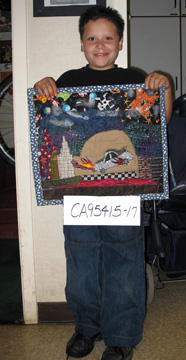
Note: This interview with Juan Pablo happened during his school recess. Karen Musgrave (KM): This is Karen Musgrave. Today’s date is March 7, 2007. I am doing a Quilters’ S.O.S. – Save Our Stories interview with Juan Pablo in Boonville, California, and it is 12:10 in the afternoon. Juan, tell me about the quilt that you brought today. Juan Pablo (JP): I like the cars because they are cool. KM: What kind of car is this? JP: Maserati. KM: Where did you get the fabric for the Maserati? JP: My mom got it for me from the school [where the Los hilos de la vida meet.] KM: Got it from the school. You knew exactly what you wanted to do with it when you saw it? So did you pick out all the fabrics for the quilt? JP: Um, hum. KM: Why did you pick them out? JP: Because I like them. KM: You have up at the top, what kind of fabric do you have up here? JP: Black sky. KM: Black sky. So you wanted a black sky. Is it night? The quilt is done at night? JP: Yeah. KM: You have a Maserati with flames? How old were you when you made this quilt? JP: Like six. KM: You were six years old when you made this quilt? Wow so that was a couple of years ago. What made you decide that you wanted to make a quilt? JP: I just like the idea. KM: Is it because your mom makes quilts that you wanted to make a quilt? JP: Yeah. KM: Have you made any other quilts? JP: No. KM: Just this one? JP: Yeah. KM: Is this going to be in the book? Do you know if it is going to be in the book? You don’t know? Did you write a story to go with this quilt? JP: Yeah. KM: What was the story? JP: The Maserati. KM: The Maserati. Would you like to own a Maserati? Do you like fast cars? JP: Um, hum. KM: That is good. Cool. Have you made any other quilts? JP: Um, hum. KM: Are you going to? JP: Yeah. KM: What is your next one going to be about? JP: Like a horse. KM: Horse. Doing what? JP: Eating, man that is getting him to eat. KM: A man and a horse. A man feeding a horse. JP: Ah huh. KM: What do you do with this quilt? Does it hang in your room? JP: No. KM: No. JP: I don’t know. KM: You don’t know what you do with it? How come it is not hanging in your room? JP: I don’t know, because I don’t have it. KM: You don’t have it because the school has it. We have to tell Molly [Johnson Martinez.] that she has to let you have your quilt, right. Did you mom sew this together for you? JP: Yeah. KM: Did you cut the pieces out. So you cut everything out and laid it out, decided where everything was going to be and then your mom sewed it for you. JP: Um, hum. KM: Very good. Does anybody else make quilts at your house? No, just your mom. JP: Um, hum. KM: What do you brothers, your brothers? JP: Yeah. KM: What do they think of this quilt? JP: Um, that it was cool. KM: That it is cool. Did you draw the car? JP: Yeah. KM: You drew the car all by yourself? JP: Um, hum. KM: I like the fabric that you picked out for the tires, it is very cool. You cut the flames out all by yourself? JP: Um, hum. KM: Did you make this at home? JP: Yeah. KM: How long did it take you, do you remember? No, you don’t remember how long it took you? JP: Like four days. KM: Four days of working, that is pretty good for somebody that age, don’t you think? You must be pretty special. JP: Yeah. KM: Do you like quiltmaking? JP: Yeah. KM: Would you sell this quilt, or do you want to keep it? JP: Selling it. KM: You would sell it? How much would you sell your quilt for? JP: Three hundred. KM: Three hundred dollars. Your mom has sold quilts, right? JP: Yeah. KM: What is your favorite quilt of your mom’s, do you know? No. Do you like all of them? So there is nothing she makes that you don’t like? JP: No. KM: That is good. Have your friends seen this quilt? JP: No. KM: You don’t share it. I bet they would think it is cool though. Right? JP: Um, hum. KM: Good. Do you think quilts are important? JP: Yeah. KM: Why do you think quilts are important? JP: Because you can get more money. KM: Get more money, okay. What about expression? Do you like the fact that you could express something? No. Do you want to say anything else? JP: No. KM: I didn’t think so. Do you want to go to recess? JP: Yeah. KM: Thank you. Thank you for doing the interview with me….

by Amy Milne | Apr 25, 2019
Karen Musgrave (KM): This is Karen Musgrave. It is August 29, 2001. It’s 5:09 in the afternoon. I’m conducting an interview with Juanita Yeager for Quilters’ S.O.S. – Save Our Stories project in Louisville, Kentucky. Juanita, tell me about the quilt you brought in today. Juanita Yeager (JY): This is called “Red and Yellow Number Two.” Although I have someone who thought it should be called “Rooty Tooty.” But it’s the second in a series of quilts where I have used this particular floral design, the big flowers. It’s what I call flowers on a grand scale. I’m currently into a series of doing those kinds of flowers sort of ala Georgia O’Keefe but not necessarily totally as she painted them. But this one is two big flowers. I love flowers. I love color. And the reason I do my quilts mostly is for the color too. I use flowers as a transport or a vehicle to convey color. And so these flowers–while I love flowers. I love organic shapes. I’m not a gardener. I don’t do dirt. I’m just as happy to go to a nursery and buy my flowers and bring them home or bring cut flowers home to the house where I usually always have them in the house. And so my flowers have the shape and suggestion of a particular plant, a blossom but they are not botanically correct. I don’t–I’m not trying to illustrate or be an illustrator of a particular flower in cloth. And so when I go about doing a quilt I usually have a focal blossom and then maybe have some side views and some bud shapes and some leaves. And it’s not even necessarily the leaf that really goes with that particular flower. So once I find an interesting shape for a flower I may search for an interesting leaf shape from some other flower and generally the source of my inspiration or the source of my flowers is usually nursery and seed catalogs which a friend of mine graciously passes along to me. So that’s where I usually and get the first inspiration or I may get it from a magazine that shows a picture of a flower. You know a gardening magazine or something like that. This quilt is appliquéd–all the flowers are appliquéd and it’s on what I call a multi fabric background that is fractured. KM: Is that typical? Do you typically fracture your backgrounds? JY: I’ve been doing that a lot lately. I’m trying to find ways of making really interesting backgrounds for my quilts that don’t interfere with whatever the subject is because I really don’t like the idea of just putting something there for the foreground without something visually interesting in the background as well. So this quilt was probably the third or fourth a long in the series and I’m just trying different ways of fracturing, some very regular patterns and some very random. KM: What special meaning does this quilt have for you? JY: It’s really hard for me to say that I am emotionally attached or really have meaning to a quilt. I brought this one as an example of my work. One because it depicts the color pallet that I really like to work in but sentimentally this is really the last quilt that my husband saw that I completed before he died in January so this one has some emotional attachment for me. And he [Phillip.] was always very supportive of my work. He was actually my number one fan and promoter and he would just take me anywhere. If I needed to get to a quilt show or get my work exhibited or something like that, he was just out there always pushing me forward. He was very supportive so this one is dear to me for that particular reason and he really liked it. He would just– Let someone come to our door he’d jester them in saying, ‘You’ve got to come into Juanita’s studio and see what she has on the wall.’ He was just like that. KM: How has your quilting impacted your family? JY: When I first started quilting it was to save my sanity so to speak and but I think the beginning in–I started in ’83, ’84. But beginning in about ’88, I knew I was serious about quilts. My husband knew I was serious about quilts. And my children knew I was serious about quilts. My grandchildren knew I was serious about quilts. [laughs.] All of them are proud of what I do. They all love what I do. They all have their name on a list waiting in line to inherit the pieces. And to save them from killing each other when I die I have this list in my computer that as I finish each quilt it’s assigned to a child but if one of the pieces gets sold then their name gets–you know moved to the next piece–that quilt gets whited out and another one gets put in its place or something like that. But they all value what I do. All of them are proud to display them in their homes and that sort of thing. They are very supportive of me. KM: What type of quilts do you make? JY: I make what I call art quilts. They’re always for the wall. I have done, very early on a bed quilt. I started lots of bed quilts. I only finished one bed quilt and I think I started it probably in ’86 and finished it about ’88. It took two years back then I was working as a registered nurse full time. And I sent it off to the Kentucky State Fair for a competition for first bed quilts and it won a blue ribbon. And then I sent it to another competition where it also won a blue ribbon. Well I got a big head. [laughs.] Whoa. I know what I’m doing and I didn’t know [laughs again.] what I was doing. That particular quilt is a 1930 pattern with curved seams. It was on the cover. I think it was issue 102 or 107 of Quilter’s Newsletter Magazine. And where as before when I started in ’83 I think I started with what everybody else did in that era making quilt block quilts. Log Cabin blocks. Star blocks. I must have tried to do every star pattern I could find. I was always at the library getting books out, looking at patterns and trying them. Just samplers. Teaching myself how to put them together. But the colors of the fabrics in the early ’80’s were those dusty rose and powder blues and gray blues and beige and you know everybody’s colors–they were ugly colors. It wasn’t where I was. [KM points her finger down her throat.] Yeah. Yes. [ laughs.] And so even though I liked the feel of fabric and the tactile feel of fabric working with the fabric and liked the challenge of figuring out how to do each block. Draw them. Do my own templates because I’m math minded. Once I knew I could do it there was no longer a challenge to complete it and there certainly wasn’t a challenge to complete 30 or 40 of the same thing repetitively on and on and on and on and on. The reason I think I finished my real first quilt as I call it is because it had curved pieces. It was a lily or tulip. A 1930 stylized flower. It was pink, soft pinks, dusty rose because you couldn’t get anything else but there was a lively green and very nice yellow which makes the quilt pretty. And so consequently I was saying, ‘Well, you know for me it really is all about the color.’ And so when you think about quilts you’re really looking at color and as women I think when we think color we probably have thoughts of flowers and flower gardens and that side of things. And we think of yellow daisies and red roses. So I think flowers or doing flowers was probably that next step in doing in doing quilting and finding patterns and I do like appliqué but I found I didn’t like doing that little bitty tight teeny appliqué stuff. I definitely don’t like Baltimore Albums. [clears her throat.] It’s too fussy. So I would probably say from ’88 through maybe ’94 or ’95 when I really started thinking about flowers, a single flower, a single bloom and working on a large scale. It was really an era of trail and error and search and seek. I went through doing a series I call “Flowers in the Round” which are circle flowers divided and sectioned in original settings. The Round Flowers I could say was truly my own style at that time. One of the quilts that I did make in that series–the first one I made started that series, I really woke from a dream with the design in my head. Got up, went to the drafting table and drew it out in full size and made it and sent it off to the Hoffman Challenge. This was probably in ’91. And I was delighted they took it. [laughs.] And it traveled. And from that one which was the first flower in the round design I went on to make a second one that I called “Lilies of Autumn.” And that particular quilt–that quilt I made featuring round flowers is now in the permanent collection of the American Quilt Society in Paducah [Kentucky.] So if I have one claim to fame that’s probably it. [laughs.] That’s probably it but also before the museum purchased it I entered the quilt in a Better Homes and Gardens competition. First it was judged on the state level. It won the entry for the state of Kentucky then it went on to be judged nationally and it wound up winning the grand prize for the national competition which was truly a big head time. [laughs.] But a–so from there I’ve made probably several other quilts from that series that have been juried into and exhibited in different places and that sort of thing. KM: So you’ve been published? JY: I’ve been published. Not only with the quilts as a result of being in AQS [American Quilt Society.] magazine. My quilts have appeared in Quilter’s Newsletter Magazine. I’m part of the Communion of the Spirits [A Communion of the Spirits, Roland Freeman, Rutledge Hill Press, TN Nov. 1996.] quilts that Roland Freeman did when he was looking for African American quilters across the United States. I have a quilt in an AIDS Publicity Calendars, how that happened was really kind of funny. I made a quilt early, very early on which was a pineapple block that I called “Decidedly Red.” The block was constructed wrong but I put the quilt together anyway. It just made a very interesting geometric kind of abstract pattern across the surface of the quilt and I sold it in probably 1990, the first quilt I actually sold. It was to a lady who was looking for something to take home to Senegal as a memento for having been in Kentucky and she had looked at several other quilts, traditional Kentucky made quilts and didn’t find anything she really liked. I showed her this piece. It was probably 45 by 45, not a very large size but she fell in love with it; the colors I think more so than anything just a variety of reds and black and a real vivid blue that kind of wound its way across in a kind of woven pattern intergradations so she purchased it and of course I was very delighted to have sold a piece and I thought I would go buy myself something. Last year–year before I came home from teaching in Virginia to a guild over there I got this phone message when I went through my messages on my answering machine and there was a lady in New York and she said, ‘I’ve seen your quilt.’ And she said, ‘It’s called “Decidedly Red.” My next door neighbor has it.’ And she says, ‘I want to include it in a calendar.’ And she says, ‘Can I have your permission to publish it? Give me a call back.’ And so she left a number and I called her back and she told me. When I thought this quilt was in Africa. The quilt is back in the United States and was in New York. And I said, ‘Well, sure I have no problem with you using an image of the quilt.’ Because this was for the International AIDS calendar and their fundraising project. And I said, ‘Yeah, no problem.’ So she says, ‘I’m going to send you a release because we have to have your permission to publish it in writing.’ And she says, ‘And when we get the release back signed we’ll send you a check.’ And when she told me how much she was sending a check for I almost had apoplexy, you know. [laughs.] I was thinking, ‘My God, they are paying me six times more for the photograph of the quilt than I got for having sold the quilt in the first place.’ It was–and so I thought, ‘This is really neat.’ And of course as a result of that I think about last month or so they had a little blurb of the quilt on their web site and so they sent me more money. So it’s–so in that way outside the quilt community people who looked at your work as art know that there is value in the visualness of it and realize that the person who made it needs to be treated as an artist as well as anyone else who has made a photograph or sculpture or some artwork or something like that. KM: Are their quilters in your family? JY: No. Not a one. I didn’t know there was such an animal as quilts until I caught a blurb on Georgia Bonesteel on the television and this was somewhere in the ’80’s. And at the time she was doing this little blurb that I was probably walking from the bathroom through my bedroom and it just happened to be on the educational channel and I stopped and looked and I thought, ‘Oh God, that is ugly fabric. What is she doing?’ And went out of the room. And it probably was on enough that it just caught my attention but no, I was raised in the city in a house with central heat. My family was well off enough that we could buy our goods and so consequencely there was no need for the utilitiness of covers for warmth and that sort of thing and my mother was not a needle woman. Now my father’s mother was the only woman in my family who was and this goes back to even my maternal great grandmother who lived until I was 13 so I knew very well that she did nothing with her hands as far as needle art. My paternal grandmother tatted, embroidered and crocheted and all of that kind of handwork but she too had no need for bedcovers which was what quilts were generally used for so it just wasn’t a part of my raising to know about them. And so–but I think probably when I got into quiltmaking it was with the understanding that quilts were quilts and quilts were to be used as bedcovers but once I got through that first one which took me two years to do I began to rethink quilts. Nobody has slept underneath my first quilt. I made it initially thinking that I would make it for my oldest daughter and then I would make my other three children quilts and they don’t have bed quilts to this day and neither does she have that one. [laughs.] It’s–I still have it at home. It’s folded up and it’s in a basket as decorative thing. It’s not being used at all. [laughs.] KM: So what age did you start quilting? JY: Oh, you’re asking age. KM: That’s all right. JY: I’ll tell you. Let’s see. I started in about ’83. [KM: quietly ‘Okay.’] So I was into my forties, yes. I can’t believe it. [laughs.] KM: Have you ever used quilting to get through a difficult time? JY: Yes. I do. Quilts–if you look at–there was a period—I had a really bad period probably ’94 through ’95 but I never lost the desire to quilt but what I did notice was that my color pallet changed drastically. I was doing everything in black and gray and awful depressing colors because that was my mood. I mean I was in this funk of a funk of a funk but anyway I kept quilting because it kept me sane. Disbelievingly everything I did during that period people liked they wanted. I would start a piece and someone else would be willing to finish it. Then I would start another dark depressing piece and couldn’t keep on with that particular piece and somebody would take it off my hands and finish it. You know, because they did like the color. The colors didn’t represent their mood just mine. And finally probably January of ’96, I climbed out of the dumps as I was finishing a piece that I call “East of Morning,” which is an original design. It got me back into using curves again and it has a big sun face on it. It’s very bright. It represented hope and I could see light at the end of the dark tunnel that I was in. The background was basically dark purples but it was no longer black. And the–I used Mariner’s Compasses in the composition of the piece Mariner’s Compass in place of stars. The compass stars were done in bright colors so I knew that I was coming out of my dark place at that time. This year even though my husband–last year–no this year last year even though my husband was diagnosed with a terminal cancer through all of that I still kept quilting and I kept working in my color pallet and that I think I have to attribute to him [Phillip.] because of the way he accepted what he had and he would not let me get into a funk. You know, he said, ‘It’s nothing I did to myself and you have to go on. You have to do what you do.’ So that’s why my “Red and Yellow Number Two” is a bright, cheery quilting and so everything after that has been as well. KM: What are your plans for quilting in the future? JY: I’m going to keep on keeping on. [laughs.] I am now exploring I think more seriously because I think I have kind of solved the problem, which for a while I was trying to do with several quilts, was trying to solve the problem of working with flowers that looked real enough without overly augmenting them with other mediums like paint. That one does have some fabric paint to give some depth to the flowers and it does have some thread work on it. But I didn’t want to stretch as far as actually painting, you know, using acrylic paint but I will use fabric markers and maybe some diluted dyes because I think dyes, inks don’t change the hand of the fabric. I didn’t really want to change the hand of the fabric because I still think quilts even though they’re for the wall still have this tactical snugness, the feeling of comfort that I want to preserve. I don’t really want my work to feel like I’ve got a stiff canvas even though it is three layers. So I think I have pretty much solved what I want to do with the flower part of it. I think now I’m looking more at what I can do to enhance the background. So my current piece is also a flower but I’ve now fractured it with curved lines in a grid and that sort of thing so I guess it is a step beyond this piece. KM: Is this hand appliquéd? JY: This is hand appliquéd. Most of what I do is hand. I loved handwork. I do have a near top of the line sewing machine but I absolutely hate [laughs.] machine work and so I’ve said and not in talking about people and what they do. I will say I will do everything except straight lines by hand, you know the kind of idiot work you know, sew a straight seam then I will sew it on a sewing machine but for more intricate things I find I have no problem I am really a fast hand piecer. And love hand quilting. Most of my pieces are hand quilted. My bigger pieces I quilt in a floor frame. This particular piece I was on deadline a little bit too tight one. I sent it as an unfinished in progress piece for consideration for an exhibit at The Kentucky Museum in Bowling Green, at Western Kentucky University along with a couple other pieces for consideration that were completed. Of course naturally that’s how it usually goes, they want the piece that is still in progress and the deadline was looming so I had to quickly do something with it so the flowers are machine quilted and the leaves too but when I got that part done and I knew I was not going to be happy with it unless I did the background with hand quilting so it’s a combination of both. KM: How do you feel about long arm quilting? JY: No. I’m saying no because I really have not found the love for any sewing machine. And I think you have to love your tools and I think you have to be at one with your tools. And I’m not at one with my sewing machine and I don’t think I can make myself that-into that. I think it would be totally–it’s totally foreign to me to do that. I have found people who master it. It’s like anything else. You know, it’s what you master. It’s what you love. And if you can–if the end product is ecstatically pleasing, visually pleasing and well done no matter what tool another artist chooses to use then I’m fine with the end result. How they achieved it but for me to do my quilting that particular way, no I wouldn’t. KM: From whom did you learn to quilt? JY: Essentially I taught myself. I started off with a pattern once I did decide to try it, ‘Oh well this looks a little interesting,’ and went off to buy fabric and came back from–with a little Workbasket Magazine with a pattern in it. I didn’t know you needed template plastic. I was doing the pattern similar to what you would do as a dressmaker. You know, thin pieces of paper pinned onto the fabric and cut around with a 5/8-seam allowances was how some of the first things that I put together that’s how they were constructed then I went off to library and started reading books and they said, ‘No quarter inch seam allowance is what you use and you use plastic.’ And then I discovered quilt shops as oppose to the fabric stores and then probably by the time I finished the second–the quilt that I consider my first quilt then I thought well maybe I need to go take some lessons from somebody. I mean I had won these blue ribbons but I didn’t think I was truly deserving of them. And so I went off to take a class from the Jefferson County Adult Education Program and the teacher there didn’t teach me anymore than I already knew. What she did was provide some vital information to me at the time. Although I was grateful to her for she did tell me about quilting guild and the local Nimble Thimbles Guild which I did not know existed. She told me when and where they met and she also told me about AQS [American Quilter’s Society.] So I am one of the original charter members of AQS, which I think was probably in ’88 because their first show was in ’88. And I did go to their first–I think I went to their first show in ’88. I know I was there in ’89 and saw what quilts were and course, then it was just a whole other world besides what I saw in books because most of the books were older books. They were from around the time when the quilts came back into being in ’76. And I read magazines and I saw there were– you know, what people were saying were quilts in ’76 but they were all bicentennial red, white and blue kind of things which were kind of–it wasn’t in my color pallet and I wasn’t going to decorate a room in that way so The Ladies Home Journal look just sort of passed me by, you know. It held no interest to me so–but when I went off to see the quilt show I thought, ‘Wow.’ You know it’s like one quilt was much more breathtaking than the next one although they were bed quilts then I went downstairs to the wall quilts and it was just another world. It was just phenomenal but I didn’t know that I could do that in ’89. And I knew that I could probably take some traditional patterns and modify them somewhat and work in a smaller size not just for the bed but for the wall. And I did a lot of contest competitions and stuff like that early on. You know entering NQA [National Quilt Association.] contests and those kind of things and challenges and fabric challenges. I think I probably had a more traditional route to where I am then most people who went toward art from early in the ’80s and currently. KM: Do you teach quilting? JY: I teach quilting. I teach beginning quilting if I have to. I really much prefer to teach people how to find their own style, how to make what’s in their head, what they see, what they can visualize and of course I tell them that if they can draw, if there is someway for them to get it out of their head as a line drawing on paper then I can teach them the techniques they need to get it from that line drawing into fabric. And so I really try to stay abreast of what is new technique wise- foundation piecing, freezer paper, the use of this and that, raw edge, etc. And actually I do teach machine quilting which astounds some people I know because, ‘You teach machine quilting and you can’t stand it.’ I say, ‘Well it’s easy to teach a technique. You don’t have to love it to be able to teach it.’ I don’t think as long as you understand the principals of it. KM: Where do you teach? JY: I teach locally. I teach at the Artopia which is what the facility used as studio and gallery space by the Louisville Visual Art Association calls it. I’ve taught through the University of Louisville in adult continuing education program. I taught for a time through the Jefferson County Adult Education Program. I have classes–I have ladies who come to my home to take classes. Right now I have two groups–two days of ladies that come. There’s a group that comes on Monday nights and ladies that come on Tuesday nights. A lot of people know me across the country so they will call me and say, ‘Can you come over and teach?’ KM: What do you like about teaching? JY: I like sharing what I know with people and I love the enthusiasm a new quilter who has just found it has. [laughs.] Sunday I had a group of five ladies at the house who were dyeing fabric and I thought it was going to be an hour introduction on hand dyeing and it turned into this miracle of , ‘Can we buy more fabric and can we dye more fabric?’ I thought, ‘You’re killing me. Let’s go home.’ [laughs.] I just love the enthusiasm of a new quilter who has found and loves it. I don’t know–some of them from the time that they walk through the door you know that they are just going to love it and go on with it. I don’t know if I really had that love initially because I had tried doing other things before. I tried everything imaginable knitting, crochet, upholstering, quilling and painting china. Just anything that you can do with your hands short of having a wood working shop, I tried. When I went into quilting I really did not know that it was going to be the thing that I was going to be doing the rest of my life. And then consequently too if I had been home all the time I could have gotten much more intensively into it earlier on as well. I didn’t. I was working full time as a registered nurse at that time so it really was what I could do in the time I had when I got home in the afternoon with the kids around–actually I had two in college at that time but I had Michael who is a handful. A thirteen year old at the time. It took a little bit longer for me to get into it and say, ‘Yes.’ And it took a little longer for me to realize that this was going to–I hate to say legacy but it has turned out to be for me what is me. What I can point to and say, ‘This is Juanita.’ It has given me more rewards and feeling of satisfaction than being a wife, being a mother and being a nurse because even all of that in the end if it was all I was and I don’t know if anybody but my children will remember me 15 years from now but I’m hoping 50 years from now that someone could pick up one of my quilts, find my name on the back of it and say, ‘Juanita Yeager from Kentucky. Oh, she made this in the year 2000 or 1999,’ and will know that I as a person lived. I as a person, not as a nurse nobody would know or had anything to leave as a legacy. I didn’t start the Red Cross or anything major like that. KM: So in what ways do you think quilts have special meaning for women’s history in America? JY: I really think if you follow–if you took quilts from where they started they truly parallel American life period. They parallel the migration. They parallel the economic times. They parallel the political climate. They parallel your graphic area. Where you live. The quilts that were made in the South are very much different from the quilts that were made in New England. The quilts of the Victorian era with the money and the excesses were different–from maybe the quilts that were made in the plains for comfort and warmth. The colors of the 1930’s were certainly happy to kind of dispel the fact that the country was going toward the Depression. It really is a good documentation of us and I don’t know if there is anything else that could do as well as quilts if you truly follow quilts they follow the Industrial Revolution as far as the fabrics. The quilts, the fabrics, the textiles being made at home and or locally quilts parallel where and when the making of commercial fabric and the availability on the larger scale as a commercial product. Quilting certainly has meant for a lot of women economic freedom because it has been a source of income where they can take their talents to teach, to open a shop, to start a quilt show, to being very independent as far as their economic well being is. I just think–in studying quilts you can see 500 years or more ago and 500 years from now [laughing.] there will be a history with documentation for someone studying us as we are now they would have a really good view of what we were as a people. KM: So how do you think your quilts reflect your community? JY: I have to say my quilts reflect who I am and where I am. And it reflects my beliefs. Reflects the fact that I was not raised to be an ethnic person. I was raised to be [Marti Plager who was also present says something but it is inaudible.] an American person with a love of beauty and even though my mother isn’t frou frou into doilies and lace. You know that sort of thing but she loved flowers. She loved orderliness and she always taught us to do the best we could do, be the best person we could be and she always championed whatever causes you went about. She was very encouraging in that regard. So I would just say that if you were not just looking at me and looking at my work I think you would probably say I’m a person of the black community. I don’t have any stories to tell. I don’t have any causes to champion. I don’t have–there are a lot of quilts that are made for those reasons because someone wants to put forth an idea even to quilter back into the old days did with the “Fifty-four, Forty or Fight.” Those black and other women probably had some statement they wanted to make that could only be said through a quilt because they certainly couldn’t get out into the county square nor politic for a certain person. They probably could in their bedroom with their husbands at night but they probably couldn’t make the community hear them. I find that I don’t need my quilts as a platform to make my voice heard. What I use my quilts for is simply my way of expressing my creativity, my love of color. The fact that I quilt with passion, do something productive with my life, use the talents that God gave me, gifts that if squander I would not feel I have lived life fully as a person for what He wants me to do. And I really think He wants me to do this. He has made it so easy for me in providing the people around me that give me the support and providing me with the facilities, the supplies. Made it easy for me to go on and find the knowledge that I needed to further what I am doing. KM: How many hours a week to do quilt or a day? JY: Eight in a day. [laughs.] It depends. If I wake up with an idea of a quilt in my head [clears throat.] I’m subject to come out of my bedroom without brushing my teeth and go to my studio and start to work. I could well be in there a good long time. My husband use to come to the door 9 o’clock at night and just say, ‘Are we eating today?’ [laughs.] Very nicely. So I would say that some days I can’t get there just because of circumstances won’t let me get there. Then there are some days that I’m there all day from the time I get up and have breakfast until late at night, some times until wee hours of the morning and that sort of thing. I do know that if I don’t get to work, if I have not touched fabric for several days, I get to be a very nasty person. [laughing.] You don’t want to be around me if I can’t get to my quilting. So it varies. It depends on just how involved I am with a piece. I’m really much more engrossed with it as I’m trying to work out all the technical details like the colors I want to work with to make sure that–once I know the fabrics are going to work. Once I get to that stage I’m not as obsessed and then it’s just a matter of at that point of saying, ‘Yes I want to complete it.’ Therefore I will just go at it. It also depends on if I got it promised some place and how much time I have to put into it to complete it. KM: Like a deadline. JY: [laughing.] Yeah, right. [laughing.] Nothing like a deadline. KM: Is there anything else you would like to share? JY: Oh, no. I think that pretty much covers it. I think I’ve talked quite a bit. [laughs.] KM: Thank you very much. I really appreciate your doing this. JY: You’re welcome. KM: We’re going to conclude our interview now at…